Chindia Alert: You’ll be Living in their World Very Soon
aims to alert you to the threats and opportunities that China and India present. China and India require serious attention; case of ‘hidden dragon and crouching tiger’.
Without this attention, governments, businesses and, indeed, individuals may find themselves at a great disadvantage sooner rather than later.
The POSTs (front webpages) are mainly 'cuttings' from reliable sources, updated continuously.
The PAGEs (see Tabs, above) attempt to make the information more meaningful by putting some structure to the information we have researched and assembled since 2006.
BEIJING/SHANGHAI (Reuters) – China expects to import more soybeans and pork this year following the novel coronavirus outbreak and African swine fever, which has decimated its pig herds.
Soybean imports are forecast at 92.48 million tonnes this year, rising to 96.62 million tonnes in 2025 and 99.52 million tonnes in 2029, an official from the agriculture ministry told a video conference on the outlook for agriculture released on Monday.
Pork imports this year are seen rising to 2.8 million tonnes, a 32.7% increase from the previous year.
China is a key buyer and consumer of soybeans and pork globally, and typically imports millions of tonnes of soybeans per year to crush for meal to feed its livestock.
The African swine fever outbreak, however, had slashed China’s pig herd by over 40% last year, reducing supplies in the world’s biggest pork consumer.
Combined with the coronavirus outbreak, which hit the transport of pigs and delayed the restart of slaughtering plants, prices of China’s favourite meat rose to record levels in February.
China has been increasing pork imports in recent months to make up for the drop in domestic supply.
Despite the expected surge in imports, China’s 2020 pork consumption is forecast to fall to 42.06 million tonnes, down 5.6% year-on-year, hit by high prices and a fall in consumer demand due to the coronavirus outbreak, according to the agriculture ministry.
In line with the slowing consumption, China’s slaughtered pig herd this year will fall 7.8% year-on-year to 501.49 million heads. Pork output this year will also decline to 39.34 million tonnes from 2019, but will rebound to around 54 million tonnes in 2022.
In the longer term, however, pork imports are expected to gradually fall, the ministry forecast, while beef and mutton imports are set to increase in the next decade.
Meanwhile, China’s domestic soybean output is seen at 18.81 million tonnes in 2020, a 3.9% gain from the previous year, while crushing volumes were pegged at 85.98 million tonnes.
Soybean consumption will increase steadily and continue to rely mainly on imports in the next 10 years, said a ministry official.
The ministry also said China’s corn acreage and output are both set to increase in 2020, with production forecast to reach over 260 million tonnes this year, while annual rice output is expected to hold steady above 200 million tonnes per year in the next 10 years.
China’s economy shrank for the first time in decades in the first quarter of the year, as the virus forced factories and businesses to close.
The world’s second biggest economy contracted 6.8% according to official data released on Friday.
The financial toll the coronavirus is having on the Chinese economy will be a huge concern to other countries.
China is an economic powerhouse as a major consumer and producer of goods and services.
This is the first time China has seen its economy shrink in the first three months of the year since it started recording quarterly figures in 1992.
“The GDP contraction in January-March will translate into permanent income losses, reflected in bankruptcies across small companies and job losses,” said Yue Su at the Economist Intelligence Unit.
Last year, China saw healthy economic growth of 6.4% in the first quarter, a period when it was locked in a trade war with the US.
In the last two decades, China has seen average economic growth of around 9% a year, although experts have regularly questioned the accuracy of its economic data.
Its economy had ground to a halt during the first three months of the year as it introduced large-scale shutdowns and quarantines to prevent the virus spread in late January.
As a result, economists had expected bleak figures, but the official data comes in slightly worse than expected.
Among other key figures released in Friday’s report:
Factory output was down 1.1% for March as China slowly starts manufacturing again.
Retail sales plummeted 15.8% last month as many of shoppers stayed at home.
Unemployment hit 5.9% in March, slightly better than February’s all-time high of 6.2%.
Analysis: A 6% expansion wiped out
Robin Brant, BBC News, Shanghai
The huge decline shows the profound impact that the virus outbreak, and the government’s draconian reaction to it, had on the world’s second largest economy. It wipes out the 6% expansion in China’s economy recorded in the last set of figures at the end of last year.
Beijing has signalled a significant economic stimulus is on the way as it tries to stabilise its economy and recover. Earlier this week the official mouthpiece of the ruling Communist Party, the People’s Daily, reported it would “expand domestic demand”.
But the slowdown in the rest of the global economy presents a significant problem as exports still play a major role in China’s economy. If it comes this will not be a quick recovery.
On Thursday the International Monetary Fund forecast China’s economy would avoid a recession but grow by just 1.2% this year. Job figures released recently showed the official government unemployment figure had risen sharply, with the number working in companies linked to export trade falling the most.
China has unveiled a range of financial support measures to cushion the impact of the slowdown, but not on the same scale as other major economies.
“We don’t expect large stimulus, given that that remains unpopular in Beijing. Instead, we think policymakers will accept low growth this year, given the prospects for a better 2021,” said Louis Kuijs, an analyst with Oxford Economics.
Since March, China has slowly started letting factories resume production and letting businesses reopen, but this is a gradual process to return to pre-lockdown levels.
Media caption Why does China’s economy matter to you?
China relies heavily on its factories and manufacturing plants for economic growth, and has been dubbed “the world’s factory”.
Stock markets in the region showed mixed reaction to the Chinese economic data, with China’s benchmark Shanghai Composite index up 0.9%.
The coronavirus pandemic has completely changed patterns of consumer psychology across the world, experts say
Complexity of the crisis, the number of variables and its magnitude make a consumer recovery unprecedented and difficult to predict
The coronavirus has caused panic buying around the world as consumers frantically stockpile of goods such as toilet paper, hand sanitisers and masks. Illustration: Brian Wang
Before the coronavirus crisis began rippling through the global economy, Susan Wang had big plans for 2020.
Not only was she going to buy a new Apple MacBook and iPad, plus a projector so she could host friends for movies at home, but she was set on making a career move.
“I was planning to change my job, but my headhunter told me that all recruitment has been postponed to the second quarter,” said the 27-year-old who works for a British company in Hong Kong.
“Our headquarters in London has a plan for redundancy, too. It is better to save some money in case I get laid off.”
As Covid-19 spreads across the world, sending stock markets reeling and prompting big companies to slash jobs, Wang has become increasingly frugal like scores of other consumers from China to the United States.
She has stopped eating at restaurants and now tries to keep her weekly food bill under HK$500 (US$64), whereas in the past she wouldn’t think twice about spending HK$100 per meal.
Amid mounting uncertainty, the coronavirus pandemic – which has claimed the lives of more than 41,000 people and infected at least 842,000 worldwide – is fundamentally changing consumer behaviour in Asia, Europe and North America.
Consumer experts said the 2009 global financial crisis, the Great Depression that started in 1929 and the September 11 terrorist attacks give some clues about how and when global consumption might recover. But the complexity of this crisis, the number of variables and its magnitude make this consumer recovery unprecedented and difficult to predict, they added.
Coronavirus: What impact will the economic fallout from the Covid-19 pandemic have on you?
“The coronavirus pandemic has completely changed patterns of consumer behaviour all over the world. People are afraid, and when people are afraid, they go into survival mode,” said Jesse Garcia, a Los Angeles-based consumer psychologist, who is also the CEO of market consulting firm My Marketing Auditors.
plummeted a record 44 per cent in February and those figures are only expected to get worse, with sales forecast to slump between 30 and 40 per cent in the first half of the year, according to the Hong Kong Retail Management Association.
In the US, retail sales dropped by 0.5 per cent in February, even before many states had issued stay-at-home orders to protect the world’s largest economy. The decline was the biggest fall since December 2018.
Experts say non-essential products and services are set to be worst affected by the coronavirus pandemic, while goods and services that can be consumed at home will see a spike in sales.
The coronavirus pandemic has completely changed patterns of consumer behaviour all over the world. People are afraid, and when people are afraid, they go into survival mode – Jesse Garcia
“Online consumer behaviour is frenetic,” said Ross Steinman, a professor of psychology at Widener University in the US state of Pennsylvania. “Consumers are refreshing and refreshing and refreshing websites to secure grocery delivery times, purchase paper towels from their usual big box retailer and scavenge for rice and canned soup from third party sellers on Amazon.
“A pronounced spike in coronavirus cases will only amplify the freneticism.”
So far, one of the biggest shortages for consumers is toilet paper. Television stations across the globe have beamed images of empty supermarket shelves and huge queues as people hoard toilet paper rolls, masks and hand sanitiser.
The frantic stockpiling can be explained by a psychological concept called informational conformity, said Vicki Yeung, associate professor at the Department of Applied Psychology at Lingnan University in Hong Kong.
A pronounced spike in coronavirus cases will only amplify the freneticism – Ross Steinman
“When people lack knowledge and are in an uncertain situation, they tend to follow the group’s behaviour and blindly conform, but once they obtain more information, and digest and process the situation, the panic gradually fades away,” she said.
“During this Covid-19 pandemic, people generally feel jittery and anxious because they feel their sense of control has disappeared.”
Unlike other recent global crises such as the September 11 attacks, the coronavirus is less a one-time sharp shock to the system and more of a rolling source of anxiety that could retreat and resurface repeatedly, consumer behaviour experts said.
This was the pattern with the Black Death plague that hit Europe in 1347 and returned episodically over many years, ultimately killing millions of people.
During this Covid-19 pandemic, people generally feel jittery and anxious because they feel their sense of control has disappeared – Vicki Yeung
“It may be we’ll have to shut down things again in October or August. And this could go on for years,” said Charley Ballard, an economist with Michigan State University in the US. “The more that happens, the more damage it does to buoyant consumer psychology.”
Furthermore, relative to the 2009 financial crisis and even the Great Depression, when much of the damage was concentrated at least initially in the financial sector, this crisis has seen virtually the entire economy grind to a halt all at the same time, devastating employment and consumption.
Last week, a record 3.3 million Americans applied for unemployment benefits within one week, as restaurants, hotels, barber shops, gyms and retail outlets shut down in a nationwide bid to stem the pandemic. The previous record of 695,000 was set in 1982.
On Tuesday, Goldman Sachs predicted the US jobless rate will hit 15 per cent in the second quarter of this year from the coronavirus economic freeze, and could rise further beyond that to near the historic peak of 24.9 per cent seen in 1933 during the Great Depression. Economists at the St. Louis district of the US Federal Reserve projected unemployment could cost as many as 47 million jobs in the US this year, sending the unemployment rate past 32 per cent before making a sharp recovery.
US now has world’s most coronavirus cases, surpassing China
China’s unemployment rate jumped to 6.2 per cent for January and February from 5.2 per cent in December and 5.3 per cent a year earlier. It was the highest level since records began in 2016, but did not include China’s estimated 291 million migrant workers.
Consumer spending accounts for more than 60 per cent of the Chinese economy and drives 70 per cent of the US economy. But with the pandemic causing many people to go into hibernation and likely to lead to cycles of job cuts, economists have predicted a consumer-led global recession by the second quarter of this year.
Just how long it will take for consumer behaviour to return to normal depends on each person’s psychological resilience, including how quickly they can adapt to change, how optimistic they are and whether they can adopt strategies to regain a sense of control, Yeung said.
Anirban Mukhopadhyay, chair professor of marketing at Hong Kong University of Science and Technology said as long as the coronavirus threat was still present, people would remain fearful to some extent. But he added that people were resilient.
Satellite images show world sites deserted amid coronavirus pandemic
“Human beings adapt to events and stimuli over time,” Mukhopadhyay said. “Research has shown that even people who win lotteries tend to return to their earlier levels of life satisfaction after some months, as do people who have to have amputations.
“So even if the source of the fear does not go away, we learn to live with it.”
Ballard, from Michigan State University, estimated it could take upwards of two years for American consumers to feel secure enough in their jobs and gain enough confidence to fully open their wallets. A longer and more episodic duration for the disease could push that higher, he added.
Further complicating the consumer picture, he said, is that many supply chains are at risk of breaking. And consumers will be wary of spending for a while in many traditional areas, including crowded sporting events and concerts, restaurants and flights.
A new phase of coronavirus blame game: what is the legacy of Covid-19 on global supply chains?
Some experts have even suggested that consumer behaviour may be permanently changed as a result of the pandemic.
“It seems very unlikely that people will get back to life as it was before, once the coronavirus is over,” said Andreas Kappes, a lecturer in psychology at City University of London.
“People’s behaviour is extremely orthodox, often referred to as the status quo bias and captured in expressions like ‘past behaviour best predicts future behaviour.’ Now, the crisis forces us to change our behaviour, radically, and we might discover that new way suits us better.”
An increasing proportion of young people no longer willing to wait tables in China as restaurant owners look to new technology for answers
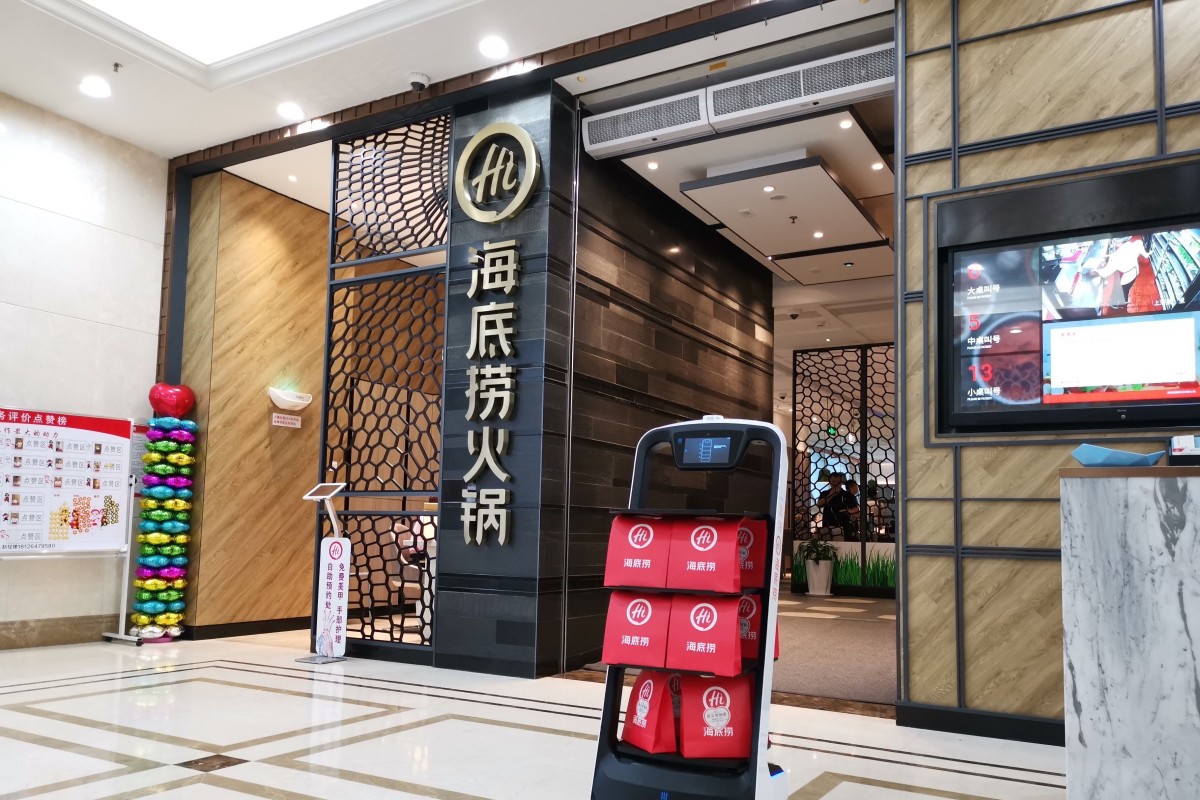
Catering robots developed by Pudu Tech, the three-year-old Shenzhen start-up, have been adopted by thousands of restaurants in China, as well as some foreign countries including Singapore, Korea, and Germany. Photo: Handout
Two years ago, Bao Xiangyi quit school and worked as a waiter in a restaurant for half a year to support himself, and the 19 year-old remembers the time vividly.
“It was crazy working in some Chinese restaurants. My WeChat steps number sometimes hit 20,000 in a day [just by delivering meals in the restaurant],” said Bao.
The WeChat steps fitness tracking function gauges how many steps you literally take and 20,000 steps per day can be compared with a whole day of outdoor activity, ranking you very high in a typical friends circle.
Bao, now a university student in Hangzhou, Zhejiang province, quit the waiter job and went back to school.
“I couldn’t accept that for 365 days a year every day would be the same,” said Bao.
“Those days were filled with complete darkness and I felt like my whole life would be spent as an inferior and insignificant waiter.”
Olivia Niu, a 23-year-old Hong Kong resident, quit her waiter job on the first day. “It was too busy during peak meal times. I was so hungry myself but I needed to pack meals for customers,” said Niu.
Being a waiter has never been a top career choice but it remains a big source of employment in China. Yang Chunyan, a waitress at the Lanlifang Hotel in Wenzhou in southeastern China, has two children and says she chose the job because she needs to make a living.
Catering robots developed by Pudu Tech, the three-year-old Shenzhen start-up. Photo: Handout
Today’s young generation have their sights on other areas though. Of those born after 2000, 24.5 per cent want careers related to literature and art. This is followed by education and the IT industry in second and third place, according to a recent report by Tencent QQ and China Youth Daily.
Help may now be at hand though for restaurants struggling to find qualified table staff who are able to withstand the daily stress of juggling hundreds of orders of food. The answer comes in the form of robots.
Japan’s industrial robots industry becomes latest victim of the trade war
Shenzhen Pudu Technology, a three-year-old Shenzhen start-up, is among the tech companies offering catering robots to thousands of restaurant owners who are scrambling to try to plug a labour shortfall with new tech such as machines, artificial intelligence and online ordering systems. It has deployed robots in China, Singapore, Korea and Germany.
With Pudu’s robot, kitchen staff can put meals on the robot, enter the table number, and the robot will deliver it to the consumer. While an average human waiter can deliver 200 meals per day – the robots can manage 300 to 400 orders.
“Nearly every restaurant owner [in China] says it’s hard to recruit people to [work as a waiter],” Zhang Tao, the founder and CEO of Pudu tech said in an interview this week. “China’s food market is huge and delivering meals is a process with high demand and frequency.”
Pudu’s robots can be used for ten years and cost between 40,000 yuan (US$5,650) and 50,000 yuan. That’s less than the average yearly salary of restaurant and hotel workers in China’s southern Guangdong province, which is roughly 60,000 yuan, according to a report co-authored by the South China Market of Human Resources and other organisations.
As such, it is no surprise that more restaurants want to use catering robots.
According to research firm Verified Market Research, the global robotics services market was valued at US$11.62 billion in 2018 and is projected to reach US$35.67 billion by 2026.
Can robots and virtual fruit help the elderly get well in China?
China’s labour force advantage has also shrank in recent years. The working-age population, people between 16 and 59 years’ old, has reduced by 40 million since 2012 to 897 million, accounting for 64 per cent of China’s roughly 1.4 billion people in 2018, according to the national bureau of statistics.
By comparison, those of working age accounted for 69 per cent of the total population in 2012.
Other Chinese robotic companies are also entering the market. SIASUN Robot & Automation Co, a hi-tech listed enterprise belonging to the Chinese Academy of Sciences, introduced their catering robots to China’s restaurants in 2017. Delivery robots developed by Shanghai-based Keenon Robotics Co., founded in 2010, are serving people in China and overseas markets such as the US, Italy and Spain.
Pudu projects it will turn a profit this year and it is in talks with venture capital firms to raise a new round of funding, which will be announced as early as October, according to Zhang. Last year it raised 50 million yuan in a round led by Shenzhen-based QC capital.
To be sure, the service industry is still the biggest employer in China, with 359 million workers and accounting for 46.3 per cent of a working population of 776 million people in 2018, according to the national bureau of statistics.
And new technology sometimes offers up new problems – in this case, service with a smile.
“When we go out for dinner, what we want is service. It is not as simple as just delivering meals,” said Wong Kam-Fai, a professor in engineering at the Chinese University of Hong Kong and a national expert appointed by the Chinese Association for Artificial Intelligence. “If they [robot makers] can add an emotional side in future, it might work better.”
Technology companies also face some practical issues like unusual restaurant layouts.
“Having a [catering robot] traffic jam on the way to the kitchen is normal. Some passageways are very narrow with many zigzags,” Zhang said. “But this can be improved in future with more standardised layouts.”
Multi-floor restaurants can also be a problem.
Dai Qi, a sales manager at the Lanlifang Hotel, said it is impossible for her restaurant to adopt the robot. “Our kitchen is on the third floor, and we have boxes on the second, third, and fourth floor. So the robots can’t work [to deliver meals tdownstairs/upstairs],” Dai said.
But Bao says he has no plans to return to being a waiter, so the robots may have the edge.
“Why are human beings doing something robots can do? Let’s do something they [robots] can’t,” Bao said.
Despite concerns about economic growth, the country’s consumers keep spending. Yet our latest survey reveals changes in what they’re buying and how they’re buying it.
Cooling economic growth, a depreciating currency, and a gyrating stock market are making political and business leaders concerned that China’s economic dream may be ending. Yet Chinese consumers remain upbeat. In fact, consumer confidence has been surprisingly resilient over the past few years as salaries have continued to rise and unemployment has stayed low.
However, our latest survey of Chinese consumers reveals significant change lurks beneath the surface. Reflecting 10,000 in-person interviews with people aged 18 to 56 across 44 cities, our 2016 China consumer report found that the days of broad-based market growth are coming to an end. Consumers are becoming more selective about where they spend their money, shifting from products to services and from mass to premium segments. They are seeking a more balanced life where health, family, and experiences take priority. The popularity of international travel is astounding among Chinese consumers, as is their adoption of trends such as mobile payments. And despite many similarities, consumer behavior can vary significantly among the country’s 22 city clusters.
In short, our latest research suggests we are witnessing the modernization of the Chinese consumer, and that will only make the market more challenging for consumer-goods companies. But for those able to get it right, the rewards may be substantial. In this article, we’ll examine the evolving behavior of Chinese consumers through three lenses: how willing they are to spend, what they are buying, and where they are buying.
How willing they are to spend
When asked about their expectations regarding future income, 55 percent of consumers we interviewed were confident their income would increase significantly over the next five years—just two percentage points lower than in 2012. (By comparison, just 32 percent of consumers in the United States and 30 percent in the United Kingdom agreed with the same statement in 2011.)
That’s not to say that Chinese consumers are unaware of the deteriorating condition of the economy. A growing number are seeking to save and invest, and we found differences in consumer confidence widening at a regional level. While confidence about income growth during the next five years rose to 70 percent in the Xiamen–Fuzhou city cluster, for example, it decreased to as little as 35 percent in Liao Central.
What they are buying
We found that consumers are generally becoming more selective about their spending. They are allocating more of their income to lifestyle services and experiences—over half plan to spend more on leisure and entertainment (the 50 percent surge in box-office receipts in the past year is just one indicator of that trend). At the same time, spending on food and beverages for home consumption is stagnating or even declining.
Chinese consumers are also increasingly trading up from mass products to premium products: we found that 50 percent now seek the best and most expensive offering, a significant increase over previous years. It’s no surprise that the growth of premium segments is outpacing that of the mass and value segments, and foreign brands still hold a leadership position in that premium market. What’s more, a rising proportion of Chinese consumers focus on a few brands, and some are becoming loyal to single brands. The number of consumers willing to switch to a brand outside their “short list” dropped sharply. In apparel, for instance, the number of consumers willing to consider a brand they hadn’t before dropped from about 40 percent in 2012 to just below 30 percent in 2015.
Becoming part of the closed set of the few brands that consumers consider, or even the one brand that consumers prefer, is increasingly challenging. Fewer consumers are open to new brands, and promotions are becoming less effective at encouraging consumers to consider them.
With a few notable exceptions, such as Huawei’s growing share of the premium-smartphone market, Chinese brands have not gained much traction in many premium segments, such as skincare, cars, sports, and fashion. That contrasts starkly with the mass segment of the market, where local brands are winning market share from foreign incumbents by offering a much stronger product proposition.
Where they are buying
Although China is the world’s largest e-commerce market—generating revenue of about 4 trillion renminbi ($615 billion) last year, around the same as Europe and the United States combined—and consumers increasingly purchase online, physical stores remain important. Consumers engage with brands both online and offline, and satisfaction with physical stores remains higher than with online ones. But the gap is narrowing, especially as satisfaction with hypermarkets declines.
One trend that is helping maintain interest in physical stores is “retailtainment.” Two-thirds of Chinese consumers say that shopping is the best way to spend time with family, an increase of 21 percent compared with three years ago. Malls—which combine shopping, dining, and entertainment experiences the entire family can enjoy—have benefited most from this trend, at the expense of big-box retail outlets such as department stores and hypermarkets.
Consumers also reinforce family ties through travel: 74 percent of consumers say it helps them to better connect with family, and 45 percent of international trips were taken with family in 2015, compared with 39 percent in 2012. More than 70 million Chinese consumers traveled overseas in 2015, making 1.5 trips on average, and shopping is integral to this experience. Some 80 percent of consumers have made overseas purchases, and nearly 30 percent actually base their choice of a travel destination on shopping opportunities. Among international travelers, around half of their watch and handbag purchases are made overseas, while apparel and cosmetics are the most frequently purchased categories.
Overall, Chinese consumers are adopting new products, services, and retail experiences at rates unseen in developed markets. To take one example, mobile-payment penetration in China went from zero in 2011 to 25 percent of the population in 2015. At the same time, there are still differences in how Chinese consumers in various regions spend. While new highways, high-speed-rail links, and mobile Internet access have strengthened connectivity between neighboring clusters over the past few years, we found that differences across the country’s 22 geographic clusters1have grown even more pronounced. For instance, 35 percent of consumers in the Shanghai city cluster have purchased apparel online in the past six months, compared with just 4 percent of consumers in the Chengdu city cluster.
The Chinese consumer is evolving. Gone are the days of indiscriminate spending on products. The focus is shifting to prioritizing premium products and living a more balanced, healthy, and family-centric life. Understanding and responding to these changes in spending habits will be decisive in determining the companies that win or lose, whether international or domestic competitors. And while scale, speed, and simplicity proved advantageous in the past 15 to 20 years, the changing shape of Chinese consumption seems sure to topple some giants of the past and elevate new champions. Which will your company be?
The country’s positive reading, which measures perceptions of local job prospects, personal finances and spending intentions, comes at a time when confidence declined in eight of the 14 countries in the Asia-Pacific region.
“Indian consumers continue to declare a resilient outlook in the face of uncertainty in the broader economy,” said Roosevelt D’Souza, senior vice president, Nielsen India Region.
Despite weak economic indicators, a poor monsoon and volatility in the job market, Indians’ belief in the fundamental prospects of the country’s economic future appear unshaken and the proportion of consumers who see brighter days ahead are growing, Mr. D’Souza said.
The Indian central bank’s softer interest rate regime and lower inflation are also likely to brighten the prospects of further improvement in consumer confidence, the survey shows.
This might be good news for the economy and consumer goods companies, who reported slow growth in their revenues for the past few quarters because of lower purchases by rural consumers.
China, India’s bigger neighbor and the world’s second-largest economy, ranked ninth in the survey, while the U.S. occupied second place.
The U.S. showed the biggest quarterly improvement of 18 points in the consumer confidence index, but China showed a decline of one point. Its economy has been racked in recent months by an unexpected slowdown and stock market rout.
Other Asian countries that found a place in the top 10 are the Philippines, Indonesia, Thailand.
China has an awesome consumer story. Yet lately you can’t pick up a newspaper, go online, or watch television without hearing continual moaning about the country’s slowing economic growth and the need for “rebalancing.” The reality is that Chinese consumers are going to continue to increase in wealth and complexity. And if you’re worried the country’s economic importance is declining, you’re probably looking at its performance the wrong way.
As in most developing Asian economies, China’s early growth was based on savings, investment, and exports. You get your population to save, move to the cities, work in factories, and make stuff. This is sold, and cash is brought back home for investment. Plus, you get some foreign investment as well. This process enabled China to develop its infrastructure largely with its own cash. That, by the way, is not the norm. Developing economies typically borrow from foreigners and then default—for example, American states such as Mississippi and Florida were chronic defaulters on foreign debt as they initially developed.
One of the downsides of this investment-first approach is that it makes consumption look small and often like it’s shrinking. Chinese consumption decreased from approximately 51 percent of gross domestic product in 1985 to 43 percent in 1995, 38 percent in 2005, and 34 percent in 2013. By comparison, consumption is around 61 percent in Japan and about 68 percent in the United States. In fact, China’s small and decreasing consumption percentage is one reason why people keep talking about “rebalancing”—the need for the economy to become driven more by consumer spending than investment and exports.
Our position? Don’t worry about this stuff.
First, from 2000 to 2010, the size of the Chinese economy more than doubled.1 So consumption grew from around $650 billion to almost $1.4 trillion. Regardless of its relative percentage of GDP, China’s consumption has been growing faster than just about any other country’s in absolute terms. Second, just getting consumer spending back to 43 percent of GDP, the level in 1995, would have a huge impact on “rebalancing.” It would also create the largest consumer market in the world. Third, most of these numbers are wildly inaccurate. Consumer spending is nearly impossible to measure in such a big, complicated economy. Combining a vague number with two other big vague numbers (investment and net exports) is very fuzzy math. Until economists start putting uncertainty estimates on their China calculations, relative percentages aren’t worth paying much attention to.
Household income is what matters, and it’s great
The number you really want to keep in mind is household income. You can’t have consumption without income. And here’s where it gets really awesome. China’s household income is huge. It is now likely above $5 trillion a year. Plus, lots of income is unreported, so this is really the lower boundary for true household income. Developing economies—especially the BRIC nations of Brazil, Russia, India, and China—are frequently grouped together, but Chinese consumers dwarf all the others in terms of household income (Exhibit 1).
Rising discretionary spending is the exciting part
Discretionary spending is buying the stuff you like but don’t need. Or you only sort of need. And, fortunately, people seem to have an endless appetite for everything from entertainment to skiing to caffe lattes. Chinese citizens are now moving beyond being able to only afford the basics of life, and their discretionary spending is taking off. Growth in spending on annual discretionary categories in China is forecast to exceed 7 percent between 2010 and 2020, and growth of 6 to 7 percent annually is expected in a second category of “seminecessities.” Both of these categories are growing faster than spending on actual necessities, which are expected to grow around 5 percent a year, about the same as expected GDP growth (Exhibit 2).
Finally, an important related issue is the Chinese tradition of saving. If we compare spending and saving rates across the emerging markets, we see a spike in savings in China. That spike is fairly understandable. First, it’s cultural. Second, they are precautionary savings—no social safety net means if you get sick, it’s all on you. Third, Chinese savings are not unique. Japan, Korea, and Taiwan all hit 30-percent-plus savings rates in their early development. And fourth, without much of a consumer-finance system, it’s tough to use debt to hit truly spectacular consumption levels. After all, a vacation home or car may cost the equivalent of a year’s income.
That’s our rant on China’s macro consumer situation. Basically, we believe it remains a great story. It may be volatile. It’s also somewhat unpredictable. But you just don’t get a consumer growth story this good anywhere else.
A severe shortage of attractive malls has made setting up shop in India easier said than done, crimping expansion plans for both foreign retailers such as Lacoste and domestic giants like department store chainShoppers Stop (SHOP.NS).
India’s searing heat, heavy traffic and cluttered pavements make malls the most popular option for urban middle class consumers looking for a day out. But many centres – despite having been built in the last decade – are struggling to draw shoppers or retailers because of poor design or because they are difficult to manage.
P.S. Puri, CEO of MGF Mall Management, which runs MGF Metropolitan, knows this all too well. Located in a posh district in the south of New Delhi, security guards and sales staff outnumbered shoppers last Tuesday evening in what was once a bustling mall.
It has restaurants but lacks popular attractions like a food court and a cinema. The sale of shop ownership piecemeal has made management difficult and now only one quarter of the space is occupied by fashion retailers – about the same amount that is vacant.
Volkswagen VOW3.XE -0.44% and General Motors GM +2.01% make many of China’s bestselling cars. But a survey of new-car purchasers suggests Chinese drivers aren’t always satisfied with what they drive off the lot.
The report, issued Friday by consulting firm J.D. Power, shows the German auto maker posted improvements for its locally made cars compared with a similar accounting a year ago. Still, it continued to rank relatively low for its locally produced cars compared with other foreign and domestic brands that drivers find acceptable. Chinese car buyers had few gripes with imported Volkswagens.
Meanwhile, models of GM’s Buick and Chevrolet didn’t appear on the list at all. That means both scored below average in the survey, J.D. Power said. A J.D. Power representative told China Real Time that Buick is showing signs of improvement compared to last year but Chevrolet remains flat.
In the market for high-end cars, Volkswagen’s Audi NSU.XE +0.62% brand also didn’t appear in the survey, meaning it performed below average but showed a marginal improvement over last year according to J.D. Power.
GM’s Cadillac also ranked below average, but is showing signs of improvement compared to last year, the J.D. Power representative said.
A spokeswoman for Volkswagen in China said the company does not comment on survey results. GM could not be reached immediately for comment.
“Audi stands for quality, which is proven by our customers’ direct feedback to us and their continued loyalty,” said Martin Kuehl, Audi’s spokesman in China.
The survey underscores the challenges of satisfying Chinese car buyers. Many of them are first-time buyers with high hopes for their new wheels, and who auto makers want to service when they go looking for their second car.
Mei Songlin of J.D Power says the performance may be explained in part by the perceptions of Chinese consumers, who widely believe foreign cars to be of higher quality. “Their expectations are sometimes too high and when they encounter any issue they can’t accept it,” he says.
For VW, the report comes amid increasing scrutiny in China. Last week the German auto maker’s China chief, took to the media to convince Chinese consumers its Sagitar brand was safe. That followed a recall of more than half a million VW cars in China, including Sagitars, for problems related to rear axles.
In an interview in September, GM’s China head, Matt Tsien, said quality was is one of the top priorities for the company. “We’re proud of the quality of the products that we offer. We have, year on year, continued to improve our quality and will continue to do so going forward,” he said.
The survey was based on evaluations by more than 21,000 owners of cars bought between October last year and June and was conducted in more than 50 cities throughout China between April and August.
Li Yuxin remembers when she had to travel from Zhangjiekou, her northern Chinese home town, to visit her half-sister in Beijing so she could buy the right clothes. Sure, Zhangjiekou has large shopping malls full of cheap t-shirts and baggy jackets, but not stores where the aspiring fashionista could purchase accessories from such foreign luxury brands as Prada (1913:HK) or even popular Western sportswear made by Nike (NKE) and Adidas (ADS:GR).
But since she started ordering clothes from Taobao and Tmall—websites owned by Alibaba Group—her options and her wardrobe have dramatically expanded. “Maybe I spend too much money now, but I have to catch up with Li Zhu,” her half-sister who lives in China’s capital, she says.
E-commerce has quickly changed the face of shopping and consumer marketing in China. Mirroring the rise of Amazon (AMZN) in the U.S., the ascendance of Alibaba in China has greatly accelerated this trend and turned China into the world’s second-largest e-commerce market.








 CHINDIA ALERT: You'll be living in their world, very soon