Archive for November, 2016

21/11/2016

U.S. panel urges ban on China state firms buying U.S. companies | Reuters

U.S. lawmakers should take action to ban China’s state-owned firms from acquiring U.S. companies, a congressional panel charged with monitoring security and trade links between Washington and Beijing said on Wednesday.

In its annual report to Congress, the U.S.-China Economic and Security Review Commission said the Chinese Communist Party has used state-backed enterprises as the primary economic tool to advance and achieve its national security objectives.

The report recommended Congress prohibit U.S. acquisitions by such entities by changing the mandate of CFIUS, the U.S. government body that conducts security reviews of proposed acquisitions by foreign firms.

“The Commission recommends Congress amend the statute authorizing the Committee on Foreign Investment in the United States (CFIUS) to bar Chinese state-owned enterprises from acquiring or otherwise gaining effective control of U.S. companies,” the report said.CFIUS, led by the U.S. Treasury and with representatives from eight other agencies, including the departments of Defense, State and Homeland Security, now has veto power over acquisitions from foreign private and state-controlled firms if it finds that a deal would threaten U.S. national security or critical infrastructure.

If enacted, the panel’s recommendation would essentially create a blanket ban on U.S. purchases by Chinese state-owned enterprises.

The report “has again revealed the commission’s stereotypes and prejudices,” Chinese Foreign Ministry spokesman Geng Shuang said in Beijing.

“We ask that Chinese companies investing abroad abide by local laws and regulations, and we hope that relevant countries will create a level playing field,” he told a daily news briefing.

EXTRA WEIGHT

The panel’s report is purely advisory, but could carry extra weight this year because they come as President-elect Donald Trump’s transition team is formulating its trade and foreign policy agenda and vetting candidates for key economic and security positions.

Congress also could be more receptive, after U.S. voter sentiment against job losses to China and Mexico helped Republicans retain control of both the House and the Senate in last week’s election.

Trump strongly criticized China throughout the U.S. election campaign, grabbing headlines with his pledges to slap 45 percent tariffs on imported Chinese goods and to label the country a currency manipulator on his first day in office.

“Chinese state owned enterprises are arms of the Chinese state,” Dennis Shea, chairman of the U.S.-China Economic and Security Review Commission, told a news conference.

“We don’t want the U.S. government purchasing companies in the United States, why would we want the Chinese Communist government purchasing companies in the United States?”

The recommendation to change laws governing CFIUS was one of 20 proposals the panel made to Congress. On the military side, it called for a government investigation into how far outsourcing to China has weakened the U.S. defense industry.

The 16-year-old panel also said Congress should pass legislation that would require its pre-approval of any move by the U.S. Commerce Department to declare China a “market economy” and limit anti-dumping tariffs against the country.

The United States and U.S. businesses attracted a record $64.5 billion worth of deals involving buyers from mainland China this year, more than any other country targeted by Chinese buyers, according to Thomson Reuters data.

The push into the United States is part of a global overseas buying spree by Chinese companies that this year has seen a record $200 billion worth of deals, nearly double last year’s tally.

CFIUS has shown a higher degree of activism against Chinese buyers this year, catching some by surprise. Prominent deals that fell victim to CFIUS include Tsinghua Holdings’ $3.8 billion investment in Western Digital (WDC.O).

Overall, data do not demonstrate CFIUS has been a significant obstacle for Chinese investment in the United States. In 2014, the latest year for which data is available, China topped the list of foreign countries in CFIUS review with 24 deals reviewed out of more than 100 scrutinized by CFIUS.

Although the number of Chinese transactions reviewed rose in absolute terms, it fell as a share of overall Chinese acquisitions, the report noted, and the vast majority of deals reviewed by CFIUS were cleared.

Source: U.S. panel urges ban on China state firms buying U.S. companies | Reuters

21/11/2016

U.S.-China Investment Flows Bigger Than Thought – China Real Time Report – WSJ

Would politicians in the U.S. and China be stronger proponents of foreign investment from each other’s nations if the amounts were bigger?

A new study estimates foreign direct investment between the U.S. and China is already two to four times the amount shown by official statistics, and its authors hope the findings will encourage politicians to forge even deeper bilateral links. “We simply did not have a good joint basis for discussion,” said Thilo Hanemann, research director at New York-based Rhodium Group.

With funding by big U.S. businesses and trade groups, Rhodium counted $228 billion in 6,677 U.S. investments into China since 1990, plus 1,200 Chinese investments into the U.S. worth $64 billion. The figures are significantly higher than official numbers produced in each country.

Publication of Rhodium’s “Two-Way Street” comes as investment and trade flows face increasingly skeptical governments in both the U.S. and China. Proponents of open flows express anxiety that, as U.S. president, Donald Trump could favor more protectionism. New policies could mean less business for investment bankers and lawyers who do cross-border deals, plus slower trade and fewer jobs in local communities.

Cool winds were already blowing before Mr. Trump’s surprise election.

Rising trade barriers are blamed for anemic global commerce this year, while cross-border investment is under such threat that Group of 20 leaders in September endorsed guidelines designed to inspire confidence in it. This week, the U.S. Congress was advised by a longtime critic of Beijing, the U.S.-China Economic and Security Review Commission, of an “inherently high risk” in allowing state-run Chinese companies to make acquisitions in the U.S.

A Chinese Foreign Ministry spokesman declined to comment on the commission’s report in a regular briefing Thursday and said the U.S.-China economic relationship is mutually beneficial.

Rhodium argues that the benefits of FDI aren’t widely enough appreciated because the amounts have been underestimated. Its researchers aimed to track every business investment of $1 million or more between the world’s two largest economies over the past quarter century.The researchers found deep impacts throughout China and the U.S., including 1.6 million jobs in China directly resulting from U.S. FDI and U.S. 100,000 due to Chinese money.

The paths into each other’s nations differ, the study determined. Some 71% of U.S. investments into China were greenfield, or new, projects. U.S. companies, including Gap Inc. and International Paper, according to their executives who participated in a launch of the report, initially went to China because it was cheaper. Today they increasingly look at its consumer market. Meanwhile, U.S. business as a whole could do more if permitted into key sectors such as entertainment and energy.

Chinese companies have mostly bought businesses in the U.S. with activity that has been almost all in the past five years, the researchers found. Dealmaking has risen so quickly that China’s flows to the U.S. topped its intake from the U.S. in 2015, with activity increasingly driven by private companies, including financial investors such as Shanghai-based Fosun Group, which also took part in the launch event.

The business community’s near-term anxiety is the election of Mr. Trump, who campaigned on allegations the Sino-U.S. economic relationship has been anything but a two-way street.

Stephen Orlins, president of the National Committee on U.S. China Relations, which sponsored the Rhodium work, predicted the 45th president will adopt open investment policies, saying: “As a business person, he will understand that foreign investment creates jobs in the United States. Trade may be different.”

Source: U.S.-China Investment Flows Bigger Than Thought – China Real Time Report – WSJ

16/11/2016

China’s top coal province says 29 percent of water unsuitable for humans | Reuters

Nearly a third of the surface water in Shanxi, China‘s biggest coal producing province, is so polluted that it cannot be used by humans, the local environmental watchdog said in a notice on Wednesday.

The Shanxi Environmental Protection Bureau said in a report that 29 out of the 100 surface water sites tested in the first three quarters of 2016 were found to be “below grade five“, which means that pollution levels are so high that the water has “lost functionality”.

China’s water is graded into five categories. Grade three and above is deemed safe for direct human contact, while grades four and five can only be used in industry and agriculture.

While there have been slight improvements compared to the first half of the year, Shanxi is still falling behind its targets, the bureau said.It said 11 sites had shown improvements compared to last year, but eight had deteriorated, including five spots in the major coal-producing city of Datong, which were found to have fallen “below grade five” over the period.

According to the Ministry of Environmental Protection‘s latest analysis of water quality on major rivers published this week, 22 percent of samples from 146 sites nationwide was found to be grade four or worse.

Shanxi produced 944 million tonnes of coal last year, more than a quarter of the national total, and decades of overmining in the province have damaged underground water tables and contaminated ground water supplies.

Source: China’s top coal province says 29 percent of water unsuitable for humans | Reuters

15/11/2016

The Economist explains: Why India scrapped its two biggest bank notes | The Economist

In a surprise televised address on the evening of November 8th, Narendra Modi, the prime minister of India, delivered a bombshell: most of the money in Indians’ wallets would cease to be accepted in shops at midnight. The two most valuable notes, of 500 and 1000 rupees ($7.50 and $15), were to be “demonetised”, economist slang for taken out of circulation. Indians have until the end of the year to visit banks to either exchange their cash against newly printed notes or deposit it in their accounts. After that, their notes will become mere pieces of printed paper with no value at all.

Citizens and businesses face weeks or months of disruption as the new currency stock is deployed. So why bother?

The government justified the move in part due to concerns over a proliferation of counterfeit notes (not unusually, it pointed the finger at neighbouring Pakistan), which it claims is fuelling the drug trade and funding terrorism. But its main impact will be on “black money”, cash from undeclared sources which sits outside the financial system. Perhaps 20% of India’s economy is informal. Some of that is poor farmers, who are largely exempt from tax anyway. But the rich are perceived to be sitting on a vast illicit loot. Though a large part of that sits in bank accounts in predictable foreign jurisdictions, a chunk of it is held in high-value Indian notes. Purchases of gold or high-end real estate have long been made at least in part with bundles (or suitcases) of illicit cash. The impact of the move is that everyone will have to disclose all their cash or face losing it. Those with mere bundles of 500 rupee notes clearly aren’t the target: the government has said tax authorities won’t be told about deposits of less than 250,000. But those who have stashed large piles of notes are in a bind. A recent amnesty programme for “black money” has just passed meaning the tax man is unlikely to look upon undeclared cash piles with sympathy.

The question is not whether the scheme will work but whether the cost of implementing it is worth it. The notes being nixed represent 86% of all cash in circulation: everyone is impacted. Queues have snaked around banks for days as Indians have tried to convert their notes into new money. And the “black money” hoarders have ways to liquidate their loot, for example hiring lots of people to deposit their notes into their own accounts and then send it back, all for a fee. The benefits are hard to gauge for now. The government is keen to be seen to be cracking down on tax-dodgers on behalf of the “common man”. But if the poor fellow then has to spend his days (like your correspondent) scouring the streets for an ATM that works, he may end up wondering if he is a beneficiary of the scheme or its victim.

Source: The Economist explains: Why India scrapped its two biggest bank notes | The Economist

10/11/2016

Theresa May promises ‘golden era’ in UK-Chinese relations – BBC News

Theresa May has promised to work for a “golden era” in the UK’s relations with China, as the country’s vice-premier visits London for talks.

Ma Kai‘s trip follows Mrs May’s decision after coming to power to delay approval of the part-Chinese-financed Hinkley Point C nuclear power plant.

The project was given the go-ahead, after China warned that “mutual trust” was needed between the countries.

Mr Ma is meeting Chancellor Philip Hammond to discuss investing in the UK.

Speaking before the eighth UK-China Economic and Financial Dialogue got under way, Mrs May said: “I’m determined that as we leave the European Union, we build a truly global Britain that is open for business.”

As we take the next step in this golden era of relations between the UK and China, I am excited about the opportunities for expanding trade and investment between our two countries.”

‘Mutual benefits’

There will be an announcement that the Chinese contractor CITIC Construction is to invest £200m in the first phase of the £1.7bn London Royal Albert Docks project, headed by the Chinese developer ABP.

Philip Hammond promises ‘constructive’ US talks

And the UK will in turn invest up to £40m in the Asian Infrastructure Investment Bank based in Beijing, for a fund to help developing countries to prepare infrastructure programmes.

Mr Hammond, who is hosting the Chinese delegation at London’s Lancaster House, said: “The mutual benefits are clear. China is the world’s second-largest economy. UK exports to China have grown rapidly and Britain is home to more Chinese investment than any other European country.”

US President-elect Donald Trump has said he wants to apply 45% tariff barriers to Chinese imports in an effort to protect free trade.

Mr Hammond told the BBC: “Britain’s always believed that the best way long-term to protect and promote prosperity is free markets and free trade.”

President Trump has just been elected by the American people. He will want to consult with his advisers, talk to officials and I’m sure we will have a very constructive dialogue, as we do with the Chinese, with the new American administration.”

He added: “It’s about getting the right balance in the global trading system, so that we can have the benefits of open markets, while being properly and appropriately protected.”

One of Mrs May’s first acts on becoming prime minister during the summer was to order a review of the project to build Hinkley Point C, in Somerset, part-financed by China.

Writing in the Financial Times in August, Liu Xiaoming, China’s ambassador to the UK, said: “If Britain’s openness is a condition for bilateral co-operation, then mutual trust is the very foundation on which this is built.”

Right now, the China-UK relationship is at a crucial historical juncture. Mutual trust should be treasured even more.”

The UK government approved Hinkley Point C in September, saying it had imposed “significant new safeguards” to protect national security.

Source: Theresa May promises ‘golden era’ in UK-Chinese relations – BBC News

10/11/2016

PM Modi heads to Japan to seal nuclear deal amid uncertainty over U.S. policy | Reuters

Prime Minister Narendra Modi headed to Japan on Thursday to seal a landmark nuclear energy pact and strengthen ties, as China’s regional influence grows and Donald Trump’s election throws U.S. policies across Asia into doubt.

India, Japan and the United States have been building security ties and holding three-way naval exercises, but Trump’s “America First” campaign promise has stirred concern about a reduced U.S. engagement in the region.

Such an approach by Washington could draw Modi and his Japanese counterpart Shinzo Abe even closer, said foreign policy commentator and former Indian ambassador M.K. Bhadrakumar.

Officials in New Delhi and Tokyo said a deal that will allow Japan to supply nuclear reactors, fuel and technology is ready for signing after six years of negotiations to find a way around Tokyo’s reservations about such an agreement with a country that has not signed the nuclear Non-Proliferation Treaty (NPT).

India says the NPT is discriminatory and it has concerns about nuclear-armed China as well as its long-time rival Pakistan.

Japan, the only country to have suffered a nuclear attack, has been seeking assurances from New Delhi that it would not conduct nuclear tests any more.

Indian foreign ministry spokesman Vikas Swarup said the two sides had reached a broad agreement on nuclear collaboration as early as last December and had since been trying to finalise the document.

A “legal, technical scrub” of the agreed text has now been done, he said, but added that he could not pre-judge the outcome of Modi’s summit talks with Abe over Friday and Saturday.

A Japanese ruling party lawmaker said the two sides will sign an agreement during Modi’s visit. A Japanese foreign ministry spokesman declined to comment.

JAPANESE AIRCRAFT ALSO DISCUSSED

The nuclear agreement with Japan follows a similar one with the United States in 2008 which gave India access to nuclear technology after decades of isolation.

That step was seen as the first big move to build India into a regional counterweight to China.

India hopes to lift ties with the United States to a new height, Modi said in a message to U.S. President-elect Donald Trump on Tuesday.

A final deal with Japan could also benefit U.S. firms.

India is in advanced negotiations with U.S.-based Westinghouse Electric, owned by Japan’s Toshiba, to build six nuclear reactors in southern India, part of New Delhi’s plan to ramp up nuclear capacity more than ten times by 2032.

“Japan is keen to put aside it’s staunch non-proliferation principles and engage with the lucrative Indian programme,” said Manpreet Sethi, nuclear affairs expert at the Centre for Air Power Studies, a New Delhi think-tank.

But the agreement will still have to be ratified by the Japanese parliament, she said.

Japan’s Yomiuri newspaper said the main accord will likely be accompanied by a separate document stipulating that Tokyo will suspend nuclear cooperation if India conducts a nuclear test. Initially, Japan wanted that inserted into the agreement itself, but India resisted, it said.India has declared a moratorium on such testing since its last explosions in 1998.

The two countries have also been trying to close a deal on the supply of amphibious rescue aircraft US-2 to the Indian navy, which would be one of Japan’s first sales of military equipment since Abe lifted a 50-year ban on arms exports.

India’s Defence Acquisitions Council met earlier this week to consider the purchase of 12 of the planes made by ShinMaywa Industries, but failed to reach a decision.

An Indian government source said opinion within the military was divided over whether to buy the aircraft when it was struggling to find resources to replace ageing and accident-prone submarines and address a shortage of helicopters.

A Japanese defence source said Japan was considering a cost reduction, which would mean a price cut for India as well as for the Japanese navy which it supplies. A US-2 currently costs about 13 billion yen ($123 million).

Source: PM Modi heads to Japan to seal nuclear deal amid uncertainty over U.S. policy | Reuters

10/11/2016

China state media warns Trump against isolationism, calls for status quo | Reuters

Chinese state media has warned the U.S. president-elect against isolationism and interventionism, calling instead for the United States to actively work with China to maintain the international status quo.

President-elect Donald Trump threatened to tear up trade deals and pursue a more unilateral foreign policy under his “America First” principle during a tempestuous election campaign.

But China and other foreign governments are uncertain how much of Trump’s rhetoric will be translated into policy because he has at times made contradictory statements and provided few details of how he would deal with the world.

Trump often targeted China in the campaign, blaming Beijing for U.S. job losses and vowing to impose 45 percent tariffs on Chinese imports. The Republican also promised to call China a currency manipulator on his first day in office. U.S. isolationist policies had “accelerated the country’s economic crisis” during the Great Depression, warned a commentary by China’s official Xinhua News Agency, though it added that “election talk is just election talk”.

The commentary also cautioned against any tilt towards intervention.

POTENTIAL PRAGMATIST

The Chinese media in the past have criticized the United States and other Western powers for intervening in Afghanistan and Iraq and meddling in international hot spots such as Ukraine.

“History has proven that U.S. overseas military interventionism causes them to pay disastrous political and economic costs,” the commentary said. Hillary Clinton was widely seen in China as the more hawkish of the two candidates, while some Chinese commentators saw Trump as a potential pragmatist on foreign policy. But Beijing fears the unpredictability of a Trump presidency as it seeks to maintain an equilibrium in Sino-U.S. relations while dealing with the daunting tasks of a reform agenda to combat a slowing economy at home.

A second Xinhua commentary published on Thursday morning said the new U.S. president and China should “jointly build a new model of major power relations”. That echoes the position of Chinese President Xi Jinping that says global powers should work to accommodate, not contain, a rising China in the international system.

‘SHOCK OF HERESY’

Trump’s victory was watched closely on the Chinese internet with the tag “Trump has won” becoming the most-searched term on Weibo, a popular Chinese microblog service, on Wednesday afternoon in Asia, well before the race was conceded.

Some of the posts agreed that Trump might be just the change agent the United States needs now.

The U.S. has chosen indeterminacy in order to create change,” according to a post by Tsinghua University professor Sun Liping on Thursday that has been shared over a thousand times. “When the usual, determined method has already been unable to solve the problems, then you need the shock of heresy instead.”

Chinese state media had previously said the U.S. election process reflects a troubled political system, and showed an increasingly divided, disillusioned and indignant U.S. citizenry. “This election has also made clear that the U.S. political system is already caught in a predicament,” a third Xinhua commentary said. “As for when it will exit this predicament, the answer is still unknown.” The Global Times, a tabloid published by the ruling party’s People’s Daily newspaper, said Trump’s victory had “dealt a heavy blow to the heart of U.S. politics” but that he would be unable to make many changes in U.S. foreign policy.”

In an elite-controlled U.S., most of those holding power don’t support Trump. And U.S. allies across the world will pressure Washington to restrain Trump from isolationism,” it said.

Source: China state media warns Trump against isolationism, calls for status quo | Reuters

10/11/2016

How the Trump Win Played Out in South Asia – India Real Time – WSJ

As Donald Trump was winning his first states in the U.S., South Asia was getting up to follow the results.In Pakistan, Javed Hassan, a former investment banker who previously worked in London and Hong Kong, got up early, at 4 a.m. local time (6 p.m. Tuesday ET), to watch election results come in at his home in the city of Karachi. On Whatsapp, he started trading messages with his son, Ali, a 20-year-old studying economics and politics at New York University.

The younger Mr. Hassan, Ali, watching TV with friends at his dorm at NYU, started his evening telling his worried father that there was no chance of a Trump victory.

“Trump won’t get enough votes in the north and the American people will not go for his racism,” he told his father.

The elder Mr. Hassan, however, was switching between CNN and BBC coverage and was seeing “long queues of white people” waiting to vote, he said, and seeing the state-by-state projections.

By 7 a.m. Pakistan time (9 p.m. Tuesday ET), father and son started to see the trends in states like Michigan.

“What really did it was when Hillary started losing in Wisconsin,” said Mr. Hassan, 51, who now runs a non-governmental organizational that provides vocational training across Pakistan. His son, enveloped in a New York bubble, with all his friends voting for Mrs. Clinton, could not see it coming, said Mr. Hassan.

Meanwhile in India, Sagar Chordia, executive director of Panchshil Realty, a real estate firm which this year built the country’s first Trump Towers in the western city of Pune, had gotten up at 5 a.m. (6.30 p.m. Tuesday ET) to watch the results on television.

Mr. Chordia said he tracked the Twitter and Facebook updates of Donald Trump Jr., who was instrumental in signing the deal with his company.

Mr. Chordia typically leaves for the office around 9 a.m. (10.30 p.m. Tuesday ET), but on Wednesday he stayed at home in Pune, glued to the TV for another hour or so, until Mr. Trump had garnered 220 electoral votes. “Now, I know he’s the winner,” he thought at the time.

Mr. Chordia said that once he got to the office, he found his staff were happy with the result, as many of them met Mr. Trump when he visited Pune in 2014. Then, Mr. Chordia said, he and his team threw a big party for Mr. Trump, with 800 guests.

He said Mr. Trump’s election is good for India, because the president elect has traveled to the country and has praised Indian Prime Minister Narendra Modi. “They really love India and they want to do more and more projects in this country,” he said of the Trumps.

In Mumbai, India, Alok Churiwala, a 48-year-old stock broker, was waiting for the benchmark stock index to open at 9.15 a.m. (10.45 p.m. Tuesday ET). Mr. Churiwala was tracking the election results on television, as well as Twitter and on his Whatsapp account.

He prepared for the market to open down, given that the Dow Jones futures were already trading lower, but he wasn’t ready for the 5% fall.“We were horrified when the markets opened,” he said.

At his morning meeting with dealers, Mr. Churiwala told his staff that clients should be kept from doing anything reckless. They were not to encourage clients to short the market, bet against it, or borrow for day trades.

As stocks swooned, he was swamped by clients calling to ask what was happening.

“Phones were ringing off the hook, because everybody was worried,” he said. “You’d think that this is apocalypse,” said Mr. Churiwala.

He skipped lunch.

He said one client who is based in the U.K. called. “What is it about Trump that is so horrifying for the market?” he said she asked him.

He said that he was neutral to both U.S. presidential candidates and he believed that Mr. Trump may not carry through on some drastic steps he had suggested on the campaign trail. “Politicians are known to make promises before elections when they want to woo voters,” he said.

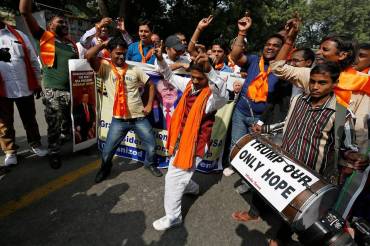
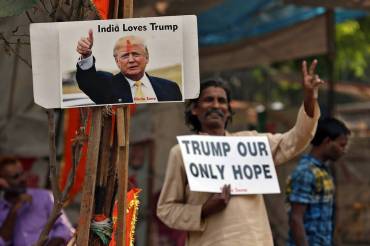
In India’s capital New Delhi, members of a small Hindu nationalist group were ready for the news of Mr. Trump’s win. They began gathering at 11 a.m. (12:30 a.m. Wednesday ET) to celebrate a Trump lead they were certain would result in a victory. The group, known as the Hindu Sena, or Hindu army, had hosted a prayer ritual for such an outcome a few months ago. It even held a birthday celebration for Mr. Trump in June.

A member of Hindu Sena celebrated Mr. Trump’s victory, in New Delhi, India, Nov. 9, 2016. PHOTO: CATHAL MCNAUGHTON/REUTERS

More than four dozen supporters gathered at a prominent square on Wednesday. They distributed Indian sweets to passers-by and beat traditional drums. Modifying a popular slogan from Indian Prime Minister Narendra Modi’s election campaign two years ago, they chanted in Hindi, “this time, a Trump government.”

Vishnu Gupta, who founded the group in 2011, said he’d sent out text messages at 7 p.m. (8:30 a.m. Tuesday ET) the previous day, asking supporters to watch the news closely and gather in the late morning. Mr. Gupta himself hadn’t slept all night, he said, glued to the television as Americans cast their ballots.

To Mr. Gupta, Mr. Trump, represents strong leadership against what he called Islamic terrorism, much like India’s Mr. Modi, he said. “Many people criticized Trump’s proposals to stop radical Muslims from entering the U.S. and mocked us for celebrating the man,” he said. “But today, we’ve come out ahead.”

Back in the U.S., the younger Mr. Hassan didn’t wait up for Trump’s victory speech. “Screw this,” he told his father in Pakistan and went to sleep at around midnight in New York.

The elder Mr. Hassan said that he was worried about his holdings on the local Karachi Stock Exchange, which plunged 2% early on Wednesday, before recovering.

Source: How the Trump Win Played Out in South Asia – India Real Time – WSJ

10/11/2016

Chinese Flag-Maker Flooded With Orders in Wake of Trump Win – China Real Time Report – WSJ

While China’s leaders weigh what to make of Donald Trump’s impending presidency, one manufacturer in the scenic city of Shaoxing has been enthusiastically carrying Mr. Trump’s banner.

Or, more accurately, he’s been printing, folding and shipping it.Yao Dandan is the owner of Shaoxing Jiahao Banner and Handicrafts Co. Ltd. Since election results suggesting a Trump victory began pouring in Wednesday morning, he says, he’s fielded a barrage of orders for Trump-themed flags.

The total number ordered as of Thursday morning: more than 40,000.

“I knew there would be demand for Trump flags after the election, so I made extra. But it’s not enough, so now I have to make more,” Mr. Yao said.The 30-year-old said that he’s been in the flag-making business for a decade and that Shaoxing’s factories specialize in making election banners. His factory has taken orders for close to half a million Trump banners in the past two months, he said.

Mr. Trump has taken heat for vowing tough restrictions on Chinese imports while over the years turning to China to source goods ranging from ties to steel, but there’s no evidence the next U.S. president purchased banners from Shaoxing. Mr. Yao said most of the orders he’s received came from Chinese clients living in the U.S.

Flags bound for the U.S. have to be higher quality than most, he said. He charges 2.5 yuan ($0.37) a piece for the smallest Trump banners, which his clients typically sell in the U.S. for between $1 or $2 (they sell for 5 yuan on e-commerce site Alibaba). The factory has produced every U.S. state flag, and earlier this year got multiple orders for Confederate flags.

What about orders for Hillary Clinton banners? Mr. Yao, who counts himself a Trump supporter, said he’s been asked but now refuses to make them because he believes Mrs. Clinton is unfair to China.

The news of Trump’s win was “a pleasant surprise,” he said. “It means I didn’t strive these past couple of months in vain.”

Asked about Mr. Trump’s vow to impose a 45% across-the-board tariff on Chinese goods, Mr. Yao confessed he wasn’t aware of that part of the property mogul’s platform but said he thought China’s government would make sure it wasn’t implemented.

The flag-maker said he’d never been to the U.S. but planned to remedy that soon.

“When things slow down, I’m going to go to the U.S. and have a look. At the very least I also contributed a little!” he said.

Source: Chinese Flag-Maker Flooded With Orders in Wake of Trump Win – China Real Time Report – WSJ

09/11/2016

5 Sectors Likely to Be Affected by India’s Surprise Move to Replace Large Rupee Notes – Briefly – WSJ

India’s move to curb corruption and counterfeiting by replacing high-denomination bank notes with new ones will likely have a significant impact on some sectors wrapped up in the cash economy.

Here are five industries likely to see change.

1 Real Estate

Many property transactions in India are made using cash. Builders often accept 10% to 20% of an asking price in cash to lower both the buyer’s and seller’s tax liability.“You may yourself have experienced when buying land or a house, that apart from the amount paid by check, a large amount is demanded in cash. This creates problems for an honest person in buying property,” Indian Prime Minister Narendra Modi said Tuesday.The use of counterfeit or undeclared earnings in this way has increased the price of real estate, Mr. Modi said. The move to scrap the current 500 and 1,000 rupee bills could reduce prices, analysts said.“This will clean up the real estate sector and bring down the cost of doing business,” says Dhiraj Relli, chief executive of HDFC Securities.

2 Gold

Investing in gold is another way some Indians keep money from the eyes of tax officials. The country is one of the world’s biggest consumers of the precious metal, along with China.According to various estimates, the current volume of gold in Indian households is above 20,000 tons. Analysts say if people are no longer able to use wads of 500- and 1,000-rupee notes to buy gold, they will have to put it into the formal banking system or invest it in stocks, mutual funds or bonds instead. This is also likely to slow down India’s gold imports and reduce foreign-currency outflows.

3 Two-Wheelers

India is one of the largest two-wheeler markets globally. In rural India, many farmers buy motorbikes and scooters with cash after they sell their their crops.The current measure may slow down two-wheeler sales as buyers are expected to postpone their purchases until they replace their existing bank notes with the new ones.No wonder, two-wheelers stocks are one of the biggest losers on India’s benchmark S&P BSE Sensex index today, falling between 4% and 6%.

4 Consumer Durables

rMany people in India also prefer to buy televisions, fridges or air-conditioners with cash. Some of those purchases involve money derived from corruption.Others are made by people who might not have a bank account and are purchasing the products as dowry items. As a result, the move to replace the existing high-denomination notes is expected to hurt sales in this segment.

5 Microfinance

rMicrofinance companies that disburse loans to poor people will likely face difficulty collecting or disbursing cash in the near term. In the worst case, they may have to postpone loan-repayment installments and disbursements may not happen in the next 10 days due to a shortage of currency notes, says broker Religare Capital Markets Ltd. However, things will likely stabilize after few weeks, it adds.

Source: 5 Sectors Likely to Be Affected by India’s Surprise Move to Replace Large Rupee Notes – Briefly – WSJ

Law of Unintended Consequences

continuously updated blog about China & India

ChiaHou's Book Reviews

continuously updated blog about China & India

What's wrong with the world; and its economy

continuously updated blog about China & India