Archive for May, 2012

23/05/2012

* Taiwan spies increase in carrier threat

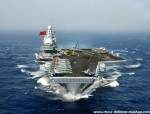
Hong Kong Standard: “Taiwan’s intelligence chief said Beijing plans to build two aircraft carriers to go with the first one in its fleet, a refitted former Soviet carrier currently undergoing sea trials.

“Indeed, the Chinese communists have decided to build two aircraft carriers on their own,” Tsai Teh-sheng, head of the National Security Bureau, told lawmakers. Construction is expected to start next year and in 2015, with the warships, which would be conventionally powered, to be delivered in 2020 and 2022. Tsai said Beijing has conducted six sea trials of its first carrier since the middle of last year, and that Taiwan expects it to go into service before the end of this year. Initially it may simply be used for training purposes but it can be sent for battles when necessary in the future,” he said. The ship’s sea trials have sparked international concern about the mainlands widening naval reach amid growing regional tensions over maritime disputes and a US campaign to assert itself as a Pacific power.”

via Taiwan spies increase in carrier threat – The Standard.

23/05/2012

* U.S. lets China bypass Wall St for Treasury orders

Reuters: “China can now bypass Wall Street when buying U.S. government debt and go straight to the U.S. Treasury, in what is the Treasurys first-ever direct relationship with a foreign government, according to documents viewed by Reuters.

The relationship means the People’s Bank of China buys U.S. debt using a different method than any other central bank in the world. The other central banks, including the Bank of Japan, which has a large appetite for Treasuries, place orders for U.S. debt with major Wall Street banks designated by the government as primary dealers. Those dealers then bid on their behalf at Treasury auctions. China, which holds $1.17 trillion in U.S. Treasuries, still buys some Treasuries through primary dealers, but since June 2011, that route hasn’t been necessary. The documents viewed by Reuters show the U.S. Treasury Department has given the People’s Bank of China a direct computer link to its auction system, which the Chinese first used to buy two-year notes in late June 2011. China can now participate in auctions without placing bids through primary dealers. If it wants to sell, however, it still has to go through the market.”

Incidentally, there is no finance benefit as commissions are not charged for such dealings.

via EXCLUSIVE: U.S. lets China bypass Wall St for Treasury orders – Reuters –.

An example of pragmatism on the part of the US government – giving special treatment to its biggest customer.

21/05/2012

* What the Chinese want

This is a much longer than usual post.  But if you are interested in either Chinese mentalilty or, more importantly, thinking of trading in China, this is a must read.

Consumers in China are increasingly modern in their tastes, but they are not becoming ‘Western.’ How the selling of coffee, cars and pizza sheds light on a nation racing toward superpower status.

By TOM DOCTOROFF, author of the book “What Chinese Want: Culture, Communism & The Modern Chinese Consumer.”

Apple has taken China by storm. A Starbucks can be found on practically every major street corner in coastal cities and beyond. From Nike to Buick to Siemens, Chinese consumers actively prefer Western brands over their domestic competitors. The rise of microbloggers, the popularity of rock bands with names like Hutong Fist and Catcher in the Rye, and even the newfound popularity of Christmas all seem to point toward a growing Westernization.

But don’t be deceived by appearances. Consumers in China aren’t becoming “Western.” They are increasingly modern and international, but they remain distinctly Chinese. If I’ve learned anything from my 20 years working as an advertising executive in China, it is that successful Western brands craft their message here to be “global,” not “foreign”—so that they can become vessels of Chinese culture.

Understanding China’s consumer culture is a good starting point for understanding the nation itself, as it races toward superpower status. Though the country’s economy and society are evolving rapidly, the underlying cultural blueprint has remained more or less constant for thousands of years. China is a Confucian society, a quixotic combination of top-down patriarchy and bottom-up social mobility. Citizens are driven by an ever-present conflict between standing out and fitting in, between ambition and regimentation. In Chinese society, individuals have no identity apart from obligations to, and acknowledgment by, others. The clan and nation are the eternal pillars of identity. Western individualism—the idea of defining oneself independent of society—doesn’t exist.

Various youth subtribes intermittently bubble to the surface—see the recent rise of “vegetable males” (Chinese metrosexuals) and “Taobao maniacs” (aficionados of the auction website Taobao). But self-expression is generally frowned upon, and societal acknowledgment is still tantamount to success. Liberal arts majors are considered inferior to graduates with engineering or accounting degrees. Few dare to see a psychologist for fear of losing “face”—the respect or deference of others—or being branded sick. Failure to have a child is a grave disappointment.

The speed with which China’s citizens have embraced all things digital is one sign that things are in motion in the country. But e-commerce, which has changed the balance of power between retailers and consumers, didn’t take off until the Chinese need for reassurance was satisfied. Even when transactions are arranged online, most purchases are completed in person, with shoppers examining the product and handing over their cash offline.

Even digital self-expression needs to be safe, cloaked in anonymity. Social networking sites such as Sina Weibo (a Chinese version of Twitter), Renren and Kaixing Wang (Chinese versions of Facebook) have exploded. But users hide behind avatars and pseudonyms. A survey conducted by the advertising firm JWT, where I work, and IAC, the Internet holding company, found that less than a third of young Americans agreed with the statement “I feel free to do and say things [online] I wouldn’t do or say offline,” and 41% disagreed. Among Chinese respondents, 73% agreed, and just 9% disagreed.

Chinese at all socioeconomic levels try to “win”—that is, climb the ladder of success—while working within the system, not against it. In Chinese consumer culture, there is a constant tension between self-protection and displaying status. This struggle explains the existence of two seemingly conflicting lines of development. On the one hand, we see stratospheric savings rates, extreme price sensitivity and aversion to credit-card interest payments. On the other, there is the Chinese fixation with luxury goods and a willingness to pay as much as 120% of one’s yearly income for a car.

Every day, the Chinese confront shredded social safety nets, a lack of institutions that protect individual wealth, contaminated food products and myriad other risks to home and health. The instinct of consumers to project status through material display is counterbalanced by conservative buying behavior. Protective benefits are the primary consideration for consumers. Even high-end paints must establish their lack of toxicity before touting the virtues of colorful self-expression. Safety is a big concern for all car buyers, at either end of the price spectrum.

To win a following among Chinese buyers, brands have to follow three rules.

First and most important, products that are consumed in public, directly or indirectly, command huge price premiums relative to goods used in private. The leading mobile phone brands are international. The leading household appliance brands, by contrast, are cheaply priced domestic makers such as TCL, Changhong and Little Swan. According to a study by the U.K.-based retailer B&Q, the average middle-class Chinese spends only $15,000 to fit out a completely bare 1,000-square-foot apartment.

Luxury items are desired more as status investments than for their inherent beauty or craftsmanship. The Chinese are now the world’s most avid luxury shoppers, at least if trips abroad to cities like Hong Kong and Paris are taken into account. According to Global Refund, a company specializing in tax-free shopping for tourists, the Chinese account for 15% of all luxury items purchased in France but less than 2% of its visitors.

Public display is also a critical consideration in how global brands are repositioning themselves to attract Chinese consumers. Despite China’s tea culture, Starbucks successfully established itself as a public venue in which professional tribes gather to proclaim their affiliation with the new-generation elite. Both Pizza Hut and Häagen Dazs have built mega-franchises in China rooted in out-of-home consumption. (The $5 carton of vanilla to be eaten at home is a tough sell in China.)

The second rule is that the benefits of a product should be external, not internal. Even for luxury goods, celebrating individualism—with familiar Western notions like “what I want” and “how I feel”—doesn’t work in China. Automobiles need to make a statement about a man on his way up. BMW, for example, has successfully fused its global slogan of the “ultimate driving machine” with a Chinese-style declaration of ambition.

Sometimes the difference between internal versus external payoffs can be quite subtle. Spas and resorts do better when they promise not only relaxation but also recharged batteries. Infant formulas must promote intelligence, not happiness. Kids aren’t taken to Pizza Hut so that they can enjoy pizza; they are rewarded with academic “triumph feasts.” Beauty products must help a woman “move forward.” Even beer must do something. In Western countries, letting the good times roll is enough; in China, pilsner must bring people together, reinforce trust and promote mutual financial gain.

Emotional payoffs must be practical, even in matters of the heart. Valentine’s Day is almost as dear to the Chinese as the Lunar New Year, but they view it primarily as an opportunity for men to demonstrate their worthiness and commitment. In the U.S., De Beers’s slogan, “A Diamond is Forever,” glorifies eternal romance. In China, the same tagline connotes obligation, a familial covenant—rock solid, like the stone itself.

The last rule for positioning a brand in China is that products must address the need to navigate the crosscurrents of ambition and regimentation, of standing out while fitting in. Men want to succeed without violating the rules of the game, which is why wealthier individuals prefer Audis or BMWs over flashy Maseratis.

Luxury buyers want to demonstrate mastery of the system while remaining understated, hence the appeal of Mont Blanc’s six-point logo or Bottega Veneta’s signature cross weave—both conspicuously discreet. Young consumers want both stylishness and acceptance, so they opt for more conventionally hip fashion brands like Converse and Uniqlo.

Chinese parents are drawn to brands promising “stealthy learning” for their children: intellectual development masked as fun. Disney will succeed more as an educational franchise—its English learning centers are going gangbusters—than as a theme park. McDonald’s restaurants, temples of childhood delight in the West, have morphed into scholastic playgrounds in China: Happy Meals include collectible Snoopy figurines wearing costumes from around the world, while the McDonald’s website, hosted by Professor Ronald, offers Happy Courses for multiplication. Skippy peanut butter combines “delicious peanut taste” and “intelligent sandwich preparation.”

Even China’s love affair with Christmas—with big holiday sales and ubiquitous seasonal music, even in Communist Party buildings—advances a distinctly Chinese agenda. Santa is a symbol of progress; he represents the country’s growing comfort with a new global order, one into which it is determined to assimilate, without sacrificing the national interest. The holiday has become a way to project status in a culture in which individual identity is inextricably linked to external validation.

The American dream—wealth that culminates in freedom—is intoxicating for the Chinese. But whereas Americans dream of “independence,” Chinese crave “control” of their own destiny and command over the vagaries of daily life. Material similarities between Chinese and Americans mask fundamentally different emotional impulses. If Western brands can learn to meet China’s worldview on its own terms, perhaps the West as a whole can too.”

http://online.wsj.com/article/SB10001424052702303360504577408493723814210.html?mod=WSJ_hp_mostpop_read

20/05/2012

* China seeks export recovery

China Daily: “China is now losing an increasing number of export orders to other emerging countries because of rising costs at home. That’s driving the government to consider supportive measures including tax rebates and reduced transportation fees, a commerce official said on Saturday during an investment and trade expo held in Changsha, Hunan province.

“Rising costs of labor and land as well as enhanced environment protection criteria has reduced the competitive edge of Chinese exporters,” said Wang Shouwen, director of the department of foreign trade at the Ministry of Commerce. Chinese labor-intensive exports, including textile, apparel and light industrial products, increased rapidly in such traditional markets as the US, the EU and Japan before 2010. But the first four months of 2012 saw Chinas textile and apparel exports to Japan expand only slightly, by about 7 percent year-on-year, while Japanese imports from other emerging countries surged by more than 40 percent in the same period, Wang said. “Overseas buyers strategy, called China plus one, also contributed to the shifting away of Chinese exporting order. China remained the main supplier for overseas buyers but one alternative procurement source in other emerging countries is established to compare the cost with China. “Further rising costs at home will drive buyers to rely more and more on their plus-one countries,” the director said.

via China seeks export recovery|Economy|chinadaily.com.cn.

Compounding worries about the Greek economy, recessions across many Euro countries, low growth in the US and slowing growth in India, comes the bad news that Chinese exports are not as high as it used to be. Bad news all round.

20/05/2012

* China dissident Chen Guangcheng arrives in the US

BBC News: “Chinese activist Chen Guangcheng has arrived in New York to begin a new life in the United States.

The blind human rights lawyer caused a diplomatic crisis when he escaped house arrest to arrive at the US embassy in Beijing last month. Speaking outside New York University, where he has been offered a fellowship, Mr Chen said China had dealt with the situation with “restraint and calm”. But he raised concerns about ongoing reprisals against his family. “Acts of retribution in Shandong have not been abated and my rights to practice law have been curbed – we hope to see a thorough investigation into this,” he said, referring to the province where he was kept under house arrest. The activist thanked US officials and his supporters for their help and said he had come to the United States for “recuperation in body and spirit”.

Chen Guangcheng and his family were taken from a Beijing hospital, where he was being treated for a foot injury, to the capitals airport on Saturday. A crowd of activists, supporters and curious New Yorkers greeted Chen at the university apartment block in Greenwich Village where he and his family will stay. Wearing dark glasses and hobbling on crutches, he may not have looked like a conquering hero, but that is how he was treated. There were cheers and screams of encouragement. Some had brought flowers, while one woman was led away in tears after failing to secure a hug from her idol.

Former House speaker Nancy Pelosi described his arrival in the US as “a milestone in the cause for human rights in China“.”

via BBC News – China dissident Chen Guangcheng arrives in the US.

19/05/2012

* The world turned upside down: how workers are moving from PIIGS to BRICS

The Times: “The eurozone was dreamland for the formerly impoverished fringe of southern Europe. To share the same currency as the powerful Germans and French was a sure sign that the bad times — of dusty villages emptied of menfolk — were over. They bought German cars, borrowed money to build villas and said farewell to centuries of emigration.

BRICS counties. BRICS - Brazil, Russia, India,...

BRICS counties. BRICS – Brazil, Russia, India, People’s Republic of China, South Africa. Português: As Potências regionais. (Photo credit: Wikipedia)

Now, as dreamland turns to nightmare, young Portuguese, Spaniards and Greeks are on the move again, travelling in search of work and security to countries they had previously treated with contempt or indifference. People from the PIIGS — Portugal, Ireland, Italy, Greece and Spain — are heading for the BRICs — Brazil, India and China but not Russia — as the global turmoil creates a new trend: reverse migration.

The movement of peoples began in earnest at the outset of the financial crisis three years ago, as the strong-growth cultures became a magnet not only for European adventurers but for well-educated native-born emigrants returning home. The rapid unravelling of the PIIGS has, however, made this an act of desperation for many. Across the globe millions of people are on the move as who is rich, who is poor, who is up, who is down is defined anew. Remarkably, at least 10,000 Portuguese have left for Angola. …Angola was a Portuguese colony for three hundred years, a supplier of slaves to the mercantile class in the 17th century. Today it is Africa’s second-largest oil producer and while not exactly a BRIC — two thirds of its population live on £1.30 a day — it has an energy that has drained from its former colonial master.

Brazil has become a natural destination for the Portuguese — and the Spanish. In Madrid, a website, Pepas y Pepes, has been set up to guide would-be emigrants. Even its name is a sad echo, adapted from a famous Spanish film called ¡Vente a Alemania, Pepe! — Come to Germany, Pepe! — which was inspired by the exodus after the Spanish Civil War. … A Barcelona businessman, Jordi Camps, has set up a travel company in China, China a la Carta. “Here you can smell growth,” he says. “It is sad to hear the news from Spain.”

There are two trends unfolding in the world. The first is that many hundreds of thousands who emigrated from what was once called the developing world to Europe and the United States are now being drawn back by the resurgent economies of their homelands. … Nowadays it is an eerily quiet place with giant razor-wired pens all empty of Mexican illegals. Instead, as the US economy wobbles uncertainly, Mexicans are heading home for work. For the first time since the Great Depression more Mexicans are leaving the US than entering it — and most of them are finding jobs.

There is huge reverse migration, too, by overseas Chinese and Indians. Almost 135,000 Chinese students returned home in 2009-10 after finishing their education abroad, an increase of 24.7 per cent. Zhang Peizhuo, a 45-year-old chemical researcher who stayed in Britain for 12 years after graduating there, has now gone back to China, in part because of government incentives. “Huge growth potential and increasing government subsidies have made returning home to start a business an attractive option for many overseas Chinese,” he said.

According to the recruitment company Kelly Services India, as many as 300,000 Indian professionals are expected to return to their homeland in the next four years: “Hype or reality, people do believe that the BRICs are the future and that there are a lot more job opportunities in India than elsewhere.” …

via The world turned upside down: how workers are moving from PIIGS to BRICS | The Times.

See also: https://chindia-alert.org/economic-factors/

19/05/2012

* How China’s 300m microbloggers are shaking the system

The Times: “There was a time when a hardline editorial in the Beijing Daily could strike fear into Chinese hearts. These days, such clumsy propaganda draws a stream of sarcasm from the country’s 300 million or so microbloggers. …

Welcome to the world of the Twitter-like Sina Weibo — weibo means microblog — which has become one of the greatest threats to Communist Party supremacy. With 20 million followers, the most popular microblogger is the actress Yao Chen, whose musings, like “the traffic is good today” or “I recommend that documentary” are hardly incendiary. But many more want to weigh in on touchier topics … It is clashes like these that are reframing the battle for control of information.

Concerns have intensified as China approaches its once-a-decade change of leadership in a state of political turmoil not seen for 20 years. What Beijing wants is stability, a smooth transfer of power and a public convinced that everything is improving. The microbloggers ensure that it will have to achieve that against a backdrop of scrutiny, mockery and even defiance.

For a regime that has long prided itself on its control of information, the huge numbers who follow the most popular microblogs are a potent reminder of diminishing influence. In common with the most followed people on Twitter, which is banned by Chinese censors, the most popular weibos have readerships that dwarf the circulation of the largest newspapers.

“It has given a voice to 300 million Chinese and that has never happened before,” said Zhan Jiang, a professor of journalism at the Beijing Foreign Studies University. “It has taken on the role of spreading information when news is breaking and that is a big challenge to the Government and media.” As the Government is quickly recognising, sheer size of readership is not the real problem. The war being lost by the authorities, said Hu Xingdou, of the Beijing University of Technology, involves the sophistication of the information in the public domain, the speed of its flow and the vibrant debate. “Weibo has started the enlightenment in China and promoted social progress,” he said. “It is pushing the Government to disclose more, exposing more truths and allowing people to play a role in politics. We should thank God for giving weibo to China: without it, our prospects would not be good.”

Some bloggers talk about 2012 as the year in which Beijing might finally lose control of information. But they also fear that some of the most influential weibos are being quietly shut down — an attempt, said one, to test the “arrogant and stupid idea” that information can still be controlled. The 140-character weibo offers far more scope for provocative content than a 140-letter Tweet. Official data is ridiculed, corruption is outed and the contradictions of the system laid bare. When officials tried to bury news of a fatal train crash in southern Wenzhou last year, it was the exposure via weibo that forced the authorities to change tactics immediately.

“The more powerful weibo has become, the more use it could be to the central government if they thought about it,” said Francis Cheung, a China economist at CLSA Securities. “They are still thinking of weibo as something that can be controlled. In reality it is a new media that is telling Beijing more about what is going on around the country than it ever knew before.”For now, the Government appears to be resorting to tried and tested strategies: it is insisting that users register with their real names and has made it a crime to spread false rumours. Some believe these measures could kill the weibo phenomenon, others are convinced the genie is out of the bottle.

A large part of the power of weibo, which is hosted by Sina, the state-owned ISP, is its resilience. When words are blocked by the censors, codes and puns evolve within minutes to get around the ban. Premier Wen Jiabao becomes known as “teletubbies” while the deposed Chongqing party secretary, Bo Xilai, becomes “tomato”.

This week, weibo users were on form when the National Bureau of Corruption Prevention said that 72.7 per cent of Chinese were satisfied with government progress on fighting corruption. The derision went viral. “Public opinion poll? Did they conduct it inside the Politburo? Poor old public opinion — raped once again,” wrote one user.

“Weibo is doing something in China that is very different from what microblogs are doing in the West,” said Mr Hu. “It has become a means of making sure that people’s constitutionally guaranteed rights are actually upheld.”

via How China’s 300m microbloggers are shaking the system | The Times.

19/05/2012

* IIT-JEE topper watched movie on exam eve

The Hindu: “A total number of 479,651 candidates appeared for both papers of the exam on April 8.

Delhi-based Arpit Agrawal, who came as all-India number one in IIT-JEE on Friday, revealed some of the secrets of his success to The Hindu. “I watched a movie the day before my exam,” he said.  “I was definitely lucky that it was on TV. It was loaded with so many emotions [that all the tension of the exam was driven from my mind].”

A student of Modern Vidya Niketan in Faridabad, Arpit says he does not believe that topping the exams comes down to the number of hours of preparation. “Everyone require different hours to prepare. The best way is to revise what you learn on the same day.” …

A total number of 479,651 candidates appeared for both papers of the exam, which was conducted on April 8. Of the total, 24,112 have secured ranks in various categories and 17,462 shortlisted for counselling for admission to 9,647 seats in the 15 IITs, IT-BHU, Varanasi, and Indian School of Mines-Dhanbad. …

This year, 150,431 girls appeared in both papers of IIT-JEE, out of which 2,886 secured ranks and the first 1,908 were shortlisted for counselling.”

via The Hindu : Education : IIT-JEE topper watched movie on exam eve.

19/05/2012

* Rich in kindness

China Daily: “Billionaire behind major philanthropic projects says there’s always more to do.

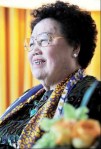
Entrepreneur and philanthropist Chan Laiwa, also known as Chen Lihua, is no stranger to lists of the world’s richest people, from Forbes to Hurun. But the self-made billionaire finds there is “so much” beyond wealth. “While wealth does come through our hard work and efforts, it is not the ultimate goal and is not above everything,” Chan, 71, says in her Manhattan hotel room the day before she was honored at an April gala as one of Time magazine’s 100 Most Influential People for 2012.

Such sentiments might seem standard from any rich person concerned with public image, but Chan in person – sincere, humble and thoughtful – makes people around her feel at ease. She impresses most with her passion for art, particularly of sandalwood, a medium she has loved since she was a girl. Born into a family of Manchu, the ethnic group that led Chinas last imperial dynasty, the Qing 1644-1911, Chan spent most of her childhood in the Summer Palace in Beijing. She is a descendant of a noble Manchu family of the Yellow Banner Clan, some members of which were ministers of state under the Qing emperor.

Chan’s childhood home was furnished with red sandalwood, a material used in the emperors’ palace in bygone times. “As I grew older, I felt the need to preserve this important part of Chinese culture,” recalls Chan, who opened a furniture factory in the 1980s and began making old-style pieces modeled after those from Beijing’s Palace Museum, more widely known as the Forbidden City.

In 1999, Chan fulfilled a childhood dream by investing in a $16 million red sandalwood museum in the capital. The thousands of treasures displayed there include a scale model of a corner tower in the Forbidden City, a reproduction of the memorial gateway carved with 320 dragons from Longquan Temple in Shanxi province, and a number of intricate furniture pieces and sculptures.

She made her fortune in the 1990s through a series of real estate ventures involving her Fu Wah International Group, the Hong Kong company fashioned out of Chan’s furniture store. The businesswoman later moved to Beijing for more opportunities. Chan was recently voted among Time magazines 100 Most Influential People in the World for 2012.

via Rich in kindness|People|chinadaily.com.cn.

19/05/2012

* Hitching his Starwood to China

China Daily: “CEO of one of world’s biggest five-star chains says future is written in Chinese.

When Frits van Paasschen first visited China as a backpacker, staying in basic accommodation and traveling on crowded buses and trains, little did he imagine that two decades later, he would be returning as the boss of a five-star hotel chain. The senior executive retains vivid memories of those days, traveling the length and breadth of the country and leaving via the Karakoram Highway from China to Pakistan, clinging precariously to the roof of a pick-up truck.

Nowadays, van Paasschen flies business class on regular visits to China from his New York head office – and stays in the luxury properties of the St Regis, Westin, Sheraton and Le Mridien hotels that make up the Starwood portfolio.Van Paasschen is president and CEO of Starwood, one of the largest hotel management groups in the world which is adding to its China portfolio at a phenomenal rate: this year alone will see 23 new properties open – roughly one every fortnight – bringing the total to 100.

The country is considered to be so important that last year the boss flew the entire senior management team to China for a months visit; executive meetings were held wherever they happened to be on their grand China tour. “If a picture is worth a thousand words, then a visit is worth ten thousand,” says van Paasschen.  …

“Literally one of the high points was being on the top floor of what will be the St Regis in Shenzhen on the 100th floor of that building, looking out and toward Hong Kong and seeing that the Shenzhen side looks snazzier and more well developed than the New Territories of Hong Kong.

“When I am asked about the future I say I can’t read it, it is written in Chinese!  …

via Hitching his Starwood to China|Last Word|chinadaily.com.cn.

Law of Unintended Consequences

continuously updated blog about China & India

ChiaHou's Book Reviews

continuously updated blog about China & India

What's wrong with the world; and its economy

continuously updated blog about China & India