Archive for April, 2015

14/04/2015

Narendra Modi: India Has Changed – India Real Time – WSJ

Indian Prime Minister Narendra Modi sought to convince German industry that India is a reliable place to do business on his first visit to Europe’s largest economy as India’s leader.

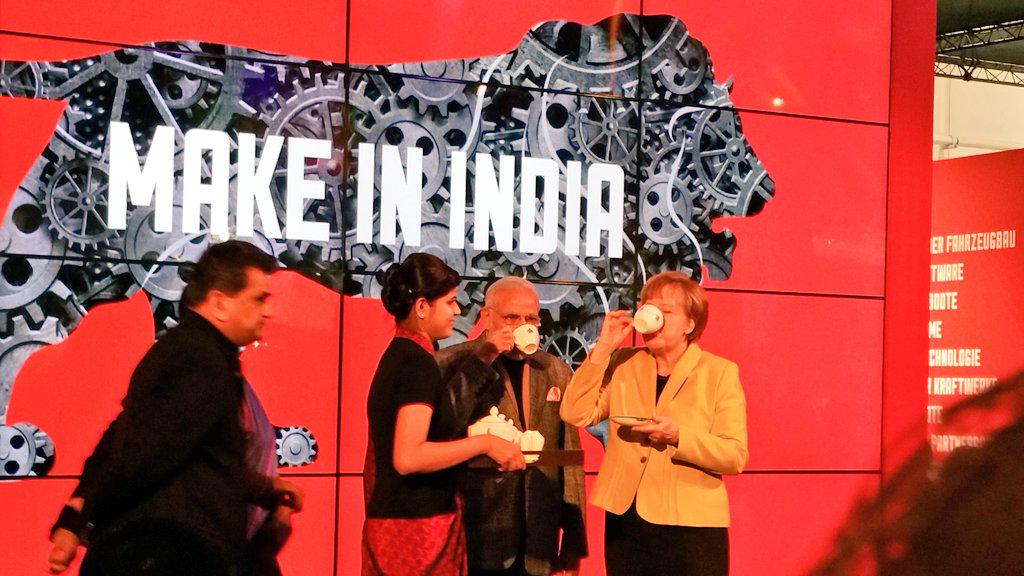
View image on Twitter

“I am here to assure German companies that India is now a changed country — transparent, responsive and stable,” Mr. Modi told a delegation of Indian and German business leaders on Monday.

The Indian leader insisted that he was committed to introducing a “predictable” business environment in his country, as German Chancellor Angela Merkel welcomed him for the start of the Hannover Messe trade fair.

As the official partner country of the Messe—the world’s largest industrial trade fair—India is promoting its industrial and technological assets as Mr. Modi seeks to draw German industrial investment to his country.

Months after his election last May, Mr. Modi, of the conservative Bharatiya Janata Party, launched a “Make in India” campaign to promote the country as an investment destination and manufacturing center. His goal is to market India as an industrial hub for foreign players eager to take advantage of the country’s large workforce, raw materials and infrastructure.

via Narendra Modi: India Has Changed – India Real Time – WSJ.

12/04/2015

Drugs for malaria, osteoporosis, diabetes: Harsh Vardhan – The Hindu

‘The “candidate drugs” for malaria, osteoporosis and diabetes were currently undergoing clinical trials’

The “candidate drugs” for malaria, osteoporosis and diabetes were currently undergoing clinical trials. Photo: V.V.Krishnan

The Indian pharmaceutical sector would soon be showcasing ‘candidate drugs’ for malaria, osteoporosis and diabetes, Union Minister for Science and Technology and Earth Sciences Harsh Vardhan said on Saturday.

With further R&D, important breakthroughs could be on the horizon for these diseases, he said following a visit to the Central Drug Research Institute (CDRI), Lucknow, a wing of the Council of Scientific and Industrial Research (CSIR).

Addressing scientists, he said Prime Minister Narendra Modi was committed to making India one of the world’s leading destinations for end-to-end drug discovery and innovation by 2020.

“I am confident that the drug laboratories under the CSIR are capable of backing up the Swasth Swachh Bharat Mission. Our scientists are focussing on both infectious and lifestyle diseases. We are developing next generation drugs, biologics, biosimilars, gene therapeutics, stem cell therapeutics, personalised medicine and multifunctional nanomedicine,” said Dr. Vardhan.

Indian R&D efforts in government laboratories like CSIR-CDRI, CSIR-Indian Institute of Chemical Technology (CSIR-IICT, Hyderabad) and CSIR-Indian Institute of Chemical Biology (CSIR-IICB, Kolkata) have a track record in making drugs for kala azar, filaria, leprosy and tuberculosis available at affordable rates to the common man, he said.

via Drugs for malaria, osteoporosis, diabetes: Harsh Vardhan – The Hindu.

12/04/2015

Modi’s ‘Make in India’ Gets $2 Billion Vote of Confidence From Airbus – India Real Time – WSJ

On Saturday, Indian Prime Minister Narendra Modi paid a visit to Airbus Group ‘sEADSY +0.49% facilities in Toulouse, France.

He was greeted with a vote of support, from the aerospace company’s CEO, for his Make in India initiative to build up manufacturing in the South Asian country.

Airbus is “ready to manufacture in India, for India and the world,” said Airbus chief Tom Enders. “India already takes a center-stage role in our international activities and we want to even increase its contribution to our products.”

Airbus Group aims to increase its sourcing of aerospace parts from Indian companies to $2 billion in the next five years, the company informed Mr. Modi, as it seeks to diversify its supplier base and tap low-cost suppliers worldwide.

The company’s strategy to ramp up outsourcing from India comes as it competes to secure billions of dollars in deals for military hardware from the country.

India has yet to decide on a joint bid by Airbus and India’s Tata Group to make Airbus’s C295 aircraft, in a contract estimated at about $3 billion. The company is also pursuing separate deals for hundreds of helicopters from the Indian military.

India has already selected Airbus to supply six A330 multirole tanker-transport planes for an estimated $2 billion.

In a presentation to the Indian prime minister on Saturday, the company said it would work with partners in India in areas such as engineering, customer services and pilot training, and to establish centers for the maintenance, repair and overhaul of planes, according to Indian Foreign Ministry spokesman Syed Akbaruddin.

In a statement, Airbus said it aims to produce helicopters, military planes, sensors as well as satellites in India, in partnerships with local firms. The company predicted India would India would require 1,291 new planes over the next two decades. It forecast the Indian air travel market to grow 11% each year through 2025.

via Modi’s ‘Make in India’ Gets $2 Billion Vote of Confidence From Airbus – India Real Time – WSJ.

10/04/2015

Opinion polls: The critical masses | The Economist

IN RECENT weeks official media have published a flurry of opinion polls. One in China Daily showed that most people in the coastal cities of Shanghai and Guangzhou think that smog is getting worse. Another noted the high salary expectations of university students. Yet another found that over two-thirds of respondents in Henan province in central China regard local officials as inefficient and neglectful of their duties. For decades the Communist Party has claimed to embody and express the will of the masses. Now it is increasingly seeking to measure that will—and let it shape at least some of the party’s policies.

Since the party seized power in 1949 it has repeatedly unleashed public opinion only to suppress it with force, from the “Hundred Flowers Campaign” in 1956, when it briefly tolerated critical voices, to the student-led protests in Tiananmen Square in 1989. For the past two decades, the party has effectively bought people’s obedience by promising—and delivering—a better, richer future. This will be tougher in the years ahead as the economy slows. Members of a huge new middle class are demanding more from their government in areas ranging from the environment to the protection of property rights. So the party must respond to concerns in order to retain its legitimacy.

Xi Jinping, who took over as China’s leader in 2012, has shown even less inclination than his predecessors to let citizens express their preferences through the ballot box. Yet the public has become ever more vocal on a wide variety of issues—online, through protests, and increasingly via responses to opinion polls and government-arranged consultations over the introduction of some new laws. The party monitors this clamour to detect possible flashpoints, and it frequently censors dissent. But the government is also consulting people, through opinion polls that try to establish their views on some of the big issues of the day as well as on specific policies. Its main aim is to devise ways to keep citizens as happy as possible in their daily lives. It avoids stickier subjects such as political reform or human rights. But people are undoubtedly gaining a stronger voice.

via Opinion polls: The critical masses | The Economist.

10/04/2015

Banyan: Where all Silk Roads lead | The Economist

NOT content with both purifying the Chinese Communist Party which he heads and with reforming his country, China’s president, Xi Jinping, also wants to reshape the economic and political order in Asia. With the flair that Chinese leaders share for pithy but rather bewildering encapsulations, his vision for the continent is summed up in official jargon as “One Belt, One Road”. As Mr Xi describes it, most recently last month at the Boao Forum, China’s tropical-beach imitation of Davos’s ski slopes, the belt-road concept will “answer the call of our time for regional and global co-operation”. Not everybody is convinced. Some see it as no more than an empty slogan; others as a thinly disguised Chinese plot to supplant America as Asia’s predominant power. Both criticisms seem misplaced. Mr Xi is serious about the idea. And it is less a “plot” than a public manifesto.

Mr Xi first floated the idea in 2013, in Kazakhstan. He mooted a “a Silk Road economic belt” of improved infrastructure along the main strands of what, centuries ago, was the network of overland routes used by silk traders and others to carry merchandise to and from China through Central Asia and Russia to northern Europe and Venice on the Adriatic. In Indonesia, Mr Xi proposed “a 21st-century maritime Silk Road”, reaching Europe by sea from cities on China’s south-eastern seaboard via Vietnam, Indonesia itself, India, Sri Lanka, east Africa and the Suez Canal. At the time, the proposals sounded rather fluffy—the sort of thing travelling leaders often trot out, harking back to a distant past of supposedly harmonious exchanges.

In the past few months, however, the idea has been given a real push. China has gone further toward putting its money where Mr Xi’s mouth is. It has promised $50 billion to its new Asian Infrastructure Investment Bank, which despite American opposition has sparked a race in which 47 countries have applied to join as founding shareholders. China has earmarked a further $40 billion for a “Silk Road fund”, to invest in infrastructure along the land belt and the maritime road. One motive for this splurge is self-interest. Chinese firms hope to win many of the engineering projects—roads, railways, ports and pipelines—that the new “connectivity” will demand. Improved transport links will benefit Chinese exporters. And helping its neighbours’ development will create new markets. That China seems to have realised this has led to comparisons with the Marshall Plan, America’s aid to help western Europe rebuild after the second world war.

China does not like that analogy, since it sees the Marshall Plan as part of America’s containment of the Soviet Union. It insists that its initiatives are for the benefit of all of humanity and are—favourite catchphrase—“win-win”. But it certainly hopes money and investment can win friends. Yan Xuetong, a prominent Chinese international-relations expert, has argued that the country needs to “purchase” friendly relationships with its neighbours.

In Central Asia, battered by low oil prices and plummeting remittances from migrant workers in Russia, the prospect of greater Chinese involvement is welcomed. Russia itself, though wary of China’s steady erosion of its influence in the former Soviet states of the region, is now too dependent on Chinese goodwill to do other than cheer. On the maritime route, however, suspicion of Chinese intentions is rife. Its arrogant behaviour in the South China Sea, where it is engaged in a construction spree to turn disputed rocks into disputed islands, has given the impression that it feels it can simply bully its smaller neighbours.

So the initial reaction in South-East Asia to the belt and road has been sceptical. In Malaysia, where the government’s usual response to a proposal from China is to applaud first and ask questions later, the defence minister, Hishamuddin Hussein, has said the maritime Silk Road has “raised questions” and that it must come across as a joint (that is, regional) initiative, rather than as a solely Chinese one. Indonesia’s president, Joko Widodo, who says he wants to turn his country into a “global maritime fulcrum”, was doubtful at first. But he now seems inclined to help—unsurprisingly since his own plan involves massive investment in ports and other infrastructure to which, he hopes, China will contribute. A visit to China last month yielded a joint statement promising a “maritime partnership” and describing his and Mr Xi’s visions as “complementary”. But Mr Joko had also made clear before arriving in Beijing that Indonesia did not accept China’s territorial claims in South-East Asian waters.

In India, another new leader, Narendra Modi, the prime minister, has his own approach to these issues. He visited Sri Lanka, Mauritius and the Seychelles last month, three Indian Ocean countries to which he promised greater co-operation and spelled out India’s own interests as a maritime power. This was not presented as a riposte to China’s plans. But in January Mr Modi and Barack Obama produced a joint “strategic vision”. Implicitly, India’s response to China’s maritime ambitions has been to reinvigorate ties with small neighbours and to cleave closer to America.

via Banyan: Where all Silk Roads lead | The Economist.

09/04/2015

China to Build Pipeline From Iran to Pakistan – China Real Time Report – WSJ

China will build a pipeline to bring natural gas from Iran to Pakistan to help address Pakistan’s acute energy shortage, under a deal to be signed during the Chinese president’s visit to Islamabad this month, Pakistani officials said. As the WSJ’s Saeed Shah reports:

The arrival of President Xi Jinping is expected to showcase China’s commitment to infrastructure development in ally Pakistan, at a time when few other countries are willing to make major investments in cash-strapped, terrorism-plagued, Pakistan.

The pipeline would amount to an early benefit for both Pakistan and Iran from the framework agreement reached earlier this month between Tehran and the U.S. and other world powers to prevent Iran from developing nuclear weapons. The U.S. had previously threatened Pakistan with sanctions if it went ahead with the project.

Dubbed the “Peace Pipeline,” the project will further bolster improving ties between Pakistan and Iran, which had been uneasy neighbors for decades as a result of Pakistan’s ties to Iran’s long-term adversaries, Saudi Arabia and the U.S.

“We’re building it,” Pakistani Petroleum Minister Shahid Khaqan Abbasi told The Wall Street Journal, referring to the pipeline. “The process has started.”

The pipeline will bring much-needed gas to Pakistan, which suffers from a crippling electricity deficit because of a shortage of fuel for its power-generation plants. Pakistan has been negotiating for months behind the scenes for China to build the Pakistani portion of the pipeline, which will cost up to $2 billion.

via China to Build Pipeline From Iran to Pakistan – China Real Time Report – WSJ.

09/04/2015

Demands for Bribes and Other Barriers Get in Way of Modi’s Banking Push for the Poor – India Real Time – WSJ

Firozaben, a nurse at an upscale clinic here, opened an account at the state-owned Bank of Baroda Ltd. in December, attracted by the promise of an overdraft provision and accident- and life-insurance policies—all for no fee, courtesy of a government program to bring India’s masses into the banking system.

The same month, Mohammad Assalam Ansari, a tailor, traveled to an account-opening “boot camp” run by the bank. He says he had to pay 100 rupees before a clerk would give him an application form. Despite this, he says his application was rejected; he isn’t sure why.

Their stories reflect both the promise and the weakness of an ambitious program by Prime Minister Narendra Modi to widen access to financial services to the country’s poor. The goal is to make India less cash dependent, shrink the black economy, reduce corruption and boost growth.

via Demands for Bribes and Other Barriers Get in Way of Modi’s Banking Push for the Poor – India Real Time – WSJ.

09/04/2015

India’s Credit Outlook Gets Boost From Moody’s – India Real Time – WSJ

India has inched farther away from junk-bond status.

Moody’s Investors Service MCO +0.71% on Thursday changed its ratings outlook on Asia’s No. 3 economy to positive from stable, citing the “increasing probability that actions by policy makers will enhance the country’s economic strength.” But it maintained its Baa3 rating, one level above junk, saying the Indian economy is still heavily exposed to external and financial shocks. Moody’s has rated India at Baa3 since 2004.

The move is a vote of investor confidence in the economic management of Prime Minister Narendra Modi and Reserve Bank of India Gov. Raghuram Rajan. Standard & Poor’s raised its India outlook to stable last fall. Fitch Ratings has had a stable outlook on India since 2013.

All three of the big agencies currently assign Indian debt their lowest investment-grade ratings. They cite similar reasons. Inflation is high. The public sector—the federal government plus the states—is highly indebted. Infrastructure is sorely deficient. The banking system is burdened with bad assets.

“While policies are beginning to address each of these factors, the extent of likely improvements is as yet unclear,” Moody’s said Thursday.

via India’s Credit Outlook Gets Boost From Moody’s – India Real Time – WSJ.

08/04/2015

Ikea bans customers sleeping on showing beds – China – Chinadaily.com.cn

Ikea has introduced new rules that forbid store visitors from sleeping on showroom sofas and beds, but the rule is proving hard to enforce, the Beijing Youth Daily reported Monday.

Ikea bans customers sleeping on showing beds

The world’s largest furniture retailer introduced the rule because many customers, both adults and children, have been sleeping in stores, creating a scene and affecting the experience of other customers.

A middle-aged woman said Ikea beds are comfortable so her friends “take a nap” there sometimes, according to the newspaper.

Pictures also show young couples lying on the sofas, their faces covered by pillows.

The newspaper said some customers take off their shoes and lie on the beds as if they were in their own homes.

Ikea encourages customers to sit or lie on beds for a short while to experience their quality, but many sleeping customers occupy the display pieces for too long, a staff member says.

The air-conditioned megastore in Beijing is known for attracting customers in summer who are looking to escape the heat.

Workers in Ikea said it is hard to enforce the no-sleeping rule as many of the perpetrators are often elderly or young children, and some customers simply ignore their requests.

via Ikea bans customers sleeping on showing beds – China – Chinadaily.com.cn.

08/04/2015

Narendra Modi to hard sell ‘Make in India’ at talks with business leaders in Hannover Messe during Germany visit – The Hindu

Prime Minister will inaugurate the Hannover Messe, considered the largest congregation of business tycoons.

Prime Minister Narendra Modi speaks at an event in New Delhi on Wednesday. Photo: V. Sudershan

Prime Minister Narendra Modi will hard sell India as an attractive investment destination while deliberating with movers and shakers of global business at the Hannover Messe during his three-day trip to Germany beginning Sunday, besides holding talks with its top leadership.

In his maiden visit to the European nation as Prime Minister, Mr. Modi will have a packed schedule and wooing investors and projecting his ambitious “Make in India” initiative will be a major focus area.

Mr. Modi will inaugurate the Hannover Messe, considered the largest congregation of business tycoons, along with German Chancellor Angela Merkel. India is the partner country of the fair this year where over 350 Indian enterprises are participating.

“In January, the world came to vibrant India in Gujarat and now exactly three months later, vibrant India is coming to the world in Germany to Hannover Messe,” German Ambassador Michael Steiner told reporters briefing on Mr. Modi’s trip.

Expecting that Mr. Modi’s visit will take the relationship to a “new level”, Mr. Steiner said Chancellor Merkel will come to India in October for the inter-governmental meeting where all major issues will be deliberated at length.

via Narendra Modi to hard sell ‘Make in India’ at talks with business leaders in Hannover Messe during Germany visit – The Hindu.

Law of Unintended Consequences

continuously updated blog about China & India

ChiaHou's Book Reviews

continuously updated blog about China & India

What's wrong with the world; and its economy

continuously updated blog about China & India