Archive for June, 2016

24/06/2016

Are fears of mass unemployment in China overblown? | Reuters

Despite its sputtering economy – or perhaps because of it – China’s labor market may be able to provide more jobs for laid off workers than many think.

The working age population is shrinking by several million each year and the number of workers willing to migrate beyond their home province is falling, leaving jobs available for those willing to travel.

This suggests concerns about mass unemployment as China cuts down its industrial capacity and the risk that this could lead to social unrest may be overdone.

Take Li Xi, 34, for instance.After losing his job of 15 years at Highsee Iron and Steel in the slow-growing northern province of Shanxi, Li was not out of work for long.

Encouraged by friends to join them at an electronics factory 1,000 km (620 miles) to the south, he made the journey to Suzhou near Shanghai. The rest was easy.”On the first day I did a health check, and on the second day I was working,” Li said.

China’s economic growth slowed to a 25-year-low in 2015 of less than 7 percent and Beijing has flagged layoffs as it reduces massive surplus industrial capacity and gears the economy more to services and consumption.

Sources said in March that China was expecting to lay off 5-6 million state workers in the next two to three years as it curbs production capacity and pollution in rust-belt provinces.

While there is scant official data to build an accurate picture of Chinese unemployment, Chang Chun Hua, China economist at Nomura, said the jobs market can handle the unemployment pressures for now.

The working age population has been shrinking since 2012. Last year, the number of people between the ages of 16 and 59 shrank by 4.87 million, government statistics show. In 2014, the age group contracted by 3.71 million.

At the same time, the government says a higher-than-expected 5.77 million jobs were created between January and May this year.

“In general, the current unemployment pressure is still manageable for the Chinese government,” Hua said.

Source: Are fears of mass unemployment in China overblown? | Reuters

24/06/2016

Capturing China’s $5 trillion productivity opportunity | McKinsey & Company

It won’t be easy, but shifting to a productivity-led economy from one focused on investment could add trillions of dollars to the country’s growth by 2030.

After three decades of sizzling growth, China is now regarded by the World Bank as an upper-middle-income nation, and it’s on its way to being one of the world’s advanced economies. The investment-led growth model that underpinned this extraordinary progress has served China well. Yet some strains associated with that approach have become evident.

In 2015, the country’s GDP growth dipped to a 25-year low, corporate debt soared, foreign reserves fell by $500 billion, and the stock market dropped by nearly 50 percent. A long tail of poorly performing companies pulls down the average, although top-performing Chinese companies often have returns comparable with those of top US companies in their industries. More than 80 percent of economic profit comes from financial services—a distorted economy. Speculation that China could be on track for a financial crisis has been on the rise.

The nation faces an important choice: whether to continue with its old model and raise the risk of a hard landing for the economy, or to shift gears. A new McKinsey Global Institute report, China’s choice: Capturing the $5 trillion productivity opportunity, finds that a new approach centered on productivity could generate 36 trillion renminbi ($5.6 trillion) of additional GDP by 2030, compared with continuing the investment-led path. Household income could rise by 33 trillion renminbi ($5.1 trillion).

Pursuing a new economic model

China has the capacity to manage the decisive shift to a productivity-led model. Its government can pull fiscal and monetary levers, such as raising sovereign debt and securing additional financing on the basis of 123 trillion renminbi in state-owned assets. China has a vibrant private sector, earning three times the returns on assets of state-owned enterprises. There are now 116 million middle-class and affluent households (with annual disposable income of at least $21,000 per year), compared with just 2 million such households in 2000. And the country is ripe for a productivity revolution. Labor productivity is 15 to 30 percent of the average in countries that are part of the Organisation for Economic Co-operation and Development (OECD).

A new productivity-led model would enable China to create more sustainable jobs, reinforcing the rise of the consuming middle class and accelerating progress toward being a full-fledged advanced economy. Such a shift will require China to steer investment away from overbuilt industries to businesses that have the potential to raise productivity and create new jobs. Weak competitors would need to be allowed to fail rather than drag down profitability in major sectors. Consumers would have more access to services and opportunities to participate in the economy.

Making this transition is an urgent imperative. The longer China continues to accumulate debt to support near-term goals for GDP growth, the greater the risks of a hard landing. We estimate that the nonperforming-loan ratio in 2015 was already at about 7 percent, well above the reported 1.7 percent. If no visible progress is made to curb lending to poorly performing companies, and if the performance of Chinese companies overall continues to deteriorate, we estimate that the nonperforming-loan ratio could rise to 15 percent. This would trigger a substantial impairment of banks’ capital and require replenishing equity by as much as 8.2 trillion renminbi ($1.3 trillion) in 2019. In other words, every year of delay could raise the potential cost by more than 2 trillion renminbi ($310 billion). Although such an escalation would not lead to a systemic banking crisis, a liquidity crunch among corporate borrowers and waning confidence of investors and consumers during the recovery phase would have a significant negative impact on growth.

Our report identifies five major opportunities to raise productivity by 2030:

  • unleashing more than 39 trillion renminbi ($6 trillion) in consumption by serving middle-class consumers better
  • enabling new business processes through digitization
  • moving up the value chain through innovation, especially in R&D-intensive sectors, where profits are only about one-third of those of global leaders
  • improving business operations through lean techniques and higher energy efficiency, for instance, which could deliver a 15 to 30 percent productivity boost
  • strengthening competitiveness by deepening global connections, potentially raising productivity by 10 to 15 percent

Capturing these opportunities requires sweeping change to institutions. China needs to open up more sectors to competition, enable corporate restructuring, and further develop its capital markets. It needs to raise the skills of the labor force to fill its talent gap and to sustain labor mobility. The government will need to manage conflicts among many stakeholders, as well as shift governance and incentives that rewarded a single-minded focus on rising GDP, even as it modernizes its own processes.

Source: Capturing China’s $5 trillion productivity opportunity | McKinsey & Company

23/06/2016

Why India’s monsoon is difficult to forecast | The Economist

METEOROLOGISTS are forecasting a bumper monsoon for India this year. This is good news for the more than 600m people—about half of India’s population—who depend on the rains it brings. Knowing when and where the monsoon will arrive is especially important for farmers; even now, two-thirds of India’s fields lack irrigation. But forecasting the monsoon remains fantastically difficult, especially as four in every ten monsoons are classified as abnormal anyway. What makes India’s monsoon so unpredictable?

The word monsoon derives from mausam in Hindi (and originally from Arabic), meaning “weather”. Monsoon climates typically have two very distinct seasons: wet and dry. In India, the onslaught of the rains begins when moist air is carried northwards from the Indian ocean during the summer. The winds transporting the main or “south-west” monsoon come from an area south of the equator which is characterised by high atmospheric pressure. As the air gathers moisture during the journey, atmospheric convection forms huge storm clouds which arrive first in southern India around early June (as they did this year). The monsoon creeps north and west, showering Pakistan and north India about a month later. By September it is in retreat, and has normally withdrawn from the south of the country by December. Many factors seem to affect the duration and intensity of the monsoon. One is El Niño, a climatic phenomenon associated with warmer temperatures in the tropical Pacific ocean. Last year the monsoon proved disappointing while El Niño was in full swing: total rainfall between June and September was 14% below the 50-year average. How exactly the phenomenon interacts with the monsoon is not well understood, however, as even large Niños in the past have coincided with normal monsoons.

Anthropogenic emissions also seem to affect rain patterns. India is the world’s fourth-biggest emitter of greenhouse gases. The insulating effect of such emissions helped make last year the hottest on record; this year looks set to be even more scorching. A warmer atmosphere probably means even greater variability in the monsoon. Rainfall extremes are expected to increase, thanks in part to the fact that a warmer atmosphere can hold more moisture (about 7% more, for every degree Celsius of warming). Air pollution complicates matters further. It is a terrible problem in India, contributing to more than 600,000 early deaths a year. Cooking at home, and the smoke it releases, accounts for much of the trouble. Aerosols such as black carbon interact with sunlight. Some of these tiny particles—many less than a tenth the width of a human hair—scatter light, while others absorb it. In the former case, this prevents the light from warming the earth’s surface. In the latter, absorbing the light causes the particles to warm the air around them. Both alter the heating of the atmosphere, and therefore the heating of the land relative to the ocean—the process which drives the monsoon.

Scientists are using a variety of techniques to better forecast the monsoon, from monitoring changes in land use (because vegetation stores more moisture) to sending underwater robots into the Bay of Bengal (to learn more about the salinity and temperature of the ocean). Their research could improve climate models and farming practices—but improved water-storage facilities, better irrigation and more access to insurance schemes might have to make up for the gaps in knowledge that will persist.

Source: The Economist explains: Why India’s monsoon is difficult to forecast | The Economist

23/06/2016

Tata patriarch’s aviation ambitions a step closer as India opens up | Reuters

Officially at least, Ratan Tata, patriarch of one of India’s wealthiest business families, retired in late 2012. In reality, he has been a driving force behind Tata’s bet on airlines and a rare public campaign to open up the booming aviation sector.

The $100 billion Tata group conglomerate is a major beneficiary of the decision last week to open up aviation in India, making it easier for start-ups to fly overseas sooner.

The decision is no panacea for Tata, whose airlines – Vistara and AirAsia India – have had a slow start in a competitive market dominated by IndiGo, owned by InterGlobe Aviation (INGL.NS), and Etihad-backed Jet Airways (JET.NS), both of which opposed the rule change.

But it marks a victory for 78-year-old Ratan Tata, and ends more than two years of airlines lobbying, of Twitter rows and of frequent public statements from the usually circumspect steel-to-salt group.

“This was a David-and-Goliath kind of situation,” said a source close to Tata group. “There was huge lobbying from the other side.

“Ultimately, sources familiar with the talks said, it was Ratan Tata, a trained pilot, who was key to sealing the deal, capitalising on his clout.In a message earlier this year, he called for “a new open market economy” and said airlines lobbying against a rule change was “reminiscent of protectionist and monopolistic pressures by vested interests’ entities who seem to fear competition.

“A spokesman for Tata Sons, which promotes the group, denied Ratan Tata was directly involved, saying he had “nothing to do with operations or management of either of the airlines” after his retirement, and that views he expressed were personal.

Source: Tata patriarch’s aviation ambitions a step closer as India opens up | Reuters

23/06/2016

Foreign Direct Investment Into India Jumps 26%, U.N. Says – India Real Time – WSJ

India’s fast-growing economy attracted $44 billion in foreign direct investment in 2015, making it the 10th largest destination globally for such investment last year, according to United Nations figures released this week.

That represents a 26% increase in foreign investment in India over the year before, according to the U.N. Conference on Trade and Development, which published the data in its latest World Investment Report. Prime Minister Narendra Modi has touted the growing stream of overseas money entering India as a signal accomplishment of his two years in office.

The latest U.N. figures suggest in particular that the Modi government’s efforts to encourage more global companies to “Make in India” are reaping some success. Foreign investments worth $28.7 billion in so-called “greenfield” manufacturing projects, or those that start from scratch, were announced in India last year—more than double the $11 billion in investments that were announced in 2014. Electronics manufacturing saw an especially big boost, with $13.5 billion invested in such projects in 2015, compared with $1.1 billion the year before.

The Modi administration has made changes to keep the money coming. Last year it began allowing foreigners to own larger stakes in Indian companies in insurance, construction, mining, manufacturing and others. This week the government announced increases in foreign-investment limits in defense, retail, civil aviation, pharmaceuticals and grocery businesses. The changes, the official press release declared, make India “the most open economy in the world” for foreign direct investment.

Some experts doubt the latest rule changes will cause more money to flood in right away, though, given the degree to which Indian regulations remain vague and regulatory decision-making remains opaque.

India has risen steadily as a host of overseas investment since 2000, when the entirety of foreigners’ stakes in the economy was valued at $16 billion. The same figure last year was $282 billion.

In terms of yearly inflows, the country still ranks far behind mainland China, which lured $136 billion in foreign direct investment in 2015; Hong Kong, which attracted $175 billion; and Singapore, $65 billion. The U.S. was 2015’s top host of investment from abroad: $380 billion of it flowed into the world’s largest economy last year.

Among executives surveyed by the UNCTAD, 19% picked India as the most promising host country for investment over the next few years. Nearly half picked the U.S.; 21% chose China. But world-wide, the U.N. body expects foreign investment flows to dip by 10% to 15% this year. Its surveys indicate that multinational companies are skittish about volatile exchange rates, geopolitical uncertainty and mounting debt in developing countries.

Source: Foreign Direct Investment Into India Jumps 26%, U.N. Says – India Real Time – WSJ

22/06/2016

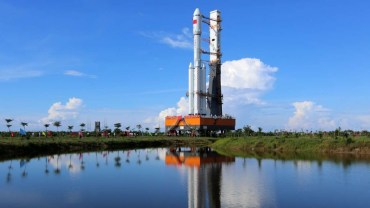
China’s newest space rocket, Long March 7, ready for blast-off | South China Morning Post

China’s latest Long March rocket arrived on the launch pad on Wednesday morning three days before it is due for blast-off on the maiden launch of both the rocket and the launch site.

At 8am on Wednesday the 600-tonnes Long March 7 rocket began a three-hour rail journey of several kilometres from the assembly complex to the launch site at Wenchang Satellite Launch Centre, China Central Television reported.

The Long March 7 will use new liquid fuel, which is environmentally friendly and costs only a fraction of the fuel used by its predecessor, LM-2.It will be carrying a test model of China’s next-generation manned spacecraft, together with several small satellites.

China’s second space lab to go into orbit this year as part of permanent manned space station by 2022

The rocket’s role in future will be to send up cargo ships to the Chinese space station.

If the weather turns bad on Saturday – which is not uncommon at the nation’s southernmost launch site on the tropical Hainan Island – the launch window will be able to remain open until Wednesday.

This launch will be different from others carried out by China because the public will be able to watch what happens in person on the mainland for the first time.

Eight designated “best spot” viewing areas covering 40 hectares around the launch site, including public parks and a private hotel beach, can accommodate about 25,000 spectators.

“This launch will open a new chapter in the history of Chinese space exploration,” a space scientist involved in the development of the new Long March rockets told the South China Morning Post.

“The blast of flames, rise of vapour, the chest-pounding noise and the trembling of the ground under people’s feet … it will be a life-changing experience for many people [watching],” the scientist said.

Source: China’s newest space rocket, Long March 7, ready for blast-off | South China Morning Post

22/06/2016

Cabinet approves auction of mobile phone airwaves – govt source | Reuters

The cabinet approved on Wednesday an auction of mobile phone airwaves, a government source told Reuters.

Earlier this year India’s telecoms ministry had proposed sale of airwaves in the 700 Mhz, 800 Mhz, 900 Mhz, 1800 Mhz, 2100 Mhz, 2300 Mhz and 2500 MHz bands.

India is the world’s second largest mobile phone market by users after China, and a rapid expansion of high-speed 4G services is expected to create demand for additional airwaves.The government is expected to announce details of the auction at a press conference later in the day, the official who did not want to be named, said.

Source: Cabinet approves auction of mobile phone airwaves – govt source | Reuters

22/06/2016

McDonald’s gets bids for China, HK stores sale in up to $3 billion deal – sources | Reuters

McDonald’s Corp (MCD.N) has received more than half a dozen bids for its China and Hong Kong stores, including offers from Beijing Tourism Group, Sanpower and ChemChina, in an auction that could fetch up to $3 billion, people familiar with the matter said.

Buyout firms including Bain Capital, TPG Capital [TPG.UL] and Carlyle Group (CG.O) too are participating in the auction with a view to teaming up with Chinese strategic bidders, they said.

The U.S. fast food company had announced in March it was reorganising its Asian operations by bringing in partners who would own the restaurants within a franchise business. Competitor Yum Brands (YUM.N) is also restructuring its China operations by spinning it off ahead of a likely IPO next year.

The planned sale of China units by McDonald’s and Yum indicates they are seeking local partners who could help ward off growing competition from domestic rivals and also better manage public perception in the wake of food-safety scares that hit the two fast-food giants in the last few years.

“Given the difficulties Western chains have had recently with public perception, local players have become a serious competitive threat,” said Elizabeth Friend, consumer foodservice analyst at Euromonitor International.

Oak Brook, Illinois-based McDonald’s has hired Morgan Stanley (MS.N) to run the sale of about 2,800 restaurants in China, Hong Kong and South Korea, Reuters previously reported. The sale in South Korea is being run separately and it was not known if the same parties have expressed interest in that sale, the people added.

As part of the deal, McDonald’s is offering a 20-year master franchise agreement to buyers, with an option to extend it by another 10 years.It has stipulated that private equity firms remain a minority partner in any bidding consortium, restrictions that discouraged some buyout funds from participating in the auction, the people added.

Among those who were preparing to place first-round bids ahead of the June 20 deadline were Beijing Capital Agribusiness Group, which is McDonald’s current China partner, and GreenTree Hospitality, the people added. It was not immediately clear if they made the bids.McDonald’s will now draw up a shortlist of bidders for the next round in the coming weeks.

Source: Exclusive: McDonald’s gets bids for China, HK stores sale in up to $3 billion deal – sources | Reuters

22/06/2016

India’s Space Agency Sends 20 Satellites Into Orbit – India Real Time – WSJ

India on Wednesday put 20 satellites into the Earth’s orbit, including 17 from foreign countries, a record number for its space agency as it seeks to become a low-cost and reliable choice for launches.

The successful mission by the Indian Space Research Organisation puts it right after Russia and the U.S. for the number of satellites launched from a single rocket so far, said an ISRO official. In 2014, a single Russian space launch vehicle deployed 33 satellites. A National Aeronautics and Space Administration rocket carried 29 satellites in 2013.

ISRO’s rocket, the Polar Satellite Launch Vehicle, carried its own Cartosat-2 series satellite for earth observation along with 13 satellites from the U.S., two from Canada, one each from Germany and Indonesia and two from Indian academic institutions.

“ISRO continues to break new barriers,” Indian Prime Minister Narendra Modi said on his Twitter account. He said the country’s space program “has time and again shown the transformative potential of science and technology in people’s lives.”

The launch comes as global space agencies face competition from private companies who are aiming to bring down the cost and time for manufacturing and launching satellites by automating their production and using unmanned reusable rockets.

U.S. businessman Greg Wyler has joined hands with Airbus Group SE to build an automated manufacturing facility in Florida that can churn out hundreds of satellites each year. Traditional satellites are built using touch labor. SpaceX, an aerospace startup founded by Elon Musk, successfully landed a rocket on an ocean platform in early May after launching a communications satellite.

India has been fast achieving recognition as a budget option for launching satellites. In 2014, ISRO put a satellite into the orbit of Mars, becoming the first Asian country to reach the red planet, and at fraction of the cost of a similar launch in U.S. and Europe.

In May ISRO launched the test model of its planned reusable space shuttle.  In April, it launched the seventh satellite needed to create its own navigation system, joining a small group of nations with their own versions of GPS.

The global space industry was estimated to be worth $330 billion in 2014, the latest year for which data are available, according to the Space Foundation, a U.S.-based research group. Commercial space activities comprised as much as 76% of the industry, it said.

There were 92 rocket launches in 2014, and Russia continues to hold its leadership in this area with 32 rocket launches, followed by U.S. with 32 and 11 by Europe, the Space Foundation said. It didn’t provide figures for India.Ajay Lele, a senior fellow at New Delhi-based Institute for Defense Studies and Analyses estimates the U.S. has about a 40% share of the global satellite-launching market, while Europe has 25% and Russia 20%. Countries such as China and India have a much smaller share of the market of about 3% percent or less, Mr. Lele said.

ISRO officials said after the launch they want to accelerate the pace of sending satellites into space by extending partnerships with private Indian companies. The space organization has launched more than 57 satellites from about 20 countries on board the PSLV over about two decades.

Source: India’s Space Agency Sends 20 Satellites Into Orbit – India Real Time – WSJ

21/06/2016

India’s suicide farmers’ widows face living death | Reuters

At the age of 24, Joshna Wandile and her two children were thrown out of the house she shared with her in-laws after her farmer husband hanged himself. He left a pile of debts after years of drought laid waste to his land.Wandile is not alone. More than 300,000 farmers have killed themselves in India over the last two decades, leaving their widows battling with the state, moneylenders, in-laws and their communities.

While widows in rural India are often ostracised and abused, farmer widows have it particularly tough, activists said ahead of International Widows’ Day on Thursday.”I had nothing when my husband died – he sold everything in the house, even the cooking vessels, to pay the creditors,” said Wandile who lives in Vidarbha in Maharashtra, among the worst affected by farmers’ suicides.

“I couldn’t even feel sad. I could only think: where will we live? How will I earn enough money? How will I keep us safe?” said Wandile, who was married at 17.

Maharashtra, which is struggling with its worst drought in four decades, accounted for more than half the 5,650 farmer suicides in India in 2014, according to official data. Some estimate last year’s toll exceeded 3,000.

“Bankruptcy or indebtedness” was the most common reason cited. Most were small farmers, with holdings of under two hectares.

There is little information on the families left behind who struggle to claim their right to the land they till and the house they live in, while battling archaic stigmas that dog their every step.

Source: India’s suicide farmers’ widows face living death | Reuters

Law of Unintended Consequences

continuously updated blog about China & India

ChiaHou's Book Reviews

continuously updated blog about China & India

What's wrong with the world; and its economy

continuously updated blog about China & India