Archive for June, 2016

09/06/2016

‘The greatest palace that ever was’: Chinese archaeologists find evidence of the fabled imperial home of Kublai Khan’s Yuan dynasty | South China Morning Post

For centuries the imperial palace of Kublai Khan’s Yuan dynasty was shrouded in mystery.

After the dynasty collapsed, there were no clues as to where it was and it lived on only in legend through writings such as those of 13th century Venetian merchant Marco Polo.

If Polo is to be believed, the walls of “the greatest palace that ever was” were covered with gold and silver and the main hall was so large that it could easily seat 6,000 people for dinner.

“The palace was made of cane supported by 200 silk cords, which could be taken to pieces and transported easily when the emperor moved,” he wrote in his travel journal.

It was a vision of grandeur but the palace disappeared, seemingly without trace.

The Yuan dynasty lasted for a less than a century, spanning the years from 1279 to 1368, and it is widely believed that the capital of the empire was Beijing.

But in the centuries since, one question has dogged historians and archaeologists in China: just where was the dynasty’s palace?

Now experts at the Palace Museum in Beijing believe that they have some answers, clues they stumbled upon during upgrades to the heritage site’s underground power and fire-extinguishing systems.

According to historical records, the Yuan palace in Beijing was abandoned by its last emperor, Toghon Temür, who was overthrown by rebel troops that established the Ming dynasty in the 14th century.

Some experts believe the palace was razed by Ming soldiers who took over the city, while others insist the buildings were removed by Ming workers on the site of what was to become the Forbidden City.

The foundations for the sprawling Forbidden City were laid in 1406 and construction continued for another 14 years. It was the imperial palace for the Ming rulers and then the Qing dynasty until 1912.

The complex has been built up, layer by layer, but researchers sifting through the sands of archaeological time said last month that they had found evidence that at least part of the Yuan palace was beneath the site.

The researchers from the museum’s Institute of Archaeology said the proof was a 3 metre thick rammed earth and rubble foundation buried beneath the layers of Ming and Qing dynasty construction.

Institute deputy director Wang Guangyao said the foundation unearthed in the central-west part of the palace was in the same style as one uncovered in Zhangjiakou, Hebei province, in the ruins of Zhongdu, one of the four capitals of the Yuan dynasty.

Some of the rubble in the newly discovered Yuan foundation dated back even further to dynasties such as the Liao (907–1125) and the Jin (1115–1234), Wang said.

Wang said a foundation of such size was rare in Yuan buildings and could have been used to support a palatial hall.

At the very least, the find proved that the Yuan palace was built on the same site as the Ming palace, though it was still too early to say these two completely overlapped.

“At least we now know that the palace was not built somewhere else but here,” Wang said.

“From a historical perspective, it gives us evidence that the architectural history runs uninterrupted from the Yuan, to the Ming and Qing dynasties.

”The discovery has also revived debate about the Central Axis of Beijing – a 7.8km strip that runs from Yongding Gate to the Drum and Bell towers and included the Forbidden City, the Temple of Heaven and Zhongnanhai, the Communist Party leadership compound.

Many Chinese believe the axis has been the city’s “sacred backbone” since the Ming dynasty but others argue that it goes back further to the mid-13th century.

Wang said it was still too early to conclude whether the Yuan, Ming and Qing were built along the same axis.

“As archaeologists, we can only define what we have found,” Wang said. “But it gives us a direction for future exploration.”

Wang said it wasn’t easy to excavate in one of the country’s most important cultural sites and more work was still to be done.

Even if we think a certain site is important for an archaeological finding, we can’t just dig the ground up because it is not allowed,” Wang said.“All we can do is to wait and collect as much evidence as we can until sometime later, probably in a generation or two, work is done in those places and we can put all the finds together to see if they are all connected.

”The new discovery would be open to the public soon, Wang said.
Source: ‘The greatest palace that ever was’: Chinese archaeologists find evidence of the fabled imperial home of Kublai Khan’s Yuan dynasty | South China Morning Post

09/06/2016

China leads resistance to India joining nuclear export club | Reuters

China is leading opposition to a push by the United States and other major powers for India to join the main club of countries controlling access to sensitive nuclear technology, diplomats said on Thursday as the group discussed India’s membership bid.

Other countries opposing Indian membership of the Nuclear Suppliers Group (NSG) include New Zealand, Ireland, Turkey, South Africa and Austria, diplomats said.

The 48-nation NSG aims to prevent the proliferation of nuclear weapons by restricting the sale of items that can be used to make those arms.

India already enjoys most of the benefits of membership under a 2008 exemption to NSG rules granted to support its nuclear cooperation deal with Washington, even though India has developed atomic weapons and never signed the nuclear Non-Proliferation Treaty (NPT), the main global arms control pact.

Opponents argue that granting it membership would further undermine efforts to prevent proliferation. It would also infuriate India’s rival Pakistan, which responded to India’s membership bid with one of its own and has the backing of its close ally China.

“By bringing India on board, it’s a slap in the face of the entire non-proliferation regime,” a diplomatic source from one of a handful of countries resisting India’s push said on condition of anonymity.

A decision on Indian membership is not expected before an NSG plenary meeting in Seoul on June 20, but diplomats said Washington had been pressuring hold-outs, and Thursday’s closed-door meeting was a chance to see how strong opposition is.U.S. Secretary of State John Kerry wrote to members asking them “not to block consensus on Indian admission to the NSG” in a letter seen by Reuters and dated Friday.

China, however, showed no sign of backing down from its opposition to India joining unless Pakistan becomes a member. That would be unacceptable to many, given Pakistan’s track record — the father of its nuclear weapons program sold nuclear secrets to countries including North Korea and Iran.

“China, if anything, is hardening (its position),” another diplomat said.

Most of the hold-outs oppose the idea of admitting a non-NPT state such as India and argue that if it is to be admitted, it should be under criteria that apply equally to all states rather than under a “tailor-made” solution for a U.S. ally.

Mexico’s president said on Wednesday his country supports India’s membership bid, but one Vienna-based diplomat said it still opposed the idea of it joining under conditions that did not apply equally to all.

Source: China leads resistance to India joining nuclear export club | Reuters

09/06/2016

India plans expanded missile export drive, with China on its mind | Reuters

India has stepped up efforts to sell an advanced cruise missile system to Vietnam and has at least 15 more markets in its sights, a push experts say reflects concerns in New Delhi about China’s growing military assertiveness.

Selling the supersonic BrahMos missile, made by an Indo-Russian joint venture, would mark a shift for the world’s biggest arms importer, as India seeks to send weapons the other way in order to shore up partners’ defenses and boost revenues.

The government of Prime Minister Narendra Modi has ordered BrahMos Aerospace, which produces the missiles, to accelerate sales to a list of five countries topped by Vietnam, according to a government note viewed by Reuters and previously unreported.

The others are Indonesia, South Africa, Chile and Brazil.The Philippines is at the top of a second list of 11 nations including Malaysia, Thailand and United Arab Emirates, countries which had “expressed interest but need further discussions and analysis”, the undated note added.

A source familiar with the matter would only say the note was issued earlier this year.New Delhi had been sitting on a 2011 request from Hanoi for the BrahMos for fear of angering China, which sees the weapon, reputed to be the world’s fastest cruise missile with a top speed of up to three times the speed of sound, as destabilizing.

Indonesia and the Philippines had also asked for the BrahMos, which has a range of 290 km and can be fired from land, sea and submarine. An air-launched version is under testing.

Source: India plans expanded missile export drive, with China on its mind | Reuters

08/06/2016

In boost to Paris climate pact, India says it aims to join this year | Reuters

India has agreed to work toward joining the Paris Agreement on climate change this year, India and the United States said on Tuesday, giving a jolt of momentum to the international fight to curb global warming.

At a time of heightened tensions in Asia over China’s assertive pursuit of territory, the two countries also pledged to expand military cooperation and outlined principles for cooperation on cyber issues.

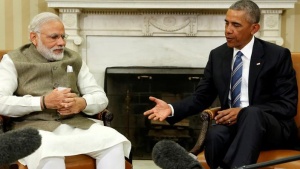
President Barack Obama welcomed Indian Prime Minister Narendra Modi to the White House for their seventh meeting since Modi took office in 2014, underscoring the warm relationship between the leaders and the world’s two largest democracies. Modi is to address the U.S. Congress on Wednesday.

“We discussed how we can, as quickly as possible, bring the Paris Agreement into force,” Obama told reporters. Climate change is a legacy issue for the U.S. president who leaves office in January.

India’s potential entrance into the agreement this year would help accelerate its enactment, perhaps years ahead of schedule. India is the world’s third-largest greenhouse gas emitter after China and the United States.

The two countries also welcomed preparations that could lead to the building of six nuclear reactors in India by U.S.-based Westinghouse, in what would be the culmination of some 10 years of work to resolve civil-nuclear issues.

The joint statement said India and the U.S. Export-Import Bank were working to complete a financing package for the project and that the Nuclear Power Corporation of India and Westinghouse had confirmed engineering and site design work would begin immediately.It said Westinghouse and the Nuclear Power Corporation of India would work toward finalizing the contract by June 2017 – a year later than Westinghouse’s chief executive, Daniel Roderick, said he hoped for in an interview with Reuters in late March.

Modi told an event organized by the U.S. India Business Council that relations between India and the United States were “closer than ever.” He said the planned reactor purchases would mark new era in nuclear and scientific cooperation.Modi’s address to a joint session of Congress will be a significant personal step. Although this has become a tradition for Indian prime ministers, he was once banned from the United States over massacres of Muslims.

More than 1,000 people, mostly Muslims, were killed in sectarian riots in Gujarat in 2002 when Modi had just become the state’s chief minister. Modi has denied any wrongdoing, and India’s Supreme Court in 2010 ruled there was no case.In the joint statement, the United States said it now recognized India as a “Major Defense Partner” and would work on technology sharing “to a level commensurate with that of its closest allies and partners.

“The text of a logistics agreement, which will allow the countries’ militaries to use each other’s land, air and naval bases, would be signed soon, a U.S. official said.

Tensions between the United States and Pakistan as well as regional concerns about China have served as a backdrop to increased security cooperation.Senator John McCain, chairman of the U.S. Senate Armed Services Committee, said the address to Congress was “entirely appropriate” given the new partnership.”

There’s no doubt there are significant tensions and challenges in the region, which argues for closer coordination between our militaries,” he said.While Modi is generally popular with U.S. lawmakers, they criticize what they see as lingering unfriendliness to U.S. firms and a stifling bureaucracy, in spite of Modi’s pro-business image. They also question New Delhi’s record on human rights.Modi got a boost on Tuesday when Amazon Inc AMZN.O Chief Executive Jeff Bezos said his company would invest an additional $3 billion in India, boosting its committed investment in the country to over $5 billion.

Source: In boost to Paris climate pact, India says it aims to join this year | Reuters

08/06/2016

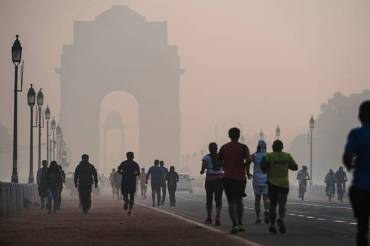
This Is How Many Years Air Pollution Will Cut From Your Life Expectancy in India – India Real Time – WSJ

Living in India’s capital city New Delhi could shorten your life by six years because of the intensity of the air pollution there, a new report says.

Inhaling tiny air pollutants reduces the life expectancy of Indians by an average of 3.4 years, with Delhi residents losing 6.3 years, the most of all states, according to a new study by the Indian Institute of Tropical Meteorology.

Those living in West Bengal and Bihar, which have high levels of air pollution, face a reduction in life expectancy of 6.1 years and 5.7 years respectively.

The study, which used data from the latest population census of 2011, found that exposure to particulate matter 2.5 results in 570,000 premature deaths each year with an additional 12,000 caused by exposure to ozone.PM 2.5 is tiny particulate matter that is smaller than 2.5 micrometers in diameter. The air pollutants, originating from dust, soot and smoke, can penetrate deep into the lungs, increasing the risk of heart and lung diseases.

Source: This Is How Many Years Air Pollution Will Cut From Your Life Expectancy in India – India Real Time – WSJ

08/06/2016

Amazon Plans $3 Billion Investment in India – India Real Time – WSJ

Amazon.com Inc. plans to invest an additional $3 billion into India, which is emerging as a critical area of growth for the e-commerce giant.

Chief Executive Jeff Bezos announced the plan at a meeting of business leaders Tuesday with the Indian Prime Minister Narendra Modi in Washington. Amazon sees “huge potential in the Indian economy,” Mr. Bezos said in a statement.

The announcement brings Amazon’s total planned investment in India to $5 billion, since it announced a $2 billion infusion in 2014. An Amazon spokesman declined to provide details such as how the new funds would be allocated or over what period.

Amazon operates a pure marketplace in India, due to local rules, selling only goods offered through its website by third parties. It nonetheless has warehouse and delivery technologies there that are particularly attuned to the local market, where internet connectivity can be spotty or nonexistent and many consumers don’t have credit cards.

Source: Amazon Plans $3 Billion Investment in India – India Real Time – WSJ

08/06/2016

U.S. Firm to Build Six Nuclear Reactors in India – India Real Time – WSJ

The U.S. and India agreed to move ahead with the construction of six nuclear reactors in India by an American company, the first such move since the countries signed a landmark civil nuclear deal in 2008.

The breakthrough capped a wide-ranging White House meeting on Tuesday between President Barack Obama and Indian Prime Minister Narendra Modi, who are seeking closer cooperation as Washington wants to boost New Delhi’s role in counterbalancing China.

The meeting, which included lunch at the White House, will be followed on Wednesday by a speech by Mr. Modi to Congress, wrapping up the Indian leader’s fourth visit to the U.S. as part of an increasingly close relationship that has been sought by both governments.

The warming Indian relationship is backed by the lure of accelerating growth in that country, signs of improvement in the business climate, shared democratic values and some overlapping strategic goals.

By contrast, recent U.S. interactions with China, a far bigger Asian economy and U.S. trading partner whose growth appears to be slowing down, have been marked by strains and warnings over economic and security issues.

Source: U.S. Firm to Build Six Nuclear Reactors in India – India Real Time – WSJ

07/06/2016

Indian solar power | The Economist

NARENDRA MODI, India’s prime minister, visits America for three days this week for talks with Barack Obama. Climate commitments may be one of many topics discussed. Six months ago 187 countries agreed to cut pollution through pledges for the UN climate talks in Paris. The deal adopted there was stronger than many expected, but much remains to be done. Even if countries manage to do all they offered, global warming will likely be held to around 3.5°C above pre-industrial temperatures. Conversely, the Paris deal aims overall to ensure warming does not exceed 2°C.

Unlike America and China, the world’s two largest polluters, India did not pledge a future reduction in aggregate emissions. It offered instead to reduce the intensity of its emissions—the amount of pollution per unit of economic output—by around a third by 2030 as measured against 2005 levels. Its greenest promise was to install 175GW of renewable power by 2022 (most of it solar). This is an enormous undertaking. In 2014, for example, the world’s entire installed solar capacity was 181GW.

The Modi government says the plans are “ambitious but achievable”. The country’s total installed solar power capacity now comes to 5.8GW; to meet its targets it will need to speed up from adding around 4GW a year to adding more than 15GW instead.

Mr Modi believes solar power is the “ultimate solution to India’s energy problem”. Of 250m households in India, 56m do not have access to electricity. The majority are in rural areas where off-grid solar installations, suitable for single homes or small clusters of buildings, could prove particularly helpful.

India’s solar programme is a good way to assess how seriously countries are taking the Paris agreement—particularly given India’s huge population and increasing economic heft. Mr Modi’s moves will illuminate the state of climate diplomacy.

Source: Daily chart: Indian solar power | The Economist

07/06/2016

Forest fires and logging threaten India’s progress on climate goals | Reuters

Since the end of April, fires in parts of Uttarakhand and Himachal Pradesh have destroyed or damaged 26,000 hectares of forests, and killed three people, officials say.

The forest fires, touched off by timber smugglers, poachers and farmers, have been a particular problem this year as a result of high temperatures and low rainfall, experts say.

Nationwide, the country is losing an average of a million hectares to fires each year, according to a 2014 report from the government’s National Institute of Disaster Management (NIDM).

The losses, combined with those from surging illegal logging, mean India has lost 2,511 square kilometres of dense and moderately dense forest since 2013, according to the Environment Ministry’s 2015 Forest Survey of India report.

That loss is a significant worry for a country trying to dramatically reduce its climate-changing emissions. As part of pledges made toward a new global deal to curb climate change, agreed in Paris in December, India has said it will increase its ability to store carbon in forests and land by up to 3 billion tons by 2030.

But criminal activity, extreme weather and flawed data all stand in the way of India’s quest to go greener, experts say, and the problem in Uttarakhand illustrates how hard achieving those goals may be.

Source: Forest fires and logging threaten India’s progress on climate goals | Reuters

07/06/2016

Here’s How Indians Are Rating Narendra Modi’s Programs – India Real Time – WSJ

Two years into his five-year term, Indian Prime Minister Narendra Modi is asking his countrymen to rate a series of initiatives undertaken by his government.

Among the top scorers so far: an effort expand and modernize the railways and a program to build more roads. Toward the bottom of the favorability rankings: Mr. Modi’s Clean India campaign, which, among other things, aims to get people to use toilets instead of defecating outside.

Mr. Modi has become known for introducing a series of high-profile initiatives, from Make in India, which seeks to promote manufacturing, to pledges to build scores of so-called smart cities across the country.Of 21,770 respondents who had participated in the online survey on the government’s mygov.in website as of Tuesday morning, 70% gave a five-star rating to the government’s efforts to upgrade the rail system. People are asked to grade programs on a scale of one to five.

In the latest federal budget, the government earmarked $17 billion to improve the state-run railroad. Wi-Fi services are being rolled out at stations. And late last year, a deal was struck with Japan to help build India’s first high-speed rail line between Mumbai and Ahmedabad.

The government’s efforts to build more highways and improve the condition of roadways have also been popular with the people. More than 65% of the respondents to the survey gave these initiatives a five-star rating. The target this year is to build 9,300 miles of highways.People taking the survey also seemed satisfied by the government’s attempts to make electricity more accessible.

One of the worst performing programs, according to the current results of the survey, which is ongoing, is Swachh Bharat Abhiyaan, or the Clean India Mission. Only 33% of the respondents gave it a five-star rating. About 16% gave it score of one or two.

India’s Competitiveness and Prosperity Rankings Rise Under ModiIn October, a year into the program, another national survey also hinted at the public’s disappointment with its impact. More the 70% of those polled in that survey said the availability of public toilets hadn’t improved and their cities hadn’t become cleaner.

Mr. Modi is no stranger to crowdsourcing. He regularly encourages Indians to submit their thoughts for his weekly radio show. Prior to delivering his speech on India’s Independence Day last year, he asked citizens to submit their suggestions on what they’d like to hear him speak about. And they did, in hordes.

Source: Here’s How Indians Are Rating Narendra Modi’s Programs – India Real Time – WSJ

Law of Unintended Consequences

continuously updated blog about China & India

ChiaHou's Book Reviews

continuously updated blog about China & India

What's wrong with the world; and its economy

continuously updated blog about China & India