Chindia Alert: You’ll be Living in their World Very Soon
aims to alert you to the threats and opportunities that China and India present. China and India require serious attention; case of ‘hidden dragon and crouching tiger’.
Without this attention, governments, businesses and, indeed, individuals may find themselves at a great disadvantage sooner rather than later.
The POSTs (front webpages) are mainly 'cuttings' from reliable sources, updated continuously.
The PAGEs (see Tabs, above) attempt to make the information more meaningful by putting some structure to the information we have researched and assembled since 2006.
A chef in southwest China became an instant celebrity after a video of him dancing while making noodles became an online sensation during the Lunar New Year holiday, according to a newspaper report.
Tian Bo, 31, was an ordinary cook of a noodle restaurant in Chengdu, the capital of Sichuan province, before he began to sway his body with coquettish look when making noodles to attract more customers, the West China City Daily reported.His signature dish, “longevity noodle,” comprises just one noodle long enough to fill a bowl and is a specialty in the historic town of Huanglongxi.
Tian told the Daily that he resorted to dancing while serving noodles in March last year when the restaurant was almost deserted and he was under enormous pressure. He fine-tuned his performance, adding pop music and coyish facial expressions.
Spinning, jumping and waving the noodles in his hand, Tian leers at the onlookers from time to time, according to the video circulated online.
After the video of his noodle performance made headlines online, his fortunes changed. Tourists arrived in town to seek him out and some even offered his a job with better pay.
Tian said he was merely acting at the restaurant and was not flirtatious in real life. He said he would stay at the restaurant for the time being but hoped to start his own noodle shop one day.
His video got mixed reviews on social media. “He is so tantalising. I just stared at the little brother and did not think about the noodles, ” said one Weibo blogger.
Said another: “I’ve seen him and I think he works too hard. He must get so tired from dancing and making noodles for long time.”
Wayne Rooney’s agent Paul Stretford is in China to see if he can negotiate a deal for the forward to leave Manchester United.
There are no guarantees of success and it is thought a deal remains highly unlikely before the Chinese transfer window closes on 28 February.
But the fact Stretford has travelled to China is a clear indication United boss Jose Mourinho would let Rooney, 31, go.
And if he does not leave this month it seems certain he will go in the summer.Rooney has fallen down the pecking order at United under Mourinho.
Rooney should stay – Phil Neville
Mourinho not ruling out Rooney exit
Would a China move work for Rooney?
The England captain has been made aware of interest in him from the Chinese Super League for some time, although it is not known which clubs Stretford has spoken to.
Beijing Guoan, believed to be the favourite team of Chinese President Xi, had been seen as one of the favourites to sign Rooney but sources close to the club have told BBC Sport they are not interested in signing him.
Because of new restrictions on overseas players, Jiangsu Suning and Tianjin Quanjian look like the most likely remaining options.
However, the England captain’s representatives have already spoken to Tianjin Quanjian and their coach, Fabio Cannavaro, said talks did not progress.
On Tuesday, Mourinho said he did not know whether Rooney, who has only just returned to training after a hamstring injury, would still be at Old Trafford in a week’s time.
It is not known whether this latest development will affect Rooney’s chances of being involved in Sunday’s EFL Cup final against Southampton.
They had appeared to have increased after Henrikh Mkhitaryan limped out of Wednesday’s 1-0 Europa League win against Saint-Etienne.
If Rooney follows former team-mate Carlos Tevez to the Chinese Super League, it would almost certainly cost him any chance of making the seven appearances he needs to become England’s most capped player.
Rooney’s preference is understood to be to remain with United for the rest of his contract, which expires in 2019, but a lack of time on the pitch is forcing him to consider alternatives.
Rooney is United’s record goalscorer and has won five Premier League titles and a Champions League trophy since joining them as an 18-year-old for £27m from Everton in 2004.
The forward, who has started only three games since 17 December, has said he would not play for an English club other than United or Everton.
The big difference between Chinese Super League clubs’ transfer process and their Premier League counterparts is the preparation.
English top-flight clubs have extensive scouting departments with links around the world. They identify players months in advance, watch many live games and base their decision on an extensive process.
Oscar moved to Shanghai SIPG from Chelsea in a £60m deal in December and scored on his debut for his new club
In CSL, the process is more agent-led. Most of the clubs are approached with recommendations for a position they are recruiting in, rather than seeking out players themselves.
Foreign players coming in on large fees are commanding three-, four-, five-year deals, even at the end of their career. They have the upper hand in negotiations and wouldn’t leave European football without long-term financial guarantees.
However, the Chinese government is concerned about capital leaving the country and it is difficult for these big transactions to exist while they are trying to crack down in other areas.
I think we will see a levelling out in fees. The £15m-£20m transfers will continue to happen for the next few years, but maybe we won’t see the likes of the £60m deal that brought Oscar to China.
China’s smog-choked northern province of Hebei is no stranger to lofty goals. For one thing, it has to shut down two-thirds of its steel factories by 2020.
Here comes another: becoming a provincial powerhouse in soccer. Perhaps understandably, it has given itself a few decades to do it.
The “Hebei Province’s Soccer Medium-to-Long Term Development Plan (2016-2050)” unveiled Thursday sets out plans for 1,000 “soccer campuses,” 3,000 amateur leagues and at least one club in the Chinese Super League, the country’s highest tier of professional soccer.
Such plans to pursue the “beautiful game,” as soccer is often called, are quite the departure for China. The world’s second-largest economy used to nurture its sport stars the Soviet way, by picking and grooming its talent from an early age. It still harvests most of its medals using this model. But in soccer, Beijing is trying a looser model perfected in the West: shopping for world-class players world-wide and hoping to spot homegrown talent via a grassroots network of soccer programs in local schools.
“By 2050, we must contribute to China’s bid to host the World Cup,” the Hebei Provincial Sports Bureau said.
At media conferences, officials spoke wistfully of “a soccer tourism route” and “a garden of sports,” a somewhat jarring image of Hebei, which currently produces more than twice the annual steel volume of all U.S. mills combined and is home to China’s smoggiest cities.
In its quest to become a leading purveyor of football talent, Hebei already faces some domestic competition. Fujian province, in China’s south, last month said it also has such plans. Earlier this month, so did the aluminum-producing province of Gansu, known more for its deserts than its dazzling dribbles.
More provinces are likely to follow. The central government last year put out a blueprint detailing bigger, broader goals to mint “two to three first-class soccer teams in Asia, that are internationally known.”
President Xi Jinping has a soft spot for the sport, and in 2011 made known his desire for China to both qualify for and host a World Cup tournament and ultimately to win one.
This has proven difficult. Back-to-back losses last fall all but derailed China’s dream of qualifying for the 2018 World Cup. Profligate spending to attract foreign talent led the General Administration of Sport last month to criticize Chinese teams for “burning money” on astronomical recruitment fees and wages, while “neglecting the development of homegrown players.”
Still, Hebei might have an edge. The province, where Mr. Xi spent some time early in his career as a county-level Communist Party official, won government support in a successful bid to host the 2022 Winter Olympics, despite having only a set of somewhat stumpy mountains with sporadic snow.
Some of the province’s residents aren’t exactly hopeful. “The economy is finished,” one of them wrote on the popular microblogging platform Weibo. “And you still have time to focus on soccer?”
India and Russia are nearing a joint venture to make light helicopters in India, reviving a plan announced by Russian President Vladimir Putin in 2015.
Delhi needs to replace hundreds of ageing utility helicopters deployed along its Himalayan border with China as well as in the disputed Kashmir region.
This means an initial order of 200 Kamov-226 helicopters, of which 140 will be built in India as part of Prime Minister Narendra Modi’s drive to build a domestic defence industrial base and cut imports, is expected to be increased.
And final documents relating to the $1 billion Kamov deal involving Russian Helicopters, Rosoboronexport and India’s state-run Hindustan Aeronautics (HAL) has been submitted to Putin, HAL’s chief T. Suvarna Raju, told reporters on Wednesday.
While India has sealed deals with the United States for 22 Apache attack and 15 heavy lift Chinook helicopters at total cost of about $2.5 billion, plans to buy Russian helicopters and fifth generation fighter aircraft have been dogged by problems.
“There are issues between parties, but these are being tackled,” Sergey Goreslavsky, deputy director general of Rosoboronexport, said at India’s biggest air show in the southern city of Bengaluru.
A team will assess the Indian manufacturing facilities over the next few months. “We are keeping our fingers crossed about launching production this year,” an executive at Russian Helicopters said.
The executive, who did not want to be named, said the joint venture will be modelled along the lines of Brahmos, the India-Russia entity producing supersonic missiles, which which military analysts say are among the deadliest in their class.
Russia was long the main supplier of military equipment to India, but Delhi has turned to France, Israel and increasingly the United States for supply of hardware in recent years.
U.S. aerospace and defence firms Lockheed Martin and Boeing have both offered to set up production lines in India to make combat planes.
China has lodged a strong complaint with India over a rare visit by a Taiwanese parliamentary delegation, warning New Delhi to follow one-China policy and refrain from any official contacts with Taipei.
Sharply criticising the visit, foreign ministry spokesperson Geng Shung said Beijing had lodged a “solemn representation” with New Delhi to not have any official contact with Taiwan.
Beijing has always opposed any kind of official contact between Taiwan and countries that have diplomatic ties with China, he said.
Why Trump can’t ‘haggle’ over the one-China policy
Geng spoke against any proposal to upgrade India-Taiwan ties, and warned India to be strict about following the one-China policy and be “prudent” about its ties with Taiwan.India has no formal diplomatic relations with Taiwan. The de facto Indian embassy in Taipei is called the India-Taipei Association and the Taiwanese maintain the Taipei Economic Cultural Center in New Delhi.
A three-member parliamentary delegation from Taiwan arrived in India on Monday for a three-day visit. The leader of the delegation, Kuan Bi-Ling, said Taiwan is “totally independent”.
“It (the one-China policy) is a de facto reality…We suffered a lot because of the one-China policy. We have crafted a pragmatic approach in our diplomatic engagement with major countries, including India, despite these difficulties,” Kuan told the Indian media.Hosting an official delegation from Taiwan appears to be a shift in Indian policy. In May last year, India had reportedly backtracked from sending representatives to the swearing-in ceremony of then Taiwanese president-elect Tsai Ing-wen. The visit of the Taiwanese delegation is a possible sign that both countries are attempting to increase political engagement without New Delhi moving away from the one-China policy.No country is exempt from one-China principle, says Beijing
In September 2015, before she became Taiwan’s first woman president, Tsai had spoken about India being in focus for her country to strengthen ties.“Asean and India are poised to become two of the world’s largest economic bodies. Strengthening our overall relations is a natural choice for Taiwan as we diversify our economic and trade ties. In the future, we will form a new task force to actively pursue this policy objective,” Tsai had said in a key speech at the time.
The New Southbound Policy Office, which directly functions under the president, will focus on strengthening all-round ties with Asean and South Asia, particularly India, Taiwanese diplomats had then told the Hindustan Times.
Earlier on Wednesday, nationalistic tabloid Global Times said India is playing with fire and will suffer if it challenges the one-China policy and increases engagement with Taiwan.
How a snub of the one-China policy almost led Beijing and US into war in the 1990s
“At a time when new US President Donald Trump has put the brakes on challenging China over the Taiwan question, agreeing to change course and respecting the one-China policy, India stands out as a provocateur,” it said. “Some Indians view the Taiwan question as an Achilles’ heel of the mainland. India has long wanted to use the Taiwan question, the South China Sea and Dalai Lama issues as bargaining chips in dealing with China,” writer Yu Ning wrote in an opinion piece for the newspaper.
“By challenging China over the Taiwan question, India is playing with fire,” Yu wrote.
The newspaper blamed Tsai for inciting India.“Tsai is exploiting India’s vigilance and strategic suspicions against China. The pro-independence leader came up with the ”new southbound policy” to ramp up trade and economic interactions in Southeast Asia, South Asia and Oceania, in which India is considered “not one of the, but the most” important country…Tsai hopes to put pressure on the mainland by tying India and Taiwan closer.”
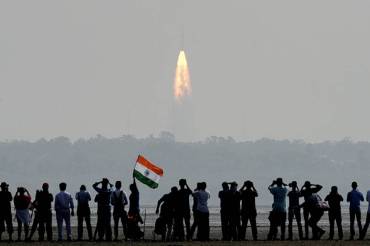
India’s space agency on Wednesday launched a record 104 satellites from a single rocket as it crossed another milestone in its low-cost space-exploration program.
The satellites from seven countries were carried by the Indian Space Research Organization’s Polar Satellite Launch Vehicle on its 38th consecutive successful flight.
The mission reinforces India’s emerging reputation as a reliable and cost-effective option for launching satellites. In 2014, ISRO put a satellite into the orbit of Mars, becoming the first Asian country to reach the red planet at fraction of the cost of a similar launch in U.S. and Europe.
ISRO has now put 226 satellites into orbit, including 180 from foreign nations. The global space industry was estimated to be worth $323 billion in 2015, the latest year for which data are available, according to the Space Foundation, a U.S.-based research group. Commercial space business comprised as much as 76% of the industry.
Rajeswari Pillai Rajagopalan, senior fellow in space-security studies at the Observer Research Foundation, a New Delhi think tank, said the launch was a “showcase of India’s growing capabilities.”
Spectators watched the launch of ISRO’s Polar Satellite Launch Vehicle (PSLV-C37) at Sriharikota on Feb. 15, 2017.
“India’s space program has come a long way,” she said.
Ms. Rajagopalan said the trend for sending more small satellites–instead of fewer large ones–will benefit ISRO due to the cost advantages it offers over its American and European competitors. The Space Foundation said nano satellites comprised 48% of launches in 2015
Wednesday’s feat eclipses the record set by Russia in 2014 when it launched 37 satellites in a single mission. A National Aeronautics and Space Administration rocket carried 29 satellites in 2013.
The PSLV rocket blasted off from the Satish Dhawan Space Center at Sriharikota in the southeastern state of Andhra Pradesh at 9.28 a.m. Wednesday local time (10.58 p.m. Tuesday ET).
The ISRO rocket hurtles through the sky after launch from Sriharikota, India, Feb. 15, 2017.
It first released its main cargo, ISRO’s 714 kilogram Cartosat-2 series satellite, which will be used for earth observation. It then released two smaller ISRO satellites, followed by the remaining 101 nano satellites, one each from Israel, Kazakhstan, Netherlands, Switzerland, United Arab Emirates, and 96 from the U.S. As many as 88 of the nano satellites belonged to U.S.-based company Planet Inc.
ISRO’s two smaller satellites are carrying equipment for conducting various experiments.
Indian Prime Minister Narendra Modi tweeted his congratulations. “This remarkable feat by @isro is yet another proud moment for our space scientific community and the nation. India salutes our scientists,” the message said.
Mission Director B. Jayakumar said it was a challenge to “find real estate (on the PSLV rocket) to accommodate all the satellites.” He said a “unique separation sequence” was designed due to the large number of satellites.
ISRO chairman Kiran Kumar Rao, right, held up models of the CARTOSAT-2 and Polar Satellite Launch Vehicle (PSLV-C37) after the launch in Sriharikota, India, Feb. 15, 2017.
ISRO said the satellites went into orbit 506 kilometers from earth, inclined at an angle of 97.46 degrees to the equator–very close to the intended orbit–after a flight of nearly 17 minutes. In the subsequent 12 minutes, all 104 satellites were successfully separated from the rocket in sequence, it said.
After separation, the two solar panels of ISRO’s Cartosat-2 series satellite were deployed and the space agency’s command center in Bangalore took control. In the coming days, the satellite will begin to provide start sending back black and white, and color pictures, ISRO said.
Two years ago, Bill Gates admitted one of his life regrets was never becoming conversant in any foreign language.
Mr. Gates, 61 years old, has made some progress. Over the weekend, he gave a 12-word welcome in Mandarin in an opening video for his new blog on Chinese social network WeChat.
“Hello,” he said in Chinese. “Welcome to my official WeChat account.”
Mr. Gates is the latest U.S. tech executive to risk ridicule by speaking publicly in Chinese, joining Facebook’s Mark Zuckerberg and Uber’s Travis Kalanick. But his brief, accented remarks made clear that while he might rival Mr. Zuckerberg in entrepreneurship and philanthropy, the Microsoft Corp. founder is a less formidable challenger in Chinese oration.
“His Chinese pronunciation is not quite as good as Zuckerberg’s,” announced China’s official Global Times newspaper on Weibo, China’s equivalent of Twitter.
Chinese viewers online gave mixed reviews, with some encouraging his effort (“Great!”) and others panning it (“There appears to be a big difference between his Chinese and English”).
Mr. Gates had praised Mr. Zuckerberg’s fluency in Chinese as “incredible” in a 2015 Reddit question-and-answer session.“I feel pretty stupid that I don’t know any foreign languages,” wrote Mr. Gates in the Reddit Q&A. “I took Latin and Greek in high school and got As and I guess it helps my vocabulary but I wish I knew French or Arabic or Chinese. I keep hoping to get time to study one of these—probably French because it is the easiest.”
Mr. Gates’s attempt at Chinese was occasioned by the launch of his new WeChat account “gatesnotes.” In China, public figures often use WeChat official accounts to share their opinions and musings with fans. For foreign business leaders, WeChat has become a go-to option as both Facebook and Twitter are blocked in China. Mr. Gates’ new WeChat account appears to be a Chinese version of his English blog by that name.
Mr. Gates was an early adopter of Chinese social media, launching an account on microblogging platform Weibo in 2010, where he has posted sporadically. He now has 3.2 million Weibo followers compared with 33 million on Twitter.
The new WeChat account isn’t verified but claims to be the official account for Mr. Gates. It was set up by Bridge Consulting Co. Ltd., a Chinese joint venture of international health consulting company Global Health Strategies. Global Health Strategies lists the Gates Foundation as a client and donor on its website.
The WeChat account said Mr. Gates will use the space to share his thoughts on people he meets, books he has read and lessons learned, with topics ranging from health to energy and resources. It had drawn more than 100,000 views and over 9,000 “likes” by late Monday, although the only content so far is the welcome video and a note saying regular posts will begin Tuesday.
Bridge Consulting describes its mission as “shaping and promoting the images of international celebrities on Chinese social media”, according to a job ad posted by the company.
Andre Shen, a former media consultant with the Bill & Melinda Gates Foundation in China, is listed as founder of the company, according to regulatory filings. Mr. Shen said in an email he had to check with Mr. Gates’s team in Seattle before making any public statements.
Chinese has become increasingly popular among U.S. entrepreneurs as they seek to get a foot in the door of the world’s biggest internet market. Facebook appears to be in the lead, with Mr. Zuckerberg giving bravura performances such as a half-hour-long speech in Mandarin in Beijing. Facebook Senior Vice President Vaughan Smith and incoming virtual reality chief Hugo Barra have also studied the language.
So far, Uber’s Mr. Kalanick is closer to Mr. Gates than Mr. Zuckerberg in Mandarin prowess, though he has peppered his English speeches in Beijing with the occasional Chinese phrase, like “Hello, students”, to cheers from the crowd.
IN A speech to London’s Constitutional Club in 1931, Winston Churchill poured scorn on the idea of India. “India is a geographical term. It is no more a united nation than the equator,” he spat, a slur that invites such uniform disagreement from Indians as to disprove itself. Less well known, but more worthy of debate, is the previous line of Churchill’s speech: “India is no more a political personality than Europe,” he contended.
The personalities of both India and Europe have changed a great deal since 1931. But in explaining India to outsiders, Banyan often finds it helpful to compare it to the European Union (EU) rather than to the United States. Neither parallel does India justice, of course. The frequent comparisons to America can imbue India with a false cohesion. The less common comparison to the EU suggests a false disunity. But if the two parallels are judiciously combined, the falsities may help to cancel each other out.
One obvious example is Indian politics. This month voters took part in elections for the state legislatures of Punjab and Goa. As is often the case, turnout was higher than in India’s national election in 2014. In comparison with the United States, where races for national office, especially the presidency, overshadow state-level contests, that is a puzzle. In comparison with the EU, where elections in member states command far more attention than races for the European Parliament, it seems less strange.
The composition of India’s legislature also looks more like Strasbourg’s multicoloured mosaic than Washington’s two-tone Congress. The Lok Sabha, India’s lower house, seats as many as 35 parties. With the exception of the Bharatiya Janata Party and Congress, few of them have influence beyond one or two states. If America is the benchmark, the obvious question is why India’s voters have failed to coalesce around rival nationwide philosophies of government. But if the template is Europe, the fragmentation is easier to grasp. Few of Europe’s parties could appeal across national lines, however compelling their policies.
Another example is language. India’s constitution lists 22 “scheduled” languages. An American might wonder how it copes. But the EU, with 24 official languages, is even more polyglot. India’s national anthem had to be translated into Hindi from the original Bengali. But the EU’s anthem has no official lyrics, so as to leave open the question of what tongue to sing them in. Pick any two Indians at random, and the chance that they share the same mother tongue is less than 20%, according to data compiled by Romain Wacziarg of the University of California, Los Angeles, and his colleagues. But for the EU as a whole, according to Banyan’s calculations, the odds are less than 10%. Linguistically, then, India is neither as unified as the United States nor as divided as the EU.
National welding
The author of India’s anthem, Rabindranath Tagore, also saw value in comparing his country to both Europe and America. Like India, the United States faced the problem of “welding together into one body various races”. This challenge set both countries apart from Europe, which, Tagore felt, could take its racial unity for granted. Indeed, he saw Europe as one people divided into many states, unlike India’s many peoples “packed into one geographical receptacle”.
The gap between India’s many peoples remains large. The GDP per person of Bihar, India’s poorest state, is only a fifth of Haryana’s and little more than a tenth of Goa’s. That is a much bigger income gap than between Mississippi and Massachusetts, but comparable to the gulf between Bulgaria and Belgium.These gaps have motivated increasing numbers of Indians to move from one part of their geographical receptacle to another. The government’s latest economic survey, written by Arvind Subramanian, its chief economic adviser, calculates that interstate migration nearly doubled between the 1990s and the 2000s, yielding a migrant population of over 55m in 2011 (roughly 4.5% of India’s population). That may fall well short of American mobility, but compares favourably with the EU, where 13.6m citizens (2.7% of the total population) live in another member state.
The movement of goods tells a similar tale. In India, unlike America, state prerogatives often trump the imperatives of interstate commerce. Trade is distorted by a patchwork of local levies, which the central government is keen to replace with a new goods and services tax. The familiar sight of lorries queuing at state borders suggests an economy that is hopelessly fragmented. But again, the benchmark matters. Drawing on new data, Mr Subramanian shows that trade among India’s states is now equivalent to about 54% of GDP, rather higher than many suspected. That is low compared with America (78%), but impressive compared with the EU (20%).
Net trade is even more dramatic. India’s single market and currency allow some states to run enormous trade deficits with others. Four run deficits in excess of 20% of local output. That is far greater than the euro area has been able to sustain.
India’s divisions hamper it in its dealings with other nations. Its diplomacy has a reputation for parochialism and mal-coordination—an elephantine inability to “dance”. But perhaps it is not given enough slack. Compared with the EU, India’s foreign policy is positively twinkle-toed. India, lest it be forgotten, is as populous as 150 other countries combined. By encompassing all of these people in a single political entity, it dramatically reduces the complexity of global governance—even if it does not always feel like that. Had the republic not succeeded in refuting Churchill, had it disintegrated into multiple sovereign states, the world’s negotiating tables might have needed to accommodate dozens of additional quarrelling players. When the Americans want to talk to India, they know whom to call—however frustrating the conversation sometimes proves to be.
US President Donald Trump has sent a letter to Xi Jinping, his first direct approach to the Chinese leader.
The president thanked Mr Xi for congratulating him on his inauguration last month and said he looked forward to “constructive” relations.
Mr Trump has not yet spoken to Mr Xi but did call other world leaders.
Chinese foreign ministry spokesman Lu Kang said his country attached great importance to the letter, Reuters news agency reports.
He commended Mr Trump for sending Lunar New Year greetings to the Chinese people and said co-operation between the two countries was the only option.
Change in tone
The letter, featuring standard diplomatic pleasantries, comes after a steady stream of belligerent attacks aimed at Chinese trade and policies.
In recent months, Mr Trump has challenged Beijing on sensitive issues such as Taiwan and the South China Sea. He angered China by taking a call from Taiwan’s President Tsai Ing-wen, the first involving a US president or president-elect in decades.
China sees Taiwan as a breakaway province to be reunited with the mainland, by force if necessary. The US cut formal ties with Taiwan in 1979.
China’s gamble for global supremacy in the Trump era
Is Taiwan a bargaining-chip for Trump on China?
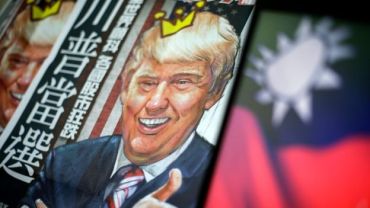
Chinese Year of the Rooster marked with huge Trump sculpture
“President Trump stated that he looks forward to working with President Xi to develop a constructive relationship that benefits both the United States and China,” the letter said, according to the White House.
Mr Trump also wished the Chinese people “a happy Lantern Festival and prosperous Year of the Rooster”.
Lunar New Year celebrations officially end on Saturday with a Lantern Festival.
China has been angered by Mr Trump’s comments on the One China policy concerning Taiwan
The conciliatory tone is in stark contrast to previous statements by Mr Trump, whose presidential campaign was marked by anti-China rhetoric that continued after winning the election.
In December, before his inauguration, Mr Trump posted a series of tweets criticising China for its exchange rate policy and its operations in the South China Sea.
He also questioned the One China policy, which is the diplomatic acknowledgement by the US of Beijing’s position that there is only one Chinese government, following his call with Taiwan.
Shortly after he took office on 20 January, his administration vowed to prevent China from taking territory in the South China Sea.
Beijing has so far responded cautiously, expressing “serious concern” about Mr Trump’s position on the One China policy, and urging the US to maintain close ties with China.
It also lodged a protest over the phone call with Ms Tsai, dismissing it as a “petty trick”, and maintained it would “defend its rights” in the South China Sea.
But state media outlets have been less restrained and have issued strongly-worded rebukes, blasting Mr Trump for “playing with fire” on the Taiwan issue.
They also warned of serious action and a “resolute battle” against Mr Trump.
IN 1375 a secretary in the justice department wrote a long petition to the Ming emperor. Bored by the endless preamble, the Son of Heaven had the functionary dragged to the court and flogged. That night he read to the end of the petition and discovered four sensible proposals crammed into its final page. He ordered them to be enacted the next day.
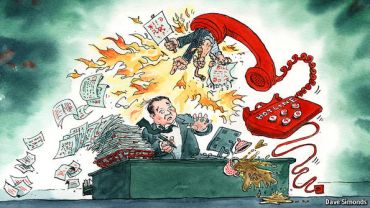
Xi Jinping, China’s president, is less attentive to petitions (called “memorials to the throne” in imperial times) than was his Ming predecessor. China still has bureaus where citizens can appeal against official injustice, but the government discourages people from using them. It often locks up those who try, putting them in “black jails” without trial. But if appeals to the emperor now fall on deaf ears, humbler forums for complaint are encouraged. The two main ones are known as “mayor’s mailboxes” and “12345 hotlines”.
There are mayor’s mailboxes on the websites of every municipal government, usually indicated by a button next to a biography of the official with an exhortation to “write me a letter” (or, in practice, send an e-mail). The hotlines allow people to be put through to a local bureaucrat. The first one was set up in 1983. Since then they have proliferated, creating an unco-ordinated tangle. But the past few years have seen rounds of consolidation. Shanghai announced a single hotline in 2013. Guangzhou, in the south, did so in 2015. The unified ones all use the same number, 12345.
Such services may sound parochial, but they play an important role. Chinese officials find it hard to gauge what citizens are thinking. There is no free press and no elections to give them clues. Internet chatter is censored automatically, often before criticism reaches officials’ ears. So e-mails to the “mayor” and hotline calls provide rare and valuable guides to public concerns about a wide range of issues: local governments handle everything from social housing to education and health care. The Communist Party hopes that the hotlines and e-mails will make local administrations more accountable, more efficient and—perhaps—more popular. But do they?
In recent months state media have been promoting what they call a model example—the 12345 hotline in Jinan, capital of the coastal province of Shandong. It was launched in 2008, has about 60 operators on duty and gets nearly 5,000 calls a day, rising to 20,000 on busy ones. In 2014 Wang Zongling of the Standardisation Administration, which sets national standards, looked at the hotline’s impact on the government in Jinan. Before it was set up, the city had 38 hotline numbers for contacting different departments. That was “chaos”, the administration said.
The single hotline brought some order. The average time for handling a complaint fell from 10-15 days before it was set up to five afterwards. The share of calls put through to the right person rose from 80% to 97%. Partly because it is now possible to call city hall without wasting your time, enquiries rose from just over 4,000 a day between 2008 and 2011 to almost 5,000. Since the 12345 operators were better trained than before, they processed calls more quickly and the cost per call fell.
But Jinan is a special case. A survey last year by Dataway Horizon, a consultancy in Beijing, found wide variations in the quality of service. In Beijing, Shanghai and Chongqing, which are among the richest cities, all hotline calls were put through right away. In Yunnan, Tibet, Shaanxi and Qinghai—less-developed provinces in the west—only a fifth of calls were even answered on the first attempt. A meeting last July to introduce a hotline in Wuxi near Shanghai reportedly degenerated into a squabble between a deputy mayor and district councillors who argued that it would waste money. In nearby Hangzhou the hotline crashed last month when parents flooded it with calls complaining that school exams were too difficult.
In an attempt to improve widely varying levels of service, the central government recently laid down rules for running 12345 hotlines. Starting in July, calls must be answered within 15 seconds, at least one person on duty should be able to speak a language other than Mandarin and the line should be open 24 hours a day.
Perhaps because they are often poorly run, hotlines do not seem to be making local governments any more popular. These form the most despised tier of authority in China: many of the most egregious face-to-face abuses of power take place locally. In Jinan, despite all those efficiency gains, the survey found that “enquirer satisfaction” was only 1.3% higher after the hotline was established than before it. The spread of hotlines has had no discernible impact on the rise of anti-government demonstrations, most of which are aimed at local governments (see chart).
But it is possible that there would have been even more protests without the safety-valve of hotlines. State media say one of their roles is to help with “stability maintenance” by alerting officials to potential flashpoints. Many public protests relate to bread-and-butter issues, such as the ones a local newspaper said were most frequently raised by callers to the 12345 hotline in Nanjing, a southern city: the management of apartment blocks, the water supply, illegal construction, violations of consumer rights and shoddily built housing.
The same topics flood mayors’ mailboxes (both virtual and real). Diana Fu of the University of Toronto and Greg Distelhorst of the Massachusetts Institute of Technology have trawled through over 8,000 letters and e-mails sent to mayors’ offices in nearly 300 cities. They found that environmental problems headed the list of concerns. Four of the top 15 involved various kinds of dispute over property.
Arguments over property are among the most frequent causes of unrest. Local government is largely financed by selling land, which is often seized without fair compensation. Very few people dare to protest explicitly about political issues, but all politics is local—and in China local politics is all about land.
Calling for the resignation of a mayor may be risky, but the correspondence read by Ms Fu and Mr Distelhorst shows that complainants are not shy about pointing fingers at lower-level officials. “Zhou’s behaviour is despicable,” seethes one writer about a civil-service examiner caught up in a bribery case in Zhaotong city, Yunnan province. Another, from Shaanxi province, asks: “Is it possible that the budget for road repairs has been swallowed up by corruption (just a suspicion)? I would not rule out reporting it to the media…”
For bureaucrats, such accusations may be a salutary surprise. Most officials spend their lives talking to one other about party business, not listening to the public. Over the next few months, party committees across the country will hold tens of thousands of meetings to discuss preparations for a five-yearly congress in Beijing later this year. As some officials admit privately, none of these gatherings will help them understand any better what most of the country is thinking. Perhaps the hotlines and mailboxes may.







 CHINDIA ALERT: You'll be living in their world, very soon