Archive for January, 2019

21/01/2019

Karnataka seer Shivakumara Swami dies; PM Modi, dignitaries pay tributes

Congress president Rahul Gandhi also expressed his condolences on Twitter, saying that Shivakumara Swami’s passing has left behind a deep spiritual void.

INDIA Updated: Jan 21, 2019 16:13 IST

HT Correspondent
HT Correspondent
Hindustan Times, New Delhi
Shivakumara Swami,Karnataka,Karnataka seer
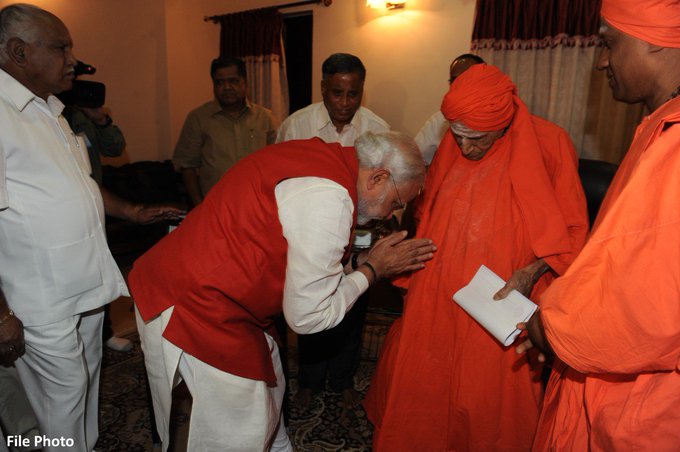
Soon after the Shivakumara Swami’s death, Prime Minister Narendra Modi tweeted that the Swami had lived for the people, especially the poor and vulnerable and expressed his prayers and solidarity with the seer’s devotees around the world.(Twitter/ @narendramodi)

Shivakumara Swami, the 111-year-old revered seer of Karnataka’s Siddaganga Mutt at Tumakuru, died early at 11.44 am on Monday.

The state government has announced a three-day mourning in honour of the seer and has declared Tuesday a statewide holiday, Deputy chie fminister G Parameshwara said soon after announcing the seer’s death.

The Swami, known among his followers as the “Walking God”, was one of the oldest known living persons in India. He was suffering from a lung infection for the past few weeks and was on ventilator for the last 15 days. Over the last few years he had been in and out of the hospitals due to age-related ailments.

Soon after the Swami’s death, Prime Minister Narendra Modi tweeted that the Swami had lived for the people, especially the poor and vulnerable and expressed his prayers and solidarity with the seer’s devotees around the world.

“HH Dr. Sree Sree Sree Sivakumara Swamigalu remained at the forefront of ensuring better healthcare and education facilities for the marginalised. He represents the best of our traditions of compassionate service, spirituality and protecting the rights of the underprivileged,” he said.

“I have had the privilege to visit the Sree Siddaganga Mutt and receive the blessings of His Holiness Dr. Sree Sree Sree Sivakumara Swamigalu. The wide range of community service initiatives being done there are outstanding and are at an unimaginably large scale,” the PMsaid.

President Ramnath Kovind expressed his condolences to the countless followers of the Swami.

“Extremely sad to learn of the passing of spiritual leader Dr Sree Sree Sree Sivakumara Swamigalu Ji. He contributed immensely to society particularly towards healthcare and education. My condolences to his countless followers,” the President tweeted.

President of India

@rashtrapatibhvn

Extremely sad to learn of the passing of spiritual leader Dr Sree Sree Sree Sivakumara Swamigalu Ji. He contributed immensely to society particularly towards healthcare and education. My condolences to his countless followers

406 people are talking about this
Congress president Rahul Gandhi also expressed his condolences on Twitter, saying that the swami’s passing has left behind a deep spiritual void.

Rahul Gandhi

@RahulGandhi

I am sorry to hear about the passing of Shivakumar Swami Ji, Pontiff of the Siddaganga Mutt. Swami Ji was respected & revered by millions of Indians, from all religions & communities. His passing leaves behind a deep spiritual void. My condolences to all his followers.

2,786 people are talking about this
“I am sorry to hear about the passing of Shivakumar Swami Ji, Pontiff of the Siddaganga Mutt. Swami Ji was respected & revered by millions of Indians, from all religions & communities. His passing leaves behind a deep spiritual void. My condolences to all his followers,” Rahul Gandhi tweeted.

Among the last people to call on him were Karnataka chief minister HD Kumaraswamy visited the Mutt to enquire about Swami’s health. BS Yeddyurappa, MB Patil, KJ George and Sadananda Gowda were also present.

The Swami was believed by his followers to be an incarnation of the 12th century social reformer Basava. He headed the Sree Siddaganga Education Society, which runs about 125 educational institutions in the state – from engineering colleges to business schools.

Security has been tightened at the Mutt as hundreds of followers gathered, praying for the holy man’s recovery.

Source: Hindustan Times

21/01/2019

Xi keeps China on high alert for ‘black swan’ events – Xinhua

BEIJING (Reuters) – China must be on guard against “black swan” risks while fending off “grey rhino” events, President Xi Jinping said on Monday, adding that the economy faces deep and complicated changes, state news agency Xinhua reported.

A “black swan” event refers to an unforeseen occurrence that typically has extreme consequences, while a “grey rhino” is a highly obvious yet ignored threat.

Xi’s warning came after the release of data on Monday showed the economy posted the slowest growth in 28 years last year, hurt by faltering domestic demand and bruising U.S. tariffs.

Local governments and state organizations should find a balance between stabilizing growth and fending off risks, controlling the pace and intensity of such policies, Xi said in remarks during a meeting with provincial and department officials.

Sliding growth had pressured the government to roll out more stimulus to avert a sharper slowdown. The central bank has cut the reserve requirement ratio for banks five times in the past year.

Economic operations would be maintained within a reasonable range, Xi said, adding financing difficulties of small businesses will be resolved pragmatically while authorities would also step up support for companies to stabilise jobs.

Zombie firms – companies with a lot of debt – would be dissolved properly and resettlement of workers would be taken care of accordingly, Xi added.

China would implement long-term mechanisms that support the stable and healthy development of the property market, while making thorough evaluation of the potential impact on financial markets when drafting policies, according to Xi, who did not elaborate.

He emphasized that technology safety was an important part of national security and the country will accelerate legislation in artificial intelligence, gene editing, autonomous vehicles and drones.

Faced with complicated and difficult external environment, China would step up the protection of its overseas interests while making sure of the safety of major overseas projects and their personnel, Xi said.

Meng Wanzhou, the chief financial officer of Chinese telecommunication giant Huawei HWT.UL was arrested last month in Canada on a U.S. extradition request.

Western intelligence agencies have for years raised concerns about Huawei’s ties to China’s government and the possibility its equipment could be used for espionage.

Source: Reuters

21/01/2019

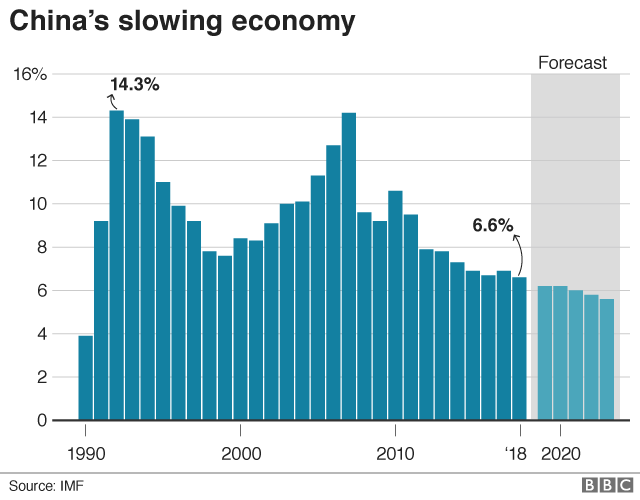
China economy: Annual growth slowest since 1990

China’s economy grew at its slowest rate since 1990, stoking fears about the impact on the global economy.

China expanded at 6.6% in 2018, official figures out Monday showed.

In the three months to December, the economy grew 6.4% from a year earlier, down from 6.5% in the previous quarter.

The data was in line with forecasts but underlines recent concern about weakening growth in the world’s second-biggest economy.

China’s rate of expansion has raised worries about the potential knock-on effect on the global economy. The trade war with the US has added to the gloomy outlook.

China GDP

The official figures out Monday showed the weakest quarterly growth rate since the global financial crisis.

While China watchers advise caution with Beijing’s official GDP numbers, the data is seen as a useful indicator of the country’s growth trajectory.

Presentational grey line

Analysis: Wider implications?

By Karishma Vaswani, BBC Asia business correspondent

China’s economic slowdown is not news in itself. Beijing has broadcast this for several years, that it’s going to focus on the quality not quantity of growth.

But still, we should be worried.

Slower growth in China means slower growth for the rest of the world.

It accounts for one-third of global growth. Jobs, exports, commodity producing nations – we all depend on China to buy stuff from us.

Slower growth in China also means it is harder for China to address its mountain of debt, even with the Communist Party’s undoubted ability to be able to support the economy.

Presentational grey line

Slowdown warnings

Growth has been easing for years, but concern over the pace of the slowdown in China has risen in recent months as companies sound the alarm over the crucial market.

Earlier this month Apple warned weakness in China would hit its sales.

Carmakers and other firms have spoken out on the impact of the trade war with the US.

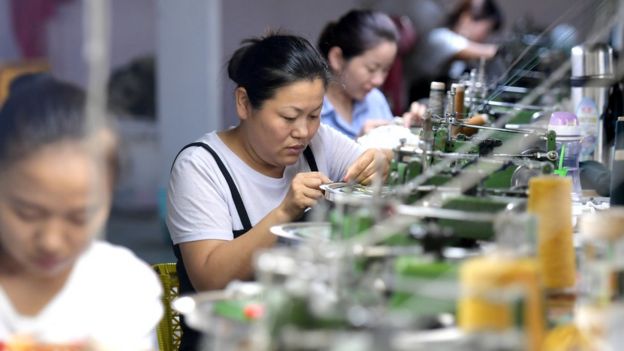
Women work in a factory in ChinaImage copyrightGETTY IMAGES

China’s government has been pushing to shift away from export-led growth to depend more on domestic consumption.

Policymakers in China have stepped up efforts in recent months to support the economy.

Those measures to boost demand include speeding-up construction projects, cutting some taxes, and reducing the level of reserves banks need to hold.

Capital Economics China economist Julian Evans-Pritchard said the Chinese economy remained weak at the end of 2018 “but held up better than many feared”.

“Still, with the headwinds from cooling global growth and the lagged impact of slower credit growth set to intensify… China’s economy is likely to weaken further before growth stabilises in the second half of the year.”

Source: The BBC

21/01/2019

China plans major cut in number of people allowed to climb Everest

  • Fewer than 300 people will be allowed to climb the world’s highest mountain from the north side as part of a major clean-up operation
PUBLISHED : Monday, 21 January, 2019, 7:43pm
UPDATED : Monday, 21 January, 2019, 7:43pm

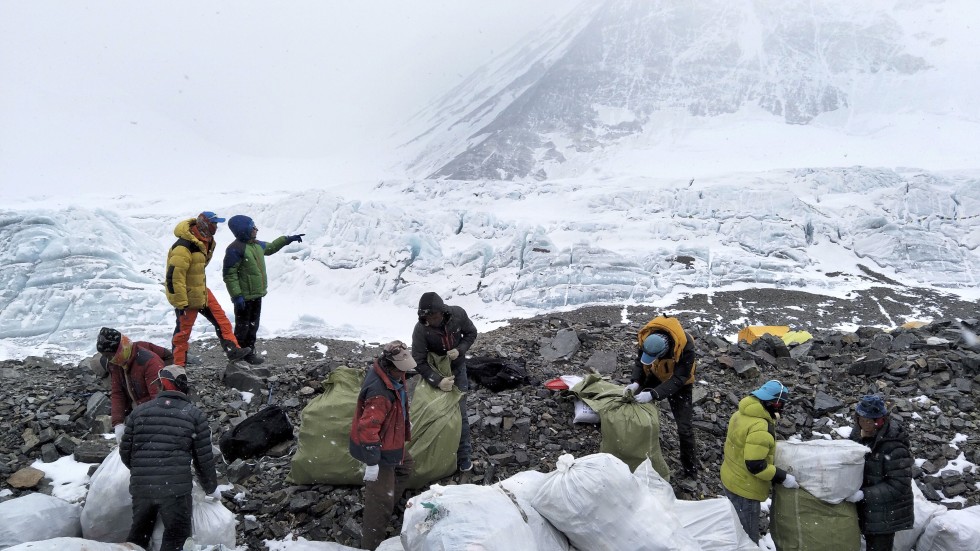
China will cut the number of climbers attempting to scale Mount Everest from the north by one-third this year as part of plans for a major clean-up on the world’s highest peak, state media reported Monday.

The total number of climbers seeking to reach the summit from the north will be limited to less than 300 and the climbing season restricted to spring, China Dailyreported.

The clean-up efforts will include the recovery of the bodies of climbers who died more than 8,000 meters (26,246 feet) up the mountain, they said.

Parts of Everest are in China and Nepal. Each year, about 60,000 climbers and guides visit the Chinese north side of the mountain, which China refers to by its Tibetan name, Mount Qomolangma.

China has set up stations to sort, recycle and break down rubbish from the mountain, which includes cans, plastic bags, stove equipment, tents and oxygen tanks.

On the Nepalese side, mountaineering expedition organisers have begun sending huge refuse bags with climbers during the spring climbing season to collect waste that then can be winched by helicopters back to the base camp.

Everest claims multiple victims each year, often in the “death zone” above 8,000 meters (26,246 feet), where the air is too thin to sustain human life.

In 2017, 648 people climbed Everest, including 202 from the north side, according to the non-profit Himalayan Database.

Six people were confirmed to have died on the mountain that year, one of them on the north side.

Source: SCMP

21/01/2019

Chinese consul general calls for stronger people-to-people bonds with U.S.

U.S.-LOS ANGELES-CHINA-DIPLOMATIC RELATIONS-40TH ANNIVERSARY-CELEBRATION

Guests attend a celebration marking the 40th anniversary of the establishment of China-U.S. diplomatic relations, in Los Angeles, the United States, Jan. 19, 2019. Chinese Consul General in Los Angeles Zhang Ping on Saturday called for concerted efforts to develop strong people-to-people bonds between China and the United States. (Xinhua/Qian Weizhong)

LOS ANGELES, Jan. 19 (Xinhua) — Chinese Consul General in Los Angeles Zhang Ping on Saturday called for concerted efforts to develop strong people-to-people bonds between China and the United States.

Zhang made the remarks at a celebration held in Los Angeles marking the 40th anniversary of the establishment of China-U.S. diplomatic relations, with over 500 people participating.

Zhang said that over the past four decades, despite various ups and downs and twists and turns, China-U.S. relations have achieved historic progress, bringing huge benefits to the two peoples and contributing greatly to world peace, stability and prosperity.

“As we look at the journey that the bilateral relations have gone through, we are gratified to see that the relationship is getting wider support from different walks of life in both countries,” he said.

Chinese and American people have fond sentiments towards each other, Zhang said.

People-to-people connections and friendship between the two countries constitute the foundation of their relationship, he added.

He spoke highly of the contributions of the Chinese community to the United States in boosting understanding and friendship between the two countries.

Former U.S. Ambassador to China Max Baucus recalled his days in Beijing, saying he enjoyed his post as ambassador for two reasons. “One is the Chinese people, (who are) practical, pragmatic, getting things done, upbeat, positive. Second was the reward by getting involved in a relationship. U.S.-China relations are the most important bilateral relationship in the world.”

Baucus explained his principle for dealing with China-U.S. relations, namely, being patient, positive and persistent. He expressed confidence in the future development of bilateral ties.

Sher Li, president of the Chinese American Federation, a non-profit organization registered in California, said that as beneficiaries, practitioners and witnesses of China-U.S. relations, Chinese Americans cherish the friendship between both countries, and will continue to promote trade cooperation and cultural exchanges, as well as understanding between both countries and peoples.

Source: Xinhua

21/01/2019

Premier Li seeks opinions, suggestions for draft report of government work

CHINA-BEIJING-LI KEQIANG-GOVERNMENT WORK-DRAFT REPORT-SUGGESTIONS SEEKING (CN)

Chinese Premier Li Keqiang, also a member of the Standing Committee of the Political Bureau of the Communist Party of China (CPC) Central Committee, presides over a symposium where he consults representatives from the education, science and technology, culture, health, and sports sectors, as well as members of the public, on a draft version of the government work report, in Beijing, capital of China, Jan. 18, 2019. Vice Premier Han Zheng, also a member of the Standing Committee of the Political Bureau of the CPC Central Committee, attended the symposium. (Xinhua/Wang Ye)

BEIJING, Jan. 20 (Xinhua) — Premier Li Keqiang has said the government should work to address key and difficult problems closely related to the people’s well-being and advance a harmonious development of economy and society.

Li, also a member of the Standing Committee of the Political Bureau of the Communist Party of China (CPC) Central Committee, made the remarks when presiding over a symposium Friday where he consulted representatives from the education, science and technology, culture, health, and sports sectors, as well as members of the public, on a draft version of the government work report.

Seven representatives from relevant fields introduced achievements in their work and gave suggestions on improvements to the draft report.

Vice Premier Han Zheng, also a member of the Standing Committee of the Political Bureau of the CPC Central Committee, attended the symposium.

Premier Li said that to accomplish the work for the year, the government needs to rely on the people pulling together and also to make efforts to unleash market vitality and resist the downward pressure on the economy.

Issues in the representatives’ speeches included education of higher learning, high-quality scientific and technological innovation, urban and rural landscape protection, advancing a healthy development of film and television industry by improving social governance and relying on rule of law, prevention and control of chronic diseases of children, vaccine management, winter sports promotion and building a talent pool for the rural vitalization.

Li listened to their opinions, gave responses and asked relevant government departments to pay attention to the issues and improve their work in these regards.

Source: Xinhua

21/01/2019

Hainan to handle 6.3 million air passengers during festival travel season

HAIKOU, Jan. 20 (Xinhua) — The two major airports in south China’s island province of Hainan are expected to handle more than 6.3 million passengers during the travel season of the upcoming Spring Festival.

According to Haikou Meilan International Airport in the provincial capital, it will handle 22,071 flights and 3.5 million passengers during the travel season, which will last from Jan. 21 to March 1.

The Phoenix International Airport, in the popular resort city of Sanya, is expected to handle 15,006 flights and 2.8 million passengers during the period.

Red-eye flights will also be arranged for the first time in Meilan airport from Feb. 9 to 24, the Civil Aviation Administration of China said.

Source: Xinhua

21/01/2019

China’s top medical research institution sets up respiratory medicine institute

BEIJING, Jan. 20 (Xinhua) — A respiratory medicine institute was set up under the Chinese Academy of Medical Sciences, China’s top medical research institution, in Beijing Sunday.

The new institute is expected to improve the prevention and treatment of respiratory diseases in China by conducting research on basic theories, translational medicine and latest trends within the discipline.

It will also be responsible for training more respiratory medicine personnel.

“With factors such as the aging population and the large number of smokers, respiratory diseases could grow to become a greater threat to public health and the prevention and treatment of such diseases will become harder,” said Wu Peixin, an official with the National Health Commission, at the inauguration ceremony.

According to the World Health Organization, about 1 billion people around the world suffer from chronic respiratory diseases.

Source: Xinhua

20/01/2019

Indian opposition stages giant joint rally to oust Modi

KOLKATA, India (Reuters) – India’s main opposition parties joined forces against Prime Minister Narendra Modi on Saturday at a rally which attracted hundreds of thousands of people months ahead of elections.

The 23 regional groups said they forged a common front to stop Modi’s Hindu nationalist Bharatiya Janata Party, which beat the main opposition Congress and regional parties in 2014.

Rural anger over weak farm prices and sluggish job creation mean Modi’s BJP faces a tough challenge to stay in power after electoral losses in three key states last month.

Hundreds of thousands of people flocked to Kolkata from rural Bengal for the rally, bringing disruption to the city.

Mamata Banerjee, chief minister of the state of West Bengal, called on regional party leaders to join a single platform to defeat the “anti-people” government of Modi, which the 64-year-old said was “nearing its end”.

A poll last month by ABP News forecast Modi’s party could fall about 25 seats short of a majority in national elections and Banerjee is among the few opposition leaders who could emerge as a prime ministerial candidate if the BJP loses.

Regional parties hold the key as they dominate the eastern states of West Bengal, Odisha, and the southern states of Andhra Pradesh, Tamil Nadu and Kerala, which together send 161 members to the 543 constituencies of parliament’s lower house.

Missing from Saturday’s lineup was Rahul Gandhi, president of the main opposition Congress party and leaders of the left parties, reflecting tensions among opposition parties on who would be their prime ministerial candidate against Modi.

Gandhi sent his representatives and a letter of support.

FOCUS ON JOBS

After the formation of a strong alliance between Samajwadi and Bahujan Samaj Party (BSP) last week in the state of Uttar Pradesh, which sends 80 members to the lower house, Modi’s party faces a risk of losing elections, Banerjee said.

Arvind Kejriwal, chief minister of Delhi, said Modi had failed to fulfil his promises including job creation.

“Modi had promised to create 20 million jobs a year but after a faulty launch of national sales tax and demonetisation in 2016 more than 10 million jobs were lost,” he said.

India’s unemployment rate hit 7.4 percent in December, highest in 15 months, while the number of people employed fell by nearly 11 million from a year ago, a report by the Mumbai-based Centre for Monitoring Indian Economy, said this month.

Politicians at the rally, whose organisers said was attended by more than a million people, said India’s growth had slowed during Modi’s term and their first priority was to defeat him, adding a replacement would be decided after the elections.

The BJP dismissed the prospects of an opposition alliance, questioning who would lead such a coalition.

Modi is expected to detail a package worth more than 1 trillion rupees ($14 billion) in his last budget on Feb 1, including benefits for farmers and other taxpayers.

Source: Reuters

20/01/2019

From pariah to demi-god – transgender leader a star at massive Indian festival

PRAYAGRAJ, India (Reuters) – In a desert tent guarded by armed police and a thick-set bouncer, Laxmi Narayan Tripathi is blessing a constant stream of pilgrims, who garland her with marigolds and kneel to touch her feet.

Tripathi, a tattooed transgender leader and a former reality TV star, has become an unlikely icon at India’s Kumbh Mela, a huge religious festival being held on the banks of the Ganges river in the city of Prayagraj. Up to 150 million people are expected to attend by the time the festival ends in March.

On Tuesday, her religious movement, called the Kinnar Akhada, became the first transgender group to bathe at the confluence of the holy Ganges and the Yamuna rivers on the first day of the ancient festival, traditionally reserved for reclusive Hindu priests, almost all of whom are men.

“After centuries down the line, it was when the community finally got its due,” Tripathi told Reuters, seated on a pedestal next to her Michael Kors bag, juggling calls on an iPhone.

Many at the festival cheer Tripathi for reclaiming the lost place in Hinduism for India’s “third gender”, known as the hijras, worshipped as demi-gods for thousands of years, but ridiculed and sidelined during British colonial rule.

A law passed in 1871 classed the hijras as “criminals”.

Little changed after independence and hijras were pariahs, living in tribes, begging or soliciting for sustenance and harassed by police.

It was only in 2014 that the Supreme Court officially recognised transgender people as a third gender.

Tripathi is one of the best known. But her support for building a controversial Hindu temple on the site of a demolished mosque has angered some in the LGBT community, who allege she is courting support from India’s powerful religious right to further her own influence.

FALL AND RISE

The place of hijras in Indian culture dates back to the Ramayana, a more-than 2,000 year-old Hindu epic poem venerated and performed across India.

In the text, the god-king Ram is exiled from the holy city of Ayodhya, with the entire kingdom following him into the forest. He orders them to turn back, but returning after 14 years, finds the hijras waiting for him in the same spot. Impressed by their devotion, he grants them the power to invoke blessings and curses on people.

For centuries, though their lives were far from easy, hijras held a special role in India’s royal courts, tasked with guarding harems and rising to influential positions.

Today, despite their legal recognition, many still face prejudice in what is a conservative country, forced into sex work or seeking alms at weddings and births, a long-held practice among hijras. Hate crimes against them are common and HIV prevalence within the community is many times higher than the general population.

“The ritual seeking of alms is now seen as begging,” said Anindya Hajra, a transgender activist at the Pratyay Gender Trust. “It criminalises and pushes an already vulnerable community to its very brink.”

COLOURFUL LIFE

Born in 1979 in Thane, a suburb of India’s financial capital Mumbai, Tripathi says she had a difficult childhood scarred with abuse by a close relative. A sickly child who was bullied at school for being feminine, she grew in confidence after learning Bharatanatyam, a classical Indian dance.

“I chose not to remember the prejudice,” she said. “Rather I think (about) the good things that have happened to me, and be a flamboyant rainbow.”

Long recognised as one of the most influential figures in the LGBT community in India, she become famous across the country when she appeared on reality TV show “Bigg Boss” in 2011. She was a petitioner in the landmark court ruling that recognised transgender people.

In 2015, she founded her Akhara and began a campaign to have hijras represented at the at the first “Shahi Snan”, or royal bath, of the Kumbh Mela.

“It all started to reclaim the lost position in the dharma,” Tripathi said, referring to the Hindu cosmic law underlying correct behaviour and social order. “I was not very religious until 2015 – life changed.”

ANCIENT TRADITION

Devout Hindus believe bathing in the waters of the Ganges absolves people of sins and doing so at the time of the Kumbh Mela, or the “festival of the pot”, brings salvation from the cycle of life and death.

At the festival, 13 religious orders, or Akhara, set up camp on the banks of the Ganges.

The umbrella body overseeing the Akharas initially refused to recognise the Kinnar Akhara as the 14th order.

But Tripathi has forged close bonds with the largest of the other holy orders at the Kumbh Mela, the Juna Akhara. They agreed to bathe together.

On the first royal bathing day on Tuesday, Tripathi rose at 4 a.m., dressed in a saffron sari and applied her makeup. She and her dozens of disciples then began the long procession to the river on a fleet of elaborately decorated trucks.

At the banks of the Ganges, they waited for their turn to bathe. Tripathi met with Hari Giri, the leader of Juna Akhara.

Her Kinnar Akhara “was there, is there, and will always be there”, Giri told Tripathi.

Shortly after sunrise, she plunged into the waters, to the cheers of the crowds who gathered to watch.

DIVISIVE FIGURE

Tripathi has courted controversy with support for the building of a temple dedicated to Ram on the site of a former mosque in Ayodhya which was demolished by hardline Hindus in 1992, leading to riots in which thousands died.

Many Hindus claim the mosque was built over an ancient temple that marked the birthplace of Ram, and the row is expected to be a major issue in a general election due to be held in the country by May. Many activists of India’s ruling Hindu nationalist Bharatiya Janata Party have been agitating for the construction of a temple at the site, alarming the country’s sizeable Muslim minority.

“There has been an attempt by the right to co-opt trans voices to suit a certain version of history,” said Hajra, the activist. “Our apprehension is also that some are trying to further (their) own personal career moves.”

A letter signed in November by hundreds of transgender people and rights groups accused Tripathi of fuelling “the right-wing politics of communal hatred”.

She is unrepentant.

“Where my Lord Ram was born, there the temple has to come,” she said. The Mughals “brought (the temple) down and then they enslaved us all”, she said, referring to the Muslim emperors who ruled India in the 16th and 17th century.

Tripathi plans to spend the rest of the Kumbh festival at her Akhara, receiving visitors among her colourful band of followers, who have little in common with the holy men living monastic lives in the other camps.

“We are not celibate,” she said. “We are demi-gods, not saints. We have our own rules.”

Source: Reuters

Law of Unintended Consequences

continuously updated blog about China & India

ChiaHou's Book Reviews

continuously updated blog about China & India

What's wrong with the world; and its economy

continuously updated blog about China & India