Archive for January, 2019

15/01/2019

Chinese premier urges efforts to keep growth within reasonable range

CHINA-BEIJING-LI KEQIANG-STATE COUNCIL-PLENARY MEETING (CN)

Chinese Premier Li Keqiang presides over a plenary meeting of the State Council, which discusses a draft version of the government work report and analyzes economic work in the first quarter of 2019, Jan. 14, 2019. (Xinhua/Rao Aimin)

BEIJING, Jan. 14 (Xinhua) — Chinese Premier Li Keqiang on Monday called for efforts to ensure economic growth within a reasonable range.

Chairing a plenary meeting of the State Council, which discussed a draft version of the government work report and analyzed economic work in the first quarter of 2019, Li said the country faces a more complicated development environment this year, with growing challenges and downward pressure on the economy, creating arduous tasks for the government.

He urged efforts to strike a balance among stabilizing growth, promoting reforms, restructuring, improving people’s well-being and preventing risks.

The government will strive to innovate and improve its macro-regulation but not resort to massive economic stimulus, Li said.

He said the country will keep economic growth within a reasonable range through range-based, targeted and precise regulation, and resist downward pressure with market vitality unleashed by reform and opening-up.

The government will continue to improve the business environment, foster new momentums, improve weak links, expand the domestic market, and promote coordinated development among different industries and regions.

Efforts will be made to extend the country’s advantage of having sufficient maneuver room for economic development, improve people’s living standards, promote high-quality development, and lay a solid foundation for securing a victory in building a moderately prosperous society in all respects, Li said.

He urged relevant authorities to better implement policies aimed at supporting enterprises and improving people’s livelihood, stabilize and boost market confidence, and strive for a good start to the economy in the first quarter to create conditions favorable to achieving major economic and social development targets set for 2019.

The country achieved its key economic and social targets in 2018, which Li said were “hard-won.”

The draft version of the government work report, which will be submitted for deliberation at the annual session of the National People’s Congress in March, will be distributed to provincial governments and central government departments to solicit opinions, according to a decision made at the meeting.

15/01/2019

China, UAE to cement bilateral cooperation, promote BRI

UAE-ABU DHABI-CHINA-YANG JIECHI-CROWN PRINCE-MEETING

Sheikh Mohamed bin Zayed Al Nahyan (R), Crown Prince of Abu Dhabi, meets with Chinese President Xi Jinping’s special representative Yang Jiechi (L), also a member of the Political Bureau of the Communist Party of China (CPC) Central Committee and director of the Office of the Foreign Affairs Commission of the CPC Central Committee, in Abu Dhabi, capital of the United Arab Emirates (UAE), Jan. 14, 2019. (Xinhua/Wu Huiwo)

ABU DHABI, Jan. 14 (Xinhua) — The Crown Prince of Abu Dhabi, Sheikh Mohamed bin Zayed Al Nahyan, on Monday met with Chinese President Xi Jinping’s special representative Yang Jiechi here, and discussed means to further bilateral cooperation and the Belt and Road Initiative.

The crown prince said that Xi’s visit to the United Arab Emirates (UAE) last year has upgraded the bilateral cooperation to a higher level.

He stressed that under the Belt and Road Initiative, the UAE is willing to implement, together with China, all the consensus between the leaderships of the two countries, enhance cooperation and coordination in international affairs, and boost the comprehensive strategic partnership.

Xi paid a visit to the UAE in July 2018, the first by a Chinese head of state in 29 years to the Arab state. The two sides agreed that both countries will strengthen their in-depth cooperation in various fields, and promote continuous development of bilateral ties.

Yang, also a member of the Political Bureau of the Communist Party of China (CPC) Central Committee and director of the Office of the Foreign Affairs Commission of the CPC Central Committee, said his visit is to help implement the consensus reached during Xi’s historic visit.

“China will join hands with the UAE to maintain the momentum of frequent high-level visits and make China-UAE ties closer,” he said.

Yang highlighted that bilateral cooperation, especially under the Belt and Road Initiative, has been proceeding smoothly, and both sides will guarantee all the related coordination to realize more practical fruits and benefit the two countries’ people.

Meanwhile, the two sides also agreed on more work on anti-terrorism for mutual interests and regional stability.

Yang is now on his official visits to the UAE, Egypt, Equatorial Guinea and Cameroon scheduled from Jan. 13 to 19.

15/01/2019

China Focus: China, Finland vow to write new chapter in bilateral ties

CHINA-BEIJING-XI JINPING-FINNISH PRESIDENT-TALKS (CN)

Chinese President Xi Jinping (2nd R) and his wife Peng Liyuan (1st R) pose for a group photo with Finnish President Sauli Niinisto (2nd L) and his wife Jenni Haukio in Beijing, capital of China, Jan. 14, 2019. Xi held talks with Niinisto at the Great Hall of the People in Beijing on Monday. Before their talks, Xi held a welcome ceremony for Niinisto. (Xinhua/Ju Peng)

BEIJING, Jan. 14 (Xinhua) — Chinese President Xi Jinping and his visiting Finnish counterpart Sauli Niinisto agreed to work together to write a new chapter in bilateral ties during their talks on Monday.

Hailing that China and Finland have been committed to forging a future-oriented new-type of cooperative partnership in recent years, Xi said it is not only in line with both countries’ and people’s interests but also conducive to world peace, stability and prosperity that China and Finland enhance dialogue and cooperation.

The two countries need to adhere to mutual respect and trust, be open-minded and inclusive, respect each other’s development path and take each other’s core interests into consideration so as to promote the steady development of bilateral ties, Xi told Niinisto during the talks held at the Great Hall of the People.

Xi encouraged both countries to expand cooperation in new areas driven by innovation.

China appreciated Finland’s support to the Belt and Road Initiative, said Xi, adding that the country is ready to work with Finland to enhance Belt and Road cooperation.

He suggested the two countries make the best use of the China Railway Express and other facilities to boost two-way trade, conduct third-party cooperation, discuss opportunities for cooperation on the Arctic shipping routes and jointly build the Polar Silk Road.

Xi also called for enhanced cultural and people-to-people exchanges as the two presidents would jointly launch the 2019 China-Finland Year of Winter Sports in the hope of forging a model of winter sports cooperation.

The two countries need to jointly promote the reform on global governance, enhance cooperation on international affairs, push forward the establishment of the open world economy, safeguard the multilateral trading system, and implement the Paris Agreement on climate change, Xi said.

Stressing that China has always supported the European integration, Xi said China hopes Europe will maintain unity, stability, openness and prosperity and play an active and constructive role in the international arena, calling on Finland to continue contributing to China-Europe ties.

On the Arctic affairs, Xi said China stands ready to work with Finland to enhance cooperation under the framework of the Arctic Council and boost the sustainable development in the Arctic region.

China will also maintain close contact with Nordic countries and the Nordic Council of Ministers to develop cooperation between China and Nordic countries, Xi said.

Hailing the rapid development of bilateral ties, Niinisto said that Finland speaks highly of China’s achievements, values China’s role in international affairs and cherishes its friendship with China.

The Belt and Road Initiative proposed by Xi is very important, he said, adding that Finland is willing to play a positive role to better align this initiative with the European Union (EU) to promote the connectivity of the Eurasian continent.

During Niinisto’s visit to China, the two sides are scheduled to publish a joint action plan (2019-2023) on promoting the future-oriented new-type cooperative partnership between China and Finland.

Finland is ready to work with China to implement the action plan, strengthen pragmatic cooperation in areas including trade, innovation, environment, tourism, and Arctic affairs, boost people-to-people exchanges and cement cooperation on sports, particularly winter sports, Niinisto said.

It is important for the two countries to maintain close communication and coordination on international affairs under the current situation, he said, adding that Finland applauds China’s positive role in tackling climate change and safeguarding the multilateral trading system.

Finland will assume the rotating presidency of the EU in the second half of this year. The country will take this as an opportunity to promote closer ties between the EU and China, Niinisto said.

After the talks, the two presidents witnessed the signing of cooperation agreements and attended the inaugural ceremony of the 2019 China-Finland Year of Winter Sports.

During the 1952 Helsinki Olympic Games, the People’s Republic of China made its debut at the Olympic Games, and for the first time China’s national flag was raised at the Olympic arena, Xi said.

There is huge potential for cooperation on winter sports between the two countries given the high complementarity, Xi said while addressing the inaugural ceremony.

“I believe the 2019 China-Finland Year of Winter Sports will boost the two countries’ sports cooperation, inject new vitality to people-to-people exchanges, and further advance the future-oriented new-type cooperative partnership between China and Finland,” Xi said.

Finland supports China in hosting the 2022 Beijing Winter Olympic Games, Niinisto said, adding that he is glad Finland will be the first country to launch the Year of Winter Sports with China and he believes this will further promote friendship between the two countries.

China is on its way of becoming a big power in winter sports and Finland is willing to lend a helping hand, Niinisto said.

Niinisto is paying a state visit to China from Sunday to Wednesday at the invitation of Xi.

14/01/2019

Kumbh Mela: How to plan a festival for 100m people

Indian devotees shower flower petals on Hindu holy men during a religious procession towards the Sangam area during the 'royal entry' for the upcoming Kumbh Mela festival in Allahabad on January 2, 2019Image copyrightGETTY IMAGES
Image captionDevotees have been gathering in Allahabad for days

India’s Kumbh Mela festival is billed as the world’s biggest gathering of people.

Between now and March organisers expect about 120 million pilgrims to bathe at the Sangam – the confluence of the Ganges, the Yamuna and the mythical Saraswati rivers.

Hindus believe that doing so will cleanse them of their sins and help them attain “moksha”, setting them free from the cycle of birth and death.

So how does one prepare for a gathering of humanity so mammoth it can be seen from outer space?

The mela (Hindi for fair) is held in the northern city of Allahabad (recently renamed Prayagraj) every 12 years.

On Tuesday, when the festival formally begins, officials are preparing for 15 to 20 million visitors. But the biggest test they face will be on 4 February when 30 million are expected to attend for the most auspicious bathing day. The festival ends on 4 March.

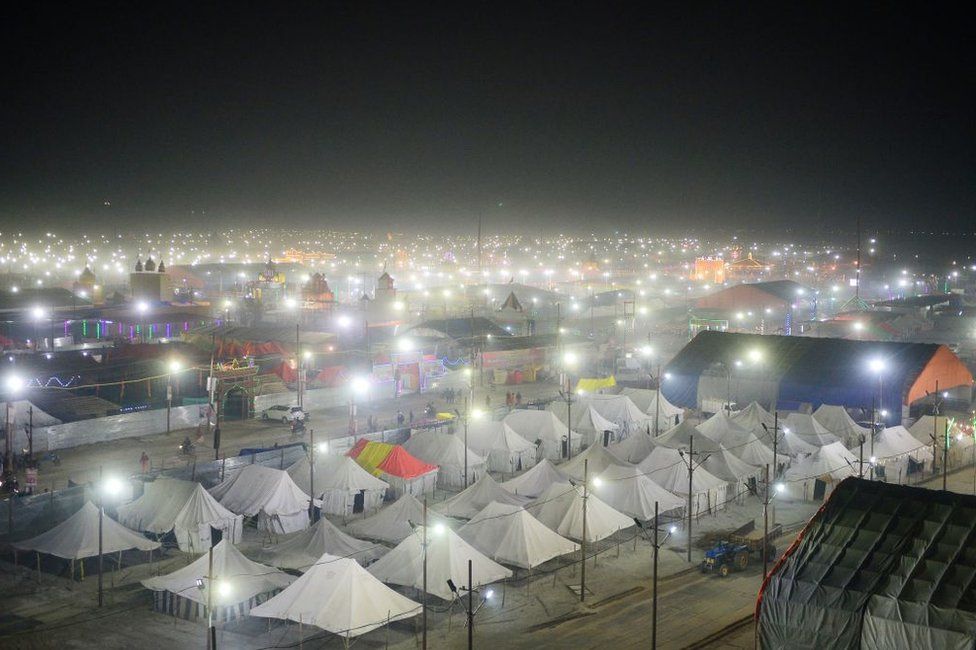
Tents are pitched on the banks of Sangam, the confluence of the Ganges, Yamuna and mythical Saraswati rivers, for the upcoming Kumbh Mela festival in Allahabad on January 9, 2019.Image copyrightGETTY IMAGES
Image captionThe budget for the festival is about $400m

This year’s festival is an “ardh Kumbh” – a “half-size” version that falls mid-way between two Kumbhs – but there’s nothing diminutive about it. In fact, it’s much bigger than the last full Kumbh held in 2013.

Where does everyone stay?

A vast tent city has been built on the mudflats of the river delta and thousands of officials are working round the clock to ensure the festival runs as smoothly as possible.

“We’ve been working for more than a year,” senior administration official Rajeev Rai said when I met him in his office a few days ago.

14/01/2019

Millions expected to throng Indian city for world’s largest religious festival

PRAYAGRAJ, India (Reuters) – Pilgrims from across the world are gathering in India for the Kumbh Mela, a heady mix of spirituality, politics and tourism that begins on Tuesday, garnering extra attention ahead of a general election in the Hindu-majority country this year.

During the eight-week festival at Prayagraj in the northern state of Uttar Pradesh, authorities expect up to 150 million people, including a million foreign visitors, to bathe at the confluence of the Ganges, the Yamuna, and a mythical third river, the Saraswati.

Devout Hindus believe that bathing in the waters of the Ganges absolves people of sins and bathing at the time of the Kumbh Mela, or the “festival of the pot”, brings salvation from the cycle of life and death.

“Belief is what brings us here, to bathe in the waters despite the cold,” said Ram Krishna Dwivedi, making his way back from the shore dressed in flowing white robes.

More than 80 percent of India’s 1.3 billion people are Hindus, many of them deeply religious despite an increasingly Westernized middle class.

SPONSORED

ADVERTISING

On Tuesday, millions of pilgrims, led by naked, ash-smeared ascetics, some of whom live in caves, will plunge themselves into the cold waters during the first Shahi Snan, or Royal Bath, that begins at around 4 a.m. (2230 GMT).

With less than 24 hours until the festival starts, the last of the arriving ascetics paraded towards temporary ashrams, or monasteries, built of corrugated iron and canvas, many bedecked with fairy lights, on the east bank of the Ganges.

Pilgrims poured in to the site, which is closed to traffic around bathing days, carrying bundles on their heads, while vendors peddled balloons and candy floss, as security men stood guard, with priests and police seated side-by-side.

Authorities have set up temporary bridges, 600 mass kitchens and more than 100,000 portable toilets in a pop-up city at the confluence of the rivers, which is known as the sangam.

Those with cash can stay at luxury campsites on the river banks that offer ayurvedic spas and yoga, and cost up to 32,000 rupees ($455) a night.

Most pilgrims make do with more modest lodgings, sleeping in big communal tents or out in the open.

“I don’t know where I will stay yet, but you do not often get to meet these saints and sadhus,” said Rajendra Singh, a retired soldier and now a security guard, who came by bus from the state capital, Lucknow, about 200 km (124 miles) away.

On Monday, a small fire broke out at one of the camps, though there was no report of any casualty, according to Reuters partner ANI. Authorities later warned pilgrims about open fires.

POLITICAL PILGRIMAGE

This year’s event comes at a critical time for Modi’s Hindu nationalist Bharatiya Janata Party (BJP), expected to face a tough contest in a general election due by May.

It lost power in three key states in assembly elections in December, and will want to avoid a similar result during the general election in Uttar Pradesh, a state of 220 million where a good showing can often decide the outcome.

Slideshow (16 Images)

The state’s chief minister, Yogi Adityanath, is a firebrand Hindu priest from the BJP, who has championed policies that play to the party’s core Hindu base.

This year Adityanath has transformed a smaller Ardh, or “half” Kumbh Mela, into a full version of the festival.

He has also lobbied to build a Hindu temple on the site of a former mosque, and renamed several cities with Hindu names – including Prayagraj, which was Allahabad until October.

Modi and his rival, opposition Congress leader Rahul Gandhi, are both expected to attend the festival before it wraps up in March.

14/01/2019

European shares in reverse after shock China data; luxury stocks fall

LONDON (Reuters) – China’s surprisingly weak trade data brought a four-day rally in European shares to a halt on Monday, with luxury goods and technology stocks leading the drop as investors fretted about slowing global growth and weaker-than-expected earnings.

The pan-European STOXX 600 was down 0.6 percent at 0833 GMT, reversing some of last week’s gains which saw the index hit a one-month high. The market notched up four straight days of gains, its longest winning streak since November.

Luxury goods retailers, which rely on appetite for handbags and jewellery from China’s burgeoning middle class, bore the brunt of the selling.

LVMH (LVMH.PA), Hermes (HRMS.PA) and Gucci owner Kering (PRTP.PA) were among the biggest fallers in Paris, each down between 1.2 and 2 percent, while Moncler (MONC.MI) in Milan dropped 1.9 percent. On average, one third of the luxury sector is exposed to Chinese demand.

Danish jeweler Pandora (PNDORA.CO) slumped 7 percent to the bottom of the STOXX 600. Burberry (BRBY.L) bucked the trend, garnering strength from a BAML upgrade to neutral from underperform.

UK-listed miners .FTNMX1770, which are also exposed to the health of the world’s No. 2 economy, were down 0.7 percent.

Gloom across technology stocks .SX8P returned after chip designer and Apple supplier Dialog Semiconductor (DLGS.DE) reported fourth-quarter results at the low end of its target range. The shares opened down 2.6 percent.

Around 75 percent of Dialog’s business is supplying power-management chips to Apple, which warned in November of slow year-end sales and on Jan. 3 issued its first sales warning in 12 years, blaming weaker iPhone sales in China.

Continental (CONG.DE) shares were down 0.8 percent after the auto parts supplier warned of deteriorating conditions in the car sector.

14/01/2019

Rare sight of robin in Beijing causes stir and Brexit jokes

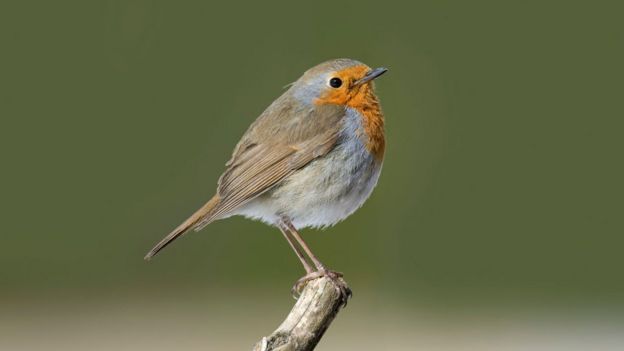
Photo of robin spotted in BeijingImage copyrightTERRY TOWNSHEND
Image captionThis is the bird that caused masses to flock to Beijing Zoo

The rare appearance of a European robin in Beijing has caused a stir among Chinese nature fans.

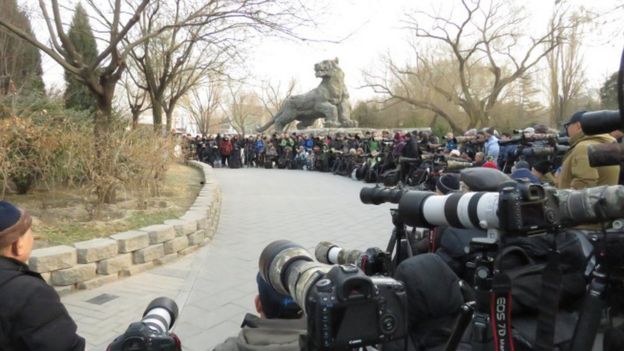
Hundreds of bird-watching photographers flocked to the Beijing Zoo last Friday after word spread that a European robin had been spotted there.

The red-breasted bird is common across Europe but is rarely seen in Beijing – it’s only the third time one has been recorded in the capital.

Some birdwatchers have joked the robin might be a “Brexit refugee”.

“It’s very rare to see [the European robin] in Beijing,” Terry Townshend, founder of Birding Beijing told the BBC.

“Almost 200 photographers camped out for it. I think a lot of people want to [capture it] because it’s a very photogenic bird and it has that sort of exotic feel.”

Birds in odd places

Mr Townshend was among the 200 photographers who camped out at Beijing Zoo last Friday.

200 photographers camped outImage copyrightTERRY TOWNSHEND
Image captionHundreds of photographers camped out for a chance to catch the bird

He said he found out about the sighting through bird watching groups on WeChat – a messaging app in China.

“A lot of people associate the bird with Britain… [so] someone in the WeChat group called the bird a ‘Brexit refugee’ because [they joked that it was] escaping the political chaos in the UK,” said Mr Townshend.

“Then the name kind of just caught on really.”

It is not common for robins to migrate and it is unclear how this one might have landed so far away from home.

“It normally lives in Europe [and] Beijing is at least 1,500 miles of where it should normally be,” said Mr Townshend. “But it’s likely that this bird is from the eastern part of Europe and not Britain.”

European robin perched on branch in winter.Image copyrightGETTY IMAGES
Image captionThe European robin is, as its name suggests, normally only found in Europe

“We don’t really know why birds sometimes turn up in odd places, it might be related to weather, when they are migrating they could be blown by strong winds.”

However it got there, the European robin is expected to stay in Beijing for some weeks to come.

Mr Townshend said a robin would normally only leave for home at the end of winter.

“So we would expect it to stay in Beijing for the rest of winter and it would probably disappear in March.”

The European robin was in 2015 chosen as UK’s first national bird in a poll of more than 200,000 people.

14/01/2019

China to advance poverty alleviation in health care

BEIJING, Jan. 13 (Xinhua) — China will advance poverty alleviation in health care and ensure all medical institutions at county, township and village levels in impoverished areas reach set standards by 2020, according to the National Health Commission.

Hu Qiangqiang, a spokesperson for the commission, said Thursday that high-level hospitals in China will help their county-level counterparts in poor regions with talent building, and each township-level institution will have one general practitioner by 2020.

Telemedicine services will cover all township-level hospitals in poor regions. Screening of breast and cervical cancers for rural women and screening for newborns in poor areas will make further progress, Hu said.

Incentives will also be raised for medical professionals working at grassroots-level hospitals. Individuals who are impoverished by major or chronic diseases could be further compensated, Hu said.

14/01/2019

Beijing’s new airport to be surrounded by forest

BEIJING, Jan. 13 (Xinhua) — Beijing’s new international airport, which is set to be operational this year, will be an airport in the forest, district officials said Sunday.

The Beijing Daxing International Airport is located 46 km south of downtown Beijing. It sits at the junction of Beijing’s Daxing District and Langfang, a city in neighboring Hebei Province.

Forest will cover 17,866 hectares of surrounding areas of the new airport, officials said at the on-going Daxing district people’s congress.

Decoration work is under way for the interior of the hub. Highways leading to and out of the airport are under construction.

The airport is expected to handle 45 million passengers annually by 2021 and 72 million by 2025, the Civil Aviation Administration of China (CAAC) said.

The new airport is aimed at taking pressure off the overcrowded Beijing Capital International Airport in the northeastern suburbs, which handled over 100 million passengers last year, the world’s second busiest airport in passenger traffic.

China Eastern Airlines and China Southern Airlines will be the main carriers at the new airport. Overseas airlines can choose which airport to use or operate in both airports, according to the CAAC.

14/01/2019

Economists upbeat about China’s economy

BEIJING, Jan. 13 (Xinhua) — China’s economy is expected to remain steady in 2019 as the country rolled out a raft of fiscal and monetary policies to support the economy, economists and experts have said.

“It takes time for policies to make actual effects on China’s economy after implementation,” Sheng Songcheng from the People’s Bank of China (PBOC) was quoted by Securities Daily as saying.

Sheng forecast that the country’s economy will stabilize after the first quarter of 2019 and is likely to warm up in the second half of the year.

China’s gross domestic product (GDP) expanded 6.7 percent year on year in the first three quarters of 2018, above the government’s annual growth target of around 6.5 percent.

Sheng also said the growth of the M2, a broad measure of money supply, is expected to rebound in 2019 with the upgrade of investment structure, the acceleration of industrial transformation and upgrading, and the growth of services consumption.

PBOC data showed that M2 rose 8 percent year on year to 181.32 trillion yuan at the end of November 2018.

The M2 growth was flat with that registered in October 2018 and 1.1 percentage points lower than that of the same period a year earlier.

Zhu Baoliang, an economist with the State Information Center, said the structure, quality, and efficiency of China’s economy have made some progress and the financial risks have also been partly released.

To maintain stable economic growth, China may take measures such as further reducing taxes and fees, and expanding fiscal budget deficit, among others, some experts said.

Law of Unintended Consequences

continuously updated blog about China & India

ChiaHou's Book Reviews

continuously updated blog about China & India

What's wrong with the world; and its economy

continuously updated blog about China & India