Archive for January, 2019

09/01/2019

Chinese, Djibouti presidents exchange congratulations on 40th anniversary of ties

BEIJING, Jan. 8 (Xinhua) — Chinese President Xi Jinping on Tuesday exchanged congratulatory messages with Djibouti President Ismail Omar Guelleh to mark the 40th anniversary of bilateral relations.

In his message, Xi said that in the past 40 years, China and Djibouti have seen a healthy and stable development of their relations, with mutual understanding and support on issues of great concern to or concerning the core interests of each other, in addition to plentiful fruits of cooperation in various fields.

Xi recalled the top-level exchanges that included Guelleh’s state visit to China in November 2017 when they together announced the establishment of a bilateral strategic partnership; and their exchange in September 2018 when they reached a new consensus on further ties and witnessed the signing of a memorandum of understanding on pushing forward the Belt and Road construction.

Xi said he highly values the development of China-Djibouti relations, and is willing to work with Guelleh and take the opportunity of the 40th anniversary of bilateral diplomatic ties to consolidate the mutual political trust, deepen the cooperation in co-building the Belt and Road, and implement the results from the Forum on China-Africa Cooperation (FOCAC) Beijing Summit, so as to lift the bilateral strategic partnership to new heights.

In his message to Xi, Guelleh said he is satisfied with and proud of the smooth development of bilateral ties over the 40 years since his country and China established a diplomatic relationship.

The November 2017 decision to lift bilateral relations to a strategic partnership showed the two countries’ resolve to forge closer ties while providing the direction for their economic and trade cooperation, he said.

Guelleh thanks the Chinese government and people for the help and support to Djibouti. He said Djibouti will continue adhering to the one-China policy.

Guelleh added that he is willing to join Xi in the efforts to push bilateral relations further forward.

08/01/2019

China deploys vehicle-mounted cannons in Tibet along border with India

China has either deployed or plans to induct cutting-edge weaponry for its land border troops to use. Last August, China said it was building rockets for its artillery brigades that will be propelled by the “electromagnetic catapult” technology and can be used in the high altitude plateaus of the TAR.

WORLD Updated: Jan 08, 2019 16:41 IST

Sutirtho Patranobis
Sutirtho Patranobis
Hindustan Times, Beijing
China,China army,China forces
China has equipped its forces in Tibet, which has a long border with India, with new vehicle-mounted howitzers to improve combat capability at high altitudes, reports sourced from the People’s Liberation Army (PLA) said on Tuesday.(Reuters File Photo)

China has equipped its forces in Tibet, which has a long border with India, with new vehicle-mounted howitzers to improve combat capability at high altitudes, reports sourced from the People’s Liberation Army (PLA) said on Tuesday.

It is the same cannon used by an artillery brigade during the 73-day Sino-India border standoff at Doklam (Donglang in Chinese), a state media report said, indicating that since then it has been inducted in high-altitude brigades on a wider scale in the border areas of the Tibet Autonomous Region (TAR).

The deployment comes at a time with China’s border issues, with India and Bhutan, remain unresolved and “…challenged by pro-Tibet independence forces and terrorists,” an analyst told the state media.

The deployed weapon is said to be the rarely seen PLC-181 vehicle-mounted howitzer cannons, capable of firing and then rapidly changing positions. It is said to be a new addition in the arsenal of the PLA ground forces (PLAGF).

The information was first released on a social media app by the PLAGF, saying the PLA in the Tibet Military Command is equipped with the new howitzer, which Chinese military analysts said is supposed to be the PLC-181 vehicle-mounted howitzer.

Song Zhongping, a military expert, told the nationalistic tabloid Global Times the howitzer has 52-caliber cannon with a range of over 50 kilometres and shoots laser-guided and satellite-guided projectiles.

“It will boost the high-altitude combat capability of the PLA in Tibet,” Song said.

“As part of military training in 2019, an artillery brigade in the Tibet Military Command ordered soldiers to take part in a military skills competition at a training ground on the Qinghai-Tibet Plateau 3,700 meters above sea level,” the report said.

Video from the China News Service on Sunday shows soldiers engaged in military boxing, standstill shooting and firing in motion, as well as assembling guns on the snowfields to improve their attack capability.

The information about the new deployment comes within days of President Xi Jinping commanding China’s armed forces to be ready for combat and be prepared for unexpected crisis and war.

The armed forces should have enhanced awareness of danger, crisis and war, Xi told a meeting of the central military commission (CMC), the top military organisation in the country of which he is the chairperson.

The deployment is not to provoke neighbours but defensive in nature, Zhao Gancheng, director of the Centre for Asia-Pacific Studies at the Shanghai Institute for International Studies told the Global Times.

China has either deployed or plans to induct cutting-edge weaponry for its land border troops to use.

Last August, China said it was building rockets for its artillery brigades that will be propelled by the “electromagnetic catapult” technology and can be used in the high altitude plateaus of the TAR.

Calling the innovation “unprecedented”, the report said the catapult-propelled rockets, which can hit targets beyond 200 km, will be more powerful and effective than conventional artillery guns.

08/01/2019

China smartphone shipments seen down 12-15.5 percent last year – market data

(Reuters) – Smartphone shipments in China fell between 12-15.5 percent last year, market data indicated, suggesting a bleak outlook for the sector at a time when behemoths Apple (AAPL.O) and Samsung Electronics (005930.KS) have already issued dour forecasts.

China Academy of Information and Communications Technology (CAICT), a research institute under the country’s Ministry of Industry and Information Technology, said shipments dropped 15.5 percent to roughly 390 million units for the year, with a 17 percent slump in December.

Market research firm Canalys estimates shipments fell 12 percent in China last year and expects smartphone shipments in 2019 to dip below 400 million for the first time since 2014.

The Chinese smartphone market, the world’s largest, could shrink another 3 percent this year, Canalys said, in what would be a third straight year of declines. Smartphone shipments in the country had fallen 4 percent in 2017.

Shipments are the number of smartphones that manufacturers deliver to retailers and carriers, different from sales that happen when customers actually buy these smartphones.

The plunge in Chinese shipments expected in 2018 could lead to a 1 percent contraction in the global smartphone market, Canalys said.

Apple triggered a selloff in global markets last week after it took the rare step of cutting its quarterly sales forecast citing slowing iPhone sales in China.

China boasts the world’s biggest smartphone market, but a slowing economy, exacerbated by a trade war with the United States, has seen demand for gadgets drop across the tech sector.

TuanAnh Nguyen, a Singapore-based analyst for Canalys, told Reuters that China was now a fully mature market and lengthening refresh cycles for smartphones would be the new normal.

“Weaker economic growth and lower consumer confidence will likely hit the premium segment well into the first half of 2019,” Nguyen said.

“Apple certainly was the biggest victim of this trend, with added effects from the fact that it’s lagging behind local competitors in innovation and attractive pricing,” he said.

Apple rival and supplier Samsung on Tuesday estimated that its fourth-quarter earnings plunged 29 percent and that profitability would remain subdued in the current quarter due to weak demand for its memory chips.

Also, Samsung’s display business is struggling due to the lack of growth of its own devices as well as worse-than-expected performance of Apple’s X/XS/XS Max iPhone series, Nguyen said.

Chinese firms Huawei and Xiaomi (1810.HK) are challenging Samsung’s dominance in many key markets, he added.

Huawei dominates the Chinese market, where the once-market leading Korean firm is now nearly a bit player.

Samsung controls over a fifth of the global market, followed by Huawei, which has a 14-percent market share, Canalys said.

08/01/2019

North Korea’s Kim Jong-un visits China’s Xi Jinping

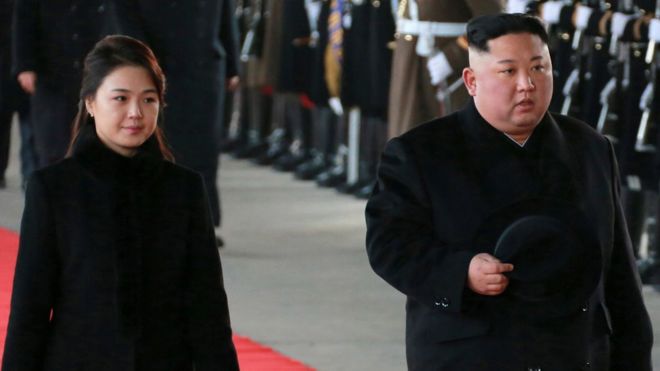
North Korean leader Kim Jong-un and his wife Ri Sol-ju as they prepare to leave for China from Pyongyang, North Korea, 7 January 2019Image copyrightEPA
Image captionMr Kim is visiting China with his wife Ri Sol-ju, state media report

North Korean leader Kim Jong-un has arrived in Beijing for an unannounced visit, at the invitation of Chinese President Xi Jinping.

Mr Kim will be in China until 10 January with his wife Ri Sol-ju, according to state media reports.

The visit comes amid reports that negotiations are under way for a second summit between Mr Kim and US President Donald Trump.

The two met last June, the first such meeting for a sitting US president.

Speculation had grown on Monday that Mr Kim was possibly making his way to China after South Korea’s Yonhap news reported that a North Korean train had been seen crossing the border.

Dozens of security vehicles and officials blocked roads around the train station in the border town of Dandong.

Hotel guests in Dandong had also not been allowed to enter rooms that faced the border, with news outlet Kyodo calling this an “apparent move to prevent the train from being seen”.

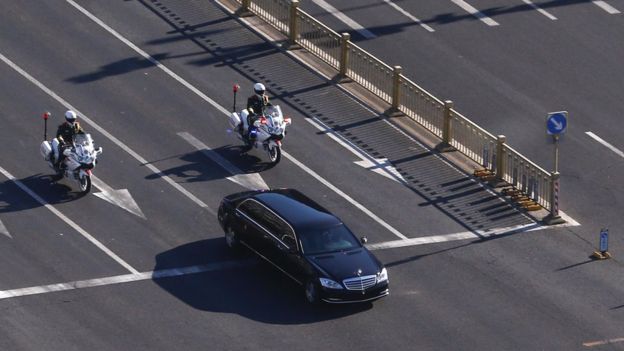
A vehicle that is part of a motorcade that is believed to be carrying North Korean leader Kim Jong Un makes its way through central BeijingImage copyrightREUTERS

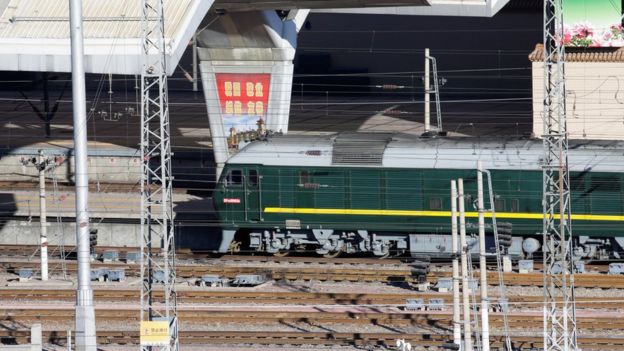
Both countries’ media confirmed the visit on Tuesday morning. Mr Kim’s distinctive green and yellow train arrived at a station in Beijing later in the day.

The train, the same one used during Mr Kim’s first visit to China, resembles the one used by his father Kim Jong-il during his visits to China and Russia in 2011.

A motorcade with heavy security was later seen driving through central Beijing.

A train believed to be carrying North Korean leader Kim Jong Un arrives at Beijing Railway Station in Beijing, China January 8, 2019.Image copyrightREUTERS
Image captionMr Kim travelled to Beijing on his distinctive personal train

Mr Kim’s visit, during which he is being accompanied by several leading North Korean officials, is his fourth to China in less than a year.

Tuesday is also reportedly Mr Kim’s 35th birthday, though his date of birth has never been confirmed by Pyongyang.

China is an important diplomatic ally for North Korea, and one of its main sources of trade and aid.

“[Mr] Kim is eager to remind the Trump administration that he does have diplomatic and economic options besides what Washington and Seoul can offer,” Harry J Kazianis, director of defence studies at the Centre for the National Interest told Reuters.

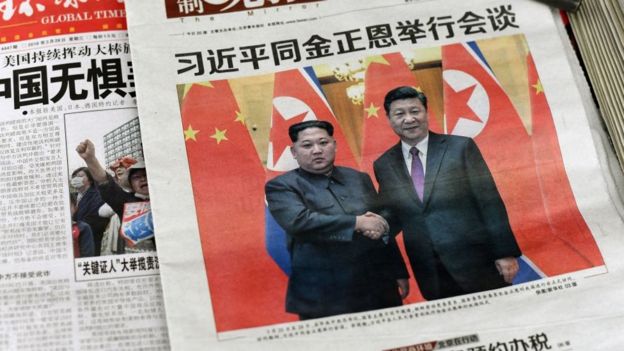
Images of Xi Jinping with Kim Jong Un, are displayed at a newspaper stand in Beijing on March 28, 2018Image copyrightGETTY IMAGES
Image captionMr Kim’s first visit to China came in March last year

Mr Kim, unusually, did not meet Mr Xi for the first six years of his leadership of North Korea.

But last year, he visited China three times. None of the trips was announced in advance.

The BBC’s Laura Bicker in Seoul says two of the trips, which took place ahead of the historic summits with the South Korean leader Moon Jae-in and Mr Trump, were seen by some as a chance to co-ordinate strategy.

The latest three-day visit, our correspondent says, is likely to fuel speculation that a second US-North Korean summit will take place soon.

Earlier this week, Mr Trump said a location for another meeting between the two would be announced in the not-too-distant-future.

Mr Trump told reporters in Washington DC that “a good dialogue” was taking place with North Korea, but that sanctions on Pyongyang would remain in place.

In his annual new year’s speech last week, Mr Kim said he was committed to denuclearisation, but warned that he would change course if US sanctions remained.

Diplomatic progress between Mr Trump and Mr Kim has stalled since the Singapore summit. Both parties signed a pledge at the time to denuclearise the Korean peninsula, though it was never clear what this would entail.

08/01/2019

Slight Chinese nurse saves heavyweight patient from hospital window leap attempt

  • Patient struggled and tried to bite her as she clung on to his arm for eight minutes until help arrived
PUBLISHED : Tuesday, 08 January, 2019, 5:40pm
UPDATED : Tuesday, 08 January, 2019, 5:40pm
Martin Choi

<a class="scmp-icon-cross" onclick="popoverClose(this);"></a><h3 class="popover-title"></h3>

” data-original-title=””> 

21SHARE

RELATED TOPICS

Related Articles

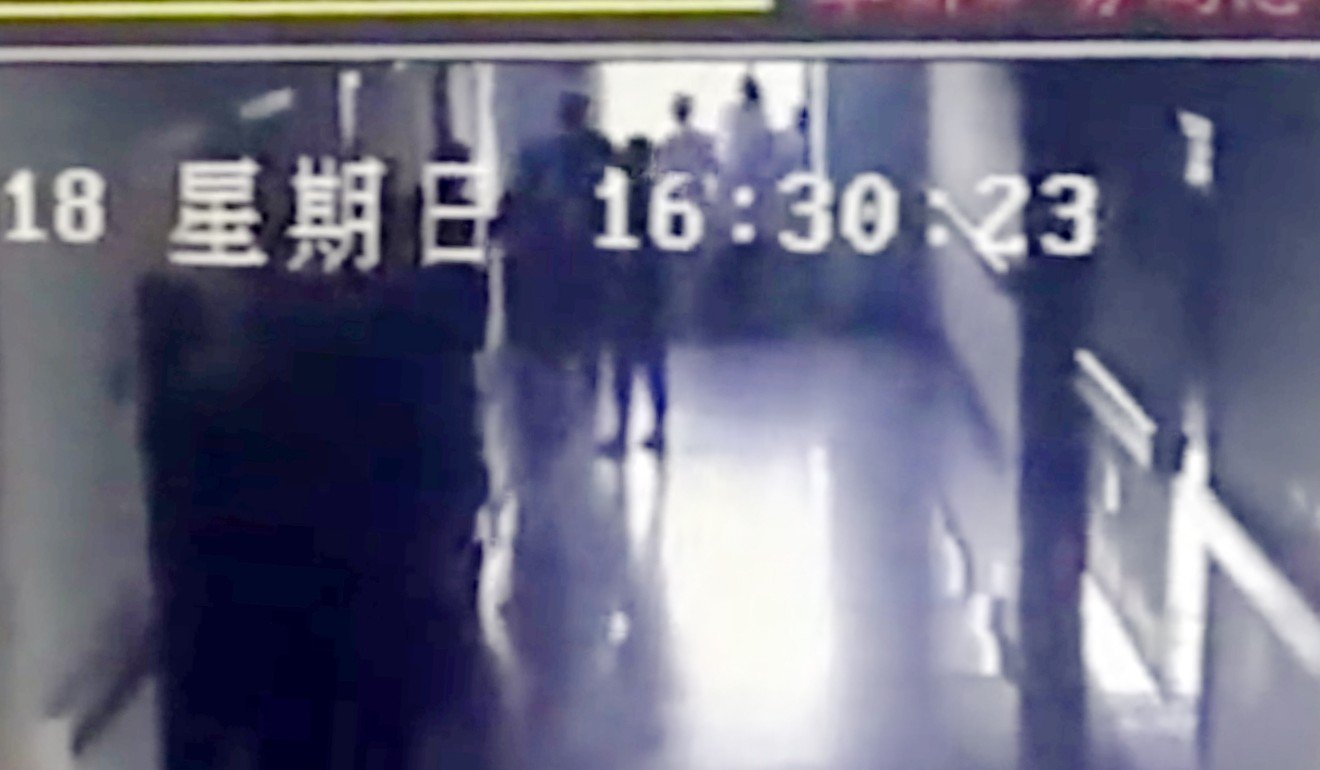
A slightly-built female nurse managed to hang on to a heavyweight patient as he dangled out of a 13th floor hospital window while struggling to escape her grasp.

Nurse Dong Jing grabbed the 80kg (176 pounds) man’s arm and held on to him for eight minutes until rescuers arrived at the hospital in Liaoning province, northeastern China.

The 52-year-old patient, a farmer surnamed Fu, smashed the window with a chair and was grabbed by Dong – who weighs around 50kg (110 pounds) and is less than 160cm tall (5ft 2in) tall – as he jumped out.

Colleagues and patients in the ward rushed to her aid but all they could do was apply their own weight to Dong as she held on to the man with her right hand through the 50cm (19.6 inches) window space until security guards and police arrived.

The man, who was around 178cm (5ft 8in) tall, tried to break free from Dong’s grip, making several attempts to bite her arm, according to the Liaoshen Evening Newspaper.

“He tore three buttons off my undergarments with his teeth. Any longer, and it would have been too late,” Dong said.

“I’m not very strong. I was able to hold on to him, not because of my strength, but the conviction that I could not let him go,” she told local media.

“Although I’m a girl, there was only one thought in my mind: to save a life.”

Dong, who has been a nurse at the General Hospital of Mining Industry Group Fuxin in Liaoning for 12 years, couldn’t feel anything in her swollen right arm after the incident, and was diagnosed with nerve injury.

Feng Chunwei, the hospital’s chief orthopaedic surgeon, said Dong’s recovery from the brachial plexus injury would take time, and that she would be monitored for the next three months.

Surgery was not ruled out if she did not recover in that time.

Although her heroic act may leave its mark on her right arm, Dong told local media she did not regret her actions.

“As long as I held on, there was a possibility he could live,” she said.

According to local media reports, the man had been under pressure after his wife passed away due to illness, leaving him to care for their disabled child.

08/01/2019

China to expand investment in civil aviation sector in 2019

BEIJING, Jan. 7 (Xinhua) — China’s civil aviation regulator said Monday that the country aimed to expand its fixed-asset investment in the civil aviation sector to 85 billion yuan (about 12.41 billion U.S. dollars) in 2019.

This was compared with 81 billion yuan made in 2018, according to the Civil Aviation Administration of China (CAAC).

Total transport turnover of the country’s civil aviation industry was expected to rise 11.8 percent year-on-year to 136 billion tonne-kilometers in 2019, said Feng Zhenglin, head of the CAAC, at a work conference.

Passenger transport volume as well as cargo and mail transport volume are likely to increase 11 percent and 5.7 percent respectively this year, according to the CAAC.

Feng said the civil aviation industry had made remarkable achievements last year, with the total transport turnover up 11.4 percent year-on-year to 120.64 billion tonne-kilometers.

In 2018, 167 new international flight routes were launched, with 105 of them linking domestic cities with countries along the Belt and Road, taking number of China’s total flight routes to 4,206.

Efforts will be made to push forward the construction of Beijing’s new international airport and ensure its opening to air traffic at the end of September this year, Feng said.

He said as of the end of 2018, 55.49 billion yuan had been invested Beijing Daxing International Airport. The new airport is expected to handle 45 million passengers annually by 2021 and 72 million by 2025.

08/01/2019

Chinese vice president to attend WEF annual meeting in Davos

BEIJING, Jan. 7 (Xinhua) — Chinese Vice President Wang Qishan will visit Switzerland and attend the World Economic Forum (WEF) annual meeting in Davos from Jan. 21 to 24, a Foreign Ministry spokesperson announced Monday.

Wang is making the visit and attending WEF annual meeting at the invitation of Ueli Maurer, president of Swiss Confederation, and WEF Founder and Executive Chairman Klaus Schwab, spokesperson Lu Kang said.

During his attendance at the WEF annual meeting, Wang will deliver a speech, meet with Schwab, and exchange views with those attending the meeting, Lu said at a press briefing.

Responding to external views and comments on the economic situation in China, Lu said that China’s economy has on the whole maintained stable performance and is making progress.

Lu said that in spite of external uncertainties and unstable factors, the positive momentum of China’s economy over the long run will remain unchanged, as China enjoys “enough resilience and great potential” for its development.

“We are strongly confident about the positive momentum of China’s economic fundamentals over the long run, as well as achieving the goal of maintaining a medium-high rate of growth while advancing toward a medium-high level of development,” he added.

At the upcoming WEF annual meeting, Wang will further expound on China’s views and propositions about its development, economic globalization, and other major international issues, according to the spokesperson.

“We welcome all parties to work with China, based on the principle of seeking shared benefits via extensive consultation and joint contribution, to advance an open world economy and the common development of humanity,” Lu said.

08/01/2019

Senegal hopes to further advance cooperation with China: president

SENEGAL-DAKAR-CHINA-WANG YI-MEETING

Senegalese President Macky Sall (L) meets with Chinese State Councilor and Foreign Minister Wang Yi in Dakar, Senegal, on Jan. 6, 2019. (Xinhua/Wang Teng)

DAKAR, Jan. 7 (Xinhua) — The dynamic and practical relations between Senegal and China are a fine example for other countries, and Senegal hopes to further cooperation with China in various fields, President Macky Sall said on Sunday.

He made the remarks during talks with visiting Chinese State Councilor and Foreign Minister Wang Yi.

Sall extended congratulations upon the successful soft landing of China’s Chang’e-4 lunar probe on the far side of the moon, saying that his country is willing to strengthen cooperation with China in such fields as science, technology and innovation.

The successful Beijing Summit of the Forum on China-Africa Cooperation (FOCAC) in 2018 shows China’s strategic vision to develop China-Africa ties, the president said.

In the hearts of the African people, they know who is a true friend to them, Sall said, adding that Africa and China share a relationship featuring mutual respect, mutual benefit, win-win cooperation and common development.

Sall said Senegal is willing to push forward the comprehensive strategic cooperative partnership with China and will support China’s rightful stance on international affairs.

For his part, Wang said Chinese President Xi Jinping’s successful and historic visit to the West African country in 2018 has injected strong impetus into the two countries’ relations.

The solid political trust between China and Senegal consolidates the foundation for the two countries’ high-quality cooperation in various areas, Wang said.

China is willing to be an enduring and reliable partner for Senegal, the Chinese foreign minister said. He called for closer coordination between China and Senegal, the co-chairs of the FOCAC, to jointly implement the results of the summit and build a closer community with a shared future for China and Africa.

07/01/2019

Exclusive: RBI expected to pay India government up to $5.8 billion interim dividend – sources

NEW DELHI (Reuters) – India’s central bank, having changed management last month following a clash with the government, is likely to transfer an interim dividend of 300-400 billion rupees ($4.32 billion-$5.8 billion) to the government by March, according to three sources with direct knowledge of the matter.

The dividend could help Prime Minister Narendra Modi’s administration bridge a widening budget deficit following a drop in tax collections, and would come after the government pushed the RBI for the additional funds ahead of a national election due by May.

Former finance ministry official Shaktikanta Das was appointed as the new governor of the Reserve Bank of India (RBI), following resignation of Urjit Patel last month amid tensions over the dividend payout and other issues.

The government and RBI have now appointed a panel to look into the issue around the sharing of the RBI’s reserves.

“We are absolutely sure that an interim dividend of more than 300 billion rupees would be paid before March end,” one of the sources told Reuters.

The RBI did not respond to an email seeking comment, while the Finance Ministry declined to comment.

The funds are crucial to meet the fiscal deficit target of 3.3 percent of the GDP for the financial year ending in March, as the government’s revenue shortfall may be as high as 1 trillion rupees, according to two finance ministry officials who declined to be named.

The RBI could make a final decision on the dividend by the time Jaitley presents the government’s budget on Feb. 1, the sources said.

07/01/2019

Centre clears 10 per cent reservation for economically weaker sections

The Narendra Modi government is ready with a bill to introduce 10 per cent reservation for economically backward sections. The constitution amendment bill will be introduced in parliament tomorrow, the last day of the Winter Session.

Hindustan Times, New Delhi

Upper caste reservation,PM Narendra Modi
Modi government has cleared 10 per cent reservation for economically weaker upper castes (Photo | Hindustan Times )

The government has cleared a 10 per cent quota in jobs and educational institutions for the economically weaker sections, sources told Hindustan Times after a Cabinet meeting chaired by Prime Minister Narendra Modi. The government is ready with a Constitution amendment bill which will be introduced in parliament tomorrow, the last day of the Winter Session.

The decision comes months before the government’s tenure is to end in a few months and the country is headed into election mode.

The bill seeks to amend two constitutional provisions, Articles 15 and 16, which prohibit discrimination on any grounds in jobs and admissions to educational institutions.

People who have an annual income less than 8 lakh, own less than 5 acre farm land, have house smaller than 1,000 sq feet in a town or a 100 sq yard house in notified municipal area would qualify for the proposed quotas.

The move, a BJP leader hinted, would come in handy to deal with reservation demands from communities that had been demanding that they be counted as other backward classes, or OBCs that have 27 per cent quota for government jobs and admission to educational institutions.

It would also help the national coalition led by the BJP to consolidate its the upper caste vote, considered one of the three crucial pillars of the BJP’s support base. The other backward classes (OBC), and the new Dalit sub-castes who shifted loyalties, are considered the other two pillars.

Already, the BJP, which had gone to great lengths to neutralise the dilution of the SC/ST atrocities law last year, had ended up antagonising the upper castes far beyond what it had anticipated. In the recent assembly elections where it lost three states to the Congress, there had been anecdotal evidence that the upper castes had, in some cases, shifted.

Dalit leader and junior social justice minister Ramdas Athawale had earlier supposed reservation for upper castes, arguing that since quotas could not be ended, parliament should give 25 per cent reservation to the upper castes.

“I welcome wholeheartedly reservation given to economically… Now the ceiling will be raised from 50 to 60 per cent… Parliament is very much empowered to raise this ceiling,” BJP MP and Udit Raj said.

Law of Unintended Consequences

continuously updated blog about China & India

ChiaHou's Book Reviews

continuously updated blog about China & India

What's wrong with the world; and its economy

continuously updated blog about China & India