Chindia Alert: You’ll be Living in their World Very Soon
aims to alert you to the threats and opportunities that China and India present. China and India require serious attention; case of ‘hidden dragon and crouching tiger’.
Without this attention, governments, businesses and, indeed, individuals may find themselves at a great disadvantage sooner rather than later.
The POSTs (front webpages) are mainly 'cuttings' from reliable sources, updated continuously.
The PAGEs (see Tabs, above) attempt to make the information more meaningful by putting some structure to the information we have researched and assembled since 2006.
Saina Nehwal will play Chen Yufei or Carolina Marin in the final. (AFP)
Saina Nehwal defeated China’s He Bingjiao 18-21, 21-12, 21-18 in their Indonesia Masters semi-final to reach the final.
It was an intense three-set battle before Nehwal held her nerves in the deciding game to win the match. The Indian shuttler started the match strongly but blew a substantial lead to surrender the first game 18-21.
She made a strong comeback in the second game to take it 21-12. The deciding game turned out to be a tense affair as both the shuttlers refused to give an inch to the other. However, Nehwal held her nerves to prevail over her Chinese opponent 21-18 to win the thriller.
Nehwal will play the winner of the other semi-final between Chen Yufei and Carolina Marin for the title on Sunday.
The 70th Republic Day parade showcased a dazzling display of ‘Nari Shakti’, led by the Assam Rifles contingent.
SNS Web | New Delhi | January 26, 2019 10:56 am
Republic Day parade (Photo: Twitter)
As India celebrates its 70th Republic Day on Saturday, Prime Minister Narendra Modi was among the first leaders to greet the nation. The Republic Day parade began after PM Modi paid tributes to the martyrs at the Amar Jawan Jyoti.
South African President Matamela Cyril Ramaphosa is the chief guest for the event.
President Ram Nath Kovind unfurled the National Flag followed which the National Anthem was played with a 21 gun salute.
Lance Naik Nazir Ahmed Wani, who lost his life while killing 6 terrorists in an operation in Kashmir, was awarded the Ashok Chakra. The award was received by his wife and mother from President Ram Nath Kovind.
The underlining theme of this year’s Republic Day celebration is Mahatma Gandhi, as India is celebrating 150th year of his birth.
The parade began from Vijay Chowk and pass through Rajpath, Tilak Marg, Bahadur Shah Zafar (BSZ) Marg, Netaji Subhash Marg and proceed for the Red Fort. CDR Major Heneral Rajpal Punia led the parade at Rajpath.
India’s military might was at display with Captain Navneet Eric of 45 Cavalry commanding T-90 (Bhishma), the main battle tank of the Indian Army, and Captain Devansh Bhutani commanding K-9 Vajra-T, a self-propelled howitzer at the parade.
Twenty-two tableaux of states and central government departments were showcased during the 90-minute parade.
The 70th Republic Day parade showcased a dazzling display of ‘Nari Shakti’, led by the Assam Rifles contingent. A lone woman officer also exhibited bike stunts on Rajpath as part of the iconic daredevil team. Contingents of the Navy, Army Services Corps and a unit of Corps of Signals was led by women officers.
In a first, four veterans of Netaji Subhas Chandra Bose’s Indian National Army, all aged over 90 years, participated in the country’s 70th Republic Day celebrations.
Earlier, Union Minister Arun Jaitley, who is in the United States for medical treatment, extended his greetings to the nation.
Congress President Rahul Gandhi also extended his greetings to the nation.
Elaborate traffic arrangements and restrictions have been put in place in Delhi for smooth conduct of the Republic Day parade that starts from Vijay Chowk and culminates at Red Fort grounds.
The Delhi Traffic police has closed C Hexagon- India Gate for traffic movement from 2 am till parade crosses Tilak Marg.
(This version corrects throughout story to say that the “Fruit Ninja” game deleted by the CAC was not developed by iDreamSky Technology Holdings Ltd, nor distributed by Tencent)
BEIJING (Reuters) – China’s cyber watchdog said on Thursday it has deleted close to 8,000 “malicious” mobile apps, as regulators step up efforts to tighten control over the country’s internet.
The Cyberspace Administration of China (CAC) said in a statement it had ordered telecom operators to shut down the services of 7,873 apps after finding they had overcharged and cheated users as well as stolen information.
It launched the campaign in September with other Chinese government ministries to target “malicious mobile apps that infringe on users’ rights”, the agency said.
Among the apps targeted by the agency was a Chinese version of “Fruit Ninja”, which caused economic losses to users by tricking them into signing up to unwanted fee-based services, the agency said.
There are three games named “Fruit Ninja” registered with China’s publishing regulator and it was unclear which one was deleted by the CAC.
A game with the same name was previously launched by iDreamSky (1119.HK) and distributed by Tencent in 2013. However it was later removed from all channels in 2016, according to iDreamSky.
Other games such as “Bathroom Goddess” and “Naughty Housemaid” that were developed and published by other firms committed “online hooligan activities” like information theft, spamming, and forced downloads.
China’s video game market, the world’s largest, has been under strict scrutiny since last year when authorities stopped approving new titles for almost a year. It recently resumed approvals but industry leaders Tencent and NetEase (NTES.O) have yet to receive any.
Political control of the internet has also tightened under President Xi Jinping, an effort that has accelerated since 2016 as the ruling Communist Party seeks to crack down on dissent on social media.
The CAC on Wednesday said it had deleted more than 7 million pieces of online information as well as 9,382 mobile apps, and criticised a news app run by Tencent for spreading “vulgar and low-brow information.
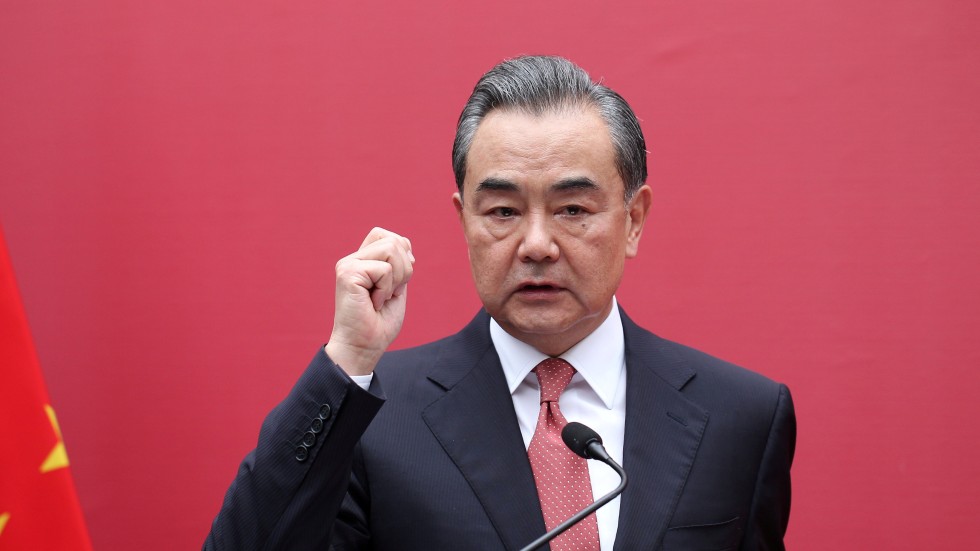
The use of state power to smear or discredit a legitimate business is “not only unfair but also immoral”, China’s Foreign Minister Wang Yi said in Rome on Friday when asked to comment on the recent problems faced by Huawei Technologies.
“Considering the obvious political intentions and manipulation behind it, it is even more unacceptable,” he said, without naming the Chinese telecom equipment giant.
“I believe that all countries should be vigilant and resist this unreasonable practice, and such bullying,” he told reporters from China’s state media at the end of a three-day trip to France and Italy, according to an article on the ministry’s website.
“Of course, every country is entitled to protect their right to maintain information security, but they cannot use security as an excuse to damage or even strangle legitimate business operations,” he said.
“Companies are just companies, and the survival and development of companies must ultimately be determined by market competition. What governments have to do is to provide them with a fair, just and transparent business environment.”
Wang’s comments came after Vodafone Group became the latest Western company to boycott Huawei products. The British telecom conglomerate said on Friday it had suspended its purchases of the Chinese firm’s equipment for the core of its wireless networks.
Huawei is the world’s largest telecom equipment supplier and has been the subject of intense international scrutiny since its chief financial officer Sabrina Meng Wanzhou was arrested in Canada on December 1, pending extradition to the United States.
The US has sought to persuade its allies, including Japan, Australia and New Zealand, not to use Huawei products in their fifth-generation wireless networks, on the grounds Beijing could use them for spying. The telecom giant has denied any such links to the Chinese government.
During his low-key European tour, Wang met French President Emmanuel Macron on Wednesday before attending a ceremony with his opposite number Jean-Yves Le Drian to mark the 55th anniversary of the two countries establishing diplomatic ties on Thursday.
Wang ended his trip on Friday with a meeting in Rome with Italian Prime Minister Giuseppe Conte.
Xi Jinping, general secretary of the Communist Party of China (CPC) Central Committee, delivers a speech while presiding over a group study session of the CPC Central Committee Political Bureau at the People’s Daily in Beijing, capital of China, Jan. 25, 2019. Xi stressed efforts to boost integrated media development and amplify mainstream tone in public communication so as to consolidate the common theoretical foundation for all Party members and all the people to unite and work hard. (Xinhua/Xie Huanchi)
BEIJING, Jan. 25 (Xinhua) — Xi Jinping, general secretary of the Communist Party of China (CPC) Central Committee, on Friday stressed efforts to boost integrated media development and amplify mainstream tone in public communication so as to consolidate the common theoretical foundation for all Party members and all the people to unite and work hard.
Xi made the remarks at a group study session of the CPC Central Committee Political Bureau.
The move will provide strong spiritual strength and public support for the realization of the two centenary goals and the Chinese dream of national rejuvenation, Xi said.
Led by Xi, members of the Political Bureau of the CPC Central Committee visited the People’s Daily on Friday morning.
During the visit, Xi stressed Party newspapers and periodicals should strengthen the development and innovation of their means of communication.
Efforts should be made to develop websites, microblogs, WeChat, electronic newspaper bulletins, mobile newspapers, internet protocol television and other forms of new media to enable the voice of the Party to directly reach all kinds of user terminals and gain new public opinion fields, he added.
The work of news and public opinion is facing new challenges as profound changes have taken place in the ecology of public opinion, the media landscape and the means of communication, Xi said.
The integrated development of the media should be accelerated to make the penetration, guidance, influence, and credibility of the mainstream media more powerful, said Xi, urging for building of competitive, strongly influential new types of mainstream media.
“Priority should be given to mobile platforms,” he said, calling for the exploration of using artificial intelligence in news gathering, generation, distribution, receiving and feedback.
“We should strengthen the management of new media in accordance with the law to ensure a cleaner cyberspace,” Xi stressed.
Xi also asked the mainstream media to provide more authentic and objective information with clear viewpoints in a timely manner, and called for efforts to improve the online content to safeguard the country’s political, cultural and ideological security.
Party committees and governments at all levels should give greater support to integrated media development in terms of policies, funds and talent, he said.
While stressing the status of the People’s Daily as the CPC Central Committee’s official newspaper, Xi demanded the newspaper improve its work to give full play to its key role in guiding public opinion.
Chinese Premier Li Keqiang has a discussion with some foreign experts working in China prior to the Chinese Lunar New Year, which falls on Feb. 5 this year, at the Great Hall of the People in Beijing, capital of China, Jan. 25, 2019. (Xinhua/Yao Dawei)
BEIJING, Jan. 25 (Xinhua) — Chinese Premier Li Keqiang said Friday that the country has full confidence and capability to keep economic growth rate within an appropriate range in 2019 despite challenges.
The remarks came as Li had a discussion with some foreign experts working in China at the Great Hall of the People in downtown Beijing prior to the Chinese Lunar New Year, which falls on Feb. 5 this year.
“China’s economy has enough resilience, potential and ample room for growth, especially with a huge domestic market and rich human resources of nearly 1.4 billion people, therefore, we are fully confident and capable of keeping economic growth rate within an appropriate range in spite of multiple risks and challenges in 2019,” Li told foreign experts.
China’s economy, the world’s second largest, grew 6.6 percent year on year to reach 90.0309 trillion yuan (about 13.28 trillion U.S. dollars) in 2018, above the official target of around 6.5 percent, according to data issued by the National Bureau of Statistics on Monday.
“The growth rate of 6.6 precent is hard-won, as it is on the basis of China’s very high economic output, fairly sufficient employment and continuous improvement of environment,” said Li.
China will forge ahead with reforms unswervingly and inspire the vitality and creativity of some 100 million market entities, Li said.
He said China will further streamline administration, delegate more power, strengthen regulation, provide better services, reduce taxes and fees on a larger scale, further ease market access and provide a business environment of fair competition.
China is committed to opening wider to the outside world and learning advanced technology and experience from foreign countries, he said.
As a developing country, China will stick to inclusive development, said Li.
“China welcomes the entry of all competitive commodities and technology in the world, and we will strictly protect intellectual property rights and speed up the market transformation of innovation results,” the premier said.
Li had an in-depth exchange of views with renowned experts from the United States, Germany, Britain, Cuba and Sweden about their advice and suggestions on issues including economic growth, scientific innovation, intelligence manufacturing and environment protection.
The experts were Paul Romer, Nobel laureate in economics and professor at New York University; Peter Sachsenmeier, member of the National Academy of Sciences and Engineering of Germany and professor at Oxford University; Konstantin Novoselov, Nobel laureate in physics and professor at the University of Manchester; Juan Jesus Guanche Perez, a Cuban academician and vice president of Hebei Foreign Studies University; and Christopher Flensborg, a Swedish expert in finance.
Welcoming foreign experts to work in China, Li said China will further improve policies to better facilitate their work and life and hopes that they will offer more advice to promote the common development of China and the world.
BEIJING, Jan. 25 (Xinhua) — Chinese President Xi Jinping sent a congratulatory message on the launch of the China-Laos Tourism Year 2019 in Vientiane on Friday, expressing his hope for deepening understanding and friendship between the two peoples.
Noting that China and Laos enjoy mutual political support, comprehensive economic cooperation and constant deepening of traditional friendship, Xi said China views Laos as a good neighbor, friend, comrade and partner. He also said China is willing to work with the Laotian side to better dovetail development strategies, enhance cooperation on Belt and Road construction, and promote the China-Laos comprehensive strategic partnership of cooperation to achieve new fruits.
China and Laos both have brilliant cultures and beautiful sceneries, Xi said. People of both countries, drinking water from the same river, have the strong aspiration to deepen mutual understanding and friendship, the Chinese president added.
Xi said he hopes the two countries will take the chance of holding the year of tourism to expand people-to-people and cultural exchanges, and to consolidate the public and social basis for the building of a China-Laos community of shared future.
The agreement to hold the China-Laos Tourism Year was reached during the talks between Xi and visiting Laotian President Bounnhang Vorachit in Beijing in May 2018.
Both sides will jointly hold exhibitions, artistic performances, forums, training programs and other events, to promote mutual understanding and friendship, as well as to make contributions to building a China-Laos community of shared future.
Italian Prime Minister Giuseppe Conte (R) meets with Chinese State Councilor and Foreign Minister Wang Yi at Palazzo Chigi, the Italian prime minister’s office, in Rome, Italy, Jan. 25, 2019. (Xinhua/Cheng Tingting)
ROME, Jan. 25 (Xinhua) — Chinese State Councilor and Foreign Minister Wang Yi and Italian Prime Minister Giuseppe Conte agreed on Friday to push bilateral ties to a new high.
During their meeting at Palazzo Chigi, the Italian prime minister’s office, Conte asked Wang to convey his sincere greetings to Chinese President Xi Jinping and Prime Minister Li Keqiang.
Italy attaches great importance to Italy-China relations and hopes to maintain high-level exchanges with China and deepen mutual cooperation in such areas as economy, trade, investment and energy, said Conte.
Italy also attaches great importance to the cooperation under the frame of the Belt and Road Initiative and is willing to make joint efforts with China to continuously cultivate new growth points for bilateral cooperation,Conte said added.
Wang conveyed Chinese leaders’ cordial greetings to Conte.
As the respective birthplace of Eastern and Western civilizations, China and Italy have enjoyed friendly exchanges since ancient times, Wang said.
This year marks the 15th anniversary of the China-Italy comprehensive strategic partnership, and the next year will mark the 50th anniversary of the establishment of the diplomatic relations, Wang noted, expressing the hope that both sides seize the opportunity to lift bilateral relations to a new high.
China and Italy should understand and support each other and establish a long-lasting comprehensive strategic partnership regardless of how the international situation changes, Wang said.
Wang also said Italy is a natural partner to cooperate with under the Belt and Road Initiative and that China welcomes Italy to actively participate in the construction of the Belt and Road to benefit the two peoples and promote Eurasian interconnection and development.
China has been expanding its opening-up and its market potential has been steadily released, which will bring significant opportunities to various countries including Italy, Wang said.
As the Chinese and Italian economies are highly complementary, Wang said, enhancing cooperation in such fields as manufacturing, agriculture and innovation will surely bring tangible benefits to the two peoples.
Wang also noted that China is willing to encourage qualified Chinese companies to invest in Italy and believes Italy will provide them with a fair commercial environment.
Wang arrived in Italy on Friday to attend the ninth joint meeting of the China-Italy Government Committee at the invitation of Italian Foreign Minister Enzo Moavero Milanesi, with whom he also held talks.
Li Zhanshu (R), chairman of China’s National People’s Congress (NPC) Standing Committee, holds talks with Maya Fernandez Allende, president of the Chilean Chamber of Deputies, in Beijing, capital of China, Jan. 25, 2019. (Xinhua/Liu Weibing)
BEIJING, Jan. 25 (Xinhua) — China’s top legislator Li Zhanshu held talks with Maya Fernandez Allende, president of the Chilean Chamber of Deputies, in Beijing Friday.
Hailing the traditional friendship between the two countries, Li, chairman of China’s National People’s Congress (NPC) Standing Committee, said the precious experience of bilateral friendship should be passed down and carried forward.
“We are glad to see that China-Chile relations have been upgraded to a comprehensive strategic partnership and have yield cooperative results in various fields,” said Li, adding that those achievements were derived from “sincere treatment, mutual respect and trust, complementary advantages, mutually beneficial and win-win results” between the two countries.
China-Chile relations will embrace new opportunities in the next two years, said the top legislator, calling on the two sides to enhance friendly cooperation in various fields and promote comprehensive strategic partnership for continued development featuring exchanges of two heads of state and jointly building the Belt and Road.
“China stands ready to work with Chile and countries around the world to build a community of a shared future featuring equality, mutual benefit and common development, but not targeting or excluding any third party,” he said.
On enhancing cooperation between the two legislative bodies, Li called on the NPC and the National Congress of Chile to continue to give full play to the political communication committee, expand experience exchanges on legislation, supervision and governance, guarantee the joint construction of the Belt and Road and expansion of economic and trade cooperation in compliance with rule of law, optimize the business environment, and promote cultural and people-to-people exchanges and cooperation between the two countries.
Fernandez said the National Congress of Chile stands ready to work with the NPC of China to continue to give full play to communication mechanism and platform, explore cooperation potential, facilitate people-to-people exchanges, and constantly enrich the connotation of bilateral relations. She said Chile will, as always, adhere to the one-China policy.
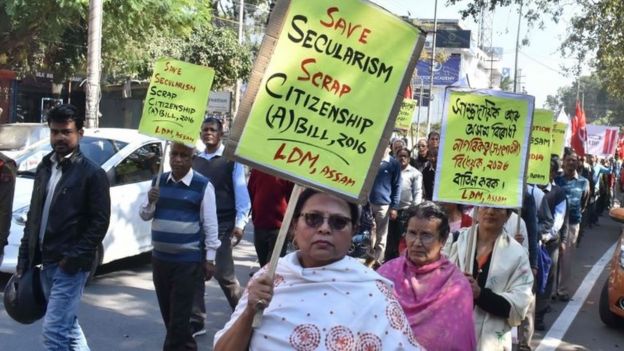
The bill attempts to grant citizenship to immigrants who are not Muslim.
Students, activists, politicians and celebrities have all joined the protests against India’s ruling party.
What does the bill say?
The Citizenship (Amendment) bill seeks to provide citizenship to non-Muslim migrants from Pakistan, Bangladesh and Afghanistan.
Supporters of the bill defend it by saying that Muslims have been excluded as the bill offers Indian nationality only to religious minorities fleeing persecution in neighbouring countries.
It comes months after the publication of the National Register of Citizens (NRC) – a list of people who can prove they came to the state by 24 March 1971, a day before neighbouring Bangladesh became an independent country. Around 3.62 million of those left off the register have submitted claims for inclusion again.
Media captionLiving in limbo: Assam’s four million unwanted
India said the process was needed to identify illegal Bangladeshi migrants.
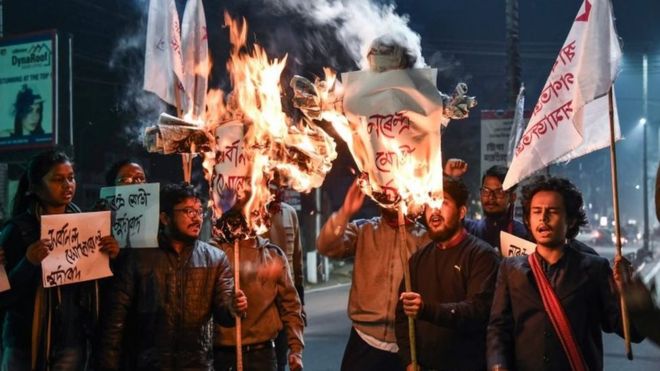
Thousands of students have joined writers, artists and activists in regular protests against the bill, fearing that tens of thousands of Bengali Hindu migrants who were not included in the NRC may still get citizenship to stay on in the state.
How bad are the protests?
Offices of the Bharatiya Janata Party (BJP), which runs both the federal government and Assam’s state government, have been burnt down by angry mobs in many places.
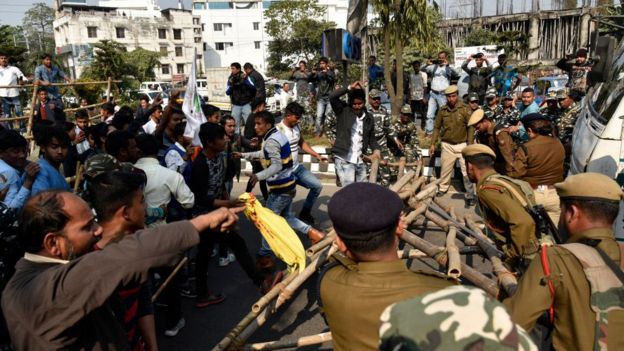
Protesters have also frequently surrounded the state secretariat in the capital, Guwahati, demanding the shelving of the amendment.
Some supporters of Assamese peasant leader Akhil Gogoi even staged a nude protest in the national capital, Delhi, earlier this month.
“The movement against the bill has gained momentum across the north-east and if it is not withdrawn, the situation in the region may turn volatile,” Sammujal Bhattacharyya of the All Assam Students Union (Aasu), which is leading the protests against the bill in Assam, told the BBC.
He said it was an attempt to provide citizenship “by backdoor” to illegal non-Muslim migrants who were excluded from the NRC.
Image copyrightGETTY IMAGESImage captionAssam has seen vocal protests against the bill
In the early 1980s, Aasu was behind the anti-migrant protests in Assam that paralysed the state and degenerated into rioting that led to more than 3,000 deaths.
The agitation ended in 1985 after March 1971 was agreed as the cut-off date to determine citizenship.
Why is the BJP determined to get the bill through?
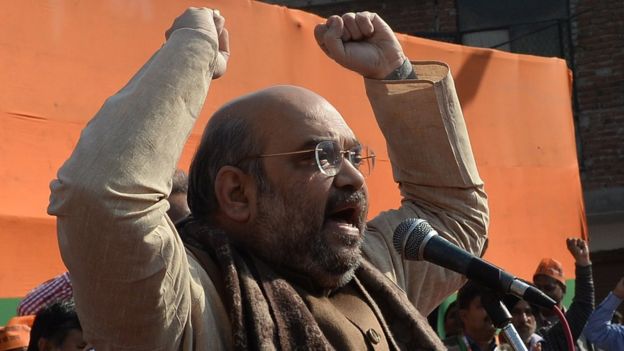
Despite the protests, BJP president Amit Shah has insisted that the government is determined to pass the bill.
“Hindus from these countries have nothing to fear, they will all get Indian citizenship,” Mr Shah told a rally in West Bengal state this week. Analysts say it’s an obvious attempt to win over Bengali Hindus to the BJP’s cause.
The Bengali Hindus are in a majority in the states of West Bengal and Tripura, with substantial numbers in Assam. The three states together will account for 58 seats in upcoming general elections.
Image copyrightGETTY IMAGESImage caption BJP president Amit Shah has said the government is committed to pass the bill
But while the BJP may seek to win many of these seats to offset possible losses in north India, it risks losing the support of the ethnic Assamese, who voted for the party in the 2016 state elections.
Assam Chief Minister Sarbananda Sonowal, himself a former Aasu leader, is on the defensive, requesting students not to join the agitation which, he says, is fuelled by “misinformation”.
“Nobody will automatically get citizenship if the amendment is passed into law. The government will closely examine all applications and reject those that are not tenable,” he said this week.
What are the other reactions to the bill?
India’s main opposition Congress party opposes the bill on the grounds that determining citizenship on the basis of religion goes against the spirit of the constitution.
Regional parties who have joined hands with the BJP to form governments in Assam and the neighbouring states of Meghalaya, Nagaland and Mizoram have threatened to renege on their alliances because they all oppose the bill.
Image copyrightAFPImage caption Demands to scrap the bill have been growing louder
“Anyone who came to Assam after March 1971 is a foreigner, an illegal migrant. We don’t care if he or she is Hindu or Muslim. Religion is not the issue here, it is a question of protecting indigenous people from being swamped by foreigners in their own land,” university student Mitali Baruah told the BBC as she marched to a protest rally.
That has been the dominant sentiment with most of the indigenous communities – a migrant is unwelcome, regardless of religion.
“The BJP has failed to understand the pulse of the region, because they see everything through the prism of religion,” said analyst Samir Purkayastha.







 CHINDIA ALERT: You'll be living in their world, very soon

COMMENTS: 6