Chindia Alert: You’ll be Living in their World Very Soon
aims to alert you to the threats and opportunities that China and India present. China and India require serious attention; case of ‘hidden dragon and crouching tiger’.
Without this attention, governments, businesses and, indeed, individuals may find themselves at a great disadvantage sooner rather than later.
The POSTs (front webpages) are mainly 'cuttings' from reliable sources, updated continuously.
The PAGEs (see Tabs, above) attempt to make the information more meaningful by putting some structure to the information we have researched and assembled since 2006.
The remarks by Pitroda come on a day when the Pakistan High Commission in Delhi is hosting the reception for the Pakistan National Day, the invite to which has been declined by India.
SNS Web | New Delhi | March 22, 2019 12:11 pm
Lashing out heavily at the Congress after Sam Pitroda’s remarks on the IAF strike, Prime Minister Narendra Modi on Friday said the most trusted advisor and guide of Rahul Gandhi has kickstarted the Pakistan National Day celebrations on behalf of the Congress, ironically by demeaning Indian armed forces.
The PM said the Opposition has insulted the country’s armed forces time and again.
Sparking a massive controversy, Gandhi’s close confidant and Chairman of Indian Overseas Congress Sam Pitroda earlier in the day made shocking remarks on the IAF strike questioning the death toll in Balakot after the Indian Air Force dropped bombs on JeM camps in a pre-dawn attack on February 26.
Questioning the strike impact, Pitroda asked, “I would like to know more as I have read in New York Times and other newspapers, what did we really attack, we really killed 300 people?”
“If you say 300 people were killed, we all need to know that; all Indians need to know that. Then comes the global media which says nobody was killed. I look bad as an Indian citizen,” he added.
Referring to the 26/11 Mumbai terror attacks that killed 166 people, Sam Pitroda further said, “Eight people come and do something, you don’t jump on an entire nation. It is naive to assume that just because some people came here and attacked, every citizen of that nation is to be blamed. I don’t believe in that way”.
He also said that “attacks happen all the time, it also happened in Mumbai”, adding that the government could have then reacted and just sent fighter planes, but that is not the right approach”.
The Indian Overseas Congress chief further said that it was not the right approach by the Government to send Indian fighters to deal with issues like terror attacks.
Taking a dig at the Congress, PM Modi reacted saying the “loyal courtier of Congress’ royal dynasty admits what the nation already knew – that the Congress was unwilling to respond to forces of terror”.
“This is a New India – we will answer terrorists in a language they understand and with interest,” PM Modi.
The Prime Minister further appealed to the citizens of the country to question the Opposition leaders on their statements and let them know that the 130 crore Indians will not forgive or forget the Opposition for their antics.Union Minister Smriti Irani too hit back at the Congress saying “now the nation knows why Rahul Gandhi’s UPA chose not to respond with full might post the Mumbai terror attacks”, adding that “Congress sympathies with Pakistan stands exposed”.
The remarks by Pitroda come on a day when the Pakistan High Commission in Delhi is hosting the reception for the Pakistan National Day, the invite to which has been declined by the Government citing the presence of Hurriyat leaders.
Many Congress leaders have demanded proof of the retaliatory assault and casualties in the aftermath of the Pulwama terror attack that left over 44 CRPF men dead on February 14.
Following the Pulwama attack, India carried out “non-military pre-emptive” airstrikes targeting the JeM training camp in Balakot in Pakistan’s restive Khyber Pakhtunkhwa province, about 80-km from the Line of Control (LoC) early on February 26.
Hours after the pre-dawn offensive, Government sources had claimed that over 300 terrorists were killed.
The sparring between the government and the opposition intensified after BJP chief Amit Shah claimed that “more than 250” terrorists were killed in the operation, even when the government was yet to give out an official count of the terrorists killed.
BEIJING, March 20 (Xinhua) — China reiterated its stance on China-Africa cooperation on Wednesday, calling for more countries to think highly of Africa.
Foreign Ministry spokesperson Geng Shuang made the remarks at a press briefing in response to the groundless accusations made against China’s policy towards Africa, such as the Mombasa-Nairobi Standard Gauge Railway (SGR) Project in Kenya will put the country in debt.
Geng cited Kenyan President Uhuru Kenyatta as saying that “in recent years, Kenya-China relations have become closer and closer, and cooperation between the two countries has become tighter in such fields as industry and infrastructure construction.”
The SGR is one of the most ambitious infrastructure projects in Africa and has brought great changes to the lives of the Kenyan people, the president said.
Geng said China appreciates that the leaders of many African countries, including Djibouti and Kenya, and people of insight from all walks of life have a fair evaluation of China-Africa relations and China-Africa cooperation.
China will intensify pragmatic cooperation in various fields with African countries under the Belt and Road Initiative, steadily implement the consensus reached by Chinese and African leaders and promote constant development of the China-Africa comprehensive strategic cooperative partnership.
“We hope more countries will truly pay attention to Africa, attach importance to Africa, and invest in Africa, and work together with China to help Africa’s peace, stability, development and prosperity,” he added.
SHANGHAI, March 20 (Xinhua) — The number of licensed social workers in Shanghai has increased by over 10,000 from the end of 2017 to reach 27,344, according to data released by the Shanghai Civil Affairs Bureau.
As one of the first Chinese cities to pilot social work, Shanghai has witnessed healthy growth of professional social work organizations over the years, said Gu Donghui, president of the Shanghai Association of Social Workers.
There are currently 603 such organizations in the eastern metropolis, and many are offering more innovative services, according to Gu.
On Tuesday, Shanghai Children’s Hospital released six cartoon figures each representing a social worker in the hospital to help child patients be more familiar with them.
“Social workers in children’s hospital used to wear the same white gown as doctors, making it difficult for them to connect with the children,” said Niu Jun, head of the social work department of the hospital.
The number of licensed social workers has exceeded 440,000 in China, while registered volunteers have surpassed 100 million, according to the Ministry of Civil Affairs.
Chinese President Xi Jinping (R) meets with president of Harvard University Lawrence Bacow at the Great Hall of the People in Beijing, capital of China, March 20, 2019. (Xinhua/Li Tao)
BEIJING, March 20 (Xinhua) — Chinese President Xi Jinping met with president of Harvard University Lawrence Bacow in Beijing Wednesday and expressed the hope that Sino-U.S. cultural and people-to-people exchanges could produce more positive results.
Noting that this is Bacow first overseas visit after taking office, Xi said the tour showcases the importance attached by Bacow to Sino-U.S. education exchanges.
Xi said education exchanges and cooperation are an important part of Sino-U.S. relations and help enhance the public opinion of the bilateral friendship. China advocates mutual learning, encourages Chinese students to study abroad and supports education exchanges and cooperation with other countries.
Xi said that he felt very happy that U.S. President Donald Trump also expressed support for bilateral cultural and people-to-people exchanges and cooperation in their meeting in Argentina at the end of last year.
Xi stressed that over the past 40 years of reform and opening up, China’s rapid development has also benefited from the improvement of education. China is committed to advancing the modernization of education and making its education system satisfying for its people.
“We will expand the opening up of education, strengthen exchanges and experiences sharing with countries around the world, and jointly promote the development of education,” said Xi, expressing the willingness to conduct more extensive exchanges and cooperation with U.S. educational and research institutions such as Harvard University.
Bacow said he is visiting not only as the president of Harvard University but also as a representative of U.S. universities to promote education exchanges with China.
He said maintaining and deepening exchanges and cooperation between the two countries’ education and cultural institutions is crucial to promoting U.S.-China relations in the long run. Hailing the popularity of the Chinese language at Harvard, Bacow boasted that Harvard has a large number of Chinese students.
Bacow said it is admirable that the Chinese government attaches great importance to higher education and makes huge efforts in this regard, noting that Harvard will continue to promote exchanges and cooperation with Chinese educational and scientific research institutions.
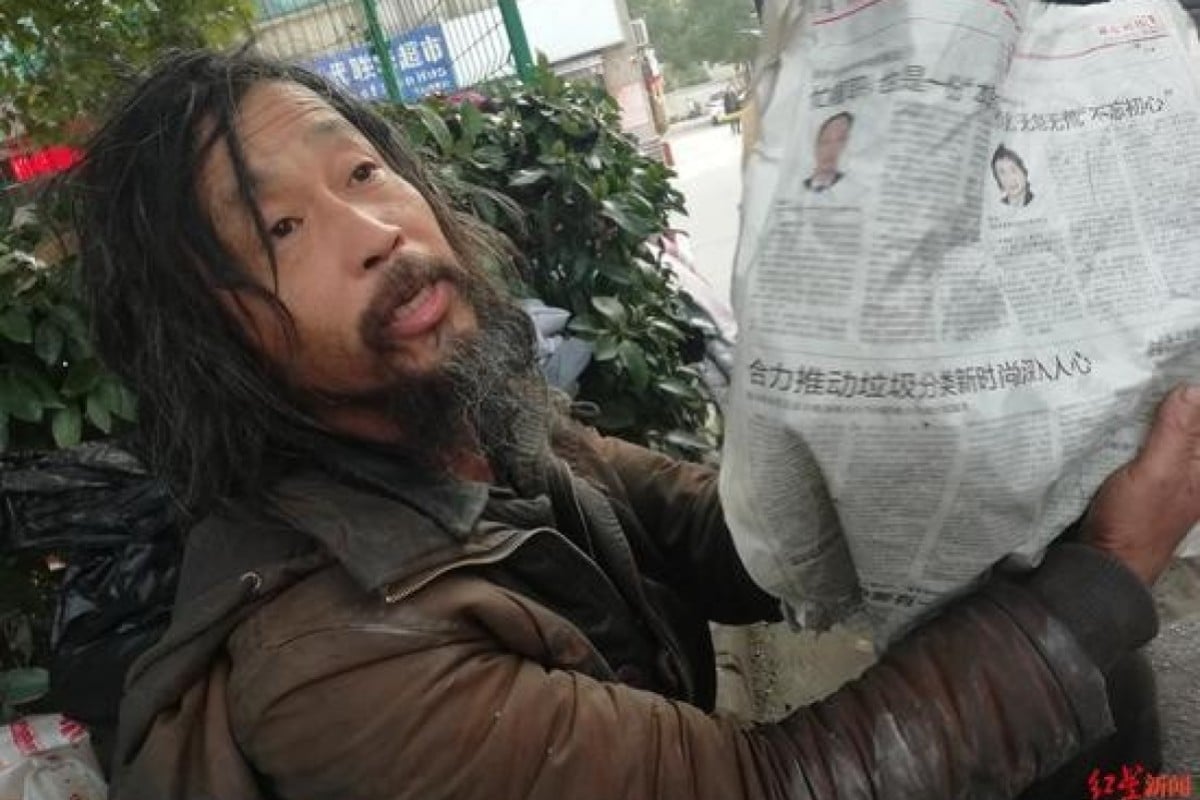
Online influencers try to gain an advantage from homeless man’s wisdom and learning, but he says all he cares about is reading
Shen Wei has been living on the streets for 17 years and says he just wants to be left in peace after his online brush with fame
Shen Wei was filmed discussing literary classics including the Analects of Confucius. Photo: Red Star News
A homeless man in Shanghai has become an overnight celebrity for his eloquent commentary on classic Chinese texts such as the Analects of Confucius.
Videos of Shen Wei have been gaining momentum on Chinese social media since Wednesday, earning at least 14 million post views on microblogging site Weibo.
But despite the attention he has attracted, Shen said he would rather be left alone and told people that if they really cared about him they should read more books.
In one of these videos, the scavenger was filmed discussing the merits of Liao Fan’s Four Lessons, a Ming dynasty work from the 16th century, and the Analects.
Other videos show dozens of people swarming around him with their phones held out to catch a shot of him near an unfurnished building.
A March 20 video report by Thepaper.cn said they were online influencers hoping an appearance of Shen in their videos would gain them more views.
The report also showed several well-dressed young women seen live streaming with Shen before being ushered away by others who want their turn.
But Shen appeared unconcerned about his brush with online fame and dismissed suggestions that he was to be pitied.
“Since I was young, everything I’ve done has always been about reading,” Shen told news portal Thepaper.cn.
Young women were seen queueing up to livestream themselves with Shen. Photo: The Paper
He told Red Star News he has been living on the streets of the city’s Pudong district since he was evicted from his flat in 2002.
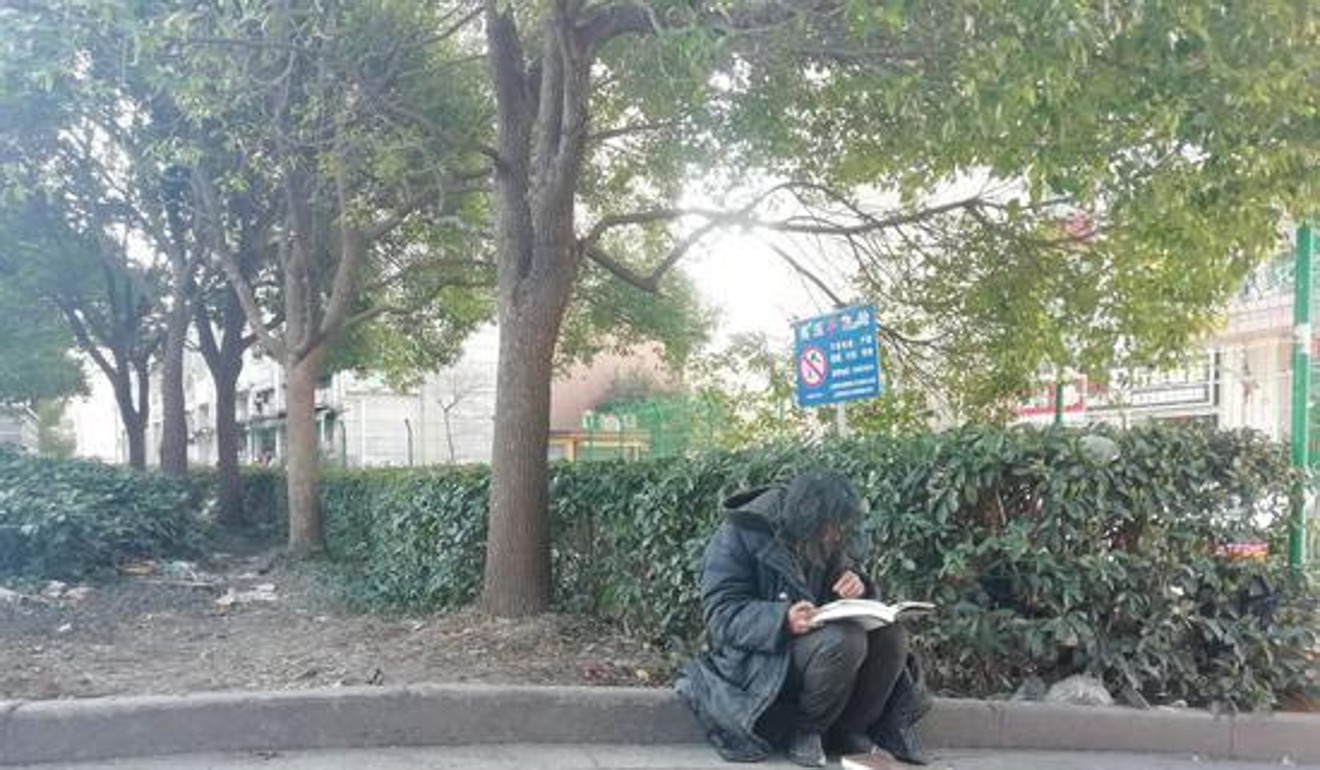
Shen spends most of his days picking rubbish and sorting through it and also enjoys reading, drawing and caring for stray cats.
When he was young, he did not have enough money to buy books, he continued. So he picked rubbish and sold whatever was valuable. The habit stayed with him, even after he started working at the Xuhui district audit bureau.
His manager reprimanded him for collecting rubbish at work and thought he had a mental illness and decided to suspend him.
He is still technically an employee of the bureau and has been on sick leave since 1993. Shen continues to receive a sickness benefit of around 2000 yuan (US$300) a month, according to the report. The bureau said it was looking into why he continues to be paid after all these years.
The former civil servant has been sent to a psychiatric hospital for assessment twice, according to Thepaper. The results of the assessment were not known.
The 52-year-old also said that his brother and two sisters had cut off contact with him.
Shen said he wanted to be left in peace to read. Photo: Red Star News
But despite an outpouring of sympathy on social media, Shen did not take kindly to the attention he received.
“At first glance, I pitied him. When he started speaking about the knowledge in the books, I pitied myself,” a Weibo user from Sichuan wrote. “He might be wearing ragged clothes but he has dignity and freedom. Many of us are dressed in suits but are constrained by our materialism.”
“Out of politeness, I won’t turn away anyone… But if you really care about me, please read more books,” Shen said in the video. “I can’t really handle this. I just want peace and quiet. I don’t want the attention.”
The online influencers who helped bring him to public attention also attracted widespread criticism for apparently taking advantage of his situation.
“What kind of world is this? Before nobody paid him any attention. Now internet influencers are buzzing around him like flies,” one user commented.
Image copyrightGETTY IMAGESImage captionChina has bought up a majority stake in the Greek port of Piraeus – and Italy might be next
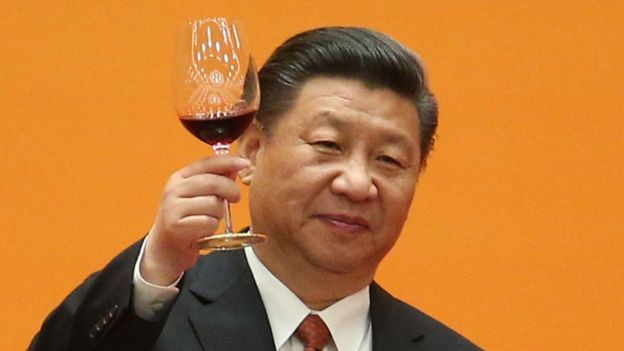
China’s president lands in Rome on Thursday, where he is expected to sign a landmark infrastructure deal that has raised eyebrows and suspicions among Italy’s Western allies.
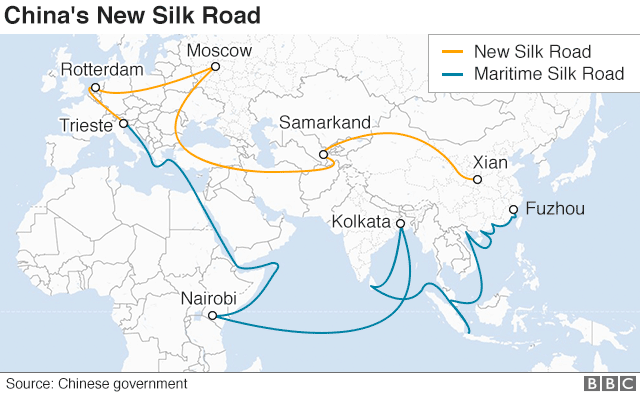
Xi Jinping’s project is a New Silk Road which, just like the ancient trade route, aims to link China to Europe.
The upside for Italy is a potential flood of investment and greater access to Chinese markets and raw materials.
But amid China’s growing influence and questions over its intentions, Italy’s Western allies in the European Union and United States have concerns.
By land and by sea
The New Silk Road has another name – the Belt and Road Initiative (BRI) – and it involves a wave of Chinese funding for major infrastructure projects around the world, in a bid to speed Chinese goods to markets further afield.
It has already funded trains, roads, and ports, with Chinese construction firms given lucrative contracts to connect ports and cities – funded by loans from Chinese banks.
The levels of debt owed by African nations to China have raised concerns in the West – but roads and railways have been built that would not exist otherwise:
In Uganda, Chinese millions built a 50km (30 mile) road to the international airport
The country slipped into recession at the end of 2018, and its national debt levels are among the highest in the eurozone. Italy’s populist government came to power in June 2018 with high-spending plans but had to peg them back after a stand-off with the EU.
It is in this context that China’s deal is being offered – funding that could rejuvenate Italy’s grand old port cities along the Maritime Silk Road.
Italian Prime Minister Giuseppe Conte has mentioned the cities of Trieste and Genoa as likely candidates.
“The way we see it, it is an opportunity for our companies to take the opportunity of China’s growing importance in the world,” said Italy’s undersecretary of state for trade and investment, Michele Geraci.
“We feel that amongst our European partners, Italy has been left out. We have wasted a little bit of time,” he told the BBC.
Italy’s move is “largely symbolic”, according to Peter Frankopan, professor of Global History at Oxford University and a writer on The Silk Roads.
But even Rome admitting the BRI is worth exploring “has a value for Beijing”, he said.
“It adds gloss to the existing scheme and also shows that China has an important global role.”
Image copyrightGETTY IMAGESImage captionPresident Xi Jinping has made the BRI a flagship policy
“The seemingly innocuous move comes at a sensitive time for Europe and the European Union, where there is suddenly a great deal of trepidation not only about China, but about working out how Europe or the EU should adapt and react to a changing world,” Prof Frankopan told the BBC.
“But there is more at stake here too,” he added. “If investment does not come from China to build ports, refineries, railway lines and so on, then where will it come from?”
Ahead of his arrival, President Xi declared that the friendship between the two nations was “rooted in a rich historical legacy”.
“Made in Italy has become synonymous with high quality products. Italian fashion and furnishings fully meet the taste of Chinese consumers; pizza and tiramisu are liked by young Chinese people,” he wrote in an article published by Corriere della Sera.
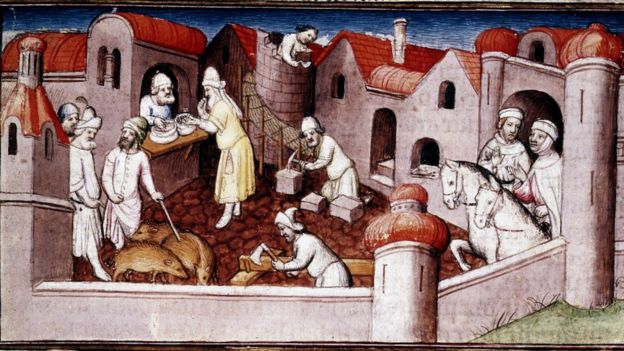
Image copyrightOXFORD SCIENCE ARCHIVE/GETTY IMAGImage captionExplorer Marco Polo’s travels along the Silk Road were immortalised in the “Book of Marvels”
That “made in Italy” label carries a reputation for quality worldwide, and is legally protected for products items processed “mainly” in Italy.
Better connections for cheap raw materials from China – and the return of finished products from Italy – could exaggerate that practice.
“Predatory” investment
The non-binding deal being signed by the two countries on Thursday comes amid questions over whether Chinese firm Huawei should be permitted to build essential communications networks – after the United States expressed concern they could help Beijing spy on the West.
That is not part of the current negotiations in Italy.
As President Xi tours Rome, EU leaders in Brussels will be considering 10 points for relations with China.
While they include deepening engagement, they also involve plans to “address the distortive effects of foreign state ownership” as well as “security risks posed by foreign investment in critical assets, technologies and infrastructure”.
In March, US National Security Council spokesman Garrett Marquis pointed out that Italy was a major economy and did not need to “lend legitimacy to China’s vanity infrastructure project”.
Members of Italy’s ruling right-wing League party have their owns concerns about national security
Interior Minister Matteo Salvini warned that he did not want to see foreign businesses “colonising” Italy.
“Before allowing someone to invest in the ports of Trieste or Genoa, I would think about it not once but a hundred times,” Salvini warned.
Setting the scene
Italian officials are keen to point out that the deal being signed is not an international treaty, and is non-binding.
“There are no specific projects,” Mr Geraci said. “It is more of an accord that sets the scene.”
Other European nations already accept Chinese investment through something called the Asian Infrastructure Investment Bank, he said – something the UK was the first to sign up to.
BEIJING (Reuters) – PetroChina, Asia’s largest oil and gas producer, plans to boost its capital expenditure to a near record 300 billion yuan (£34.16 billion) in 2019, up 17 percent from last year, a company filing to the Hong Kong Stock Exchange showed.
The surge in spending came as PetroChina pledged to ramp up oil and gas production and reserves to answer Beijing’s call for greater energy security.
PetroChina’s fourth-quarter net earnings, though, fell 18 percent from the same period the previous year to 4.46 billion yuan, making it the worst quarterly performance since the third quarter of 2016, Reuters calculations showed.
India’s Prime Minister Narendra Modi wants to connect more than a billion Indians to the internet – and his BJP government is counting on a project taking cheap high-speed broadband to rural areas to achieve this.
The project, to build a nationwide optical fibre network, was launched in 2014 and is the flagship scheme of the government’s Digital India programme.
In the run-up to the Indian election, which gets under way on 11 April, BBC Reality Check is examining claims and pledges made by the main political parties.
So has the project been a success?
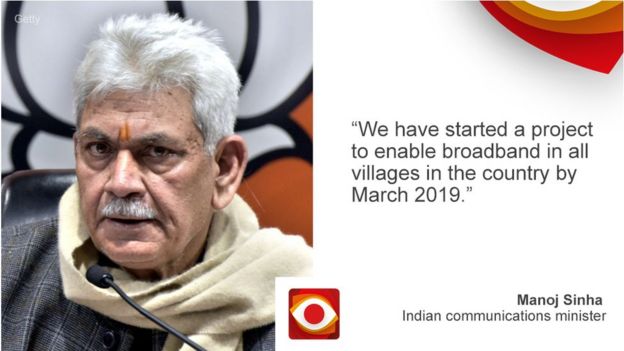
Pledge: Indian Communications Minister Manoj Sinha promised to provide every village in the country with high speed broadband and that this would be achieved by March 2019.
Verdict: The project to set up digital infrastructure in rural India has made substantial headway but has so far achieved less than 50% of its intended target.
An ambitious plan
India has the second highest number of internet users in the world but the penetration is quite low for its size and population.
The BharatNet scheme aims to connect more than 600,000 villages in India with a minimum broadband speed of 100Mbps.
It would enable local service providers to offer internet access to the local population, primarily through mobile phones and other portable devices.
India’s telecom regulator says there were 560 million internet connections in India in September last year.
India’s broadband users
Source:
But the pace of internet adoption is lower in rural areas, where most Indians live.
What’s been achieved so far?
The government’s overall target is to connect 250,000 village councils covering more than 600,000 individual villages across the country.
The work of laying cables and installing equipment to connect 100,000 of them was finally completed in December 2017 after significant delays.
This milestone was hailed a success but there were also critical voices, especially from government opponents about whether the cables were actually operational.
Image copyrightGETTY IMAGES
The next phase, to connect the remaining councils by March 2019, has been under way for a year now.
In total, as of the end of January this year, official data shows optical fibre cables have been laid in 123,489 village councils – and equipment installed in 116,876 of them.
There is also a plan to install wi-fi hotspots in more than 100,000 council areas – but as of January these were operational in only 12,500 of them.
Old plan, new name
It has been an ambition of successive governments to connect all India to the internet but plans have hit many roadblocks.
BharatNet was first conceived in 2011 by the then Congress government as the National Optical Fibre Network but did not make much headway in its pilot phase.
A parliamentary committee said the project had been affected by “inadequate planning and design” from 2011 to 2014.
When the BJP came to power in 2014, it took over the project and has pushed ahead with national broadband coverage.
And in January last year, the government said it would complete the work ahead of the stipulated deadline of March 2019.
Has the deadline been met?
There was impressive progress made in 2016 and 2017 but since then the pace has slowed.
In January this year, the agency executing BharatNet said 116,411 village councils were “service ready”.
This means that provisions for ready-to-use connectivity have been made.
Status of BharatNet project
Source: Bharat Broadband Network Limited
But not all “service ready” village councils have proper connections, says Osama Manzar, from the non-governmental Digital Empowerment Foundation (DEF).
And only 31 of them had “functional”, but slow, internet connections.
Mr Manzar notes that this is problematic considering “the public welfare distribution and the financial sectors rely heavily on digital infrastructure today”.
BharatNet has faced also difficulties with electricity supply, theft, low-quality cables and poorly maintained equipment.
And these delays come as India aims to provide broadband in all households and move to 5G networks by 2022.
An official source defended BharatNet as a large-scale infrastructure project tackling difficult sites and not a service scheme, saying it was natural to see delays between set-up and use.
Chinese Vice President Wang Qishan (R) meets with Pakistani Foreign Minister Shah Mahmood Qureshi in Beijing, capital of China, March 19, 2019. (Xinhua/Huang Jingwen)
BEIJING, March 19 (Xinhua) — Chinese Vice President Wang Qishan met with Pakistani Foreign Minister Shah Mahmood Qureshi here Tuesday, and hoped that the two countries would deepen all-round cooperation.
“China and Pakistan are good neighbors, and the friendly relationship between the two countries has stood the test of times and the changing international situation,” said Wang, adding that leaders of the two countries frequently met in recent years and the all-weather strategic cooperative partnership has yielded continuous progress.
Wang said establishing good-neighborly and friendly relations and creating a good surrounding environment on the basis of mutual understanding and mutual trust is an important condition for a country to achieve peaceful development.
He said China supports Pakistan in seizing opportunities and tackling challenges, and properly handling relations with its neighbors, to achieve stable development.
Wang expressed the hope that the two countries would continue to deepen all-around cooperation, and promote the progress of important projects under the Belt and Road Initiative, including the China-Pakistan Economic Corridor.
Qureshi said Pakistan appreciates China’s constructive role in moderating tensions between India and Pakistan.
He said Pakistan stands ready to enhance cooperation with China in various fields and push the all-weather strategic cooperative partnership to a new level.
NANNING, March 19 (Xinhua) — China and Vietnam officially opened a new cross-border bridge on Tuesday linking the city of Dongxing in China and the city of Mong Cai in Vietnam.
The 27.7-meter-wide Beilun II bridge has four main lanes and two auxiliary ones. Its opening means that the busy port of Dongxing will have two bridges, and improved capacity to serve booming border trade between China and Vietnam.
Construction of the bridge started in 2014 and was completed in September 2017, involving an investment of about 220 million yuan (32.7 million U.S. dollars) from China and Vietnam.
It will shorten waiting time for customs clearance, thus boosting border logistics and trade and promoting connectivity under the Belt and Road Initiative, said Huang Xiong, deputy director of Dongxing Customs.
The new bridge will be used for freight vehicles, while the existing Beilun bridge, 3 km away, will be reserved for the passage of personnel only, officials said.
Dongxing, in southwest China’s Guangxi Zhuang Autonomous Region, faces Mong Cai across the Beilun river and has become an important goods channel between China and Southeast Asia.
In 2018, trade between Dongxing and Vietnam reached 24.45 billion yuan. The Dongxing port last year handled over 47,000 vehicles and about 12 million passengers, a record high.
Last year, trade volume between China and Vietnam reached a record high of nearly 150 billion U.S. dollars, and China accounted for the largest number of foreign tourists in Vietnam, roughly 5 million people.






 CHINDIA ALERT: You'll be living in their world, very soon