Archive for March, 2019

19/03/2019

Man detained in connection with Pulwama terror attack dies in police custody

The 28-year-old, identified as Rizwan Asad Pandith, worked as a teacher at a private school. Police said that he was an activist of the banned Jamaat-e-Islami in the Pulwama area of South Kashmir.

Violence erupted in downtown Srinagar and Awantipura areas when a man, who was detained for interrogation in connection with the terror attack in which 44 CRPF personnel were recently killed, died in police custody on Tuesday.
The 28-year-old, identified as Rizwan Asad Pandith, worked as a teacher at a private school. Police said that he was an activist of the banned Jamaat-e-Islami in the Pulwama area of South Kashmir.
Rizwan was picked up by the police three days ago in connection with the terrorist attack and died around midnight yesterday. A magisterial inquiry under Section 176 CRPC has been ordered into his death.
IGP (Kashmir zone) SP Pani has confirmed that the teacher died in police custody and the cause of his death was being investigated. The police, too, separately initiated a probe in the jurisdictional area of incident.
Incidents of stone-pelting were reported in downtown Srinagar and Awantipura as news about death of the teacher spread. Police fired teargas shells to disperse the stone-pelters, who were demanding action against the NIA and policemen interrogating Rizwan.
Reacting to the death of the teacher, National Conference chief Omar Abdullah tweeted, “I had hoped custodial deaths were a thing of our dark past. This is an unacceptable development & must be investigated in a transparent, time-bound manner. Exemplary punishment must be handed out to the killers of this young man.”
In another tweet, Omar said, “Midnight raids, crackdowns, rampant arrests, custodial murders, denial of democratic right to choose a government. Kashmir continues to suffer the fallout of the disastrous PDP-BJP alliance and from the Modi government’s muscular approach to J&K.”
PDP chief and former chief minister Mehbooba Mufti tweeted, “Innocent men hauled up from their homes for interrogation return home only in coffins now. GOI’s repressive approach leaves young educated men vulnerable who are forces to take up arms. Stop using Kashmir to exhibit your sick chauvinistic nationalism. We have suffered enough.
The National Investigation Agency (NIA) is investigating 14 February terror attack case in which an explosive-laden SUV driven by a suicide attacker of Jaish-e-Mohammad (JeM) rammed into the convoy of CRPF.
The NIA is learnt to have scanned the mobile phones that were operating in the area at the time of the terror attack. Five top JeM terrorists have been killed in encounters with security forces after the incident.
Source: The Statesman
18/03/2019

Hong Kong University, Japan’s Tohoku University sign agreement on AI, robotic technologies collaboration

HONG KONG, March 17 (Xinhua) — The University of Hong Kong (HKU) announced on Sunday that it has signed an agreement with Tohoku University, Japan (Tohokudai) to collaborate on the research of transformative AI and robotics technologies.

The signing ceremony was held on Saturday at the HKU campus. HKU and Tohoku University will combine their advantages and strengthen the application of AI and robotics in areas including manufacturing industry, construction industry and the development of smart cities. They are planning to establish the Center for Transformative AI and Robotics Technologies in Hong Kong.

Under the collaboration, top researchers from both universities will be brought together, forming a team to transform and upgrade the technologies of AI and robotics, to improve the automation technology and to develop smart and flexible robots with self-learning ability that are adaptable to different environment.

Zhang Xiang, president and vice-chancellor of HKU said both universities will strive to achieve pioneering world-class research projects, bring more learning opportunities for students, and build greater engagement with industrial partners.

“We are eager to further strengthen the tie between the two universities and closely work together in the field of transformative AI and robotics technology to create social innovation and solve social problems in Hong Kong and Japan,” Hideo Ohno, president of Tohoku University, said.

Nicholas Yang, secretary for innovation and technology of China’s Hong Kong Special Administrative Region government, also attended the ceremony. He said that true innovation comes from collaboration and by pooling together the world’s top scientific institutions to collaborate with local universities. Hong Kong is poised to become a hub for global research collaboration, he said.

Source: Xinhua

18/03/2019

China Focus: Massive coal industry park cleans up “scars”

YINCHUAN, March 17 (Xinhua) — The largest coal chemical park in northwest China’s Ningxia Hui Autonomous Region has launched a campaign to clean up over 120 small and disorderly coalfields.

The Ningdong Energy and Chemical Industry Base, one of China’s largest coal production bases and a coal-to-chemical industry base, is located close to Shaanxi Province and Inner Mongolia Autonomous Region, areas with large coal deposits.

Since last year, it has shut down 127 disorderly coalfields which occupied over 533 hectares. Over 2 million tonnes of coal has been cleaned and 90 percent of the construction above ground has been dismantled.

The coalfields were a major logistical base that stored coal from the local area and Inner Mongolia, and then loaded them onto trucks to send to local fire power plants, boilers, and consumers in Yunnan and Jiangsu provinces. Annual turnover was 25 million tonnes, totaling 10 billion yuan (1.5 billion U.S. dollars).

These coal fields, however, were poorly managed. Most never met environmental requirements. The decision to close them was met with great resistance by the coalfield owners who paid a hefty rent to the villages and created jobs for the people living in the area.

“Money from the coalfields helped cover medical and social insurance costs for the villagers. One of the villages received four million yuan a year for leasing out the land to coal yard owners. Every family received a dividend of over 5,000 yuan,” said Yan Xinmin, an official with the base administration.

Yang Jia, general manager of Ningxia Xinwen Energy Technology Company, said he once had to hide from environmental inspectors because he did not have credentials for operation.

Yang was the first to shut down the old coal yard and move his business to new coalfield, an 133-hectare area at the southern part of the base.

Thirty-four companies have been chosen to move their coal storage facilities into the new coal field, which cost 600 million yuan to build.

Ma Sanqing, an official with the base administration, said the villagers will find new jobs and sources of income at the new coalfield.

The villagers will become shareholders of a special service company for the coalfield.

“If we have 1,000 trucks every day, the management of the trucks, dining and cleaning services will generate 5 million yuan every year,” said Ma.

“It is a necessary step to clean up the old coal yards,” said Yang Fu, head of the Huiminxiang village.

“We are planning to build parking lots, dining facilities, auto repair shops and other services,” he said.

Efforts are underway to clean the black slags and mud that blocked the flood discharge channels. Trees will be planted to restore the greenery at the coalfields, said Ma.

Construction of the Ningdong Energy and Chemical Industry Base began in 2003. Now it is home to around 130 enterprises. The gross industrial output value reached 117 billion yuan in 2017.

Source: Xinhua

18/03/2019

Across China: Top tourist city strengthens cultural protection

KUNMING, March 17 (Xinhua) — Every day, He Runyuan explains what happiness is to hundreds of tourists.

“Dongba symbols are used by China’s Naxi ethnic minority and one of the world’s only remaining pictographs. For them, happiness is a steaming hot pot of food,” He said. “As in the past, having a hot meal means everything.”

In a traditional Naxi costume of goatskin vest and a white robe, 42-year-old He guides tourists to learn the Naxi scripts, history, culture and tradition in his center of Naxi Dongba pictographs and paintings in the Old Town in the city of Lijiang, southwest China’s Yunnan Province.

“Peak seasons such as national holidays and summer and winter vacations see around 5,000 visitors a day,” he said.

“After explaining the symbols, I will ask the tourists to pick one they like and try to write it down,” he added.

As a Naxi minority, He grew up in the Old Town, a UNESCO World Heritage Site with an 800-year history, which attracted more than 14 million tourists last year.

He has been learning Naxi painting and pictographs for about 30 years. “With a population of more than 300,000, less than 700 Naxi people now understand Dongba pictographs, and only a dozen can do traditional Naxi paintings,” he said.

“I think it’s my responsibility to pass down our culture and let more people know about it, which is so vivid and charming,” he said, adding that most Naxi people live in Lijiang. “That’s why I came back here after graduation. The origin of Naxi culture is here.”

His devotion of cultural protection is greatly supported by the local government which entrusted He to open the experience center in 2016 in the busiest area of the Old Town and gives him 400,000 yuan (about 59,600 U.S. dollars) a year for daily maintenance and other expenses.

“The local government offered us this two-story cultural courtyard with traditional Naxi characteristics as our center, covering about 300 square meters. We have separated it into several rooms for exhibitions and classrooms,” he said.

He and four other Naxi guides work 14 hours a day. “During peak seasons, we can barely take a sip of water,” he said.

“It’s hard, but it’s worth it. We are so proud of what we are doing,” he said.

By the end of last year, there were 17 free cultural courtyards in the Old Town of Lijiang, including He’s. With the support of the local government, a further 12 are expected to open to the public this year.

“I think the courtyard is a window for promoting the culture of Lijiang, as well as an important base for visitors to learn and try by themselves to have a more comprehensive understanding of our culture,” he said.

He’s experience center has also cooperated with travel agencies, summer camps and schools to offer free training classes on Naxi culture, receiving more than 7,000 students each year.

“Without the courtyard, nothing would even be close to possible,” he said.

To prevent the ancient Chinese city from over commercialization after years of tourism development, the local government has set up a specialized annual fund of 10 million yuan for cultural protection in the Old Town.

“Lijiang has long been China’s name card to the world with the Old Town as its core. For sustainable development, we must spare no effort in protecting our culture and make it one of the most attractive parts of the city,” said He Tang with the protection and administrative bureau of Lijiang Old Town.

All the buildings in the Old Town are required to maintain traditional ethnic characteristics. Dancing halls, Internet bars, and among others that are inconsistent with the ancient Old Town have all been closed.

A total of 299 traditional houses and 236 yards have so far been restored and renovated by the local government and the Global Heritage Fund.

“We also invite folk artists and culture inheritors to show their skills in the Old Town to get more tourists involved. On traditional festivals, we hold grand celebrations in the Old Town.” He Tang said.

More than 90 sets of books telling stories of Lijiang and the culture of Naxi have also been published.

“Our life is limited, but so long as everyone makes even an effort, the life of a culture can exist forever,” He Runyuan said.

Source: Xinhua

18/03/2019

Cash-strapped Chinese regions seek support from Beijing to meet costs of environmental clean-up

  • Delegates to recent National People’s Congress asked for more help from central government and warn of cost of fighting pollution
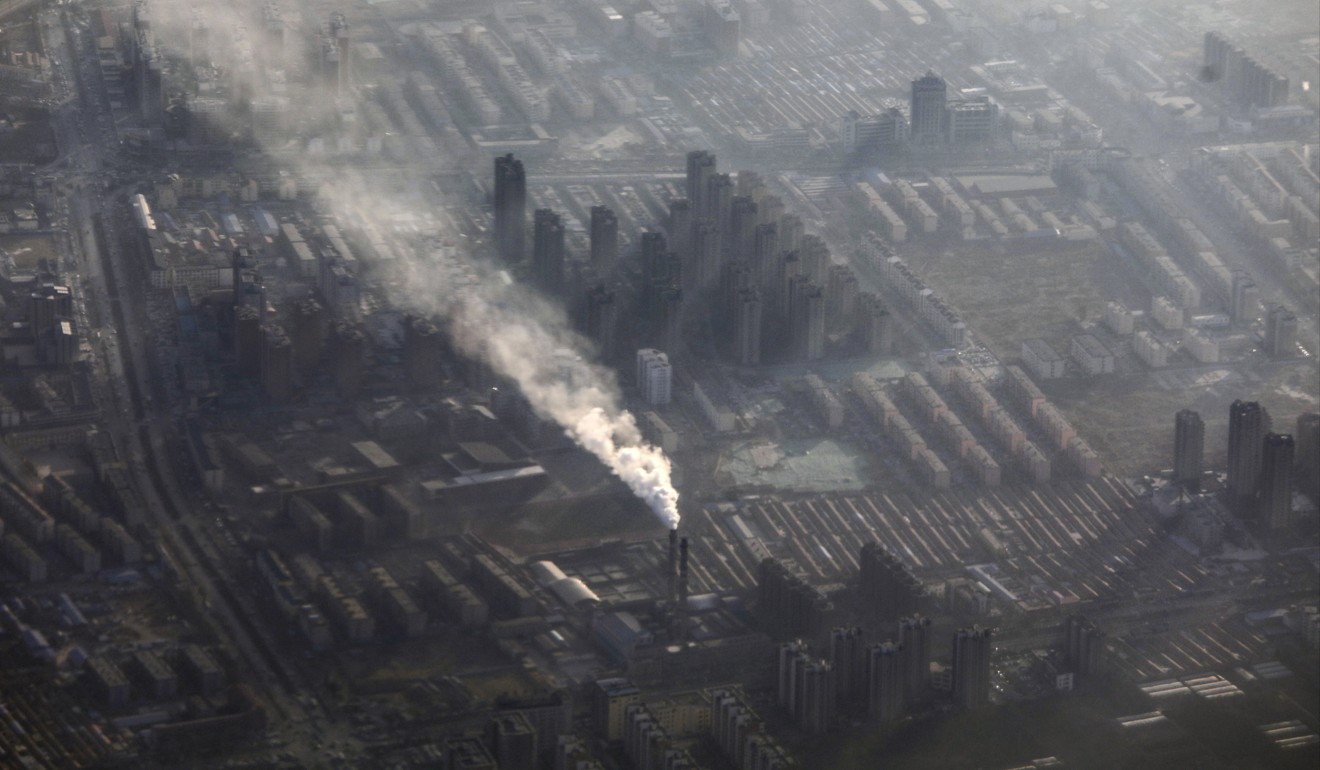
Beijing residents wearing masks on a smoggy day last year. Photo: Simon Song

China’s cash-strapped regions are lobbying Beijing to loosen its purse strings to help fight pollution, saying they do not have the funds to follow state policies aimed at fixing the damage done by decades of unrestricted development.

The cost of environmental compliance was a major theme at this month’s annual session of the National People’s Congress, where thousands of non-binding recommendations submitted by delegates give an insight into the major preoccupations of legislators.

Beijing has been at pains to stress it will not ease up in the “war on pollution” launched five years ago by Premier Li Keqiang, even though the economy grew at its slowest rate since 1990 last year.

But with resources tight and controlling debt a priority, many parliamentary delegates called for more spending support from Beijing and a more “coordinated” approach to keeping pollution in check and the economy on track.

“We cannot stop or hinder economic development in order to pursue environmental protection,” said delegate Pei Chunliang from central China’s Henan province, which has struggled to find new sources of growth.

Provinces have been given a set of targets by central government to reduce emissions. Photo: Simon Song

“In some regions the rules of economic development have not been respected,” Pei warned in a proposal calling for more support for environmentally friendly firms.

For regions under pressure to meet smog targets or resolve long-standing environmental problems while trying to meet growth targets, immediate relief is seen as essential.

Zhang said his city had spent hundreds of billions of yuan to tackle problems like land subsidence, but it was “far from enough”, and the state needed to establish a giant fund to help resource-dependent cities meet their goals.
China pollution pledge: Beijing to cut 60pc of power sector emissions by 2020

Many regions called for state aid to rectify such long-standing pollution problems, with delegates from coal-producing regions like Shanxi lobbying for tax and debt relief.

Other regions are also struggling to implement new directives to prevent agricultural pollution and clean up rivers.

“Due to insufficient local financial resources and historical debts, it is difficult to meet the funding requirements,” said delegate Yu Huiwen, head of the environment bureau in Sichuan province, which is responsible for protecting the upstream area of the Yangtze.

The finance ministry said in its report to parliament this month that it will allocate 25 billion yuan (US$3.7 billion) to a smog prevention fund this year, a 25 per cent increase on 2018, and 30 billion yuan to treat water pollution, up 45 per cent.

Environment Minister Li Ganjie, who acknowledged earlier this year that some regions were struggling with the “historical burdens” of polluting industries, also told a briefing during the parliamentary session that China would provide more support for local governments.

The government was “currently studying and preparing to adopt new measures”, he said, but added it wasn’t just about money, but also policies and technical guidance.

“Whatever the difficulties, we will help them find a reasonable solution,” he said.

Source: SCMP

18/03/2019

China’s crowded co-working industry turns to services amid funding crunch

HONG KONG/SHANGHAI (Reuters) – Co-working space operators in China are shifting their focus from ambitious expansion plans to services such as customising offices for clients, as rising vacancy rates and tighter financing slow their exponential growth of the past two years.

The strategy shift marks a turn of fortunes for the Chinese co-working industry, whose rapid expansion has helped operators such as Ucommune, MyDreamPlus and Kr Space raise hundreds of millions of dollars.

The combined area of co-working space in four first-tier cities in China surged by almost 60 percent between the end of 2017 and October last year, according to industry association China Real Estate Chamber of Commerce.

However, 40 percent of the co-working centres were more than half empty as of October and 40 co-working brands had shut in the first 10 months of 2018, it added.

“There’s a shake-out in the flexible office space,” said Paul Salnikow, global CEO of The Executive Centre, which entered China in 2001 and currently operates 45 premium flexible working centres in nine Chinese cities.

“Since November, we’ve seen operators in China walking away from centres, trying to give it back to the landlord. We’ve been offered furniture from some of these people, saying they’re trying to raise money.”

A common solution for firms appears to be diversification into services that require less capital investment, such as office design and management.

“Our focus this year is ‘management output’,” Mao Daqing, founder of Ucommune, one of the largest co-working space operators in China, told Reuters.

The company expected to partner with enterprise clients and open another 30 flexible working centres for them this year, providing design and management services, from 15 currently, he said. Ucommune’s own branded centres would add five to 10 more to the over 200 already in place.

U.S.-based WeWork started providing such services in China last year and also plans to grow the business.

One industry executive who declined to be identified told Reuters the asset-light model helped to shift rental costs to clients, boosting income.

LANDLORDS AT RISK

A survey of Chinese flexible working space operators by real estate consultancy CBRE in January found that around 68 percent planned to slow or halt expansion this year.

But the rise in vacancy rates and operators dropping out of the business could also spell trouble for Chinese office landlords, especially in major cities like Shanghai where co-working is more common than the rest of Asia-Pacific.“Co-working operators need to go further asset-light and slow one-off CAPEX investment to stay in operation,” said Virginia Huang, CBRE Greater China managing director of advisory and transaction services.

“What this means is landlords also share some risks of this industry, not only the operators.”

Terms of underwriting co-operating operators are also changing, with landlords bearing more costs and risks.

Stanley Ching, Citic Capital’s head of property, said operators were increasingly seeking fit-out subsidies and leasing on profit-sharing models with landlords, as they become more reluctant to pay high rents to secure space.

LaSalle Investment Management, which rents space to co-working operators in China, said picking the right operators and limiting exposure was crucial.

“They’re not recession-proof yet; they haven’t gone through a recession, we don’t know who’s going to survive or who’s not,” said Elysia Tse, LaSalle IM Asia Pacific head of research and strategy.

“So we’ll make sure our portfolio of co-working tenants is a small minority portion.”

One positive trend for co-working operators is the growth in demand from larger corporates amid China’s broader economic slowdown.

“As companies’ outlook on the economy turns conservative and they want to save office costs, they turn to co-working space which provides flexibility,” said Ucommune’s Mao.

“Our clients for office design service also increased for this reason.”

Source: Reuters

18/03/2019

India election 2019: Is India’s bullet train on time?

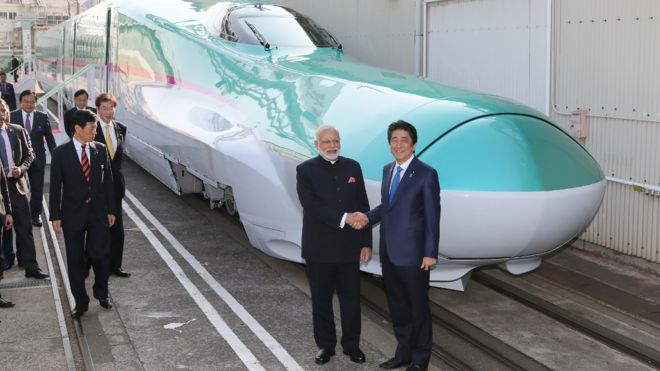
Modi and Abe with bullet trainImage copyrightGETTY IMAGES

India has undertaken an ambitious project for a bullet train to run between two of the country’s major cities.

A deal was signed in 2015 with Japan, which is helping to finance its construction.

The project is part of the government’s commitment to revitalise the country’s creaking 165-year-old rail network.

In the run-up to the Indian election, which gets under way on 11 April, BBC Reality Check is examining claims and pledges made by the main political parties.

Presentational grey line

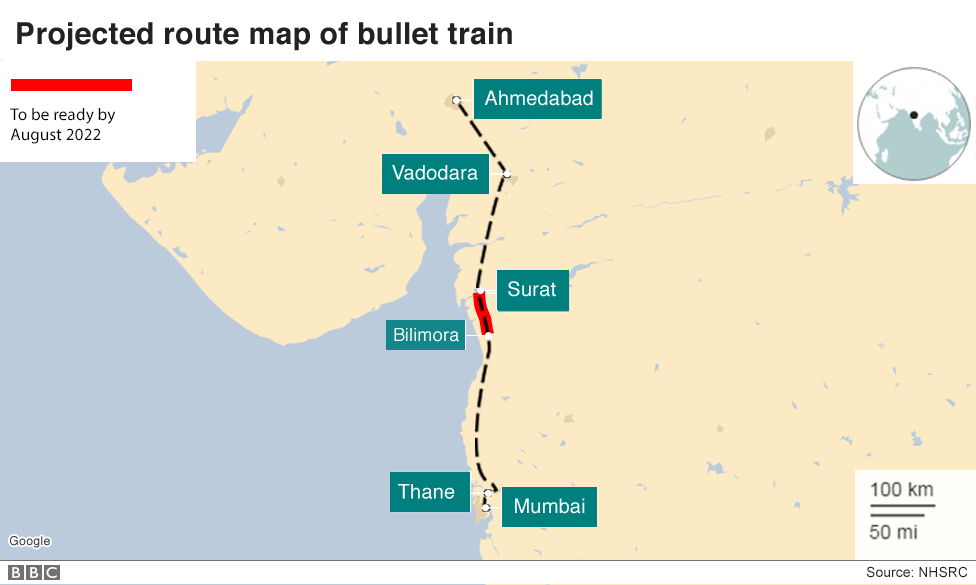
Claim: India will have a bullet train service running by August 2022. This will run down the west coast, connecting the cities of Mumbai and Ahmedabad.

Verdict: Passengers may get to experience a modern high-speed train on just a small section of line by 2022. It looks unlikely the promised bullet train will be fully operational by then or even by the following year.

Presentational grey line

The bullet train project was officially launched at a ceremony in September 2017 attended by the Japanese Prime Minister, Shinzo Abe.

That year, the Indian Ministry of Railways said “all-out efforts” would be made to complete the high speed rail project by 15 August 2022.

However, officials involved with the plan now estimate that only a small part of the route will be completed by this time, with the rest finished in 2023.

The Congress opposition leader, Rahul Gandhi, has described it as a “magic train” that will never be completed.

Why is it needed?

India’s vast rail network offers a cheap and vital transport service for 22 million people a day on about 9,000 trains.

But travellers have long complained of poor services and a lack of investment in modernisation.

Vande Bharat leaving DelhiImage copyrightGETTY IMAGES
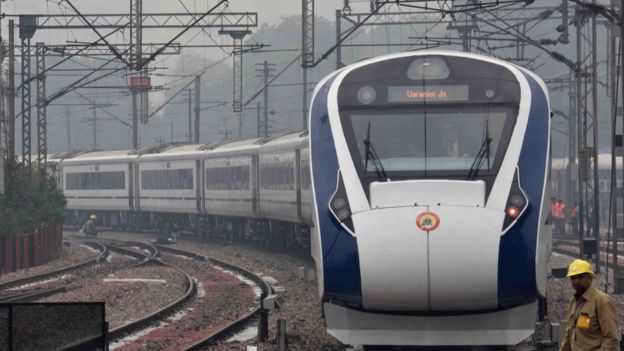
Image captionIndia’s Vande Bharat train – the fastest currently in service

Currently, India’s fastest train is the Vande Bharat Express, which has reached 180km/h (110mph) during trials.

The Japanese bullet train is almost twice as fast, capable of speeds up to 320km/h (200mph).

Once completed, the $15bn (£11bn) high-speed rail route will connect India’s major business and financial hub of Mumbai with important business centres in Gujarat state such as Surat and Ahmedabad.

The 500km-long journey now takes about eight hours.

That’s expected to drop to well under three hours, with the fastest journey times estimated at just two hours and seven minutes.

Map of bullet train route

When will it be finished?

Some experts think even the current deadline given by officials, of December 2023, is overly optimistic.

“I am not sure – considering how slow things are moving,” Debolina Kundu, an associate professor at the National Institute of Urban Affairs, told BBC News.

“And there are bureaucratic hurdles.”

Presentational grey line

Read more from Reality Check

Presentational grey line

The main obstacle is land acquisition.

The train project needs to acquire more than 1,400 hectares (14 sq km) of land, most of it privately owned.

The National High Speed Rail Corporation had been aiming to complete this process by the end of last year but has recently said it will continue until mid-2019.

In February, it told BBC News there were now agreements with more than 1,000 landowners – out of an estimated total of 6,000.

New Delhi railway station queueImage copyrightGETTY IMAGES

One barrier to the land sales has been dissatisfaction with the amount of compensation being offered to the owners.

There have been protests in some areas over plans for land acquisition – and multiple petitions filed in the courts.

And in India, court cases challenging land acquisition can drag on for years.

But those running the project say they are paying compensation of 25% above the legal requirement.

Another potential barrier is the need for wildlife and other environmental clearances, as the train will pass through three wildlife areas and coastal regions.

It will also cross areas classified as forest – and this land can be acquired only once environmental impact studies have been completed and reforestation plans drawn up.

Source: The BBC

18/03/2019

India, Pakistan threatened to unleash missiles at each other – sources

NEW DELHI/ISLAMABAD (Reuters) – The sparring between India and Pakistan last month threatened to spiral out of control and only interventions by U.S. officials, including National Security Advisor John Bolton, headed off a bigger conflict, five sources familiar with the events said.

At one stage, India threatened to fire at least six missiles at Pakistan, and Islamabad said it would respond with its own missile strikes “three times over”, according to Western diplomats and government sources in New Delhi, Islamabad and Washington.

The way in which tensions suddenly worsened and threatened to trigger a war between the nuclear-armed nations shows how the Kashmir region, which both claim and is at the core of their enmity, remains one of the world’s most dangerous flashpoints.

The exchanges did not get beyond threats, and there was no suggestion that the missiles involved were anything more than conventional weapons, but they created consternation in official circles in Washington, Beijing and London.

Reuters has pieced together the events that led to the most serious military crisis in South Asia since 2008, as well as the concerted diplomatic efforts to get both sides to back down.

The simmering dispute erupted into conflict late last month when Indian and Pakistani warplanes engaged in a dogfight over Kashmir on Feb 27, a day after a raid by Indian jet fighters on what it said was a militant camp in Pakistan. Islamabad denied any militant camp exists in the area and said the Indian bombs exploded on an empty hillside.

In their first such clash since the last war between the two nations in 1971, Pakistan downed an Indian plane and captured its pilot after he ejected in Pakistan-controlled Kashmir.

Hours later, videos of the bloodied Indian pilot, handcuffed and blindfolded, appeared on social media, identifying himself to Pakistani interrogators, deepening anger in New Delhi.

With Prime Minister Narendra Modi facing a general election in April-May, the government was under pressure to respond.

“NO GOING BACK”

That evening, Indian National Security Adviser Ajit Doval spoke over a secure line to the head of Pakistan’s Inter Services Intelligence (ISI), Asim Munir, to tell him India was not going to back off its new campaign of “counter terrorism” even after the pilot’s capture, an Indian government source and a Western diplomat with knowledge of the conversations told Reuters in New Delhi.

Doval told Munir that India’s fight was with the militant groups that freely operated from Pakistani soil and it was prepared to escalate, said the government source.

A Pakistani government minister and a Western diplomat in Islamabad separately confirmed a specific Indian threat to use six missiles on targets inside Pakistan. They did not specify who delivered the threat or who received it, but the minister said Indian and Pakistani intelligence agencies “were communicating with each other during the fight, and even now they are communicating with each other”.

Pakistan said it would counter any Indian missile attacks with many more launches of its own, the minister told Reuters, speaking on condition of anonymity.

“We said if you will fire one missile, we will fire three. Whatever India will do, we will respond three times to that,” the Pakistani minister said.

Doval’s office did not respond to a request for comment. India was not aware of any missile threat issued to Pakistan, a government official said in reply to a Reuters request for comment.

Pakistan’s military declined to comment and Munir could not be reached for comment. Pakistan’s foreign ministry did not respond to a Reuters request for comment.

TRUMP-KIM TALKS

The crisis unfolded as U.S. President Donald Trump was trying to hammer out an agreement with North Korean leader Kim Jong Un in Hanoi over its nuclear programme.

U.S. security advisor Bolton was on the phone with Doval on the night of Feb 27 itself, and into the early hours of Feb 28, the second day of the Trump-Kim talks, in an attempt to defuse the situation, the Western diplomat in New Delhi and the Indian official said.

Later, U.S. Secretary of State Mike Pompeo, who was also in Hanoi, also called both sides to seek a way out of the crisis.

“Secretary Pompeo led diplomatic engagement directly, and that played an essential role in de-escalating the tensions between the two sides,” State Department deputy spokesperson Robert Palladino said in a briefing in Washington on March 5.

A State Department official declined comment when asked if they knew of the threats to use missiles.

Pompeo spoke to Doval, the Indian and Pakistani Foreign Ministers Sushma Swaraj and Shah Mahmood Qureshi, respectively, Palladino said.

U.S. Indo-Pacific Command Admiral Phil Davidson told reporters in Singapore last week that he had separately been in touch with the Indian navy chief, Sunil Lanba, throughout the crisis. There was no immediate response from Lanba’s office to a question on the nature of the conversations.

U.S. efforts were focused on securing the quick release of the Indian pilot by Pakistan and winning an assurance from India it would pull back from the threat to fire rockets, the Western diplomat in New Delhi and officials in Washington said.

“We made a lot of effort to get the international community involved in encouraging the two sides to de-escalate the situation because we fully realized how dangerous it was,” said a senior Trump administration official.

The Pakistani minister said China and the United Arab Emirates also intervened. China’s foreign ministry did not respond to requests for comment. The government of the UAE said Abu Dhabi Crown Prince Sheikh Mohammed bin Zayed al-Nahyan held talks with both Modi and Pakistan Prime Minister Imran Khan.

India has not given details, but has said it was in touch with major powers during the conflict.

On the morning of Feb 28, Trump told reporters in Hanoi that he expected the crisis to end soon.

“They have been going at it and we have been involved in trying to have them stop. Hopefully that is going to be coming to an end.”

Later that afternoon, Khan announced in Pakistan’s parliament that the Indian pilot would be released, and he was sent back the next day.

“I know last night there was a threat there could a missile attack on Pakistan, which got defused,” Khan said. “I know, our army stood prepared for retaliation of that attack.”

The two countries have gone to war three times since both gained independence in 1947, the last time in 1971. The two armies are trading fire along the line of control that separates them in Kashmir, but the tensions appear contained for now.

Diplomatic experts said that the latest crisis underlined the chances of misread signals and unpredictability in the ties between the nuclear-armed rivals, and the huge dangers. It still was not clear whether India had targeted a militant camp in Pakistan and whether there were any casualties, they said.

“Indian and Pakistani leaders have long evinced confidence that they can understand each other’s deterrence signals and can de-escalate at will,” said Joshua White, a former White House official who is now at Johns Hopkins.

“The fact that some of the most basic facts, intentions and attempted strategic signals of this crisis are still shrouded in mystery … should be a sobering reminder that neither country is in a position to easily control a crisis once it begins.”.

Source: Reuters

18/03/2019

Mayawati snubs Congress over its 7-seat offer, says don’t create confusion

The BSP leader’s statement came a day after the Congress said it was leaving seven of the 80 Lok Sabha seats in Uttar Pradesh for the SP-BSP combine

LOK SABHA ELECTIONS Updated: Mar 18, 2019 14:38 IST

HT Correspondent
HT Correspondent
Hindustan Times, New Delhi
Mayawati,Bahujan Samaj Party,Samajwadi Party
Bahujan Samaj Party president Mayawati has said that the SP-BSP combine was strong enough to defeat the Bharatiya Janata Party in Uttar Pradesh and that they did not need the support of the Congress.(PTI file photo)
Bahujan Samaj Party president Mayawati, in a strong snub for the Congress, said on Monday that the SP-BSP combine was strong enough to defeat the BJP in politically important Uttar Pradesh in the upcoming Lok Sabha elections.
The BSP leader’s statement came a day after the Congress said it was leaving seven of the 80 Lok Sabha seats in Uttar Pradesh for the SP-BSP combine, which recently formed an alliance and had left two seats – Rae Bareli and Amethi – for the Congress.
“The Congress is free to put up candidates in all Uttar Pradesh seats, our alliance is strong enough to defeat the BJP. The Congress should not create confusion about any alliance with us,” Mayawati tweeted.

She made it clear that the SP-BSP combine had no poll understanding with the Congress anywhere in the country. “Our supporters should not fall for doubts being created by the Congress,” the former chief minister of Uttar Pradesh said.

Watch: Congress leaves 7 seats for SP, BSP and RLD in UP for Lok Sabha polls

LS polls: Congress leaves 7 seats for SP, BSP and RLD in UP
Uttar Pradesh Congress Committee chief Raj Babbar announced that Congress will not be contesting on 7 seats in UP. Congress will leave those seats for the SP-BSP-RLD alliance in the state.

Minutes later, Samajwadi Party leader Akhilesh Yadav tweeted a similar message saying the SP-BSP- RLD alliance in Uttar Pradesh was capable of defeating BJP. “Congress should not create any confusion,” he added.

The Congress had on Sunday announced that it would not be contesting Mainpuri, Kannauj and the seats from where BSP chief Mayawati and RLD leaders Ajit Singh and Jayant Chaudhary will contest the upcoming Lok Sabha elections.

At the press conference UPCC chief Raj Babbar said, “We are leaving 7 seats vacant for SP, BSP and RLD. These include Mainpuri, Kannauj, Firozabad and whatever seats Mayawati ji & RLD’s Jayant ji and Ajit Singh contest from. We will also give two seats to Apna Dal – Gonda & Pilibhit.”

Mayawati has time and again made it clear that her alliance has nothing to do with the Congress. A week back she had said: “It is being made clear again that the Bahujan Samaj Party will not have any electoral alliance with the Congress in any state.”

This drew a sharp retort from the Congress with its Uttar Pradesh unit spokesperson saying, “We don’t need her.”

Uttar Pradesh will go to polls in all seven phases starting April 11 and ending on May 19. Counting of votes will take place on May 23.

Source: Hindustan Times

18/03/2019

PM Modi leaves for Goa to pay tribute to Manohar Parrikar

Prime Minister Narendra Modi on Monday morning left for Goa to attend the last rites of Chief Minister Manohar Parrikar who passed away on Sunday evening due to pancreatic cancer.


SNS Web | New Delhi | 

Prime Minister Narendra Modi on Monday morning left for Goa to attend the last rites of Chief Minister Manohar Parrikar who passed away on Sunday evening due to pancreatic cancer.

The PM left for the coastal state after attending a Union Cabinet meeting in which the demise of the Bharatiya Janata Party (BJP) icon was condoled.

Meanwhile, thousands of people from across the state thronged the BJP office in Panaji where Parrikar’s mortal remains have been kept for tributes from party workers.

The truck carrying the 63-year-old Chief Minister’s body, wrapped in tricolour, travelled 5 km from his private residence in Dona Paula to Panaji during which hundreds of people tried to catch a last glimpse of the beloved leader who knew even the commonest man in Panaji by name.

The scene at the BJP office was of grief. People emotionally recollected the simplicity of the man who was the first IIT-ian in India’s history to become both an elected MLA and, eventually, a Chief Minister.

His body will be taken to Kala Academy for public tributes that will continue till 4 pm.

From Kala Academy, the funeral procession will proceed to Miramar, where Parrikar’s mortal remains will be consigned to flames at 5 pm. He will be accorded a state funeral with full military honours.

The cremation will be held next to the memorial of Goa’s first chief minister Dayanand Bandodkar, who was also cremated at Miramar beach.

Union Minister for Road Transport and Highways Nitin Gadkari, who reached Panaji on Sunday evening, offered his last respects to the mortal remains of Parrikar at the state’s BJP headquarters on Monday.

According to reports, Gadkari arrived in the coastal state to negotiate with regional parties and independent MLAs for the formation of a new coalition government following Parrikar’s death. But there was no breakthrough despite the meeting continuing until 4.30 am.

Parrikar passed away following a long battle against pancreatic cancer that left a visible impact on his health.

The four-time Goa Chief Minister also served as India’s Defence Minister from 2014 to 2017. He is credited with turning the military into a lean fighting machine with key defence purchases and policy decisions within a short time.

The central government has announced national mourning on Monday. The state government announced a seven-day mourning.

Source: The Statesman
Law of Unintended Consequences

continuously updated blog about China & India

ChiaHou's Book Reviews

continuously updated blog about China & India

What's wrong with the world; and its economy

continuously updated blog about China & India