Archive for March, 2019

15/03/2019

Profile: Farmer lawmaker’s fight for rural prosperity

BEIJING, March 14 (Xinhua) — Farmer Zhao Huijie, spiced with humor when speaking at panel discussions at the second session of the 13th National People’s Congress (NPC), China’s national legislature, has a clearer vision for the development of her village.

The 48-year-old woman from north China’s Inner Mongolia Autonomous Region has fought for fortune for her fellow villagers after she became the village Party chief in 2009, and now for the interest of more people in rural China now that she is a deputy to the NPC.

At the ongoing second session of the 13th NPC, Zhao submitted a suggestion on pollution control in animal husbandry and farming in rural areas.

“Random disposal of livestock waste has not only damaged the rural environment, but also polluted groundwater,” she said, advising the government to fund major livestock farms in harmless waste treatment.

She also suggested the government to subsidize farmers to use degradable plastic films to protect the environment.

Unlike legislators in the West who make a career of politics, NPC deputies are from all walks of life and work part-time. Of the nearly 3,000 national lawmakers, more than 15 percent are workers and farmers.

Zhao, an ethnic Manchu, is also one of the 400-plus ethnic minority deputies.

URBAN WOMAN’S RURAL LIFE

Born into a worker’s family, Zhao worked at a gold mine in the city of Chifeng, Inner Mongolia, where she got married in 1991.

“He was four years older than me. I think it was a perfect match considering I am talkative, while he is quiet,” Zhao said of her husband.

Their daughter was born in 1992. In the same year, the gold mine went bankrupt, forcing the couple back to her husband’s home in Xiaomiaozi Village.

Located between two mountains with a river traversing through, Xiaomiaozi was known for its poverty back then. Shabby houses, bumpy roads and barren farmland formed the major landscape, and the only crop villagers grew was corn.

To make ends meet, Zhao’s husband found a job in town, and she rented a small plot of farmland at home.

She had to learn how to farm from scratch, including driving a horse to plow in the field. When she was farming, she had to place her baby on the field ridge.

“I didn’t want to depend on my parents after getting married. If the other villagers could get used to the country life here, how could I not?” she said.

In 1995, she started teaching at the village elementary school. Four years later, she was assigned to take charge of family planning and women’s work in the village.

“I was familiar with every household — newborn babies, young brides marrying into our village, and the elderly,” Zhao said.

In 2009, she was elected unanimously as the village Party chief.

As soon as she took office, Zhao was asked to attend “a meeting” in the township.

“It turned out to be a training for Party chiefs of backward villages. That was shameful,” she said, determined to change the situation.

NEW ROAD, NEW LIFE

The first thing she decided to work on was to build a concrete road, as she found corn buyers were reluctant to come due to the bumpy roads. Higher transport costs even dragged down corn prices in the village.

For more than a year, Zhao visited door to door to persuade villagers to relocate to give way to the road. She talked so much that she was diagnosed with sphagitis, and had to undergo a surgery.

“I liked singing in the past, but after the surgery, I could never hold a high note,” she said.

After the road project was completed, Zhao had a bridge built, ending the days when villagers had to trek in waters to cross the river.

In 2013, when Zhao engaged herself in the bridge project, she broke her left arm and knee in a road accident.

“After work, I was riding my motorcycle in the dark when a donkey rushed on to the road. I was thrown away along with the vehicle,” she said.

Instead of lying in bed, Zhao insisted going to the construction site on crutches, touching the villagers and drawing more and more followers.

Li Yongbo, a villager who used to work in Beijing, was persuaded home and led the farmers to grow traditional Chinese medicine (TCM) such as balloon flower root, which secures three times the income of corn.

According to Li, the sandy soil, big day-and-night temperature difference and easy access to irrigation made the village an ideal place for TCM plantation.

The village has expanded the TCM plantation areas to more than 200 hectares now, producing more than 4,000 tonnes of TCM every year. A TCM processing workshop has been established, further doubling the income from mere TCM plantation.

The per capita income of the village reached 14,000 yuan (2,087 U.S. dollars) in 2018, 10,000 yuan more than the levels of 2010.

“As villagers get rich and spend more, my tiny store now can bring me more than 100,000 yuan of profit every year,” grocery runner You Junguang said.

Last year, Zhao was elected as a deputy to the 13th NPC. She suggested utilizing private investment in rural development.

“To my delight, the Ministry of Finance replied to me, accepting my suggestion and pledging to encourage private investors to contribute to revitalizing the rural areas.”

Zhao said they had registered “Xiaomiaozi Village” as a brand, and were talking to a tourism company on cooperation to entice tourists with the village’s Manchu and Mongolian ethnic cultures, as well as its beautiful landscape.

After graduating from college, Zhao’s daughter found a teaching job in Changsha City in central China in 2014. Her son is studying in a senior high school in Chifeng City. Zhao is too busy to visit them.

“I feel guilty because I have rarely taken care of my kids. But I hope I can set an example for them by trying my best to do everything, be it vital or trivial, and making positive contribution to the society,” she said.

Source: Xinhua

15/03/2019

China moves to upgrade Internet services

BEIJING, March 14 (Xinhua) — China will improve Internet services and cut fees this year, according to guidelines issued by the Ministry of Industry and Information Technology (MIIT).

In 2019, the MIIT will strive to make 98 percent of the country’s villages gain access to 4G network services and 98 percent of poor villages connected by broadband network.

For small and medium-sized enterprises, the average broadband service cost will be cut by 15 percent this year, while the average mobile Internet service charge will see a decrease of at least 20 percent, according to the guidelines.

The MIIT also vowed to expedite the commercial use of 5G technology and crack down on irregularities such as crank calls and arbitrary charges.

Source: Xinhua

15/03/2019

Li Keqiang says decoupling from US ‘not realistic’, denies China would ask tech firms to spy

  • Premier refutes spying suggestion, saying it is ‘not how China behaves’ and that Beijing would never require Chinese companies to do so
  • He says ‘the whole world would like to see’ resolution to tariff war with mutually beneficial outcomes
Premier Li Keqiang admitted relations between China and the US had seen some “twists and turns”, particularly over trade. Photo: Simon Song
Premier Li Keqiang on Friday said economic decoupling from the United States was “not realistic”, while refuting claims that Beijing would ever require Chinese tech companies to spy on foreign governments or individuals.
During a news conference in Beijing at the end of the annual legislative meetings, Li admitted relations between China and the US had recently seen “twists and turns”, particularly over trade, but said he hoped ongoing negotiations to resolve the tariff war would deliver mutually beneficial outcomes.
“I believe that result is also what the whole world would like to see,” he said. “As two large economies, China and the US have become closely entwined through years of growing their relationship and years of cooperation. It is neither realistic nor possible to decouple the two economies.”
While the world’s two largest economies have held off on applying further tariffs this year, multiple rounds of discussion in Beijing and Washington have yet to yield a trade deal to resolve the dispute – one the US hopes will be address issues including its trade deficit with China, market access, industrial subsidies, intellectual property protection, forced technology transfers, and cybertheft. Chinese Vice-Premier Liu He spoke by phone with US Trade Representative Robert Lighthizer and Treasury Secretary Steven Mnuchin on Thursday and they made “concrete progress” towards a deal, according to state news agency Xinhua.
But as trade tensions have played out, Washington’s hawks have pushed for a “decoupling” between the two economies or at least a “partial decoupling” in the hi-tech sphere.
Premier Li Keqiang reassures Hong Kong over mainland China’s foreign investment law

Li on Friday also rejected the claim that Beijing had or would mandate Chinese tech companies to assist in spying on foreign governments or individuals, a key concern for countries considering using hi-tech equipment from China in sensitive sectors.

The premier initially sidestepped a question about Chinese technology spying, but later made a point to go back and “very explicitly respond” to it after taking a separate question about China’s economic reform.

“Let me tell you explicitly that this is not consistent with Chinese law. This is not how China behaves,” Li said. “We did not do that, and we will not do that in the future.”

His comments come as the US has been pushing for a ban on the use of Chinese telecoms giant Huawei’s technology in critical 5G networks over national security concerns, with US Secretary of State Mike Pompeo warning European countries in February that using the company’s equipment could hurt their ties with Washington.
In recent months, Huawei has come under growing scrutiny and pressure, with the US levelling serious fraud charges against the company and its executive Sabrina Meng Wanzhou related to alleged violations of US sanctions on Iran. Washington has ordered Meng be extradited from Canada, where she remains awaiting extradition proceedings.
Huawei pleads not guilty to US charges of bank fraud and violating Iran sanctions in case that triggered a global firestorm
Huawei’s founder and president Ren Zhengfei, who is also Meng’s father, has claimed in interviews that he would “definitely” refuse any requests by the Chinese government to hand over user data. But observers have been sceptical that the tech giant would be able to refuse these requests from Beijing, which has responded strongly to the actions taken against Huawei, including with what has been seen as the reciprocal detentions of two Canadians in China – former diplomat Michael Kovrig and businessman Michael Spavor.
Li’s annual press conference on Friday – an event where questions are carefully screened and planned in advance – comes after the conclusion of the yearly gathering for the National People’s Congress, a largely rubber-stamp legislative body. National delegates also voted to approve a new foreign investment law that touched on intellectual property and technology transfer concerns raised by the US, although foreign business bodies warned that the legislation was vague and pushed through quickly in light of the trade war.
As businesses and market watchers look to a proposed summit between Chinese President Xi Jinping and his US counterpart Donald Trump at the Mar-a-Lago estate in Florida to clinch a trade deal, Li stressed that China was seeking cooperation rather than confrontation.
“We need to continue to follow the principles of cooperation before confrontation, mutual respect, equality, and mutual benefit to continue to grow the China-US relationship, including their economic and trade ties,” Li said. “As for their differences and disagreements, we have confidence that people of the two countries have the wisdom and the capability to defuse their differences and manage them properly to pursue steady and sound growth of the US-China relationship.”
Source: SCMP
15/03/2019

China foreign investment: How doing business will change

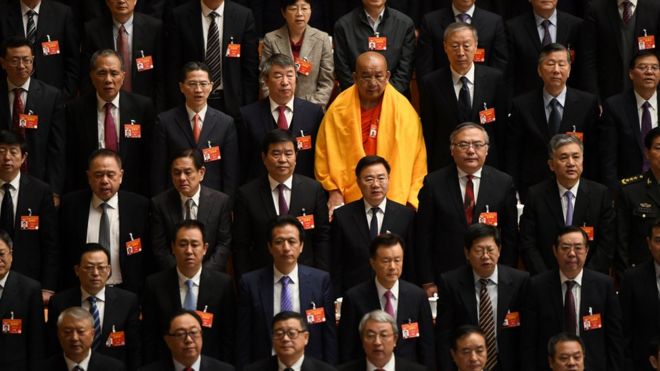
Delegates stand during the national anthem at the end of a plenary session of the National People's Congress in March 2019Image copyrightGETTY IMAGES
Image captionOnly a handful of delegates at China’s People’s Congress ever vote against legislation

China is rushing through a foreign investment law in an apparent attempt to placate Washington as negotiators try to dig the world’s two largest economic powers out of an ongoing trade war. But will it work?

The 3,000 or so delegates to China’s annual National People’s Congress (NPC) endorsed the new law on Friday. They don’t oppose legislation. That’s not how it is done here.

When a vote is taken there are normally only a handful who vote against. Some of them potentially for show, because 100% “yes” votes one after another would look ridiculous.

If there is pushback against a draft bill and amendments made, this happens well before the NPC sits, at a series of standing committee meetings behind closed doors. The process can take years.

This time it took three months.

The Chinese government appears to have rushed through the investment law as an olive branch to the US amid trade war negotiations.

However, many in the business community here in China see this law as a kind of sweeping set of intentions rather than a specific, enforceable set of rules. They fear it could be open to different and changing forms of interpretation.

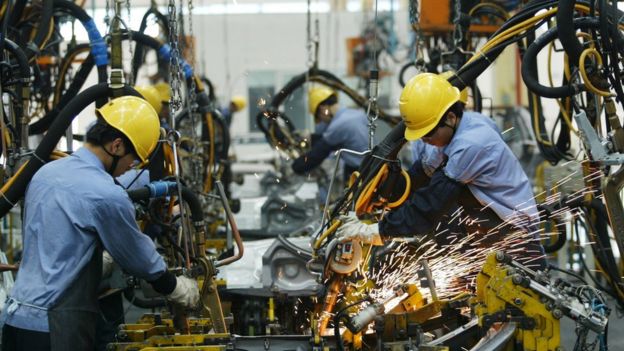
Employees working in a car factory in ChinaImage copyrightGETTY IMAGES
Image captionForeign companies may no longer have to partner with local firms to enter the Chinese market

The big-ticket items it is said to address, in terms of the concerns of foreign companies, include intellectual property theft, the requirement for international firms to partner up with a local entity, and unfair subsidies to Chinese companies.

It will also address the preferential treatment in awarding contracts to Chinese companies, and forcing foreign firms to hand over their technological secrets as the price of entry to the massive Chinese market.

But this law isn’t going to help everyone.

There is a “black list” of 48 sectors that will not be open to foreign investment or, in some cases, not open without conditions or special permission.

For example, there is a complete ban on investing in fishing, gene research, religious education, news media, and television broadcasting.

Partial investment is allowed in oil and gas exploitation, nuclear power, airlines, airport operation, and public health, amongst others sectors.

Non-renewable energy automobile production will require partnerships for a few years but then be phased out.

For industries not on the list, the principle is that foreign companies will receive the same treatment as their Chinese counterparts.

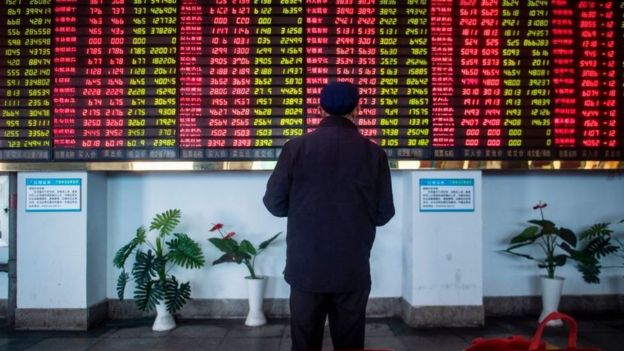
Man stands in front of stock market boards in ChinaImage copyrightGETTY IMAGES
Image captionWhile China is opening up more to foreign investment, many sectors remain out of bounds

But should foreign companies also be wary?

One of the provisions will include a requirement for the local subsidiaries of international firms to report various details of their operation to Chinese officials.

This could include performance indicators relating to labour relations, overall staffing numbers, pollution records and the like.

That sounds fine except that foreign companies have asked for – and not received – legal guarantees that this data will not be passed on to their Chinese competitors.

Then there is the promised complaints procedure should you seek redress following any perceived violations of the new law.

If this system is run through the normal Chinese courts, which routinely guarantee results favourable to the Communist Party, then to many this would not seem like a satisfactory enforcement mechanism.

One part of the law specifies that there is to be a ban on “illegal government interference” in the activities of foreign business.

The further you go up the government ladder the more implausible it would be to win in such a dispute.

Over the years we have reported on many cases of foreign businesspeople, especially ethnic Chinese, who have been sent to prison on highly questionable charges following a commercial dispute with a local business person who enjoys the backing of low-level Communist Party cadres.

Those here with long memories know this and are approaching the new law with an understandable level of caution.

15/03/2019

Protesters arrested in Hong Kong over proposed China extradition law

HONG KONG (Reuters) – Hong Kong police on Friday arrested five women who staged a protest inside the government’s headquarters over a proposal to allow fugitives to be extradited to mainland China, stoking human rights concerns.

In February, Hong Kong’s Security Bureau submitted a paper to the city’s legislature, proposing amendments to extradition laws that would include granting the city’s leader executive power to send fugitives to jurisdictions not covered by existing arrangements, including mainland China and Taiwan.

The proposal has been strongly opposed by some lawmakers, legal and rights groups who fear such it could be exploited by Beijing’s Communist Party leaders and lead to an erosion of Hong Kong’s judicial independence.

In video footage posted online, the five, who were demanding the extradition amendments be scrapped, rushed into the lobby of government headquarters where they staged a sit-down protest.

“Oppose legalised kidnapping,” the women, including several members of the pro-democracy party Demosisto, shouted. They were later hauled out by police into vehicles.

The Hong Kong government said in a statement a total of nine protesters were “removed” for blocking the lobby of its headquarters, and that a female security guard had been injured in a skirmish. A police spokesman gave no immediate comment.

Since Hong Kong reverted from British to Chinese rule in 1997 with the guarantee that it would enjoy a high degree of autonomy and freedoms not allowed in mainland China, there has been no formal mechanism for the surrender of fugitives to mainland China.

The Hong Kong Bar Association said in a statement that this was not an oversight, but a result of “grave concerns” about China’s legal and judicial system.

It said authorities were “jumping the gun” in seeking to force through such ad hoc rendition arrangements with China without a full consultation.

Some business groups, including the American Chamber of Commerce, expressed “serious reservations” about the proposal in a submission to Hong Kong’s Secretary for Security John Lee, and said they would “undermine perceptions of Hong Kong as a safe and secure haven for international business operations”.

The proposal also seeks to remove legislative oversight on individual extradition requests that may arise by giving the city leader executive authority to make such decisions.

In the February paper, the Security Bureau said “human rights and procedural safeguards” would remain unchanged. Requests in relation “to offences of a political character” shall be refused, the bureau said.

But some critics have expressed concern over how a political offence might be defined.

Demosisto, in a statement, described the proposed extradition reform as “an attempt to prepare to entrap oppositional voices for China”.

A former Chinese deputy minister for public security, Chen Zhimin, told reporters in Beijing this week that more than 300 “fugitives” wanted by mainland authorities were hiding in Hong Kong. He did not give details.

Source: Reuters

15/03/2019

France freezes assets of Jaish-e-Mohammed founder Masood Azhar

PARIS (Reuters) – France has decided to freeze the assets of Jaish-e-Mohammed (JeM) founder and leader Masood Azhar, the French government said on Friday.

A joint statement issued by the French interior ministry, finance ministry and foreign ministry added that France would discuss putting Masood Azhar on a European Union list of people suspected of being involved in terrorism.

Pakistan is under pressure from global powers to act against groups carrying out attacks in India, including Jaish-e-Mohammed, which claimed responsibility for a Feb. 14 attack in Kashmir that killed at least 40 Indian paramilitary police.

Source: Reuters

14/03/2019

China to invest more in emerging industries

BEIJING, March 13 (Xinhua) — China’s emerging industries will become a major driving force for investment growth this year, the Economic Information Daily reported Wednesday.

China will increase policy support for and infrastructure investment in emerging industries in 2019, including commercial applications of 5G, artificial intelligence, industrial internet and internet of things, according to the National Development and Reform Commission (NDRC).

The country will cultivate emerging industrial clusters with market influence and distinctive advantages that can vigorously drive regional economic transformation, the newspaper quoted Ren Zhiwu, deputy secretary-general of the NDRC, as saying.

The Ministry of Industry and Information Technology also plans to promote the deep integration of the internet, big data and artificial intelligence with the real economy, and encourage innovation in new technologies and new forms of industry, the newspaper said.

Local governments will also step up support for strategic emerging industries in financial aid, technological innovation and the business environment. Efforts should be made to improve strategic emerging industries’ capabilities to innovate, said the newspaper.

Source: Xinhua

14/03/2019

China Focus: Tibetan Buddhism well respected, preserved: political advisors

BEIJING, March 13 (Xinhua) — Chinese religious figures serving as political advisors at this year’s “two sessions” are pleased with the country’s protection of Tibetan Buddhism in southwest China’s Tibet Autonomous Region.

Political advisor Lhapa from Jokhang Temple is among the over 2,000 members of the National Committee of the Chinese People’s Political Consultative Conference (CPPCC), who gathered in Beijing for this year’s session that started on March 3 and concluded Wednesday.

Jokhang Temple, in downtown Lhasa, the regional capital of Tibet, is a must for visitors to Tibet and a sacred site for Tibetan Buddhists. It attracts about 800,000 tourists and receives over three million Buddhist followers each year.

Built in the 7th century in the Tang Dynasty (618-907), Jokhang Temple is home to plenty of historical relics and typical Tibetan architecture. It was included in the UNESCO World Heritage List in 2000.

The Chinese government has attached great importance to the protection and preservation of the temple, said Lhapa, executive deputy director of the management committee of Jokhang Temple. Five years ago, for example, the government invested over 60 million yuan (8.94 million U.S. dollars) in gilding the five golden roofs of the temple.

The Buddha figures, Thangka and murals in the temple have also been well preserved. To better protect these precious cultural relics, a database for Buddha statues and Thangka in both Mandarin and Tibetan languages, launched in 2015, will be completed next year, he added.

Experts from Beijing and Xi’an have been invited to help build the database. More than 6,000 Buddha statues and over 600 Thangka have been included in the database, according to Lhapa.

“The government has invested 100 million yuan in protecting the cultural relics,” Lhapa said. “I’m really satisfied with the government’s role in protecting the temple, a treasure of the country.”

As a political advisor from the religious circles, Lhapa said he must serve all the people, including tourists, believers and researchers who visit the temple.

“We have personnel working 24/7 in the halls of the temple, including monks, firefighters and police officers to prevent the cultural heritage from being destroyed or stolen, and to ensure tourists’ safety,” Lhapa said.

The monks in Jokhang Temple usually spend about nine hours every day conducting religious activities such as chanting sutra and learning Buddhist doctrine, Lhapa said.

“Anyone who comes to Jokhang Temple will see worshippers crowd the square in front of the main hall throughout the year,” Lhapa said.

Every Tibetan New Year, Jokhang Temple opens for 24 hours to provide convenience for believers and tourists.

“On the Lamp Festival, we have Dharma assembly here and the butter lamps are lit on top of the temple. Believers come to pray for happiness and health,” he said.

Similar to Jokhang Temple, almost all the temples and monasteries in Tibet are under national or regional protection, according to Lhapa.

Living Buddha Drigung Khyungtsang echoed Lhapa’s ideas, saying today’s Tibet observes many traditional folk and religious activities. The Shoton festival at Zhaibung Monastery and the worship activities at Sera Monastery are among the most popular ones.

“Tibetan Buddhists, young and old, would sway their praying wheels and chant sutras when significant activities are launched,” said Drigung Khyungtsang.

As vice chairman of the Tibet branch of the Buddhist Association of China, Drigung Khyungtsang is in charge of the Kangyur printing. The precious wooden templates of the Kangyur have been well preserved and printing is suspended in winter because cold weather may cause damage to the templates.

Political advisor Lodro Gyatso, a senior monk from the Sakya Monastery, the earliest monastery of the Sakya Sect of the Tibetan Buddhism, in Xigaze Prefecture, told Xinhua that the monastery has two Buddhist colleges, offering various classes including Tibetan language, Tibetan calligraphy, Buddhist texts, astronomy, calendrical calculation and philosophy to monks and lamas.

Thanks to a digital archive project launched in 2017 in the monastery, the original sutra books and archives have been preserved while their digital versions are available online.

Living Buddha Jewon Koondhor has a story different from other political advisors. He had spent most of his life outside and returned to his hometown, the city of Qamdo in Tibet, when he was 60 in 2011.

“My hometown Qamdo has changed a lot and is continually improving. The traffic there today is much more convenient. I’m happy to be back,” he said.

Source: Xinhua

14/03/2019

China-ASEAN trade hits record high in 2018

NANNING, March 13 (Xinhua) — Total volume of trade between China and the Association of Southeast Asian Nations (ASEAN) countries hit a record high of 587.87 billion U.S. dollars in 2018, up 14.1 percent year on year, an official with the Ministry of Commerce said Wednesday.

China-ASEAN trade maintained a strong upward momentum last year, with two-way investments amounting to 205.71 billion U.S. dollars, said Yang Weiqun, deputy head of the Department of Asian Affairs, Ministry of Commerce.

The mutual investment stock has grown 22 times since 2004, Yang added when attending a senior officials meeting for the 16th China-ASEAN Expo, which is scheduled to be held from Sept. 20 to 23 in Nanning, capital of south China’s Guangxi Zhuang Autonomous Region.

The theme of this year’s expo is “Building the Belt & Road, Realizing Our Vision for A Community of Shared Future,” with Indonesia as the Country of Honor.

Yang said China hopes to take this chance to strengthen communication and cooperation with ASEAN countries.

Gustanto, Consul General of the Consulate General of the Republic of Indonesia in Guangzhou, said the expo has made positive contributions to bilateral trade between Indonesia and China.

As the Country of Honor, Indonesia plans to bring more exhibitors and deepen bilateral economic and trade cooperation, he said.

Initiated in 2004, the expo is an important platform to promote trade and relations between China and the ASEAN.

Source: Xinhua

14/03/2019

Chinese police detain suspect after several children are attacked at primary school in Hebei

  • Video from scene shows man on ground, imploring police to ‘Beat me to death’
  • Investigations go on after pupils treated for non-life-threatening injuries
Video footage purports to show a suspect apprehended by police after reports of assaults on pupils at a primary school in Fengrun district of Tangshan city in Hebei province. Photo: Handout
Several pupils were attacked outside a primary school in northern China on Thursday.

Police said the incident took place in the Fengrun district of Tangshan city in Hebei province at about 1.30pm. It was not clear how many pupils were wounded or how their wounds were inflicted.

According to video footage obtained by The South China Morning Post, a suspect was arrested by police next to a pool of blood on the ground.

He could be heard saying, “Beat me to death, just beat me to death,” in the video.

Police officers named the suspect as Cui Zhenjiang, 54, of Fengrun.

Pupils involved in the attack were taken to hospital for treatment of non-life-threatening injuries, officials said.

Police said investigations were ongoing.

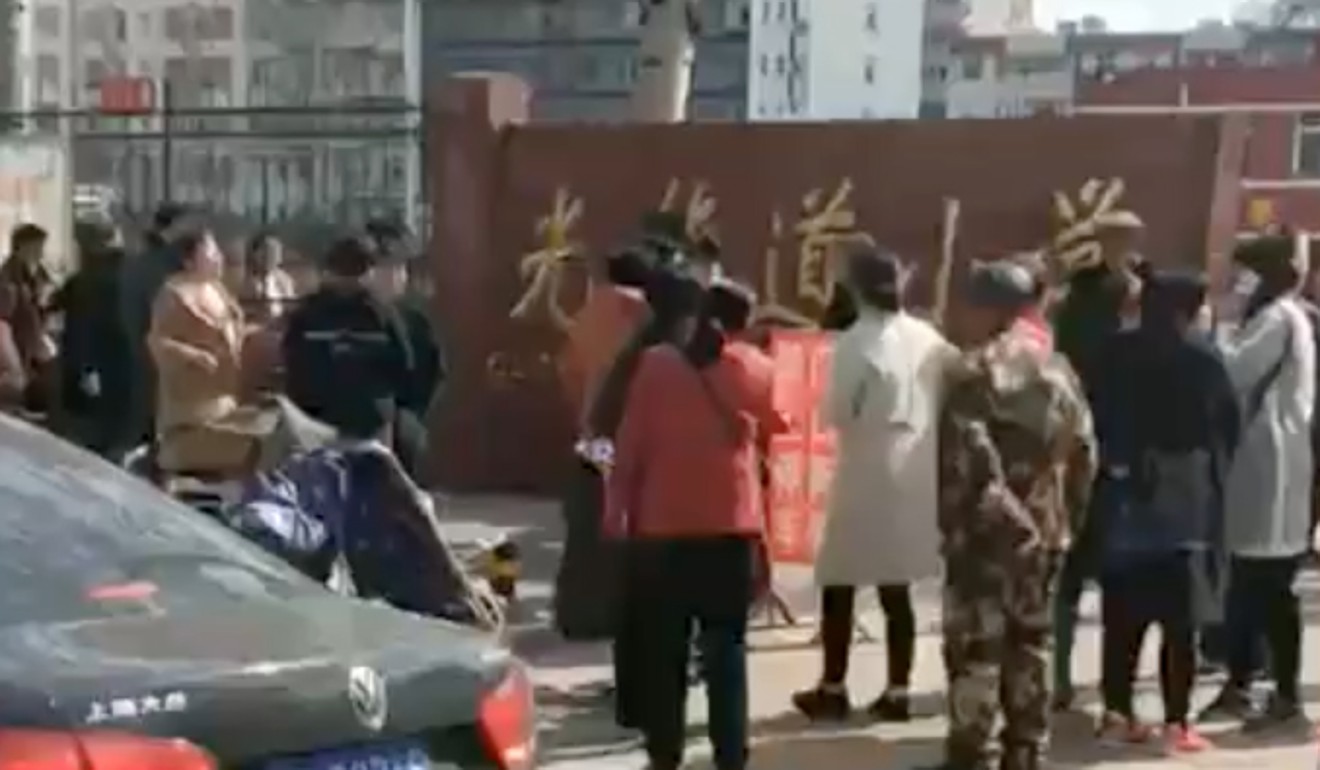
Onlookers and families gather at a primary school in the Fengrun district of Tangshan city in Hebei province after reports of an incident on Thursday afternoon. Photo: Handout
Onlookers and families gather at a primary school in the Fengrun district of Tangshan city in Hebei province after reports of an incident on Thursday afternoon.
Source: SCMP
Law of Unintended Consequences

continuously updated blog about China & India

ChiaHou's Book Reviews

continuously updated blog about China & India

What's wrong with the world; and its economy

continuously updated blog about China & India