Archive for April, 2019

22/04/2019

China to hold shadow play art week

BEIJING, April 21 (Xinhua) — Representative shadow play works from around China will be displayed from April 28 to 30 during the art week in Huazhou District of Weinan City, northwest Shaanxi Province, which is dubbed the “home of shadow play.”

Co-organized by the Prince Kung’s Palace Museum in Beijing and provincial and municipal authorities in Shaanxi, the event will also include academic forums and performances of intangible cultural heritage music, dances, and Chinese operas.

Shadow play, also known as shadow puppetry, dates back to the Han Dynasty around 2,000 years ago. Performers hold cowhide-carved figures between a source of light and a translucent curtain, make movements of the figures for storytelling, and add drum sounds and Chinese opera to accompany the movements.

Chen Xiaowen, the deputy curator of the museum, said at a press conference in Beijing that they will try to organize more state-level shadow play events in Weinan and establish a special committee for the art form in the city.

Source: Xinhua

22/04/2019

Chinese president, premier send condolence messages to Sri Lanka over deadly attacks

BEIJING, April 21 (Xinhua) — Chinese President Xi Jinping and Premier Li Keqiang on Sunday sent condolence messages to their Sri Lankan counterparts, respectively, after multiple deadly attacks shook the country.

In his message to Sri Lankan President Maithripala Sirisena, Xi said that he was shocked to know the series of explosions in Sri Lanka, which have caused large casualties.

“I, on behalf of the Chinese government and people, as well as myself, send my deep condolences to the victims, and my sincere sympathy to the injured and families of the victims,” he added.

The Chinese government and people will firmly stand by the people of Sri Lanka and firmly support the Sri Lankan government’s effort to maintain national security and stability, Xi said.

On the same day, Chinese Premier Li Keqiang also sent condolences to Sri Lankan Prime Minister Ranil Wickremesinghe over the attacks.

Source: Xinhua

22/04/2019

China lifts 3 ethnic minorities out of poverty

KUNMING, April 21 (Xinhua) — China has lifted three ethnic minority groups out of poverty in the southwestern province of Yunnan as it steps toward delivering the goal of completely eliminating poverty by 2020.

The ethnic minority groups of Dulong, Deang and Jino had a total population of more than 50,000, according to the last national population census in 2010.

The proportion of residents living in poverty has been reduced from 24.25 percent a few years ago to 2.42 percent, well below the required 3 percent that removes them from the poverty list in western China.

The ethnic minority groups of Dulong, Deang and Jino live in the mountainous regions in the northwestern, western and southern parts of Yunnan, respectively.

Huang Yunbo, head of the provincial office of poverty alleviation and development, said a total of seven ethnic minority groups will be removed from the poverty list this year.

The number of such ethnic groups who are lifted out of poverty will reach 11 by 2020, Huang said.

The battle against poverty is one of the “three tough battles” that the country must win to build a moderately prosperous society in all respects by 2020. To achieve the goal, China needs to lift around 30 million poor rural residents out of poverty between 2018 and 2020.

Source: Xinhua

22/04/2019

Five Chinese still missing after Sri Lanka bombings as tourists return home

  • Embassy officials have contacted families of two Chinese nationals who were killed in the blasts on Easter Sunday, and visited five who were injured
  • Four of the missing were travelling to the Indian Ocean on a study trip
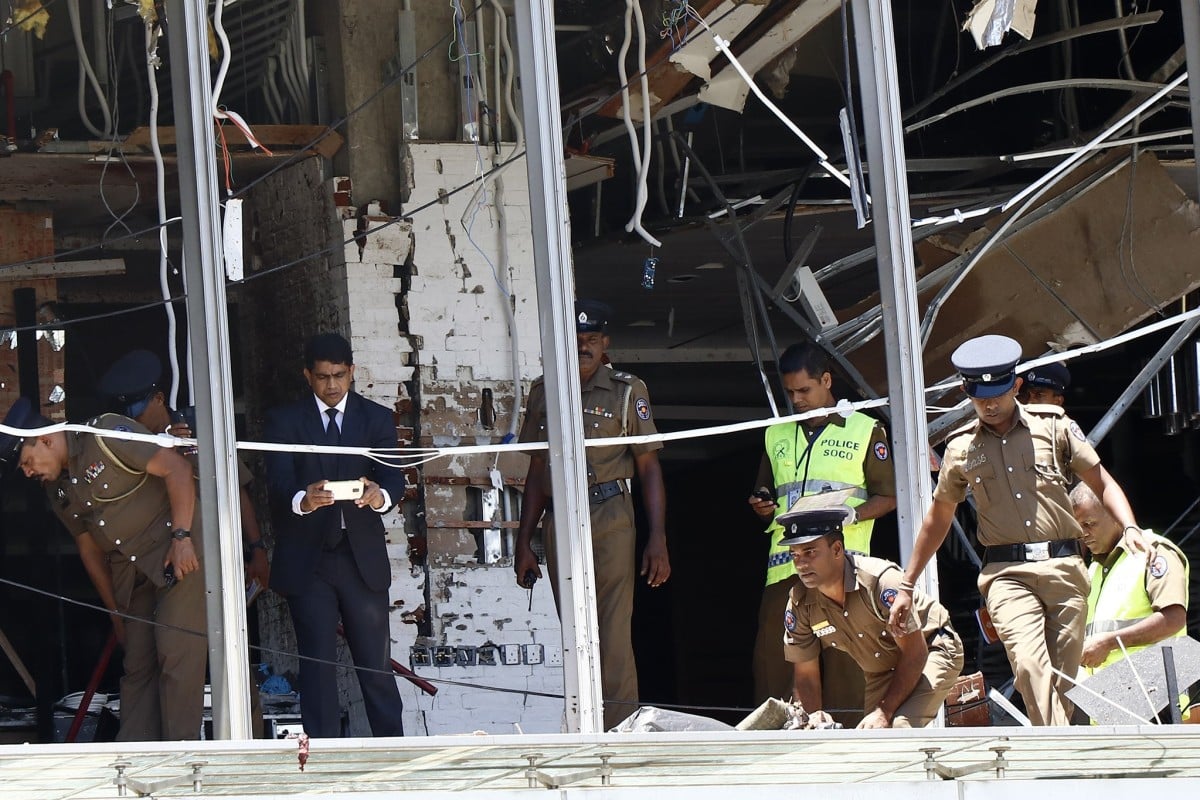
Police and investigators work at the Shangri-La Hotel blast scene in Colombo on Sunday, where the two Chinese were killed. Photo: Xinhua
Five Chinese nationals remain missing following a series of suicide bombings in hotels and churches in Sri Lanka on Easter Sunday that claimed the lives of 
two other Chinese

and injured five more.

At least 290 people were killed and more than 500 others injured in the blasts, according to a Sri Lankan government official on Monday, who said a local militant group was behind the attacks.
The Chinese embassy in Colombo had contacted the families of the two deceased Chinese and was awaiting police confirmation on the fate of the five still missing, state-run People’s Daily reported.
Two Chinese nationals sustained serious injuries in the blasts and three others minor ones. Embassy officials had visited them several times in hospital, the report said.
“The embassy will closely monitor the situation, urge Sri Lankan police to confirm the whereabouts of the missing persons and assist Chinese citizens and families to properly handle the aftermath,” the embassy was quoted as saying.
The two Chinese who died, cousins surnamed Tan, were caught in a blast at the Shangri-La Hotel in Colombo, Red Star News quoted a Chinese businesswoman in the Sri Lankan capital as saying.
“Their families identified them at the scene,” she said.
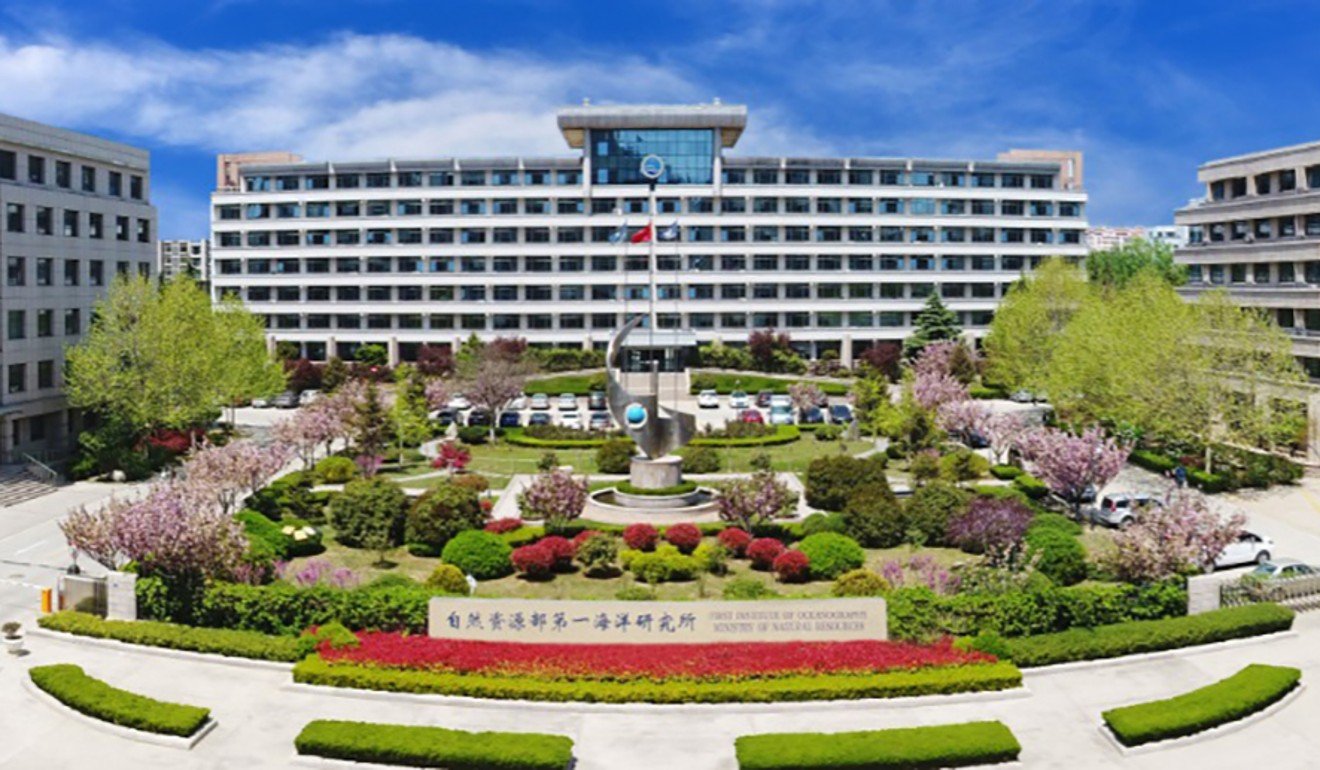
Four of the missing Chinese are students from the First Institute of Oceanography at the Ministry of Natural Resources. Photo: FIO

Four of the missing Chinese – Li Dawei, Li Jian, Pan Wenliang and Wang Liwei – are students from the Ministry of Natural Resources’ First Institute of Oceanography who were going to take part in a study in the Indian Ocean, an institute staff member told Red Star News.

The institute has sent staff to 

Sri Lanka

to handle the emergency.

Four of the five injured are students from the Chinese Academy of Sciences’ South China Sea Institute of Oceanology, who were en route to a study trip in the eastern Indian Ocean.

“It is an annual scientific expedition programme and they were on the way to replace the 10 others who had completed their rotation,” a staff member told The Beijing News. “Some sustained bruising on their legs and one could hardly hear after the blast.”

Tourists who returned to Shanghai and Chengdu, Sichuan province, told the newspaper that their trip had to be cut short as shops were closed and a curfew imposed amid tight security.

“All the private cars, coaches, vans and buses had to open their doors for inspection. There were checkpoints every 10 metres,” said one tour guide from Chengdu.

A traveller from the same city said airport security had also been stepped up. “There was a bombing 20 minutes after we left a restaurant and another one outside the airport when we were waiting there. We had to pass through three or four very strict security checks at the airport,” she said.

Back in Shanghai, another woman said: “We were not scared there but we are very glad to be back home.”

Source: SCMP

22/04/2019

Tesla says investigating car explosion in Shanghai

Logo of a Tesla Motors store in Hangzhou downtown. Tesla Motors is an American automotive and energy storage company selling luxury electric cars and battery products. It aims to produce its $76,000 and up vehicles in ChinaImage copyright GETTY IMAGES

Tesla said it is investigating a video on Chinese social media that appears to show one of its vehicles bursting into flames in Shanghai.

In a statement, the carmaker said it had sent a team to investigate the matter, and that there were no reported casualties.

The video, which has not been verified by the BBC, showed a stationary car erupting into flames in a parking lot.

Tesla did not confirm the car model but social media identified it as Model S.

“After learning about the incident in Shanghai, we immediately sent the team to the scene last night,” according to a translation of a Tesla statement posted on Chinese social media platform Weibo.

“We are actively contacting relevant departments and supporting the verification. According to current information, there are no casualties.”

The video showed smoke rising from a parked, white vehicle and seconds later it bursts into flames.

The time stamp on the video shows the incident happened on Sunday night, local time (Sunday morning GMT).

Previous incidents involving Tesla vehicles catching on fire seem to have happened while the cars were moving.

In 2018, a Tesla car driven by British TV director Michael Morris burst into flames, following another such incident involving a Model S model in France in 2016.

A series of fires involving Tesla Model S cars took place in 2013.

Source: The BBC

22/04/2019

Huawei says launches ‘world’s first’ 5G communications hardware for autos

BEIJING (Reuters) – China’s Huawei Technologies launched on Monday what it said was the world’s first 5G communications hardware for the automotive industry, in a sign of its growing ambitions to become a key supplier to the sector for self-driving technology.
Huawei said in a statement that the so-called MH5000 module is based on the Balong 5000 5G chip which it launched in January. “Based on this chip, Huawei has developed the world’s first 5G car module with high speed and high quality,” it said.
It launched the module at the Shanghai Autoshow, which began last week and runs until Thursday.
“As an important communication product for future intelligent car transportation, this 5G car module will promote the automotive industry to move towards the 5G era,” Huawei said.
It said the module will aid its plans to start commercializing 5G network technology for the automotive sector in the second half of this year.
Huawei has in recent years been testing technology for intelligent connected cars in Chinese cities such as Shanghai, Shenzhen and Wuxi and has signed cooperation deals with a swathe of car makers including FAW, Dongfeng and Changan.
The company, which is also the world’s biggest telecoms equipment maker, is striving to lead the global race for next-generation 5G networks but has come under increasing scrutiny from Washington which alleges that its equipment could be used for espionage. Huawei has repeatedly denied the allegations.
Source: Reuters
21/04/2019

BRI to address global infrastructure imbalance: AECOM

BEIJING, April 20 (Xinhua) — The Belt and Road Initiative (BRI) will be an efficient way to address the imbalance in global infrastructure development, according to U.S. engineering firm AECOM.

Under the BRI, financing platforms including the Asian Infrastructure Investment Bank and the Silk Road Fund have emerged, which will help narrow the development gap, said Ian Chung, chief executive of AECOM for Greater China.

“The BRI is an opportunity for all. It is open, inclusive, and will bring economic development to the next level,” Chung told Xinhua.

According to Chung, countries and regions of different development phases can all benefit from the BRI, especially in infrastructure.

For developing economies, such as some in Africa, the BRI will significantly improve local infrastructure connectivity and boost economic growth, Chung said.

For fast-growing economies such as some in Southeast Asia, Chinese firms could share their experience in high efficiency and green construction via the BRI to meet the rising demand for sustainable infrastructure, he said.

As for many other developed countries, the demand for infrastructure still abounds, as many existing facilities are becoming aged, he added.

The BRI has opened plenty of opportunities for AECOM, as the company has been partnering with Chinese firms on many overseas projects, offering consulting services on design, local regulations, environmental and safety standards.

“Chinese firms excel in construction and financing, while we share a competitive edge in project design, knowledge of local regulations, procedures as well as culture. It’s a win-win for all of us,” Chung said.

Seeing business opportunities from the BRI, the company set up a new department in its Beijing office three years ago to work with Chinese firms on BRI projects.

The firm just opened its new offices in Chengdu and Changsha, following the set-up of its China headquarters in Shanghai last year, another sign that shows the company’s confidence in China’s development, Chung said.

“I am very optimistic that we will have more value-added cooperation with Chinese firms under the BRI,” Chung said.

Source: Xinhua

21/04/2019

Spotlight: Chinese, American scholars call for cooperation on ecological civilization at Int’l forum in California

CLAREMONT, the United States, April 20 (Xinhua) — Chinese and American scholars called on the two countries and the rest of the world to strengthen cooperation on ecological civilization at an international forum, which kicked off here on Friday in western U.S. state of California.

Themed “Ecological Civilization and Holistic Human Development,” the forum is hosted by the Institute for Postmodern Development of China, a U.S. think tank and non-profit organization.

Over 160 scholars from China, the United States and other countries are exchanging views on the latest developments in ecological civilization at the Pitzer College in the two-day event.

“Let’s work together to create an ecological civilization,” said John B. Cobb Jr., a 94-year-old member of the American Academy of Arts and Sciences in his welcome remark at the opening ceremony.

“I have said many times that my hope for the future of process thinking is in China,” said Cobb, noting that China is now far in the lead in the development of ecological civilization. Cobb has been advocating for green development and more efforts to avoid global ecological crisis since 1970s.

“More and more, we want to learn from you and to share our ideas with you,” he told Chinese scholars in his speech.

He noted that China has adopted the goal of ecological civilization and changed policies accordingly.

Cobb is the author of more than 50 books and the founding president of the Institute for Postmodern Development of China, donating all of his money to support its operation and activities.

He said that China’s commitment to become an ecological civilization has inspired some cities in other countries and expressed hope for more cooperation between China and the United States in future.

“I hope that, as citizens and local communities, we can continue to build ties of friendship and mutual support,” Cobb concluded.

Philip Clayton, president of the Institute for Postmodern Development of China, urged China and western countries to jointly deal with climate change.

“China became the global leader in the development of ecological civilization in 2007. China has begun to bring attention to ecological civilization in the United States, and many western countries inspired by that movement,” Clayton told Xinhua.

The Chinese government announced its first national action plan to respond to climate change in 2007, becoming the first developing country to formulate and implement the National Climate Change Program. Respect nature, follow its way and protect it. The Chinese leadership has been tirelessly promoting a simple, moderate, green, and low-carbon life for Chinese people, and asked them to treat the ecological environment with the same importance they treat their own lives.

“We have begun an annual series of international forums on ecological civilization that helps the west learn about Chinese ideas of ecological civilization. We are at a phase of new partnership opening up between China and western nations like the United States,” said Clayton, adding that as the environmental crisis grows greater, the room for cooperation is much more expanded.

“This is a really important time in the history of our planet. We have an increasingly short amount of time in order to be able to take real, concerted effort to address the climate crisis, and our countries have an opportunity to collaborate and cooperate to reduce the impact of industry and agriculture in order to form the ecological civilization,” said Brian G. Henning, Professor of Department of Environmental Studies at the Gonzaga University.

“It’s clear to us now that no country will be unaffected by the changes to our climate. I live in Washington State and the wild fires each year are getting worse and worse. And this is causing people all over our country to realize that we need to take climate change seriously and to reduce the carbon pollution in our environment,” he added.

Some Chinese scholars introduced the latest development of China’s ecological civilization construction, emphasizing the importance and necessity of cooperation in the field.

In her plenary speech, Dr. Fan Meijun, program director of Institute for Postmodern Development of China, argued that new education model is urgently needed to cultivate persons who serve the local community, serve the ecological civilization.

Fan stressed that ecological civilization is a huge project which needs countries to work more in-depth cooperation.

“In this sense, the cooperation between China, the second largest economy, and the United States, the largest one, is extremely important,” she noted.

Source: Xinhua

21/04/2019

Beijing Int’l Horticultural Exhibition to kick off on April 29

CHINA-BEIJING-HORTICULTURAL EXPO-VENUES (CN)

Aerial photo taken on April 19, 2019 shows the China Pavilion of the 2019 Beijing International Horticultural Exhibition (Expo 2019 Beijing) in Yanqing District of Beijing, capital of China. The 2019 Beijing International Horticultural Exhibition is slated to kick off on April 29, 2019. (Xinhua/Hou Dongtao)

Source: Xinhua

21/04/2019

How much of Europe does China own?

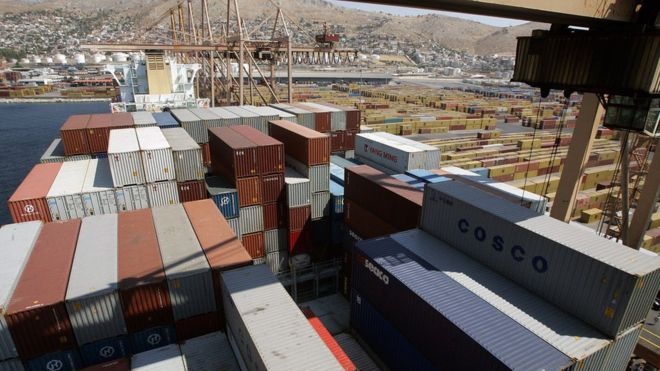
Shipping containers at PiraeusImage copyrightAFP
Image caption China now has a majority stake in the Greek port of Piraeus

The European Union has introduced a new mechanism for screening foreign investment.

It’s widely believed to have been prompted by concerns over China’s economic ambitions in Europe.

It will allow the European Commission – the EU’s executive arm – to give an opinion when an investment “threatens the security or public order” of more than one member state or undermines an EU-wide project such as the Galileo satellite project.

In March, the European Commission called China a “systemic rival” and a “strategic competitor”.

The Chinese Ambassador to the EU urged the bloc to remain “open and welcome” to Chinese investment, and not to “discriminate”.

How much foreign investment is in the EU?

China’s ownership of EU businesses is relatively small, but has grown quickly over the past decade.

A third of the bloc’s total assets are now in the hands of foreign-owned, non-EU companies, according to a report from the European Commission in March.

Of these, 9.5% of companies had their ownership based in China, Hong Kong or Macau – up from 2.5% in 2007.

That compares with 29% controlled by US and Canadian interests by the end of 2016 – down from nearly 42% in 2007.

So, it’s a significant increase, but the total amount is not huge, comparatively speaking.

China in the EU

Foreign direct investment into the 28 member stAlthough the levels of Chinese foreign direct investment in the EU have been increasing rapidly, it peaked at €37.2bn in 2016 amidst a slowdown in Chinese investment globally, according to the Rhodium Group and the Mercator Institute for China Studies.

In European countries outside the EU, investment also dropped in 2018.

What and where is China investing?

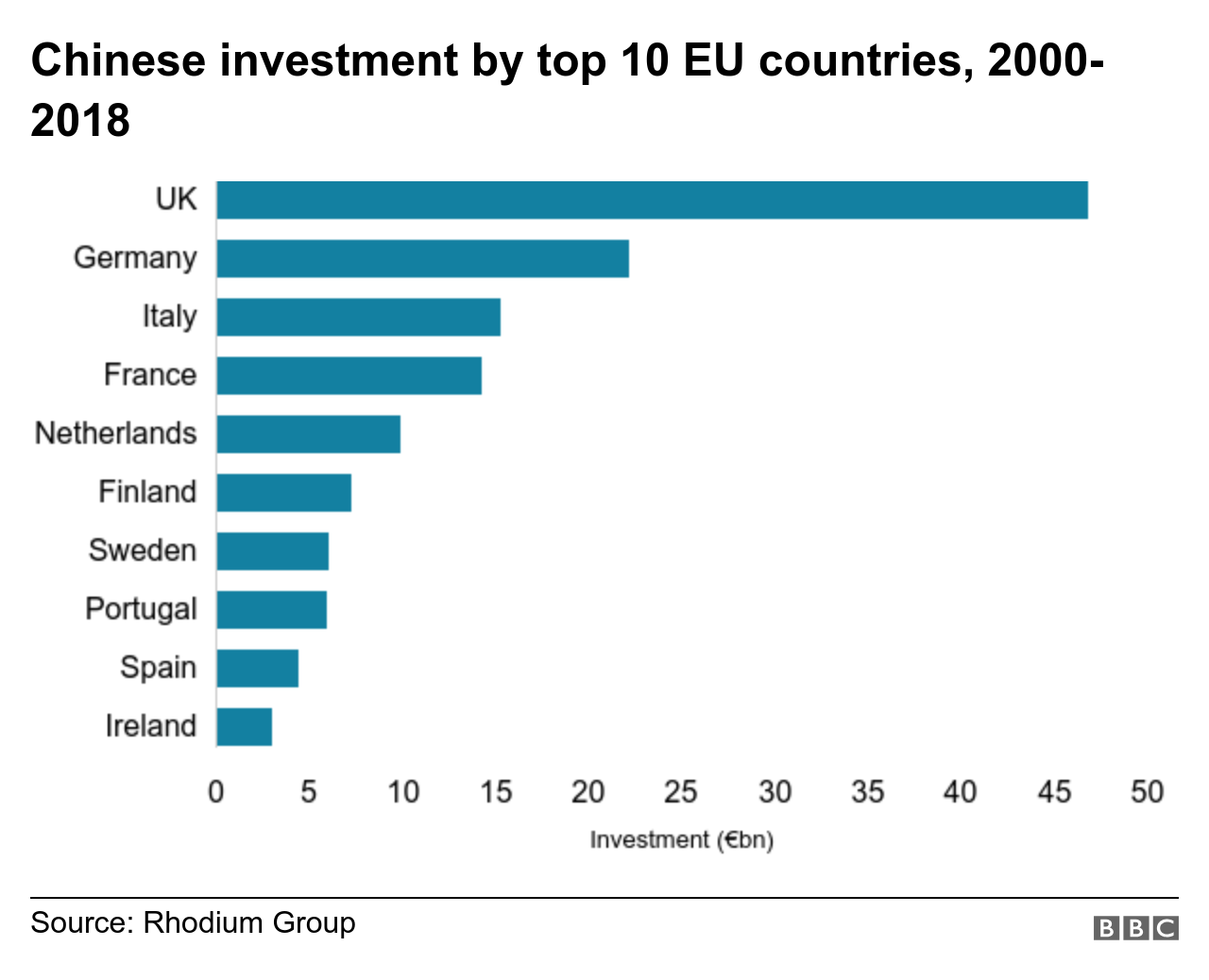
A large proportion of Chinese direct investment, both state and private, is concentrated in the major economies, such as the UK, France and Germany combined, according to the Rhodium Group and Mercator Institute.

Chinese investment by top EU countries

Analysis by Bloomberg last year said that China now owned, or had a stake in, four airports, six maritime ports and 13 professional soccer teams in Europe.

It estimated there had been 45% more investment activity in 30 European countries from China than from the US, since 2008.

And it said this was underestimating the true extent of Chinese activity.

What about infrastructure?

In March, Italy was the first major European economy to sign up to China’s new Silk Road programme – known as the Belt and Road Initiative (BRI).

It involves huge infrastructure building to increase trade between China and markets in Asia and Europe.

Officially more than 20 countries in Europe (including Russia) are part of the initiative.

For example, China is financing the expansion of the port of Piraeus in Greece and is building roads and railways in Serbia, Montenegro, Bosnia-Herzegovina and North Macedonia.

This could prove attractive to poorer Balkan and southern European countries, especially as demands for transparency and good governance can make EU funding appear less attractive.

However, analysts point out that Chinese loans come with conditions – such as the involvement of Chinese companies – and also risk burdening these countries with large amounts of debt.

Will Chinese investment grow?

Globally, China’s outward direct investment has slowed over the last year or two, after more than a decade of expansion.

“This is mainly the result of stricter controls on capital outflows from China, but also of a changing political environment globally concerning Chinese investment,” says Agatha Kratz of the Rhodium Group.

China’s global investment slows

The Trump administration is taking a tougher line towards China’s economic activities.

Governments elsewhere are more cautious – particularly when it comes to investment in sensitive areas of the economy, such as telecommunications and defence.

But there’s little doubt China is now a significant player in Europe, whether through direct investments or via the new Silk Road project.

Source: The BBC

Law of Unintended Consequences

continuously updated blog about China & India

ChiaHou's Book Reviews

continuously updated blog about China & India

What's wrong with the world; and its economy

continuously updated blog about China & India