Recognise Taiwan’s title and then we’ll talk, Foxconn billionaire Terry Gou tells Beijing

  • Presidential hopeful takes a stand on ‘Republic of China’ after critics question his sovereignty credentials
  • Foxconn chief’s investments on mainland and close contact with mainland leadership have brought him under intense scrutiny
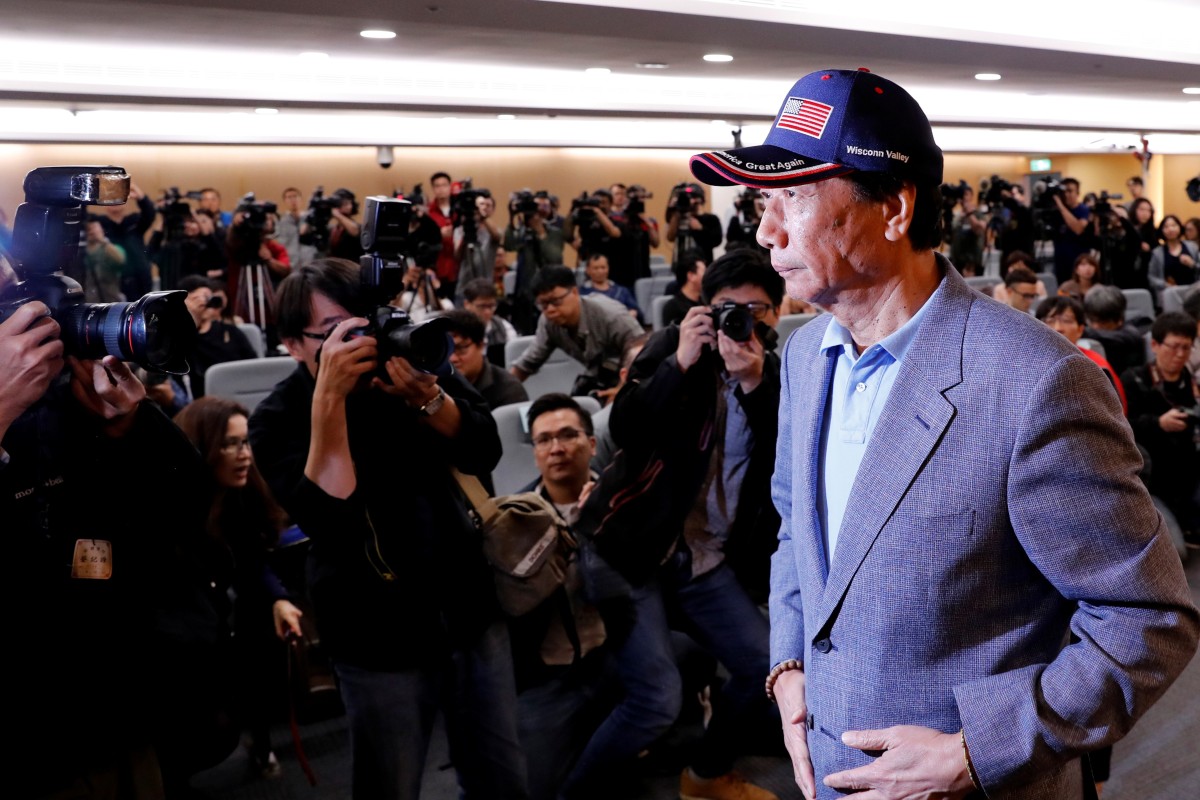
Taiwanese presidential hopeful Terry Gou. Photo: Reuters
Foxconn’s billionaire chairman and aspiring Taiwanese presidential candidate Terry Gou has called on Beijing to recognise the “Republic of China”, Taiwan’s official title.
Gou also said he had no plan to meet Chinese President Xi Jinping, countering critics who claim he would sell out the self-ruled island because of his multibillion-US dollar manufacturing empire on the mainland.
The businessman, who hopes to be the nominee for the Beijing-friendly Kuomintang (KMT) in the presidential race next year against incumbent Tsai Ing-wen, gave the assurances after the Tsai government accused him of spreading erroneous information about Taiwan’s sovereignty – a highly sensitive election issue.
In Taipei on Monday after returning from a trip to the United States,

where he met US President Donald Trump

, Gou said he would do all he could to defend the interests of the island.

“And since I have announced that I will take part in the KMT primaries to run on the party ticket for president, I will continue to do so without hesitation. As the president of the [Republic of China] of course, I must make the interests of the ROC the priority without a second thought,” he said.
He said he had long required Foxconn employees to sing the island’s anthem and hoist the island’s flag during annual parties.
Taiwan can turn a hi-tech profit from China-US rivalry: Foxconn chief

He also said he had the island’s flag displayed prominently during a ceremony marking his purchase of Japanese electronics maker Sharp in 2016 – all because he wanted the world and the mainland to note the existence of the ROC.

“If the Chinese mainland does not want to take note of the existence of the ROC, then what does it want us to be?” he said.

Gou added that he decided to run for president because he wanted to talk to Beijing about this issue “on an equal basis”.

Beijing considers Taiwan a wayward province that must returned to the mainland’s fold – by force if necessary.

It has suspended exchanges with Taiwan since Tsai became president in 2016. She refused to accept the “1992 consensus” – an understanding that allows the two sides to continue talks as long as they support the principle that there is only one China.

Since Gou launched his presidential bid last month, his huge investments on the mainland and his close contact with the mainland leadership have brought him under intense scrutiny from the pro-independence camp.

On Monday, Chen Ming-tung, head of Taiwan’s Mainland Affairs Council, which charts the island’s cross-strait policy, took aim at Gou for “incorrectly” saying that Taiwan was a part of the People’s Republic of China – mainland China’s official title.

Chen was responding to various Taiwanese media outlets that reported Gou as saying in the US that Taiwan was an inseparable part of China.

Cho Jung-tai, chairman of the ruling Democratic Progressive Party, also accused Gou of diminishing the island’s sovereignty.

In response, Gou said he was describing historical and religious links between the island and the mainland – not commenting on sovereignty.

Terry Gou: Taiwan’s wealthiest man – and future presidential candidate
“I hereby solemnly clarify that what I meant was that ‘China’ is the ROC as underlined in our constitution, and Taiwan, of course, is part of the ROC,” he said, adding “the ROC was never a part of the PRC”.
Gou said Foxconn had invested greatly in businesses not just on the mainland but also in other parts of the world, and it was unlikely for him to bow to Beijing simply because of his huge investments on the mainland.
He said he wanted to run for president because he hoped to be the peacemaker between Taiwan, the mainland and the US.
“No [Taiwanese] business can escape a conflict between the two sides of the Taiwan Strait,” he said.
During his meeting with Trump, Gou said he told the US leader of his desire to forge a mutually beneficial peace and improve commercial links between the three sides.
Observers said Gou must work out a cross-strait policy to convince voters that he would stand firm on Taiwan’s interests, and the scrutiny from the pro-independence camp would only grow if he was on the KMT’s presidential ticket.
Source: SCMP

Leave a comment

This site uses Akismet to reduce spam. Learn how your comment data is processed.

Law of Unintended Consequences

continuously updated blog about China & India

ChiaHou's Book Reviews

continuously updated blog about China & India

What's wrong with the world; and its economy

continuously updated blog about China & India