Chindia Alert: You’ll be Living in their World Very Soon
aims to alert you to the threats and opportunities that China and India present. China and India require serious attention; case of ‘hidden dragon and crouching tiger’.
Without this attention, governments, businesses and, indeed, individuals may find themselves at a great disadvantage sooner rather than later.
The POSTs (front webpages) are mainly 'cuttings' from reliable sources, updated continuously.
The PAGEs (see Tabs, above) attempt to make the information more meaningful by putting some structure to the information we have researched and assembled since 2006.
XI’AN, May 16 (Xinhua) — The fourth Silk Road International Exposition concluded Wednesday in Xi’an, capital of northwest China’s Shaanxi Province.
During the five-day expo, 65 contracts in various fields including education, medical care, modern agriculture and intelligent manufacturing were signed with a total investment of 115.1 billion yuan (about 16.7 billion U.S. dollars).
Themed “New Era, New Pattern, and New Development,” the fourth Silk Road International Exposition attracted more than 2,000 Chinese enterprises and more than 200 overseas enterprises from 25 countries and regions, including Russia, the United States and Cambodia.
More than 30 activities and exhibitions were staged during the five-day event, including forums, conferences and investment and trade activities. An international forum on poverty relief was first held during the expo to contribute China’s experience and efforts to the global poverty reduction.
Known in ancient times as Chang’an, Xi’an was the starting point of the ancient Silk Road and plays a key role in the Belt and Road Initiative.
TIANJIN, May 16 (Xinhua) — President Xi Jinping sent a congratulatory letter to the Third World Intelligence Congress, which opened in northern China’s Tianjin municipality Thursday.
In the letter, Xi expressed his sincere welcome to renowned international entrepreneurs, industry leaders and Turing Award winners who attended the congress.
Noting that artificial intelligence (AI) is casting significant and far-reaching impacts on economic development, social progress and global governance, Xi said China attaches high importance to innovative development and takes new-generation AI as the driving force for scientific and technological development, industrial optimization and upgrading, as well as increasing productivity, striving to achieve high-quality development.
Xi expressed hope that participants of the congress could further exchanges, enhance consensus and step up cooperation to promote the healthy development of the new-generation AI.
Having read out Xi’s letter at the opening ceremony, Li Hongzhong, secretary of the Tianjin Municipal Committee of the Communist Party of China, said Tianjin would embrace a new era of intelligence, create a new intelligence-based economy, step up cooperation with other countries in the field of AI and speed up building “intelligent Tianjin.”
WASHINGTON/NEW YORK (Reuters) – The Trump administration on Wednesday took aim at China’s Huawei Technologies Co Ltd, banning the firm from buying vital U.S. technology without special approval and effectively barring its equipment from U.S. telecom networks on national security grounds.
Taken together, the two moves threaten Huawei’s ability to continue to sell many products because of its reliance on American suppliers, and represents a significant escalation in the U.S. government’s worldwide campaign against the company.
The steps also come at a delicate time in relations between China and the United States as the world’s two largest economies ratchet up tariffs in a battle over what U.S. officials call China’s unfair trade practices.
Washington believes the handsets and network equipment for telecommunications companies made by Huawei could be used by the Chinese state to spy on Americans.
Huawei, which has repeatedly denied the allegations, said in a statement that “restricting Huawei from doing business in the U.S. will not make the U.S. more secure or stronger; instead, this will only serve to limit the U.S. to inferior yet more expensive alternatives, leaving the U.S. lagging behind in 5G deployment.”
“In addition, unreasonable restrictions will infringe upon Huawei’s rights and raise other serious legal issues.”
The ban on U.S. suppliers, which appears similar to one on Huawei rival ZTE Corp. last year, could hit the shares of Huawei’s biggest U.S. suppliers, including chipmakers Qualcomm Inc and Broadcom Inc (AVGO.O).
In the first action taken on Wednesday, President Donald Trump signed a long-awaited executive order declaring a national emergency and barring U.S. companies from using telecommunications equipment made by firms posing a national security risk.
The order invoked the International Emergency Economic Powers Act, which gives the president the authority to regulate commerce in response to a national emergency that threatens the United States. It directs the Commerce Department, working with other government agencies, to draw up an enforcement plan by October.
Members of Congress said Trump’s order was squarely aimed at Chinese companies like Huawei, which generated $93 billion in revenue last year and is seen as a national champion in China.
“China’s main export is espionage, and the distinction between the Chinese Communist Party and Chinese ‘private-sector’ businesses like Huawei is imaginary,” Republican Senator Ben Sasse said.
ENTITY LIST
Soon after the White House announced the order had been signed, the Commerce Department said it had added Huawei and 70 affiliates to its so-called Entity List – a move that bans the telecom giant from buying parts and components from U.S. companies without U.S. government approval.
U.S. officials told Reuters the decision would make it difficult, if not impossible, for Huawei, the largest telecommunications equipment producer in the world, to sell some products because of its reliance on U.S. suppliers. It will take effect in the coming days.
Commerce Secretary Wilbur Ross said in a statement Trump backed the decision that will “prevent American technology from being used by foreign owned entities in ways that potentially undermine U.S. national security or foreign policy interests.”
With Huawei on the Entity List, U.S. suppliers will need to apply for licenses to provide the Chinese company with anything subject to U.S. export control regulations. Obtaining such licenses will be difficult because they will have to show the transfer of items will not harm U.S. national security, said John Larkin, a former export control officer in Beijing for the Commerce Department.
The United States in January unsealed a 13-count indictment against Huawei accusing the company and its chief financial officer of conspiring to defraud global financial institutions by misrepresenting Huawei’s relationship with a suspected front company that operated in Iran.
The indictment was unsealed a month after CFO Meng Wanzhou was arrested in Canada on a U.S. warrant for her role in the alleged fraud. Meng, who maintains her innocence, is fighting extradition.
5G NETWORKS
Reuters reported on Tuesday that Trump was expected to sign his long-awaited executive order this week. The order does not specifically name any country or company, but U.S. officials have previously labeled Huawei a “threat”.
The United States has been actively pushing other countries not to use the Chinese company’s equipment in next-generation 5G networks that it calls “untrustworthy.” In August, Trump signed a bill that barred the U.S. government from using equipment from Huawei and another Chinese provider, ZTE Corp.
ZTE was added to the Commerce Department’s Entity List in March 2016 over allegations it organised an elaborate scheme to hide its re-export of U.S. items to sanctioned countries in violation of U.S. law.
The restrictions prevented suppliers from providing ZTE with U.S. equipment, potentially freezing the company’s supply chain, but the restrictions were suspended in a series of temporary reprieves, allowing the company to maintain ties to U.S. suppliers until it agreed to a plea deal a year later.
The status of Huawei and ZTE has taken on new urgency as U.S. wireless carriers rollout 5G networks.
While the big wireless companies have already cut ties with Huawei, small rural carriers continue to rely on both Huawei and ZTE switches and other equipment because they tend to be cheaper. Trump’s order applies to future purchases and does not address existing hardware, officials said Wednesday.
India is in full election mode: voting began on 11 April, and the final ballot will be cast on 19 May with results out on 23 May. Every day, the BBC will be bringing you all the latest updates on the twists and turns of the world’s largest democracy.
Ruling party candidate calls Gandhi’s killer a patriot
What is happening?
Controversial Bharatiya Janata Party (BJP) politician Pragya Thakur has made headlines again. This time it was for calling Nathuram Godse – the man who assassinated Mahatma Gandhi – a “patriot”.
Her comment was made in response to a statement by southern actor-turned politician Kamal Haasan who had said India’s first “extremist” was a Hindu”, referring to Godse.
#WATCH BJP Bhopal Lok Sabha Candidate Pragya Singh Thakur says ‘Nathuram Godse was a ‘deshbhakt’, is a ‘deshbhakt’ and will remain a ‘deshbhakt’. People calling him a terrorist should instead look within, such people will be given a befitting reply in these elections
His statement, made on Monday, was heavily criticised by the BJP, which accused him of indulging in “divisive politics” and filed a complaint against him with the Election Commission of India.
Why does this matter?
The BJP has responded by criticising Ms Thakur and asking her to publicly apologise.
“BJP does not agree with this statement, we condemn it. Party will ask her for clarification, she should apologise publicly for this statement,” party spokesperson GVL Narasimha Rao told reporters.
However, Ms Thakur’s comments do reflect the views of some right-wing Hindus who support the BJP and have long seen Gandhi as too moderate.
Godse, who shot Gandhi in the chest three times at point-blank range on 30 January 1948, was also an activist with nationalist right-wing groups, including those closely associated with the BJP.
Hindu hardliners in India accuse Gandhi of having betrayed Hindus by being too pro-Muslim, and even for the division of India and the bloodshed that marked Partition, which saw India and Pakistan created after independence from Britain in 1947.
Ms Thakur has seen her fair share of controversy. Her candidature caused outrage as she is an accused of involvement in a blast that killed seven people and injured 100 others. On 18 April, she said that police officer Hemant Karkare had died in the November 2008 Mumbai terror attacks because she had “cursed” him. She was then banned from campaigning for 72 hours as a result.
A team led by Mr Karkare had arrested her for questioning in connection with the Malegaon blast.
During her campaign, she also said she was “proud” of her part in the demolition of the 16th Century Babri mosque. In 1992, right-wing Hindu mobs razed the mosque to the ground, claiming it was built on the site of a temple destroyed by Muslim rulers. The site, which is in the city of Ayodhya, has been a religious flashpoint for Hindus and Muslims for decades.
Campaigning ends in West Bengal a day before deadline
What happened?
The Election Commission (EC) has told political parties to end their campaigning in West Bengal state, a day before the deadline in the wake of poll-related violence.
The campaign will end on Thursday at 10pm local time, and voting will be held on Sunday.
The decision comes after clashes broke out between the Bharatiya Janata Party (BJP) workers and protesters believed to be from the ruling Trinamool Congress (TMC) in Kolkata (formerly Calcutta) on Tuesday.
It happened during a roadshow of BJP chief Amit Shah. Several people were injured and vehicles were set on fire. A statue of renowned Bengali reformer Iswarchandra Vidyasagar was also vandalised in the clashes.
Both parties have accused each other of starting the violence.
Why does this matter?
Image copyright GETTY IMAGESImage caption Violence took place during BJP chief Amit Shah’s rally in Kolkata on Tuesday
The BJP welcomed the decision, saying it validated their argument that the state had “descended into anarchy” under the leadership of chief minister Mamata Banerjee.
Ms Banerjee said that the move was “undemocratic” and “it had insulted the people of Bengal”.
“Tomorrow, [Prime Minister Narendra] Modi has two meetings in Bengal. When he finishes, the campaigning also ends… Instead of punishing Amit Shah, the Election Commission has given a gift to the BJP,” she said.
Image copyright AFPImage caption Several people were injured and vehicles were set on fire during the violence
Both parties are locked into a fierce election battle to win most out West Bengal’s 42 seats. Ms Banerjee has ambitions of becoming the prime minister in case a nationwide coalition of regional parties wins enough seats.
The state has also become crucial for the BJP as it’s trying to expand its reach in the eastern state. It won only two seats in the 2014 election.
The BJP performed well in northern states like Uttar Pradesh and Rajasthan in 2014, but this time it’s expected to suffer loses against a coalition of regional parties and the main opposition Congress.
So the party is trying to make up for the losses in West Bengal.
TMC, BJP accused each other of poll violence
Image copyright GETTY IMAGES
What happened?
The war of words between West Bengal state chief minister Mamata Banerjee and the governing Bharatiya Janata Party (BJP) intensified ahead of voting on Sunday.
The latest verbal duel comes after violence was reported during BJP chief Amit Shah’s roadshow in Kolkata (formerly Calcutta) on Tuesday.
Clashes broke out between BJP supporters and protesters who were holding “Amit Shah go back” posters.
Some people suffered minor injuries and a few vehicles were set on fire.
The BJP said the protest was “orchestrated” and called it an “attempt to strangulate democracy”.
Why does this matter?
The eastern state has become politically crucial for the BJP as it has intensified campaigning in the past few days.
And that has sparked a feverish electoral battle between the BJP and Ms Banerjee’s Trinamool Congress (TMC).
“What does Amit Shah think of himself? Is he above everything? Is he god that no one can protest against him?” Ms Banerjee said.
In reply, Mr Shah accused the TMC of not following democratic norms during elections.
“Have faith in the people of Bengal that they’d face the TMC goons,” he said.
Prime Minister Narendra Modi is scheduled to hold more rallies in the coming days, so one can expect more verbal fireworks from the two leaders.
On Tuesday, the saga of the morphed Mamata meme continued
What happened?
India’s top court stepped in to release an activist belonging to India’s governing Bharatiya Janata Party (BJP) who was sent to prison for sharing a doctored image of West Bengal Chief Minister Mamata Banerjee.
Priyanka Sharma was sentenced to two weeks in prison on 10 May after she shared a picture of Bollywood star Priyanka Chopra and her husband Nick Jonas at the Met Gala – but with Ms Banerjee’s head superimposed on to Chopra’s body.
Earlier the court had said Ms Sharma could be released only if she apologised to Ms Banerjee, but later waived this condition.
Why does this matter?
The battle for West Bengal in this general election has been absolutely bruising.
The BJP, led by Prime Minister Narendra Modi himself, has been campaigning hard for votes in the state. This has brought them toe-to-toe with the state’s feisty chief minister. The fact that voting for West Bengal’s 42 seats has been split across all nine phases of voting has meant that the battle has been long and drawn-out.
And with just one phase to go before voting finally ends, the gloves are well and truly off. The two parties have traded insults on the campaign stage, their workers have attacked each other, and the violence on the ground has intensified. And now the battle has spread to cyberspace as well.
The country’s finance minister Arun Jaitley jumped at news of Ms Sharma’s release to call Ms Banerjee a dictator.
Humour, wit, sarcasm survive in a free society. They have no place in autocracies. Dictators laugh at people. They don’t like people laughing at them. Bengal, today is a case in point.
Analysts say that this political row is so bitter because the BJP has clearly identified West Bengal as one of the states where they may be able to make gains this election. This becomes more important for the party in the context of their fight in the politically crucial state of Uttar Pradesh, which sends the most number of MPs (80) to parliament.
They are up against a powerful coalition of regional parties there, and many expect them to lose seats as a result.
And PM Modi said Rahul Gandhi should be ashamed of 1984 riots
What happened?
Prime Minister Narendra Modi said that main opposition Congress party chief Rahul Gandhi should be “ashamed of himself” over his colleague’s remark on the 1984 anti-Sikh riots.
Mr Modi was replying to a controversial statement made by Sam Pitroda, who is a strategist of the Congress party.
In his reply to a question about the Congress’ role in the riots, Mr Pitroda had said “so what?”.
“I don’t think so, this is also another lie, and what about 1984? You speak about what you [Mr Modi] have done in five years. It [the riots] happened in 1984, so what?” he said.
Mr Gandhi said he was “ashamed” of Mr Pitroda’s statement, and asked him to apologise.
Mr Pitroda later said his statement was “twisted” and he did not mean to hurt sentiments.
But Mr Modi said the Congress chief “must apologise”.
“I was watching that naamdar [the dynast] told his guru that he should be ashamed of what he said. I want to ask naamdar, you pretended to scold your mentor for what? Because he exposed what was always in the Congress’s heart, and in the discussions of the naamdar family? Because he made public a family secret? Naamdar, it is you who should be ashamed,” Mr Modi said.
Why does this matter?
The controversy matters because it comes days ahead of voting for the 13 seats in the northern state of Punjab.
The BJP, which has formed a coalition with regional Shiromani Akali Dal, is locked in a bitter electoral battle with the ruling Congress in the state.
Sikhs are a majority in the state and the 1984 riots is still an emotional issue for many of them.
More than 3,000 Sikhs were killed in 1984 after the assassination of former prime minister Indira Gandhi by her Sikh bodyguards.
They were angry at her decision to send the army into the Golden Temple – Sikhism’s holiest shrine – to flush out militants earlier in the year.
The killing of Mrs Gandhi, who belonged to the Congress, saw mobs attack and murder members of the Sikh community across the country.
And both parties appear to be trying to come across as pro-Sikh ahead of the vote on 19 May.
On Sunday, Delhi voted but not enthusiastically
Image copyright GETTY IMAGESImage caption Delhi’s voter turnout was lower than in 2014
What happened?
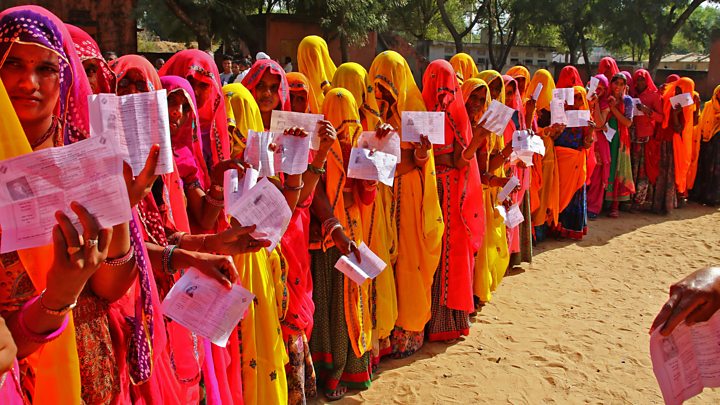
Sunday saw India’s capital Delhi vote along with several other states in the polls – the penultimate phase of the country’s mammoth general election.
Voters turned out to vote, but in fewer numbers than they did in 2014. The election commission said that around 60% of the capital’s registered voters had actually cast ballots, which was about a five percent drop from 2014.
Delhi Chief Electoral Officer Ranbir Singh expressed disappointment, saying that the turnout did not match expectations.
Why does this matter?
The election commission is right to be disappointed – it had run a series of campaigns in the city, encouraging more people to vote.
But it was not as though polling in Delhi was an entirely smooth process. Some voters complained that their names were missing from electoral lists even though they had all the necessary documents. There were also reports that around 1,200 Electronic Voting Machines (EVMs) had malfunctioned across the city, delaying the polling process.
The fact that Delhi became a three-cornered contest after the main opposition Congress and the Aam Aadmi Party (AAP), which controls the Delhi state assembly, failed to stitch up an alliance may also have put voters off. Many analysts believe that this failure will only split voters who were against prime minister Narendra Modi’s Bharatiya Janata Party (BJP) and effectively hand them victory.
So they may have decided to just stay home, and not bother queuing up in the blistering heat – it touched 40C on Sunday.
MUMBAI (Reuters) – Amazon.com faced a social media backlash in India on Thursday after toilet seat covers and other items emblazoned with images of Hindu gods were spotted on its website.
Thousands of Twitter users backed a call for a boycott of the U.S. retailer, making #BoycottAmazon India’s top trending topic on Twitter. Some tagged Indian Foreign Minister Sushma Swaraj, urging her to take action against the company.
Amazon, the world’s biggest online retailer, said it was removing the products from its online store.
“All sellers must follow our selling guidelines and those who do not will be subject to action including potential removal of their account,” the company said in a statement.
The episode is reminiscent of an incident in 2017 when the Indian government took Amazon to task after its Canadian website was spotted selling doormats resembling India’s flag.
Swaraj at the time threatened to rescind visas of Amazon employees if the doormats were not removed from its site.
Reuters found several listings of toilet seat covers, yoga mats, sneakers, rugs and other items depicting Hindu gods, or sacred Hindu symbols, on Amazon’s U.S. website.
Some of the items were no longer available for purchase.
“Until you hit these Hinduphobics Business hard they will keep on insulting your gods, your beliefs & your entire civilization,” tweeted Sumit Kandel, whose profile describes him as a film trade analyst.
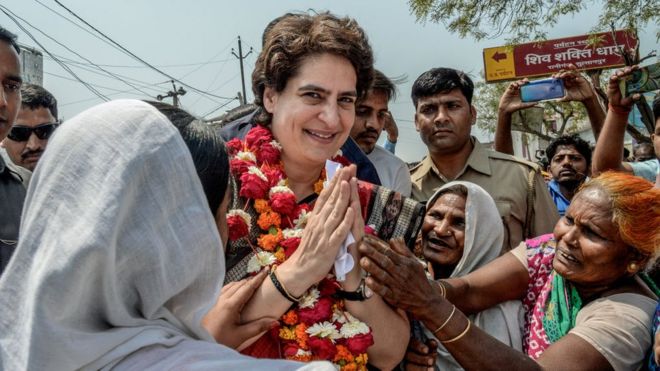
On Wednesday, Priyanka Gandhi is taking on Prime Minister Narendra Modi on his home turf – by holding a road show in his constituency Varanasi. Ever since she formally joined politics in February, she has been on a whirlwind tour, campaigning mostly in Uttar Pradesh where Varanasi is located. But will her efforts make any difference to the fortunes of the Congress party in the general elections?
When Ms Gandhi, the charismatic sister of Congress party president Rahul Gandhi, walked up onto the stage at a rally in the town of Pratapgarh last week, she was greeted by shouts of “Priyanka Gandhi zindabad! [Long Live Priyanka Gandhi!]”. A massive garland of red roses was held up by local Congress leaders to frame her and a golden crown was placed on her head.
Ms Gandhi launched a direct attack on Mr Modi, accusing him of not fulfilling the promises he had made before the 2014 elections.
His government, she said, had failed to create jobs, his decision to scrap high denomination banknotes had broken the backs of poor people and small businesses, and she chided the prime minister for denying farmers their rights.
When the Congress is voted to power, she said, the job scheme for the poor would be extended, wages paid on time and high school education made free.
Image caption Ms Gandhi connects easily with people, especially women
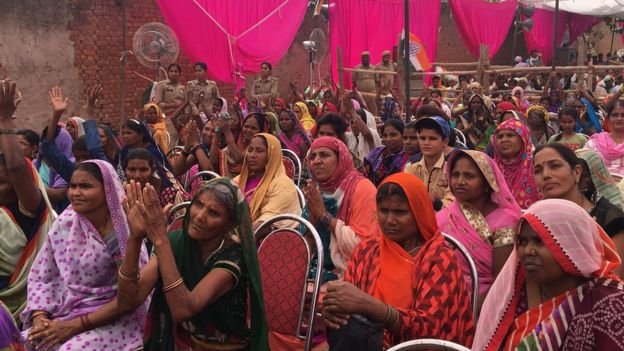
The rally was held in a small ground in the town centre and it was a small crowd, but the audience was responsive, clapping and cheering as she spoke in flawless Hindi. She ended her speech by appealing to them to vote for the Congress candidate, to vote in the change.
Mithilesh Kumar Yadav, a 21-year-old student in the audience, told me that as a young man, that’s what he wanted.
“Priyanka Gandhi wants to bring change here. As a young man I want change. Mr Modi’s policies have affected people adversely,” he said, adding that “the prime minister doesn’t talk about issues that are important. He’s trying to divert attention from his unkept promises.”
Congress spokesman Akhilesh Pratap Singh told me that Ms Gandhi had been brought in to strengthen her brother’s hands, help energise the party rank and file and counter Mr Modi’s Bharatiya Janata Party (BJP).
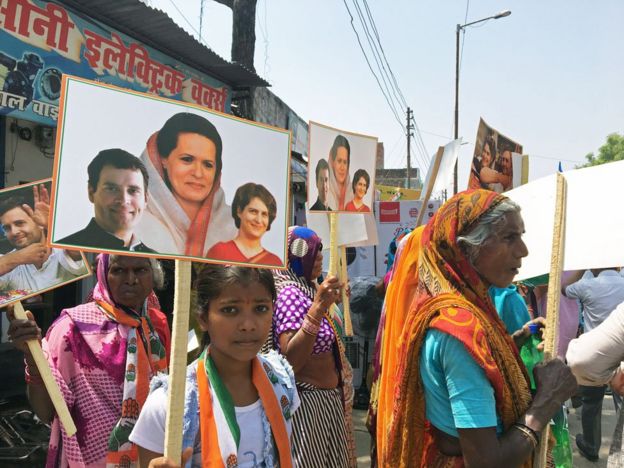
Since taking the plunge into active politics, Ms Gandhi has hit the ground running. In the past three months, I too have travelled extensively in this bellwether state that elects 80 MPs, talking to Congress party supporters to understand why they clamour for the Gandhis, especially her.
At her rallies and road shows, I have met people who are enthused by her presence, her decision for a more active political role, but I didn’t meet a single person who said they were going to vote for the Congress because of her.
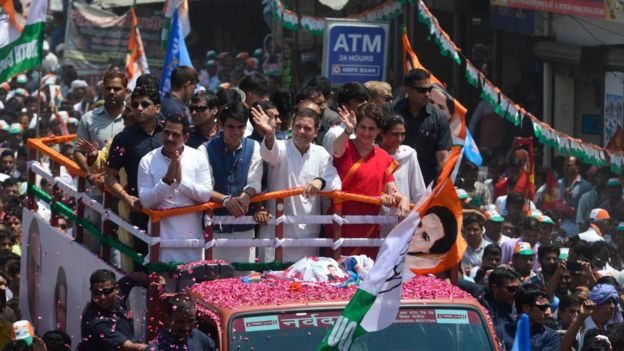
Ms Gandhi has spent hours campaigning in cars, trucks and even a boat, participated in dozens of road shows and addressed scores of rallies, grinning and waving at supporters, often reaching out to shake hands.
In February, when she made her first public appearance as a full-time politician in the state capital, Lucknow, along with her brother, thousands of supporters thronged the streets to greet them. Party workers and supporters were charged up and many told me that the Congress was now on course to win the elections and form the next government.
Similar scenes were repeated later in Amethi, Mr Gandhi’s constituency, and in towns and cities across northern India.
Image copyright GETTY IMAGESImage caption The Gandhi siblings received a tumultuous welcome during their road show in Amethi
A natural politician, Ms Gandhi is extremely articulate in Hindi and English and connects easily with people, especially women. With her short hair and crisp cotton saris, she bears a striking resemblance to her grandmother, India’s tough and only female prime minister Indira Gandhi.
And even though she’s not running for parliament, there is obsessive media interest in everything she does – during her visit to a village of snake charmers in her mother’s constituency Rae Bareli, she’s photographed holding up snakes, and in central India, a sari-clad Priyanka Gandhi is seen scaling a fence to mingle with the crowd at a rally while her security men race to catch up with her.
Her visits to temples and shrines to woo the religious are streamed live on TV channels, her road shows get prime time, and her comments about PM Modi often make headlines. And increasingly, it’s her who’s taking on Mr Modi, countering his criticism of her family and his charge that the siblings are there not because of merit but their name.
Ms Gandhi is not exactly a newcomer to politics. For almost two decades now, she has managed campaigns for her brother and mother Sonia Gandhi, but been reluctant to take on a wider role.
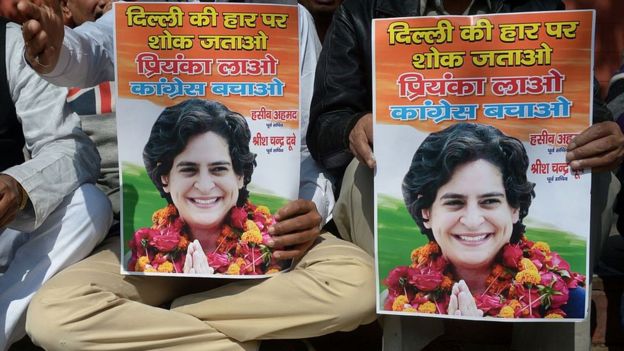
The 47-year-old mother-of-two has always been regarded as the more charismatic of the Gandhi siblings. And in recent years, as the Congress has suffered major electoral setbacks, the chorus for her to take on a larger role has been getting louder. In 2015, some party workers demonstrated outside the Congress headquarters in Delhi, holding placards that read, “Priyanka lao, Congress bachao [Bring Priyanka, Save Congress]”.
So when it was announced in January that she had been appointed as general secretary for the eastern part of Uttar Pradesh, supporters celebrated by setting off fireworks and dancing outside the party office. She was described as the “Brahmastra” – a mythical celestial weapon of last resort deployed by Hindu deities to annihilate the enemy.
In a recent interview with a Hindi-language newspaper, Ms Gandhi explained the reasons why she finally said yes.
“Democracy, constitution and our institutions are under attack and it would have been cowardly not to take the plunge now. In 2017, Rahul asked me to take on Uttar Pradesh but I didn’t. It was a mistake but people learn from their experiences, so this time when he asked, I agreed.”
The Gandhi siblings are the fourth generation of the Nehru-Gandhi dynasty, often described as India’s political royalty. Their great-grandfather, Jawaharlal Nehru, was the first prime minister of independent India, their grandmother and father also served as prime ministers, while their mother, Italian-born Sonia, was the Congress chief until poor health forced her to hand over the reins to her son.
Image copyright GETTY IMAGESImage caption In 2015, some party workers demonstrated outside Congress HQ in Delhi, holding placards that read “Bring Priyanka, Save Congress”
Mr Modi often mocks the siblings, saying they lead the Congress because of entitlement and not achievement.
Congress supporters, however, don’t seem unduly worried about the dynasty link – they talk about the fact that their grandmother and father were assassinated and the “sacrifices” the family has made for the country.
Spokesman Akhilesh Pratap Singh says Rahul – and now Priyanka – have re-energised the party. “BJP leaders, including PM Modi, are rattled, otherwise why would they call her names or say she won’t make any impact on the elections?”
Mr Singh says the most important thing is that “our workers are enthused and the public confidence in the party has grown”.
But will all this adulation really convert into votes and seats for the party?
“Definitely,” Mr Singh says. “When the votes are counted, you’ll see our voting percentage has gone up.”
Image caption Congress says Ms Gandhi has been brought in to help energise the party rank and file in Uttar Pradesh
Political analyst Neerja Chowdhury says Ms Gandhi has lots of charisma but she is a great example of its limits.
She “left it a bit too late” and should have come out a year ago and worked to galvanise the people, she says.
“The party organisation is decimated in the state and has to be built from scratch. She doesn’t have a magic wand.”
Ms Chowdhury says expecting Ms Gandhi to turn around the party in such a short time is asking her to do the impossible and it’s unfair on her because it will open her to being dismissed as a failure.
But in the absence of a strong party machinery or leadership in Uttar Pradesh, Ms Gandhi’s efforts can take Congress only so far and no further.
Ms Chowdhury says she would need to build the party base in the state brick-by-brick – that would require much more than charisma, and plenty of hard work.
But one thing, she says, she’s sure about is that “Ms Gandhi is here to stay”.
BEIJING, May 12 (Xinhua) — Facing U.S. tariff hike threats, China has adhered to its bottom line, defended national dignity and people’s interests, experts with domestic think tanks said Sunday at a symposium on China-U.S. trade relations.
Imposing new tariffs goes against the will of the people and the trend of the times. China has the resolution, courage and confidence to rise to all sorts of challenges, they said.
The United States on Friday increased additional tariffs on 200 billion U.S. dollars worth of Chinese imports from 10 percent to 25 percent.
At the 11th round of economic and trade consultations that ended in Washington the same day, the Chinese delegation made clear its consistent and resolute stance: problems can not be solved by increasing tariffs and cooperation is the only right choice for the two sides, but it has to be based on principles. China will never make concessions on major issues of principle.
RAISING TARIFFS MORE DETRIMENTAL TO U.S. ECONOMY
“Increasing tariffs will impact enterprises of both countries, but harm American businesses more,” said Gao Lingyun, a researcher with the Institute of World Economics and Politics under the Chinese Academy of Social Sciences (CASS).
The additional tariffs can not change U.S. demand for Chinese goods and will be eventually passed on to American consumers and retailers by U.S. importers, Gao said.
“If the United States insists on going its way to raise tariffs on all Chinese imports, its domestic prices would be dramatically pushed up, resulting in inflation,” Gao said.
A wide range of U.S. industry associations have expressed strong opposition to imposing additional tariffs on Chinese imports. Raising tariffs to 25 percent could cost nearly one million American jobs and increase volatility of financial market, said the Tariffs Hurt the Heartland campaign.
Of the Chinese goods already under higher tariffs, more than 70 percent are intermediates and investment goods. Such a higher proportion means that the tariffs will be eventually be passed on to American businesses, consumers and farmers, said Chen Wenling, chief economist with the China Center for International Economic Exchanges.
Chen said the trade war provoked by the United States is ineffective. The United States wanted to fix the problem of trade deficit but its trade deficits to China, European Union and other economies rose rather than fell. In addition, the corresponding industry chain restructuring did not benefit the U.S. either. Auto makers Tesla and Ford are moving to the Chinese market instead.
“Some U.S. enterprises may find it difficult to survive if quitting the Chinese market as a very large share of their profits come from China,” said Liang Ming, a researcher with a research institute of the Ministry of Commerce.
Based on an estimate of the effect of having additional tariffs on 200 billion U.S. dollars worth of Chinese goods, Liang said the United States still needs to import a majority of the goods from China. But most of the Chinese products involved are less dependent on the U.S. market, and can be exported to other markets, Liang noted.
Experts said that the spill-over effect of trade wars can reach the whole world, posing severe challenges to the global order, rules, trade systems, supply chains and even bringing negative impact on the peaceful development of the world.
“What China emphasizes, such as avoiding raising tariffs and a balance in the appeals of both sides, is not only the requests of China but also the rational choice for any country when facing unreasonable trade demand,” said Dong Yan, a researcher with the CASS’s Institute of World Economics and Politics.
Analysts agreed at Sunday’s symposium that cooperation benefits China and the Unites States, while conflicts hurt both; cooperation is always the right path to resolve the China-U.S. trade dispute.
NO YIELDING ON PRINCIPLES, FIGHT AND TALK ALTERNATELY
Experts said that the U.S. accusation of China’s “backtracking” for the unsuccessful talks is untenable and irresponsible as the two are still in the process of negotiation. As a matter of fact, the U.S. side is to blame for the negotiating setback as it has been exerting pressure on China and upping the ante.
“The U.S. requests involve China’s core interests and major concerns. They touch the bottom line and China will not compromise,” said Wei Jianguo, executive deputy director of the China Center for International Economic Exchanges.
He noted that a successful agreement must ensure both sides are satisfied for the most part and have both sides to make compromises.
If an agreement satisfies only one side with the concerns of the other side not respected or not taken care of, it can hardly sustain during the implementation and may even be revoked, he said.
After more than a year, both sides have conducted 11 rounds of economic and trade consultations, which experts said fully displays that the consultation is a continuing battle. Taking it easy is necessary while preparations must be fully made psychologically and at working level.
“It’s normal for major countries to have frictions. China must adapt to it,” said Wang Wen, executive dean of the Chongyang Institute for Financial Studies, Renmin University of China.
Chen Wenling said Chinese negotiators have stuck to their principles and stance during the consultation. “It will be normal for both sides to fight and talk alternately. China must not be vague in resolutely safeguarding its core national interests and major concerns and upholding national dignity,” Chen said.
Experts noted that China’s position on upholding the overall interests of the China-U.S. relations and consolidating bilateral economic and trade cooperation remains unchanged. The two countries should meet each other halfway in line with the principles of mutual respect, equality and mutual benefit and resolve their core differences through dialog rather than confrontation.
Dong Yan said that the Sino-U.S. economic and trade friction is a long-term problem, complicated and arduous. Before everything, China and the United States should continue to build mutual trust, step up coordination in bilateral and multilateral areas, and expand common interests.
“We believe that in the face of huge cooperative interests, the U.S. side is also very clear that a trade war will not solve the economic and trade differences between the two countries,” said Liang Ming.
Although the tariff escalation is regrettable, Liang said he believed both sides had hope for the future of their economic and trade relations. A win-win cooperation between China and the United States is in line with the aspirations of the two peoples and the world at large, Liang said.
FACING CHALLENGE WITH CONFIDENCE
“Above 8,000 meters, it is the stratosphere, where the air gets thin. For mountain climbers, this requires extra efforts to overcome, which is similar to the phase that China’s economy has to overcome in order to achieve high-quality development.”
Wang Wen, citing mountain climbing as a metaphor, said the current stage requires China to stay patient and make hard work persistently according to a set route.
With both solid strength and huge potential as well as a strong capability to cope with risks and strikes, China has the confidence, resolution and ability to face all kinds of risks and challenges, said Zheng Shuiquan, deputy secretary of the Party Committee of Renmin University of China.
“No matter how the situation goes in the future, we need to manage our own affairs well,” said Zhang Yansheng, chief research fellow with the China Center for International Economic Exchanges.
Since last year, a series of measures have been taken by the central government to consolidate the growth momentum of the Chinese economy. Wang Jinbin, deputy dean of School of Economics, Renmin University of China, said that stabilizing expectation and confidence is very essential.
Starting this year, transition towards new growth engines from the traditional ones has accelerated, with new industries and businesses constantly emerging, said Yan Jinming, executive director of the National Academy of Development and Strategy of the Renmin University of China.
He said that the Chinese economy has strong resilience and flexibility, a huge market and promising prospect.
“The key is to manage our own affairs now, so as to constantly increase the potential for economic development,” said Yan.
“A win-win cooperation is an unstoppable trend of development. Trade development needs to be aligned with major national strategies. By deepening Belt and Road economic cooperation, China will see its high-quality development path getting broader and broader,” said Chen.
BEIJING, May 12 (Xinhua) — China has unveiled “the Implementation Plan for the National Ecological Civilization Pilot Zone (Hainan),” foreseeing comprehensive experiments of ecological civilization system reform to be carried out in the southern island province.
Jointly issued by the General Office of the Communist Party of China (CPC) Central Committee and the General Office of the State Council, the document vows to bring about a new pattern of harmonious coexistence of man and nature in China’s modernization drive and write a chapter of Hainan for building a Beautiful China.
The pilot zone aims at reaching world leading level in terms of environmental quality and resource utilization efficiency, according to the plan.
The zone will focus on developing a system for building an ecological civilization, optimizing spatial distribution of land, coordinating development and conservation of land and sea, improving environmental quality and resource utilization efficiency, realizing ecological products’ values, promoting green production modes and lifestyle, and other aspects of exploration.
In building the pilot zone, “it will be ensured that the environmental quality of Hainan become only better, not worse, and the people have a greater sense of fulfillment as the environment is beautiful,” says the plan.
By 2020, significant progress will have been made in the building of the pilot zone in Hainan, where the proportion of days with good air quality in cities remains above 98 percent, and the annual average concentration of fine particulate matter, or PM2.5 (particulate matter less than 2.5 micrometers in diameter), are not higher than 18 micrograms per cubic meter, according to the document. Energy consumption per unit of gross domestic product will decrease by 10 percent compared with 2015, and carbon dioxide emissions per unit of gross regional product will decrease by 12 percent compared with 2015, it adds.
The plan foresees that by 2035, the environmental quality and the resource utilization efficiency will be of world leading level in the pilot zone.
Visitors tour the Shanxi Garden at the Beijing International Horticultural Exhibition in Yanqing District of Beijing, capital of China, May 12, 2019. The “Shanxi Day” theme event held as part of the Beijing International Horticultural Exhibition kicked off here on May 12. (Xinhua/Ren Chao)
BEIJING, May 13 (Xinhua) — Beijing Daxing International Airport completed its first test flight of passenger planes as four aircraft landed safely on the runway Monday morning.
China Southern Airlines, China Eastern Airlines, Air China and Xiamen Airlines sent their flagship models A380, A350-900, B747-8 and B787-9, respectively, for the test.
“The test shows that the new airport has now turned its focus from infrastructure construction to operation preparations,” said Wan Xiangdong, chief pilot of Civil Aviation Administration of China.
The test followed the airport’s first flight of verification planes on Jan. 22 this year. The airport is scheduled to take low-visibility flight test in August and go into operation before Sept. 30.
Located 46 km south of downtown Beijing, the new airport is aimed at taking pressure off the overcrowded Beijing Capital International Airport in the northeastern suburbs. It sits at the junction of Beijing’s Daxing District and Langfang, a city of neighboring Hebei Province.
It is expected to handle 45 million passengers annually by 2021 and 72 million by 2025.





 CHINDIA ALERT: You'll be living in their world, very soon
Gandhi killer ‘patriot’ comment by BJP candidate draws outrage
India is in full election mode: voting began on 11 April, and the final ballot will be cast on 19 May with results out on 23 May. Every day, the BBC will be bringing you all the latest updates on the twists and turns of the world’s largest democracy.
Ruling party candidate calls Gandhi’s killer a patriot
What is happening?
Controversial Bharatiya Janata Party (BJP) politician Pragya Thakur has made headlines again. This time it was for calling Nathuram Godse – the man who assassinated Mahatma Gandhi – a “patriot”.
Her comment was made in response to a statement by southern actor-turned politician Kamal Haasan who had said India’s first “extremist” was a Hindu”, referring to Godse.
End of Twitter post by @ANI
His statement, made on Monday, was heavily criticised by the BJP, which accused him of indulging in “divisive politics” and filed a complaint against him with the Election Commission of India.
Why does this matter?
The BJP has responded by criticising Ms Thakur and asking her to publicly apologise.
“BJP does not agree with this statement, we condemn it. Party will ask her for clarification, she should apologise publicly for this statement,” party spokesperson GVL Narasimha Rao told reporters.
However, Ms Thakur’s comments do reflect the views of some right-wing Hindus who support the BJP and have long seen Gandhi as too moderate.
Godse, who shot Gandhi in the chest three times at point-blank range on 30 January 1948, was also an activist with nationalist right-wing groups, including those closely associated with the BJP.
Hindu hardliners in India accuse Gandhi of having betrayed Hindus by being too pro-Muslim, and even for the division of India and the bloodshed that marked Partition, which saw India and Pakistan created after independence from Britain in 1947.
Ms Thakur has seen her fair share of controversy. Her candidature caused outrage as she is an accused of involvement in a blast that killed seven people and injured 100 others. On 18 April, she said that police officer Hemant Karkare had died in the November 2008 Mumbai terror attacks because she had “cursed” him. She was then banned from campaigning for 72 hours as a result.
A team led by Mr Karkare had arrested her for questioning in connection with the Malegaon blast.
During her campaign, she also said she was “proud” of her part in the demolition of the 16th Century Babri mosque. In 1992, right-wing Hindu mobs razed the mosque to the ground, claiming it was built on the site of a temple destroyed by Muslim rulers. The site, which is in the city of Ayodhya, has been a religious flashpoint for Hindus and Muslims for decades.
Campaigning ends in West Bengal a day before deadline
What happened?
The Election Commission (EC) has told political parties to end their campaigning in West Bengal state, a day before the deadline in the wake of poll-related violence.
The campaign will end on Thursday at 10pm local time, and voting will be held on Sunday.
The decision comes after clashes broke out between the Bharatiya Janata Party (BJP) workers and protesters believed to be from the ruling Trinamool Congress (TMC) in Kolkata (formerly Calcutta) on Tuesday.
It happened during a roadshow of BJP chief Amit Shah. Several people were injured and vehicles were set on fire. A statue of renowned Bengali reformer Iswarchandra Vidyasagar was also vandalised in the clashes.
Both parties have accused each other of starting the violence.
Why does this matter?
The BJP welcomed the decision, saying it validated their argument that the state had “descended into anarchy” under the leadership of chief minister Mamata Banerjee.
Ms Banerjee said that the move was “undemocratic” and “it had insulted the people of Bengal”.
“Tomorrow, [Prime Minister Narendra] Modi has two meetings in Bengal. When he finishes, the campaigning also ends… Instead of punishing Amit Shah, the Election Commission has given a gift to the BJP,” she said.
Both parties are locked into a fierce election battle to win most out West Bengal’s 42 seats. Ms Banerjee has ambitions of becoming the prime minister in case a nationwide coalition of regional parties wins enough seats.
The state has also become crucial for the BJP as it’s trying to expand its reach in the eastern state. It won only two seats in the 2014 election.
The BJP performed well in northern states like Uttar Pradesh and Rajasthan in 2014, but this time it’s expected to suffer loses against a coalition of regional parties and the main opposition Congress.
So the party is trying to make up for the losses in West Bengal.
TMC, BJP accused each other of poll violence
What happened?
The war of words between West Bengal state chief minister Mamata Banerjee and the governing Bharatiya Janata Party (BJP) intensified ahead of voting on Sunday.
The latest verbal duel comes after violence was reported during BJP chief Amit Shah’s roadshow in Kolkata (formerly Calcutta) on Tuesday.
Clashes broke out between BJP supporters and protesters who were holding “Amit Shah go back” posters.
Some people suffered minor injuries and a few vehicles were set on fire.
The BJP said the protest was “orchestrated” and called it an “attempt to strangulate democracy”.
Why does this matter?
The eastern state has become politically crucial for the BJP as it has intensified campaigning in the past few days.
And that has sparked a feverish electoral battle between the BJP and Ms Banerjee’s Trinamool Congress (TMC).
“What does Amit Shah think of himself? Is he above everything? Is he god that no one can protest against him?” Ms Banerjee said.
In reply, Mr Shah accused the TMC of not following democratic norms during elections.
“Have faith in the people of Bengal that they’d face the TMC goons,” he said.
Prime Minister Narendra Modi is scheduled to hold more rallies in the coming days, so one can expect more verbal fireworks from the two leaders.
On Tuesday, the saga of the morphed Mamata meme continued
What happened?
India’s top court stepped in to release an activist belonging to India’s governing Bharatiya Janata Party (BJP) who was sent to prison for sharing a doctored image of West Bengal Chief Minister Mamata Banerjee.
Priyanka Sharma was sentenced to two weeks in prison on 10 May after she shared a picture of Bollywood star Priyanka Chopra and her husband Nick Jonas at the Met Gala – but with Ms Banerjee’s head superimposed on to Chopra’s body.
Earlier the court had said Ms Sharma could be released only if she apologised to Ms Banerjee, but later waived this condition.
Why does this matter?
The battle for West Bengal in this general election has been absolutely bruising.
The BJP, led by Prime Minister Narendra Modi himself, has been campaigning hard for votes in the state. This has brought them toe-to-toe with the state’s feisty chief minister. The fact that voting for West Bengal’s 42 seats has been split across all nine phases of voting has meant that the battle has been long and drawn-out.
And with just one phase to go before voting finally ends, the gloves are well and truly off. The two parties have traded insults on the campaign stage, their workers have attacked each other, and the violence on the ground has intensified. And now the battle has spread to cyberspace as well.
The country’s finance minister Arun Jaitley jumped at news of Ms Sharma’s release to call Ms Banerjee a dictator.
End of Twitter post by @arunjaitley
Analysts say that this political row is so bitter because the BJP has clearly identified West Bengal as one of the states where they may be able to make gains this election. This becomes more important for the party in the context of their fight in the politically crucial state of Uttar Pradesh, which sends the most number of MPs (80) to parliament.
They are up against a powerful coalition of regional parties there, and many expect them to lose seats as a result.
And PM Modi said Rahul Gandhi should be ashamed of 1984 riots
What happened?
Prime Minister Narendra Modi said that main opposition Congress party chief Rahul Gandhi should be “ashamed of himself” over his colleague’s remark on the 1984 anti-Sikh riots.
Mr Modi was replying to a controversial statement made by Sam Pitroda, who is a strategist of the Congress party.
In his reply to a question about the Congress’ role in the riots, Mr Pitroda had said “so what?”.
“I don’t think so, this is also another lie, and what about 1984? You speak about what you [Mr Modi] have done in five years. It [the riots] happened in 1984, so what?” he said.
Mr Gandhi said he was “ashamed” of Mr Pitroda’s statement, and asked him to apologise.
Mr Pitroda later said his statement was “twisted” and he did not mean to hurt sentiments.
But Mr Modi said the Congress chief “must apologise”.
“I was watching that naamdar [the dynast] told his guru that he should be ashamed of what he said. I want to ask naamdar, you pretended to scold your mentor for what? Because he exposed what was always in the Congress’s heart, and in the discussions of the naamdar family? Because he made public a family secret? Naamdar, it is you who should be ashamed,” Mr Modi said.
Why does this matter?
The controversy matters because it comes days ahead of voting for the 13 seats in the northern state of Punjab.
The BJP, which has formed a coalition with regional Shiromani Akali Dal, is locked in a bitter electoral battle with the ruling Congress in the state.
Sikhs are a majority in the state and the 1984 riots is still an emotional issue for many of them.
More than 3,000 Sikhs were killed in 1984 after the assassination of former prime minister Indira Gandhi by her Sikh bodyguards.
They were angry at her decision to send the army into the Golden Temple – Sikhism’s holiest shrine – to flush out militants earlier in the year.
The killing of Mrs Gandhi, who belonged to the Congress, saw mobs attack and murder members of the Sikh community across the country.
And both parties appear to be trying to come across as pro-Sikh ahead of the vote on 19 May.
On Sunday, Delhi voted but not enthusiastically
What happened?
Sunday saw India’s capital Delhi vote along with several other states in the polls – the penultimate phase of the country’s mammoth general election.
Voters turned out to vote, but in fewer numbers than they did in 2014. The election commission said that around 60% of the capital’s registered voters had actually cast ballots, which was about a five percent drop from 2014.
Delhi Chief Electoral Officer Ranbir Singh expressed disappointment, saying that the turnout did not match expectations.
Why does this matter?
The election commission is right to be disappointed – it had run a series of campaigns in the city, encouraging more people to vote.
But it was not as though polling in Delhi was an entirely smooth process. Some voters complained that their names were missing from electoral lists even though they had all the necessary documents. There were also reports that around 1,200 Electronic Voting Machines (EVMs) had malfunctioned across the city, delaying the polling process.
The fact that Delhi became a three-cornered contest after the main opposition Congress and the Aam Aadmi Party (AAP), which controls the Delhi state assembly, failed to stitch up an alliance may also have put voters off. Many analysts believe that this failure will only split voters who were against prime minister Narendra Modi’s Bharatiya Janata Party (BJP) and effectively hand them victory.
So they may have decided to just stay home, and not bother queuing up in the blistering heat – it touched 40C on Sunday.
Source: The BBC
Posted in Aam Aadmi Party (AAP), Amit Shah, Arun Jaitley, assassinated, Ayodhya, Babri mosque, Bharatiya Janata Party (BJP) politician, bjp candidate, Chief Minister, comment, Congress party chief, Delhi, Delhi Chief Electoral Officer, Election Commission, Election Commission (EC), Electronic Voting Machines (EVMs), extremist, finance minister, Gandhi killer, Hindu, Hindus, Indira Gandhi, Iswarchandra Vidyasagar, Kolkata, Kolkata / Calcutta, mahatma gandhi, Mamata Banerjee, Muslims, Nathuram Godse, outrage, patriot, PM Modi, Pragya Thakur, Priyanka Chopra, Priyanka Sharma, Punjab, rahul gandhi, Ranbir Singh, Sikh bodyguards, Trinamool Congress (TMC), Uncategorized, West Bengal | Leave a Comment »