Chindia Alert: You’ll be Living in their World Very Soon
aims to alert you to the threats and opportunities that China and India present. China and India require serious attention; case of ‘hidden dragon and crouching tiger’.
Without this attention, governments, businesses and, indeed, individuals may find themselves at a great disadvantage sooner rather than later.
The POSTs (front webpages) are mainly 'cuttings' from reliable sources, updated continuously.
The PAGEs (see Tabs, above) attempt to make the information more meaningful by putting some structure to the information we have researched and assembled since 2006.
SHANGHAI, May 10 (Xinhua) — Nearly 200 domestic exhibitors are showcasing their products Friday at the 2019 China Brand Day series held in Shanghai, which focuses on the exposition of indigenous brands.
Quality goods including the latest hydrogen FCVs, smart pianos with a recording function, and gel pens made of a degradable material are showcased in 13 experience zones of consumer goods at the Shanghai Exhibition Center.
The booth area for businesses covers more than 20,000 square meters, where visitors can participate in online and offline interactive activities such as live demonstrations, virtual images, live streaming, online shopping, and interacting with celebrities.
An official with the National Development and Reform Commission, one of the hosts of the event, said this year’s China Brand Day plays an important role in the building of more brands and the forming of a strong domestic market.
The 2019 International Forum on China Brand Development and seven sub-forums will be held during the three-day event.
Established in 2017, the China Brand Day is marked on May 10 every year. The theme of this year is “China Brand, World Sharing.”
Wang Yang, a member of the Standing Committee of the Political Bureau of the Communist Party of China Central Committee and chairman of the Chinese People’s Political Consultative Conference National Committee, meets with representatives of media outlets from both sides of the Taiwan Strait, who attended a media summit, in Beijing, capital of China, May 10, 2019. (Xinhua/Yao Dawei)
BEIJING, May 10 (Xinhua) — Top political advisor Wang Yang Friday met with representatives of media outlets from both sides of the Taiwan Strait.
The trend of the times that the cross-Strait relations move forward in the new era cannot be obstructed by anyone or any forces, said Wang, chairman of the Chinese People’s Political Consultative Conference National Committee, while meeting with the representatives who attended a media summit in Beijing.
Media outlets across the Strait shoulder the social responsibility of maintaining and promoting the peaceful development of cross-Strait relations, said Wang, also a member of the Standing Committee of the Political Bureau of the Communist Party of China Central Committee.
He called on the media on both sides to continue giving voice to pushing forward the peaceful development of cross-Strait relations and advancing the process toward the peaceful reunification of the motherland and to make their contributions to realizing the rejuvenation of the Chinese nation.
CHENGDU, May 10 (Xinhua) — Sichuan, a quake-prone province in southwest China, will provide its residents earthquake early warning services by the end of this year, according to the Sichuan Earthquake Administration.
The early warning services include alerting residents seconds before seismic waves arrive through multiple broadcasting systems, using the theory that radio waves travel faster than seismic waves.
Earthquake research has found that being aware of an earthquake three seconds beforehand can save 14 percent of casualties, 10 seconds can save 39 percent of casualties, and 20 seconds can save 63 percent of casualties.
The services will also offer residents brief information about the quake one to two minutes after a quake strikes, its magnitude two to five minutes later, and an assessment of the disaster within two hours.
China’s capacity in earthquake monitoring and disaster relief has improved since 2008, when the Wenchuan Earthquake in Sichuan killed more than 69,000 people and left nearly 18,000 missing, said a report submitted to the country’s top legislature last year.
A new generation of earthquake monitoring and warning systems have been installed along more than 20 high-speed railway lines spanning 6,642 km, said the report.
SARAJEVO, May 10 (Xinhua) — An agreement has been signed in Beijing on recording a remake of the 1969 movie “The Bridge” by the Sarajevo Film Center (SFC), Shanghai Huahua Culture Media Co. Ltd and Dandelion Productions Inc. of Serbia, SFC Director Jasmin Durakovic told Xinhua on Friday.
Directed by Hajrudin “Siba” Krvavac, “The Bridge” tells the story of partisans during World War II who send an elite team of explosive experts to blow up a strategically important bridge.
Durakovic emphasized that all movies directed by Krvavac are precious cultural assets in the Bosnia and Herzegovina’s (BiH) film archives.
He hopes that the remake of “The Bridge” — and possibly also of “Walter Defends Sarajevo” — will present the culture of BiH and the region through the global language of the film to today’s audiences.
Durakovic said he was highly confident that the remake will attract audiences in the countries of the former Yugoslavia, in other European countries and even in the United States.
In a telephone interview with Xinhua, Huahua Chief Executive Officer Kefei Wang, said his company will use cutting-edge film technology to present this period of history and its heroes “so as to revitalize the classics and live up to the profound expectations of the people of China, Serbia, and Bosnia and Herzegovina for movies.”
Production on the remake will begin in early 2020.
Chinese Premier Li Keqiang, also a member of the Standing Committee of the Political Bureau of the Communist Party of China (CPC) Central Committee, presides over a symposium on the implementation of reducing taxes and fees in Beijing, capital of China, May 10, 2019. Vice Premier Han Zheng, also a member of the Standing Committee of the Political Bureau of the CPC Central Committee, attended the symposium. (Xinhua/Pang Xinglei)
BEIJING, May 10 (Xinhua) — Chinese Premier Li Keqiang on Friday called for more efforts to implement tax and fee cuts in a bid to let enterprises enjoy concrete benefits and further boost the vitality of market entities.
Li, a member of the Standing Committee of the Political Bureau of the Communist Party of China (CPC) Central Committee, made the remarks at a symposium on the implementation of reducing taxes and fees.
Larger-scale tax and fee reductions are a key measure to improve the business environment and boost the vitality of market entities, which not only contribute to steady economic growth and stable employment but also encourage enterprises to increase investment on innovation and enhance competitiveness, Li said.
As a key task for this year, tax and fee cuts have been carried out and are proceeding as expected, Li said, demanding more efforts to ensure the complete implementation of related policies.
At the meeting, several entrepreneurs shared their opinions and made suggestions on tax and fee reductions.
The tax burden for the manufacturing sector should be lowered significantly and industries which create many jobs such as construction should also see tax reductions.
Li urged efforts to ensure the tax burden for all industries is lowered and micro and small enterprises should see a substantive reduction of their tax burden.
Measures, including stricter market supervision, will be taken to guarantee the effects of tax and fee cuts.
Besides tax and fee-reduction policies, China plans to unveil more measures to deepen reform and opening-up, encourage entrepreneurship and innovation as well as foster fair competition to withstand economic hardship amid downward pressure, he said.
Vice Premier Han Zheng, also a member of the Standing Committee of the Political Bureau of the CPC Central Committee, attended the symposium.
Birth rate continues to fall three years after one-child policy was relaxed
Survey finds high cost of raising children biggest deterrent to second baby
Chinese mothers say financial pressures are stopping them from having another child. Photo: Shutterstock
Half of China’s working mothers do not want a second child, mainly because of financial pressures, a survey released ahead of Mother’s Day has found.
Another 40 per cent said they hoped to have a second child, but dared not to, according to the 2019 working mothers’ living condition survey by Chinese recruitment website Zhaopin.com, which polled 8,739 women over the past two weeks.
The biggest obstacle deterring the mothers from having a second child was economic pressure, with 85 per cent saying they could not afford the high cost of raising children.
China’s low birth rate has been a top concern for the government since it introduced a universal two-child policy in 2016. After decades of a rigidly enforced restriction on couples to have only one child, the number of newborns has not risen as expected.
Births across the country have continued to fall over the past three years, from 17.86 million in 2016, to 17.23 million in 2017, and 15.23 million last year, according to data from the National Bureau of Statistics.
Social demography professor Yang Juhua, from the Centre for Population and Development Studies at Renmin University of China in Beijing, said there were several factors influencing Chinese women’s decision to stick to one child, despite the policy relaxation.
“People are reluctant to give birth because of two reasons: no money to raise kids and no people to look after them, especially when the babies are too young to be admitted to kindergartens,” she said.
The economic stress of raising a child was not about basic living costs, but the expense of extracurricular courses and tuition fees at elite private schools, she said.
“Parents have to send their kids to learn various subjects in order to keep up with their peers amid fierce competition. So the kids are called cash-smashers.”
‘Burden’ of homework leaves kids sleep-deprived Doris Ding, a mother of an eight-year-old boy in Shanghai, said she decided years ago not to have another child.
The senior manager at an audit firm and her husband, an IT engineer at a technology company, pay more than 200,000 yuan (US$30,000) a year for their son to attend an international primary school. His after-school classes, which include piano and public speaking, cost another 50,000 yuan a year.
“So it’s out of our reach to raise a second kid,” Ding said.
Yang said that for many families the second major challenge was an inability to find relatives or other trustworthy people to take care of their children while they were at work.
“Grandparents are too old or not strong enough to do that. We often hear complaints from old people that they are tired of raising the first kid and don’t want to help raise the second one. Otherwise, they don’t have a personal life at all for many years,” she said.
Chinese database lists whether 1.8 million women are ‘BreedReady’
Nurseries providing places for children under the age of three was far from sufficient to resolve the problem, Yang said.
On Thursday, China’s executive State Council proposed a raft of policies aimed at easing the childcare burden for new parents, including encouraging companies to set up day care services for children aged three and under, as well as extended childcare and maternity leave.
According to research by Zhu Qin, a professor from the Centre for Population and Development Policy Studies at Shanghai’s Fudan University, China’s total fertility rate is just 1.54 per woman, putting the country among the lowest birth rates in the world.
As well as the economic factors, Zhu said women were not willing to give birth because of the lack of support from society.
The latest survey from Zhaopin.com showed only 8 per cent of companies had designated rooms for mothers and infants, while 40 per cent of working mothers said they did not take their legally entitled maternity or breastfeeding leave.
“In big cities, white-collar women face the challenge that their career progress will be affected by having babies,” Zhu said.
Pro-democracy lawmaker James To originally led the session on the controversial extradition bill but earlier this week those supportive of the new law replaced him as chairman.
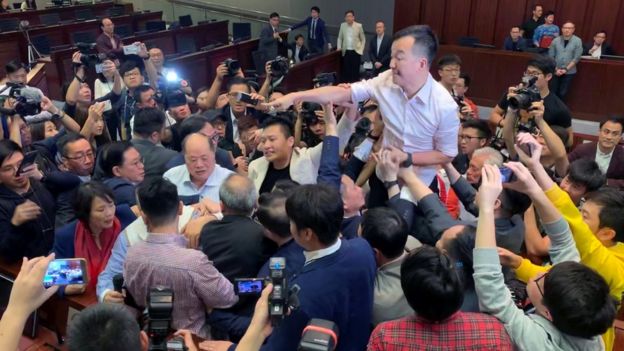
Tensions boiled over on Saturday, with politicians swearing and jumping over tables amid a crowd of reporters as they fought to control the microphone.
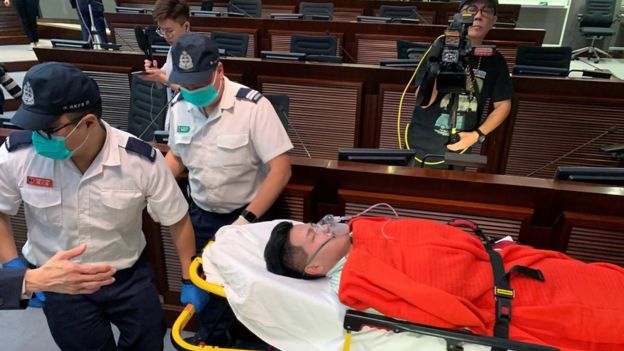
Image copyright REUTERSImage caption Opponents and supporters of the bill clashed in the legislatureImage copyright REUTERSImage caption Pro-democracy lawmaker Gary Fan was taken out on a stretcher
Pro-democracy legislator Gary Fan collapsed and was carried out on a stretcher, while one pro-Beijing legislator was later seen with his arm in a sling.
Why change the extradition laws?
Under a policy known as “One Country, Two Systems”, Hong Kong has a separate legal system to mainland China.
Beijing regained control over the former British colony in 1997 on the condition it would allow the territory “a high degree of autonomy, except in foreign and defence affairs” for 50 years.
But Hong Kong’s pro-Beijing leader Carrie Lam earlier this year announced plans to change the law so suspects could be extradited to Taiwan, Macau or mainland China on a case-by-case basis.
Image copyright REUTERSImage caption Some critics say Carrie Lam has “betrayed” Hong Kong over the law change
Ms Lam has cited the case of a 19-year-old Hong Kong man who allegedly murdered his pregnant girlfriend while on holiday in Taiwan before fleeing home.
While Taiwan has sought his extradition, Hong Kong officials say they cannot help as they do not have an extradition agreement with Taiwan.
Even the normally conservative business community has objected. The International Chamber of Commerce in Hong Kong said the bill has “gross inadequacies” which could mean people risk “losing freedom, property and even their life”.
And Chris Patten, the last British governor of Hong Kong, told the government-funded broadcaster RTHK last month the proposal was “an assault on Hong Kong’s values, stability and security”.
BEIJING/FRANKFURT (Reuters) – China’s BAIC Group is seeking to buy a stake of up to 5 percent in Daimler as a way to secure its investment in Chinese Mercedes-Benz manufacturing company Beijing Benz Automotive, three sources familiar with the matter told Reuters.
BAIC informed Daimler of its intention to buy a 4-5 percent stake in the German maker of Mercedes-Benz cars earlier this year, two of the three sources said.
BAIC has asked local authorities in Beijing to support a 4-5 percent stake purchase, two of these sources said.
BAIC has started acquiring Daimler shares on the open market, one source said.
“Daimler’s share price is currently being underpinned by a buyer who appears to be building a stake,” a person familiar with the matter said.
BAIC did not respond to repeated phone calls and text messages seeking comment outside regular business hours. Daimler declined to comment.
It remains unclear whether BAIC Group can raise the nearly 3 billion euros (£2.6 billion) that a 5 percent stake in Daimler would cost, based on the German carmaker’s closing market value on Friday of 57.6 billion euros, two of these sources said.
German regulatory filings do not show BAIC as a significant shareholder of Daimler. German takeover rules allow a buyer to acquire a stake of up to 3 percent before a regulatory disclosure is required.
Daimler has ruled out issuing new stock to help an outside party build a stake, forcing potential buyers to acquire shares on the market.
BAIC signalled its interest in buying a Daimler stake as far back as 2015, and has redoubled its effort after Li Shufu, chairman of rival Chinese carmaker Zhejiang Geely Holding Group built a 9.69 percent stake in Stuttgart-based Daimler in early 2018.
By using Hong Kong shell companies, derivatives, bank financing and structured share options, Li kept the plan under wraps until he was able, at a stroke, to become Daimler’s single largest shareholder.
The Germans in March agreed to build the next generation of Smart-branded city cars together with Geely, which is based in Hangzhou. Daimler has also reassured BAIC that any new industrial alliances involving Mercedes and a Chinese partner would only happen after a consensus is found with BAIC.
NEW DELHI/SRINAGAR, India (Reuters) – Islamic State (IS) claimed for the first time that it has established a “province” in India, after a clash between militants and security forces in the contested Kashmir region killed a militant with alleged ties to the group.
IS’s Amaq News Agency late on Friday announced the new province, that it called “Wilayah of Hind”, in a statement that also claimed IS inflicted casualties on Indian army soldiers in the town of Amshipora in the Shopian district of Kashmir.
The IS statement corresponds with an Indian police statement on Friday that a militant called Ishfaq Ahmad Sofi was killed in an encounter in Shopian.
IS’s statement establishing the new province appears to be designed to bolster its standing after the group was driven from its self-styled “caliphate” in Iraq and Syria in April, where at one point it controlled thousands of miles of territory.
IS has stepped up hit-and-run raids and suicide attacks, including taking responsibility for the Easter Sunday bombing in Sri Lanka that killed at least 253 people.
“The establishment of a ‘province’ in a region where it has nothing resembling actual governance is absurd, but it should not be written off,” said Rita Katz, director of the SITE Intel Group that tracks Islamic extremists.
“The world may roll its eyes at these developments, but to jihadists in these vulnerable regions, these are significant gestures to help lay the groundwork in rebuilding the map of the IS ‘caliphate’.”
Sofi had been involved in several militant groups in Kashmir for more than a decade before pledging allegiance to Islamic State, according to a military official on Saturday and an interview given by Sofi to a Srinagar-based magazine sympathetic to IS.
He was suspected of several grenade attacks on security forces in the region, police and military sources said.
“It was a clean operation and no collateral damage took place during the exchange of fire,” a police spokesman said in the statement on Friday’s encounter.
The military official said it was possible that Sofi had been the only militant left in Kashmir associated with IS.
Separatists have for decades fought an armed conflict against Indian rule in Muslim-majority Kashmir. The majority of these groups want independence for Kashmir or to join India’s arch-rival Pakistan. They have not, like Islamic State, sought to establish an empire across the Muslim world.
Nuclear powers India and Pakistan have fought two wars over Kashmir, and came to the brink of a third earlier this year after a suicide attack by a Pakistan-based militant group killed at least 40 paramilitary police in the Indian-controlled portion of the region.
A spokesman for India’s home ministry, which is responsible for security in Kashmir, did not respond to a request for comment.
Chinese Vice Premier Liu He receives an interview in Washington D.C., the United States, May 9, 2019. Liu He, a member of the Political Bureau of the Communist Party of China Central Committee and chief of the Chinese side of the China-U.S. comprehensive economic dialogue, arrived in Washington D.C. on Thursday for the 11th round of high-level economic and trade consultations with the U.S. side. (Xinhua/Liu Jie)
WASHINGTON, May 9 (Xinhua) — Chinese Vice Premier Liu He arrived in Washington on Thursday for the 11th round of high-level economic and trade consultations with the U.S. side.
Liu told reporters upon his arrival that he came to Washington with sincerity, saying that under the current special circumstances he hopes to engage in rational and candid exchanges with the U.S. side.
Liu is also a member of the Political Bureau of the Communist Party of China Central Committee and chief of the Chinese side of the China-U.S. comprehensive economic dialogue.
China believes that raising tariffs is not a solution to the problems, Liu said, noting that it is harmful to China, to the United States and to the whole world.





 CHINDIA ALERT: You'll be living in their world, very soon