Archive for May, 2019

06/05/2019

Ex-CIA agent Jerry Chun Shing Lee admits spying for China

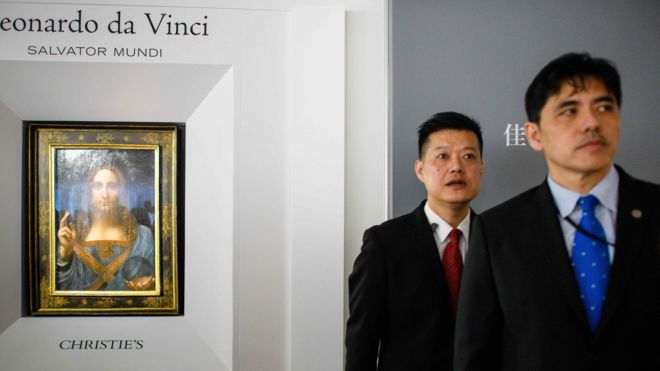
A man (R, wearing blue tie) identified by local Hong Kong media as former CIA agent Jerry Chun Shing LeeImage copyrightAFP
Image caption A man (R in blue tie) identified as Jerry Chun Shing Lee by Hong Kong media

An ex-CIA agent has pleaded guilty to spying for China, the US justice department says, in a case believed to be linked to the dismantling of a US espionage network.

Jerry Chun Shing Lee, 54, left the CIA in 2007 to live in Hong Kong, where he was recruited by Chinese agents.

Prosecutors say the naturalised US citizen was then paid to divulge information on US covert assets.

This led China to bring down a network of informants between 2010 and 2012.

About 20 informants were killed or jailed during that period – one of the most disastrous failures of US intelligence in recent years.

The US Assistant Attorney General for National Security, John Demers, said Lee’s case was the third involving US agents and China in less than a year.

“Every one of these cases is a tragic betrayal of country and colleagues,” he said.

What did Lee do?

Lee, who worked for the CIA between 1994 and 2007, pleaded guilty to conspiracy to deliver national defence information to aid a foreign government in a court in Virginia on Wednesday, the justice department said in a statement.

It said Lee was contacted by the Chinese intelligence agents in 2010. They offered him money, promising to take care of him “for life” in exchange for the required secret information. Hundreds of thousands of dollars were deposited in his Hong Kong bank account between May 2010 and December 2013.

Mr Lee created a document containing information about CIA activities, including locations to which US agents would be assigned.

In 2012, FBI agents searched a hotel room in Hawaii registered in Mr Lee’s name and found a USB drive. Investigators found the document on unallocated space in the drive, suggesting it had been deleted.

The search also revealed Lee to have a day planner and address book containing notes of intelligence provided by CIA agents, their true identities, operational meeting locations and phone numbers, and information about covert facilities.

Lee was interviewed by CIA officers in 2012 during which he said he had met Chinese intelligence officers but concealed the fact that they had set him tasks, the justice department said. In 2013 he first denied knowing about the document on his USB drive and then admitted he had created it but said he had never handed it on to Chinese agents.

Mr Lee was arrested at New York’s JFK airport in January 2018. He will be sentenced in August.


Spy v Spy

By Tara McKelvey, BBC News, Washington DC

The Lee case shows that the battle between Chinese and US spies has intensified over the past year, turning into a new “Cold War”, as Michael Collins, the deputy assistant director of the CIA’s East Asia mission center, called it.

The Chinese are investing more resources into their efforts to ferret out information about the US government, while the US government has become more aggressive in its pursuit of US citizens who have helped Chinese agents.

And when the guilty party is a former CIA officer, one of their own, the men and women who work in the field of US intelligence are ready to “bring the hammer down”, one senior intelligence official said.


CIA spy operation in China: Key dates

Three armed Chinese policemen guarding the US embassy in BeijingImage copyright AFP
Image caption Chinese police guard the US embassy in the capital, Beijing
  • 2010: Information gathered by the US from sources deep inside the Chinese government bureaucracy start to dry up
  • 2011: Informants begin to disappear. It is not clear whether the CIA has been hacked or whether a mole has helped the Chinese to identify agents
  • 2012: FBI begins investigation
  • May 2014: Five Chinese army officers are charged with stealing trade secrets and internal documents from US companies. Later that same month, China says it has been a main target for US spies
  • 2015: CIA withdraws staff from the US embassy in Beijing, fearing data stolen from government computers could expose its agents
  • April 2017: Beijing offers hefty cash rewards for information on foreign spies
  • May 2017: Four former CIA officials tell the New York Times that up to 20 CIA informants were killed or imprisoned by the Chinese between 2010 and 2012
  • June 2017: Former US diplomatic officer Kevin Mallory is arrested and charged with giving top-secret documents to a Chinese agent
  • January 2018: Former CIA officer Jerry Chun Shing Lee is arrested

Source: The BBC

06/05/2019

Warren Buffett says U.S.-China trade war ‘bad for the whole world’

(Reuters) – Warren Buffett said on Monday that a trade war between the United States and China would be “bad for the whole world.”

Buffett spoke after U.S. President Donald Trump tweeted on Sunday that he will raise tariffs on $200 billion of Chinese imports to 25 percent from 10 percent beginning on Friday, and “shortly” slap a 25-percent tariff on $325 billion of Chinese goods that have not been taxed.

Major stock markets fell worldwide on Monday in response to the president’s tweet, which came ahead of scheduled trade talks this week, and was a “rational” response, Buffett said on CNBC television.

Buffett’s conglomerate Berkshire Hathaway Inc owns or invests in many companies that do business in China, including Apple Inc, in which it has a more than $50-billion stake.

“If we actually have a trade war it will be bad for the whole world,” Buffett said.

A full-scale trade war is unlikely but “would be bad for everything Berkshire owns,” Buffett added.

He nonetheless said it would be “nonsense” for investors to sell stocks based on headlines, and that the U.S.-China would not affect how Omaha, Nebraska-based Berkshire operates.

“We will buy the same stocks today that we were buying last week,” he said.

Trump on Monday tweeted that the United States has for many years lost $600 billion to $800 billion annually on trade, and “with China we lose 500 Billion Dollars. Sorry, we’re not going to be doing that anymore!”

Buffett said tough talk ahead of trade negotiations was understandable, saying that for some people “the best technique is to act half-crazy,” but it would be ineffective to “shake your fist first and then shake your finger later on.”

He added that Trump’s threat raises the stakes for Chinese leader Xi Jinping.

“You’re talking about two personalities who are very much used to getting their way in politics, and talking about how they will be perceived in their own country in terms of their behavior,” Buffett said. “It gets very complicated.”

Buffett said the trade dispute has already had an effect on Berkshire’s BNSF railroad.

Last week, Jim Weber, the chief executive officer of Berkshire’s Brooks Running unit, said in an interview that his company was ending most shoe production in China and moving it to Vietnam because of tariff concerns.

Buffett also said the United States should bolster its trade relations with Canada and Mexico.

“We’ve got lots and lots and lots of common interests,” he said. “Trade with Mexico and Canada is enormously important. We should treat them as neighbors, and not adversaries.”

Berkshire ended March with $191.8 billion of equity investments. It also owns more than 90 companies including energy and utility companies, Geico auto insurance and Dairy Queen ice cream.

Source: Reuters

05/05/2019

2nd Digital China Exhibition held in Fuzhou, China’s Fujian

CHINA-FUJIAN-FUZHOU-DIGITAL CHINA EXHIBITION (CN)

Photo taken on May 5, 2019 shows the booth of Xinhua News Agency at the 2nd Digital China Exhibition in Fuzhou, southeast China’s Fujian Province. The 2nd Digital China Exhibition runs from May 5 to 9 at the Fuzhou Strait International Conference & Exhibition Center. (Xinhua/Wei Peiquan)

Source: Xinhua

05/05/2019

Trump to raise tariffs on $200bn of Chinese goods

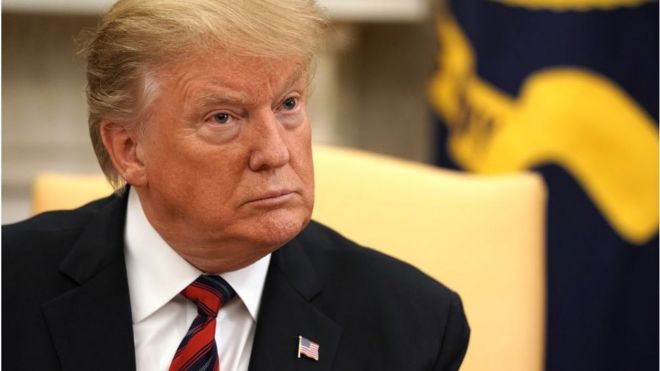
Donald TrumpImage copyright GETTY IMAGES

Donald Trump has said he will raise tariffs on $200bn in Chinese goods this week, because talks on a US-China trade deal are moving “too slowly”.

The US president tweeted that tariffs of 10% would rise to 25% on Friday, saying: “The Trade Deal with China continues, but too slowly, as they attempt to renegotiate. No!”

Some $325bn of untaxed goods will also face 25% duties “shortly”, he said.

It follows signals from Washington that a US-China trade deal was imminent.

The move dramatically increases the pressure on China, after Mr Trump previously delayed the tariff increases earlier in the year, citing progress in talks.

Trade trade talks are due to resume this week, with Chinese Vice Premier Liu He due to travel to Washington.

That follows talks in April in Beijing that US Treasury Secretary Steven Mnuchin called “productive.”

So far, the US has imposed tariffs ranging from 10-25% on $250bn (£191bn) of Chinese goods, having accused the country of various unfair trade practices

Beijing has hit back with duties on $110bn of US goods, blaming the US for starting “the largest trade war in economic history”.

Source: The BBC

05/05/2019

China putting minority Muslims in ‘concentration camps,’ U.S. says

WASHINGTON (Reuters) – The United States accused China on Friday of putting well more than a million minority Muslims in “concentration camps,” in some of the strongest U.S. condemnation to date of what it calls Beijing’s mass detention of mostly Muslim Uighur minority and other Muslim groups.

The comments by Randall Schriver, who leads Asia policy at the U.S. Defense Department, are likely to increase tension with Beijing, which is sensitive to international criticism and describes the sites as vocational education training centres aimed at stemming the threat of Islamic extremism.

Former detainees have described to Reuters being tortured during interrogation at the camps, living in crowded cells and being subjected to a brutal daily regimen of party indoctrination that drove some people to suicide.

Some of the sprawling facilities are ringed with razor wire and watch towers.

“The (Chinese) Communist Party is using the security forces for mass imprisonment of Chinese Muslims in concentration camps,” Schriver told a Pentagon briefing during a broader discussion about China’s military, estimating that the number of detained Muslims could be “closer to 3 million citizens.”

When asked by a reporter why he used the term, Schriver said that it was justified “given what we understand to be the magnitude of the detention, at least a million but likely closer to 3 million citizens out of a population of about 10 million.””So a very significant portion of the population, (given) what’s happening there, what the goals are of the Chinese government and their own public comments make that a very, I think, appropriate description,” he said.
The Chinese embassy in Washington did not immediately respond to a request for comment.
U.S. Secretary of State Mike Pompeo on Thursday used the term re-education camps to describe the sites and said Chinese activity was “reminiscent of the 1930s.”
The U.S. government has weighed sanctions against senior Chinese officials in Xinjiang, a vast region bordering central Asia that is home to millions of Uighurs and other Muslim ethnic minorities. China has warned that it would retaliate “in proportion” against any U.S. sanctions.
The governor of Xinjiang in March directly dismissed comparisons to concentration camps, saying they were “the same as boarding schools.”
U.S. officials have said China has made criminal many aspects of religious practice and culture in Xinjiang, including punishment for teaching Muslim texts to children and bans on parents giving their children Uighur names.
Academics and journalists have documented grid-style police checkpoints across Xinjiang and mass DNA collection, and human rights advocates have decried martial law-type conditions there.
Source: Reuters
05/05/2019

India student leader ‘a symbol of protest’ against PM Modi

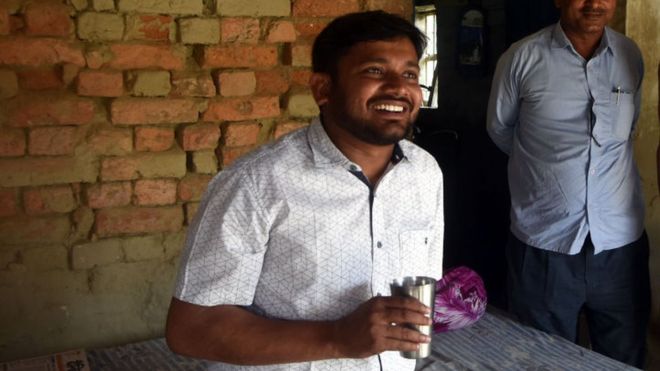
Kanhaiya Kumar CPI Candidate for Begusarai Lok Sabha seat meets with people in rural area on April 2, 2019 in Begusarai, India.Image copyrightGETTY IMAGES
Image caption Mr Kumar is a candidate for the Communist Party of India

A district in one of India’s poorest states has made national headlines in the ongoing general election after a firebrand student leader decided to run for a seat there. Kanhaiya Kumar, who was charged with “sedition” for allegedly shouting anti-India slogans and spent a few weeks in jail in 2016, is a candidate from Begusarai constituency where voting was held on Monday. Neha Thirani Bagri reports.

It is early morning in the Bihari village of Bihat, when Kanhaiya Kumar emerges from his home.

He is immediately swamped by young men rushing to shake his hand, asking to take selfies with him, wearing t-shirts emblazoned with his image.

Mr Kumar, who grew up here, shot to fame in 2016 when he was arrested and charged with sedition.

Then a student union leader at Delhi’s Jawaharlal Nehru University, he was accused of chanting anti-India slogans at a campus event to commemorate the anniversary of the hanging of Mohammed Afzal Guru, a Kashmiri man convicted of plotting the 2001 attacks on the Indian parliament.

His arrest became the rallying cry for critics of the Hindu nationalist politics of India’s ruling Bharatiya Janata Party (BJP), with student protests organised across the country.

Mr Kumar is still fighting the charge of sedition, a colonial-era statute that has been used to clamp down on dissent in India, which he calls “completely false propaganda.”

“Kanhaiya Kumar has become a symbol of protest against the politics which is represented by Prime Minister Narendra Modi,” said Sanjay Kumar, director of the Centre for the Study of Developing Societies.

Mr Kumar has since completed his PhD. On Monday, he had his first foray into politics, when he ran for election in the constituency of Begusarai in the fourth phase of polling in the Indian election. Votes will only be counted in late May.

The constituency was once a communist stronghold known as the “Leningrad of Bihar.”

“This was not a choice, to enter politics. It was a forced responsibility,” Mr Kumar said during a full day of campaigning before his constituency went to the polls.

Mr Kumar is from the Communist Party of India (CPI), the influence of which has been waning over the past few years.

Presentational grey line

India votes 2019

Presentational grey line

“Our constitution talks about a secular country. If they are attempting to invoke a particular religion and change the character of the state, then, of course, we will oppose this.”

While Mr Modi swept to a historic victory in India’s last election in 2014 on the promise of better days ahead, many rural Indians have been disappointed with rising unemployment and an agrarian crisis.

Mr Modi and other BJP leaders have been criticised for spouting communally-charged rhetoric and remaining silent in the face of increasing religious violence.

The main opposition Congress party has struggled to mount a strong challenge, though gained some momentum with victories in key state elections last year.

Bihar, India’s third most populous state, elects 40 members out of 545 to India’s lower house of parliament. In the 2014 general election, the BJP won 22 of the 40 seats.

On Monday, Mr Kumar went up against BJP’s Giriraj Singh, who once said that those who oppose Mr Modi should go to Pakistan. It was a three-way contest with the regional Rashtriya Janata Dal (RJD), which has fielded a Muslim candidate.

Media captionKanhaiya Kumar talks about his politics

“Right now, people’s real issues have vanished from the conversation,” said Mr Kumar.

He has become known for often emphasising education, jobs, public healthcare, and minority rights in his speeches.

Mr Kumar has garnered the support of civil rights campaigners, activists, and celebrities from across India.

His outsized social media presence has also made him particularly popular with young people, many of whom are drawn towards Mr Kumar’s charismatic personality, fiery oratory, and local roots.

‘Connect with the young’

Videos of his speeches, often critical of the BJP and right-wing politics, have garnered millions of views on YouTube and Facebook.

“Kanhaiya’s thinking connects with us young people,” said Pankaj Kumar, 24, adding that he often shares the politician’s speeches with his friends on WhatsApp.

“If Kanhaiya wins at least we will have pride – it was because of him that Begusarai became famous in India and even the whole world.”

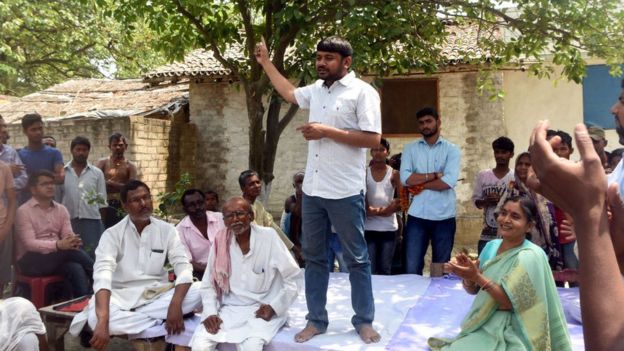
Kanhaiya Kumar CPI Candidate for Begusarai Lok Sabha seat addresses people of rural area on April 2, 2019 in Begusarai, India.Image copyrightGETTY IMAGES
Image captionMr Kumar’s fiery speeches have drawn in voters

Mr Kumar’s speeches have also attracted a sizeable number of Muslim voters – many in the district were vocal supporters of him.

“People with power in this country are only thinking about how to create religious division,” said Mohammed Shoaib Alam.

“Kanhaiya will raise his voice for the issues of poor people,” he added.

While Mr Kumar’s popularity has drawn national attention to the contest for the parliamentary seat from this remote constituency, his victory is far from certain.

“All odds are against him,” said Neelanjan Sircar, a senior fellow at the Centre for Policy Research, adding that Mr Kumar did not benefit from having the backing of a large political party or coalition or the consolidated vote from one community.

“If he pulls this off – and he is massively popular on the ground – it would just be a testament to his individual political skill.”

Source: The BBC

05/05/2019

India’s rural pain goes beyond farmers, and it may be a problem for Modi

ZADSHI VILLAGE, India (Reuters) – Three years ago, brick mason Pundlik Bhandekar was always busy as farmers in his tiny hamlet in Maharashtra commissioned new houses and nearby towns were undergoing rapid urbanisation. Now, as the rural economy sinks and the pace of construction slows, Bhandekar is struggling to get work.

“I used to get a new construction project before I could even finish one. People would come to my house to check when I would be free to work for them,” said Bhandekar, as he sat with friends under the shade of a tree on a hot afternoon.

From daily wage workers such as masons, to barbers and grocery shop owners – just about everyone in Zadshi village, some 720 km (450 miles) from India’s financial hub Mumbai, says a drop in farm incomes has dented their livelihoods.

Their woes are symptomatic of a wider problem across India, where more than half of the country’s 1.3 billion people are dependent on agriculture for their livelihoods, as the slowdown in the rural economy is felt in the dampening sales of consumer goods, especially the biggest such as car and motorbike sales.

The slowdown has also dented Prime Minister Narendra Modi’s popularity in the hinterland that propelled him to power in 2014, and political strategists say it may mean he struggles to form a majority after voting in a staggered general election that began on April 11 concludes on May 19.

Zadshi has been almost entirely dependent on annual cotton and soybean crops that, according to farmers, have given lacklustre returns in the past few years due to a dip in prices, droughts and pest attacks.

And as incomes have dropped, farmers have cut back on big-ticket spending such as building new houses, digging wells or laying water pipelines, squeezing employment opportunities for people such as Bhandkekar.

“No one is interested in hiring us. We are ready to work even at 250 rupees ($3.60) per day,” said Bhandekar, who charged 300 rupees a day when work was steady, but now gets work only once or twice in a fortnight.

LOWER WAGES, LESS SPENDING

Economic data reflects the plight of farmers and daily wage workers.

Retail food inflation in the fiscal year ended on March 31 fell to 0.74 percent, even as core inflation stood at 5.2 percent, according to Bank of America Merrill Lynch Research, eroding the spending power of farmers.

Inflation adjusted wage growth for workers involved in crop sowing was just 0.6 percent 2018/19 compared with 6.5 percent in 2013/14.

The value of farm produce at constant prices grew 15 percent in the past five years, compared with 23 percent in the previous five, while the manufacturing sector grew 40 percent, against 32.6 percent in the previous five years, government data shows.

“Lower rural wages will result in lesser spending, which in turn will reduce demand for goods and services that are part of the rural basket,” Rupa Rege Nitsure, group chief economist at L&T Finance Holdings in Mumbai, told Reuters.

The government needs to spend more in rural areas to generate employment and boost incomes, Nitsure said.

Modi’s Hindu nationalist government did introduce various support schemes in the past six months, such as a 6,000 rupees yearly handout to small farmers.

The main opposition Congress party has gone much further with its pledges though, saying it would introduce a basic minimum income, where the country’s poorest families would get 72,000 rupees annually, benefiting some 250 million people.

RISING UNEMPLOYMENT

In Zadshi, as the mercury touched a searing 40 degrees Celsius(104F), a group of villagers gathered under the trees lining a dusty road and began chatting about everything from crop prices to politics.

“What else we can do? Had work been available in urban areas, we could have moved there but even in the cities construction has slowed down,” said Amol Sontakke, an unskilled labourer who works in farms and on construction sites.

Job opportunities have slowed even in urban areas and India’s unemployment rate touched 7.2 percent in February, the highest since September 2016, according to data compiled by the Centre for Monitoring Indian Economy (CMIE). Official data is unavailable for recent periods.

The mood in Zadshi was glum. While four dozen villagers interviewed by Reuters were hopeful that if there was a good monsoon this year it could improve farm incomes, they’ve been cutting back on spending in the meantime.

“People are thinking twice before buying new clothes during festivals,” said Avinash Gaurkar, a farmer currently doubling up as a part-time driver. “Buying big-ticket items such as motorcycles or refrigerators is out of the question.”

Two years ago Gaurkar began building a house, but had to give up midway as his five-acre farm could not generate the money needed, he said, pointing towards a half-finished structure without doors.

In 2018, just four villagers bought new motorbikes compared with as many as 10 a year about four years ago, said cotton farmer Raju Kohale, whose son is sitting at home unemployed after graduating as an engineer.

“Poor monsoon or lower prices, something or the other has been hurting us in the past few years,” Kohale said.

MODI AGAIN?

In the 2014 general election, most in Zadshi voted for Modi, but the farmers’ distress has swayed many towards the opposition Congress party. That was clear from Reuters’ interviews with 48 villagers, who cast their ballots last month.

Farmers are at the bottom of the Modi administration’s priority list, said labourer Sagar Bahalavi.

“They are building big roads to connect metros and calling it development. How is that useful for us?” he said.

Some, though, want to give Modi a second chance.
“Modi’s intentions are good, it’s the bureaucratic system that is not supporting him,” said Gulab Chalakh, who owns a 20-acre farm and is among the richest in the village. “We should give him another chance.”
Source: Reuters
02/05/2019

China, Thailand to hold joint naval training

ZHANJIANG, Guangdong, May 1 (Xinhua) — China and Thailand’s naval forces will hold their joint training, code-named Blue Commando-2019, starting on Thursday.

The fleet of Thai forces arrived at the port city of Zhanjiang, south China’s Guangdong Province on Wednesday.

They were welcomed by the navy of the Southern Theater Command of the Chinese People’s Liberation Army.

The drill will be held both on land and at sea, as Chinese and Thai fleets and marines will train on subjects including fleet defense, landing, live-fire attacks and marine rescue.

Source: Xinhua

02/05/2019

Tibet launches venture base to promote cultural industry

LHASA, May 1 (Xinhua) — China’s Tibet Autonomous Region Tuesday launched its first innovation and entrepreneurship base for small and micro venture companies wanting to take a share of the booming cultural industry.

The base, established by the regional department of culture, prioritizes incubating locally-established cultural startups by providing innovation-oriented training as well as displaying featured cultural products.

Sambo, deputy head of the department, said the base aims to promote Tibetan culture through innovative companies and their featured cultural products.

Official data shows the number of cultural companies in Tibet exceeded 6,000 with more than 50,000 employees by the end of 2018. Their total annual output value surpassed 4.6 billion yuan (about 683 million U.S. dollars), with average yearly growth being maintained at over 15 percent.

Source: Xinhua

02/05/2019

China, U.S. hold 10th round of high-level trade consultations in Beijing

CHINA-U.S.-ECONOMIC AND TRADE CONSULTATIONS (CN)

This combo photo shows Chinese Vice Premier Liu He, who is also a member of the Political Bureau of the Communist Party of China Central Committee and chief of the Chinese side of the China-U.S. comprehensive economic dialogue, posing for photos with U.S. Trade Representative Robert Lighthizer and Treasury Secretary Steven Mnuchin. They held the tenth round of China-U.S. high-level economic and trade consultations in Beijing from April 30, 2019 to May 1, 2019. (Xinhua/Shen Hong, Zhai Jianlan)

BEIJING, May 1 (Xinhua) — Chinese Vice Premier Liu He, U.S. Trade Representative Robert Lighthizer and Treasury Secretary Steven Mnuchin held the tenth round of China-U.S. high-level economic and trade consultations in Beijing from Tuesday to Wednesday.

As planned, the two sides will hold the 11th round of high-level economic and trade consultations in Washington D.C. next week.

Liu is also a member of the Political Bureau of the Communist Party of China Central Committee and chief of the Chinese side of the China-U.S. comprehensive economic dialogue.

Source: Xinhua

Law of Unintended Consequences

continuously updated blog about China & India

ChiaHou's Book Reviews

continuously updated blog about China & India

What's wrong with the world; and its economy

continuously updated blog about China & India