

- After a six-month closure, Boracay reopened in October with new rules that prohibit smoking, drinking, dining and littering on the beachfront. But the dos and don’ts seem to have escaped notice, especially among tourists from China and South Korea
-
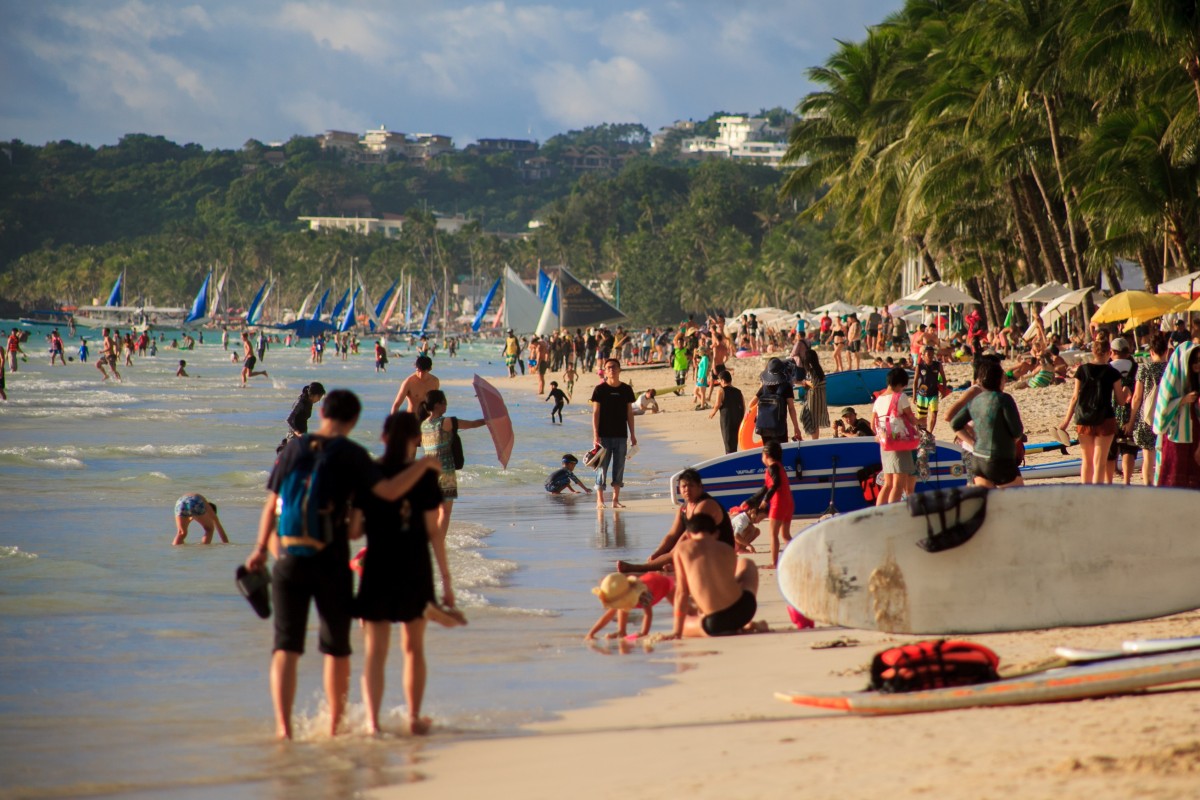 Tourists enjoy Boracay’s famous White Beach in January. Photo: ShutterstockTravel has changed a lot since the 19th century. Obviously. But attitudes towards travellers have not, if the diaries of Francis Kilvert are anything to go by.“Of all noxious animals, the most noxious is a tourist,” the English clergyman wrote in the 1870s, and while Kilvert asserted that it was the British who were “the most vulgar, ill-bred, offensive and loathsome” of them all – a contention that might be challenged today – an increasing number of places across the globe have had their fill of imprudent outsiders, regardless of where they are from.The island of
, in the Philippines, the original face of overtourism in the region, is one of them. In February last year, Philippine President Rodrigo Duterte vowed to
the popular tourist hotspot, saying, “Boracay is a cesspool. It is destroying the environment of the Republic of the Philippines and creating a disaster.” The septic metaphor was no melodrama – a number of hotels, restaurants and other tourism-related businesses were dumping untreated sewage directly into the ocean, contaminating White Beach’s crystalline waters and tarnishing Boracay’s reputation. As Duterte decreed, the island shuttered for six months from April, during which time infrastructure was to be installed and new environmental requirements implemented.
When Boracay, in October, it was heralded as a rare success in the ongoing fight against the tourist menace, despite the fact that thousands of
, the nation’s economic growth had suffered and, heaven forfend, holidaymakers had been forced to cancel hard-earned vacations. And the rehabilitation is far from complete. In January, the Boracay Inter-Agency Task Force, the organisation overseeing the ecological overhaul, announced a 25.3 billion peso (US$485 million) action plan, which, if approved, will fund 233 projects related to the enforcement of laws and regulations, pollution control and prevention, rehabilitation and recovery of the ecosystem, and the sustainability of land activities, according to a report on Philippine news site Rappler.
But still the tourists come, albeit in smaller numbers than before, and just as in pre-closure times, not all of them are welcome; in particular those who pay little attention to the new rules, which prohibit smoking, drinking, dining, littering, partying and fire dancing on the beachfront.A complaint about Chinese tourists, posted to Facebook in April. Photo: Facebook / @philippinesdefenseOn April 29, Wilson Enriquez, the Boracay Tourism Regulatory Enforcement Unit chief, revealed that tourists from China were the worst violators of these regulations, as stated in an article on the Philippines Lifestyle News website. Since the beginning of the year, 739 Chinese had been apprehended.
“Tour guides have informed them about the ordinances but [Chinese tourists] are really stubborn,” Enriquez told the news site. Korean tourists took a distant second, with 277 apprehensions, with most infractions recorded for smoking, eating and drinking on the beach, or littering.
Eighty per cent of the visitors Boracay received in the first quarter of this year hailed from China and South Korea, according to the local tourism office – the former accounting for almost half of all arrivals, 149,019 of 309,591 – so perhaps it is unsurprising that the Chinese break the most rules.
One disgruntled Filipino took to social media (where else) to air their grievance, writing that Boracay had been “teeming with loud, garbage-throwing, spitting everywhere Chinese tourists” during their Holy Week visit, while another told Philippines Lifestyle News, “I saw [Chinese tourists] with my own eyes, breaking ordinances all over the place.”
That there has been a recent rise in anti-China sentiment in the Philippines, a reaction to Duterte’s “love affair” with the Middle Kingdom, according to an article on SupChina’s website, should be noted. But really, if we want to be able to enjoy Boracay, or anywhere for that matter, for years to come, we should all stick to the rules and exercise respect for the community and environment hosting us.
Airbnb bounces back in Japan
 A sign on the door to a block of flats in Tokyo communicating a ban on using units in the property for Airbnb, in March 2018. Photo: ReutersIt has been a year since Japan implemented its minpaku law, aimed at regulating short-term lets, such as those advertised on home-sharing site
. It effectively rendered hosts whose homes were not licensed illegal, and all those without the required permit were forced to delist their properties and cancel bookings. Almost 80 per cent of listings disappeared.
However, Airbnb is back in business. In a statement published on June 6, the company said that 50,000 listings were now available in the country, as well as 23,000 rooms in hotels and ryokan. Just before the rules came into force last June, Airbnb had a total of 60,000 listings.Presumably the company’s efforts to appease local regulations will pay off next year, when Japan hopes to receive 40 million visitors as host of the 2020 Summer Olympics. Whether those 40 million will be welcomed by residents remains to be seen.
Monkey troubles – wild macaque gets cheeky in Bali
If you need any reminder that the macaques that roam Ubud’s Sacred Monkey Forest, in the uplands of the Indonesian, are wild animals, then this tourist’s experience should jog your memory. While posing for a picture, a monkey climbed onto the lap of Sarah Wijohn, a visitor from New Zealand, had a good old scratch and then yanked down her top, almost exposing her to the world.
Fortunately, neither Wijohn nor the primate seemed too scarred by the incident, unlike those who have written blog posts about being attacked by the animals and made videos advising how not to catch rabies from the “crazy monkey forest”.Here’s an idea: don’t go.Source: SCMP
Chinese tourists breaking rules ‘all over the place’ in Boracay
This site uses Akismet to reduce spam. Learn how your comment data is processed.

 CHINDIA ALERT: You'll be living in their world, very soon
Leave a comment