13/06/2019
- Chinese social media finds light relief in struggle over gaokao Question 12 in an American cafe
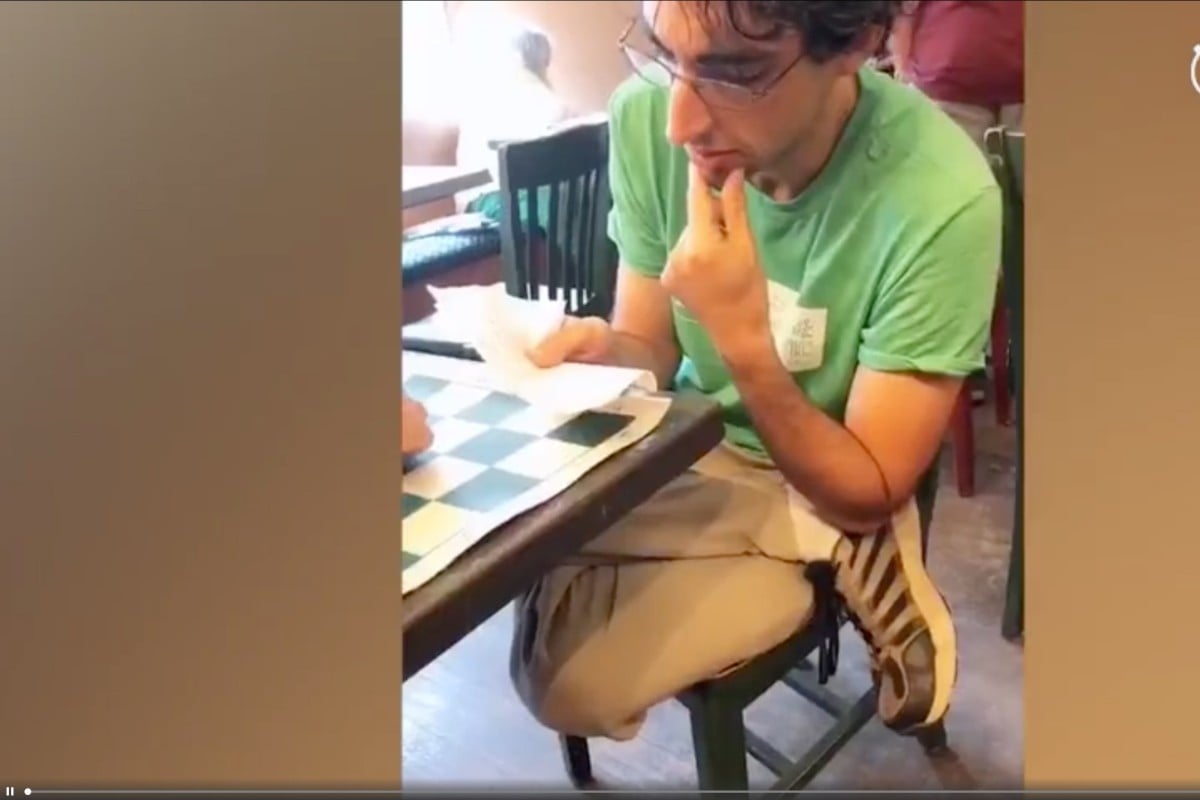
Video of a US middle school maths teacher trying to complete a mathematics question from a Chinese exam paper has been widely shared on Chinese social media. Photo: Weibo
A video of a US secondary school maths teacher comically trying – and failing – to complete a mathematics question from a Chinese gaokao exam paper has been widely shared on social media in China.
The video was shared on June 8 by an unidentified Chinese teacher working in the United States. It shows her friend, a US secondary school maths teacher, trying to solve a question from this year’s gaokao, the annual Chinese college entrance examination that has a reputation for difficulty, even by international standards.
The question was taken from section II of the natural sciences mathematics exam paper on the national level, which is generally a more challenging test given to students who select the science track.
“I heard this year’s gaokao maths questions are very difficult so I searched online and tried to solve one in a cafe. But it has been a long time, so I forgot how to solve it,” the Chinese teacher told online news platform Guancha Syndicate.
At that moment, the US maths teacher was sitting next to her and playing chess with his friends, “so I asked if he could help me solve a question, but that posed a big challenge for him”, she said.
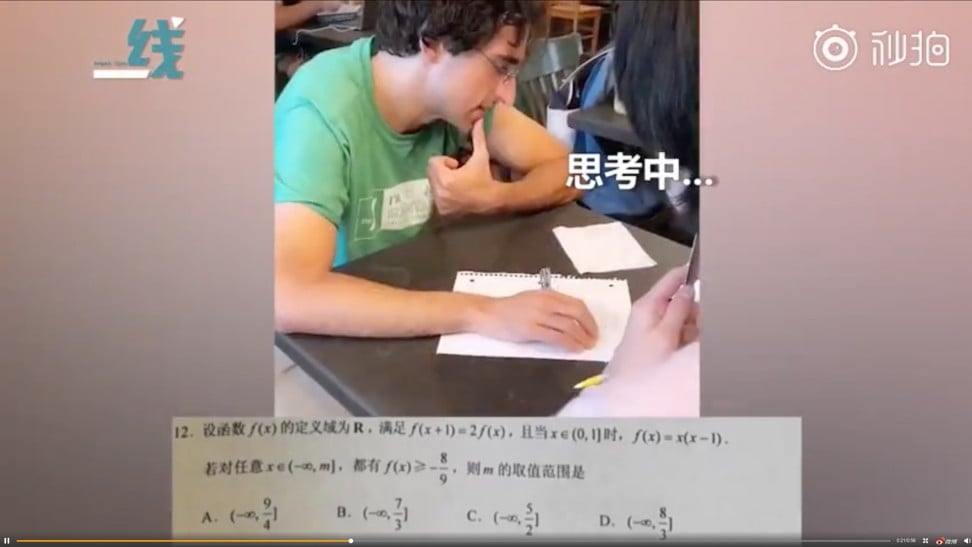
In the video, the US teacher looks confused by question 12, a multiple choice question about functions. He reads it for three minutes, then starts to analyse and explain the steps to the Chinese teacher.
He first tries the method of substitution but fails and finally chooses D by exclusion.
The US secondary school maths teacher still doesn’t know his answer was wrong. Photo: Weibo
“I think it’s this one (option D), it’s matching, it’s D!,” the American teacher says confidently. Later in the video, the Chinese teacher explains, “He spent around seven to eight minutes on this question and finally chose D, so he should get it correct, shouldn’t he?”
However, the answer turned out to be B, much to the amusement of social media users. Posts about the video have been viewed 140 million times on microblogging site Weibo, and the video has been picked up by other Chinese news media.
Crunch time as gaokao exam season starts for China’s university hopefuls
Weibo users shared their views below the post, with comments such as, “Question 12 is usually the hardest one”; “these multiple choices should not take more than 50 seconds”; and “he would not be able to finish the whole paper at this speed”.
According to the Chinese teacher, her US friend still doesn’t know his answer was wrong.
“He just said the question is ‘worded really weird’ and he cannot clearly figure it out,” she said.
Source: SCMP
Posted in American cafe, Chinese exam paper, college entrance examination, gaokao, international standards, light relief, maths question, natural sciences mathematics exam paper, reputation, social media, struggles, stumped, Uncategorized, university entrance exam, US maths teacher, US teacher |
Leave a Comment »
13/06/2019
- After a six-month closure, Boracay reopened in October with new rules that prohibit smoking, drinking, dining and littering on the beachfront. But the dos and don’ts seem to have escaped notice, especially among tourists from China and South Korea
-
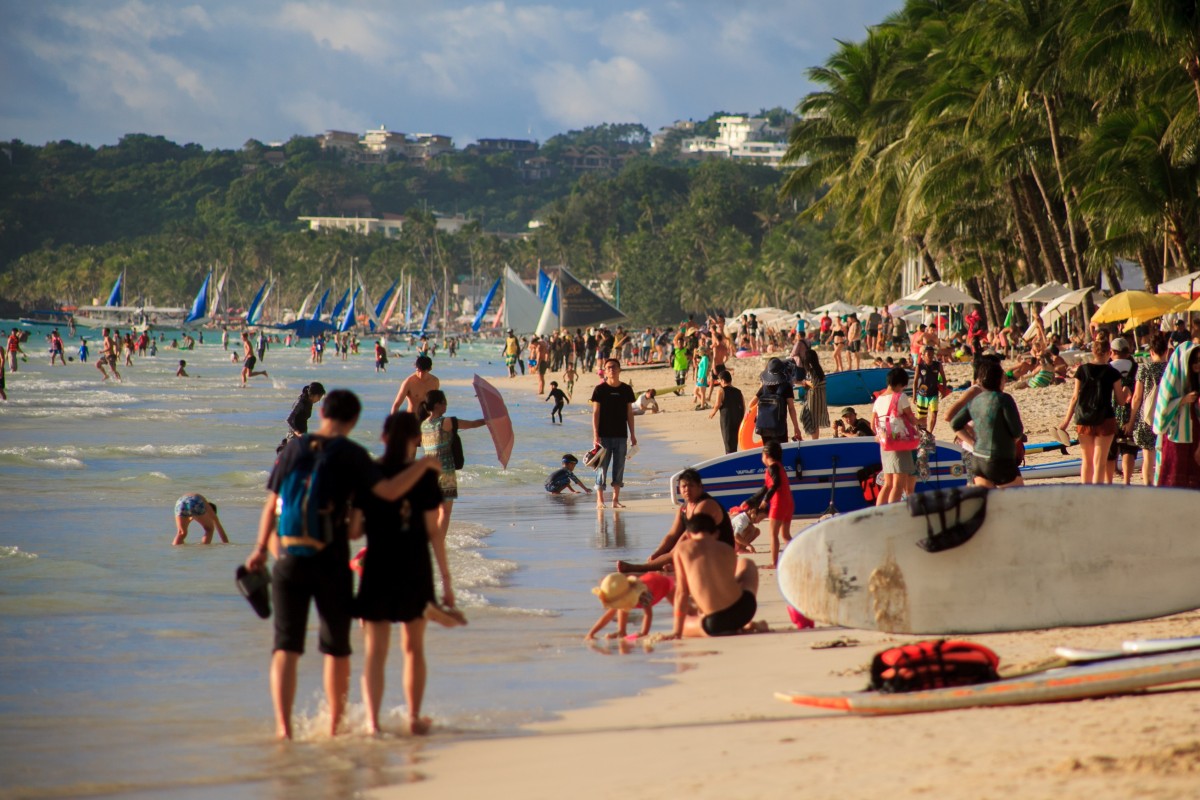
Tourists enjoy Boracay’s famous White Beach in January. Photo: Shutterstock
Travel has changed a lot since the 19th century. Obviously. But attitudes towards travellers have not, if the diaries of Francis Kilvert are anything to go by.
“Of all noxious animals, the most noxious is a tourist,” the English clergyman wrote in the 1870s, and while Kilvert asserted that it was the British who were “the most vulgar, ill-bred, offensive and loathsome” of them all – a contention that might be challenged today – an increasing number of places across the globe have had their fill of imprudent outsiders, regardless of where they are from.
The island of
, in the Philippines, the original face of overtourism in the region, is one of them. In February last year, Philippine President Rodrigo Duterte vowed to
the popular tourist hotspot, saying, “Boracay is a cesspool. It is destroying the environment of the Republic of the Philippines and creating a disaster.” The septic metaphor was no melodrama – a number of hotels, restaurants and other tourism-related businesses were dumping untreated sewage directly into the ocean, contaminating White Beach’s crystalline waters and tarnishing Boracay’s reputation. As Duterte decreed, the island shuttered for six months from April, during which time infrastructure was to be installed and new environmental requirements implemented.
When Boracay
, in October, it was heralded as a rare success in the ongoing fight against the tourist menace, despite the fact that thousands of
, the nation’s economic growth had suffered and, heaven forfend, holidaymakers had been forced to cancel hard-earned vacations. And the rehabilitation is far from complete. In January, the Boracay Inter-Agency Task Force, the organisation overseeing the ecological overhaul, announced a 25.3 billion peso (US$485 million) action plan, which, if approved, will fund 233 projects related to the enforcement of laws and regulations, pollution control and prevention, rehabilitation and recovery of the ecosystem, and the sustainability of land activities, according to a report on Philippine news site Rappler.
But still the tourists come, albeit in smaller numbers than before, and just as in pre-closure times, not all of them are welcome; in particular those who pay little attention to the new rules, which prohibit smoking, drinking, dining, littering, partying and fire dancing on the beachfront.
A complaint about Chinese tourists, posted to Facebook in April. Photo: Facebook / @philippinesdefense
On April 29, Wilson Enriquez, the Boracay Tourism Regulatory Enforcement Unit chief, revealed that tourists from China were the worst violators of these regulations, as stated in an article on the Philippines Lifestyle News website. Since the beginning of the year, 739 Chinese had been apprehended.
“Tour guides have informed them about the ordinances but [Chinese tourists] are really stubborn,” Enriquez told the news site. Korean tourists took a distant second, with 277 apprehensions, with most infractions recorded for smoking, eating and drinking on the beach, or littering.
Eighty per cent of the visitors Boracay received in the first quarter of this year hailed from China and South Korea, according to the local tourism office – the former accounting for almost half of all arrivals, 149,019 of 309,591 – so perhaps it is unsurprising that the Chinese break the most rules.
One disgruntled Filipino took to social media (where else) to air their grievance, writing that Boracay had been “teeming with loud, garbage-throwing, spitting everywhere Chinese tourists” during their Holy Week visit, while another told Philippines Lifestyle News, “I saw [Chinese tourists] with my own eyes, breaking ordinances all over the place.”
That there has been a recent rise in anti-China sentiment in the Philippines, a reaction to Duterte’s “love affair” with the Middle Kingdom, according to an article on SupChina’s website, should be noted. But really, if we want to be able to enjoy Boracay, or anywhere for that matter, for years to come, we should all stick to the rules and exercise respect for the community and environment hosting us.
Airbnb bounces back in Japan
A sign on the door to a block of flats in Tokyo communicating a ban on using units in the property for Airbnb, in March 2018. Photo: Reuters
It has been a year since Japan implemented its
minpaku law, aimed at regulating short-term lets, such as those advertised on home-sharing site
. It effectively rendered hosts whose homes were not licensed illegal, and all those without the required permit were forced to delist their properties and cancel bookings. Almost 80 per cent of listings disappeared.
However, Airbnb is back in business. In a statement published on June 6, the company said that 50,000 listings were now available in the country, as well as 23,000 rooms in hotels and ryokan. Just before the rules came into force last June, Airbnb had a total of 60,000 listings.
Presumably the company’s efforts to appease local regulations will pay off next year, when Japan hopes to receive 40 million visitors as host of the 2020 Summer Olympics. Whether those 40 million will be welcomed by residents remains to be seen.
Monkey troubles – wild macaque gets cheeky in Bali
If you need any reminder that the macaques that roam Ubud’s Sacred Monkey Forest, in the uplands of the Indonesian
, are wild animals, then this tourist’s experience should jog your memory. While posing for a picture, a monkey climbed onto the lap of Sarah Wijohn, a visitor from New Zealand, had a good old scratch and then yanked down her top, almost exposing her to the world.
Fortunately, neither Wijohn nor the primate seemed too scarred by the incident, unlike those who have written blog posts about being attacked by the animals and made videos advising how not to catch rabies from the “crazy monkey forest”.
Here’s an idea: don’t go.
Source: SCMP
Posted in all over the place, beachfront, Boracay, breaking rules, chinese tourists, dining, drinking, fire dancing, littering, overtourism, partying, Philippine President, prohibit, Republic of the Philippines, Rodrigo Duterte, Shutterstock, smoking, South Korea, Uncategorized, White Beach |
Leave a Comment »
13/06/2019
- Visit to beauty spot spoiled as tourists ordered off the bus to spend, spend, spend
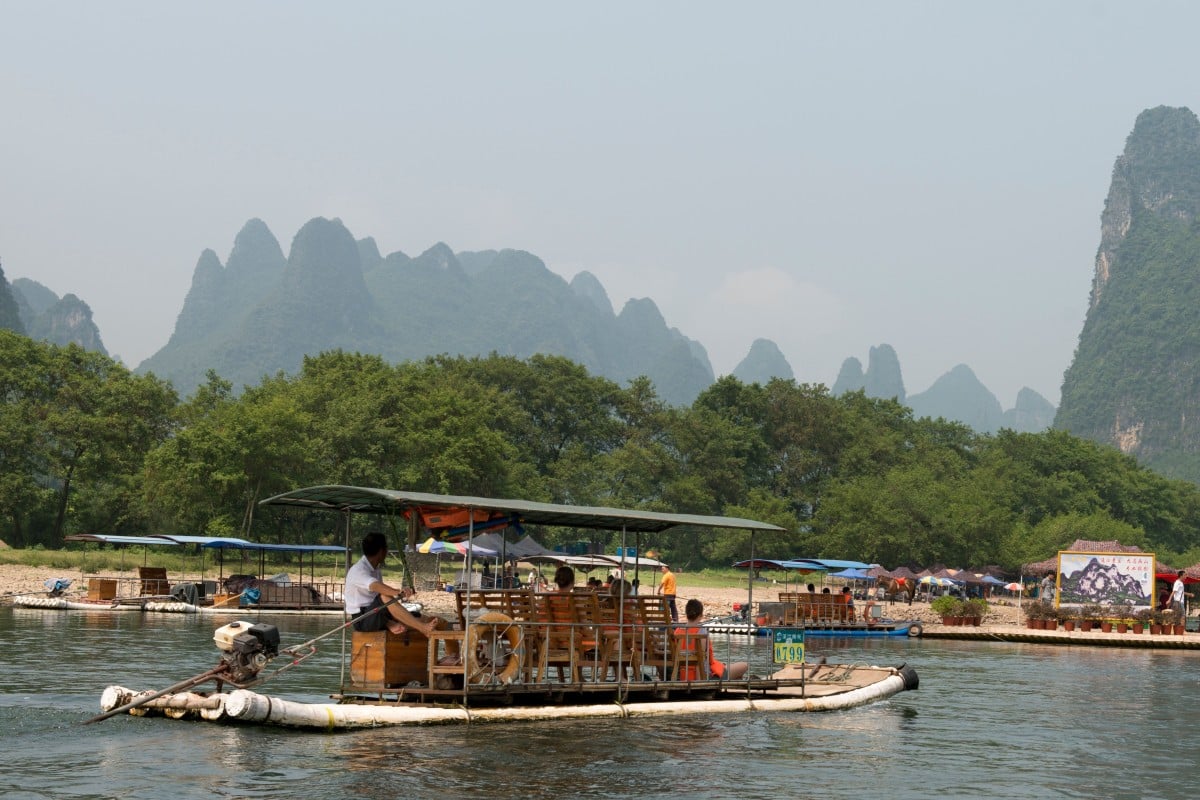
Guilin is renowned for its scenic cruises along the Li River, through magnificent karst mountains. But one tour group was forced on an unexpected shopping trip. Photo: Alamy
A tour guide in the scenic city of Guilin in southern China has been stripped of her licence after forcing tourists to spend at least 20,000 yuan (US$2,900) in local shops.
The tour guide, surnamed Zhao, was captured on video telling her customers they had an hour to spend the money and she would accept no excuses.
The short clip, which has been circulating widely on Chinese social media this week, was filmed on June 1, according to online news portal QQ.com.
“You might have thousands of reasons to refuse me, such as you already have this stuff at home,” Zhao said in the video. “I don’t care why you have come to Guilin. Now you have chosen this group … get off the bus and spend 20,000 yuan [in] an hour.”
Tiffany loses its shine with Chinese tourists as US sales fall 25 per cent
Some of the tourists can be heard on the video murmuring “how can it be like this?”
The 55 members of the tour group, from Hunan province in central China, had travelled to Guilin in the Guangxi Zhuang autonomous region from May 30 to June 2. According to their itinerary, they were supposed to visit three shops on the day the incident happened, but instead visited six, the QQ.com report said.
In its statement on microblogging platform Weibo, the authority also said it was investigating her employer.
Ferrying tourists along China’s Yellow River
Tour guides are banned from forcing tourists to shop or join programmes charging extra fees. A State Council regulation issued two years ago set a 10,000-50,000 yuan penalty for individuals violating the rule, and a further 100,000-500,000 yuan fine for their tour company.
Despite the crackdown in recent years, it is not uncommon for Chinese tourists to be coerced by tour guides into extra spending during their trips. China’s authorities have repeatedly reminded the public to be wary of companies that lure potential tourists with extremely low group fees.
In July last year, a group of 300 elderly people, from the central province of Henan, were reportedly forced to buy jewellery from a shop in Hong Kong. The tour agency charged them just 380 yuan for the whole package and promised there would be no forced shopping activity, according to Henan TV.
But, despite the assurance, they were taken to a jewellery shop where their tour guide told them, “Henan people, spend some money to earn face for your Henan folks.”
Those who did not spend as they were urged had to wait in the shop for hours and were cursed by the tour guide, according to the television report. It is not clear if the tour guide or the agency received any penalty.
Source: SCMP
Posted in barred, forced shopping trip, Guangxi Zhuang Autonomous Region, Guilin, Henan province, Hong Kong, jewellery, karst mountains, Li River, licence, news portal qq.com, State Council regulation, Tiffany, tour guide, Uncategorized, video, Yellow River |
Leave a Comment »
13/06/2019
Air force and army helicopters on Wednesday had airdropped 15 mountaineers for rescue operations last evening. The IAF said eight reached the An-32 crash site on Thursday morning.
INDIA Updated: Jun 13, 2019 14:35 IST
Air force and army helicopters on Wednesday had airdropped 15 mountaineers for rescue operations last evening.(ANI )
Thirteen military personnel on board the An-32 aircraft that crashed in Arunachal Pradesh on June 3 have died, the Indian Air Force said on Thursday hours after the first recce team reached the crash site. Air force and army helicopters on Wednesday had airdropped 15 mountaineers for rescue operations. Eight of them reached the crash site and transmitted the tragic news.
“IAF is sad to inform that there are no survivors from the crash of An32,” the air force said in a string of tweets to “pay tribute to the brave air-warriors who lost their life” in the crash.
The IAF also identified the air warriors who died in the crash: Wing Commander GM Charles, Squadron Leader H Vinod, Flight Lieutenants R Thapa, Ashish Tanwar, S Mohanty and Mohit K Garg, Warrant Officer KK Mishra, Sergeant Anoop Kumar, Corporal Sherin, Leading Air Craftsman SK Singh and Pankaj and two non combatant enrolled employees Putali and Rajesh Kumar.
Also Read | AN-32 pilot’s wife was on ATC duty in Jorhat when the aircraft went off the radar
The An-32 was on its way to an advanced landing ground at Mechuka in Arunachal Pradesh’s West Siang district – about 15 km from the Line of Actual Control, the disputed border with China – when it lost contact with ground control in about 30 minutes after taking off from Jorhat in Assam.
The aircraft was equipped with an emergency locator transmitter, an emergency beacon in the cargo section that can broadcast distress signals to reveal the location of an aircraft. But no signal came from this device.
The The 24-metre-long aircraft with a wingspan of about 29 metres was a speck in a treacherous search zone spanning hundreds of square kilometers dotted with towering ridges, thick forests and deep valleys, officials familiar with the search said. The search efforts were hampered by bad weather, with fierce rains and poor visibility narrowing the scope of operations.
For eight days, the IAF deployed every possible asset it could – right from satellites in space, specialised surveillance aircraft from the Navy, unmanned aerial vehicles, and Global 5000 surveillance jet of the country’s external spy agency to locate the Soviet-origin transport plane that mysteriously disappeared from its radar screens. It also announced a Rs 5 lakh reward for information that could help it locate the aircraft.
The first firm clue about the crash site came eight days later from a villager in Arunachal Pradesh’s remote mountains, according to state government officials in the West Siang district.
Also Read | From ‘missing’ to ‘crash’: The family of IAF cook swings between hope and despair
A Mi-17 helicopter, among the scores of aircraft involved in the massive search, finally sighted the wreckage at 12,000 feet near a tiny village called Lipo with a population of just around 120 people. The first image of the crash site indicated the plane had blown up into a ball of fire on impact and dimmed hopes about the possibility of the IAF personnel surviving the crash.
The crash is similar to an incident from 10 years ago in which the wreckage of an AN-32 that crashed in West Siang with the same number of people on board was found at 12,000 feet. There were no survivors in the June 2009 crash. The IAF has lost 10 aircraft this year.
In 2016, another AN-32 – flying from Chennai to the Andaman and Nicobar Islands – went missing above the Bay of Bengal with 29 people on board. Search teams were not able to locate the aircraft despite a massive operation.
Source: Hindustan Times
Posted in AN-32 aircraft, Andaman and Nicobar Islands, army helicopters, Chennai, crashed, emergency beacon, emergency locator transmitter, Global 5000 surveillance jet, Indian Air Force (IAF), Mi-17 helicopter, mountaineers, navy, recce team, rescue operations, surveillance aircraft, survivors, Uncategorized, unmanned aerial vehicles, West Siang |
Leave a Comment »
12/06/2019
BEIJING, June 12 (Xinhua) — Chinese President Xi Jinping left Beijing on Wednesday afternoon for Kyrgyzstan and Tajikistan.
At the invitation of Kyrgyz President Sooronbay Jeenbekov, Xi will pay a state visit to Kyrgyzstan and attend the 19th meeting of the Council of Heads of State of the Shanghai Cooperation Organization (SCO) in Bishkek, capital of Kyrgyzstan.
At the invitation of Tajik President Emomali Rahmon, Xi will attend the fifth summit of the Conference on Interaction and Confidence Building Measures in Asia (CICA) in Dushanbe, capital of Tajikistan, and pay a state visit to the country.
Xi’s entourage includes Ding Xuexiang, member of the Political Bureau of the Communist Party of China (CPC) Central Committee, member of the Secretariat of the CPC Central Committee, and director of the General Office of the CPC Central Committee; Yang Jiechi, member of the Political Bureau of the CPC Central Committee and director of the Office of the Foreign Affairs Commission of the CPC Central Committee; State Councilor and Foreign Minister Wang Yi; and He Lifeng, vice chairman of the National Committee of the Chinese People’s Political Consultative Conference and head of the National Development and Reform Commission.
Source: Xinhua
Posted in Beijing, Bishkek, Chinese President Xi Jinping, Conference on Interaction and Confidence Building Measures in Asia (CICA), Council of Heads of State of the Shanghai Cooperation Organization (SCO), Dushanbe, Emomali Rahmon, Foreign Minister Wang Yi, General Office of the CPC Central Committee, He Lifeng, Kyrgyz President, Kyrgyzstan, member of the Political Bureau of the Communist Party of China (CPC) Central Committee, National Committee of the Chinese People's Political Consultative Conference (CPPCC), National Development and Reform Commission, Office of the Foreign Affairs Commission of the CPC Central Committee, Secretariat of the CPC Central Committee, Sooronbay Jeenbekov, State Councilor, Tajik President, Tajikistan, Uncategorized, vice chairman |
Leave a Comment »
12/06/2019
- Many of those involved feel profound ‘guilt and shame’ over the lives lost in Beijing 30 years ago, according to two former PLA officers
- Move to tone down language used to describe movement – as ‘political turmoil’ rather than a ‘counter-revolutionary rebellion’ – came from army
The brutal military crackdown on peaceful protesters in Beijing 30 years ago might have saved the Communist Party’s rule, but it has since become a cross to bear for the People’s Liberation Army.
Today, the world’s largest fighting force is still haunted by the
tragedy in 1989, despite efforts to rebuild its image. After the bloodshed, it was the military that suggested the pro-democracy student movement be referred to not as a “counter-revolutionary rebellion” but as a time of “political turmoil”, two former PLA officers told the South China Morning Post.
They said the move to tone down the language around the crackdown reflected the anxiety and shame felt by many rank-and-file officers over a fateful decision that has tainted the military’s reputation and legacy.
Up to that point, the PLA had been widely respected by the Chinese public. Even during the turbulent decade of the Cultural Revolution from 1966, the military was largely uninvolved. Rather, it was instrumental in bringing an end to the chaos and setting China on the path of reform and opening up.
The crackdown in 1989 was unprecedented for the PLA and dealt a crippling blow to its reputation and morale – and the question over the legitimacy of the decision to send in the tanks and open fire on the protesters remains.
“[I believe] the Tiananmen crackdown will be revisited one day – it’s just a matter of time. The ultimate responsibility will fall to those military leaders who directly implemented the decision,” a retired researcher with the PLA’s Academy of Military Science, who requested anonymity, told the Post.
PLA soldiers with automatic weapons eat ice creams as protesters plead with them to leave Tiananmen Square on June 3, 1989. Photo: Reuters
Throughout history and across cultures, following orders has been a fundamental principle of military service. But the absence of a written order on the mission from the commander in chief – late paramount leader Deng Xiaoping – puts its legality in doubt.
It is estimated that hundreds, or perhaps more than 1,000, civilians were killed during the crackdown that began on the night of June 3 and continued until the morning.
“No matter whether it is one or 10,000 people killed, it’s still wrong to shoot at unarmed civilians,” said a retired PLA officer who served in the army’s political department and also declined to be named. “But [the troops] had to do this dirty job because the party’s rule was in danger.”
According to the former military researcher, many commanders involved in the crackdown questioned the decision to use force to quell the protests, particularly since they had only been given a verbal order from above and never saw a written instruction from Deng, who was chairman of the Central Military Commission (CMC).
This was further complicated by the fact that Zhao Ziyang, the party’s general secretary at the time, openly opposed a military crackdown. Without the support and approval of the party’s chief, the operation violated the long-held principle of “the party commanding the gun”.
Even then CMC vice-chairman Yang Shangkun and Xu Qinxian, commander of the 38th Army Corps that had been sent to Beijing, had qualms about carrying out the verbal order, according to the former researcher.
It is not known how many troops were sent in to crush the protests, but the number could be as high as 200,000, according to a book by US-based scholar Wu Renhua.
Soldiers patrol Changan Avenue in Beijing on June 4, 1989. Photo: Jeff Widener/AP
The retired PLA political officer said the instruction to commanders was to “clear out Tiananmen Square by June 4 – and whoever stands in our way is an enemy of the state”.
“Most officers and soldiers were only trained to use heavy weapons like machine guns and tanks. They didn’t even know there were things like rubber bullets, tear gas or other kinds of non-lethal weapons for crowd control,” said the former officer.
“To meet the deadline to clean up the square, some commanders asked their troops to shoot into the air to scare away the crowds – that was the only thing they could think of doing,” he said.
But although they started off firing into the air, ricocheting bullets hit many protesters as they fled and in the chaos and bloodshed, inexperienced troops panicked and started firing into the crowd, according to the former officer.
The army’s clean image was destroyed overnight, and in the minds of many, renmin zidibing – the army of our sons – became the feared and reviled tool of a killing regime.
It also left a psychological scar on the military, which is reflected in the effort to tone down the narrative around the crackdown.
The former researcher said the push to use “political turmoil” instead of the more provocative “counter-revolutionary rebellion” to describe the movement first appeared in a military academy reference book, the Chinese Military Encyclopaedia, in 1997. He said it was proposed by military advisers who believed it could help soften attitudes towards the crackdown.
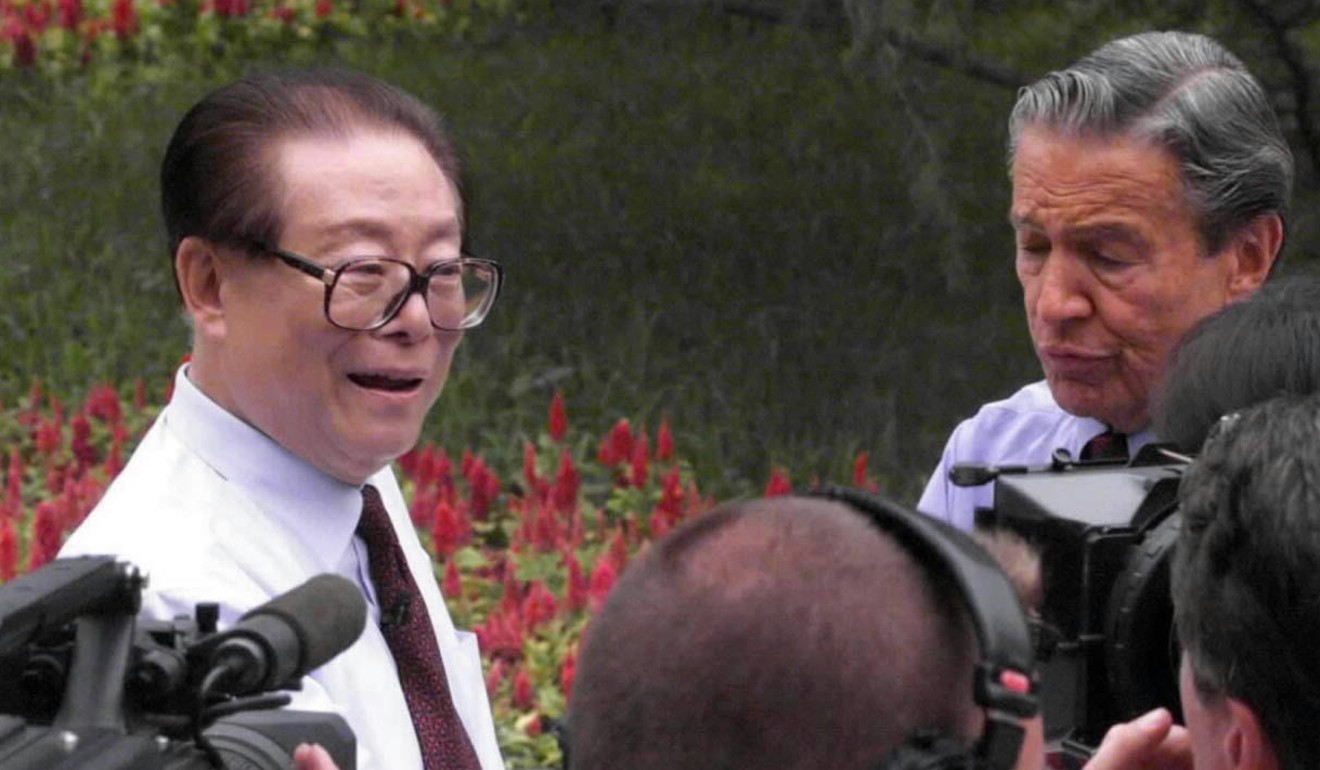
Then president Jiang Zemin with American journalist Mike Wallace during an interview in 2000. Photo: Xinhua
Former president Jiang Zemin spoke of the “political turmoil” in 1989 during an interview with American journalist Mike Wallace in 2000, and the wording has since been widely used by state media.
Meanwhile, the suppression of the protesters also prompted calls for a separation of the army and the party, so the PLA would be a “national” force rather than a political one.
But after
, the idea was squashed by the top leadership in 2007, on the eve of the PLA’s 80th anniversary. It was labelled as a plot by hostile Western forces to topple communist rule in China and is now a taboo subject.
“But despite banning discussion of military nationalisation, the calls from within the PLA to rehabilitate the military and for a review of what happened with the student movement have never stopped,” the former PLA political officer said.
“Many senior military officers believe the students weren’t attempting to overthrow communist rule – they were just asking for a better political system. That’s why calling it a counter-revolutionary rebellion is wrong.”
Curious Beijing residents gather to look at the military hardware in Tiananmen Square on June 7, 1989. Photo: AP
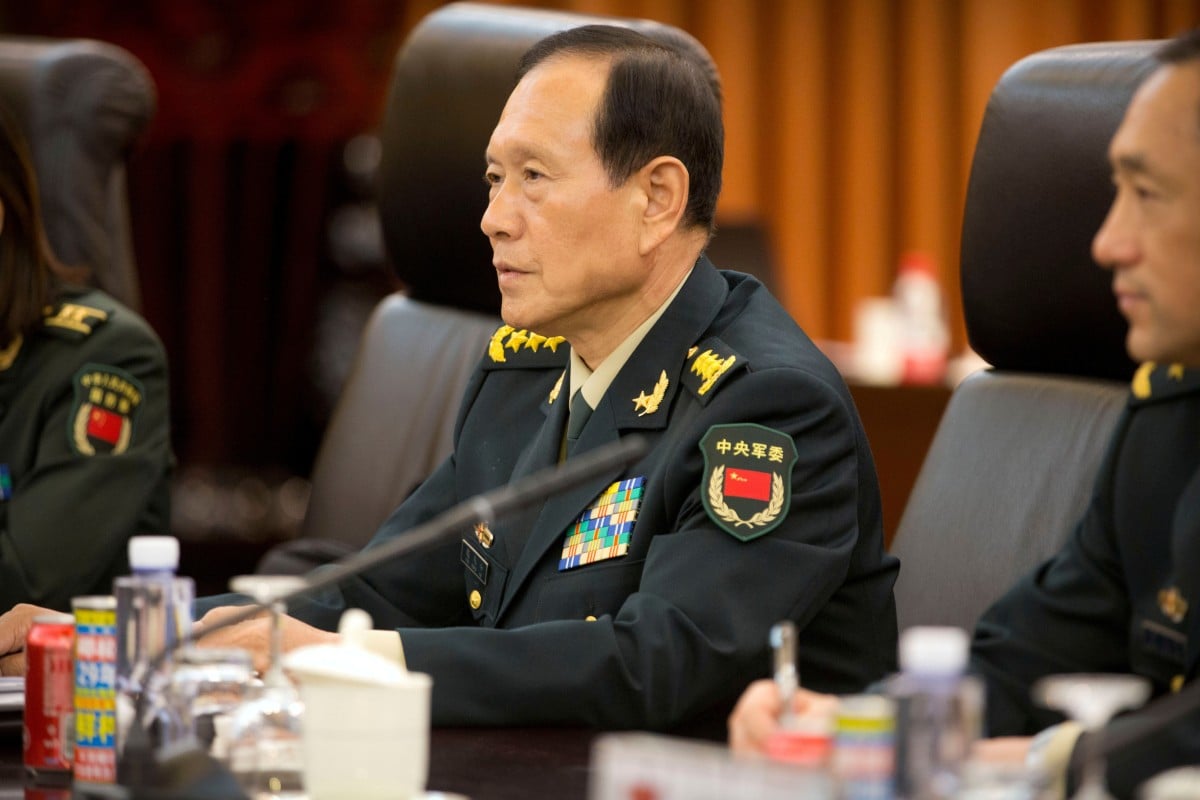
On Sunday, days ahead of the 30th anniversary, Defence Minister General Wei Fenghe
, telling a regional defence forum that putting an end to the “political turbulence” had been the “correct policy”.
“Throughout the 30 years, China under the Communist Party has undergone many changes – do you think the government was wrong with the handling of June Fourth?
There was a conclusion to that incident. The government was decisive in stopping the turbulence,” Wei said at the Shangri-La Dialogue in Singapore.
But according to the former PLA researcher, military top brass involved in the crackdown still felt profound “guilt and shame” over the lives lost.
“None of those people in the PLA would feel a sense of honour for participating in the crackdown,” he said. “Instead they harbour a deep feeling of shame.”
Source: SCMP
Posted in Academy of Military Sciences, army, Beijing, Central Military Commission (CMC), China’s military psyche, Chinese Military Encyclopaedia, Communist Party, counter-revolutionary rebellion, deep scar, Deng Xiaoping, paramount leader, People’s Liberation Army, PLA officers, political turmoil, president jiang zemin, Shangri-La Dialogue, Singapore, south china morning post, Tiananmen crackdown, Uncategorized |
Leave a Comment »
12/06/2019
- Observers will be watching to see if General Wei Fenghe holds talks with his American counterpart
- Forum comes as Beijing and Washington are at odds over issues ranging from security to trade
General Wei Fenghe will be the first Chinese defence minister to attend the Shangri-La Dialogue in eight years. Photo: Reuters
China is sending its defence minister to a leading Asian security forum next week, the first time in eight years that a high-ranking Chinese general will represent the country at the conference.
General Wei Fenghe, a State Councillor and China’s defence minister, will speak at the three-day Shangri-La Dialogue in Singapore, a gathering that comes as Beijing and Washington are at odds over issues ranging from security to trade.
“In a highly anticipated speech, General Wei Fenghe will speak on China’s role in the Indo-Pacific at a pivotal time for the region,” the International Institute for Strategic Studies, an organiser of the conference, said on Monday night.
Chinese military sources said that Wei would lead a “relatively big” delegation to the gathering, which starts on May 31 and is co-organised by the Singaporean government.
South China Sea stand-offs ‘a contest of wills’
The last time Beijing sent a high-ranking officer to the event was in 2011 when General Liang Guanglie, then the defence minister, attended.
Acting US secretary of defence Patrick Shanahan will also attend the conference and deliver a speech.
The spoils of trade war: Asia’s winners and losers in US-China clash
Beijing-based military specialist Zhou Chenming said observers would be watching to see whether the two senior defence officials held talks.
“The whole world will keep a close eye on any possible encounters between the Chinese and the Americans … At least now China has shown its sincerity in sending Wei to attend the conference, who is of equal standing as Shanahan, if the latter is willing to hold talks with him in good faith,” Zhou said.
But he said a meeting between Wei and Shanahan would be difficult because of the current distance between Beijing and Washington on major issues.
How Trump’s tweets bested China in the trade war publicity battle
“It’s not realistic to expect they will make a breakthrough because both sides will just sound their own bugles. The … mistrust between China and the US is actually growing every day,” Zhou said.
Just on Sunday, the USS Preble, an Arleigh Burke-class guided missile destroyer, sailed within 12 nautical miles of the Scarborough Shoal, an area in the South China Sea claimed by both China and the Philippines.
The
by strongly urging “the US to stop such provocative actions” and saying it would “take all necessary measures” to protect its “national sovereignty”.
Military analysts said the size of the Chinese delegation at the conference would underscore the importance of the People’s Liberation Army (PLA) attached to the event this year.
One military insider said the delegation would also include Lieutenant General He Lei, former vice-president of the Academy of Military Science, who headed China’s delegation in 2017 and 2018; and Senior Colonel Zhou Bo, director of the defence ministry’s Centre for Security Cooperation. In addition, the PLA would send a number of Chinese academics to speak at various sessions of the forum.
China tries to go one on one with Malaysia to settle South China Sea disputes
Singaporean Prime Minister Lee Hsien Loong will deliver a keynote speech on the opening day of the annual dialogue.
Japan and South Korea are also sending their defence ministers, according to a report by The Korean Times on Tuesday. The report also said South Korean Defence Minister Jeong Kyeong-doo was keen to hold one-on-one meetings with his Chinese and Japanese counterparts on the sidelines of the conference.
Source: SCMP
Posted in Academy of Military Sciences, Beijing, China alert, defence minister, defence ministry’s Centre for Security Cooperation, General Wei Fenghe, guided missile destroyer, Japan, Jeong Kyeong-doo, Lee Hsien Loong, Lieutenant General He Lei, Malaysia, Patrick Shanahan, People's Liberation Army (PLA), Philippines, Scarborough Shoal, Security Conference, Shangri-La Dialogue, Singapore, Singaporean Prime Minister, South China Sea, South Korea, South Korean Defence Minister, State Councillor, tensions, The Korean Times, Uncategorized, US, US secretary of defence, USS Preble, Washington |
Leave a Comment »
12/06/2019
- Washington’s support for Taipei sends ‘wrong message’ to independence-leaning forces on self-ruled island, Lieutenant General Shao Yuanming says at Shangri-La Dialogue
- Chinese military will ‘resolutely defend the unity of our motherland at all costs’, he says
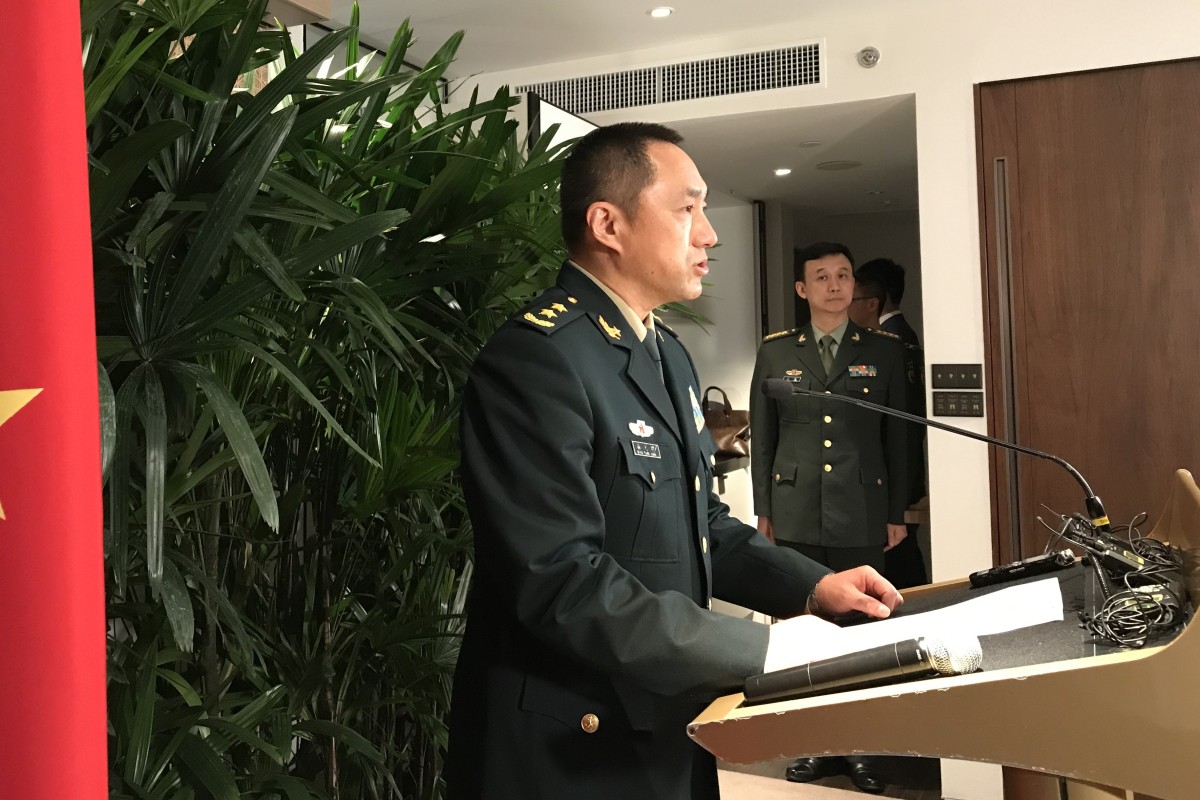
Lieutenant General Shao Yuanming accused acting US defence secretary Patrick Shanahan of sending the wrong message to Taiwanese separatists. Photo: Minnie Chan
A senior Chinese military officer has accused the United States’ top defence official of using sensitive issues like Taiwan and the South China Sea to promote instability in the Asia-Pacific region.
Speaking on Saturday at the Shangri-La Dialogue in Singapore, Lieutenant General Shao Yuanming, deputy chief of the Joint Staff Department, said that acting US defence secretary Patrick Shanahan, in an
at the same event, had sent a “terribly wrong” message to independence-leaning forces on the self-ruled island.
“The one-China principle is the political foundation of Sino-US relations and the common consensus in the international community,” Shao told a press conference.
“[But] recent words and deeds released by the US side have sent terribly wrong signals to Taiwan’s independence forces, which could undermine regional peace and stability.”
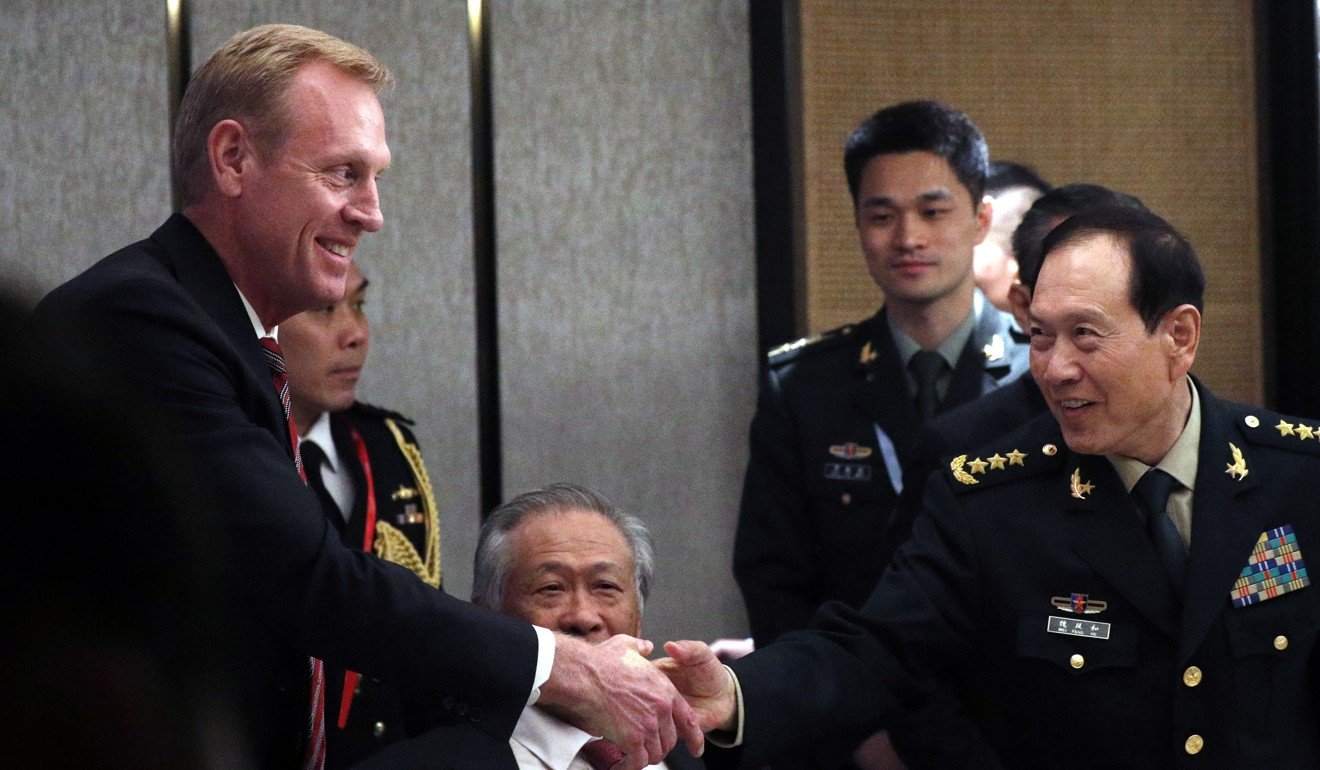
Acting US defence secretary Patrick Shanahan shakes hands with China’s Defence Minister General Wei Fenghe on the sidelines of the Shangri-La Dialogue. Photo: EPA-EFE
Any efforts to promote independence for Taiwan would face staunch opposition, he said.
“China must be unified and the unification of China is inevitable … [it is] the collective will of the Chinese people. If anyone wants to separate Taiwan from the country, the Chinese military will resolutely defend the unity of our motherland at all costs.”
Too much risk in Huawei’s ties to Chinese government, US defence chief says
In his speech, Shanahan said the US would continue to support Taiwan’s efforts to defend itself, suggesting Washington had no plans to stop selling weapons to Taipei.
Beijing has said repeatedly that Taiwan – which it considers a wayward province awaiting reunification, by force if necessary – is a thorn in its relationship with the US.
Speaking of the threat to regional stability, Shanahan warned of “actors” that “undermine the system by using indirect, incremental actions and rhetorical devices to exploit others economically and diplomatically, and coerce them militarily”.
“Behaviour that erodes other nations’ sovereignty and sows distrust of China’s intentions must end,” he said. “The US does not seek conflict, but we know that having the capability to win wars is the best way to deter them.”
Shao said China welcomed the United States’ efforts to maintain a stable military-to-military relationship with the People’s Liberation Army, but opposed its so-called freedom of navigation operations in the air and at sea, which he said were an excuse to reconnoitre Chinese territory.
“China has indisputable sovereignty of the islands, reefs and nearby sea territory in the South China Sea,” Shao said. “We have deployed necessary defence facilities in accordance with the security situation the islands and reefs are facing … in response to these provocative actions.”
Just an hour after Shao’s press conference, three US senators from the House Armed Services Committee – Angus King, Tammy Duckworth and Marsha Blackburn – held a similar event at which they expressed Washington’s commitment to maintaining regional stability.
“A stable, prosperous and free Indo-Pacific region is key to the interests of all nations,” Duckworth said.
She urged Beijing to respect international rules and said the US “would stand against people who cheat”.
Chinese defence chief warns US not to underestimate Beijing on Taiwan
The senators also stressed the importance of maintaining peace through deterrence, with King going so far as to liken the situation in the region to the rise of the Nazis.
“Deterrence is a necessary part of maintaining a peaceful world. Hitler could have been stopped in the mid-30s fairly easily by the countries of Europe, which did not have the stomach for confrontation.” he said. “To avoid war we need to prepare for war.”
King said also that the prevailing global order had not been designed by the US but had instead evolved over millennia.
“[These] aren’t things we made up. These are internationally recognised rules and norms that go back thousands of years,” he said.
“‘Don’t lie, don’t steal’, those aren’t things Americans invented … We don’t want to gain territory but we do want to preserve freedom of navigation.”
Blackburn said that many countries welcomed the United States’ engagement in the region, saying US officials had held bilateral meetings with their counterparts from South Korea, Malaysia, Thailand and Singapore.
As defence officials from the US and across Asia continued their discussions and negotiations in Singapore, maritime authorities in Hainan said the PLA Navy would on Sunday begin a three-day naval exercise in waters off the south China province.
Source: SCMP
Posted in Uncategorized |
Leave a Comment »
12/06/2019
- Radar expert Liu Yongtan says surface wave system could track ships and planes from hundreds of kilometres away and is protected from anti-radiation missiles
Stealth aircraft like the US F-35 are less well protected against high-frequency surface wave radars. Photo: AP
China has developed a radar system that could detect stealth fighters from a long distance, its creator has told state media.
Liu Yongtan, a member of the Chinese Academy of Sciences, told Naval and Merchant Ships that the new high-frequency surface wave radar (HFSWR) was also masked from anti-radiation missiles which can detect and destroy radio waves from other early warning systems.
The interview with the monthly magazine, which is published by the China Shipbuilding Engineering Academy, was reprinted by state-owned tabloid Global Times on Monday.
Liu, an 83-year-old who has dedicated his life to studying radar systems, said the new radar features “high-frequency electromagnetic waves that have long wavelengths and wide beams”.
Unlike microwave or skywave signals, surface waves travel along the spherical surface of the earth.
“A land-based version of the system can detect naval and aerial hostile objects from hundreds of kilometres away, which helps expand the range of China’s maritime early warning and defence systems,” Liu said.
He also said the long wavelength could help detect stealth aircraft, which use special protective materials and designs to make them “invisible” to microwave radars, but have no such protection against high-frequency surface waves.
Chinese navy’s new ‘compact’ radar will allow it to keep watch over an area the size of India
Another advantage of the maritime radar system is what Global Times described as “immunity” to attack from anti-radiation missiles, which track and destroy the origin of the electromagnetic waves.
Liu said that anti-radiation missiles would need huge antennas to track high-frequency surface waves because their beams are too wide for the antennas currently in use to track.
Plenty of practical challenges – such as signal loss and noise interference – need to be overcome to use high-frequency surface waves in radar.
Liu Yongtan was given China’s top scientific honour for his work on the radar. Photo: Weibo
However, Shi Lao, a Shanghai-based military commentator, said Liu’s team must have overcome those challenges.
Shi said he believed that as Liu’s technology developed it could be used as a low-cost coastal monitoring system that could protect the coastline within a range of 400km (250 miles).
Japan boosts island radar surveillance to catch Chinese, North Korean ships
The technology can also be used in conjunction with skywave radar systems, which usually have a longer monitoring range of 1,000km (621 miles).
“HFSWR could work 24 hours in all weathers, which would be much cheaper than operating early warning aircraft,” Shi said.
“They can be deployed relatively quickly with high mobility if they are mounted on vehicles, and may be loaded onto warships in the future.”
State broadcaster CCTV has previously reported that China has built a high-frequency surface wave radar test centre in Weihai, on China’s east coast in Shandong province.
In January
, China’s highest award for scientists which includes prize money of 8 million yuan (US$1.2 million), for his work on the radar system.
Source: SCMP
Posted in antennas, anti-radiation missiles, CCTV, China Shipbuilding Engineering Academy, China’s maritime early warning and defence systems, Chinese Academy of Sciences, Chinese navy, creator, electromagnetic waves, Global Times, high-frequency radar system, high-frequency surface wave radar (HFSWR), India alert, invisible, Japan, long distance, microwave radars, Naval and Merchant Ships, North Korean ships, shandong province, spot, State Pre-eminent Science and Technology Award, stealth aircraft, surface wave system, Uncategorized, Weihai |
Leave a Comment »
12/06/2019
- Ship was en route to Pacific for routine exercise when spotted in East China Sea on Tuesday, state media says
- PLA Navy has plenty of other military options to contest maritime conflicts over sovereignty
China’s state media says it is unlikely aircraft carriers will ever be used to resolve maritime disputes. Photo: AFP
The appearance of a Chinese aircraft carrier in the East China Sea on Tuesday had nothing to do with the country’s territorial disputes in the region but was rather part of a routine training exercise, Beijing said.
The
, the country’s only fully operational carrier, and several other naval vessels were spotted passing through the Miyako Strait that separates the Japanese islands of Miyako and Okinawa en route to the Pacific Ocean, according to Japanese broadcaster NHK.
Beijing said it was a routine mission that had been conducted in accordance with international law, and called on other nations to respect its right of passage.
Xiakedao, a social media account run by the overseas edition of Communist Party mouthpiece People’s Daily, said in a commentary that the Liaoning had no role to play in sovereignty disputes.
Instead its operations covered the four areas of maritime traffic protection, naval diplomacy, regional deterrence, and humanitarian aid and rescue missions.
“It is very unlikely that Chinese carriers will ever be involved in resolving maritime disputes with neighbouring countries,” the article said, adding that the People’s
Liberation Army, China’s military, had plenty of other options, like long-range aircraft, missiles and destroyers, for such missions. “Why bother using aircraft carriers?” it said.
China forced to rethink navy spending as trade war bites
The Liaoning’s Pacific mission involved at least five other vessels – two guided missile destroyers, two frigates and a supply ship – according to photographs released by Japan’s defence ministry.
The presence of the 45,000-tonne Type 901 Hulun Lake fast combat support ship – the first time such a vessel has taken part in one of the carrier’s missions – suggested the Liaoning was headed for the high seas.
“This is probably going to be a long journey,” naval expert Li Jie said. “We will see how far they go [but] … the whole purpose of an aircraft carrier is that it can operate far out in the ocean.”
Having a supply ship as part of the strike group, which would allow the Liaoning to travel an extra 10,000 nautical miles or conduct thousands of hours of operations, was essential on such missions, he said.
The exercise is the carrier’s first Pacific deployment since undergoing a major maintenance programme earlier in the year.
The 300km (186 mile) wide Miyako Strait is the most convenient route for China’s navy and air force to access the Western Pacific through the so-called first island chain, which sits between the Chinese coast and the vast ocean.
“The Miyako Strait is wide enough and the sea conditions are usually stable,” Li said. “Pacific training missions will become routine and other Chinese carriers will probably also take this route.”
Details of new carrier revealed in sea trial footage
The Liaoning, accompanied by a fleet of eight vessels, first passed through the strait in December 2016 as part of its first Pacific mission. In April last year, the carrier and its escorts conducted an exercise in the ocean after reaching it via the Bashi Strait, which runs between the Philippines and Taiwan.
As well as the Liaoning, China’s first home-grown aircraft carrier – the
– is conducting sea trials and expected to go into full service later this year, while at least one more is under construction.
Chinese defence ministry spokesman Wu Qian said in 2017 that the navy would increase its activities in the Miyako Strait until the Japanese side “gets used to it”.
Source: SCMP
Posted in Chinese aircraft carrier, East China Sea, Liaoning, pla navy, territorial disputes, Uncategorized |
Leave a Comment »












 CHINDIA ALERT: You'll be living in their world, very soon