Archive for June, 2019

25/06/2019

China, African countries vow to enhance cooperation

CHINA-BEIJING-WANG YI-SOUTH AFRICA-FM-MEETING (CN)

Chinese State Councilor and Foreign Minister Wang Yi (R) meets with South African Foreign Minister Naledi Pandor in Beijing, capital of China, June 24, 2019. Naledi Pandor was here to attend the Coordinators’ Meeting on the Implementation of the Follow-up Actions of the Beijing Summit of the Forum on the China-Africa Cooperation (FOCAC). (Xinhua/Zhai Jianlan)

BEIJING, June 24 (Xinhua) — Chinese State Councilor and Foreign Minister Wang Yi held respective meetings with foreign ministers from nine African countries on Monday, and they pledged efforts to strengthen cooperation and uphold multilateralism.

The foreign ministers are Naledi Pandor from South Africa, Palamagamba Kabudi from Tanzania, Ezechiel Nibigira from Burundi, Aurelien Agbenonci from Benin, Nhial Deng Nhial from South Sudan, Mamadou Tangara from Gambia, Joseph Malanji from Zambia, Luis Filipe Tavares from Cape Verde, and Gbehzohngar Findley from Liberia.

The African foreign ministers are in Beijing to attend the Coordinators’ Meeting on the Implementation of the Follow-up Actions of the Beijing Summit of the Forum on the China-Africa Cooperation (FOCAC), with the aim of better implementing the outcomes of Beijing Summit in 2018.

While holding talks with Pandor, Wang hailed the solid mutual trust and deep-rooted traditional friendship between China and South Africa.

Wang said China and South Africa, both as major representatives of emerging markets and developing countries, should jointly safeguard the missions and principles of the United Nations Charter, champion multilateralism, uphold basic norms governing international relations, and oppose any form of unilateralism and bullying, to promote world peace, development and prosperity.

Pandor said South Africa and the whole African continent, as China’s partners for jointly resisting unilateralism and bullying practice, would stand together with China in safeguarding multilateralism and an open, inclusive global trade system.

In the meeting with Kabudi, Wang expressed China’s readiness to work with Tanzania to keep high-level exchanges, and avail the opportunity of jointly building the Belt and Road and the Coordinators’ Meeting to ensure better outcomes in bilateral cooperation.

Calling the Beijing Summit of the FOCAC a milestone, Kabudi said Tanzania is willing to facilitate cooperation in infrastructure construction, industrial capacity, and in cultural, educational sectors and other areas.

In respective meetings with Nibigira, Agbenonci, Nhial and Tangara, Wang said the current international situation is complex but China’s determination to strengthen its solidarity and friendship with African countries remains unchanged.

Nibigira said Burundi agreed with the Belt and Road Initiative and would continue to support China on issues concerning China’s core interests and major concerns.

Agbenonci said multilateralism was now the only correct choice. Only through multilateralism can the voice of small and medium-sized countries, especially African nations, be heard, he said.

Nhial said South Sudan thanked China for its help in various fields, especially its support and contributions to the peace process in South Sudan.

Tangara said since the resumption of diplomatic relations between China and Gambia, bilateral cooperation in various fields had developed fast, and Gambia can be trusted as a sincere partner of China.

When holding separate meetings with Malanji, Tavares and Findley, Wang said China would continue to uphold justice and pursue the shared principles of sincerity, results, affinity and good faith.

China’s cooperation with Africa is sincere and selfless, and has no geopolitical purposes, said Wang, adding that China had always followed the principle of non-interference, provided aid as Africa needed, carried out South-South cooperation, and helped achieve common development.

He said China-Africa cooperation was conducive to Africa’s infrastructure construction, economic and social benefits, and self-development.

“Africa offers a grand stage of cooperation between different countries, not an arena of major powers’ game,” said Wang, adding that “African friends will get a right conclusion on who truly attaches importance to, respect, and support Africa.”

Malanji said claims that Zambia-China cooperation had led to Zambia’s debt problem were inconsistent with the facts and China’s loans were used on the infrastructure that Zambia needs most, to promote Zambia’s economic development and bring social welfare.

Tavares said Cape Verde cherished relations with China and upheld the one-China principle. He said Cape Verde stood ready to fully implement consensus reached by leaders of the two countries, enhance strategic dialogue, and deepen cooperation, particularly marine economy cooperation, to push bilateral relations into a new era.

Findley said China is Liberia’s true friend which has helped fight Ebola alongside Liberia and played an important role in post-epidemic reconstruction. He said Liberia is ready to enhance mutually beneficial cooperation with China.

Also on Monday, Yang Jiechi, a member of the Political Bureau of the Central Committee of the Communist Party of China (CPC) and director of the Office of the Foreign Affairs Commission of the CPC Central Committee, met with all delegation heads here to attend the coordinators’ meeting.

The meeting will formally open Tuesday morning.

Source: Xinhua

24/06/2019

Jharkhand: Arrests over lynching of India Muslim man

Tabrez AnsariImage copyright BBC HINDI
Image caption A video showing Ansari pleading for his life has been widely circulated on social media

Indian police have arrested five people after a Muslim man was beaten to death by a mob.

Tabrez Ansari, 24, died days after being attacked by people who accused him of stealing a motorcycle in the eastern state of Jharkhand.

A video showing Ansari pleading for his life, and being forced to say chants praising Hindu gods has been widely circulated on social media.

His family alleges that police denied him treatment despite his injuries.

His wife Shahista Parveen told the BBC that Ansari had been tied to an electricity pole overnight and only handed to police the next day who then arrested him for theft.

He was transferred to a hospital four days later. She says he was beaten only after refusing to repeat the chants praising the Hindu gods.

State police have denied wrongdoing.

There have been several incidents of lynching reported in the state in recent years.

Source: The BBC

24/06/2019

Kashmir separatists ready for talks, Indian government says

SRINAGAR (Reuters) – The leader of disputed Kashmir’s largest separatist group said it was ready for talks with India’s government on Monday, after the state governor said he was optimistic about dialogue.

The Muslim-majority Kashmir valley is at the heart of more than seven decades of hostility between nuclear arch-rivals India and Pakistan. Both claim it in full but rule it in part.

Rhetoric from both sides, as well as Kashmiri separatists, some of whom want to join Pakistan, has been highly charged since a February suicide car bomb attack by a Pakistan-based militant group killed more than 40 Indian police in the part of the region it controls.

Any talks to resolve the conflict would be hugely difficult.

But on Saturday, Satya Pal Malik, the governor of Jammu and Kashmir state where Indian-controlled Kashmir lies, told a news conference he had seen a softening in approach from separatist leaders, including the influential Hurriyat Conference.

“I feel happy that the temperature in the valley has gone down as compared to what it was during my arrival in Kashmir,” he told a news conference.

Malik has governed the state since August 2018, shortly after India’s ruling Bharatiya Janata Party (BJP) withdrew from a coalition with a local party, imposing direct rule from New Delhi.

“Today Hurriyat, who once closed their doors… are ready for the talks with the Government of India,” Malik added.

In response, Mirwaiz Umar Farooq, the chairman of Hurriyat, a political movement that wants independence from India, told Reuters on Monday he would welcome talks.

“Hurriyat Conference has always been in favour of talks as the means of resolution,” he said.

“Kashmiris, being the most affected party for the past 72 years, naturally want its resolution.”

Kashmir, whose fate was left unresolved during partition in 1947, is a key focus for the BJP government led by Prime Minister Narendra Modi, that won a second term in power with an increased majority in May.

The BJP also wants to abolish special privileges for Jammu and Kashmir, India’s only Muslim majority state, to the fury of many Kashmiris.

Source: Reuters

24/06/2019

China Focus: African ministers in Beijing to discuss closer cooperation with China

CHINA-BEIJING-WANG YI-CAMEROON-FM-MEETING (CN)

Chinese State Councilor and Foreign Minister Wang Yi (R) meets with Cameroon’s Foreign Minister Lejeune Mbella Mbella in Beijing, capital of China, June 23, 2019. Lejeune Mbella Mbella was here to attend the coordinators’ meeting on the implementation of the Forum on China-Africa Cooperation (FOCAC) Beijing Summit outcomes. (Xinhua/Yin Bogu)

BEIJING, June 23 (Xinhua) — Chinese State Councilor and Foreign Minister Wang Yi held talks or meetings here Sunday with foreign ministers from eight African countries, who are here to attend the upcoming coordinators’ meeting on the implementation of the Forum on China-Africa Cooperation (FOCAC) Beijing Summit outcomes.

The foreign ministers are Sierra Leone’s foreign minister Nabeela Tunis, Gabon’s foreign minister Alain Claude Bilie, Cameroon’s foreign minister Lejeune Mbella Mbella, San Tome and Principe’s foreign minister Elsa Teixeira Pinto, Somali foreign minister Ahmed Isse Awad, Madagascar’s foreign minister Andriantsit Ohaina Franck Michel Niaina, Congo’s foreign minister Jean Claude Gakosso and Senegal’s foreign minister Amadou Ba.

In talks with Tunis, hailing the two countries as “good friends and good brothers”, Wang called on the two sides to continue to firmly support each other on issues concerning each others’ core interests and major concerns, strengthen alignment of the Belt and Road Initiative and the eight major initiatives proposed at the FOCAC Beijing Summit with Sierra Leone’s medium-term national development plan, and beef up cooperation on infrastructure, agriculture and fishery, health care, communication, and capacity building.

Sierra Leone supports Africa and China to deepen partnership and is ready to strengthen communication and coordination with China on implementing the sustainable development goals of the 2030 Agenda, the Paris Agreement on climate change, and reform of the global governance system, Tunis said.

When meeting with Bilie, Wang said 53 countries in Africa have sent high-level delegations to the coordinators’ meeting, including 25 foreign ministers. The move fully reflected the importance that the African side attaches to the China-Africa ties and the unbreakable solidarity and friendship between the two sides.

Wang said the two sides should continue the support to each other on issues involving each other’s core interests, seize opportunities of the 45th anniversary of diplomatic ties between China and Gabon this year to create new progress in ties, and expand cooperation on Belt and Road Initiative and multilateral issues.

Bilie said Gabon is willing to strengthen exchanges of experience with China in governance and seek synergy between its own development strategy with the Belt and Road Initiative.

In meeting with Mbella, Wang said Cameroon is China’s traditional friend and important partner in Africa. Both sides should continue to understand and support each other on issues involving each others core interests and major concerns. China’s financial support for African countries is based on equality and voluntarism and aims to help Africa improve its capacity for independent and sustainable development.

There is no such thing as a “debt trap” between China and Cameroon or between China and Africa, said Wang, adding that China will not seek any political purpose.

Mbella said that Cameroon spoke highly of China’s policy toward Africa and thanked China for its understanding and sincere assistance to Cameroon in alleviating the debt problems.

When meeting with Pinto, Wang said facts have proved that the resumption of diplomatic relations is in full compliance with the interests of the two countries and peoples. The Chinese side appreciates Sao Tome and Principe’s active support for the Belt and Road Initiative and is willing to continue to provide assistance within its capacity to the African country.

Pinto said Sao Tome and Principe will firmly adhere to the one-China principle, strengthen political and diplomatic dialogue with China, actively promote cooperation in infrastructure and enhance non-governmental exchanges.

In the meeting with Awad, Wang said China supports Somalia to restore stability and embark on the path of recovery. China is ready to explore new ways to develop mutually beneficial cooperation with Somalia under the new situation, and conduct cooperation in the areas most needed by Somalia such as agriculture, fisheries and processing industries.

Awad said Somalia expects to strengthen exchanges with China, and promote cooperation in areas such as infrastructure construction.

In the meeting Niaina, Wang expressed the will to promote the alignment with Madagascar’s development strategy, and said China is ready to enhance the cooperation on multilateral issues.

When meeting with Gakosso, Wang hailed bilateral relationship and also reiterated China’s stance to safeguard multilateralism.

In the talks with Amadou Ba, Wang said China would like to work with other international partners in conducting tripartite cooperation in Senegal, on the basis of respecting Senegal’s willingness.

The coordinators’ meeting will be held in Beijing from June 24 to 25. There will be over 80 African ministerial-level officials at the meeting. On the sidelines of the meeting, more than 40 bilateral and multilateral activities will be held to implement the outcomes of the FOCAC Beijing Summit, synergize efforts, consolidate consensus and deliver more benefits to the peoples.

Source: Xinhua

23/06/2019

India rejects U.S. report on attacks on minority Muslims

NEW DELHI (Reuters) – India on Sunday rejected a U.S. State Department’s annual report on religious freedom that raised questions about the government’s inability to curb violent attacks on the country’s minority Muslims.

Preparing for a visit by U.S. Secretary of State Mike Pompeo on Tuesday, India’s foreign ministry issued a stiff rejoinder to the U.S. criticism.

“India is proud of its secular credentials, its status as the largest democracy and a pluralistic society with a longstanding commitment to tolerance and inclusion,” Raveesh Kumar, the ministry’s spokesman, said in a statement.

The State Department report, released on Friday, said some senior officials from Prime Minister Narendra Modi’s ruling Hindu nationalist Bharatiya Janata Party (BJP) last year had made “inflammatory speeches” against religious minorities.

Kumar said India’s constitution guarantees fundamental rights and religious freedom of all citizens, including its minority communities. Muslims make up 14 percent of India’s 1.3 billion people.

“We see no locus standi for a foreign entity to pronounce on the state of our citizens’ constitutionally protected rights,” Kumar said.

The U.S. State Department report examined attacks on minorities during 2018.

“Mob attacks by violent extremist Hindu groups against minority communities, especially Muslims, continued throughout the year amid rumours that victims had traded or killed cows for beef,” the report said.

It also noted reports by non-governmental organisations that the government sometimes failed to act on mob attacks on religious minorities, marginalized communities, and critics of the government.

While in New Delhi, Pompeo is expected to hold talks aimed at laying the ground for a meeting between U.S. President Donald Trump and Modi during a Group of 20 summit in Japan later next week.

Source: Reuters

23/06/2019

China’s transition to consumer economy makes it more investable: senior investors

NEW YORK, June 22 (Xinhua) — Chinese ongoing efforts to transform itself from an export-oriented economy toward a consumption-based one would offer great investment opportunities for international investors, according to senior investment advisors.

China’s regulatory interference in the last 12 months is really going to catalyze the move to create it into a consumer economy, which is actually happening, said Barry Gill, managing director and head of active equities with UBS Asset Management in a recent media roundtable meeting.

The story is extremely strong in China and “it makes it super investable,” said Gill.

China’s economic stabilization should drive increased investment there as the country is expected to contribute 33 percent of global economic growth in 2019, and the Chinese bond market is on the verge of becoming the world’s second largest one, according to Suni Harford, head of investment with UBS Asset Management.

Active management of investment could fetch double digit yearly returns in some cases from Chinese capital market in the last decade while passive management of investment in Chinese benchmarks could offer about 4 percent of annual return, according to Gill.

Gill added that China still has a huge amount of tools at its disposal to maintain economic growth for some expanded period of time.

“If they can make structural investments in the safety net on the health care level, education level, tax code and all of these things, it will drive a completely new engine of growth for China,” said Gill.

The potential growth in China driven by consumption would be a lot more similar to that in developed markets and “it is showing up already,” Gill said, citing a large number of Chinese tourists in Japan.

China needs to reduce people’s savings rate from around 25 percent to a lower level by building a sound social safety net, according to Gill.

A lower savings rate in China “will lead to a feedback loop that will both change the dynamics of the economy and will provide the next leg of growth,” said the senior investor.

China has embarked on a path to empower domestic consumption with contribution of final consumption expenditure to economic growth at 76.2 percent in 2018 up from 45.3 percent in 2007, according to China’s National Bureau of Statistics.

UBS Asset Management, which manages as much as 824 billion U.S. dollars of assets worldwide, is pushing for a standalone allocation to China thanks to size of Chinese economy and continuous growth in the country.

“China’s continuing growth and its standing as the world’s second largest economy support experts’ belief that the case for a standalone approach to China is growing increasingly compelling,” said the latest “Panorama” report by UBS Asset Management.

Chinese bonds market is one uniquely defensive market and Chinese currency RMB would move to the reserve currency status, creating an RMB bloc in Asian and Pacific region, according to the report.

An active and standalone allocation supported by on-the-ground knowhow rather than as part of overall strategy for emerging markets would offer investors the best chance of capitalizing on many opportunities emerging from China’s growing role in the global economy, the report said.

Source: Xinhua

23/06/2019

Chinese cities see improving air quality from Jan. to May

BEIJING, June 23 (Xinhua) — Air quality improved in Chinese cities in the first five months of 2019, according to the Ministry of Ecology and Environment (MEE).

Some 337 Chinese cities enjoyed good air quality on 80.3 percent of days from January to May this year, up 0.6 percentage points from the same period last year. Nearly 120 cities met the air quality standards, including 20 cities joining this year, data of MEE showed.

The average PM2.5 density, a key indicator of air pollution remained unchanged at 44 micrograms per cubic meter over the period and the average density of PM10 and sulfur dioxide fell 2.6 percent and 13.3 percent respectively year on year.

Haikou, Lhasa and Shenzhen ranked top three on the list of 168 cities’ air quality in the first five months while cities in the provinces of Hebei, Henan and Shanxi lagged behind.

Several regions saw a decrease in PM2.5 in May 2019, with that in Beijing-Tianjin-Hebei region and Yangtze River Delta down 16.7 percent and 8.6 percent year on year respectively.

China pledged to coordinate its efforts on environmental protection and economic development in 2019.

The country vowed to reduce imports of solid waste and push for better air quality with better regional coordination and heavy-polluter revamps, according to the ministry.

Source: Xinhua

23/06/2019

Chinese, Irish leaders exchange congratulations on 40th anniversary of ties

BEIJING, June 22 (Xinhua) — Chinese President Xi Jinping on Saturday exchanged greetings with his Irish counterpart Michael D. Higgins on the 40th anniversary of the establishment of bilateral relations.

Since the forging of the diplomatic ties 40 years ago, the two countries have been adhering to the spirit of mutual respect, treating each other on an equal footing, mutual benefit and win-win to push forward healthy and stable development of the bilateral relations and scored fruitful achievements in exchanges and cooperation in various fields, Xi said in a congratulatory message.

President Higgins paid a state visit to China in 2014 and the two heads of state conducted in-depth and friendly exchanges and mapped out a blueprint of China-Ireland relations, Xi recalled.

The Chinese president said he attaches high attention to advancing the ties between China and Ireland and stands ready to make joint efforts with President Higgins to lift the mutually beneficial strategic partnership to a new stage to benefit the two countries and peoples while taking the 40th anniversary as a new starting point.

For his part, Higgins said in a message that, over the last four decades, the bilateral ties have become even stronger as time goes by and pragmatic cooperation in various fields have been increasingly deepening.

The Irish side highly values developing ties with China and is willing to further explore potentials for pragmatic cooperation, boost coordination on safeguarding multilateralism and other global affairs and promote the Ireland-China ties toward further development, he added.

Also on Saturday, Chinese Premier Li Keqiang and Irish Prime Minister Leo Varadkar exchanged congratulatory messages.

Li said China, with the opportunity of the 40th anniversary of the establishment of diplomatic ties, is ready to work with Ireland to push the two countries’ mutually beneficial strategic partnership and friendly cooperation to continuously move forward.

Varadkar said that China’s reform and opening up and achievements in development carry global significance, noting that the Irish side will continue to fully develop Ireland-China partnership based on the spirit of mutual respect.

Source: Xinhua

23/06/2019

Caohai Lake in China’s Guizhou recovers original size

CHINA-GUIZHOU-WEINING-CAOHAI NATIONAL NATURE RESERVE (CN)

Photo taken on June 20, 2019 shows scenery at Caohai National Nature Reserve in Weining County, southwest China’s Guizhou Province. Caohai Lake, a major wetland in southwest China and an important wintering place for black-necked cranes, has recovered its original size. The lake once shrank sharply due to pollution and farming practices. (Xinhua/Tao Liang)

Source: Xinhua

23/06/2019

Xi Jinping’s state visit to North Korea aims for ‘new impetus’ in ties

  • Stalled denuclearisation talks also expected to be on the agenda when Chinese president meets Kim Jong-un this week
  • Analysts say Korean peninsula has become intense diplomatic battleground between Beijing and Washington
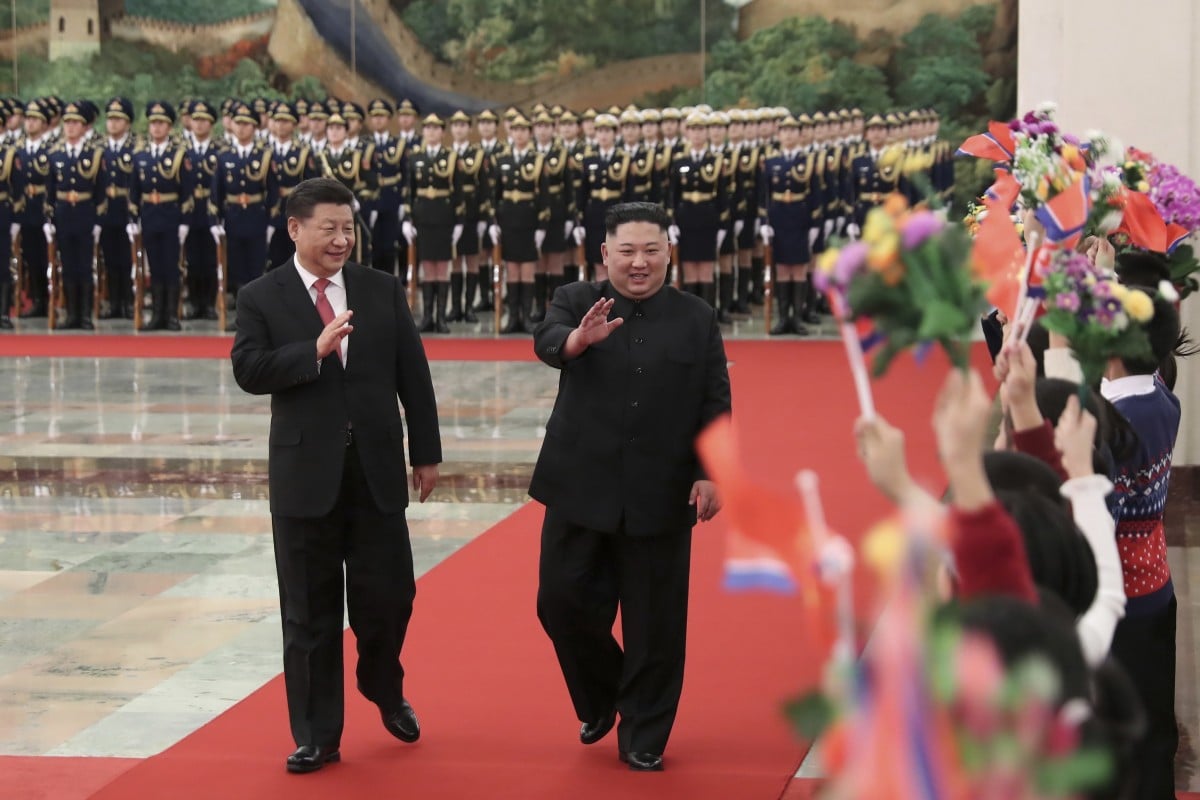
North Korean leader Kim Jong-un (right) attends a welcome ceremony in Beijing with Chinese President Xi Jinping in January. Xi will begin a visit to Pyongyang on Thursday. Photo: AP
Xi Jinping’s upcoming trip to 
North Korea

will be a state visit – a higher status than the last trip to the hermit kingdom by a Chinese president, highlighting the close bilateral ties between Beijing and Pyongyang.

Xi’s two-day trip, which 
begins on Thursday

, is the first by a Chinese president to North Korea in 14 years and comes just a week before he is due to meet US President Donald Trump for talks on the sidelines of the Group of 20 summit in Japan.

“Leaders of the two countries will review the development of the bilateral relationship and carry out an in-depth exchange of opinions on the development of Sino-North Korean relations in the new era, and chart the future course of development,” state news agency Xinhua reported on Tuesday.
Xi’s predecessor, Hu Jintao, went to North Korea in October 2005 on a three-day trip described as an “official goodwill” visit.
Speaking at a regular press briefing in Beijing on Tuesday, foreign ministry spokesman Lu Kang said Xi’s visit aimed to “inject new impetus” into relations in the year the two countries marked the 70th anniversary of establishing diplomatic ties, and to give stalled denuclearisation talks a much needed push.
“Regarding the progress on denuclearisation, as I said, the result of the Hanoi leaders’ meeting in February was indeed a little unexpected. But after that, everyone actually looks forward to the resumption of dialogue in a good direction,” Lu said, referring to the failed talks between Trump and North Korean leader Kim Jong-un in the Vietnamese capital four months ago.

Trump hinted at the possibility of another meeting with Kim after receiving what he called “a beautiful letter” from the North Korean leader last week. On Tuesday, South Korea’s chief nuclear negotiator, Lee Do-hoon, said the US had been in contact with the North.

Life in North Korea the ‘admiration and envy’ of others, state media says

Washington will also send US Special Representative for North Korea Stephen Biegun to South Korea next week, days after Xi’s visit to Pyongyang, to fully align its position on North Korea with its ally.

Meanwhile, Trump confirmed he would meet Xi for talks in Osaka next week, saying in a tweet on Tuesday they had “a very good telephone conversation” and would hold “an extended meeting” at the G20 summit, where they are

expected to try to cool tensions

over an almost year-long trade war.

Donald J. Trump

@realDonaldTrump

Had a very good telephone conversation with President Xi of China. We will be having an extended meeting next week at the G-20 in Japan. Our respective teams will begin talks prior to our meeting.

Analysts said the Korean peninsula had become an intense diplomatic battleground between Beijing and Washington.
Cha Du-hyeogn, a visiting research fellow at the Asan Institute for Policy Studies in Seoul, said China and the US were competing for influence over the peninsula.
“The US and China are seeking a greater sphere of influence in the region. After the Singapore summit between Trump and Kim last year, the US and North Korea are the only key players on peninsula matters. China may want to restore its influence and become a major player,” Cha said.
“But China is less likely to have a so-called strategic competition with the US – that is to say, it won’t challenge the US-led sanctions regime and its goal in achieving North Korea’s denuclearisation. In fact, it is likely to persuade Kim to come to the negotiating table for complete denuclearisation.”
Chinese tourists flood North Korea as Beijing remains Pyongyang’s key ally

Pyongyang has demanded the lifting of sanctions imposed on the regime following its nuclear and missile tests, while Beijing has said the livelihoods of North Koreans should not be affected. But Washington insists full sanctions should remain in place.

The US has also voiced scepticism about Chinese compliance with the sanctions. At a security summit in Singapore earlier this month, US acting Pentagon chief Patrick Shanahan – who on Wednesday stepped down from his role 

amid domestic abuse claims

– presented his Chinese counterpart Wei Fenghe with photographs and satellite images of North Korean ships transferring oil near China’s coast.

Analysts said Xi would seek to use the visit to boost China’s diplomatic leverage on the North Korean nuclear front, strengthening its hand in dealing with the US.
Exports from North Korea to China, which account for the bulk of its trade, plunged 87 per cent last year from 2017, and the country has faced other economic problems at a time when Kim has vowed to deliver on the economy.
A diplomatic source said China was expected to offer a large amount of humanitarian assistance, such as food and fertiliser, to North Korea, which could weaken the impact of sanctions.

China’s goal of denuclearisation on the Korean peninsula is unwavering and will not changeLu Chao, North Korean affairs expert at Liaoning Academy of Social Sciences

Communist Party mouthpiece People’s Daily on Tuesday said via its social media account that Xi would discuss economic and trade cooperation with Kim during the visit.

Quoting Zheng Jiyong, director of the Centre for Korean Studies at Fudan University in Shanghai, the newspaper said Pyongyang had taken steps to reform its economy and introduced China’s industrial manufacturing blueprint.

In September, Beijing proposed building a rail link from the city of Dandong, in China’s northeastern Liaoning province, to Pyongyang and then on to Seoul and Busan in the South, as well as a new road between Dandong and Pyongyang through Sinuiju.

Lu Chao, a North Korean affairs expert at the Liaoning Academy of Social Sciences, said large-scale economic cooperation between China and North Korea was unlikely because of the sanctions, but smaller moves were possible.

Chinese tourists flood North Korea as Beijing remains Pyongyang’s key ally

“For example, China may export daily necessities to North Korea. And if it’s needed, China is very likely to provide [food] assistance to North Korea,” Lu said. “I believe the UN sanctions on North Korea should change, because it has shown a more substantive approach to [achieving] denuclearisation.”

But analysts said Beijing remained firm on the need for Pyongyang to honour its pledges so that denuclearisation could be achieved.

“China’s goal of denuclearisation on the Korean peninsula is unwavering and will not change … China supports [North Korea] and the US continuing to hold talks,” Lu said.

Beijing also had an important part to play in the peace process, according to Boo Seung-chan, an adjunct professor at the Yonsei Institute for North Korean Studies in Seoul.

“China can have a positive role as a mediator to facilitate the peace process on the Korean peninsula,” Boo said.

Source: SCMP

Law of Unintended Consequences

continuously updated blog about China & India

ChiaHou's Book Reviews

continuously updated blog about China & India

What's wrong with the world; and its economy

continuously updated blog about China & India