Chindia Alert: You’ll be Living in their World Very Soon
aims to alert you to the threats and opportunities that China and India present. China and India require serious attention; case of ‘hidden dragon and crouching tiger’.
Without this attention, governments, businesses and, indeed, individuals may find themselves at a great disadvantage sooner rather than later.
The POSTs (front webpages) are mainly 'cuttings' from reliable sources, updated continuously.
The PAGEs (see Tabs, above) attempt to make the information more meaningful by putting some structure to the information we have researched and assembled since 2006.
CHANGCHUN, Sept. 18 (Xinhua) — High emissions, out-of-date passenger cabs, gas-guzzling — heavy-duty trucks often leave a clunky image in people’s minds.
Yet Jiefang, the first auto brand to come from Changchun-based FAW, the cradle of China’s automotive industry, has reversed the stereotype with its latest J7 trucks.
With a streamlined body and a full-vision cab equipped with a one-piece dashboard, the J7 truck provides enough space for both the driver and passengers to walk freely in the compartment.
Since its launch in late November last year, Jiefang J7 trucks have gained a reputation with its European-level performance and reliability and price advantage over imported trucks.
The Chinese truck maker has developed seven generations of truck products in six decades, with a combined production of over 7 million units.
The first home-grown Jiefang truck rolled off the assembly line three years after FAW broke ground on July 15, 1953, in Changchun, capital of northeast China’s Jilin Province. It was the first motor vehicle produced by China.
Jiefang CA10, the first-generation truck, soon became the main force in China’s road transportation and had various civilian variants such as ambulances, refueling trucks, water tankers, dump trucks and lift trucks.
In its 30 years of production until 1986, CA10 trucks set an output record of 1.28 million units, which was almost half of China’s total production during that period.
Industry insiders say Jiefang is like a totem to the Chinese automotive industry and has nurtured many management and engineering talent for the country.
Hu Hanjie, chairman of the FAW Jiefang Automotive Co., Ltd., said independent innovation never stops at Jiefang, which places a high priority on its technological strategy to ensure a market-leading position.
As some domestic truck manufacturers partner with established global brands to grab market share, Jiefang was all alone. However, it held its R&D forces, core technology and time-honored brand tightly in its hands, Hu added.
The company leads the industry in setting a world-class standard warranty of three years with no mileage limit and has amazed its industry peers with an extended oil drain interval as high as 100,000 km for engines, gearboxes and rear axles of its trucks.
Jiefang also developed many customized truck products to suit multiple road and weather conditions across the country and is exploring new frontiers like self-driving and smart logistics. It plans to put self-driving vehicles into commercial operation on expressway by 2023.
“Jiefang has witnessed and made contributions to China’s development and will have a brighter future as the country prospers,” Hu said.
BEIJING, Sept. 18 (Xinhua) — China’s state-owned enterprises (SOEs) have navigated torrential waters over the past 70 years, from breaking the ground for the country’s industrial system to becoming the model of enterprises worldwide, and are now pledging more contributions to the world economy.
LAYING THE FOUNDATION
At a time when China’s manufacturing industry was still in its infancy, it was the SOEs that supplied the bedrock of the country’s industrial development.
The seamless steel pipe that debuted in China 66 years ago, the green-clad truck bearing the brand name “Jiefang” as well as the silver-white fighter jet that first rolled off production lines in 1956 attested to the SOEs’ early triumphs.
Seven decades have proved long enough for China’s SOEs to emulate their foreign counterparts and lead global innovation.
As a long-time pillar of the Chinese economy, the steel industry delivered a total output of 928 million tonnes in 2018, almost 5,900 times that of 1949, accounting for more than half of the world’s annual steel production.
Today, SOEs remain active in the advent and growth of China’s most acclaimed industrial fronts, including high-speed railway, supercomputers and navigation satellite systems, to name a few.
UNLEASHING VITALITY
Alongside their dazzling achievements, the SOEs’ quest to maintain vitality is equally memorable.
China’s SOEs have undergone a series of reforms in terms of shareholding, payroll and human resource management since 1978, in an effort to better fit into the big picture of China’s economy, which at the time was morphing into a socialist market economy marked by diverse corporate ownerships.
These reforms focused on granting the SOEs more leeway in making corporate decisions.
In 2003, the founding of the State-owned Assets Supervision and Administration Commission (SASAC) of the State Council further improved the management system for China’s SOEs and better prepared them for market competition.
Ongoing tasks of SOE reform include mixed-ownership reforms, employee shareholding and differentiated salary systems, with the underlying logic of delegating power unchanged.
GOING TOP-TIER
Years of continuous reforms have honed Chinese SOEs’ competitive edge, equipping them with the technologies and managerial skills needed to become global top-tier enterprises.
From 1978 to 2018, the business revenue and profit of China’s SOEs expanded at an annual rate of 11.9 percent and 10.3 percent, respectively.
The combined total assets of China’s SOEs in 2018 reached 247.1 times those in 1978, while shareholders’ equity amounted to 130 times.
The number of Chinese enterprises in the Fortune 500 list has risen for the 14th consecutive year, surpassing the U.S. in 2019 with 129 companies, among which 48 are centrally administered SOEs.
Seventy years on, the path of glory continues for China’s SOEs.
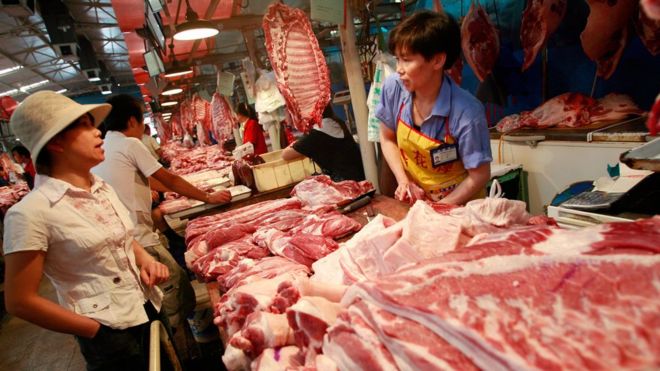
China is set to release pork supplies from its central reserves as it moves to tackle soaring prices and shortages caused by an outbreak of swine fever.
A state-backed body will auction 10,000 tonnes of frozen pork from its strategic reserves on Thursday.
China, the world’s biggest producer and consumer of pork, has struggled to control the spread of the disease.
In a bid to stabilise prices, a state-backed group that manages the pork reserves will auction imported frozen pork from countries including Denmark, France, the US and UK.
Only 300 tonnes will be sold to each bidder at the auction.
Pork is used widely in Chinese festivals, and the auction comes as the country prepares to celebrate a week-long national holiday for the 70th anniversary of the People’s Republic of China.
Julian Evans-Pritchard, senior China economist at Capital Economics, said the auction would provide slight relief to the industry but would not do much to contain prices.
“In itself, I don’t think it will be able to prevent pork prices from rising further unless they manage to get the disease under control,” he said.
Beijing created its strategic pork reserve in 2007 but the size of the stockpile is not known.
Capital Economics estimates that at most, the stockpile would hold four days’ worth of pork supplies to feed China.
About 1.2 million pigs have been culled in China in an effort to halt the spread of swine fever since August 2018, according to data from the Food and Agriculture Organization, a UN agency.
In April, Rabobank estimated Chinese pork production would fall by up to 35% this year due to swine fever.
The supply shortage has sent pork prices soaring and has eaten into household incomes.
That poses a fresh challenge for the Chinese economy, which is already facing a slowdown and a trade war between Beijing and Washington.
Chinese Premier Li Keqiang and his Russian counterpart Dmitry Medvedev jointly meet the press in St. Petersburg, Russia, Sept. 17, 2019. (Xinhua/Yin Bogu)
ST. PETERSBURG, Russia, Sept. 17 (Xinhua) — China and Russia should open up more to the world and to each other to achieve mutual benefit and common development, Chinese Premier Li Keqiang said here Tuesday.
Jointly meeting the press with Russian Prime Minister Dmitry Medvedev, Li said that as the two countries observe the 70th anniversary of their diplomatic ties this year, the sound and stable development of bilateral relations is in the interests of both sides and also conducive to human progress under current circumstances.
Describing bilateral pragmatic cooperation as comprehensive, broad and of high level, Li said while the two countries’ cooperation in traditional spheres like energy is making new breakthroughs, their cooperation in new areas like cross-border e-commerce and sci-tech innovation is also gaining steam.
He expressed hope that the two sides will actively explore deepening refining-petrochemical integration, and increase the added value of energy cooperation to help realize their goal of doubling bilateral trade on time.
Noting that both countries support multilateralism and free trade, Li said China is furthering opening up with its manufacturing sector fully open now. He invited Russian companies to seize the opportunity and invest in China.
Li also urged the two countries to tap their cooperation potential in sci-tech innovation as they have designated the years of 2020 and 2021 as “Year of Scientific and Technological Innovation” in each other’s country.
Medvedev said the two countries’ comprehensive strategic partnership of coordination has entered a new era, and the two sides are in close communication with pragmatic cooperation in various areas achieving new progress.
Earlier Tuesday, Li and Medvedev co-chaired the 24th regular meeting between Chinese and Russian heads of government.
Medvedev said that during the meeting, the two sides signed a slew of cooperation agreements in a wide range of areas. He pledged Russia’s willingness to work with China to expand their cooperation from traditional energy to high-tech to inject new vitality to their comprehensive strategic partnership of coordination for a new era.
ZHENGZHOU, Sept. 18 (Xinhua) — Xi Jinping, general secretary of the Communist Party of China Central Committee, urged the development of real economy bolstered by manufacturing, with self-reliance as the basis of all endeavors during his tour to central China’s Henan Province.
Xi also pointed out that although China has the largest manufacturing industry in the world, efforts are still needed in realizing industrial transformation and upgrade through innovation. He called for technical and industrial innovation to move China’s manufacturing up in the industry chain.
Chinese President Xi Jinping, also general secretary of the Communist Party of China Central Committee and chairman of the Central Military Commission, communicates with workers while inspecting Zhengzhou Coal Mining Machinery Group Co., Ltd. during his tour in Zhengzhou, central China’s Henan Province, Sept. 17, 2019. (Xinhua/Ju Peng)
ZHENGZHOU, Sept. 17 (Xinhua) — Xi Jinping, general secretary of the Communist Party of China Central Committee, inspected a manufacturing enterprise and ecological protection of the Yellow River during his tour in Zhengzhou, central China’s Henan Province on Tuesday afternoon.
Authorities investigating why passenger suddenly leapt to her feet and went through open door
The woman in yellow died after alighting from the moving bus in Fenggang county, Guizhou province, on Sunday. Photo: Weibo
Police in southern China are investigating the death of a woman who suddenly leapt from her seat and through the door of a moving bus on the weekend.
The unidentified woman was confirmed dead at hospital in Fenggang county, Guizhou province, on Sunday after alighting from the bus through the rear door which should have been closed, according to county police.
An officer from the county’s traffic police bureau told the South China Morning Post that an investigation into the woman’s action and the bus driver’s responsibility was under way.
Surveillance footage posted online shows the woman in a yellow top sitting near the open back door before suddenly getting up and rushing through the door.
The door then closes and the bus stops moments later as passengers appear shocked.
Chinese police do U-turn on traffic crash after online crowd doubt official account
The footage was shared widely online on Weibo, China’s Twitter-like platform.
Some internet users said the woman might have been dozing and awoke suddenly thinking she had missed her stop.
Others noted that the door should not have been open.
Just late last month, a woman was injured getting off a moving bus in Chongqing as the driver accidentally opened the rear door, video news app Kankanews.com reported.
The woman, in her 60s, simply stepped off as she saw the door open and thought she had arrived at her destination.
The driver said his safety belt loosened and he accidentally triggered the door button while trying to buckle up. He was held fully responsible for the passenger’s injury.
Video of staff washing tableware with laundry detergent goes viral
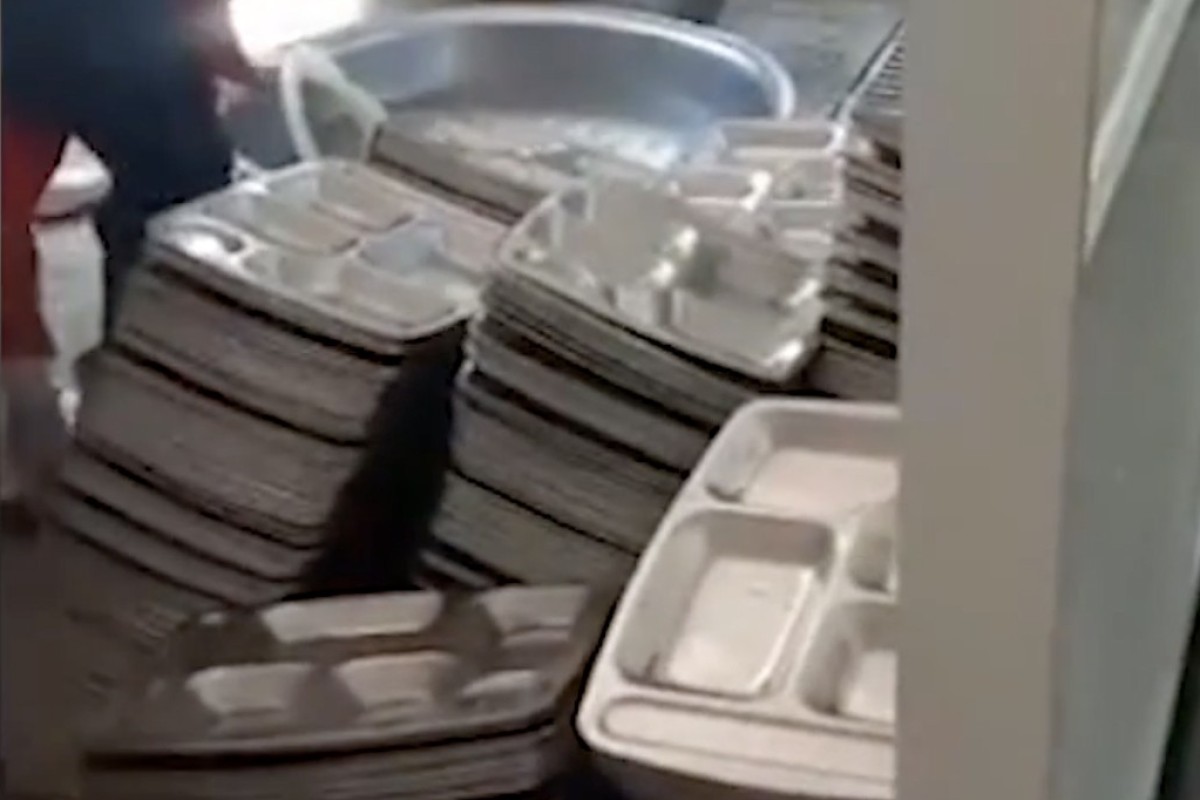
A primary school principal has been sacked after it emerged laundry detergent was used in the canteen to wash tableware. Photo: Thepaper.cn
The head of a primary school in northeastern China has been sacked and a government investigation is underway into the use of laundry washing powder to clean tableware in the school canteen.
The scandal came to light when a video of canteen staff washing up at Dongfeng Primary School in Zuanghe, Liaoning province, went viral on Chinese social media.
The video shows staff, wearing white uniforms and aprons, cleaning plates and bowls in basins containing water tainted with laundry detergent. It is unclear when the incident happened.
In a statement on Weibo, China’s version of Twitter, on Tuesday, the municipal government said the head of the school had been dismissed and representatives had been assigned by the authorities to take charge of the school’s daily operation. Due diligence investigations of the relevant department would begin “immediately”, the statement said.
Chinese school heads told to eat with pupils after string of scandals
The local administration for market regulation had also been ordered to speed up an examination of the food samples, tableware and washing products at the school, and the results would be made public in a timely manner, the authorities said.
Until the investigation is concluded, meals at the school, which has about 400 pupils, will be the responsibility of the municipal education department.
As an added precaution, food safety inspections would be carried out at all elementary and middle schools in the region.
The prompt action by the authorities reflects the wide public attention in China to any food safety scandal which involves children.
The principal of an international school in Shanghai was dismissed in October after parents of students found mouldy tomatoes and onions in a kitchen where food was prepared for pupils. In May, video footage showing mouldy food in the canteen of a middle school in Chengdu, Sichuan province, triggered angry parents to stage protests outside the school and the local government building.
Police investigation reveals animal had escaped from a nearby restaurant
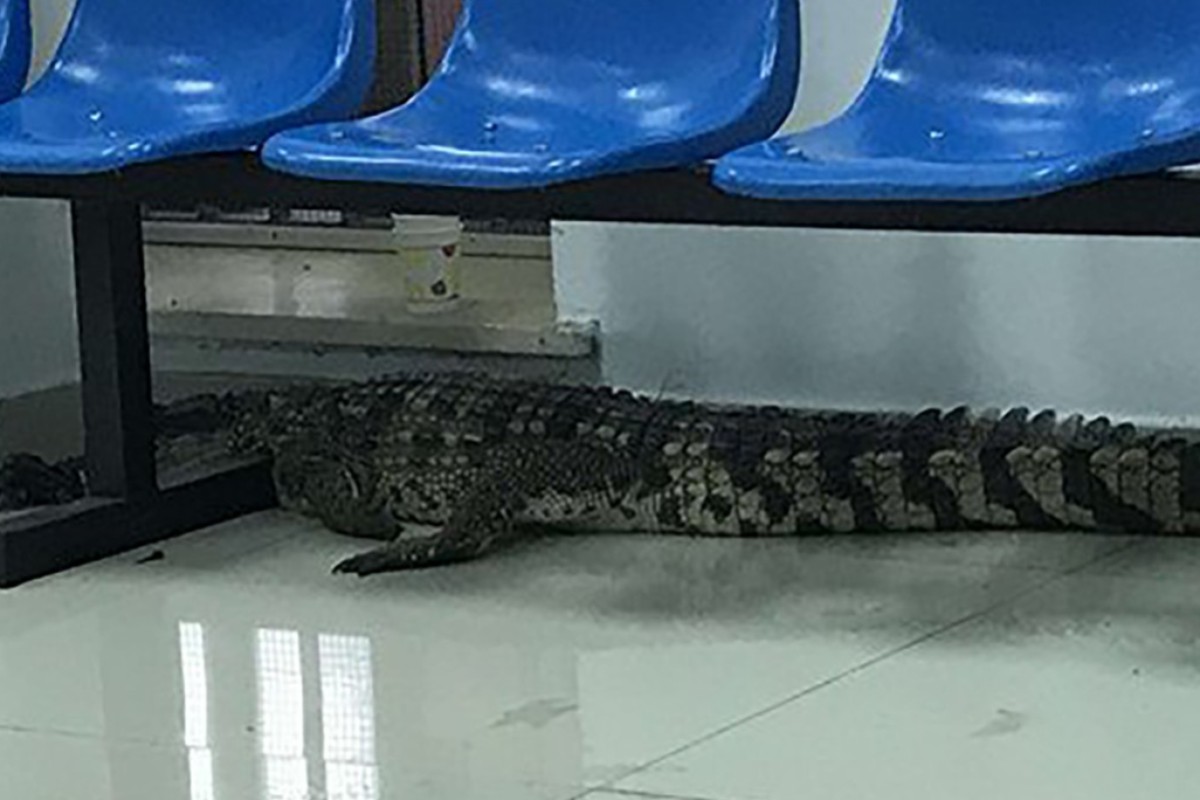
The escaped crocodile was captured by police officers and taken to the local station. Photo: Handout
A security guard at a beauty spot in eastern China was shocked to discover a 2-metre (6ft 6in) crocodile while on his rounds in the early hours of Monday morning.
The animal was lying motionless on a road at Xinlonghu Park in Changzhou, Jiangsu province, with its jaws tied by a strip of cloth, when it was spotted by the security guard, who immediately called the police, according to the Modern Express newspaper.
It took a number of officers to capture the crocodile and take it to the local police station, where an investigation revealed the animal had escaped from a nearby restaurant. The animal was returned and the restaurant owner was “criticised” by police, who urged that a close eye be kept on the animal, the report said.
“They bought it from a farm somewhere as a food material to attract customers. It has been killed for crocodile meat dishes,” an officer told the South China Morning Post on Wednesday.
Crocodiles were once vegetarians – but it was just a phase
Police said it was fortunate that the crocodile had been caught before it had entered the park’s lake or caused any danger to people.
It is unclear what species the crocodile belonged to but China permits the commercial breeding and use of the critically endangered Siamese crocodile, as well as saltwater and Nile crocodiles, which are listed as least concern species.
A staff member of the restaurant, called No. 1 Lakeside, told the Post stewed crocodile meat was on the menu for 168 yuan (US$23.60) a serving, while stewed crocodile claw was also available at 258 yuan.
Crocodile appears in ancient Chinese medicine books as a treatment for respiratory illnesses and the meat has long been regarded as a delicacy, especially in southern China, such as Guangdong province. Crocodile skin also remains a popular material for luxury handbags and other leather goods.
In June, another crocodile, measuring about 1.5 metres, was found in a road puddle during a heavy rain in Wuhan, in the central province of Hubei, where many restaurants have crocodile meat on their menus, the Chutian Metropolis Daily reported.
In that incident it took three officers to capture the animal which was sent to a wildlife centre where a physical check-up showed it had been bred in captivity, most likely for food.
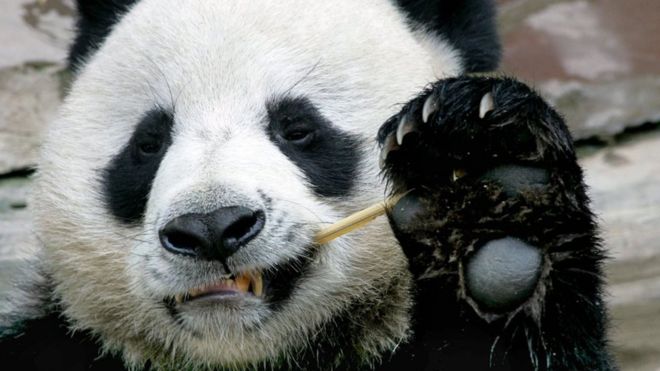
Image copyright AFPImage caption Chinese experts will investigate Chuang Chuang’s death
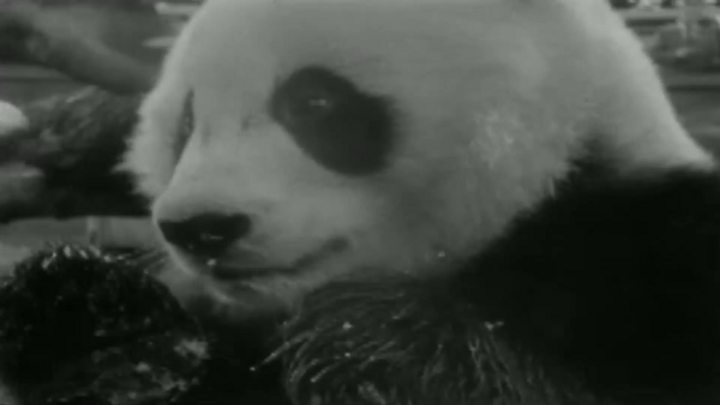
A popular giant panda has died unexpectedly in a Thai zoo – prompting China to send experts to investigate.
Chuang Chuang had been at the Chiang Mai zoo on loan from China since 2003.
The 19-year old bear was widely popular across Thailand, especially due to repeated efforts by the zoo to get him to mate with his female companion.
His unexplained death on Monday caused uproar on Chinese social media, with many users accusing Thailand of not caring properly for the animal.
Giant pandas, which are native to China, usually live for 25 to 30 years in captivity. They were regarded as endangered, but were reclassified as “vulnerable” by the International Union for Conservation of Nature, following an increase in numbers.
China loans the animals to countries around the world as a way of strengthening diplomatic ties.
There’s extensive reporting in China about the animals’ lives overseas, and Chuang Chuang’s early death has received widespread coverage in state media.
Media caption Panda diplomacy: China’s cutest peacemakers
According to Chinese news agency Xinhua, an investigation will be carried out to establish the cause of death, and experts from the China Conservation and Research Centre will travel to Chiang Mai to work with their Thai counterparts.
Some social media users on China’s Twitter-like platform Weibo were concerned, saying: “Thailand is not suitable for raising pandas”, and “they don’t treat animals as well as we think”.
Others asked for the remaining female panda in Chiang Mai, Lin Hui, to be returned to China.
Chuang Chuang had been at the Chiang Mai zoo since 2003, alongside his female companion.
Failing to show any sexual interest in Lin Hui, the zoo tried various methods to boost his sex drive, including putting him on a low-carb diet, and showing videos of mating pandas.
With all efforts failing, the zoo eventually resorted to artificial insemination and Lin Hui gave birth in 2009.






 CHINDIA ALERT: You'll be living in their world, very soon