Chindia Alert: You’ll be Living in their World Very Soon
aims to alert you to the threats and opportunities that China and India present. China and India require serious attention; case of ‘hidden dragon and crouching tiger’.
Without this attention, governments, businesses and, indeed, individuals may find themselves at a great disadvantage sooner rather than later.
The POSTs (front webpages) are mainly 'cuttings' from reliable sources, updated continuously.
The PAGEs (see Tabs, above) attempt to make the information more meaningful by putting some structure to the information we have researched and assembled since 2006.
BEIJING, Oct. 30 (Xinhua) — China on Wednesday urged countries including the United States and Britain to stop distorting facts on Xinjiang-related issues and make real and concrete efforts to support the healthy development of the international human rights cause.
Foreign Ministry spokesperson Geng Shuang made the remarks at a press briefing when he was asked to comment on what happened during the dialogue between the Third Committee of the United Nations General Assembly and the Committee on the Elimination of Racial Discrimination.
On Oct. 29, a few Western countries including the United States and Britain delivered a common speech during the dialogue, criticizing China’s Xinjiang policy, while more than 60 others countries also made common speeches supporting China’s position on Xinjiang, praising China’s great progress in human rights protection and opposing interference in China’s domestic affairs under the name of human rights.
“The anti-China show put on by a handful of Western countries was a disgraceful failure,” Geng said.
He said the vocational and educational training institutions in Xinjiang were set up as preventive measures to combat terrorism and radicalization, which have turned the security situation around.
For three years, not a single violent or terrorist incident has taken place in Xinjiang, and the region now enjoys social stability and unity among all ethnic groups, said Geng, adding that people there are now living a happy life with a stronger sense of fulfillment and security, while their rights to life, health and development are also significantly improved.
“We urge countries like the United States and Britain to stop calling white black and standing on the opposite of facts,” Geng said.
Geng noted that in March this year, the 46th session of the Council of Foreign Ministers of the Organization of Islamic Cooperation (OIC) adopted a resolution, which spoke highly of and fully recognized the efforts China has made for Chinese Muslims.
In July, ambassadors from more than 50 countries to the UN office at Geneva co-signed a letter to the president of the UN Human Rights Council and High Commissioner for Human Rights, praising China for its respect and protection of human rights in fighting terrorism and deradicalization.
“These events fully indicated to us what is the overwhelming opinion of the international society. Tarnishing China will not get support and is completely futile,” Geng said.
As countries like the United States and Britain have disgraceful human rights records, they have no right to judge other countries and should seriously reflect on themselves, said Geng, adding that China urges those countries to stop politicizing and using double standards on human rights issues, and stop interfering in other countries’ domestic affairs under the pretext of human rights.
Chinese State Councilor and Foreign Minister Wang Yi (R) meets with former Ethiopian President Mulatu Teshome, who visits China as special envoy of Ethiopian Prime Minister Abiy Ahemd, in Beijing, capital of China, Oct. 30, 2019. (Xinhua/Yue Yuewei)
BEIJING, Oct. 30 (Xinhua) — State Councilor and Foreign Minister Wang Yi met with former Ethiopian President Mulatu Teshome and outgoing Cuban Ambassador to China Miguel Angel Ramirez Ramos on two separate occasions Wednesday.
When meeting with Teshome, who was visiting China as a special envoy of Ethiopian Prime Minister Abiy Ahmed, Wang said the two sides should enhance mutual political trust, firmly support each other on issues involving respective core interests.
To expand pragmatical cooperation, China will encourage more Chinese companies to invest in Ethiopia and advance cooperation in infrastructure construction, while stepping up coordination on regional and global issues and jointly safeguarding the interests of developing countries, said Wang.
The Ethiopian guest expected to cement exchanges with China on governance, and strengthen cooperation and coordination.
When meeting with the outgoing Cuban ambassador, Wang said as next year marks the 60th anniversary of bilateral diplomatic ties, the two sides should enhance high-level visits and exchanges at all levels and lift cooperation to new heights.
Wang also expressed China’s support for the Communist Party of Cuba and the Cuban government, saying China will continue to support Cuba in following the path of socialism, support its struggle to safeguard its integrity and national dignity, and fight against hegemonism.
Ramirez expressed appreciation of China’s support, saying the Cuban side will seize the opportunity of the upcoming 60th anniversary of bilateral diplomatic ties to advance cooperation.
Liang Yanshun (2nd L), deputy head of the Publicity Department of the Communist Party of China Central Committee, presents books to Sao Paulo State Governor Joao Doria (2nd R) during the release ceremony held at Palacio dos Bandeirantes, the seat of the state government, in Sao Paulo, Brazil, Oct. 29, 2019. The Brazilian editions of the first and second volumes of “Xi Jinping: The Governance of China” in Portuguese were released here Tuesday, prior to the 11th BRICS summit to be held next month in Brazil. (Xinhua/Gao Chunyu)
SAO PAULO, Oct. 29 (Xinhua) — The Brazilian editions of the first and second volumes of “Xi Jinping: The Governance of China” in Portuguese were released here Tuesday, prior to the 11th BRICS summit to be held next month in Brasilia.
More than 260 guests, including Liang Yanshun, deputy head of the Publicity Department of the Communist Party of China Central Committee, Chinese Consul General in Sao Paulo Chen Peijie and Sao Paulo State Governor Joao Doria, attended the release ceremony held in Palacio dos Bandeirantes, the seat of the state government.
In his address, Liang said the book reflects the evolution and main points of Xi Jinping Thought on Socialism with Chinese Characteristics for a New Era, expounded on China’s path of development and its solutions to some of the common challenges facing mankind.
The publication of the book will inject new vitality into the China-Brazil efforts to strengthen exchanges on governance and chart a new course for bilateral ties, Liang added.
The book also talks about China’s approaches to keeping world peace and promoting human development, said Chen, adding that it will help Brazilian readers better understand China’s ideas and stances regarding international affairs as well as its diplomatic policies and practices.
For his part, Doria said that he felt honored that the release event was held in Sao Paulo.
Noting that China has set an example in national governance and economic development, the governor suggested Brazilians study the book, so as to draw inspiration from China’s experiences in facing various challenges.
The event was jointly held by the Chinese State Council Information Office, the Chinese Embassy in Brazil, China International Publishing Group and the Chinese Consulate General in Sao Paulo.
The deaths of three airmen in a helicopter crash and a second accident days later point to problems with training and equipment
The crashes happened within a span of 10 days, amid an increased number of intensive drills
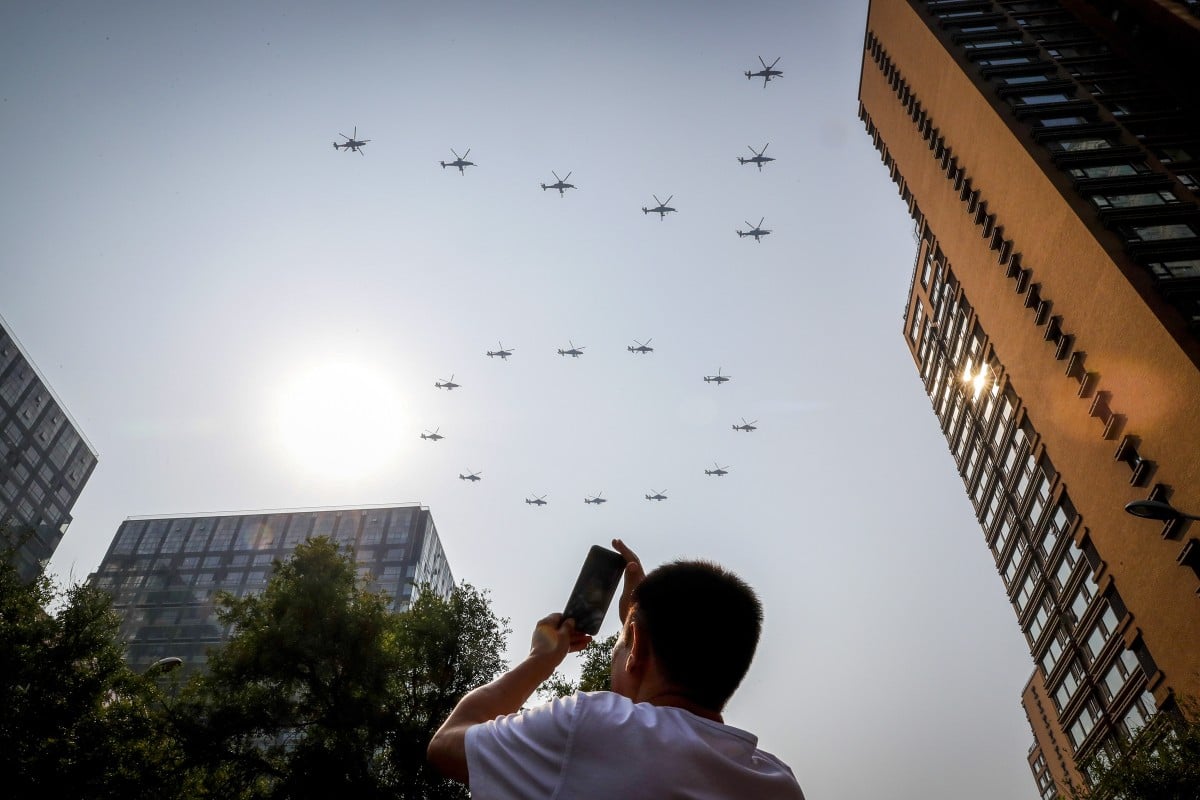
Chinese military helicopters form the number 70 as part of the National Day parade in Beijing. Photo: AP
Engine flaws and a lack of training have been identified as the likely causes of two accidents that hit the Chinese air force in the space of little over a week – one of which claimed the lives of three airmen.
Deaths from the crashes, which happened within a span of 10 days, included a helicopter pilot who took part in the National Day grand parade at the start of the month.
A number of military sources said that as the air force stepped up its exercises – part of President Xi Jinping’s call to strengthen the “combat readiness” of the military – more accidents would happen as increased drills exposed technical problems and inadequate training.
“[If these problems are not resolved], it is foreseeable that more accidents will happen because the top brass is pushing for more drills and exercises across the military,” said one source close to the air force.
The fatal accident happened about three weeks ago in central Henan province, when a transport helicopter crashed, killing all three people on board.
Gong Dachuan, 33, was one of the airmen killed in the crash. Photo: Handout
Local television reports named pilot Gong Dachuan, 33, and 37-year-old engineer Wen Weibin, as two of this killed in the crash. The third victim was later named as Luo Wei, from Luzhou in Sichuan, by an online mourning website.
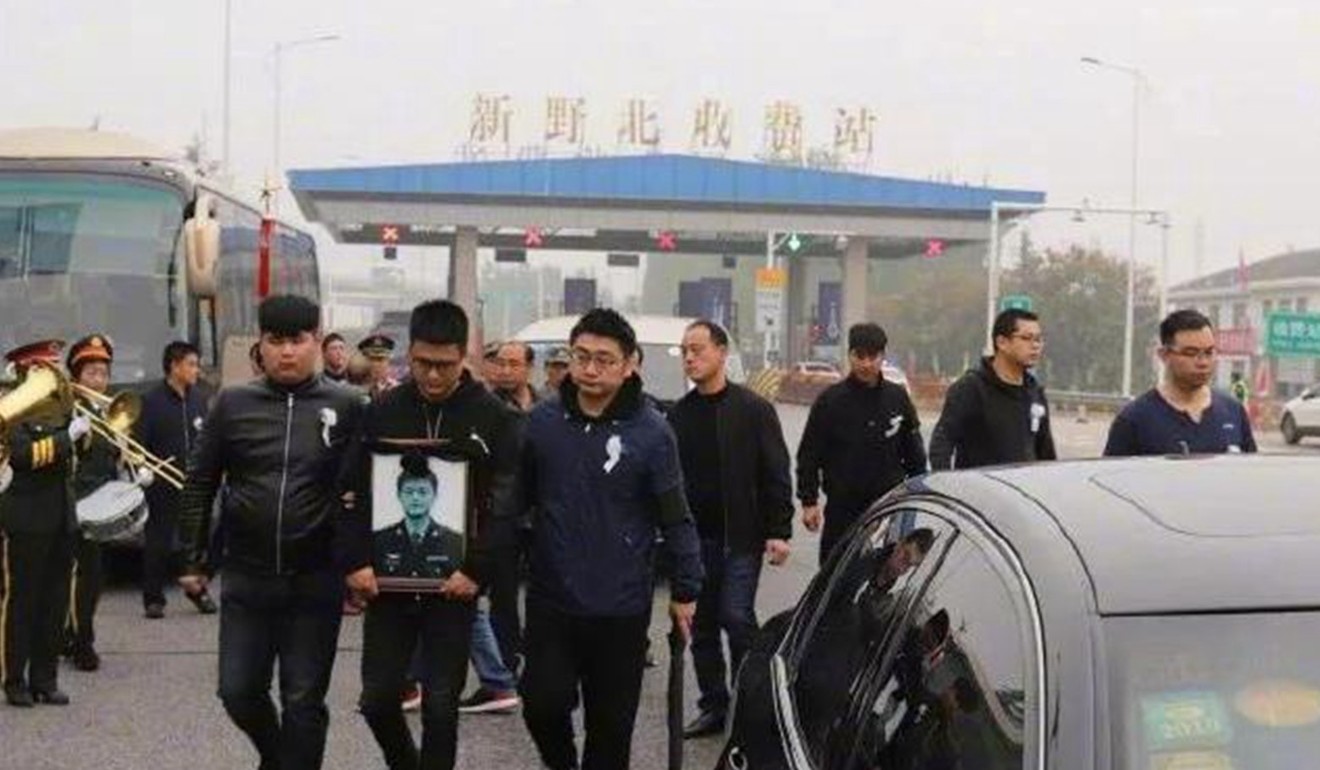
A memorial for Gong was held by the local government in Xinye County last Tuesday.
“The three people were conducting some tests on the helicopter,” said a local source who declined to disclose where the crash happened and the nature of the test.
Xinye county government in Henan province held a memorial to honour the dead pilot. Photo: Handout
Media reports said that Gong had flown in this year’s National Day parade in Beijing, while Wen had been decorated for his participation in the 2015 parade in Beijing to mark the 70th anniversary of victory over Japan in World War II.
The three dead airmen have been designated as martyrs, the reports added.
The second accident happened eight days later on the Tibetan Plateau where a J-10 fighter jet on a low-altitude flying drill crashed into the mountain.
“Fortunately, the pilot ejected safely in time, but the J-10 crashed into the mountain,” said an informed source, who requested anonymity since no official announcement about the accident has been made.
“Preliminary investigations indicated that the accident had something to with the Russian-made AL-31 engine on board the J-10,” the source said.
Military analysts said the air force needs to improve the durability of its aircraft and training for pilots.
Hong Kong-based military expert Song Zhongping suggested that problems with engines and flight control systems were also key reasons behind some of the fatal crashes.
Wen Weibin, 37, also died in the crash. Photo: Handout
Two J-15 fighter jets crashed in April 2016, resulting in one death and one serious injury. Investigations into the two crashes pointed to problems with the flight control system.
A source from the Chinese air force said that, unlike their American counterparts, PLA pilots generally lack training in avionics engineering and had little flying experience before enlistment.
“PLA pilots may be strong and courageous, and they are motivated to make sacrifices,” the air force source said. “But they don’t have as much experience as American pilots – many of [whom] have a lot of experience in flying civilian aircraft before they join the air force.”
Negotiations going ‘as planned’, foreign ministry says after cancellation of Apec summit at which presidents were set to meet to sign ‘phase-one’ agreement
With an election looming and possible impeachment inquiry, Trump in more of a hurry to reach a deal than Xi, observers say
Talks between China and the US are going well, according to the Chinese foreign ministry. Photo: AFP
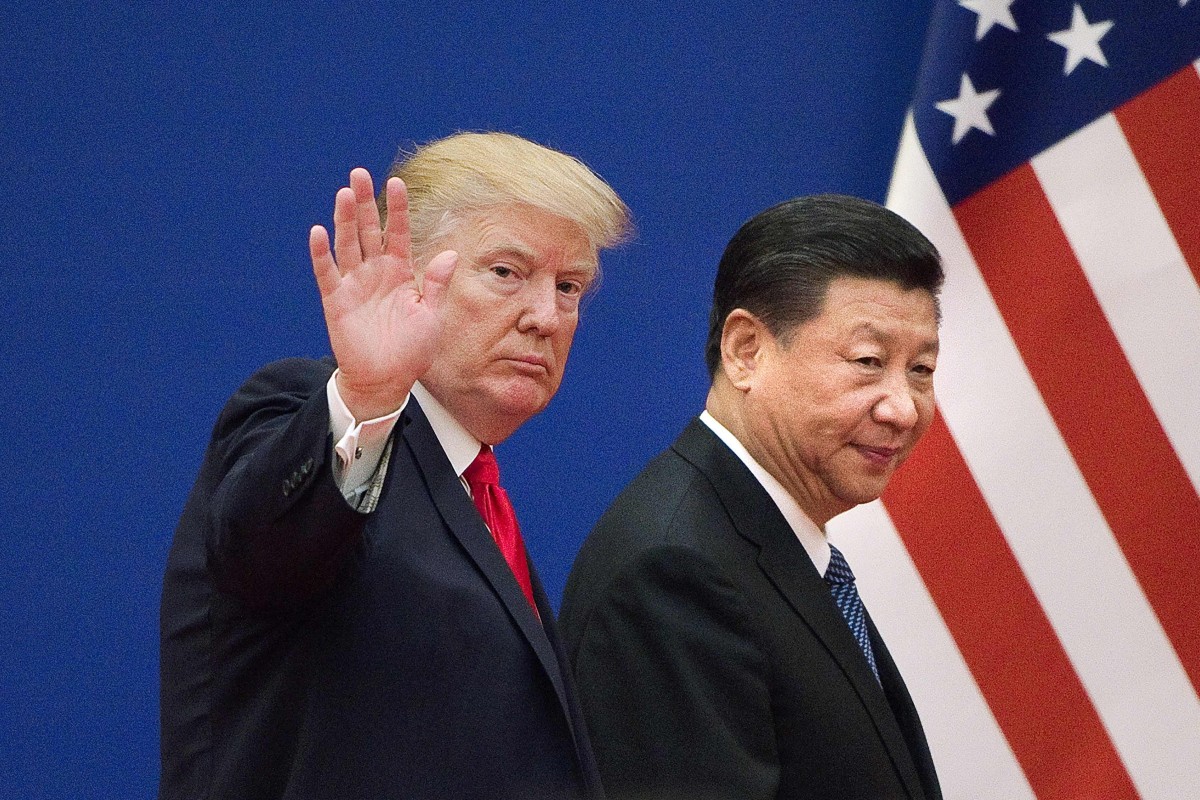
Presidents Xi Jinping and Donald Trump have “maintained contact”, China’s foreign ministry said on Thursday after authorities in Chile announced the cancellation of the upcoming Apec summit at which the US and Chinese leaders were set to meet and possibly sign a trade deal.
Talks between the two nations were going well, ministry spokesman Geng Shuang told a daily press briefing.
“The negotiations are smooth and things are working out as planned,” he said.
“Regarding the meeting between the two state leaders, they have maintained contact through various means.”
Geng’s comments came after China’s commerce ministry said that top trade negotiators from the two countries would hold a telephone conversation on Friday.
Xi and Trump were due to meet on the sidelines of the Asia-Pacific Economic Cooperation summit in Santiago on November 16-17, but the event was cancelled due to the ongoing protests in the country. The leaders were also expected to sign an interim trade deal based on the ground made at the latest negotiations in Washington on October 11.
According to diplomatic observers, while Beijing wants a truce in the trade dispute it is in less of a hurry than Trump, who is facing the threat of impeachment and trying to prepare for an election campaign.
Shen Dingli, an expert in international relations based in Shanghai, said that China faced less domestic opposition to its handling of the trade talks than Washington.
“Trump is facing a lot of problems on both the diplomatic and domestic fronts,” he said. “[But] I think both sides still need an agreement. It is always better to have an agreement than not.”
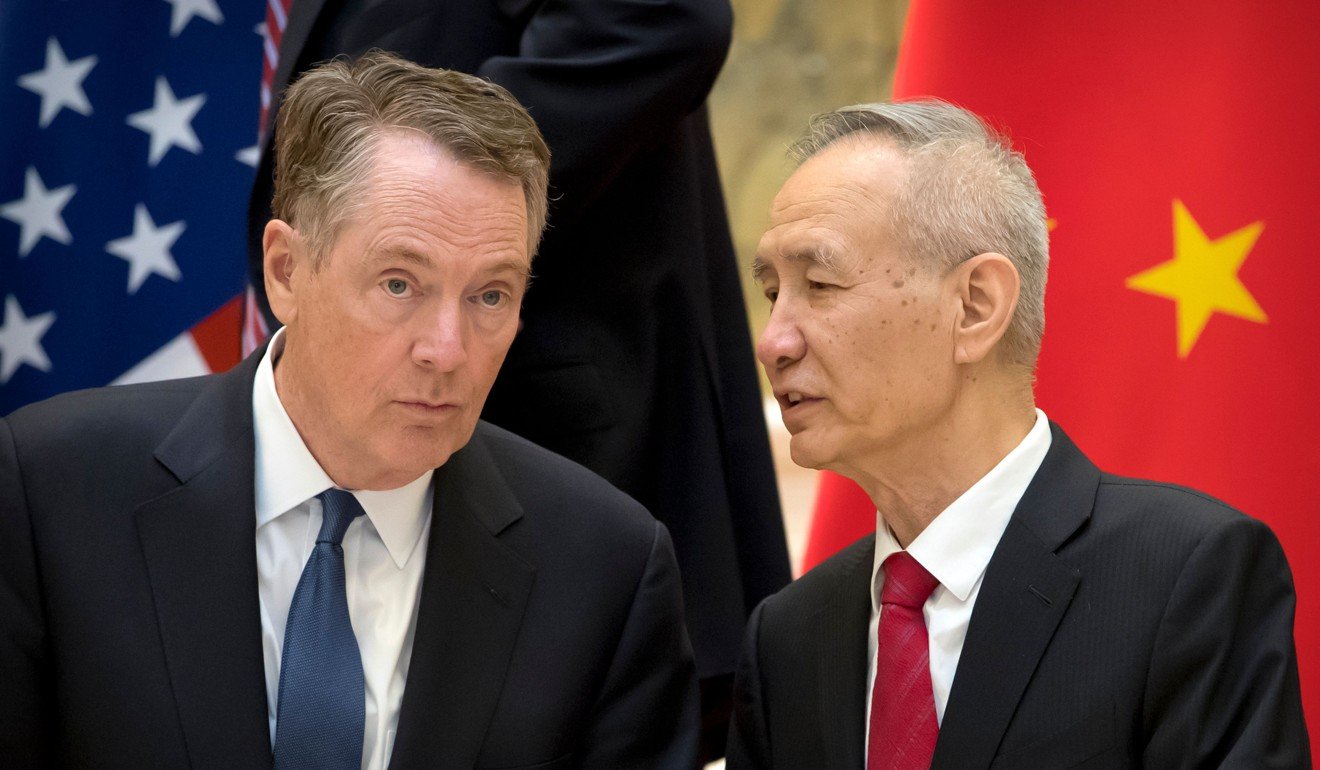
US Trade Representative Robert Lighthizer (left) and Chinese Vice-Premier Liu He met in Washington early this month. Photo: AFP
Yuan Zheng, an expert on China-US relations at the Chinese Academy of Social Sciences, said that while the Apec summit had offered a convenient way for the presidents to meet, the substance of the deal was more important than where it might be signed.
“It’s true that the deal can be signed by representatives instead of the presidents but this depends very much on how keen Trump is for the presidential meeting to happen,” he said.
“He is facing an election and huge domestic pressure, so he … needs to show his strong leadership more than Xi. But of course, if the deal is set and if the details of the meeting are practical, the Chinese side would like a presidential meeting too.”
Shen Dingli, an expert in international relations, says China faces less domestic opposition to its handling of the trade talks than Washington. Photo: AP
Speaking after the talks in Washington between Chinese Vice-Premier Liu He, US Trade Representative Robert Lighthizer and US Treasury Secretary Steven Mnuchin, Trump said the two sides had reached a “substantial phase one deal” and that after it had been put down on paper it would be signed at the Apec meeting.
Tai Hui, chief market strategist for Asia at JPMorgan Asset Management, said the cancellation of the Chile summit should not stop the US and China agreeing a truce.
“If the two sides are genuinely willing to reach an interim deal before mid-December, when the next increase in tariffs on Chinese goods is due to take place, they will find a venue to get it done,” he said.
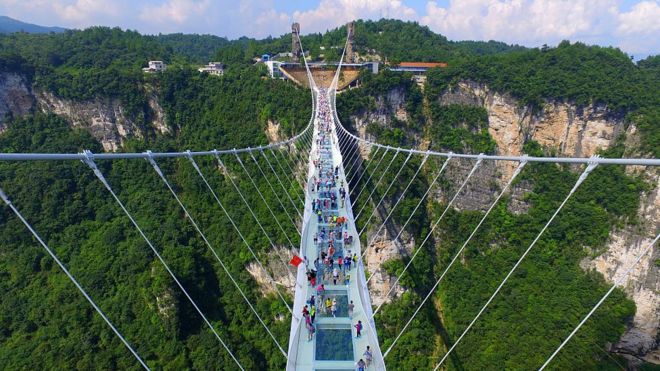
The Zhangjiajie bridge in Hunan province – which was the highest and longest glass-bottomed bridge in the world when it opened in 2016 – arguably kicked off the craze.
But earlier this year, one tourist died and six others were injured after they fell off a glass slide in Guangxi province.
Rain had made the glass extra slippery, causing the man to crash through the guardrail, and fly off the slide. He died from severe head injuries.
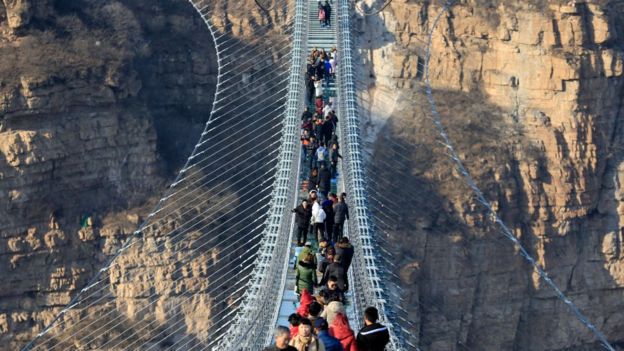
The Hongyagu glass bridge – which until May this year held the title of world’s longest glass bridge – was among those shut in Hebei province.
Image copyright GETTY IMAGESImage caption The Hongyagu bridge in Hebei province
The closures have not just affected Hebei province – across the country, a number have been shut.
Earlier this year, the government called for local tourism authorities to carry out “comprehensive safety assessments” of glass bridge projects.
On social media site Weibo, many applauded the closures, with one saying it was “about time safety was addressed”.
Others criticised the sheer number of glass bridges built over the past few years.
Media caption Thousands wobble over the world’s longest glass bridge in Hebei province, China
“I don’t really understand why there are so many glass bridges recently. It’s a waste of money,” said one commenter.
The death in Guangxi province was not the only glass attraction fatality. In 2017, a tourist died after an accident on a glass slide in Hubei.
And in 2016, someone was injured after being hit by falling rocks while walking on a glass walkway in the city of Zhangjiajie.
In 2015, a glass skywalk in Henan province cracked despite being open for only two weeks, sending tourists fleeing.
India has formally divided the state of Jammu and Kashmir into two new federally-administered territories.
In the new arrangement, Jammu and Kashmir is one territory, and Ladakh, which borders China, is separate.
The two new union territories are now ruled directly from the capital Delhi.
It’s part of a controversial move announced in August to tighten the Indian government’s control over the part of Kashmir it administers.
R K Mathur and Girish Chandra Murmu were sworn in as lieutenant governors of Ladakh and Jammu and Kashmir respectively on Thursday.
“Now the real participation of co-operative federalism will be seen. New highways, new railway lines, new schools, new hospitals will take the development of the people of Jammu and Kashmir to new heights,” Prime Minister Narendra Modi said at a public rally in the western state of Gujarat.
Union territories have far less autonomy from the federal government than states do.
The former state has long been one of the world’s most dangerous flashpoints and is a highly militarised area.
India and Pakistan both claim Kashmir in full, but control only parts of it.
How does this affect the people there?
Almost 98% of the state’s population will be in the union territory of Jammu and Kashmir, comprising two regions – the Muslim-majority Kashmir valley, which has about eight million people, and the Hindu-majority Jammu, which has about six million.
The third region, the newly created union territory of Ladakh, is a high-altitude desert inhabited by 300,000 people, with almost equal numbers of Muslims and Buddhists.
Workers from the previous state government will continue to retain their jobs in the new territories, the government said.
What’s the background?
On 5 August, the government revoked Kashmir’s special status, sparking protests in the Muslim-majority valley.
Article 370, as the constitutional provision guaranteeing special status was known, allowed the region a certain amount of autonomy, including special privileges in property ownership, education and jobs. This provision had underpinned India’s often fraught relationship with Kashmir.
Before the Bharatiya Janata Party-led government announced its decision to scrap the special status, it put the region under lockdown – mobile phone networks, landlines and the internet were cut off; and regional political leaders were placed under house arrest.
Media caption The children being ‘tortured’ in Kashmir
The region also witnessed protests where security forces often clashed with civilians. Thousands of activists and others were believed to have been picked up from their homes in the days that followed the surprise move.
Almost three months later, the situation is still far from normal.
On Tuesday, militants killed five migrant labourers in Kulgam district. Just a day before, a truck driver from outside the region was killed in Anantnag district.
Earlier this month, the Indian government restored mobile services 72 days after they were suspended.
But internet services continue to be suspended and most businesses remain closed – some in protest against the government, and others for fear of reprisals from militants opposed to Indian rule.
Chinese Premier Li Keqiang meets with South African Deputy President David Mabuza at the Great Hall of the People in Beijing, capital of China, Oct. 29, 2019. (Xinhua/Ding Haitao)
BEIJING, Oct. 29 (Xinhua) — Chinese Premier Li Keqiang met with South African Deputy President David Mabuza Tuesday in Beijing, calling on the two sides to promote bilateral relations for new development.
Noting that South Africa is an important African country, Li said the continued development of bilateral relations is beneficial to China-Africa cooperation.
China is ready to work with South Africa to consolidate mutual political trust and promote practical cooperation and people-to-people exchanges to push for new development in bilateral relations, he said.
“Both China and South Africa are developing countries and have broad common interests,” said Li, adding that China stands ready to work with South Africa to closely communicate and coordinate in international and regional affairs and enhance cooperation in multilateral mechanisms such as the UN and BRICS, to jointly safeguard developing countries’ interests and maintain regional and world peace.
Mabuza, who is on an official visit to China and will co-chair the seventh plenary session of the China-South Africa Bi-National Commission with his Chinese counterpart, offered his congratulations for the 70th anniversary of the founding of the People’s Republic of China.
He thanked China for its long-standing support for South Africa and African countries’ development and conveyed his admiration for China’s great development achievements.
Mabuza said his country is willing to learn from China’s development experience, deepen practical cooperation across the board with China and push bilateral relations to reach a new level.
Black market imports from China, confusing regulations and pollution concerns are undermining India’s fireworks industry
Industry sources say Diwali sales this year were down by 30 per cent
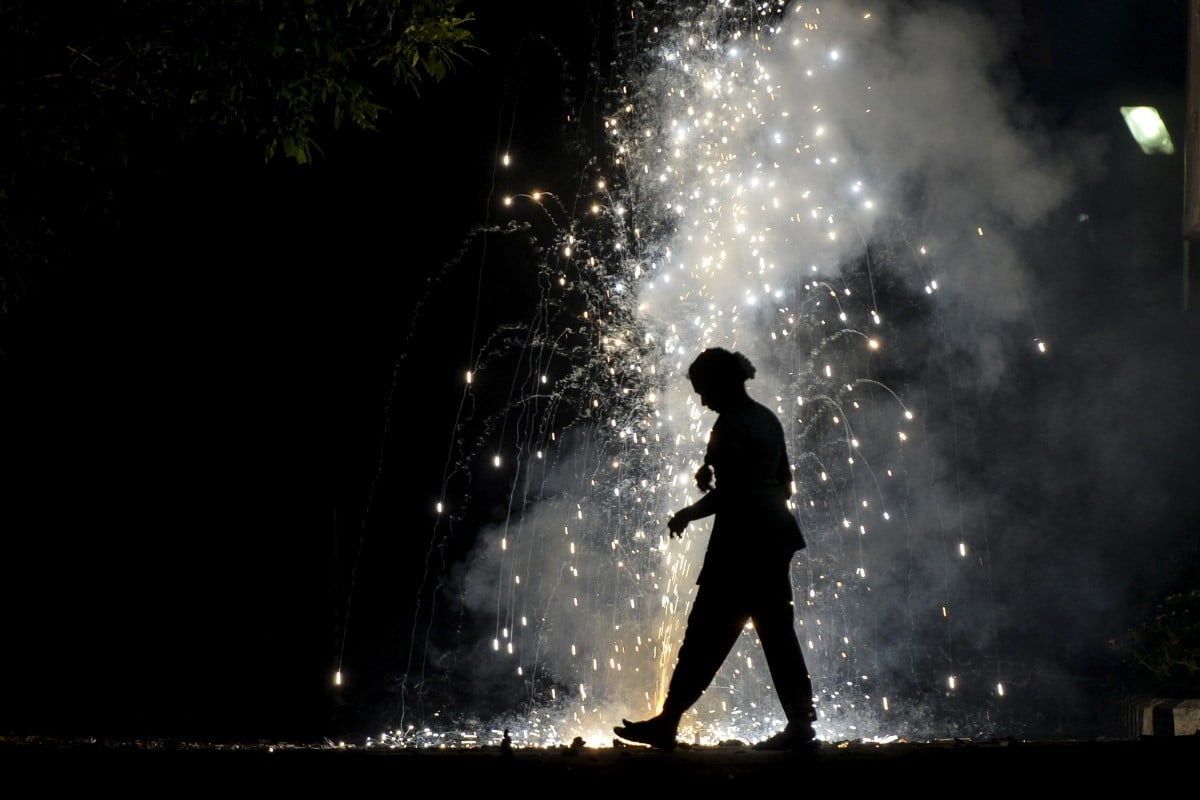
A woman is silhouetted by lit firecrackers during Diwali celebrations in Chennai. Photo: AFP
Arumugam Chinnaswamy set up his makeshift booth selling firecrackers in a Chennai neighbourhood a week ahead of Diwali, the Hindu festival of lights, with great expectations of doing a brisk trade.
Yet a week later, he has been forced to pack up more than half his stock in the hope he’ll have better luck next year.
“Four years ago, I sold firecrackers worth 800,000 rupees (US$11,288) on the eve of Diwali alone. This year, the sales have not even been a quarter of that,” said Chinnaswamy, 65, painting a grim picture that will be recognised by many in the Indian fireworks industry.
Chinnaswamy buys his firecrackers in Sivakasi, an industrial town in the southern Indian state of Tamil Nadu that produces more than 90 per cent of the country’s fireworks.
Sivakasi’s dry climate has helped to make it the firework capital of India and many production facilities in the town have been in the business for close to a century. For the most part, the industry has resisted mechanisation and still deals in handmade products. Its 1,100-plus manufacturing units provide jobs for 800,000 mostly uneducated workers and its diligent labour force have earned the town the nickname of ‘Little Japan’.
A worker lays firecrackers in an outdoor yard at a manufacturing unit involved in the production of firecrackers ahead of the Hindu festival of Diwali, in Sivakasi. Photo: AFP
But this reputation is under threat, struggling under the weight of an anti-pollution campaign, regulatory uncertainty and the arrival of cheap black-market Chinese imports. Irregular monsoons and a slowdown-induced cash crunch have not helped matters either.
Industry figures estimate the Diwali sales of India’s 80 billion-rupee firecracker industry took a 30 per cent drop this year.
A TOXIC PROBLEM
With pollution in Indian cities among the worst in the world, the government has come under pressure to do something about the nation’s toxic air – a problem that becomes more acute during Diwali due to the toxic fumes emitted when celebratory fireworks are set off. This Diwali, for instance, many areas in New Delhi recorded an Air Quality Index (AQI) of 999, the highest possible reading (the recommended limit is 60).
That makes the fireworks industry seem like an easy target when it comes to meeting government air quality targets.
Trouble began brewing in October last year when the Supreme Court banned the manufacture of traditional fireworks containing barium nitrate, a chief polluter. That decision put a rocket under the industry, as barium nitrate is cheap and is used in about 75 per cent of all firecrackers in India.
Factories in Sivakasi responded with a four-month shutdown protest that decimated annual production levels by up to a third.
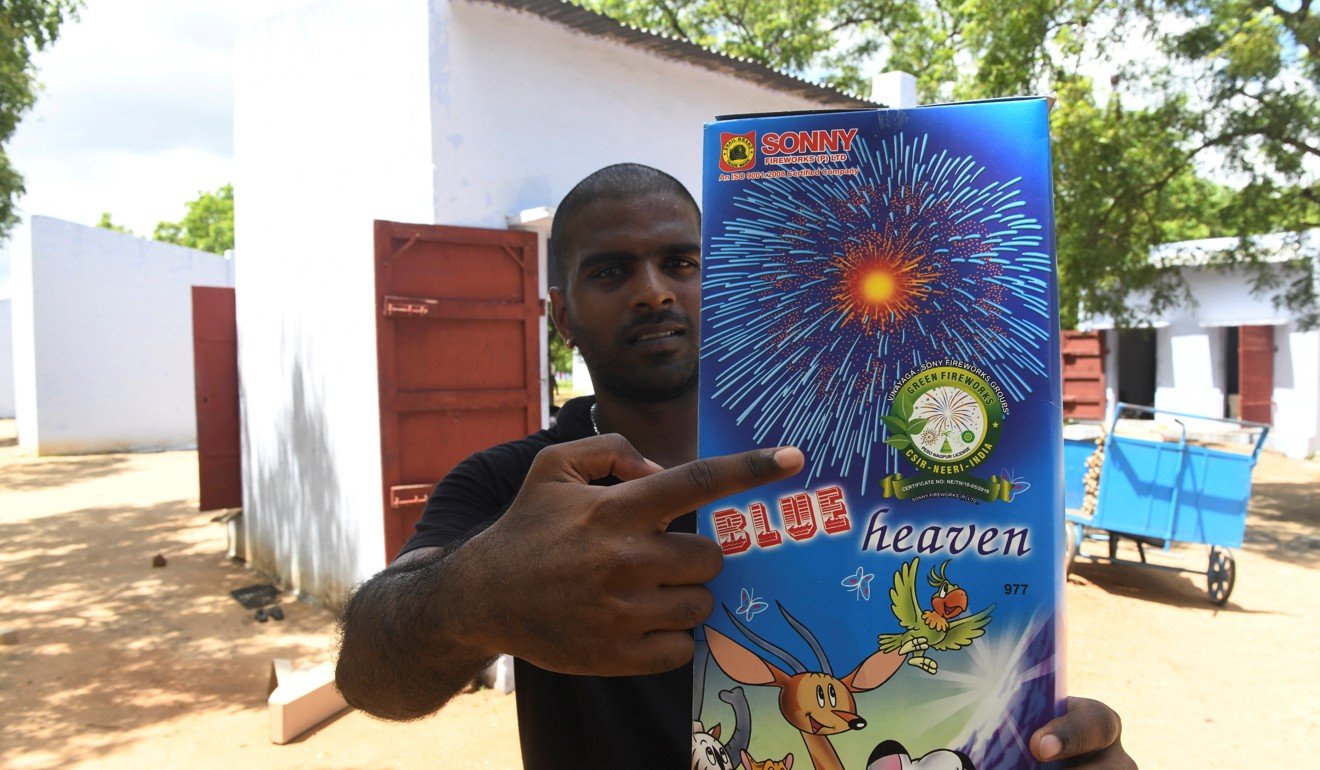
A seal denotes environment friendly ‘Green Fireworks’ at a manufacturing unit in Sivakasi. Photo: AFP
Apparently realising it had overstepped the mark – and that enforcing the Supreme Court regulations would be next to impossible – the government stepped in to rescue the industry, offering its assistance in the manufacture of environment-friendly crackers containing fewer pollutants, but it was too little, too late.
“The Supreme Court verdict was simply Delhi-centric with the vague idea of [cracking down on] urban pollution. It lacked any on-the-ground knowledge of the fireworks industry,” said Tamil Selvan, president of the Indian Fireworks Association, which represents more than 200 medium and large manufacturers.
Singapore travellers give Hong Kong a miss over Diwali long weekend
“Fireworks are low-hanging fruit for the anti-pollution drive as the industry is unorganised. Could the government or judiciary place a similar blanket ban on more pollution-causing industries like automobiles, plastics or tobacco?” asked Selvan.
CHINESE COMPETITION
The industry has also been hit by a flood of cheap Chinese firecrackers that are smuggled into the country on the black market.
In September, the country’s federal anti-smuggling agency, the Directorate of Revenue Intelligence, cautioned various government departments that huge quantities of Chinese-produced firecrackers had reached Indian soil in the lead up to Diwali.
But industry sources complain they have seen little action from the government to combat the problem.
An advert for firecrackers ahead of the Hindu festival of Diwali, in Sivakasi. Photo: AFP
Legally, Indian manufacturers can neither import nor export firecrackers. The Indian firecracker industry is the second-largest in the world after China’s.
Raja Chandrashekar, chief of the Federation of Tamil Nadu Fireworks Traders, a lobbying body, said low-end Indian-manufactured firecrackers such as roll caps and dot caps – popular among children – had struggled to compete with Chinese-made pop pops and throw bombs.
“Despite our repeated complaints to government bodies, Chinese firecrackers find a way into India, particularly in the northern parts. This is severely affecting our business,” said Chandrashekar.
While more Chinese fireworks might be entering India, the effect has been to undermine the industry, resulting in fewer sales overall.
FIZZLING OUT?
The Sivakasi fireworks industry faces other problems, too. Not least among these is the use of child labour, which had been rampant until a government crackdown a few years ago, and the practice of some factories to operate without proper licences and with questionable safety standards.
But despite the darker aspects of the industry, its role goes beyond merely helping Diwali celebrations go with a bang every year.
India is crazy about gold. But can the love last as prices skyrocket?
“The livelihoods of over five million people who are indirectly involved in the business, in areas such as trade and transport, depend on the survival of the industry,” said Chandrashekar.
That survival looks increasingly in question. Dull sales of fireworks have been reported in major cities including New Delhi, Mumbai, Bangalore and Hyderabad, though exact numbers can be hard to come by due to the unregulated nature of the industry and unreliable numbers shared by manufacturers.
So great has the resultant outcry been that some cynics even wonder whether the industry is struggling as much as it claims or whether it is part of a ploy by manufacturers to gain more government concessions and avoid any further crackdown.
“These firecracker manufacturers lie through their teeth about the Diwali sales for self-serving motives such as tax avoidance. The overall business is healthy,” said Vijay Kumar, editor of the Sivakasi-based monthly magazine Pyro India News.
“Though there was a 30-40 per cent shortage in annual production, all the manufactured products have been sold this year. No large stockpile is left with any manufacturer.”
Customers buy firecrackers on the eve of the Hindu festival of Diwali in Amritsar. Photo: AFP
Still, regardless of the manufacturers’ motives, the result of the industry’s struggles has been that street sellers like Chinnaswamy have fewer fireworks to sell – and they are struggling even to sell those.
Chinnaswamy says people are confused about the government’s anti-pollution drive and about what firecrackers are now legal and this has discouraged them from buying. Despite the government’s effort to promote “green crackers” he says these are too hard to come by to be a ready solution, at least for this year.
“There was no clarity on what type of firecrackers, whether green crackers or otherwise, can be set off and at what time of the day. Many consumers even asked me whether or not the conventional firecrackers are totally banned while there was much misinformation floating about on social media,” said Chinnaswamy.
Shaking his head, all he can do is hope that next year his Diwali goes with more of a bang.
BEIJING, Oct. 28 (Xinhua) — Premier Li Keqiang’s upcoming trip to Uzbekistan and Thailand is of great importance to cementing cooperation among both SCO members and East Asian states, as well as solidifying Chinese relations with Uzbekistan and Thailand, senior officials said at a press briefing Monday.
Premier Li is scheduled to attend the 18th meeting of the Council of Heads of Government (Prime Ministers) of the Shanghai Cooperation Organization (SCO) in the Uzbek capital Tashkent, pay an official visit to Uzbekistan, and attend the 22nd China-ASEAN (10+1) leaders’ meeting, the 22nd ASEAN-China, Japan and Republic of Korea (10+3) leaders’ meeting and the 14th East Asia Summit (EAS) in the Thai capital Bangkok before paying an official visit to Thailand, from Nov. 1 to 5.
During the SCO heads of government meeting, Li will explain Xi Jinping Thought on Socialism with Chinese Characteristics for a New Era and share the successful construction experience of the People’s Republic of China in the past 70 years, according to Assistant Foreign Minister Chen Xiaodong.
“Li will exchange in-depth views with the leaders of the participating countries on enhancing solidarity and mutual trust among member states, building the Belt and Road Initiative and cooperation in such fields as economy and trade, industrial capacity, connectivity, finance, investment and people-to-people exchanges,” Chen said.
Noting it will be Li’s first official visit to Uzbekistan, Chen said the premier will exchange views with the Uzbek side on implementing the important consensus of the two heads of state, promoting the development of bilateral relations and international and regional issues of common concern. The two sides will sign a series of cooperation agreements covering economy and trade, investment, science and technology, customs and other fields.
Regarding the East Asian leaders’ meeting on cooperation, Chen said the premier will expound on China’s policy proposals for East Asian cooperation and propose more than 20 new initiatives for deepening cooperation under various mechanisms.
The East Asian leaders’ meeting this year will strengthen consensus, deepen cooperation, improve regional economic integration, promote regional common prosperity and development, and send out a positive signal of adhering to multilateralism and free trade, building an open world economy, according to Assistant Minister of Commerce Li Chenggang.
Calling Thailand a traditional friendly neighbor and important partner for the Belt and Road cooperation, Chen said Premier Li’s official visit to Thailand is the second visit by the premier in six years.
During the visit, the premier will exchange in-depth views with the leaders of the Thai side on bilateral relations and cooperation. The two sides will issue a joint press statement between the two governments and sign cooperation documents in such fields as technology and e-commerce.










 CHINDIA ALERT: You'll be living in their world, very soon