Archive for November, 2019

12/11/2019

Xi, Greek PM visit Piraeus Port, hail BRI cooperation

GREECE-CHINESE PRESIDENT-PIRAEUS PORT-VISIT

Chinese President Xi Jinping talks with representatives of local staff members as he visits the Piraeus Port in Greece, Nov. 11, 2019. Xi and his wife Peng Liyuan, accompanied by Greek Prime Minister Kyriakos Mitsotakis and his wife, visited the Piraeus Port on Monday. (Xinhua/Xie Huanchi)

ATHENS, Nov. 11 (Xinhua) — Chinese President Xi Jinping and Greek Prime Minister Kyriakos Mitsotakis on Monday visited the Piraeus Port, a flagship project in bilateral collaboration, and hailed it as a success under the Belt and Road cooperation.

In 2009, a subsidiary of China Ocean Shipping Company, also known as COSCO, started managing the Piraeus Port’s container terminals. In 2016, COSCO acquired a majority stake in the port and formally took over its management and operation.

So far, the project has created jobs for over 10,000 local people directly and indirectly, and has built the Piraeus Port into the largest port in the Mediterranean region and one of the fastest growing container terminals in the world.

Upon their arrival, Xi and his wife Peng Liyuan, accompanied by the Greek prime minister and his wife, were warmly welcomed by Chinese and foreign employees waving national flags of the two countries.

Talking with Xi about their work and life, representatives of local staff extended heartfelt gratitude to COSCO for providing them with job opportunities in the most difficult times during the Greek debt crisis.

Thanks to the Chinese company, they now enjoy stable jobs and happy lives, the Greek employees told Xi.

With the Piraeus Port becoming an important fruit in jointly building the Belt and Road, the local staff said they feel very proud and have full confidence in the port’s future.

Delighted to visit the port, Xi said that seeing is believing, and that he has seen here today that the China-proposed Belt and Road Initiative (BRI) was not a slogan or tale, but a successful practice and brilliant reality.

Noting that the BRI upholds the principle of extensive consultation, joint development and shared benefits, Xi said no one makes decisions for others, and instead all participants share responsibilities and benefits in BRI cooperation.

China, in its external exchanges, upholds the right approach to justice and interests, said the Chinese president, adding that he is delighted to know that COSCO’s Piraeus Port project was able to help local people through hard times.

Xi called local workers important participants in and contributors to jointly building the Belt and Road as they have helped the Piraeus Port develop well, and wished them success at work and a happy life.

The Piraeus Port project is a successful example of China-Greece cooperation featuring complementing each other’s advantages, combining forces, and achieving mutual benefits, Xi said.

He urged the two sides to make continued efforts to further construct and develop the port, achieve the goal of making the port a regional logistics distribution center, and advance the building of the China-Europe Land-Sea Express Line.

Expressing his confidence in the unlimited prospects of the Piraeus Port, Xi said the cooperation fruits will continue to benefit the people of both countries and the region. He also conveyed his wish that the two countries will continuously make new achievements in their cooperation.

For his part, Mitsotakis underlined that China helped the Greek people when his country was embroiled in the debt crisis.

Facts have proved that the Piraeus Port project is mutually beneficial, and has strongly boosted the recovery of the Greek economy and social development, served the interests of Greece and its people, and received the support from the Greek people, he said.

From that the Greek side has come to a deep understanding of the true meaning of “friends,” added the prime minister.

Greece is willing to join efforts with China to further expand and strengthen the Piraeus Port project and make it a paragon in the joint construction of the Belt and Road, Mitsotakis said.

Xi arrived in the Greek capital of Athens on Sunday for a three-day state visit to the European country.

Source: Xinhua
12/11/2019

Hong Kong protests: Rule of law on ‘brink of collapse’, police say

Hong Kong’s rule of law has been pushed to the “brink of total collapse” after more than five months of protests, police have warned.

The warning came as protesters clashed with police across the city on Tuesday.

At the Chinese University of Hong Kong, police fired tear gas and rubber bullets at protesters who built barricades on the campus.

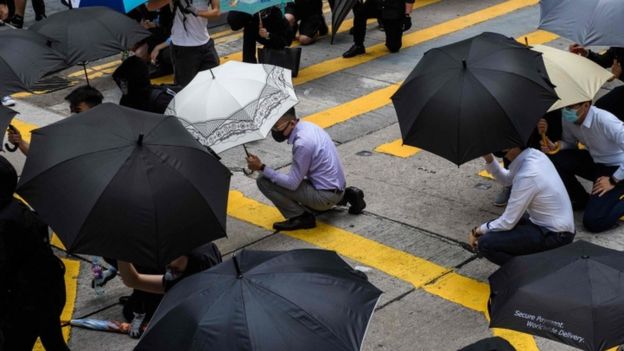
Earlier in the day, around 1,000 protesters rallied in central Hong Kong during the lunch hour blocking roads

Protesters, wearing office clothes, were seen chanting: “Fight for freedom, stand with Hong Kong!”

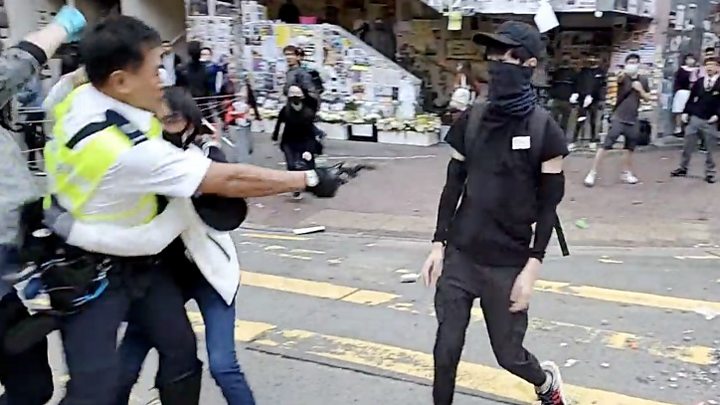
The demonstrations come just a day after the territory saw a marked escalation in violence, with police shooting one activist in the torso. A pro-Beijing supporter was set on fire by anti-government protesters.

The protests started in June against a now-withdrawn plan to allow extradition to mainland China, but have since morphed into wider demonstrations, with activists demanding greater democracy and police accountability in Hong Kong.

On Tuesday afternoon, police spokesman Kong Wing-cheung hit out at the protesters, saying they had “countless examples of rioters using random and indiscriminate violence against innocent” people.

“Hong Kong’s rule of law has been pushed to the brink of total collapse as masked rioters recklessly escalate their violence under the hope that they can get away with it,” he told reporters, adding that Monday’s attack on the pro-Beijing supporter was being investigated as attempted murder.

Office workers and protesters gather in CentralImage copyright AFP
Image caption Protesters and office workers were seen blocking roads in Hong Kong’s financial district

Speaking at the same conference, Supt Li Kwai-wah defended the officer’s decision to shoot the protester on Monday.

“We found out that our colleague did not only face threat from one person, instead it was a group of people with an organised plan attempting to steal the gun,” he said.

“In a situation like this, we believe our police are reacting according to the guideline, to protect themselves as well as the people around them.”

Both the protester and the pro-Beijing supporter remain in hospital, with the latter in a critical condition.

What happened on Tuesday?

Clashes erupted at the Chinese University of Hong Kong, with police firing tear gas to disperse students, while at City University there was a standoff between students and riot police which continued into the evening.

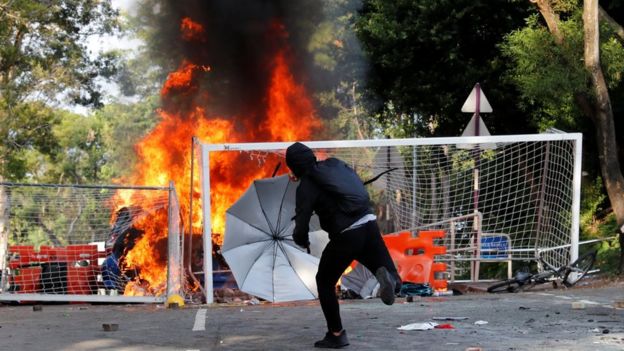
Police continued to use tear gas to try to disperse the protesters who responded with bricks and petrol bombs. Hundreds of protesters remain at the Chinese University of Hong Kong.

A university students throws an object at riot policeImage copyright REUTERS
Image caption Students at Hong Kong’s Chinese University fought with police throughout the day

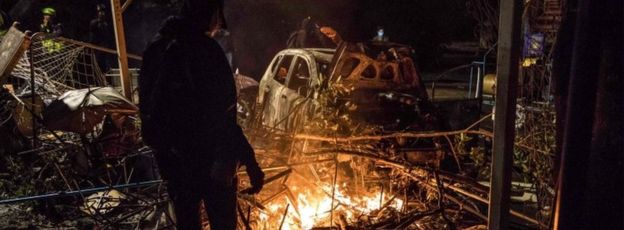
Students built roadblocks on streets in and around City University campus to stop police from entering. At one stage, a van used as part of a street barricade was set on fire.

Students at Hong Kong Polytechnic also tried to disrupt traffic near their campus.

In the morning, suspended railway services and road closures had already led to long traffic jams in the early rush hour. At noon, protesters moved into the city’s central business district for a flash mob protest.

A Christmas tree inside a shopping mall on fireImage copyright REUTERS
Image caption At Festival Walk shopping mall, a Christmas tree was set on fire

Protests continued to intensify throughout the day. A Christmas tree inside Festival Walk shopping mall was set on fire by protesters while others were seen smashing a glass railing with hammers.

Train stations were closed across the city.

Media caption This Hong Kong protester’s shooting was livestreamed on Facebook

Eight universities have announced they will suspend classes on Wednesday.

Monday’s protests saw 260 people arrested bringing the number to more than 3,000 since the protests began in June.


Students swear they will not surrender

Grace Tsoi, BBC World Service, at the Chinese University of Hong Kong

A protester looks at destruction at the Chinese University of Hong KongImage copyright AFP
Image caption Hundreds of protesters remain at the university

The ground was strewn with bricks. The air was filled with the smell of tear gas. Fire was raging on campus. Hundreds of protesters, most of them clad in black, formed human chains to pass bricks and petrol bombs to the front line.

One of the best universities in Hong Kong has turned into a battlefield after another day of intense clashes between students, who have been at the forefront of anti-government protests, and police.

The Chinese University students have been putting up resistance since the morning. On Monday, police seemed to change strategy by deploying forces to campuses. Students told me they should not be allowed there.

The university’s management has tried to deescalate the situation. Vice-chancellor Rocky Tuan was also tear gassed as he was negotiating with police.

Dozens of students have been injured, including at least one hit in the eye by a projectile. The night is young and students swear they will not surrender.


Why are there protests in Hong Kong?

Hong Kong is part of China but as a former British colony it has some autonomy and people have more rights.

The protests started in June against plans to allow extradition to the mainland – which many feared would undermine the city’s freedoms.

The bill was withdrawn in September but demonstrations continued and now call for full democracy and an inquiry into police behaviour.

Clashes between police and activists have become increasingly violent and in October the city banned all face masks.

Source: The BBC

12/11/2019

Guru Nanak: Sikh founder’s 550th birthday celebrated

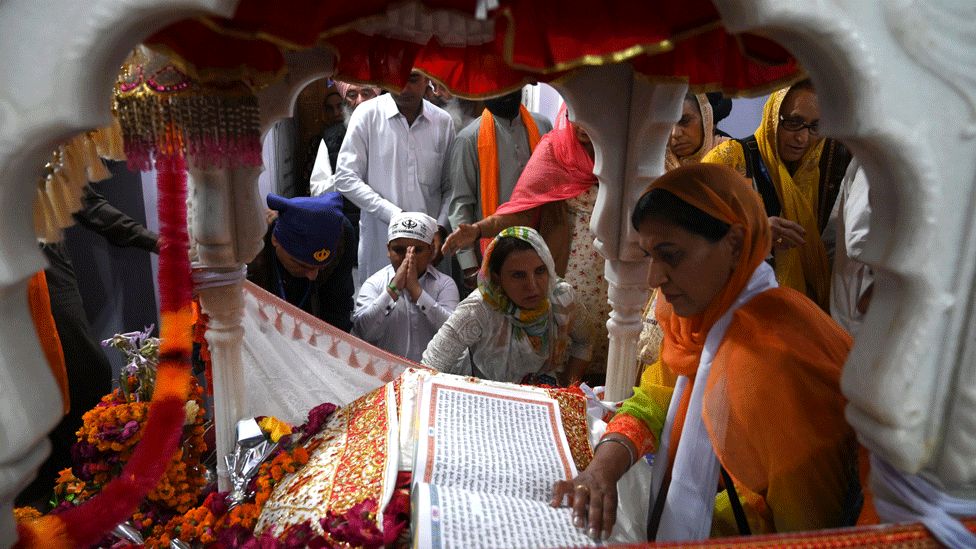
Sikh pilgrims take part in a religious ritual as they gather to celebrate the 550th birth anniversary of Guru Nanak Dev, at Nankana SahibImage copyright AFP
Celebrations have taken place in India and Pakistan to mark the 550th anniversary of the birth of Guru Nanak – the founder of Sikhism.

The anniversary comes just a few days after the historic opening of the Kartarpur corridor, which allows Indians access to one of Sikhism’s holiest shrines in Pakistan without having to apply for a visa.

Tensions between the neighbours have made it difficult for Indian pilgrims to visit the site in Pakistan in recent years. But an agreement reached last month allows Indians to make the 4km (2.5-mile) crossing to the Gurdwara Darbar Sahib Kartarpur – where Guru Nanak spent the last 18 years of his life.

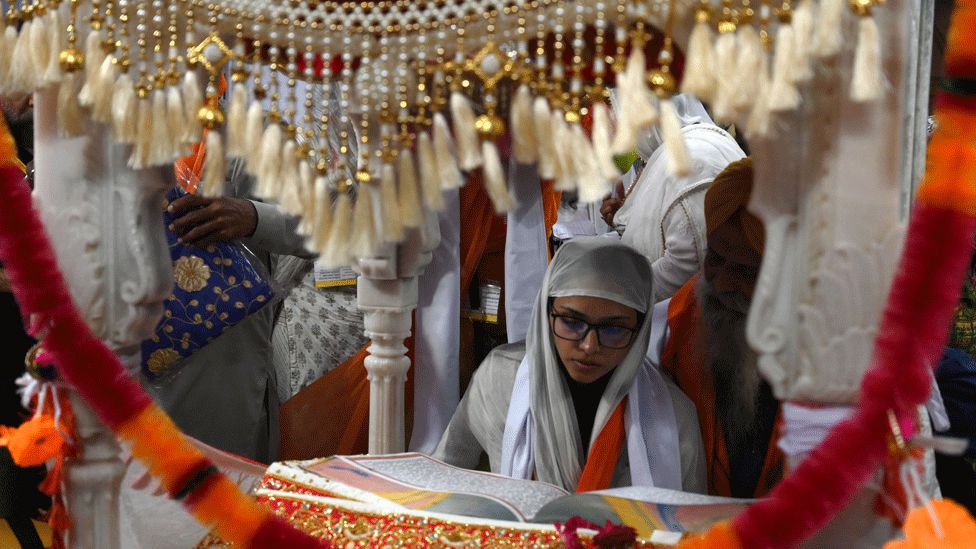
On Tuesday, Sikh pilgrims in Pakistan gathered at Nankana Sahib, the birth place of Guru Nanak, which is about 80km (50 miles) from the city of Lahore.

Sikh pilgrims take part in a religious ritual as they gather to celebrate the 550th birth anniversary of Guru Nanak Dev, at Nankana SahibImage copyright AFP

Large numbers of devotees, including women, took part in the religious rituals.

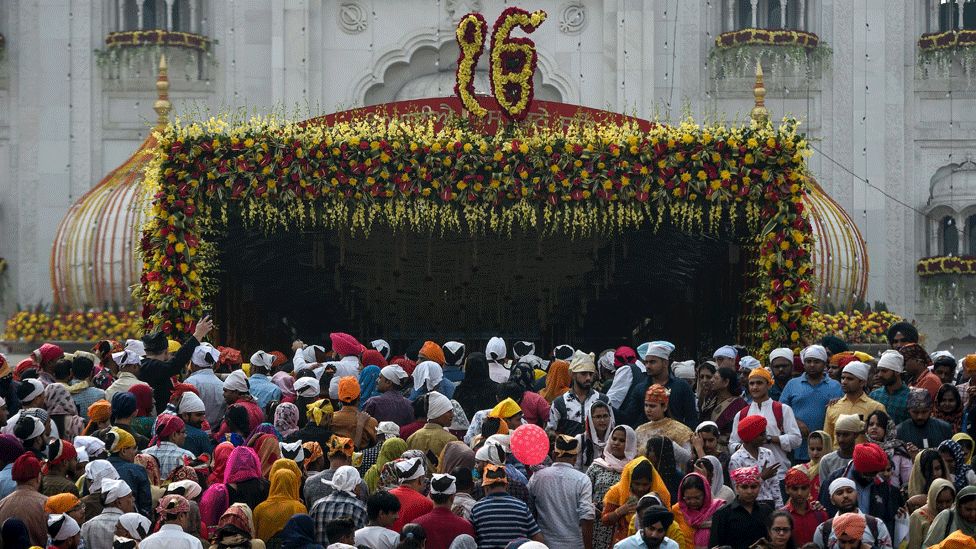
Sikh pilgrims take part in a religious ritual as they gather to celebrate the 550th birth anniversary of Guru Nanak Dev, at Nankana SahibImage copyright AFP

The auspicious day for Sikhs was also marked in India, where Guru Nanak’s birth anniversary is an annual public holiday.

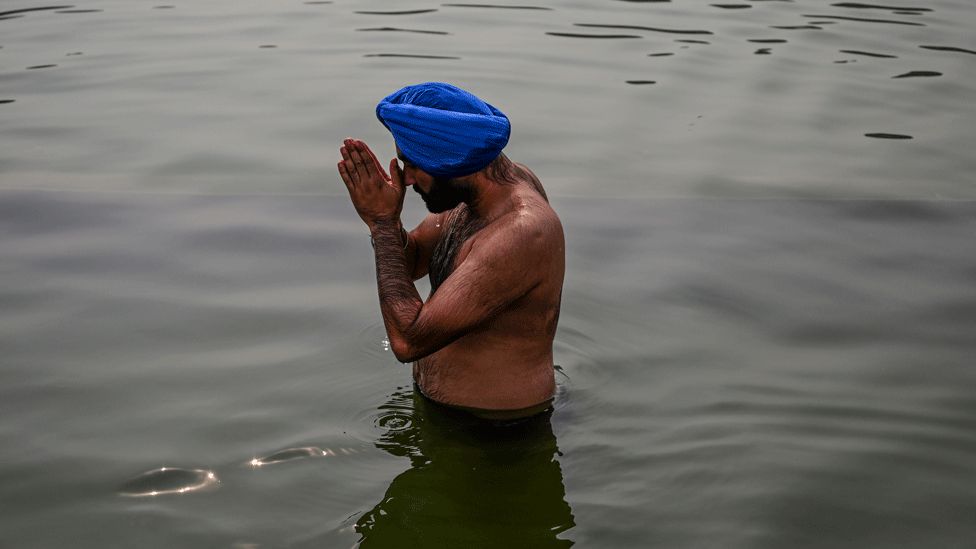
A Sikh devotee takes a holy dip on the occasion of the 550th birth anniversary of Sikhism founder Guru Nanak Dev at Gurudwara Bangla Sahib in New Delhi on November 12, 2019Image copyright AFP
Sikh devotees gathered in huge numbers at the Bangla Sahib Gurdwara in the capital Delhi.
Sikh devotees gather to pay their respects on the occasion of the 550th birth anniversary of Sikhism founder Guru Nanak Dev at Gurudwara Bangla Sahib in New Delhi on November 12, 2019Image copyright AFP

Indian Prime Minister Narendra Modi greeted the nation on the occasion, saying it was “a day to rededicate ourselves” to Guru Nanak’s “dream of a just, inclusive and harmonious society”.

Though Guru Nanak’s anniversary is an important event for Sikhs annually, this time the celebrations were more special due to the opening of the Kartarpur corridor.

Devotees from across the world visit the Kartarpur shrine every year to commemorate his birth. Indian Sikhs will now be able to visit with just their passports, but they will not be allowed to leave the site or stay overnight.

The Golden Temple in Amritsar, in north-western India, is the holiest Gurdwara (where Sikhs worship). On the eve of the anniversary, it was lit up to host processions as Sikh worshippers took part in the three-day celebration of Guru Nanak’s birth.

The Golden Temple lit up as Sikhs watch from a windowImage copyright REUTERS
On the first day of the celebrations, Sikhs read the Sikh holy book – the Guru Granth Sahib – from beginning to end.

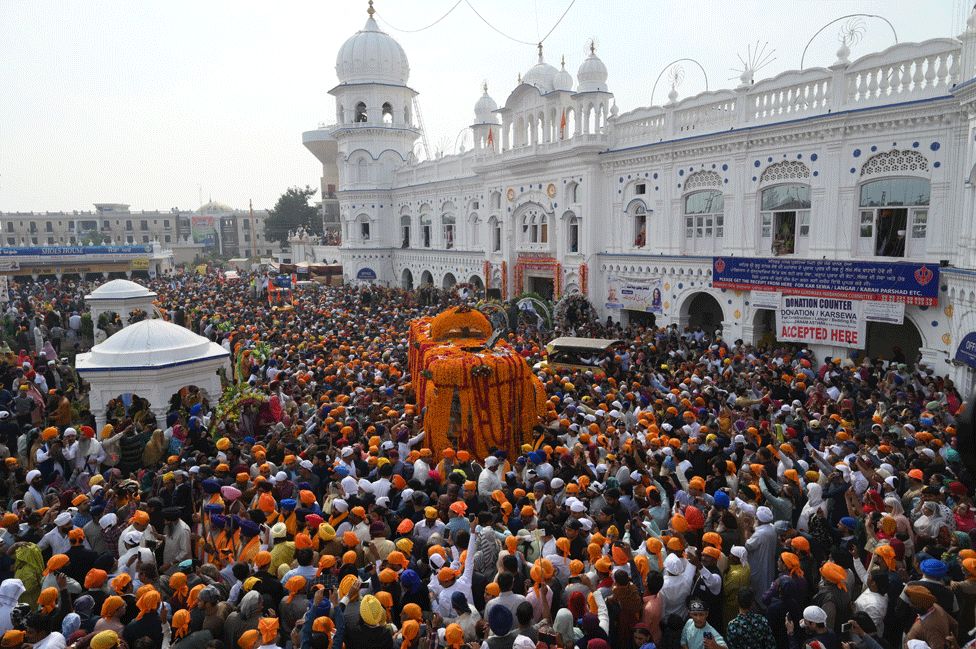
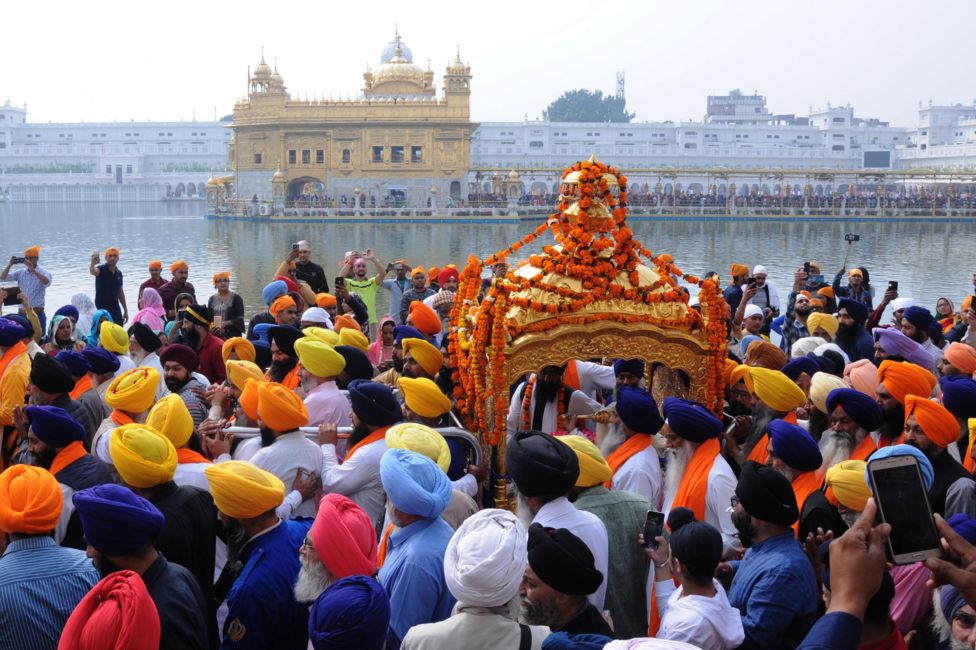
As is the tradition on the second day, the holy book was paraded through the streets of Amritsar on Monday in a hand-held carriage.

The procession was led by five people representing the original Panj Pyare – the Five Beloved Ones – who helped shape the religion.

Sikh devotees carrying the Sri Guru Granth Sahib ji - the holy book of Sikh religion - in a hand-held, golden carriageImage copyright EPA
You might also be interested in:

Media caption Find out more about the Kartarpur corridor, which leads to one of the holiest sites in the Sikh religion

Source: The BBC

11/11/2019

Spotlight: China-Brazil trade set to reach new heights

SAO PAULO, Nov. 11 (Xinhua) — Though separated by oceans and continents, China and Brazil have fostered deepening bilateral cooperation over the years, especially in  investment, trade and finance.

With the upcoming 11th BRICS summit in Brazil’s capital Brasilia, expectations are high for the development of closer ties between the two countries.

STRENGTHENING INVESTMENT

China and Brazil have bolstered investment ties in recent years, and the Asian country has become Brazil’s largest source of foreign investment.

The two countries are not only deepening cooperation in the traditional areas of agriculture, electricity, mining and infrastructure, but also fostering growth in new areas such as technology innovation and the digital economy.

Last month, Brazilian telecommunications giant Oi put Chinese company Huawei’s 5G technology to the test during a local music festival — the largest trial of the 5G technology in Brazil.

Chinese Internet giant Alibaba’s website AliExpress has become one of Brazil’s most popular cross-border e-commerce platforms. Chinese Internet company Tencent and mobile ride-hailing platform DiDi have also invested in Brazilian companies.

Finally, the participation of Latin American countries — including Brazil — in jointly building the Belt and Road will provide a great opportunity for these countries to enhance investment cooperation with China, said Oliver Stuenkel, an expert of international relations at Brazil’s Getulio Vargas Foundation.

INCREASING TRADE

Although the global economy is facing downward pressure, bilateral trade between China and Brazil has continuously climbed, as both countries are committed to opening up their markets.

China has been Brazil’s largest trading partner and largest export market for a decade. In 2018, bilateral trade hit a record 100 billion U.S. dollars, official data showed.

Cheese bread, Brazil’s favorite breakfast and snack food, is now available at cafeterias in China, thanks to the first China International Import Expo (CIIE) in Shanghai last year.

In May, Brazil’s leading cheese bread maker Forno de Minas shipped its first container of 10 tons of cheese bread to China, supplying cafeterias in Shanghai. Two months later, the bakery shipped a second batch of 18 tons to China.

Brazil is also dedicated to opening up by optimizing its business environment. Li Tie, general manager of the Brazilian branch of BYD, a leading Chinese manufacturer of electric vehicles and batteries, said that the Brazilian government has actively promoted pension and labor law reforms and is planning to carry out tax reforms.

China and Brazil should further enhance their economic and trade relations, which have been fruitful and mutually beneficial, said Sergio Segovia, president of the Brazilian Trade and Investment Promotion Agency.

FINANCIAL COOPERATION

The two countries have enhanced cooperation in the financial sector.

In September, the Brazil government relaxed restrictions on the establishment of financial institutions. Bank XCMG, affiliated to China’s Xuzhou Construction Machinery Group, has become the first foreign bank that was approved by Brazil’s central bank after the release of the new regulation, and the bank’s foreign shareholding ratio is as high as 100 percent.

Wang Yansong, XCMG’s vice president, said that Bank XCMG will carry out financial leasing and other services in Brazil and help companies reduce exchange rate risks and financing costs.

As cross-border trade grows, fin-tech companies from both countries have carried out in-depth cooperation, such as that between Brazilian financial payment company Ebanx and AliExpress, in providing consumers with cross-border payment solutions.

In 2018, Ebanx handled 35 million cross-border transactions related to Chinese merchants, said its co-founder and CFO Wagner Ruiz. He expressed the hope that the company can help Chinese merchants sell more in Latin America in the future.

The BRICS leaders’ meeting is an excellent opportunity for Brazil to deepen business, investment and financial cooperation with China and other BRICS countries, said Marcos Trojan, special secretary for foreign trade and international affairs of Brazil’s Ministry of Economy.

Source: Xinhua

11/11/2019

Chinese, Greek presidents pledge joint efforts for community with shared future for mankind

ATHENS, Nov. 11 (Xinhua) — Chinese President Xi Jinping and his Greek counterpart, Prokopis Pavlopoulos, agreed here on Monday to contribute the wisdom of ancient Eastern and Western civilizations to building a community with a shared future for mankind.

To that end, the two presidents agreed during their meeting to consolidate political mutual trust, deepen practical cooperation and promote dialogue among civilizations.

Xi arrived in the Greek capital of Athens Sunday for a three-day state visit to the European country.

Source: Xinhua
11/11/2019

Police shooting exposes deep divide online between mainland China and Hong Kong

  • Mainland social media users come out in strong support for the officer, compounding extensive coverage of vandalism of businesses with ties across the border
Hong Kong’s police force has gained support from online commenters on the mainland. Photo: Nora Tam
As Monday morning’s police shooting of a protester triggered a wave of shock and outrage in Hong Kong, across the border in mainland China, the response online was just as swift – but in support of the force.
“Support Hong Kong police opening fire! Clean up Hong Kong’s cockroaches!” one popular financial blogger on Weibo, China’s Twitter-like platform, said as he shared footage of the incident.
In the video, an officer grapples with a protester and points his gun towards another approaching protester. The second protester reaches out towards the gun, the officer dodges, steps back and shoots him in the torso.

“It feels great [to watch]! Kill them all, these trash and tumours of society,” a Weibo user replied to the video, with a thumbs-up emoji.

“Hongkong’s loser youth, [police] should totally open fire!! It would be best to shoot them in the head,” another post read.
These comments, and many others like them flooding social media in mainland China, highlight the deep divisions in views on each side of the border as Hong Kong’s political crisis drags into its sixth month.

Despite some initial sympathy, mainland public sentiment towards Hong Kong has hardened since July, amid state propaganda painting the protesters as a separatist movement plotted by “Western black hands”.

In recent weeks, the rancour from the mainland has only appeared to deepen, with photos and videos of protesters vandalising businesses with ties to the mainland spreading online.

Last month, a mainland Chinese banker was assaulted in a confrontation with protesters during his lunch break in Central, drawing the wrath of many mainlanders and renewed online calls for military intervention.

Extensive media coverage of the vandalism and attack, as well as a series of inflammatory commentaries, have further fanned the anger.

On Monday, the social media account of state-run Beijing Daily ran the story of the shooting under the headline: “This morning, a gunshot in Hong Kong, to the applause of citizens!”

“At such a critical moment, the police officer acted so bravely and restrained,” the report said.

“After the police fired the shot and subdued the rioters, some citizens at the scene directly applauded the police. The reaction of the public directly shows that the officer fired not only in a legal and reasonable way, but also in line with the will of the people.”

In the video, a man in a dark blue jumper claps his hands at a nearby traffic light, as police officers pin the protesters to the ground.

The Beijing Daily report did not refer to angry bystanders condemning the officers as “murderers”.

Hong Kong police officer who shot protester receives death threats against children after personal details released online, force says

Hu Xijin, editor-in-chief of nationalist tabloid Global Times, and a regular – and hugely popular – commentator on Hong Kong’s unrest, also weighed in.

“As a media worker, I resolutely support this Hong Kong police officer gunning down the attacking rioters,” he wrote to his 2 million fans on Weibo in a post that included video of the shooting.

Hu accused Hong Kong and Western media of “focusing their coverage on the police shooting and diluting the illegal, criminal and evil deeds of the rioters”.

“Such guiding of public opinion is disgusting,” he wrote.

Hu ended his post with a message to Hong Kong police: “Don’t you be afraid of anything, resolutely defend Hong Kong’s law and order, be strong and be tough. You’re not alone on the front lines. Behind you there are not only the [patriotic] Hong Kong public and the nation, but also the country’s paramilitary police and the People’s Liberation Army Hong Kong garrison, who can enter Hong Kong and offer support in accordance with the Basic Law when needed.”

The post was liked more than 26,000 times in six hours.

Scores of Chinese students flee Hong Kong over fears they will be attacked as anti-mainland sentiment sweeps through protesters in city

Meanwhile, Taiwanese President Tsai Ing-wen called on the Hong Kong government to give a detailed response to the Hong Kong people’s calls for democracy and freedom, which she described as “the only path to return to stability and order”.

“Governments should not fire upon unarmed people, this will only exacerbate the problem,” she wrote on her official Facebook account. “Beijing and the Hong Kong government should respond to the Hong Kong people, not with bullets but with the promise of democracy and freedom.”

Taipei’s Mainland Affairs Council, which oversees the island’s policies on Beijing, called on all sides to give up their arms and aggressive actions to make way for peaceful conversation.

Source: SCMP

11/11/2019

China’s Jingye Group agrees outline deal to rescue British Steel

BEIJING/LONDON (Reuters) – China’s Jingye Group said on Monday it has reached a provisional deal to buy British Steel and promised to invest 1.2 billion pounds ($1.5 billion) over the next decade and save thousands of jobs.

An agreement is of major political significance as Britain prepares to elect a new government on Dec. 12. The lack of opportunities in northern England, where British Steel is based, is an election issue, as the social gap between north and south widens.

The deal has yet to be finalised, but Business Minister Andrea Leadsom said in a video clip she was optimistic it would be.

Jingye Group Chairman Li Ganpo said the ambition was to create a world-class group.

“We believe that this combination will create a powerful, profitable and sustainable business that will ensure the long-term future of thousands of jobs while producing the innovative high-quality steel products that the world needs,” he said in a statement.

The value of the deal was not disclosed. Earlier a BBC report saying a deal was imminent gave a figure of 70 million pounds ($90 million), while sources close to the talks said the price was likely closer to 50 million pounds.

Uncertainty over the future of British Steel has hung over its workforce for much of the year. It was put into compulsory liquidation in May after Greybull Capital, which bought it for one pound from Tata Steel (TISC.NS) in 2016, failed to secure funding to continue its operations.

Its closure would impact 5,000 jobs in Scunthorpe and a further 20,000 jobs in the supply chain.

British Steel, which makes high-margin, long steel products used in construction and rail, would give Jingye access to Europe’s large infrastructure market.

But it could face challenges as the European steel industry grapples with weak demand, high costs for energy and labor and exacting environmental standards.

British Steel did not respond to requests for comment.

A previous deal, announced in August, with Turkey’s military pension fund OYAK fell apart and on Monday the fund said the purchase was not commercially viable.

British commodities tycoon Sanjeev Gupta’s Liberty Steel Group has also expressed interest in buying British Steel.

EMBRACE CHINA

Henri Murison, director of the Northern Powerhouse Partnership, set up to boost the economy in the north of England, said a rescue, if finalised, would be “very welcome news”.

He said it was time to embrace cooperation with China, which is extending its international reach through its Belt and Road global development strategy. Chinese companies also own a steel plant in Serbia and its sole copper mine.

Leading trade union Unite welcomed the prospect of Chinese ownership, but cautioned there had been “a series of false dawns” for the company.

Jingye, which also operates hotels and real estate, employs 23,500 and has registered capital of 39 billion yuan ($5.58 billion), giving it the financial clout to invest.

Under the terms of the agreement, Jingye would acquire certain assets of British Steel from the Official Receiver, subject to regulatory approvals.

The assets include the steelworks at Scunthorpe and Teesside in northern England, as well as its European units FN Steel in the Netherlands and British Steel France.

Chinese ownership may be contentious, especially in the steel industry. The European Union (EU), which does not include Serbia, has agreed safeguards to protect its own steel industry from competition from cheap imports from China and elsewhere.

Britain has said it will leave the EU but has yet to agree a deal on its departure from the political and economic bloc.

John Cullen,  business recovery partner  at accountancy firm Menzies LLP, said selling the whole British Steel business “in the current trading climate would be no mean feat”.

Source: Reuters

11/11/2019

Cyclone Bulbul kills 13 across India and Bangladesh

Cyclone Bulbul has ripped through coastal areas of Bangladesh and India, killing at least 13 people while more than two million others were forced to spend a night in storm shelters.

The storm packed winds of up to 120km/h (75 mph), injuring dozens and destroying thousands of homes.

Five of the six who lost their lives in Bangladesh were hit by falling trees.

Officials say that further casualties were avoided because people were evacuated in time.

Authorities say the storm is now weakening.

What damage did Cyclone Bulbul cause?

Seven people were killed in the Indian state of West Bengal, the state’s minister for disaster management told reporters.

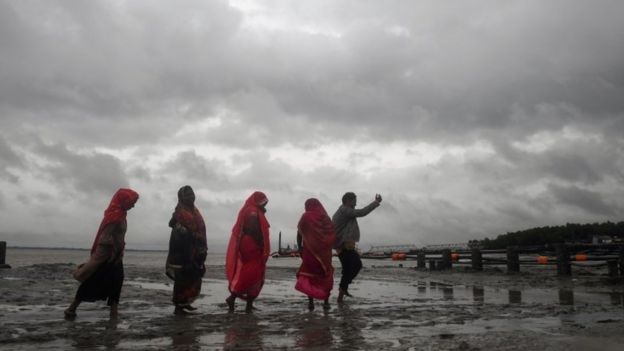
Hindu pilgrims walk back from the dock after a ferry service to Sagar Island was suspended due to the approaching Cyclone Bulbul in Kakdwip in West Bengal stateImage copyright AFP
Image caption West Bengal is one of the worst hit areas in India

The five victims hit by trees in Bangladesh included a 52-year old woman who died when a tree dropped onto her house.

A 60-year-old fisherman also lost his life after ignoring evacuation warnings.

There are increasing concerns after two fishing boats carrying more than 30 men failed to return, an official in Bangladesh’s Bhola district said.

Around 1,200 tourists, most of them Bangladeshi, were stuck on St Martin’s Island, part of Cox’s Bazar district, an official told the Reuters news agency.

“All of them will be rescued,” he said.

Services at many sea ports and airports in the region were also suspended – including the busy Kolkata airport.

Bangladesh’s two biggest ports, Mongla and Chittagong, were closed and flights into Chittagong airport were stopped.

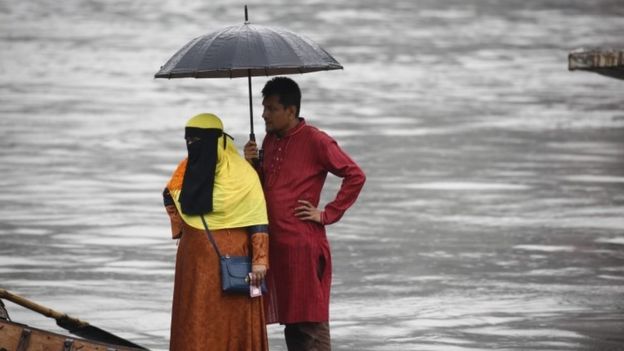
Bangladeshi passengers use an umbrella as they cross the Buriganga River by boat during a rainy day in Dhaka, BangladeshImage copyright EPA
Image caption Storms have battered areas of Bangladesh

Bangladesh’s low-lying coast is often hit by deadly cyclones, but the country has successfully reduced the number of casualties in recent years.

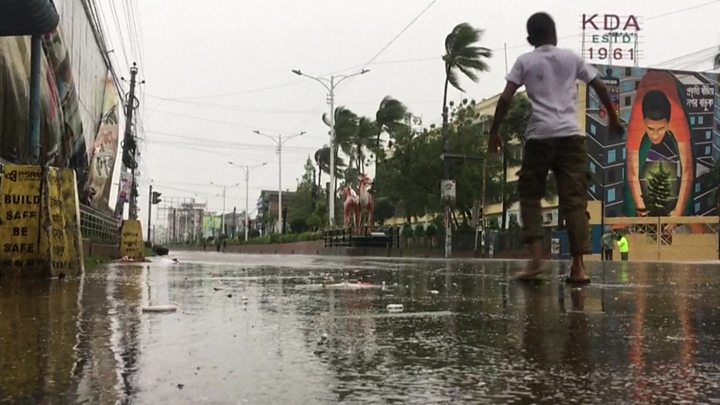
Media caption People in Khulna, Bangladesh, seek shelter from the storm

Source: The BBC

11/11/2019

With Indian court ruling, Modi’s Hindu agenda barrels forward

AYODHYA/MUMBAI (Reuters) – Just six months after sweeping to re-election, Indian Prime Minister Narendra Modi has delivered on two major promises of his party’s Hindu agenda, electrifying his base but sowing unease among liberals and the nation’s large Muslim minority

The latest boost for Modi came on Saturday, when the Supreme Court handed Hindu groups control of a contested site where a 16th-century mosque was razed over two decades ago, paving the way for the construction of a temple there that has long been an election promise of the ruling Bharatiya Janata Party (BJP).

That followed New Delhi’s move in August to strip Muslim-majority Jammu and Kashmir of its special status as a state in what Modi’s government said was a bid to integrate the restive region with the rest of predominantly-Hindu India.

Now, the BJP may move towards delivering on its third traditional plank: Creating a uniform civil code that does away with the independence of religious communities on certain issues.

“After just a few months of Modi 2.0, they’ve accomplished two out of three (main cultural objectives). It’s quite possible that they will accomplish all three by next year,” said Milan Vaishnav, a senior fellow at the Carnegie Endowment for International Peace in Washington D.C.

“It’s striking that the government has moved with a clarity of purpose on its social agenda that’s completely absent when it comes to economic matters,” added Vaishnav in reference to the slowing of the country’s once red-hot economic growth.

Many Muslims have watched with a mix of fear and resignation as the BJP has morphed into the officially secular country’s near-undisputed political force.

The controversial site in the northern state of Uttar Pradesh has been one of the most explosive issues in the nation of 1.3 billion, where Muslims constitute about 14% of the population.

In its verdict on Saturday, the Supreme Court called the mosque’s demolition illegal but handed the plot of land to Hindus, who believe the site is the birthplace of Lord Ram, a much venerated god-king. The court directed that another plot in Ayodhya be provided to a Muslim group that contested the case.
In over a dozen interviews, Muslim community leaders, businessmen, and students said they respected the verdict but it exacerbated their sense of alienation.
“Why did the court then give a ruling which is completely one-sided? Was the court under pressure? We don’t know. We can’t trust anyone now. No door is open for us,” said local Muslim community leader Azam Quadri during evening prayers in Ayodhya.

“BEST TO BE NUMB”

While Modi himself has said the court verdict should not be seen as a “win or loss” for anyone, many Muslims Reuters spoke to expressed resignation after the ruling.

Some were bitter that a probe into the demolition has inconclusively dragged on for three decades and that many of the politicians accused of conspiring to take down the mosque are prominent BJP members. Those people have said the demolition was spontaneous and not planned.

“I feel humiliated by the Supreme Court verdict,” said one affluent Mumbai-based Muslim businessman, who declined to give his name. “Others don’t care. They have become numb. It’s best to be numb in Modi’s India.”

Some people believe that Hindu nationalists, galvanized by the Ayodhya triumph, could turn their attention to two other Uttar Pradesh mosques they believe Mughal conquerors built over the remains of Hindu temples centuries ago.

“This (verdict) seems to generate incentives for Hindus to take down mosques and resettle,” said Neelanjan Sircar, an assistant professor at Ashoka University near New Delhi.

Another likely move is the uniform civil code.

New Delhi has already taken steps toward creating such a code, with the BJP-led parliament in July outlawing the centuries-old right of a Muslim man to instantly divorce his wife. While many activists thought the Muslim custom was wrong, some Muslim groups said Modi was targeting them while turning a blind eye to discrimination in Hindu society.

For a factbox on the BJP’s plans, please see:

Despite the focus on social issues, political analysts predict the government and the BJP will have to shift attention quickly to a sagging economy and surging unemployment or risk losing popular support.

India, long touted as the world’s fastest-growing large economy, has seen economic expansion wither to six-year lows.

Two college students – one Hindu, one Muslim – in Uttar Pradesh’s capital Lucknow separately said after the court verdict that they hoped the government would now focus on economic issues.

“This case has gone on for so long… Now that it’s done with altogether, maybe more economic issues can come forward”, said Rajat Mishra, a business student.

“Attention can now move beyond topics of religion,” said medical student Irfan, 22, who declined to give his surname.

Source: Reuters

08/11/2019

Xi Focus: Xi’s trip to Greece, Brazil to advance bilateral ties, BRICS cooperation

BEIJING, Nov. 7 (Xinhua) — Chinese President Xi Jinping’s upcoming visit to Greece and Brazil is expected to intensify China’s relations with the two countries and enhance BRICS cooperation, officials said here Thursday.

At the invitation of Greek President Prokopis Pavlopoulos, Xi will pay a state visit to Greece from Nov. 10 to 12, said Vice Foreign Minister Qin Gang.

This will be the first visit to the European country by a Chinese president after an interval of 11 years, which will exert a historic influence of China-Greece ties and push forward China-Europe relations and Belt and Road cooperation, Qin said.

He noted that China and Greece, both with old civilizations, are trustworthy and helpful friends respecting and supporting each other on core interests and major concerns.

Greece is among the first European Union (EU) countries to sign an intergovernmental cooperation document with China to jointly construct the Belt and Road, Qin said, adding that Greek prime ministers attended the first and second Belt and Road Forum on International Cooperation in Beijing.

The two sides have conducted fruitful cooperation on the principle of mutual benefit and win-win cooperation and witnessed increased bilateral trade and investment, Qin said.

“The Piraeus Port project, a flagship project for the Belt and Road cooperation, has made important contributions to the local economic and social development of Greece and played an important role in advancing connectivity in various regions around the globe,” said the vice foreign minister.

Speaking of people-to-people and cultural exchanges, Qin said peoples of the two countries respect each other and advocate openness and inclusiveness in their close interactions.

“Both China and Greece hold that different civilizations should respect each other and facilitate experience sharing, mutual learning and conversation among civilizations,” he said.

China and Greece are new friends of the “17 +1” cooperation. In April this year, Greece became a full member of the China-Central and Eastern European Countries Cooperation Mechanism, adding new opportunities to the development of this mechanism, which is also conducive to developing China-EU relations and China-EU connectivity, Qin said.

Greek Prime Minister Kyriakos Mitsotakis led a delegation to the ongoing second China International Import Expo (CIIE). Xi met with him, and the two leaders visited the Greek pavilion, Qin said.

According to Qin, in Greece, Xi is scheduled to hold talks respectively with Pavlopoulos and Mitsotakis, in a bid to consolidate political mutual trust and traditional friendship between the two countries, intensify pragmatic cooperation in trade, investment, infrastructure and other fields, uphold multilateralism and free trade and build an open world economy.

Besides, Qin noted that the Chinese and Greek leaders will conduct cultural exchanges and advocate dialogues among civilizations.

The two sides will issue a joint statement on strengthening the comprehensive strategic partnership, draw up a blueprint for the development of bilateral ties, sign intergovernmental cooperation documents on investment and education, and ink commercial agreements in such fields as ports, finance, and energy.

Greece, in the West, and China, in the East, are heirs of ancient civilizations. Noting that both China and Greece are faced with the mission of rejuvenation and prosperity, Qin said the two countries can enlighten the world to deal with various problems and challenges.

Xi’s upcoming visit to Greece shows respect and appreciation of the ancient Chinese civilization to the ancient Greek civilization, as well as the expectation of jointly building a community with a shared future for humanity, Qin said.

It is believed the visit will elevate the level of bilateral cooperation in an all-round way and inject new impetus to the development of China-EU relations with fruitful results, Qin stressed.

According to Vice Foreign Minister Ma Zhaoxu, at the invitation of Brazilian President Jair Messias Bolsonaro, Xi will attend the 11th BRICS summit in Brasilia, the capital of Brazil, from Nov. 13 to 14.

BRICS is the acronym for an emerging-market bloc that groups Brazil, Russia, India, China and South Africa.

Xi is scheduled to attend the closing ceremony of the BRICS business forum, closed and public meetings of the BRICS leaders’ meeting and the BRICS leaders’ dialogue with the BRICS Business Council and the New Development Bank. The leaders’ declaration is expected to be released, Ma said.

Xi will hold talks with Bolsonaro, sign cooperation documents in various fields, and hold bilateral meetings with leaders of other participating countries to exchange views on ties and BRICS cooperation, Ma said.

As the world is undergoing changes rarely seen in a century and confronted with unprecedented opportunities and challenges, BRICS countries have drawn ever-growing attention worldwide, Ma said, stressing that China appreciates the efforts made by Brazil in its preparation and stands ready to jointly prompt the meeting to achieve fruitful results.

He voiced expectations of the Chinese side.

“The Chinese side hopes that BRICS countries will further enhance political mutual trust, boost mutually beneficial cooperation and forge a more comprehensive, closer and broader partnership,” Ma said.

As for safeguarding multilateralism and strengthening global governance, Ma voiced China’s determination to make joint efforts with other BRICS countries to safeguard the rules-based multilateral trade system, the international order based on international law, and the international system with the UN at the core.

This aims to promote a more equitable, open, transparent and inclusive global governance system and safeguard common interests and development space of emerging markets and developing countries, Ma said.

“China believes the five BRICS countries should follow the trend of the new industrial revolution and facilitate economic transformation and upgrading,” Ma noted.

As an important outcome of last year’s Johannesburg meeting, the BRICS partnership for a new industrial revolution has progressed well in the past year, he said, adding that China is willing to work with concerned parties to accelerate the development of the partnership and tap more potential for cooperation projects, so as to propel high-quality development of the five countries.

“China looks forward to more cooperation on economy, trade, finance, political security and people-to-people exchanges, with projects meeting the development needs of the five countries and serving the interests of their peoples,” he said.

The Chinese side believes that with concerted efforts of all parties and under the political guidance of the five countries’ leaders, the 11th BRICS Summit will be a full success, Ma said, stressing that the BRICS countries will continue to contribute to world peace and development and the building of a community with a shared future for humanity.

Source: Xinhua

Law of Unintended Consequences

continuously updated blog about China & India

ChiaHou's Book Reviews

continuously updated blog about China & India

What's wrong with the world; and its economy

continuously updated blog about China & India