Archive for December, 2019

29/12/2019

Beijing-Zhangjiakou high-speed railway to go into service Monday

CHINA-BEIJING-ZHANGJIAKOU-HIGH SPEED RAILWAY (CN)

Photo taken on Dec. 28, 2019 shows the automatic ticketing office of the Badaling Changcheng Railway Station in Beijing, capital of China. The high-speed railway line connecting Beijing and Zhangjiakou in north China’s Hebei Province will go into service on Monday, China Railway Corporation said Saturday. (Xinhua/Peng Ziyang)

BEIJING, Dec. 28 (Xinhua) — The high-speed railway line connecting Beijing and Zhangjiakou in north China’s Hebei Province will go into service on Monday, China Railway Corporation said Saturday.

The railway line is a major project for the 2022 Olympic and Paralympic Winter Games. It will reduce the travel time between Beijing and Zhangjiakou, the co-host city of the 2022 Olympics, from currently over three hours to 47 minutes.

The railway is 174 km long, with a maximum design speed of 350 kph.

Ten stations are along the railway line, namely Beijing North, Qinghe, Shahe, Changping, Badaling, Donghuayuan North, Huailai, Xiahuayuan North, Xuanhua North and Zhangjiakou.

Chongli railway, a branch line of the Beijing-Zhangjiakou high-speed railway, will also come into service on Monday. It is 53 km long, with a maximum design speed of 250 kph.

Construction of the Beijing-Zhangjiakou high-speed railway began in the first half of 2016. The railway underwent test runs earlier this month.

Source: Xinhua

29/12/2019

Shanxi’s winter tourism turns red hot

TAIYUAN, Dec. 28 (Xinhua) — Authorities have begun to tap north China’s Shanxi Province’s winter tourism potential to bolster the local economy.

The Shanxi government has launched a “snow and ice” tourism ceremony in Jinzhong City and released a guide on the tourism products in the province known for its collieries.

Shanxi has abundant highland resources, and its icy period in winter is usually quite long, making it perfect for winter tourism, according to the provincial department of culture and tourism.

“We promote ice skating, hot springs and local traditions here,” said deputy department head Li Gui. “We have selected more than 30 winter tourism products for the public.”

Li said the sector is still “at a developing stage,” and that the local government will pay more attention to support it in the future.

Source: Xinhua

29/12/2019

Discover China: Green shoots of prosperity as asparagus takes root in rural China

YINCHUAN, Dec. 28 (Xinhua) — In the remote Xiamaguan Township of northwest China’s Ningxia Hui Autonomous Region, swathes of green asparagus sway in the endless loess field.

Farmer Dong Yi started growing asparagus in 2017 when local officials encouraged villagers to cultivate the green plant to get out of poverty.

“We had never seen asparagus before, and everybody doubted if the plant could survive the harsh environment here,” said Dong, 56. “But I decided to try it anyway, because I was struggling to make money.”

Xiamaguan Township is located deep in the mountains, and the dry weather there leaves it in dire need of water. The township is among Ningxia’s poorest, where many people are still struggling to make ends meet.

Despite years of prosperity in the coastal regions, pockets of residents still lag behind in China’s underdeveloped rural areas, which poses a challenge for the country’s battle to wipe out absolute poverty by 2020.

In 2012, China had 98.99 million rural people living under the national poverty line of 2,300 yuan (329 U.S. dollars) in annual income. By the end of 2018, the number had dropped by 82.4 million, with 16.6 million still left in poverty. Ningxia is home to one of the largest poor populations in China.

However, the asparagus has brought fortunes to Xiamaguan Township, with more than 100 families having been lifted out of poverty since the industry took root there, according to the latest government figures. Currently, more than 130 hectares of asparagus thrive in the fields.

In the past, asparagus was something unheard of among impoverished farmers such as Dong Yi in Xiamaguan. Dong’s family has about three hectares of land. For generations, the family depended on grain plantation to make a living, though they barely made enough money to live a decent life.

A few years ago, a series of irrigation projects pumped water from the Yellow River into the dry, sandy lands in Ningxia. The Yellow River is China’s second-longest river. With more water, local residents decided to grow more crops, said local Party official Dong Zhanping.

“The farmers tried a variety of plants at first, including traditional Chinese herbs, and corn, but the yields were less than satisfactory,” the official said.

In 2017, township officials decided to introduce asparagus to the area after multiple field surveys. They invited a company that had success growing asparagus in a nearby county.

“We persuaded farmers to lease their land to us and we managed the land collectively,” Dong Zhanping said, adding that they gave 3,000 yuan to the farmers for each hectare of land they leased. Experts then cultivated asparagus seedlings in greenhouses, before planting them in the fields, depending on dripping irrigation technology.

“Different from the bamboo in southern China, asparagus can adapt to a very dry environment, which is why the land in Xiamaguan is perfect for its cultivation,” said company manager He Jiang. “Besides, the air here is fresh, and the soil is very clean, so the asparagus grown here is very good quality.”

In 2017, Dong Yi, the local farmer, went to learn about asparagus cultivation with the company’s technical staff in east China’s Shandong Province. He learned about weeding and fertilizing there, and returned home to train other villagers. By commanding new techniques and with hard work, farmers like Dong saw the potential of the industry after reaping a good harvest.

“This year we will have another bumper harvest,” he said. “Currently, more than 200 villagers are toiling in the fields.”

The success of Xiamaguan Township has permeated to other villages, according to local officials. In the past, many farmers left home for big cities for decent-paying jobs, but now they stay in their hometown and attend to the asparagus.

Dong Yi said the asparagus is in high demand, with orders from buyers in the provinces of Shandong and Guangdong. Many of the buyers purchased the crop online.

“When the harvest season comes in January, we will rake in more than 150,000 yuan per hectare,” he said.

The asparagus industry has also brought environmental benefits, including less sandy areas and more moist air, in addition to the economic boost.

“We hope to bring more farmers into the industry,” said Party official Dong Zhanping. “The plant has truly changed lives here.”

Source: Xinhua

29/12/2019

China ends forced labour for sex workers

Sex workers and clients are rounded up in DongguanImage copyright AFP
Image caption Past detainees claim they were forced to work making toys and household goods

China is to end a punishment system for prostitution that allowed police to hold sex workers and their clients in custody for up to two years at so-called education centres.

Detainees were forced to work, allegedly making toys and household goods.

The detention system will come to an end on 29 December. Those still in custody will be released, according to Xinhua, China’s state media.

Prostitution remains illegal in China.

It carries punishments of up to 15 days in detention and fines of up to 5,000 yuan (£546).

China’s state media claims the “custody and education” system has helped to maintain a “good social atmosphere and public order” since it was introduced more than 20 years ago.

It added that over time, the system has become less and less appropriate.

A study by NGO Asia Catalyst in 2013 questioned whether this scheme was effective.

The report included interviews with 30 female sex workers from two cities.

It claimed detainees were unable to learn new skills during detention that could help them after their release. The report added that the detainees typically undertake manual labour.

It said: “All of the sex workers we interviewed returned to the sex trade immediately after release.”

A 2013 report by Human Rights Watch interviewed 140 sex workers, clients, police and specialists and found that many sex workers were beaten by police in an attempt to coerce confessions.

One worker claimed she had been deceived into signing a confession.

“The police told me it was fine, all I needed to do was sign my name and they would release me after four or five days,” she said.

“Instead, I was locked up in [a] Custody and Education centre for six months.”

Shen Tingting, director of Asia Catalyst, said the move to abolish forced labour detention centres is positive but only a small step towards safeguarding the rights of sex workers.

“Chinese law and policies focus on prohibition and cracking down on sex work, rather than providing a framework to ensure the health and safety of sex work as a profession,” she said.

In 2013, China announced it had abolished its system of “re-education through labour camps” for petty criminals.

That decision came after several high-profile miscarriages of justice, including a case where a mother was sent to a labour camp after demanding justice for her daughter who had been raped.

However, the abolition did not extend to the “custody and education” system affecting sex workers and their clients.

China isn’t totally abandoning the idea of re-education. Authorities in the country claim a number of camps in the north-west region of Xinjiang are voluntary education camps that help to combat extremism.

However rights groups claim many Chinese Uighur people have been rounded up into the camps and made to criticise or denounce their faith.

Source: The BBC

29/12/2019

Tourists stay away from Taj Mahal, other Indian attractions as protests flare

MUMBAI (Reuters) – India’s tourism industry has been hit by a wave of violent anti-government protests against a new citizenship law that have rocked several cities this month, with at least seven countries issuing travel warnings.

At least 25 people have been killed in clashes between police and protesters, and demonstrations against the law continue.

Officials estimate about 200,000 domestic and international tourists cancelled or postponed their trip to the Taj Mahal in the past two weeks, one of the world’s most popular tourist attractions.

“There has been a 60% decline in visitor footfalls in December this year,” said Dinesh Kumar, a police inspector overseeing a special tourist police station near the Taj Mahal who has access to visitor data. He said the decline was compared to December last year.

“Indian and foreign tourists have been calling our control rooms to check security. We assure them protection, but many still decide to stay away,” said Kumar.

The 17th century marble monument is in Uttar Pradesh, the northern state that has witnessed the highest number of deaths and intense bursts of violence in two weeks of unrest.

A group of European tourists travelling in a group across India said they now planned to cut short their 20 day trip.

“We are all retired folks, for us travel has to be slow and relaxing. The newspaper headlines have led to a sense of concern and we will leave sooner than we had planned,” said Dave Millikin, a retired banker living on the outskirts of London, who spoke to Reuters from the capital New Delhi.

The Taj Mahal, situated in the town of Agra, attracts over 6.5 million tourists every year, generating nearly $14 million annually from entrance fees. A foreign tourist pays 1,100 rupees (about $15) to enter the grounds, although nationals from neighbouring countries get a discount.

Managers in luxury hotels and guest houses around the Taj Mahal said last minute cancellations during the festive season have further dampened business sentiment at a time when the country’s economic growth has slowed to 4.5%, its slowest pace in more than six years.

In a bid to clamp down on violence and unrest, authorities have suspended mobile internet services in Agra.

“Blocking the internet has affected travel and tourism in Agra by about 50-60%,” said Sandeep Arora, president of the Agra Tourism Development Foundation that groups over 250 tour operators, hotels and guides.

The United States, Britain, Russia, Israel, Singapore, Canada and Taiwan have issued travel advisories asking their citizens to either refrain from visiting or to exercise caution when visiting regions embroiled in India’s protests.

Jayanta Malla Baruah, the head of the Assam Tourism Development Corp., said the state, home to the world’s largest concentration of one-horned rhinoceroses, is visited on average by 500,000 tourists during December.

“But this time, due to the ongoing protests and travel advisories by various countries, the number is down by 90% if not more.”

Source: Reuters

28/12/2019

China Focus: Chinese lawmakers call for more efforts to protect Yangtze River

BEIJING, Dec. 27 (Xinhua) — Chinese lawmakers Friday held panel discussions to deliberate the draft law on Yangtze River conservation during an ongoing legislative session of the country’s top legislature.

The draft was submitted Monday to the National People’s Congress (NPC) Standing Committee for the first reading.

At Friday’s discussions, lawmakers acknowledged the necessity of national legislation to protect the Yangtze River and proposed more measures of protection to improve the draft.

Lawmaker Liu Xiuwen stressed the importance of flood-prevention work to the protection and development of the Yangtze River basin and suggested related stipulations be included in the draft.

While acknowledging the draft’s focus on government responsibilities, lawmaker Liu Yuting stressed the need to include “social participation” stipulations in the draft.

The draft should add more stipulations to help transform people’s lifestyles and behaviors to better protect the river, Liu Yuting said.

A national award should be set up for local governments, institutions and individuals who make outstanding contributions to Yangtze protection, said lawmaker Wu Heng.

Wan Exiang, vice chairman of the NPC Standing Committee, proposed including education authorities’ responsibilities in the draft so that the education on Yangtze River protection could start from Chinese people’s childhood.

Lawmaker Pang Lijuan also suggested including Yangtze protection in school curriculums.

“Children should learn the beauty of the Yangtze and its significance to China in Chinese and geography classes. They should also learn the dire consequences of pollution in science classes and other extracurricular activities,” she said.

Source: Xinhua

28/12/2019

China, Senegal continue to deepen comprehensive strategic cooperative partnership in 2019

DAKAR, Dec. 27 (Xinhua) — China has continued to be a key partner for Senegal in 2019, supporting its implementation of the Plan for an Emerging Senegal, proposed by Senegalese president Macky Sall.

Fourteen years after the resumption of diplomatic relations between Beijing and Dakar, China occupies an essential place in Senegal’s political and trade relationships.

At the beginning of the year, during a visit of Chinese State Councilor and Foreign Minister Wang Yi, Senegalese president Sall said the Senegal-China relationship is dynamic, practical and effective, hailing it as a model. He said the Senegalese side hopes to further deepen cooperation with China in various fields.

According to the Chinese Embassy in Senegal, trade between the two partners, at 2.27 billion U.S. dollars in 2018, accelerated in 2019, and China has become one of the most popular destinations among Senegalese businesspeople.

The year 2019 was marked also by numerous visits by Chinese businessmen to study the Senegalese market for potential investments opportunities. The return of Chinese traders in the marketing campaign of peanuts has been hailed by many agricultural stakeholders.

Also in 2019, the inauguration of the Chinese-built Diamniadio Industrial Park, about 30 km from Dakar, won positive response from Senegalese authorities.

In terms of infrastructure, cooperation continued in a good momentum after the opening of the Museum of Black Civilizations, the Thies-Touba, Dakar-Mbour and Dakar-Thies highways, the Grand Theater in Dakar, and the Children Hospital in Diamniadio.

Chinese expertise has won acclaim in Senegal in the construction of the first Bus Rapid Transit (BRT) serving the Senegalese capital and its suburbs. China Road and Bridge Corporation (CRBC) won the international tender for the project mostly funded by the World Bank.

Senegal also counts on China for the construction of sports facilities for the organization of the Youth Olympic Games in 2022. China built Senegal’s largest stadium, Leopold Sedar Senghor Stadium, in the 1980s, and three other regional stadiums will be rehabilitated.

In the political field, Senegal is now co-chair of the Forum on China-Africa Cooperation (FOCAC). China and Senegal have worked closely to push forward their comprehensive strategic cooperative partnership, setting a good example of high-quality and sustainable cooperation.

Throughout the year, the two sides have had in-depth exchanges on bilateral ties and other issues of common interest.

Senegalese President Macky Sall reiterated, during the last visit to Senegal by Yang Jiechi, member of the Political Bureau of the Central Committee of the Communist Party of China (CPC), Senegal firmly supports and actively participates in the Belt and Road Initiative, which was launched in 2013 by his Chinese counterpart, Xi Jinping.

On several occasions, the Senegalese authorities have welcomed the support of China for the realization of development projects in the Plan for an Emerging Senegal.

Senegal and China also increased cultural exchanges in 2019. In November, Dakar hosted an international seminar on China-Africa Cooperation and the joint construction of the Belt and Road Initiative. The event was organized by the Chinese Academy of Social Sciences and the National School of Administration of Senegal.

Senegalese Minister of Infrastructure Oumar Youm said the Belt and Road Initiative meets the real needs of China and African countries.

The initiative reflects the “sincere and firm commitment of both parties to building together a common destiny even stronger and more prosperous,” he said.

In 2019, the Chinese Embassy in Senegal granted scholarships to 48 Senegalese students for them to continue their studies in China in various fields.

Local Confucius Institute students competed in the Senegal country final of the 18th edition of the worldwide “Chinese Bridge” contest.

To mark the 70th anniversary of the People’s Republic of China, Hangzhou Art Troupe performed at the Grand Theater in Dakar to showcase Chinese culture.

In the Museum of Black Civilizations, Shanghai University presented an exhibition, “The emergence of the Chinese countryside through development,” to tell the story of China’s development.

For Birane Niang, secretary general of the Senegalese Ministry of Culture and Communication, “cultural dialogue has this ability to bring people together and strengthen their friendship and mutual respect of their differences.”

China and Senegal have also continued to strengthen cooperation in the field of public health. This year, the 17th Chinese medical team, composed of 13 health professionals, treated 76,489 patients, including nearly 200 critically ill ones, performing 5,000 operations, in Senegal.

A further deepening of relations between China and Senegal is expected in 2020.

Source: Xinhua

28/12/2019

China offers new pre-election inducement to Taiwan with revised law

BEIJING (Reuters) – China’s largely rubber stamp parliament revised a law on Saturday to simplify investment procedures for Taiwan companies, in another attempt by Beijing to show goodwill to the Chinese-claimed island ahead of elections there on Jan. 11.

China, with its 1.3 billion people, is Taiwan’s favourite investment destination with Taiwan companies investing more than $100 billion there since China began landmark economic reforms in the late 1970s, drawn by a common culture and low costs.

China has extended what it views as olive branches to Taiwan in the run-up to the election, including opening further sectors to Taiwanese investors, with the ultimate goal of enticing the island to accept Beijing’s control.

Taiwan’s government has warned against falling for China’s inducements and has called on China instead to grant its own people democracy and freedom of speech. China has never renounced the use of force to bring Taiwan under its control.

The revised law removes several layers of bureaucracy to simplify procedures for investment from Taiwan, with the aim of encouraging more of it.

Chinese commerce ministry official Jiang Chenghua told reporters the central government “paid great attention” to protecting and encouraging Taiwan investment and it had support from the highest levels, including President Xi Jinping.
“Although the revised clauses are not many, they are of great significance and are conducive to optimising the investment environment for Taiwan compatriots in the mainland and to further expand economic and trade exchanges and cooperation between the two sides,” Jiang added.
The revision is designed to dovetail with a new foreign investor law which comes into force on Jan. 1. Chinese Commerce Minister Zhong Shan said this week he wanted “our Taiwan compatriots to share the benefit of this great change”.
Taiwan says China has been stepping up its efforts to sway electors and is planning an anti-infiltration law to counter Chinese influence efforts, which could pass next week.
Next month’s elections pit President Tsai Ing-wen of the pro-independence Democratic Progressive Party against Han Kuo-yu of the main opposition party the Kuomintang, which favours close ties with China.

China is Taiwan’s top trading partner, with trade totalling $226 billion in 2018. Taiwan runs a large trade surplus with China.

Taiwan has been trying to wean itself off its reliance on China and to encourage Taiwan companies to come back home or to shift their investments to other parts of the world, notably Southeast Asia.

Taiwan’s economy has benefited from its firms moving manufacturing back to the island to escape higher tariffs from the China-U.S. trade war, though the dispute has also caused some disruption for Taiwan’s economy.

Source: Reuters

27/12/2019

US-China tech war’s new battleground: undersea internet cables

  • A push to connect Pacific nations highlights a submarine struggle for dominance over the world’s technology infrastructure
  • The ambitions of Chinese tech giants like Huawei, which have laid thousands of kilometres of cable, are of increasing concern to Washington
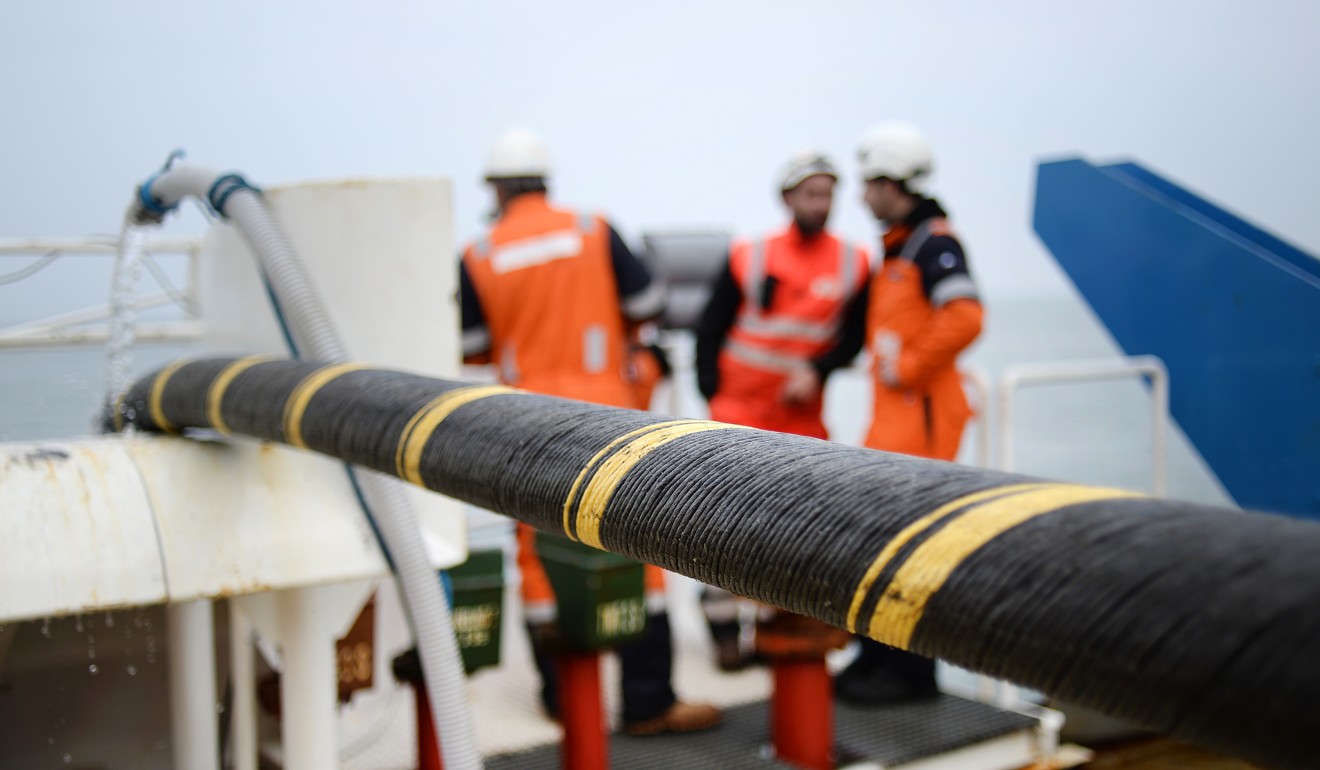
The ambitions of Chinese tech giants like Huawei, which have laid thousands of kilometres of cable, are of increasing concern to Washington. Photo: Reuters
In the contest between the US and China for dominance over the world’s technology
infrastructure, the latest battle is taking place under the Pacific Ocean.
While the US has been upping the pressure on its allies not to include equipment made by Chinese telecom giants like Huawei and ZTE in their 5G systems, Chinese companies have gained a foothold in some of the world’s most essential communications infrastructure – undersea internet cables.
Smart telecom cables: climate change hope or submarine spying tech?
14 Dec 2019
Almost all global data communications flow through cables under the ocean – just one per cent travels by satellite – and Chinese companies have quietly been eroding US, European and Japanese dominance over the backbone of the internet, the undersea cable market. Now, they have trained their sights on connecting one of the most virtually remote parts of the globe, the Pacific Island countries.
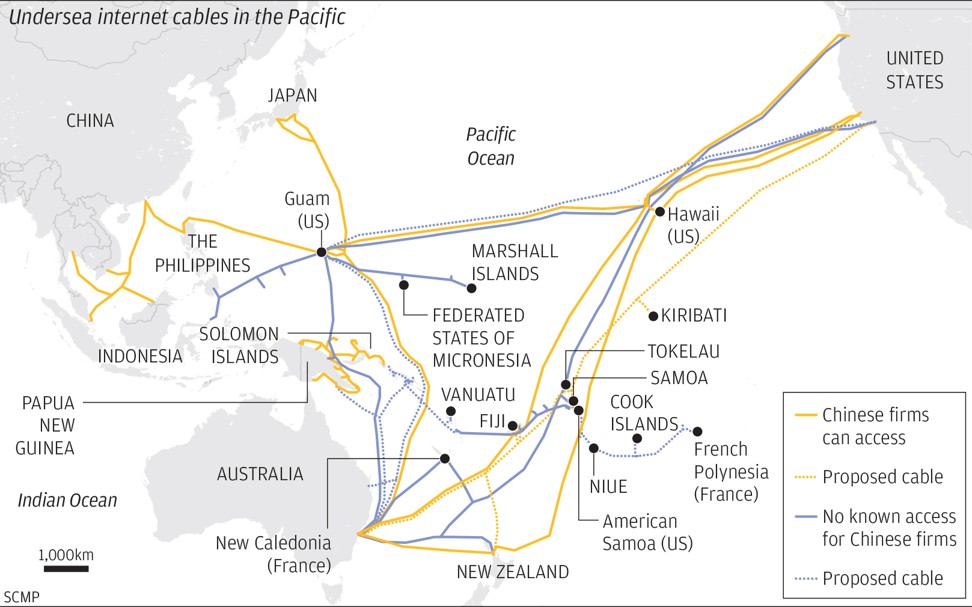
Of the 378 cables currently operating worldwide, 23 are under the Pacific. But many of these cables run right by Pacific Island nations on their paths between hubs in Los Angeles, Tokyo and Singapore.
An electric submarine cable and optical fibre. File photo
Despite the volume of data flowing under the Pacific Ocean, just half a million of the 11 million people living in Pacific Island countries and Papua New Guinea – less than five per cent – have access to a wired internet connection and only 1.5 million to a mobile connection, according to the United Nations Economic and Social Commission for the Asia Pacific (UNESCAP), compared with 53 per cent of people in Thailand and 60 per cent in the Philippines.

More than US$4 billion worth of cables are to come into service by 2021, continuing a trend in which US$2 billion worth of cables have come online every year since 2016, and six of these cables will connect Pacific Island countries.

The push to connect Pacific Island nations to the latest generation of internet infrastructure has received extra scrutiny from the US and its allies like Australia
over the involvement of Chinese tech companies.
Choose Beijing over Taipei, Solomon Islands task force recommends
13 Sep 2019

SECURITY CONCERNS

While the US has moved to block Huawei from supplying equipment to its allies’ 5G networks, experts say Chinese tech companies could contest the US, EU and

Japan’s

long-standing dominance over global data traffic through investments in subsea cables.

Chinese tech giants like Huawei have entire divisions devoted to undersea connectivity that have laid thousands of kilometres of cable, and Chinese state telecommunication companies such as China Unicom have access to many of the existing trans-Pacific cables.

But a panel led by the US Department of Justice has held up a nearly complete trans-Pacific cable project over concerns about its Chinese investor, Beijing-based Dr Peng Telecom & Media Group.

The project, the Pacific Light Cable Network, could be the first cable rejected by the panel on the grounds of national security – despite being backed by American tech giants Google and Facebook – setting a precedent for a tougher US stance on Chinese involvement in subsea cables.
Chinese tech giants like Huawei have entire divisions devoted to undersea connectivity that have laid thousands of kilometres of cable. Photo: AP
Craige Sloots, director of sales at Southern Cross Cable Network, which operates the largest existing sets of trans-Pacific cables, said for any new cable, regulators were likely to scrutinise the ownership of the companies involved and the maker of the project’s equipment.
These two factors, said Sloots, “pragmatically limit some of the providers you can use if you want to connect through the US”.
Experts say that Hong Kong, where the stalled Pacific Light Cable would land, was previously considered a more secure shore landing point than mainland China. But people close to the project say the recent unrest in the city has made this distinction less relevant, according to The Wall Street Journal.

If these nations want to be part of the international economy, they need reliable communications: Bruce Howe, University of Hawaii

Similar concerns caused a proposed Huawei-backed cable linking Vanuatu with Papua New Guinea to be called off last year after Australia stepped in to fund its own cable instead.
Just months after the government-owned Solomon Islands Submarine Cable Company agreed to the project with Huawei in mid-2017, Canberra put up US$67 million to connect Sydney with the Solomon Islands and Papua New Guinea with cables laid under the Coral Sea by Nokia’s Alcatel Submarine Networks.
Simon Fletcher, CEO of Vanuatu company Interchange, which had been planning another cable in the neighbourhood connecting Vanuatu with the Solomon Islands, said the Coral Sea project undercut the viability for small private businesses to operate in the fledgling market, where services had historically been provided by international organisations like development banks. His company’s cable has been on pause since the announcement of the Coral Sea project, though Fletcher said it would go forward next year.
US-China battle for dominance extends across Pacific, above and below the sea
22 Jul 2019

VIRTUALLY REMOTE

For years, as Japan, Hong Kong and Singapore became global hubs of high-speed internet data traffic, the cables criss-crossing the ocean floor passed by just off the shores of Pacific Island countries en route between hubs on either side of the ocean.

Tiziana Bonapace, director of UNESCAP’s information technology and disaster risk-reduction division, said the Pacific Islands remain one of the most disconnected areas in the world, where “a vast proportion of the population has no access to the internet”.

Over the past five years, international organisations like UNESCAP, the Asia Development Bank and the World Bank have been pushing for better connectivity in the region. The World Bank’s Pacific Regional Connectivity Programme has invested more than US$90 million into broadband infrastructure for Fiji, the Federated States of Micronesia, Kiribati, the Marshall Islands, Palau, Samoa and Tuvalu.

Internet cables in the Pacific Ocean.
But the business case had never been good, said Bonapace.
“A cable has to travel thousands of kilometres just to connect a population smaller than one of Asia’s megacities,” she said. “As everything we do is somehow connected to the internet, the prospects for the Pacific to become virtually more remote are even higher.”
Even nations which are connected have tenuous infrastructure. In January, Tonga experienced a total internet blackout for two weeks after damage to its single cable. Most parts of the world were linked by multiple cables to prevent this type of outage, said Bruce Howe, professor of ocean and resources engineering at University of Hawaii.
“If these nations want to be part of the international economy, they need reliable communications,” Howe said.
Is Chinese support for Pacific nations shaping their stance on West Papua?
26 Aug 2019

DRAWING NEW LINES

In Papua New Guinea, where mobile internet currently reaches less than a third of the population, a partnership between local telecoms company GoPNG and the Export-Import Bank of China funded the new Huawei-built Kumul Domestic cable system, which came online this year.

The Southern Cross Next system, owned by Spark, Verizon, Singtel Optus and Telstra – the same group of shareholders which operates the massive 30,500km (19,000 mile) set of twin cables connecting the US with Australia and New Zealand known as Southern Cross – is planned to come online in 2022, and will connect directly to Fiji, Samoa, Kiribati and Tokelau.

Chinese telecoms company China Unicom counts the existing Southern Cross cables among its network capabilities – meaning it is likely to have access to the cable through a leasing agreement with one of the other companies that uses the cable, according to Canberra think tank the Australian Strategic Policy Institute (ASPI).

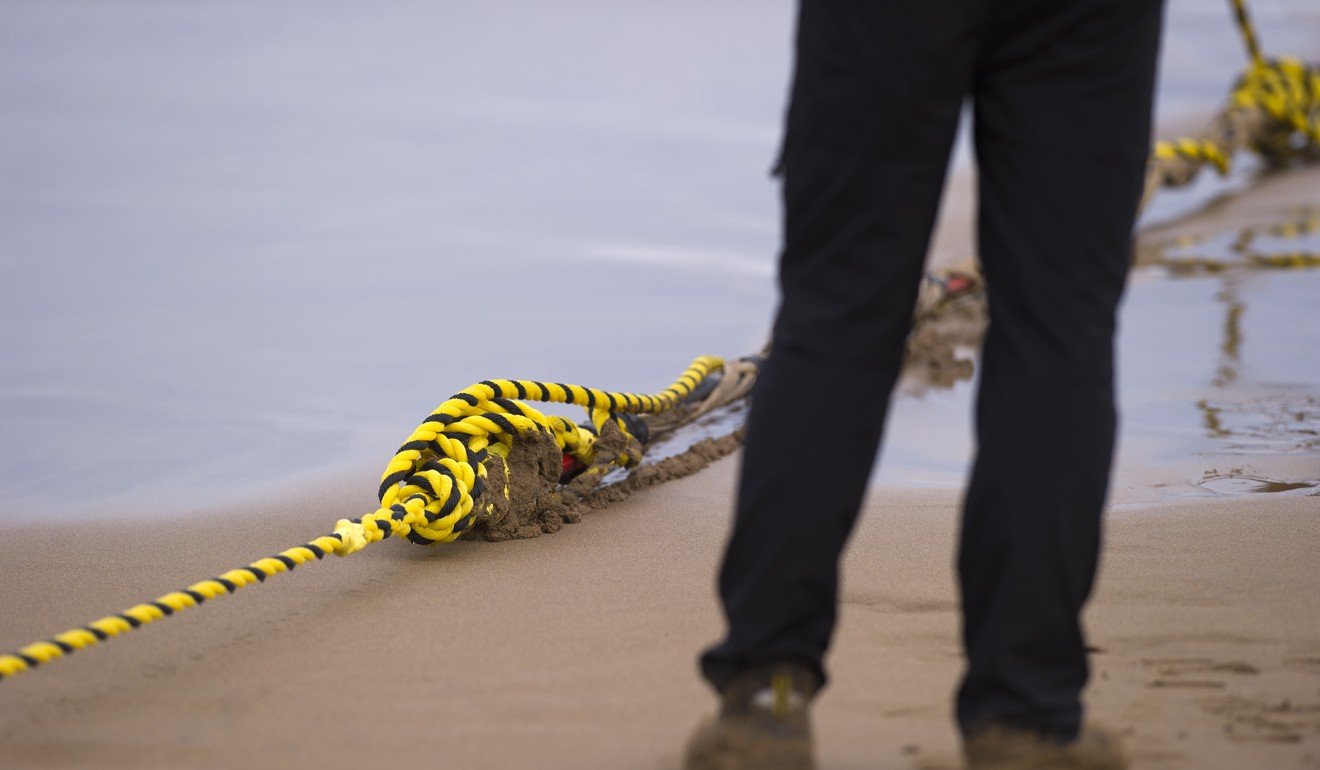
An undersea fibre optic cable. Photo: AFP
China Unicom and China Telecom also list the Asia America Gateway Cable System as one of their network capabilities, according to ASPI. The 20,000km (12,400-mile) cable came online in 2009 and connects the US, Guam, Hong Kong, Brunei, the Philippines, Singapore, Malaysia, Vietnam and Thailand.
It is owned by a consortium of carriers including AT&T, Telekom Malaysia, Telstra and Spark.
A cable backed by Google and the Australian Academic and Research Network connecting Japan and Australia through Guam is to come online early next year.
China: the real reason Australia’s pumping cash into the Pacific?
28 Jul 2018

WHAT’S NEXT

Natasha Beschorner, senior digital development specialist at the World Bank, said that while there were challenges ahead in terms of broadband access and affordability, increased connectivity was starting to bring new opportunities to the Pacific.

“Digital technologies can contribute to economic diversification, income generation and service delivery in the Pacific,” Beschorner said. “E-commerce and financial technologies are emerging and governments are considering how to roll out selected services online.”

Experts say the industry has recently seen a switch from cables being mostly funded by telecommunication carriers to being funded by content providers, like Google and Facebook. Members of the private cable industry say content companies can afford to invest in cable infrastructure to ensure the supply chain for their customers, but that the competition puts the squeeze on the research-and-development budgets of other types of companies.

Sloots at Southern Cross predicted that the nations which connected directly to the massive next-generation cable – Samoa, Kiribati and Tokelau – would be able to function as connecting points for intra-Pacific cables.

“There’s a blossoming effect in capability once certain islands are connected,” Sloots said.

There is also the push to locate an exchange point within the Pacific so that internet data no longer has to travel to a hub in Tokyo or Los Angeles and back to Pacific nations when processing – a move that could ultimately lower the cost of broadband internet service for consumers in the Pacific.

Perhaps the most effective outcome could be for Pacific nations to cut the cord and receive their internet by satellite.

The Asian Development Bank has agreed to give a US$50 million loan to Singapore’s Kacific Broadband Satellites International to provide up to two billion people across the Asia-Pacific region with affordable satellite-based internet.

The project is to be launched into orbit by SpaceX next week and aims to begin providing service by early next year.

Source: SCMP

27/12/2019

China’s ‘great friendship’ with Micronesia grows warmer, leaving US with strategic headache in Pacific

  • As US financial support expires in 2023, Beijing could ‘loosen the screws’ on regional alliance with lucrative development deals
  • Independence vote in Micronesia’s Chuuk state in March could raise the stakes, potentially allowing China access to strategically vital waters
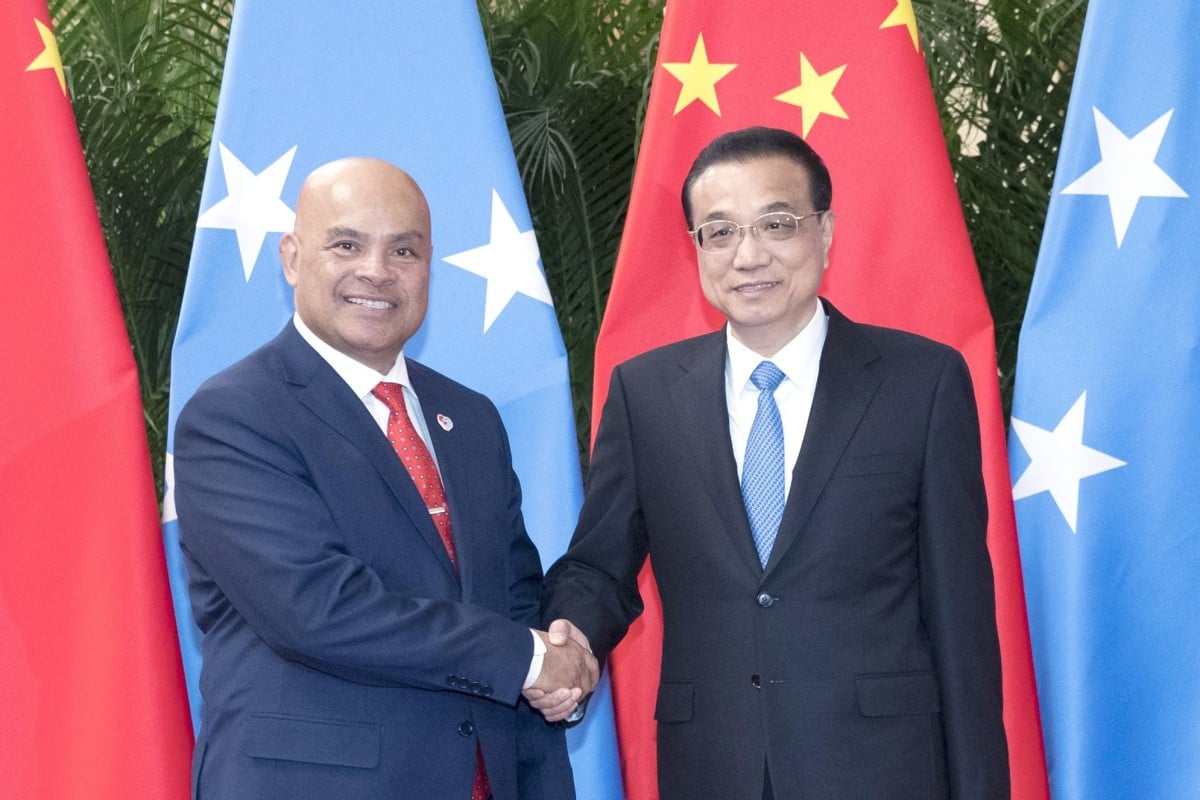
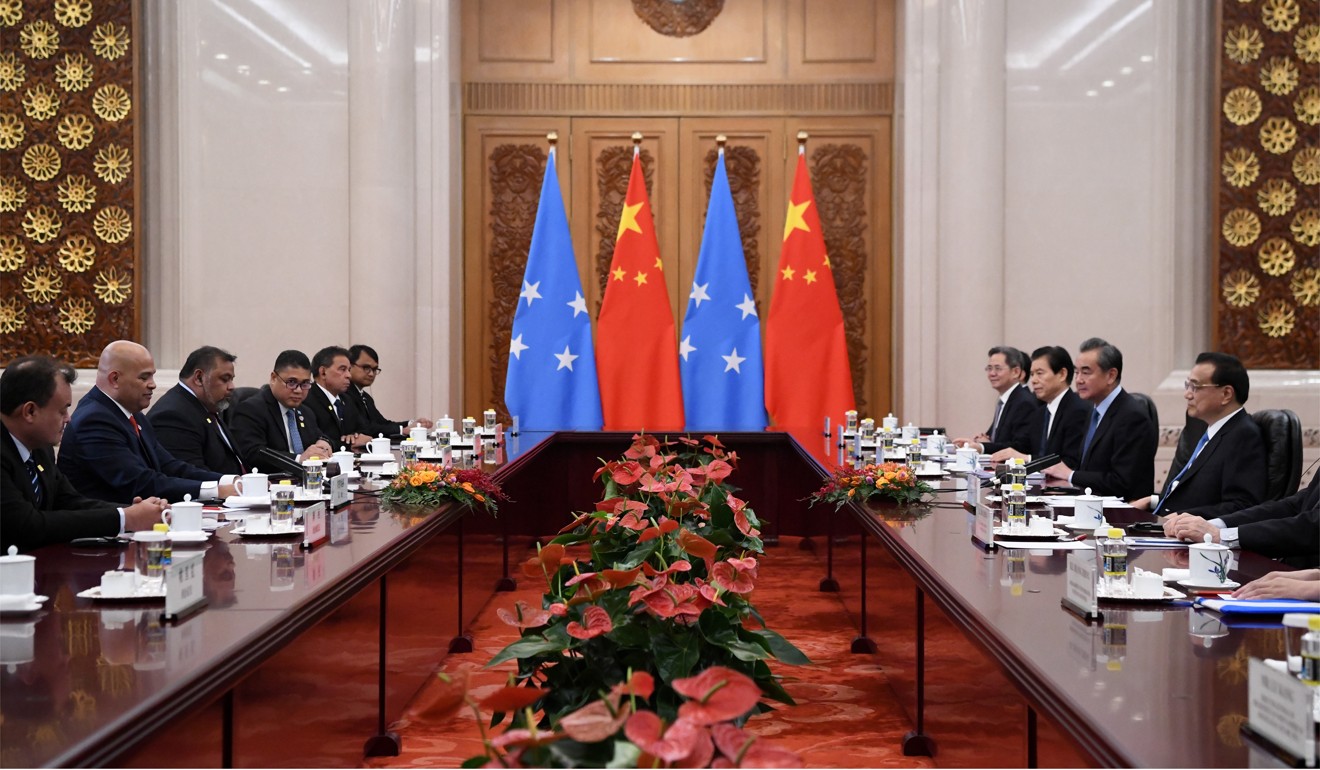
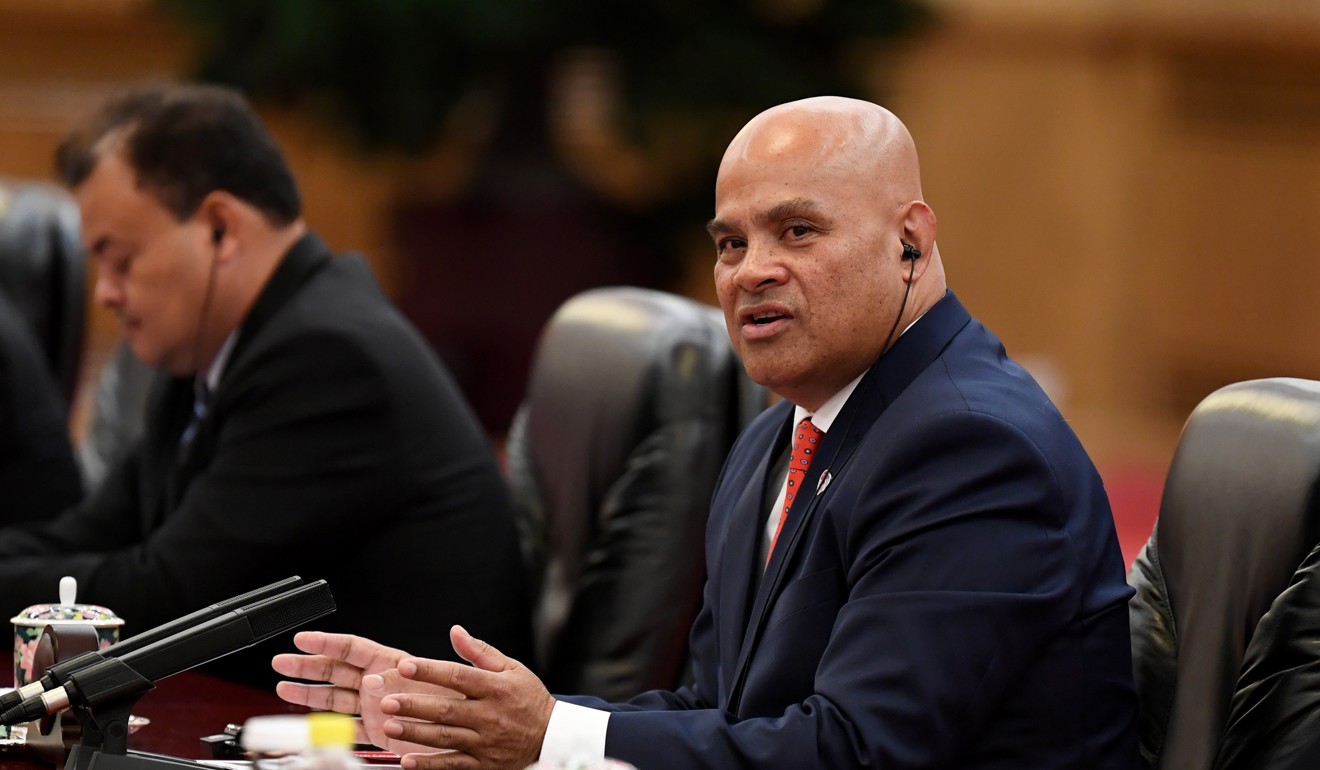
President of the Federated States of Micronesia David Panuelo shakes hands with Chinese Premier Li Keqiang at the Great Hall of the People in Beijing. Photo: Xinhua
In China earlier this month, David Panuelo, the president of the Federated States of Micronesia, climbed the Badaling section of the Great Wall. And, according to Huang Zheng, Beijing’s ambassador to the Pacific nation, the countries’ “great friendship rose to even greater heights” during Panuelo’s visit.
Chinese investment in Micronesia reached similarly lofty levels in conjunction with Panuelo’s trip, which marked three decades of diplomatic ties and included meetings with President Xi Jinping and Premier Li Keqiang. Beijing has committed US$72 million in economic development deals, almost as much as its total investment of the previous three decades.
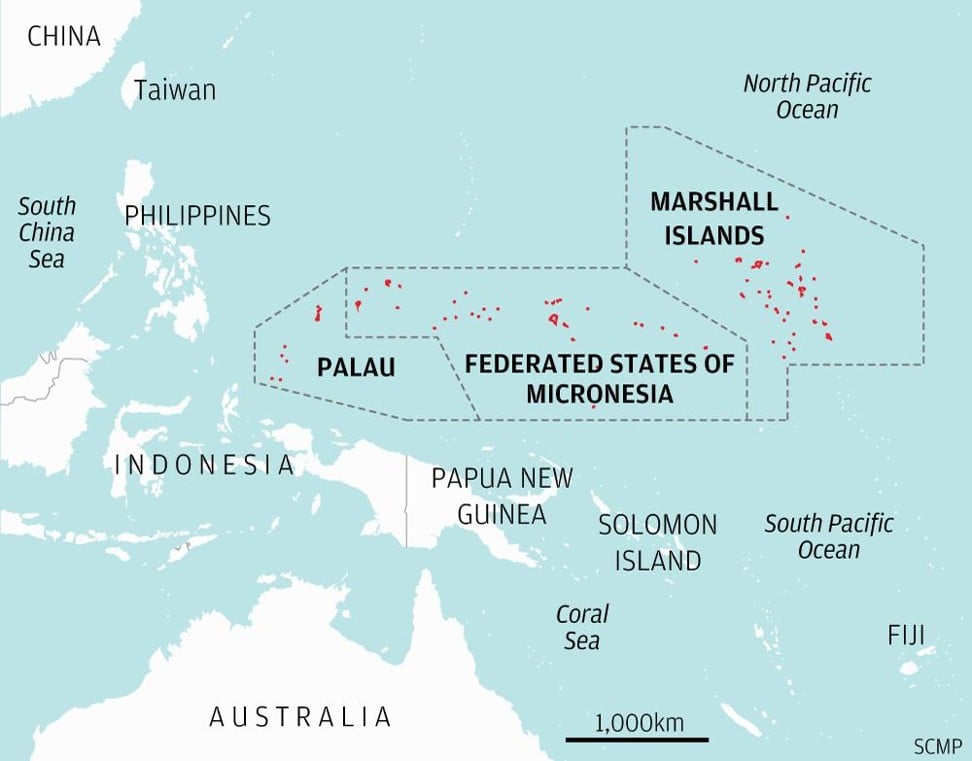
Micronesia is one of three Pacific nations with agreements with Washington, known as the Compact of Free Association (COFA), which allows their citizens to live and work in the US. In exchange, Micronesia, neighbouring Palau and the Marshall Islands grant the US exclusive military and defence access to their territorial waters – more than 2 million square miles of the Pacific that have been an essential element of Washington’s power projection in the region since World War II.
However, analysts warn Micronesia’s “great friendship” and tighter economic ties with Beijing could undermine this long-standing defence relationship with the US.
Much of China’s funding has been directed to Micronesia’s Chuuk state, which will in March vote in an independence referendum.
Although Chuuk is home to fewer than 50,000 people, its waters include one of the region’s deepest and most strategically appealing lagoons, creating extra incentive for Beijing and potential concern for Washington as the two countries

vie for influence in the Pacific.

How China ‘loosens the screws’

With a population of just 113,000 people, Micronesia relies on remittances sent home by citizens working in the US as well as the financial support from Washington under COFA. That assistance is scheduled to expire in 2023, creating uncertainty about the future of the relationship and making Chinese investment even more influential.

“Panuelo’s visit to China is a perfect example of how [the Chinese side] just needs to do a little to get a lot,” said Derek Grossman, senior analyst at Rand Corporation, a Washington think tank. “US$100 million is not very much for them and they can essentially loosen the screws [on COFA] with that.”

Micronesian President David Panuelo (second on left) and Chinese Premier Li Keqiang (right) during their talks in Beijing. Photo: EPA-EFE
The value of Micronesia’s bilateral trade with China has increased by nearly 30 per cent annually for the past five years, according to Micronesia’s Foreign Ministry. In 2017, the island nation signed onto President Xi’s signature Belt and Road Initiative which aims to build a vast network of strategic investment, trade routes and infrastructure projects across more than 150 countries.
US-China tech war’s new battleground: undersea internet cables14 Dec 2019

In recent years Chinese funding in Micronesia has built office and residential complexes for government officials, a showpiece new convention centre in the capital city Palikir, transport infrastructure and student exchanges, according to a recent report by Rand.

Jian Zhang, associate professor at UNSW Canberra at the Australian Defence Force Academy, said Beijing’s investment reflected a decision to cultivate broader, deeper ties.

Micronesian President David Panuelo during his meeting with Chinese officials in Beijing. Photo: EPA-EFE
“China’s interest in building the relationship with Micronesia is not just about its diplomatic rivalry with Taiwan or economic interests,” he said. “It has elevated the relationship to a comprehensive strategic partnership which encompasses all areas.”

During his recent visit, Panuelo described China as Micronesia’s top economic partner and the US as its top security partner. Pompeo’s visit to Micronesia highlights US anxiety about rising Chinese influence in Pacific 5 Aug 2019

Gerard Finin, professor of regional planning at Cornell University, who previously worked with the US Department of State in the Pacific, said: “China’s leadership consistently accords large ocean states the full protocol that is expected when a head of state visits.

“In contrast, Washington has only had a limited number of meetings and never hosted an official state visit to Washington for the leader of a Pacific Island nation,” said Finin.

US President Donald Trump in May hosted the leaders of Micronesia, Palau and the Marshall Islands together at the White House. When Mike Pompeo visited Micronesia
in August, he became the only sitting US secretary of state to have done so.
Pompeo said negotiations to update COFA had begun but no details have been made public. Micronesia has assembled a team to conduct the negotiations but the US has not, the Honolulu Civil Beat website reported.
US Secretary of State Mike Pompeo visited Micronesia in August. Photo: AFP

Breakaway vote could raise the stakes

Panuelo’s team met Micronesian students studying in China and representatives of state-owned China Railway Construction Corporation, which will build the roads in Chuuk, funded in part by US$50 million from Beijing. Construction of the Chuuk government complex was also funded by Beijing and the state’s governor joined Panuelo for his visit.

Should Chuuk vote to separate from Micronesia in March, it could also mean breaking from COFA, jeopardising the US work privileges of thousands of Chuukese and opening the state’s waters to other partners, particularly China.

Chuuk is home to one of the deepest lagoons in the Pacific, a geographic rarity of particular value in strategic military operations and submarine navigation.

US Coast Guard looks to bolster Pacific allegiances as Chinese clout grows
22 Oct 2019

Zhang said Beijing would explore any opportunity to build a port with potential military capability.

“China has a long-term need to gain a strategic foothold in the region,” Zhang said. “That is a key part of the Belt and Road Initiative. At the general level it’s an economic initiative but an important aspect of the maritime Silk Road is to develop a network of strategically located port facilities.”

Sabino Asor, chair of the public education committee for the Chuuk Political Status Commission, told Civil Beat seceding from Micronesia would be the best option for Chuuk’s future.

“There is no encouraging prospect if Chuuk remains within the Federation,” he said.

However, Patrick Buchan, at Washington think tank Centre for Strategic and International Studies, said Chuuk’s dependence on remittances from the US made breaking from COFA unlikely.

China courts Pacific island states in pursuit of ‘foothold’ as US risks losing influence

8 Aug 2019

In the meantime, uncertainty over COFA negotiations persists, although there is a chance it will be renewed with few changes.

“There is circulation with people easily coming and going that provides a level of understanding and friendship that does not exist between too many other countries,” Finin said.

However, China’s most attractive feature may be its willingness to at least discuss the most pressing concern of Pacific Island nations: climate change.

“When the Trump administration talks about how it doesn’t believe in climate change, or can’t even say the words – that is really offensive for Pacific nations,” Grossman said. “China knows that, and is taking full advantage of it.”

Source: SCMP

Law of Unintended Consequences

continuously updated blog about China & India

ChiaHou's Book Reviews

continuously updated blog about China & India

What's wrong with the world; and its economy

continuously updated blog about China & India