

- Item expected to feature prominently after year of protests
- Hong Kong delegates to meet top official from State Council’s Hong Kong and Macau Office on Thursday evening
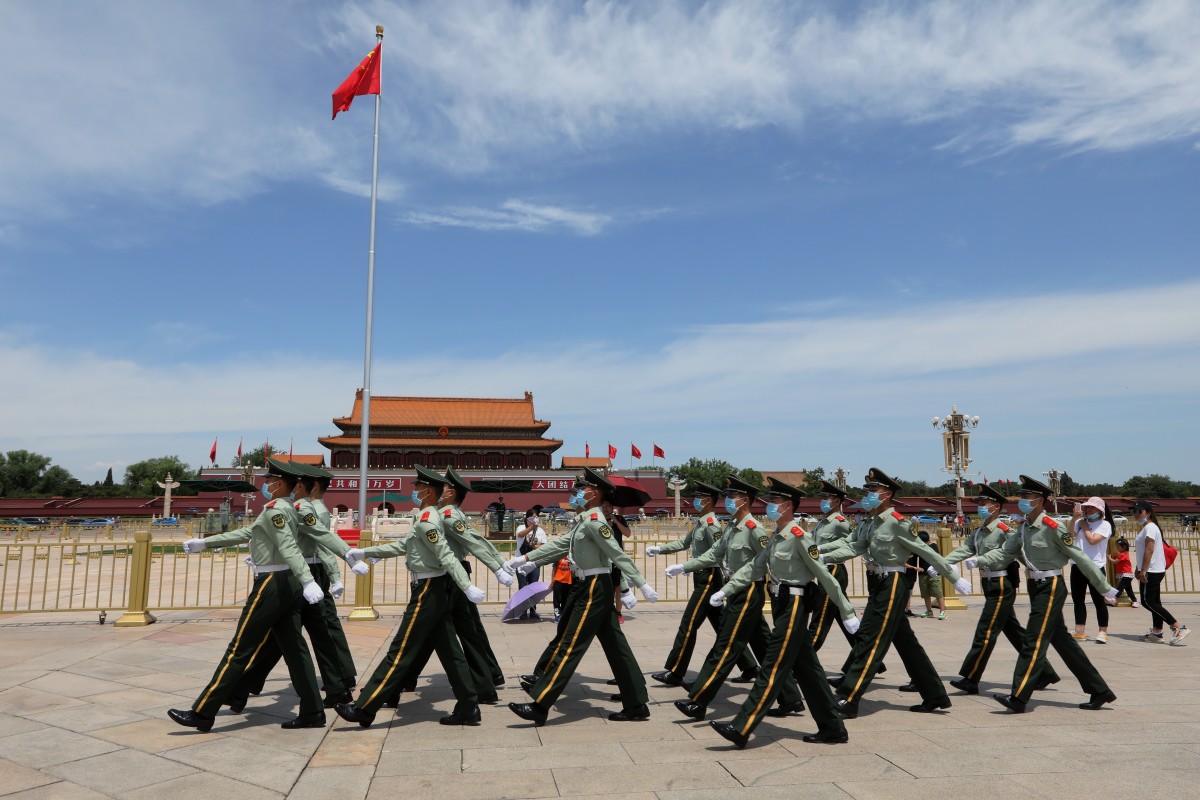
Armed policemen walk through Tiananmen Square in Beijing, ahead of the start of this year’s two sessions. Photo: Simon Song
As Hong Kong delegates to the country’s legislature gather in Beijing for the nation’s biggest political event of the year, momentum is building behind a push for national security legislation which is expected to feature prominently on the agenda.China’s “two sessions” of parliamentary meetings open on Thursday, but for Hong Kong, all eyes will be on an evening meeting with Xia Baolong, director of the State Council’s Hong Kong and Macau Office (HKMAO), that the city’s delegates have been invited to, sources told the Post.
Zhang Qingli, vice-chairman of the Chinese People’s Political Consultative Conference, the nation’s top advisory body, is also due to attend the meeting.“The national security issue is expected to be on the agenda, given the protests in the past months,” a source, who has been invited to the gathering, said.The Basic Law, or the city’s mini-constitution, requires the Hong Kong government to enact its own national security law prohibiting acts of “treason, secession, sedition, or subversion” under Article 23.
But the law has been in abeyance since 1997. In 2003, the Hong Kong government was forced to shelve a national security bill after an estimated half a million people took to the streets to oppose the legislation, which they warned would curb their rights and freedoms.
Since then, the government has steered clear of introducing such legislation. However, pressure to do so has been mounting after the anti-extradition bill protests in 2019 morphed into a wider anti-government movement, with Beijing officials suggesting foreign hands were involved in violent activities akin to terrorism.ADVERTISINGA Beijing official source said: “Certainly, Beijing is very concerned about Hong Kong increasingly becoming the loophole in China’s national security. Director Xia Baolong and Luo Huining will meet the Hong Kong National People’s Congress (NPC) delegates after their preparatory session and with Chinese People’s Political Consultative Conference (CPPCC) members later tonight, this concern will be a key talking point.”
Actions like these make it more difficult to assess that Hong Kong remains highly autonomous from mainland ChinaUS Secretary of State Mike Pompeo
Meanwhile, a Hong Kong deputy to the NPC said deputies from the city would meet Luo, director of Beijing’s liaison office in Hong Kong, after their group meeting starting at 3pm on Thursday.CORONAVIRUS UPDATEGet updates direct to your inboxSUBSCRIBEBy registering, you agree to our T&C and Privacy Policy
The two sessions in Beijing are the annual meetings of the CPPCC National Committee, the top advisory body, and the NPC, the country’s top legislature.
These will be the first formal meetings as part of the two sessions that both Xia and Luo will have with the Hong Kong delegates. Both men took over their posts earlier this year in a major reshuffle of officials taking care of Hong Kong affairs.
As former provincial party chiefs, both are seen to be firmer hands keen to steer the city back to stability, with the protest movement quelled.Beijing’s push for national security legislation comes against the backdrop of rapidly escalating tensions between the United States and China.Secretary of State Mike Pompeo launched a verbal salvo against China on Wednesday, attacking Beijing for its policies on health, defence, Taiwan and 5G and its “brutal” regime as he expressed US concern over certifying Hong Kong’s autonomy.
Pompeo, a former CIA director, also called out the recent arrests of leading Hong Kong activists such as Democratic Party founder Martin Lee, and entrepreneur and media owner Jimmy Lai, describing how they had been “hauled into court”.
“Actions like these make it more difficult to assess that Hong Kong remains highly autonomous from mainland China,” Pompeo said. “We’re closely watching what is going on there.”https://open.spotify.com/embed-podcast/episode/7FysY5fAaEnrS3uzPHxj5a
Under the Hong Kong Human Rights and Democracy Act of 2019, the US has until the end of this month to assess whether Hong Kong remains suitably autonomous from China, a prerequisite for extending the city’s preferential US trading and investment privileges.
Coronavirus and protests highlight need for national security law in Hong Kong15 Apr 2020
While few doubt that Article 23 would feature heavily during the discussions, it was not immediately clear how the legislation could be enacted. Hong Kong’s opposition politicians have vowed to do their all to block the legislation, seeing its passage as the end of the city’s autonomy.
Pro-Beijing politicians, including NPC deputy Maggie Chan Man-ki, have argued that given Hong Kong has been unable to enact Article 23 legislation, Beijing should consider invoking its power under Article 18 to promulgate a national security law in the city.
Article 18 of the Basic Law says that national laws can apply to Hong Kong once they are listed in Annex III of the mini-constitution. And if such laws have to do with defence, foreign affairs and “other matters outside the limits” of the autonomy given to the city, they can be listed under Annex III.
The national laws would then be promulgated – imported automatically – or adapted through local legislation.
Hong Kong must not delay national security law, central government adviser says21 Dec 2019
On the possibility of passing a national security law in this NPC session, the official source said: “Sure everything is possible, but we should also note that the NPC agenda is prepared way in advance. It might be too rushed to add a national security law agenda one day before opening.”
The annual sessions of the CPPCC and NPC will open on Thursday afternoon and Friday morning, respectively. The sessions, also known as “Lianghui”, are normally held in March, but this year’s meetings were postponed because of the coronavirus pandemic.
Source:SCMP

 CHINDIA ALERT: You'll be living in their world, very soon
Leave a comment