

- National People’s Congress concluded with resolution to proceed with controversial law for Hong Kong
- Premier said that China supports independent inquiry into coronavirus origin
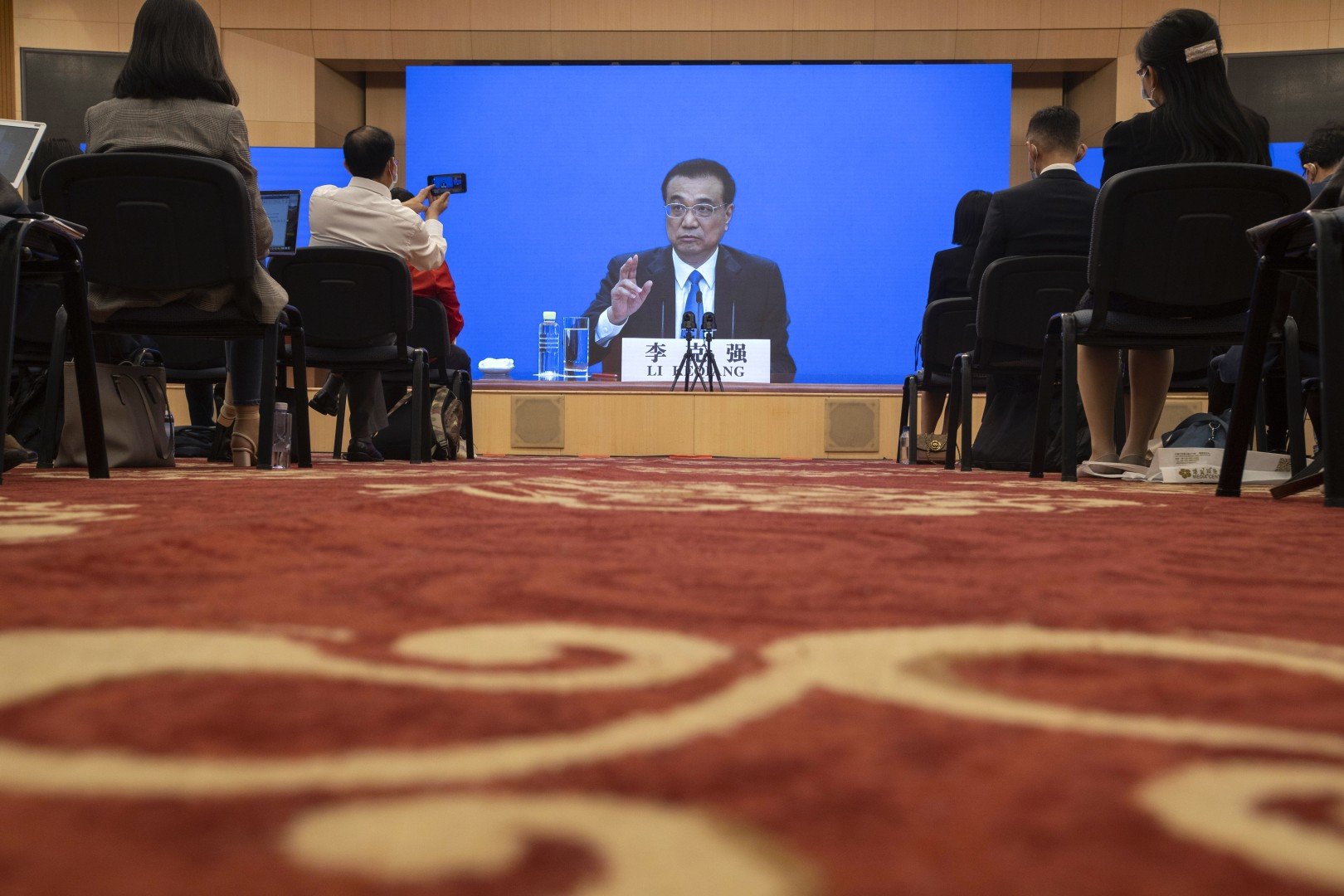
, and a pledge to boost the economy which has been hit by the Covid-19 pandemic.
The main points from Li’s press conference:
- The central government will stick to the principle of “one country, two systems”, and “Hong Kong people governing Hong Kong” with a high degree of autonomy. The NPC’s resolution for a
is designed to safeguard “one country, two systems” instead of abandoning it.
- China supports scientific efforts to
. No cover-up of the outbreak will be allowed.
- On China-US tensions, China rejects a
and the two nations should promote cooperation, such as the investment in Wuhan by a hi-tech US company.
- In his government work report, Li
. But he said at the press conference that “peaceful reunification” was still Beijing’s policy and the mainland was open to further exchanges with Taiwan.
- Even though the central government did not set a GDP growth target, China will implement
.
Li ended the press conference by stressing that China was “an enormous market”, and a place that the world should still see as a good investment.
He said China would boost imports, and the world should work together to combat the pandemic.
But he did not address ongoing anti-government protests in Hong Kong, or respond to
that Washington no longer considered Hong Kong to be autonomous from Beijing.
or China’s relations with Europe.
On the difficult and unpredictable external factors faced by China, Li said the pandemic had hit the world severely, greatly reducing exchanges between countries.
Li said that given the tough economic times, Beijing would expand coverage of subsistence allowances and unemployment benefits as well as increase pensions for the elderly.
“There can be no loopholes – if there are any gaps, then this will make people feel there is no hope for the future,” he said. “As the saying goes, the people are the foundation of a state and when the foundation is solid, the state enjoys tranquility.”
Li said that even with the fallout from the coronavirus pandemic, the country was still determined to reach its goal of eliminating poverty by 2020.
He said there were some 5 million people living below the poverty line before the outbreak, and more may have fallen below it since then, making eliminating poverty a “daunting task”.
So far Li has taken nine questions, of which four were from foreign media, one was from Hong Kong and one from Taiwan.
Even though the main focus of the NPC is the national security legislation for Hong Kong, only one question raised at the presser has been about the city.
Li said the central government must work hard to help business flourish, aiming at having 10,000 new enterprises registered each day.
The government must get rid of all unnecessary restrictions on the market, foster fair competition and create tangible wealth, he said.
He said there had been a surge in new kinds of businesses, such as online platforms, during the pandemic, and some of these businesses had seen their revenue grow by two-thirds.
was not good for either country or the world, Li said.
He said trade and economic cooperation should be based on market forces. There were differences in each other’s systems, and conflicts were inevitable, but the key was how to handle the problems.
We need to mutually respect each other’s core interests and search for areas for cooperation, Li said.
The US had in recent days issued a strategic policy that appeared to signal that Washington had abandoned its engagement policy towards Beijing.
He also spoke of new investment by a hi-tech US company in the central Chinese city of Wuhan, an example he said reflected the importance of business ties and cooperation between the countries.
Li had earlier sent a congratulatory letter to the company, the US conglomerate Honeywell.
meant that Beijing had abandoned the “one country, two systems” model for Hong Kong, Li said the law was to secure the long-term stability of “one country, two systems”.
University students are expected to graduate and enter the workforce in record numbers this year.
Li said that Beijing’s cross-strait policy would not change, and that the mainland Chinese government was open to further exchanges with Taiwan to move forward on “peaceful reunification” with the self-ruled island.
He rejected all “Taiwanese independence forces” and external interference in Taiwan.
He said Beijing remained committed to the 1992 consensus – the political understanding that there is only “one China” but that each side has its own understanding of what this means.
Li’s work report this year did not refer to the 1992 consensus and omitted the word “peaceful” in the phrase “peaceful reunification”, which some feared signalled a more hawkish stance from Beijing on Taiwan.
Last week, Taiwanese President Tsai Ing-wen officially started her second term, after a landslide election win in January that many saw as an endorsement of her harder stand against Beijing.
Li said Beijing would continue to pay high attention to the island, adding that no Taiwanese died from the coronavirus in mainland China.
, and not infrastructure construction.
Smaller firms would also be targeted for support.
“The central government will live on a tight budget,” Li said.
Li said China had successfully controlled the coronavirus within its borders and Beijing had acted in a transparent and timely manner throughout the pandemic.
“No cover-up will ever be allowed,” he said.
Li said there were two main challenges in the pandemic: controlling the virus outbreak and reopening the economy. International cooperation was important for both.
“We may have to live with Covid-19 for some time to come,” he said.
into the pandemic, Li said that China also believed it was important to find the source of the pathogen.
Li said Beijing was open to international cooperation on research and development for a vaccine. Washington has accused China of seeking to steal its vaccine research, a charge that Beijing has strongly rejected.
The cabinet is determined to stabilise the economy, according to Li.
“If there are big changes, we still have policy room, including on the fiscal, financial and social security fronts,” he said.
“We are confident that under the strong leadership of [President] Xi Jinping and with joint efforts across the nation, we will be able to prevail in the difficulties and achieve the goal of building a moderately prosperous society.”
Li said the Chinese economy was deeply integrated into the global economy, so China would not be immune from the impact of the coronavirus.
Economic development remained key to solving China’s problems today, Li said.
Li starts his annual press conference by saying that the restrictions imposed for Covid-19 will not affect his communication with the media.
This year all journalists are restricted to the press centre, the first time that the media have not been in the same room as the premier at his annual press conference.


 CHINDIA ALERT: You'll be living in their world, very soon
Leave a comment