Archive for June, 2020

30/06/2020

China passes national security law in turning point for Hong Kong

HONG KONG/BEIJING (Reuters) – China’s parliament passed national security legislation for Hong Kong on Tuesday, setting the stage for the most radical changes to the former British colony’s way of life since it returned to Chinese rule 23 years ago.

Details of the law – which comes in response to last year’s often-violent pro-democracy protests in the city and aims to tackle subversion, terrorism, separatism and collusion with foreign forces – are due out later on Tuesday.

Amid fears the legislation will crush the global financial hub’s freedoms, and reports that the heaviest penalty under it would be life imprisonment, pro-democracy activist Joshua Wong’s Demosisto group said it would dissolve.

RELATED COVERAGE

See more stories

“It marks the end of Hong Kong that the world knew before,” Wong said on Twitter.

The legislation pushes Beijing further along a collision course with the United States, Britain and other Western governments, which have said it erodes the high degree of autonomy the city was granted at its July 1, 1997, handover.

The United States, already in dispute with China over trade, the South China Sea and the novel coronavirus, began eliminating Hong Kong’s special status under U.S. law on Monday, halting defence exports and restricting technology access.

China said it would retaliate.

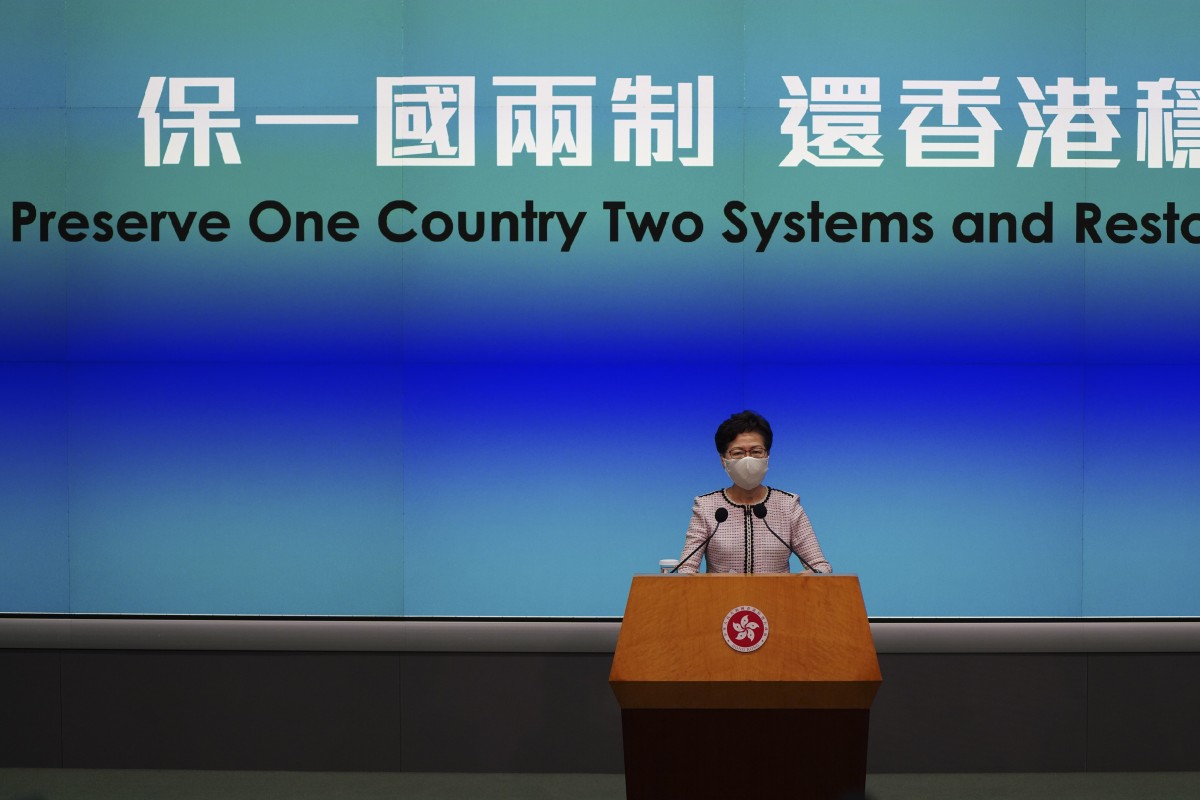
Hong Kong leader Carrie Lam, speaking via video link to the United Nations Human Rights Council in Geneva, urged the international community to “respect our country’s right to safeguard national security”.

She said the law, which is expected to come into force imminently, would not undermine the city’s autonomy or its independent judiciary.

Authorities in Beijing and Hong Kong have repeatedly said the legislation is aimed at a few “troublemakers” and will not affect rights and freedoms, nor investor interests.A pro-China supporter celebrates with champagne after China’s parliament passes national security law for Hong Kong, in Hong Kong, China June 30, 2020. REUTERS/Tyrone Siu

The editor-in-chief of the Global Times, a tabloid published by the People’s Daily, the official newspaper of China’s ruling Communist Party, said on Twitter the heaviest penalty under the law was life imprisonment, without providing details.

Details of the law would be published later on Tuesday, said Henry Tang, a Hong Kong delegate to China’s top advisory body, after a meeting at Beijing’s main representative office.

‘OVERPOWERING’

The legislation may get an early test with activists and pro-democracy politicians saying they would defy a police ban, amid coronavirus restrictions, on a rally on the anniversary of the July 1 handover.

At last year’s demonstration, which came amid a series of pro-democracy protests, a crowd stormed and vandalised the city’s legislature.

“We will never accept the passing of the law, even though it is so overpowering,” said Democratic Party chairman Wu Chi-wai.

It is unclear if attending the unauthorised rally would constitute a national security crime if the law came into force by then.

A majority in Hong Kong opposes the legislation, a poll conducted for Reuters this month showed, but support for the protests has fallen to only a slim majority.Slideshow (3 Images)

Police dispersed a handful of activists protesting against the law at a shopping mall.

Dozens of supporters of Beijing popped champagne corks and waved Chinese flags in celebration in front of government headquarters.

“I’m very happy,” said one elderly man, surnamed Lee.

“This will leave anti-China spies and people who brought chaos to Hong Kong with nowhere to go.”

This month, China’s official Xinhua news agency unveiled some of the law’s provisions, including that it would supersede existing Hong Kong legislation and that interpretation powers belong to China’s parliament top committee.

Beijing is expected to set up a national security office in Hong Kong for the first time and could also exercise jurisdiction on certain cases.

Judges for security cases are expected to be appointed by the city’s chief executive. Senior judges now allocate rosters up through Hong Kong’s independent judicial system.

It is not known which specific activities are to be made illegal, how precisely they are defined or what punishment they carry.

Britain, the European Union, Japan, Taiwan and others have also criticised the legislation.

China has hit back at the outcry, denouncing “interference” in its internal affairs.

Source: Reuters
28/06/2020

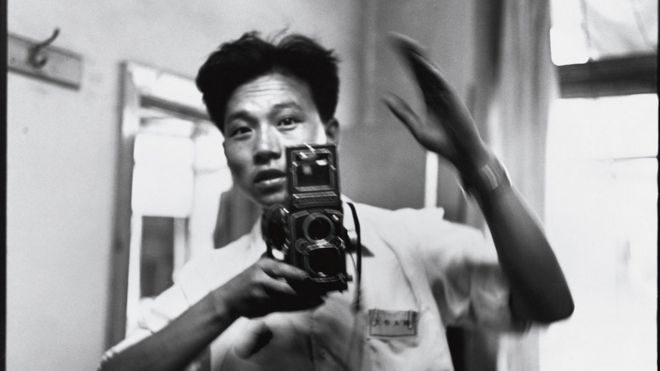
Li Zhensheng: Photographer of China’s cultural revolution

Li Zhensheng
Image caption Li Zhensheng in his youth

Li Zhensheng risked his life in his determination to capture China’s Cultural Revolution on film.

As a staff photographer working for a state-run newspaper, Li Zhensheng had rare access to people and places during one of the most turbulent periods of the 20th Century.

He took tens of thousands of photos, some of which were published, others stored in the floorboards of his flat for fear of punishment.

What he didn’t know then was that these hidden images would one day find their way out into the world.

The 79-year-old died earlier this week of cerebral haemorrhage in the US, said his Hong Kong publisher, the Hong Kong University Press.

“I have pursued witnessing and recording history all my life,” his publisher records him as saying before his death. “Now I rest in history.”

Red-colour News Soldier

Born in 1940 to a poor family in the Chinese province of Liaoning, Li grew up under difficult circumstances.

His mother died when he was three and he grew up helping his father in the fields until he was 10. Only then did he start school, but quickly rose to the top of his class.

He earned a spot at the Changchun Film School and eventually became a staff photographer for the Heilongjiang Daily newspaper in north-eastern China.

This job came during one of the most brutal periods in China’s history. The Cultural Revolution began in 1966 when Communist leader Mao Zedong began a campaign to eliminate his rivals.

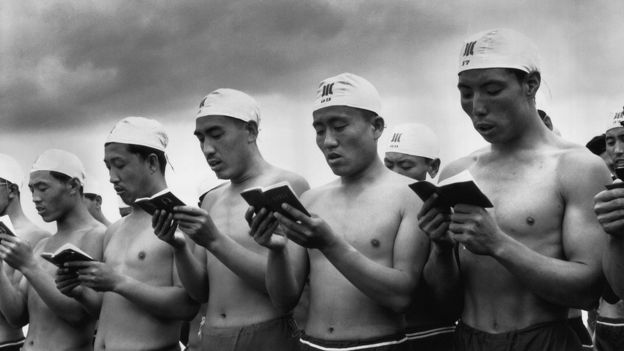
Swimmers reading the little red book
Image caption Swimmers reading Mao’s ‘Little Red Book’

Mao mobilised thousands of Chinese youth to destroy the “four olds” in Chinese culture – old customs, habits, culture and thinking.

Colleges were shut so students could concentrate on “revolution”, and as the movement spread, they began to attack almost anything and anybody that stood for authority.

Children turned on their parents and students turned on their teachers, intellectuals were exiled. Thousands were beaten to death or driven to suicide.

Li’s new job left him in the unusual position of being able to record the violence and brutality that was happening around him.

He noticed that the Red Guards – militant students – were getting access to photograph anything they wanted, so he decided to make an armband emblazoned with the words “Red-colour news soldier”.

“My work meant that I could take photographs of people being persecuted without being harassed,” he told the BBC in an earlier interview.

“I realised that this turbulent era must be recorded. I didn’t really know whether I was doing it for the revolution, for myself, or for the future.”

But he realised that the sensitive nature of the images could make him a target, so he hid the negatives away under the floorboards of his flat – around 20,000 of them.

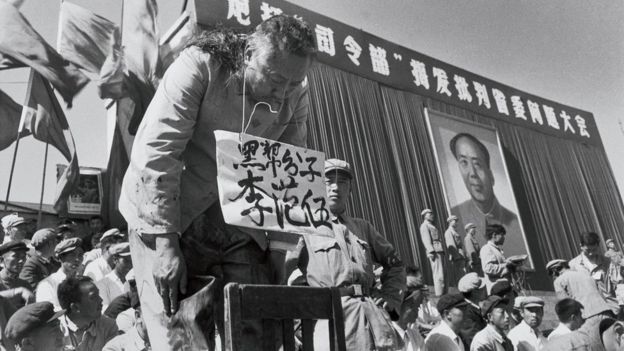
This photo shows Heilongjiang's provincial governor having his hair shaved in public
Image caption Heilongjiang’s provincial governor had his hair shaved after being accused of growing it long like Chairman Mao

When he was eventually accused of counter-revolutionary activities in 1968, his flat was ransacked by the authorities but the negatives remained undiscovered.

If they had been found, Mr Li would have been severely punished and they would almost certainly have been destroyed.

“It was kind of risky,” he admitted. “When I took these photos I was not sure how useful they would be.”

Li’s photos were safe but he was not – he was denounced and along with his wife, was forced to undergo hard labour for two years.

Upon his release he returned to his flat, and found the images safe and preserved.

He eventually became a professor at a university in Beijing and in the 1980s – a period of time when China saw a sliver of press freedom – his works were exhibited at a photography event in Beijing.

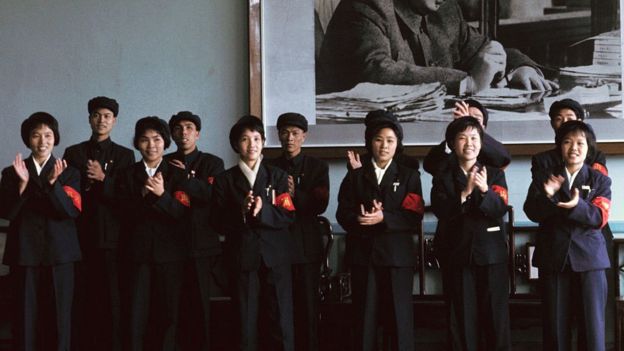
Red Guards applauding in front of Mao Zedong's portrait
Image caption Red Guards were so known for red bands they wore around their arms

It was then that his pictures were discovered by Robert Pledge of Contact Press Images (CPI), who later went on to publish a book with Li’s images.

The book’s name? Red-colour News Soldier.

“We will be forever grateful to Li for having risked so much to doggedly preserve his images at a time when most of his colleagues agreed to allow their politically ‘negative negatives’ to be destroyed,” said Pledge.

He revealed that Li kept all his photos in small brown paper envelopes. On each envelope he wrote detailed captions in delicate Chinese calligraphy. Communes and counties, people’s names, official titles and specific events were all carefully noted.

His photos were eventually exhibited in dozens of countries.

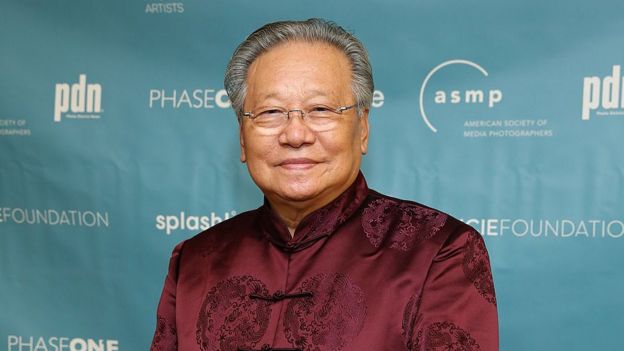
Photographer Li Zhensheng, attends the 11th Annual Lucie Awards at Zankel Hall, Carnegie Hall on October 27, 2013
Image caption Li at the Lucie Awards

In 2013, he was awarded the Lucie Award – known as the Oscars of the photography world.

And in 2018, his works were printed with Chinese text for the first time and published in Hong Kong.

“No single photographer covered the revolution more thoroughly and completely than Li,” said Contact Press Images in a statement following his death.

“He leaves an inestimable photographic legacy. He will be sorely missed.”

Source: The BBC

28/06/2020

China sees uptick in new COVID-19 cases, including 17 in Beijing

FILE PHOTO: A medical worker in protective suit collects swabs from construction workers for nucleic acid tests following a new outbreak of the coronavirus disease (COVID-19) in Beijing, China June 25, 2020. cnsphoto via REUTERS/File Photo

BEIJING (Reuters) – Mainland China reported on Saturday the highest number of new coronavirus cases in four days, driven by a COVID-19 resurgence in the Chinese capital of Beijing.

The National Health Commission reported 21 new confirmed infections in mainland China on Friday, up from 13 a day earlier and the highest since Monday.

In Beijing, 17 new confirmed cases were reported, up from 11 a day earlier and the most since June 20.

Since June 11 when Beijing reported its first case in the current outbreak, stemming from a sprawling wholesale food centre in the southwest of the capital, 297 people in the city of more than 20 million have contracted the virus.

Mainland China reported four new so-called imported cases on Friday, infections linked to travellers arriving from abroad. That compares with two cases a day earlier.

That took the cumulative number of confirmed cases in mainland China to 83,483.

Mainland China reported 12 new asymptomatic patients, who tested positive for COVID-19 but showed no clinical symptoms such as a fever, up from five a day earlier.

The national health authority does not include asymptomatic patients in its tally of confirmed cases.

The death toll stood at 4,634, unchanged since mid-May.

Source: Reuters

27/06/2020

Judges with ‘dual allegiance’ because of foreign nationality should not handle national security cases, Beijing says

  • Senior official Zhang Yong notes no country allows foreigners to preside over cases endangering domestic security
  • Remarks appear to contradict Hong Kong leader, who earlier called excluding foreign justices unrealistic
Kimmy Chung
Gary Cheung

Kimmy Chung and Gary Cheung

Published: 3:42pm, 24 Jun, 2020

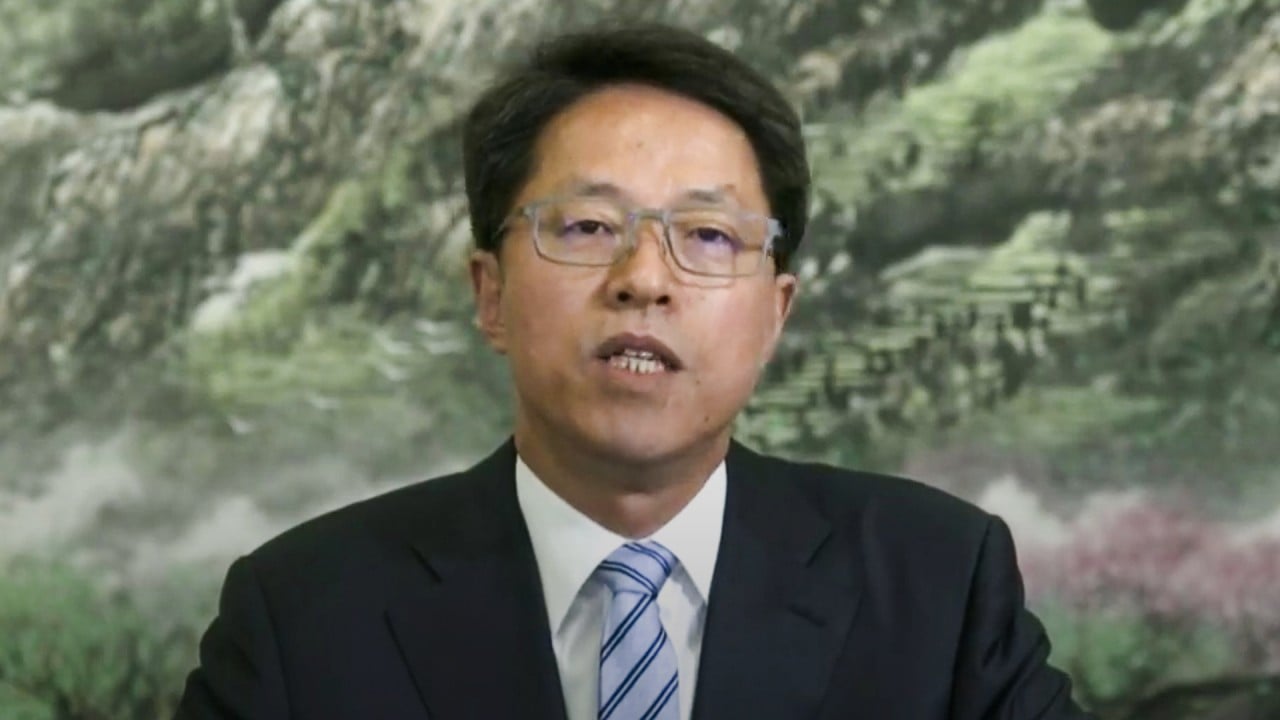
Beijing official Zhang Yong has said the power to pick judges for national security cases must lie with Hong Kong’s leader Carrie Lam. Photo: Robert Ng

Beijing official Zhang Yong has said the power to pick judges for national security cases must lie with Hong Kong’s leader Carrie Lam. Photo: Robert NgHong Kong’s leader must avoid picking judges who could be compromised by “dual allegiance” because of their foreign nationality, when selecting candidates to oversee cases under the new national security law Beijing is preparing for the city, an official from China’s top legislative body has said.Zhang Yong, vice-chairman of the Legislative Affairs Commission of the National People’s Congress Standing Committee, brushed off concerns this would undermine judicial independence, insisting it had nothing to do with jurisdiction and the central government, according to worldwide practice, should always have the final say on matters of national security.

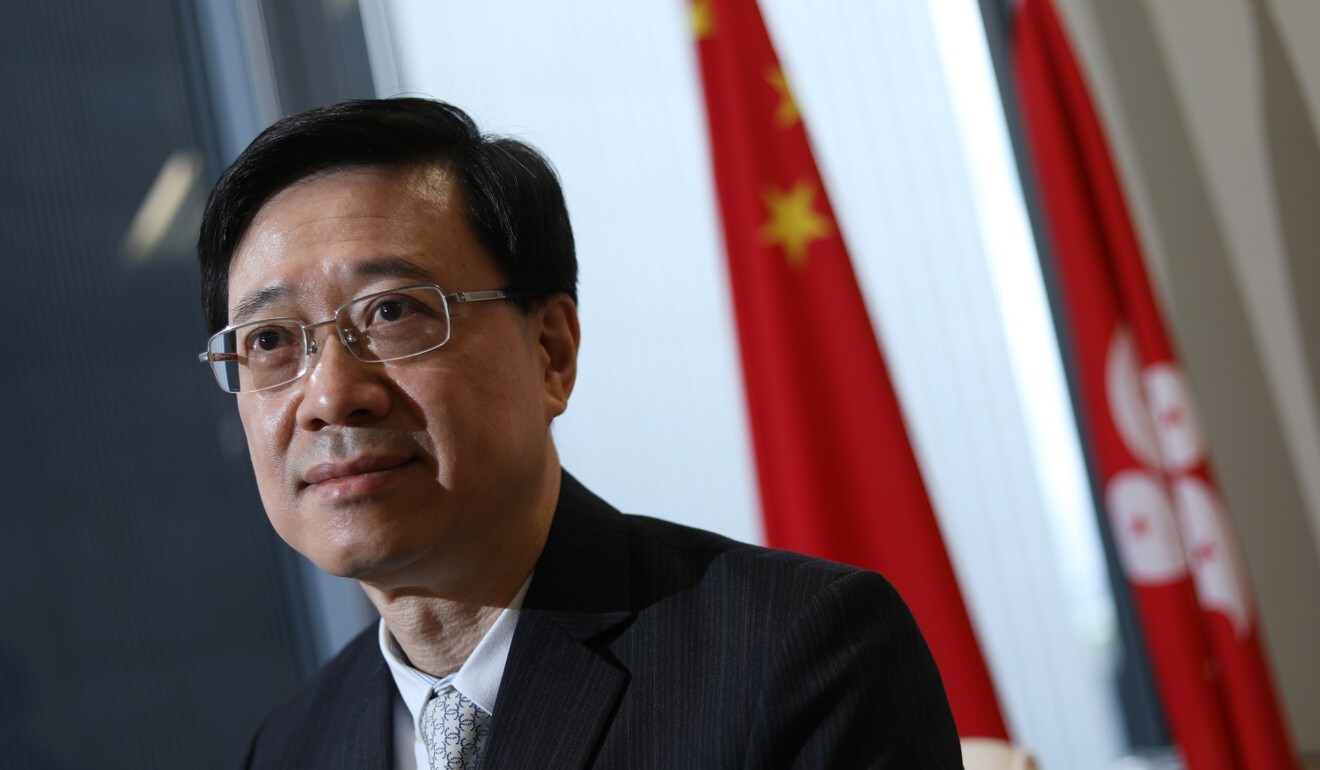
The law, the full draft of which is likely to be unveiled only after its expected passage by June 30, would be effective immediately, according to Secretary for Security John Lee Ka-chiu.

The new law will take effect the day it is passed, Secretary for Security John Lee says. Photo: May Tse

The new law will take effect the day it is passed, Secretary for Security John Lee says. Photo: May Tse

“On the day the law is passed, it becomes a Hong Kong law as it is already put in Annex III of the Basic Law, becoming a national law applying to Hong Kong,” Lee said on Wednesday. “The law is effective on the day it is announced.”Zhang’s remarks on foreign judges, in a speech to representatives from a broad swathe of Hong Kong society on Tuesday – made public a day later – appeared to directly contradict Chief Executive Carrie Lam Cheng Yuet-ngor’s rejection of calls from the pro-Beijing camp to bar non-Chinese judges from handling national security cases.

Lam had said barring judges with foreign nationality would not be realistic, and she would instead draw up a list of them to handle relevant cases after consulting the city’s chief justice, rather than hand-pick a specific judge for every case.CORONAVIRUS UPDATEGet updates direct to your inboxSUBSCRIBEBy registering, you agree to our T&C and Privacy Policy

The contradiction suggested Beijing might not endorse Lam’s attempts to pacify critics, according to Lau Siu-kai, vice-president of semi-official think tank the Chinese Association of Hong Kong and Macau Studies.

“Some among the pro-establishment camp have tried to water down the law, but what Beijing wants is actually the deterrent effect,” Lau said.

The Chief Executive’s Office has yet to respond to an inquiry filed by the Post.

 Hong Kong’s national security law is like ‘anti-virus software’, top Beijing official says

03:18

Hong Kong’s national security law is like ‘anti-virus software’, top Beijing official says

The Post on Wednesday obtained a copy of the speech Zhang gave to 120 attendees at Beijing’s liaison office in the city, explaining the new legislation.

“Among various countries around the world, no country has allowed foreigners to act as judges to try cases that endanger its own national security,” Zhang said.

The new law did not completely shut out judges with foreign nationality, but allowed the chief executive to appoint a pool of judges for relevant cases, he noted.

How will China enact Hong Kong national security law?23 Jun 2020

“Not only does it not affect judicial independence at all, but better guarantees the responsibilities of judges and judicial fairness, and reflects our respect for the current judicial system,” he said. “There is no inevitable correlation between judicial independence and jurisdiction.”Citing Article 19 of the Basic Law, which stipulates that courts in Hong Kong “shall have no jurisdiction over acts of state such as defence and foreign affairs”, Zhang said the judicial power of Hong Kong courts had limitations, but that did not undermine judicial independence.

According to an outline of the draft released over the weekend, Beijing may exercise jurisdiction over a tiny number of cases under specific circumstances, but the exact scope remains unknown.

But Zhang said Hong Kong would have no “authority or ability” to handle ones involving foreign interference, national defence or military matters.

Former Legislative Council president Jasper Tsang Yok-sing, who attended the meeting, told the Post Zhang reassured them the central government would set a “high threshold” for applying its jurisdiction. “The law would state clearly under what circumstances the central government would exercise such jurisdiction and the procedures for doing so,” Tsang said.

Leader of city’s Catholics hopes ties with the Vatican will not fall foul of legislation 24 Jun 2020

Zhang’s remarks sparked a fresh round of criticism, with opposition lawmaker Dennis Kwok of the Civic Party, a representative of the legal sector, saying, “That’s the crux of the problem, the chief executive will be under pressure regarding how to choose judges.”

He noted that judges were already required to take an oath to uphold the Basic Law and pledge allegiance to Hong Kong.

He also drew attention to the conflicting role of the city leader, as the chief executive will also chair the national security commission in charge of the prosecution.

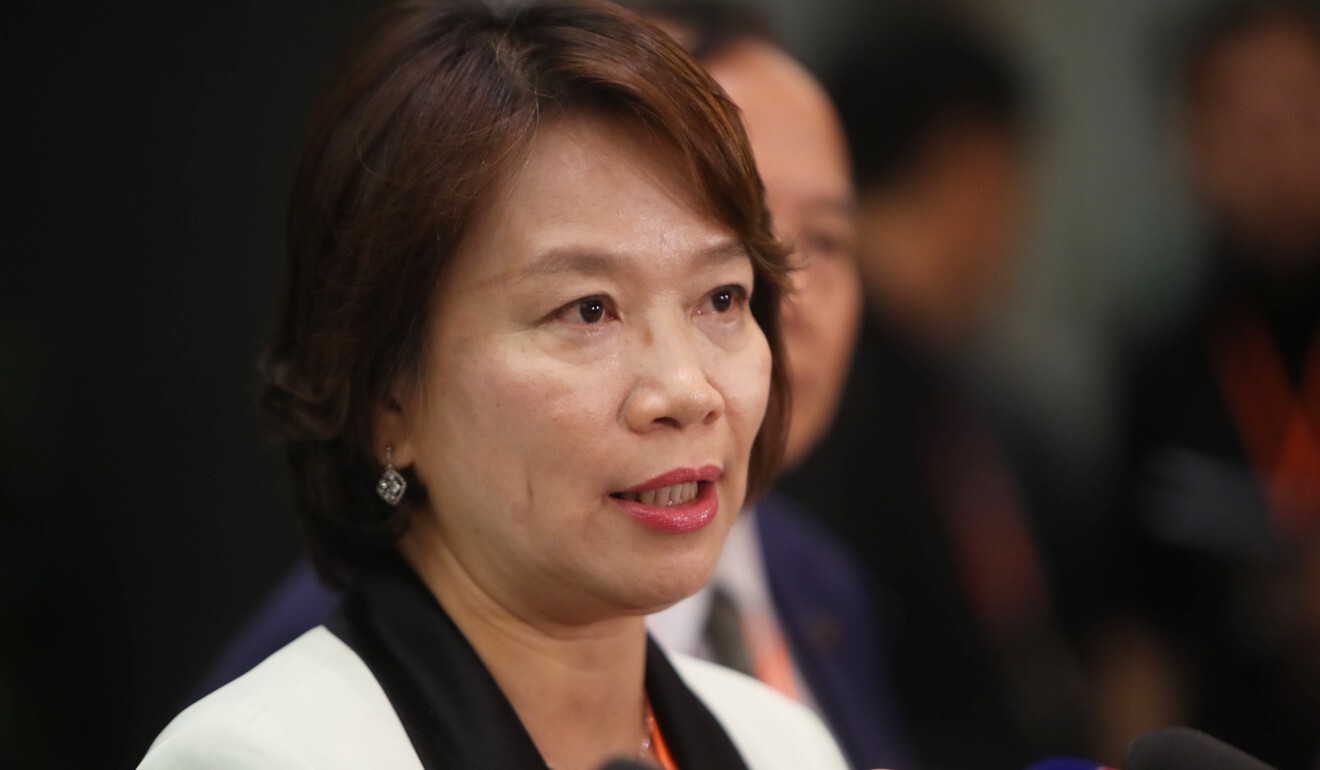
Legislator Priscilla Leung says Beijing has not ruled out the possibility there may be judicial personnel who hold right of abode elsewhere. Photo: Winson Wong

Legislator Priscilla Leung says Beijing has not ruled out the possibility there may be judicial personnel who hold right of abode elsewhere. Photo: Winson Wong

Kwok’s party colleague, Alvin Yeung Ngok-kiu, questioned if Beijing officials had a full grasp of Hong Kong’s judicial system, pointing out that all but two of the city’s judges – the heads of the Court of Final Appeal and High Court – were not required to declare if they were foreign citizens.

The city’s main grouping of solicitors, the Law Society, also expressed concern about letting the chief executive designate judges to handle national security cases.

“That (or the perception arising therefrom) prejudices judicial independence,” it said in a statement, urging that such designations should only be made upon the suggestions of the Judicial Officers Recommendation Commission in accordance with the Basic Law.

However, pro-Beijing lawmaker Priscilla Leung Mei-fun, also a member of the Basic Law Committee, said the arrangement was already a compromise.

“They haven’t ruled out the possibility that there may be judicial personnel who hold right of abode elsewhere. It is already a very moderate view from mainland China,” Leung said.

Time to stop talking about Hong Kong’s ‘premature death’

The immediate effectiveness of the law after it is passed is also causing further concern, even though the government can do so within existing rules by means of a special gazette.

“But the public needs time to digest it, even those who want to follow it and avoid stepping over any red line,” veteran opposition lawmaker James To Kun-sun To said.

According to the Basic Law, the standing committee may add to or delete from the list of laws in Annex III after consulting the Basic Law Committee, but the Post understands that a formal meeting of the 11-member advisory body has not been held.

Five Hong Kong members attended a two-hour meeting at the liaison office on Wednesday morning during which Zhang sought their views on the draft, but they were not provided with the full text, the Post has learned.

Source: SCMP

27/06/2020

China sees uptick in new COVID-19 cases, including 17 in Beijing

FILE PHOTO: A medical worker in protective suit collects swabs from construction workers for nucleic acid tests following a new outbreak of the coronavirus disease (COVID-19) in Beijing, China June 25, 2020. cnsphoto via REUTERS/File Photo

BEIJING (Reuters) – Mainland China reported on Saturday the highest number of new coronavirus cases in four days, driven by a COVID-19 resurgence in the Chinese capital of Beijing.

The National Health Commission reported 21 new confirmed infections in mainland China on Friday, up from 13 a day earlier and the highest since Monday.

In Beijing, 17 new confirmed cases were reported, up from 11 a day earlier and the most since June 20.

Since June 11 when Beijing reported its first case in the current outbreak, stemming from a sprawling wholesale food centre in the southwest of the capital, 297 people in the city of more than 20 million have contracted the virus.

Mainland China reported four new so-called imported cases on Friday, infections linked to travellers arriving from abroad. That compares with two cases a day earlier.

That took the cumulative number of confirmed cases in mainland China to 83,483.

Mainland China reported 12 new asymptomatic patients, who tested positive for COVID-19 but showed no clinical symptoms such as a fever, up from five a day earlier.

The national health authority does not include asymptomatic patients in its tally of confirmed cases.

The death toll stood at 4,634, unchanged since mid-May.

Source: Reuters

26/06/2020

People wear face masks in Croatia

Xinhua| 2020-06-26 18:43:58|Editor: Lu Hui

CROATIA-COVID-19-PUBLIC TRANSPORT-FACE MASKS

People wearing face masks get on a bus in Zagreb, Croatia, on June 25, 2020.

Source: Xinhua

25/06/2020

Satellite images show new Chinese structures near site of border clash with India

SINGAPORE/NEW DELHI (Reuters) – China appears to have added new structures near the site of a deadly border clash with India in the western Himalayas, fresh satellite pictures show, heightening concerns about further flare-ups between the nuclear-armed neighbours.FILE PHOTO: Maxar

WorldView-3 satellite image shows close up view of the Line of Actual Control (LAC) border and patrol point 14 in the eastern Ladakh sector of Galwan Valley June 22, 2020. Maxar Technologies via REUTERS

Indian and Chinese military commanders agreed on Monday to step back from a weeks-old standoff at several locations along their disputed border following the June 15 clash in the Galwan Valley in which 20 Indian soldiers were killed.

The satellite images showing new construction activity in the week following the brutal hand-to-hand combat underline the challenge of disengagement and the risk the accord could still fall apart because of overlapping claims in the arid territory.

(Open tmsnrt.rs/2Z6f0AZ in an external browser to see an interactive graphic of these satellite images)

The pictures shot on Monday by U.S.-based space technology firm Maxar Technologies show what appear to be extensive Chinese structures on a raised river terrace overlooking the Galwan River.

India says the area where the structures have sprung up are on its side of the poorly defined, undemarcated Line of Actual Control or the de facto border between the two Asian giants.

China says the whole of Galwan valley, located at about 14,000ft (4,300m), is its territory and blames Indian troops for triggering the clashes.

The new activity includes camouflaged tents or covered structures against the base of cliff, and a short distance away, a potential new camp under construction with walls or barricades. The camp was not seen in pictures made available to Reuters the previous week.

Nathan Ruser, a satellite data expert at the Australian Strategic Policy Institute, said the buildup suggested there was little sign of de-escalation.

“Satellite imagery from the Galwan Valley on June 22nd shows that ‘disengagement’ really isn’t the word that the (Indian) government should be using,” he said in a post on Twitter.

On the Indian side, defensive barriers can be seen in the latest images which were not visible in pictures taken in May. An Indian forward post appears to be scaled back compared with images a month ago.

China’s foreign ministry did not immediately respond to requests for comment on the apparent activity.

India’s defence ministry also did not respond to a request for a comment.

Indian military officials have previously said they will be closely monitoring the planned disengagement process and verify it on the ground.

“There is a trust deficit so far as the Chinese are concerned,” said former Indian army chief Deepak Kapoor.

“So if they are telling us verbally they are ready to pull back, we will wait to see it on the ground. Until then the armed forces will be on alert.”

Source: Reuters

24/06/2020

China-India border clash stokes contrasting domestic responses

BEIJING/NEW DELHI (Reuters) – The skirmish between Chinese and Indian troops over a long-disputed border this month is being treated in New Delhi as the country’s worst diplomatic crisis in decades even as it is downplayed by Beijing.

FILE PHOTO: Demonstrators burn products made in China and a defaced poster of Chinese President Xi Jinping during a protest against China, in New Delhi, India, June 22, 2020. REUTERS/Adnan Abidi

China is already locked in diplomatic combat over a host of disputes, from the United States and Australia to Taiwan and Hong Kong, and its handling of the coronavirus outbreak. It is loath to engage on yet another front – especially one that could push New Delhi closer to Washington, some analysts say.

The two sides were working to ease tensions, China’s foreign ministry said on Tuesday. Chinese media coverage has been scant.

Beijing’s response also points to its interest in de-escalating a crisis over a stretch of border that is less politically important than other territorial priorities, such as claims to Taiwan and the South China Sea and its tightening grip on Xinjiang and Hong Kong.

The contrast reflects the differences in two systems of government – India is the world’s biggest democracy, while China is ruled by the Communist Party and tightly controls its media – as well as the domestic realities of a dispute that has little political upside for the leaders of either country.

Since the deaths of 20 Indian soldiers in hand-to-hand fighting in the Galwan Valley, in the worst combat losses on the de facto border with China in more than 50 years, Indian Prime Minister Narendra Modi, a strident nationalist, has faced heated calls for a strong response.

Chinese President Xi Jinping is under no such public pressure.

“Indians watch everything that China is doing, but most Chinese only have eyes for international issues related to the U.S. or Taiwan,” said Zhang Jiadong, director of the Center for South Asian Studies at Fudan University in Shanghai.

Both governments would prefer to play down the clash, he said, but information from the remote battlefield leaking into Indian media forces Modi’s hand in a way that would not be possible in China.

“The clash happened because troops from both sides have a different understanding of where the line of actual control lies,” he said.

“This area is a barren hilltop with no economic or geostrategic value. From the Chinese government point of view, it is not worth destabilising bilateral relations over this,” said Zhang.

The border clash did not crack the top 50 searches on China’s Twitter-like Weibo on Tuesday.

PRESSURE DIFFERENTIAL

In India, opposition leaders, former generals and diplomats have criticised Modi for failing to protect Indian lives and territory. Many have called for boycotts of Chinese goods. The story garners wall-to-wall coverage in domestic media.

The perceived threat from China – which humiliated India in a brief border war in 1962 – has overshadowed India’s COVID crisis, in which the number of cases has crossed 400,000 with no sign of a peak.

Former Prime Minister Manmohan Singh said India stands behind Modi, but he must bear responsibility.Slideshow (5 Images)

“We stand at historic crossroads. Our government’s decisions and actions will have serious bearings on how the future generations perceive us,” he said.

Such language makes it harder for Modi to compromise without losing face, analysts say.

Modi rode to power in 2014 vowing to turn India into an economic and military power, but China has pulled further ahead on his watch. Its economy is five times the size of India’s, with three times the military spending.

Control Risks said in a note that Modi’s administration will likely employ economic measures against China to placate public pressure, instead of risking military conflict with a stronger adversary.

Source: Reuters

23/06/2020

China puts final satellite into orbit to try to rival GPS network

BEIJING (Reuters) – China on Tuesday successfully put into orbit its final Beidou satellite, completing a navigation network years in the making and setting the stage to challenge the U.S.-owned Global Positioning System (GPS).

A Long March-3B carrier rocket carrying the Beidou-3 satellite, the last satellite of China’s Beidou Navigation Satellite System, takes off from Xichang Satellite Launch Center in Sichuan province, China June 23, 2020. China Daily via REUTERS

The idea to develop Beidou, or the Big Dipper in Chinese, took shape in the 1990s as China’s military sought to reduce its reliance on GPS, which is run by the U.S. Air Force.

Coverage was limited to China when the first Beidou-1 satellites were launched in 2000. Now Beidou-related services such as traffic monitoring have been exported to about 120 countries.

As use of mobile devices expanded, China in 2003 tried to join the Galileo satellite navigation project proposed by the European Union but later pulled out to focus on Beidou.

The second generation of Beidou-2 satellites went into operation in 2012, covering the Asia-Pacific region.

In 2015, China began deploying the third generation of Beidou-3 satellites aimed at global coverage. The one launched on Tuesday was the 35th Beidou-3 satellite – with analysts looking at the system’s reliability and how it is rolled out.

“The civil signal from Beidou is no better than GPS or Galileo,” said Alexandra Stickings, a research analyst at the Royal United Services Institute for Defence and Security Studies, a Britain-based think-tank.

“From a defence perspective, it is difficult to say whether Beidou is superior. One hurdle that will have to be faced will be upgrading receivers across military platforms, which will take time.”

Source: Reuters

22/06/2020

Indian, Chinese commanders hold parley on border, growing calls to boycott Chinese goods

NEW DELHI (Reuters) – Indian and Chinese military commanders held a second round of talks to ease tensions at their contested border on Monday, as the public mood hardened in India for a military and economic riposte to China following the worst clash in over five decades.

FILE PHOTO: An Indian Army convoy moves along a highway leading to Ladakh, at Gagangeer in Kashmir’s Ganderbal district June 18, 2020. REUTERS/Danish Ismail

An Indian government source said corps commanders from both sides met in Moldo, on the Chinese side of the Line of Actual Control, the de facto border dividing India’s Ladakh region from the Chinese held Aksai Chin, high in the western Himalayas.

Lower ranking officers had attended the first parley last Thursday after the brutal clash June 15, when soldiers fought with rocks, metal rods and wooden clubs.

While blaming each other’s for the bloodshed, the two governments have sought to avoid any escalation that could risk further conflict between the two nuclear armed states.

Under long observed protocols, both militaries refrain from firing weapons, and the last time there was a deadly clash on the disputed border was in 1967.

The Indian foreign ministry has, however, described the fighting that left 20 Indian soldiers dead and at least 76 injured as a “pre-meditated and planned action” by China.

For its part, China has accused Indian troops of violating a military agreement, and provoking and attacking its troops in the Galwan valley in Ladakh. China has not disclosed how many casualties it suffered, though an Indian minister has said around 40 Chinese soldiers may have been killed.

Shocked and angered by the death of their soldiers, Indians have been calling for Prime Minister Narendra Modi’s nationalist government to show India will not be bullied, bitterly remembering how China humiliated their country in a war in 1962.

Members of an Indian traders body set alight a pile of Chinese goods at a New Delhi market, pushing for a nationwide boycott of products from its northern neighbour.

The Confederation of All India Traders (CAIT), which represents some 70 million traders, has asked federal and state governments to support a boycott of Chinese goods and cancel government contracts awarded to Chinese companies.

“The entire nation is filled with extreme anger and intensity to give a strong befitting response to China not only militarily but also economically,” CAIT National General Secretary Praveen Khandelwal wrote in a letter to chief ministers of some Indian states.

China is India’s second-biggest trading partner, with bilateral trade worth $87 billion in the fiscal year ending March 2019, and a trade deficit of $53.57 billion in China’s favour, the widest India has with any country.

The traders body, which advocates self reliance and has been a vocal supporter of Modi’s nationalist policies, has also asked the federal commerce ministry to amend rules and make it mandatory for e-commerce platforms to mark the country of origin for all products.

“Most of the e-commerce portals are selling Chinese goods for which the consumer remains unaware,” CAIT said in a statement.

The editor-in-chief of China’s Global Times newspaper warned that the “nationalists of India need to cool down.” The Global Times is published by the People’s Daily, the official newspaper of China’s ruling Communist Party.

“China’s GDP is 5 times that of India, military spending is 3 time,” Global Times editor Hu Xijin said in a post on Twitter.Police officers detain a demonstrator during a protest against China, in New Delhi, India, June 22, 2020. REUTERS/Adnan Abidi

Since coming to power in 2014, Modi has sought to improve relations with China, hosting Chinese President Xi Jinping most recently for an informal summit in southern India last year.

The confrontation in the Himalayas means Modi now has to reassess relations with China, posing possibly the most difficult foreign policy questions he has faced so far.

“At this moment, we stand at historic crossroads,” former prime minister Manmohan Singh said in a statement, “Our government’s decisions and actions will have serious bearings on how the future generations perceive us.”

Source: Reuters

Law of Unintended Consequences

continuously updated blog about China & India

ChiaHou's Book Reviews

continuously updated blog about China & India

What's wrong with the world; and its economy

continuously updated blog about China & India