Chindia Alert: You’ll be Living in their World Very Soon
aims to alert you to the threats and opportunities that China and India present. China and India require serious attention; case of ‘hidden dragon and crouching tiger’.
Without this attention, governments, businesses and, indeed, individuals may find themselves at a great disadvantage sooner rather than later.
The POSTs (front webpages) are mainly 'cuttings' from reliable sources, updated continuously.
The PAGEs (see Tabs, above) attempt to make the information more meaningful by putting some structure to the information we have researched and assembled since 2006.
NEW DELHI (Reuters) – Indian and Chinese military commanders made progress in talks on Wednesday to defuse a standoff along their disputed border in the western Himalayas after pulling back some troops in confidence-building gestures, Indian government officials said.
Hundreds of soldiers have been ranged against each other in the remote snow desert of Ladakh since April in the most serious border flare-ups for years after Chinese patrols advanced into what India deems its side of the de facto border, Indian officials say. China claims the territory to be its own and has objected to the Indian construction of roads in the area.
The two sides made headway in their talks on Wednesday, officials in Delhi said, speaking on the condition of anonymity because of the sensitivity of the situation.
After weeks of tension including an incident in which patrolling soldiers from the two sides came to blows on the banks of Pangong Lake, resulting in injuries, friction has eased somewhat, one of the Indian officials said.
The two armies have since thinned out some forces in a positive signal but soldiers, tanks and other armoured carriers remained heavily deployed in the high-altitude region, the official said.
“There has been some kind of disengagement, there will be more talks to resolve this over the next days, it could be weeks even,” the official said. Another Indian official said the Chinese military had moved back some tents and vehicles from the forward areas but there was still a large presence.
China’s state-run Global Times quoted Foreign Ministry spokeswoman Hua Chunying as saying the two countries were communicating through diplomatic and military channels over issues concerning the border and that a “positive consensus” has been reached. It did not elaborate.
India and China fought a brief border war in 1962 and have not been able to settle their border despite two decades of talks. Both claim thousands of kilometres of territory and patrols along the undemarcated Line of Actual Control – the de-facto border – often run into each other, leading to tensions.
“The spread of the new global Covid-19 outbreak has not been effectively controlled, and there are risks in international travel and open campuses,” the ministry said. “During the epidemic, there were multiple discriminatory incidents against Asians in Australia.”
In response, Australian Education Minister Dan Tehan said the country was a “successful, multicultural society” which provides a “world-class education”.
He also made reference to Australia’s success in flattening its virus curve which meant that it was “one of the safest countries in the world for international students to be based in right now”.
What are the broader tensions?
The advisory marks the latest escalation in tensions between China and Australia during the coronavirus pandemic.
Relations worsened after Australia echoed the US in calling for an independent inquiry into the origins of the coronavirus, first detected in China late last year.
China has dismissed that call as politically motivated. It has since imposed a tariff and blocked shipments of some Australian imports, but has denied this is economic retaliation.
Last week, it also warned citizens against travelling to the country, saying there had been a “significant increase” in racist attacks on Asian people in Australia.
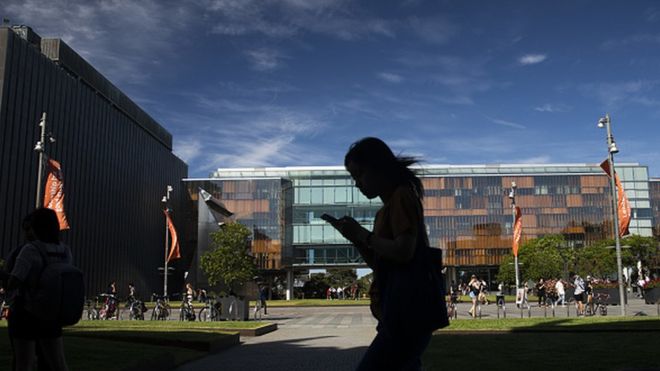
Image caption China has warned about a surge in racist attacks in Australia
Education and tourism are Australia’s third and fourth biggest exports overall, and significant contributors to the economy.
Students from China represented 28% of the more than 750,000 international students in Australia last year, government numbers show.
Australia’s universities have already faced financial difficulties during the pandemic, as border closures have deterred international students. Several institutions have said they are facing financial crisis.
Australia’s Tourism Minister Simon Birmingham said China’s assertions about the dangers to tourists had “no basis in fact”.
However, government bodies, community groups and media outlets have all catalogued hundreds of racist attacks and abuse on Asian people in Australia since the pandemic began.
In one of several high-profile incidents caught on film, a woman was accused of a racist attack on two students from the University of Melbourne in April.
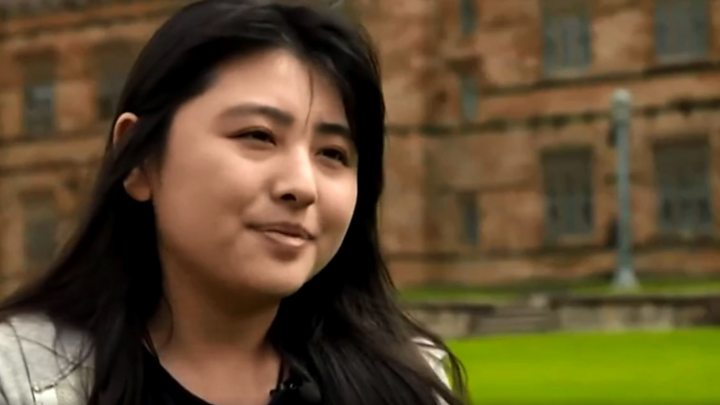
Media caption Karen Ji spent 16 days in Bangkok to get around Australia’s Covid-19 ban on arrivals from mainland China
On Wednesday, a coalition of Australia’s leading universities called China’s advisory “unjustified”. The Group of Eight said they had asked the Chinese embassy in Australia for examples of racism, which were not provided.
“It is concerning that yet again, international education, and particularly with China, is yet again the pawn in a political game that is not of our making,” said chief executive Vicki Thomson.
However, Australia’s universities have long been accused by researchers of not providing better support to international students.
Surveys of Chinese students in Australia have found many struggle to develop stronger social bonds with their Australian-born peers due to existing prejudices.
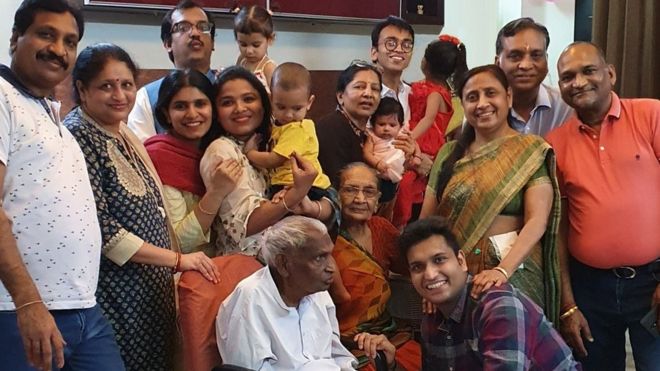
Image caption All 17 members of the Garg household
Mukul Garg wasn’t too worried when his 57-year-old uncle developed a fever on 24 April. Then, within 48 hours, two others in his family of 17 also became ill.
The symptoms trickled in as expected – temperatures spiked and voices grew hoarse with coughing.
Mr Garg initially chalked it up to seasonal flu, unwilling to admit it could be coronavirus.
“Five or six people often fall sick together in this house, let’s not panic,” he told himself.
Over the next few days, five more people in the house showed Covid-19 symptoms. And the pit in his stomach grew.
Soon, the Garg family would become its own coronavirus cluster as 11 of its 17 members tested positive.
“We met nobody from the outside and no-one entered our house. But even then the coronavirus entered our home, and infected one member after the other,” Mr Garg would later write in his blog, which has since attracted hundreds of comments from readers.
The exhaustive account shows how the multi-generational family, a mainstay of Indian life, poses a unique challenge in the fight against Covid-19.
The country’s stringent lockdown, which began on 25 March and lasted until this week, focused on keeping people at home, off its busy streets and out of packed public spaces.
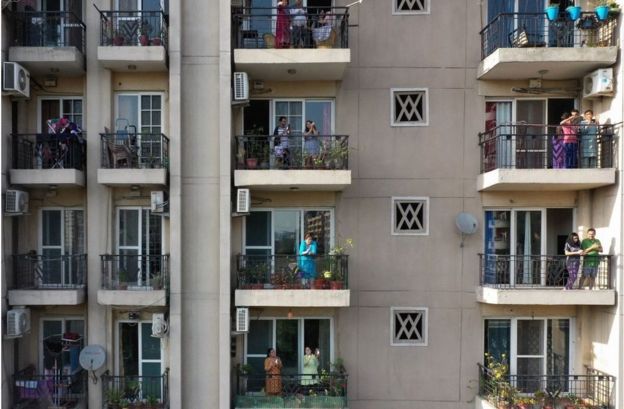
But in India – where 40% of households comprise many generations (often three or even four living together under one roof) – home is a crowded place.
“All families under lockdown become clusters the moment someone is infected, that is almost a given,” says virologist Dr Jacob John.
And, as the Gargs discovered, social distancing isn’t possible within large families, especially during a lockdown when you are already cut off from the outside world.
‘We felt so alone’
The Gargs live in a three-storey home in a packed neighbourhood in north-west Delhi.
Mr Garg, 33, his wife, 30, and their two children, aged six and two, live on the top floor, along with his parents and grandparents.
On the two floors below them live his uncles – his father’s brothers – and their families. Members range from a four-month-old baby to a bedridden grandfather of 90.
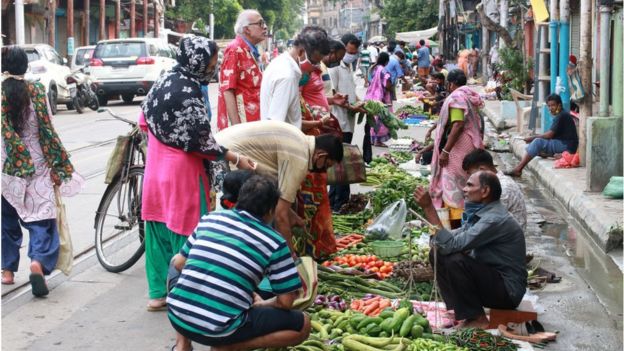
Image caption Mr Garg’s uncle may have caught the virus from a vegetable vendor
Contrary to cramped joint family homes where many people share a room and a bathroom, the Garg home is spacious. Each floor is about 250 square metres, roughly the size of a doubles tennis court, with three bedrooms, en suite bathrooms and a kitchen.
And yet, the virus spread quickly, travelling across floors and infecting almost all the adults in the house.
They identified patient zero – Mr Garg’s uncle – but the family is still not sure how he caught the virus.
“We think it could be from a vegetable vendor or from someone at the grocery store because that was the only time anyone from the family stepped outside,” he says.
But as the virus spread, fear and shame kept them from getting tested.
“We were 17 of us, but we felt so alone. We worried that if something happened to us, would anyone even come to the funeral because of the stigma associated with coronavirus?”
But in the first week of May, when his 54-year-old aunt complained of breathlessness, the family rushed her to a hospital. And, Mr Garg says, they knew they all had to get tested.
‘The month of the disease’
All of May was spent fighting the virus.
Mr Garg says he would spend hours talking to doctors over the phone, while everyone checked in on each other on WhatsApp daily.
“We also kept changing the position of the members depending on symptoms, so no two people with high fever were in the same room.”
Six of the 11 infected have co-morbidities – diabetes, heart disease and hypertension – which made them more vulnerable.
“Overnight, our home became a Covid-19 healthcare centre with all of us taking turns to play nurse,” Mr Garg says
Image caption Families are particularly vulnerable to widespread infection in a lockdown
Virologists say large families are like any other cluster, except for the range in ages.
“When you have a range of age groups sharing common spaces, the risk is disproportionately distributed, with the elderly at most risk,” says Dr Partho Sarothi Ray, a virologist.
This weighed heavily on Mr Garg, who worried about his 90-year-old grandfather.
But the virus, which continues to confound medical experts around the world, also held surprises for the Gargs.
It wasn’t unusual that he and his wife, both in their early 30s, were asymptomatic. But it was bewildering that his grandfather was also asymptomatic. And one member of the family, who had no comorbidities, was taken to hospital. The others showed typical symptoms.
Mr Garg says he wrote the blog because he wanted to reach out to people worried about seeking help.
“In the beginning, we cared so much about what people would think. And reading the comments, it’s so nice to see people saying it’s ok if you get it, it’s not something to be ashamed of.”
In the second week of May, symptoms began to vanish and the family watched as more and more negative tests rolled in, bringing relief. This was also when Mr Garg’s aunt was discharged from hospital after testing negative.
They finally felt like the worst was over.
By the end of May – “the month of the disease” as Mr Garg called it – only three people, including him, were still positive.
On 1 June, they got tested for the third time and the results came back negative.
‘Our best and worst’
India’s large families can be a source of support and care, but also friction and thorny property disputes. But at times like these they can also come to the rescue.
“Can you imagine an elderly person in quarantine all by themselves with no-one to help? Despite the challenges, joint families benefit from the young taking care of the old,” Dr John says.
Cases in India have sprinted past the 250,000-mark, spurring a debate over whether the pandemic could threaten extended families, as young people worry about carrying the infection home to older relatives.
Image caption India re-opened this week after a strict lockdown
“It’s a system that has survived hundreds of years of an onslaught of Western values and colonisation,” says Prof Kiran Lamba Jha, who teaches sociology at Kanpur’s CSJM university. “Coronavirus is not going to destroy the joint family.”
The Gargs would agree.
Before the virus struck, the family was thriving. It was almost reminiscent of a 90s Bollywood flick, Mr Garg says.
“As a family, we had never spent so much time together than we did that first one month of the lockdown. It was also the happiest the family had ever been,” he says, adding that it only made it harder to watch as one person after another fell sick.
“We saw each other at our best and worst but we came out of it stronger,” he says.
“We’re still cautious about reinfection but right now, we’re basking in the glory that we managed to beat this virus and come out on the other side.”
LONDON (Reuters) – The coronavirus might have been spreading in China as early as August last year, according to Harvard Medical School research based on satellite images of hospital travel patterns and search engine data, but China dismissed the report as “ridiculous”.
FILE PHOTO: A computer image created by Nexu Science Communication together with Trinity College in Dublin, shows a model structurally representative of a betacoronavirus which is the type of virus linked to COVID-19, better known as the coronavirus linked to the Wuhan outbreak, shared with Reuters on February 18, 2020. NEXU Science Communication/via REUTERS
The research used satellite imagery of hospital parking lots in Wuhan – where the disease was first identified in late 2019 – and data for symptom-related queries on search engines for things such as “cough” and “diarrhoea”.
“Increased hospital traffic and symptom search data in Wuhan preceded the documented start of the SARS-CoV-2 pandemic in December 2019,” according to the research.
“While we cannot confirm if the increased volume was directly related to the new virus, our evidence supports other recent work showing that emergence happened before identification at the Huanan Seafood market (in Wuhan).”
“These findings also corroborate the hypothesis that the virus emerged naturally in southern China and was potentially already circulating at the time of the Wuhan cluster,” according to the research.
It showed a steep increase in hospital car park occupancy in August 2019.
“In August, we identify a unique increase in searches for diarrhoea which was neither seen in previous flu seasons or mirrored in the cough search data,” according to the research.
Chinese Foreign Ministry spokeswoman Hua Chunying, asked about the research at a daily press briefing on Tuesday, dismissed the findings.
“I think it is ridiculous, incredibly ridiculous, to come up with this conclusion based on superficial observations such as traffic volume,” she said.
The two B777 aircraft will be operated by pilots of the Indian Air Force and not of Air India.
PTI | New Delhi | June 8, 2020 5:46 pm
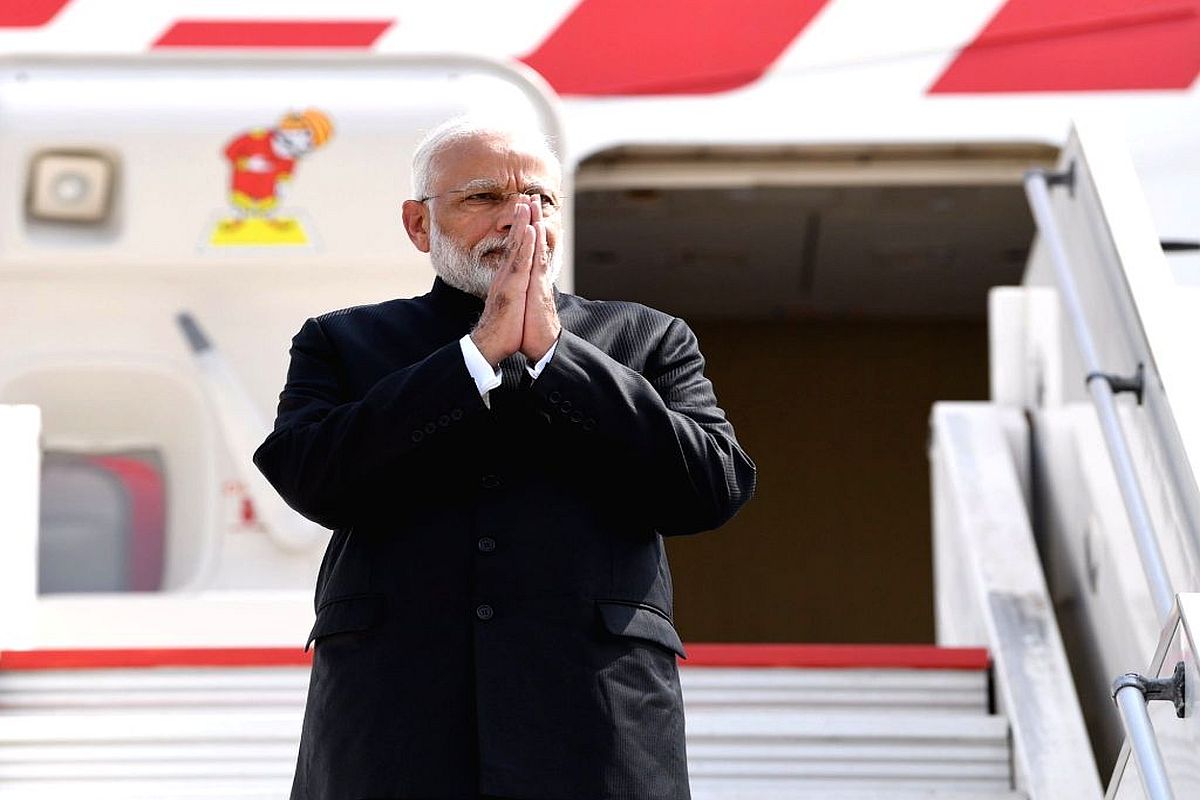
Currently, the Prime Minister, the President and the Vice President fly on Air India”s B747 planes, which have the call sign ”Air India One”. (Photo: IANS)
Two custom-made B777 aircraft, which will be used to fly Prime Minister Narendra Modi and other top Indian dignitaries, are likely to be delivered by Boeing to Air India by September, senior officials said, on Monday.
In October last year, government officials had said that the delivery of these two planes, which are earmarked for VVIP travel only, would be done by July.
“There has been some delay, primarily because of COVID-19. The two planes are likely to be delivered by September,” the officials said on Monday.
The two B777 aircraft will be operated by pilots of the Indian Air Force and not of Air India.
Police officer accused of killing George Floyd to appear in court on Monday
Derek Chauvin, the fired Minneapolis Police Department officer who pressed his knee on the neck of George Floyd for nearly nine minutes, will make his first appearance in court later today, US media is reporting.
Chauvin, 44, is scheduled to appear at the Hennepin County District Court in Minneapolis at 12.45pm Central time (roughly six hours from now). He faces charges of third-degree murder, second-degree murder and second-degree manslaughter.FacebookTwitter
I’ve been contacted by a reader who said they grew up near the city of Vidor, in east Texas. He wanted to alert me to a Black Lives Matter protest there on Saturday that consisted of just around 150 people. But it is significant, the reader said, because of Vidor’s reputation.
Vidor has been known for many things—among them the activities of the local Ku Klux Klan; its status as a “sundown town,” in which blacks were not allowed in city limits after dark; and an ugly fight in the early nineties over a federal effort to desegregate public housing in the city, which caused Texas Monthly, in a cover story that year, to describe Vidor as Texas’s “most hate-filled town.” The census estimates it to be 91 percent white.
So when word started to circulate that a Black Lives Matter rally was being planned in Vidor, many people on social media thought it was a trap—and expressed skepticism the event’s supposed planner, 23-year-old Maddy Malone, even existed. (She does.) To black folks with knowledge of the region, who had been told never to stop in Vidor, the idea seemed insane. “A civil rights rally in Vidor” is the punchline to a joke, not a thing that could happen in this world. C’mon.
The demonstration “may not seem like much”, wrote the reader in an email, “but when they gather in Vidor, Texas, that’s a big deal.”FacebookTwitterAdvertisementhttps://tpc.googlesyndication.com/safeframe/1-0-37/html/container.html
Unlike many news organisations, we chose an approach that means all our reporting is free and available for everyone. We need your support to keep delivering quality journalism that’s open and independent. Every reader contribution, however big or small, is so valuable.
For as little as £1 you can support us – and it only takes a minute. Thank you.Make a contribution
Big news from the weekend is certainly that the Minneapoliscity council pledged to disband the police department. The embattled agency responsible for George Floyd’s death could now be replaced by an alternative model of community-led safety.
The nine councilmembers who announced their support represent a supermajority on the twelve-person council, meaning Mayor Jacob Frey, who opposes the move, could not override it.
Frey was heckled by a crowd of protesters on Saturday when he ruled out defunding the police department.
Here’s a video of Frey walking through the crowds as they shout: “Go home!”-news
Play Video0:43 ‘Shame!’: Minneapolis mayor heckled by protesters – video
Note: this post was amended to make clear a vote had not yet taken place.
George Floyd’s body has been flown to his hometown of Houston, Texas, where mourners will be able to view his casket on Monday.
A six-hour viewing will be held at The Fountain of Praise church in southwest Houston, the final stop of a series of memorials across the country. Visitors in Houston will be required to wear a mask and gloves, as per coronavirus restrictions.
Floyd’s funeral will be held on Tuesday, where he will be buried next to his mother, Larcenia Floyd.
Previous memorials have taken place in Raeford, North Carolina, near where Floyd was born, and Minneapolis, where he lived at the end of his life and was killed. Mourners there observed 8 minutes 46 seconds of silence – the period that Floyd was filmed pinned under a police officer’s knee.FacebookTwitterAdvertisement
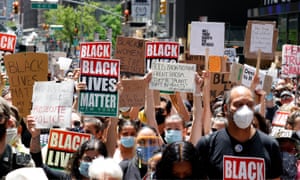
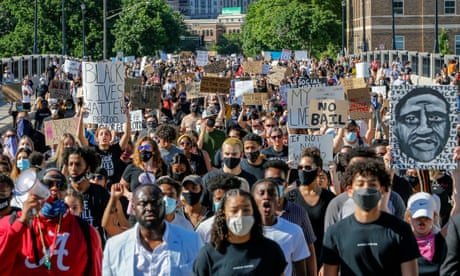
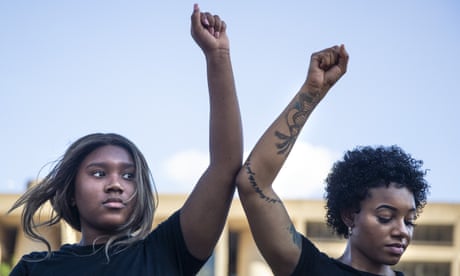
Three Guardian writers have just published features that take a deeper look at the protest movement:
Lois Beckett, who covers gun violence and the far right in the US, has been interviewing family members of black Americans who were killed by police or white vigilantes for whom the past week has been painfully familiar.
“I think people have had enough,” said Sybrina Fulton, whose unarmed 17-year-old son Trayvon [Martin] was shot to death in 2012 by a neighborhood watch volunteer, George Zimmerman, who was later acquitted of all charges.
Adam Gabbatt, who writes for us from New York, has also been looking at the potential impact of the movement, particularly around whether it could energize young voters in presidential, state and local elections.
There is precedent for real change inspired by protests, he writes.
In recent years the youth-led protests against gun violence following the Parkland school shooting, led to stronger gun laws, while young climate activists succeeded in drawing attention to the Green New Deal environment legislation, which many Democratic politicians have since endorsed.
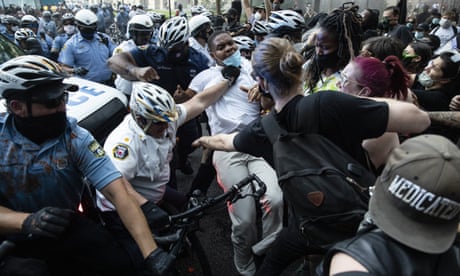
Finally, Michael Sainato, a contributor who covers civil rights issues, has written about the large numbers of protesters, more than 10,000, who have been arrested around the US.
Many were non-violent:
Ruby Anderson was arrested while non-violently protesting in Philadelphia, Pennsylvania, on 31 May. The police refused to provide a reason for her detention until they were placed in a police van, where they were told the charge was loitering. They were given a wristband that stated “unlawful assembly” and ultimately charged with disorderly conduct.
“While I was arrested, I was standing next to two white people who were doing the same thing as me, standing between a group of officers and a group of black teenagers. I was the only one arrested in my group of three, I was the only black person,” Anderson said.
…and welcome to a fresh US politics live blog as we enter a new day on Monday across the US. The sun has risen in New York while it is still the early hours of the morning along the West Coast.
I’m Oliver Holmes, and I’ll be with you for the next couple of hours. You can reach me via Twitter and also on email: oliver.holmes [@] theguardian.com
Please do send anything you think is worth including on our blog.
For those who have been sleeping or offline, here is an update with the main developments:
The Minneapolis city council pledged to abolish the city’s police department and replace it with a new system of public safety. The historic move has been hailed as the first concrete victory in the mounting nationwide movement in the aftermath of the police killing of George Floyd.
New York City’s mayor, Bill de Blasio, pledged to cut police department funding. The money will be given to Youth and Social Services. The mayor also lifted a contentious citywide curfew.
A protester was shot in Seattle, Washington. A man drove a car into a demonstration and shot a demonstrator.Police said officers have a man in custody.
The US soccer federation is considering repealing its ban on players kneeling during the national anthem, ESPN has reported.
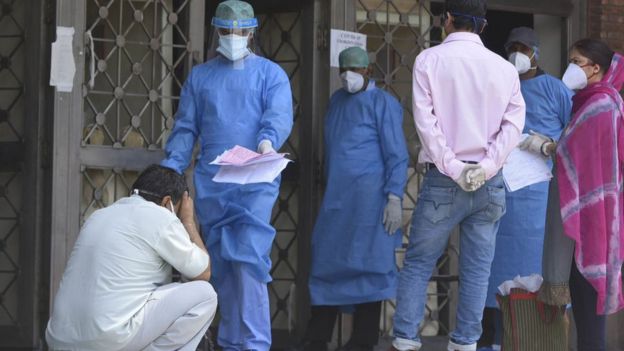
Image captionHospitals say they are overwhelmed and are turning away patients
The chief minister of India’s capital Delhi has said that state hospitals will now be reserved only for residents of the city.
Arvind Kejriwal’s announcement came amid allegations that hospitals are refusing to admit new patients.
Delhi has witnessed a surge of infections in recent days. It currently has 27,000 cases with 761 deaths.
India has a total of 256,611 confirmed Covid-19 cases, the fifth-highest number in the world.
A five-member expert committee comprising top doctors told local reporters that Delhi could record 100,000 Covid-19 cases by the end of June if we follow the trend we are looking at, which “suggests that the cases are getting doubled every 14-15 days”.
The news comes even as India has taken steps to further relax its stringent lockdown – malls, restaurants, temples and offices are open from Monday.
What are Delhi residents saying?
There have been a number of reports that people with Covid-like symptoms are being turned away from hospitals in the capital.
One report on local news site Scroll detailed the experience of one man who drove his mother to four hospitals, but was turned away from all of them.
Many others have tweeted about their own experiences trying to get help for family members.
The Delhi government’s smartphone app to track available hospital beds has also added to the confusion.
Mr Kejriwal reacted by accusing hospitals of profiteering.
“We will not tolerate this mischief. Give us a few days. We are at it. I am warning those who think they can do black marketing of beds. We will not spare you,” he said on Saturday.
A day later, he announced beds would be reserved for residents of the city.
“We have decided that the 10,000 beds under the Delhi government will be kept for residents,” he said. However, hospitals under the federal government will be available to patients from other states as well.
Shortly after, on Sunday evening, the state government released a set of documents that a person would have to provide in order to be treated at state facilities. These include voter ID cards, and electricity, water or telephone bills among others.
Mr Kejriwal added that Delhi would not open hotels and banquet halls on Monday, as they could be “converted into hospitals if the need arises”.
FILE PHOTO: Chinese Minister of Science and Technology Wang Zhigang speaks during a news conference on the sidelines of the National People’s Congress (NPC) in Beijing, China, March 11, 2019. REUTERS/Stringer
BEIJING (Reuters) – China will increase international cooperation if it succeeds in developing a novel coronavirus vaccine, the science and technology minister said on Sunday.
China would make a vaccine a “global public good” when it is ready, the minister, Wang Zhigang, told a news conference in Beijing.
The Supreme Court had on Friday granted the Centre and states 15 days’ time to transport all migrant labourers who wanted to return to their natives.
SNS Web | New Delhi | June 6, 2020 4:27 pm
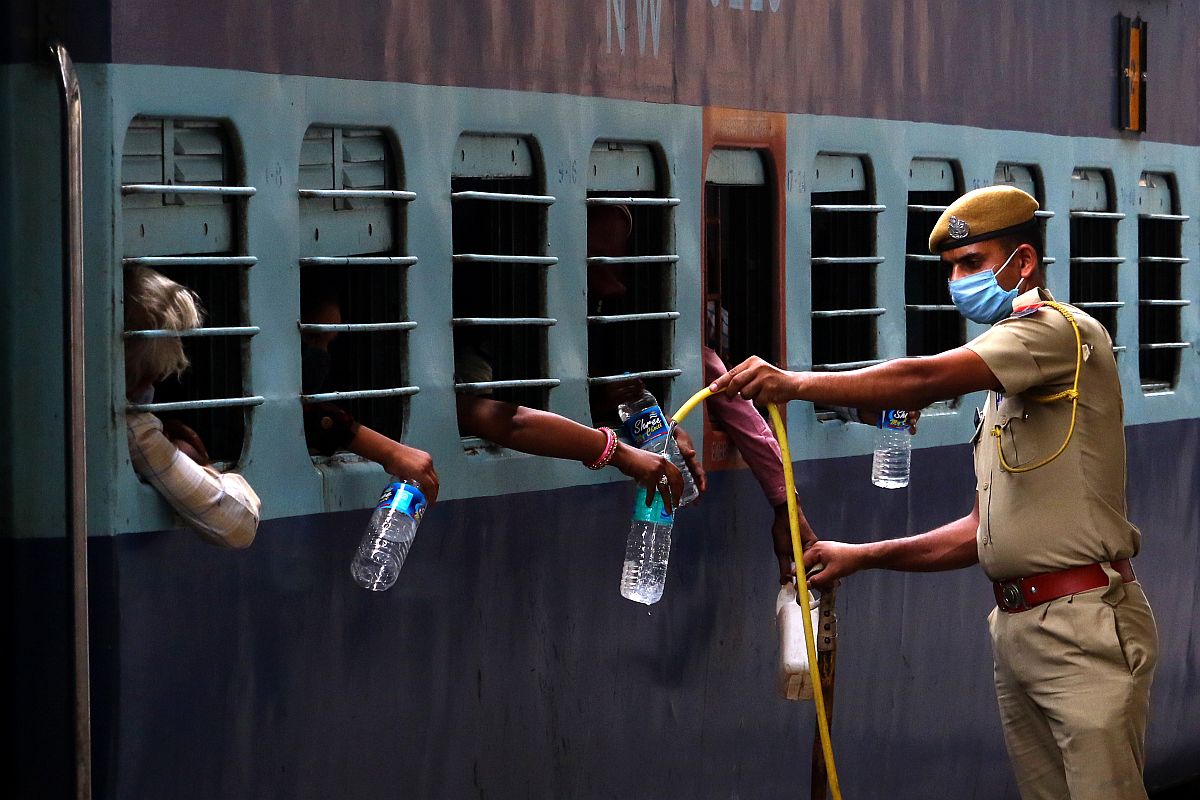
A policeman fills up bottles with drinking water to migrant workers of a special train service departing for Uttar Pradesh. (Photo: AFP)
With the Supreme Court having taken suo moto cognizance of the problems faced by migrants, the Centre on Saturday filed a detailed affidavit in the top court regarding the matter, stating that it has, along with the support of NHAI, facilitated shifting of these workers, found walking on roads, by providing them requisite transport to the nearest railway stations.
The Government further said that whenever necessary, the migrants are provided with food, drinking water, medicines, clothes, slippers and other essentials free of cost, depending upon the requirements.
The Union government added that the Supreme Court was “fully satisfied with the way the Centre has acted and discharged its obligations in the best interest of citizens most scientifically and based on collective decisions taken by the Executive at the Centre and state level in consultation and as per the advise of experts in each field”.
The Supreme Court had on Friday granted the Centre and states 15 days’ time to transport all migrant labourers who wanted to return to their natives.
The court further directed the receiving states to generate employment for the returning migrants.
The apex court told states to get all migrant labourers registered at block and district-level and added that states will have to generate employment for them and also facilitate their movement if they want to go back to other states for work.
The Supreme Court has reserved its order on the issue for Tuesday.
On May 28, the Supreme Court issued interim orders regarding the migrant crisis across the country, two days after it took suo moto cognizance of problems faced by the labourers who are stranded in different parts of the country due to the nationwide lockdown to contain the Coronavirus outbreak.
Dictating the orders, the apex court said that no train or bus fare should be charged from migrants travelling back to their homes. It directed that the migrant workers should be provided food by the concerned state and UT at places. During train journey, originating states will have to provide meal and water.
The Supreme Court had taken cognizance of the matter after several petitions were filed in the top court highlighting the plight of migrants during the COVID-19 crisis.
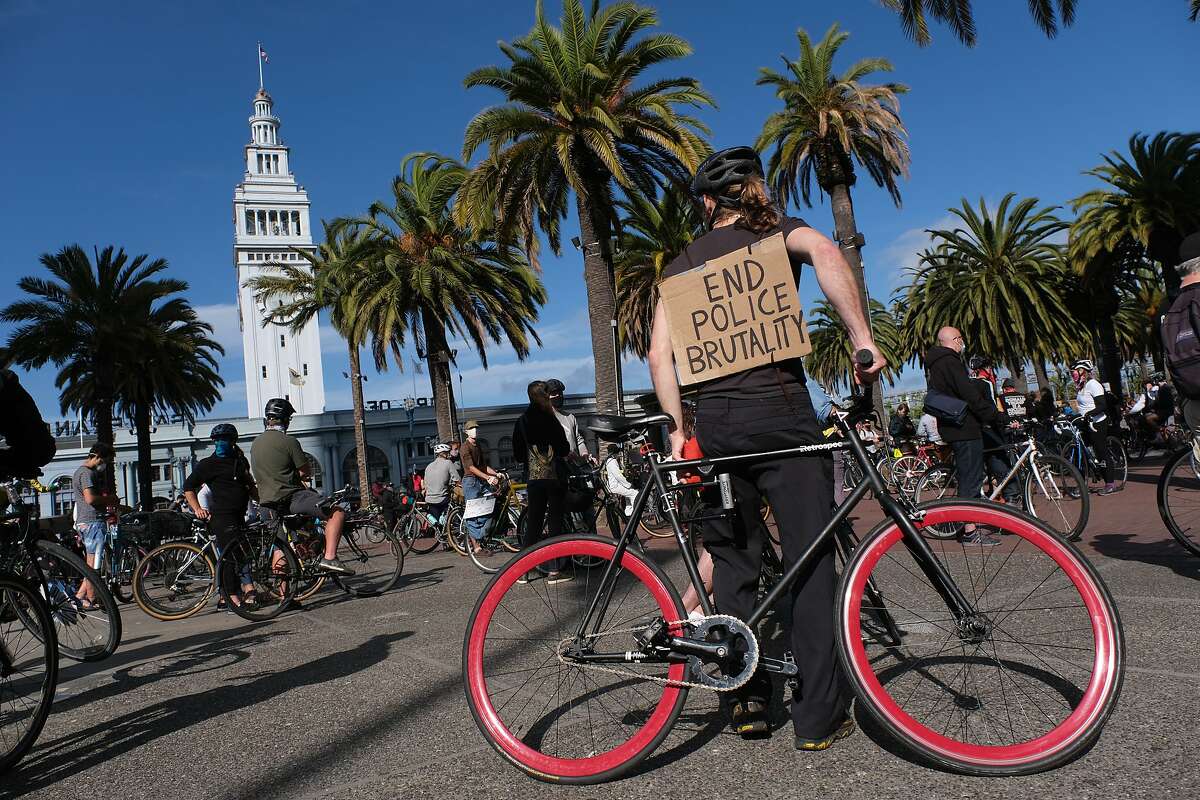
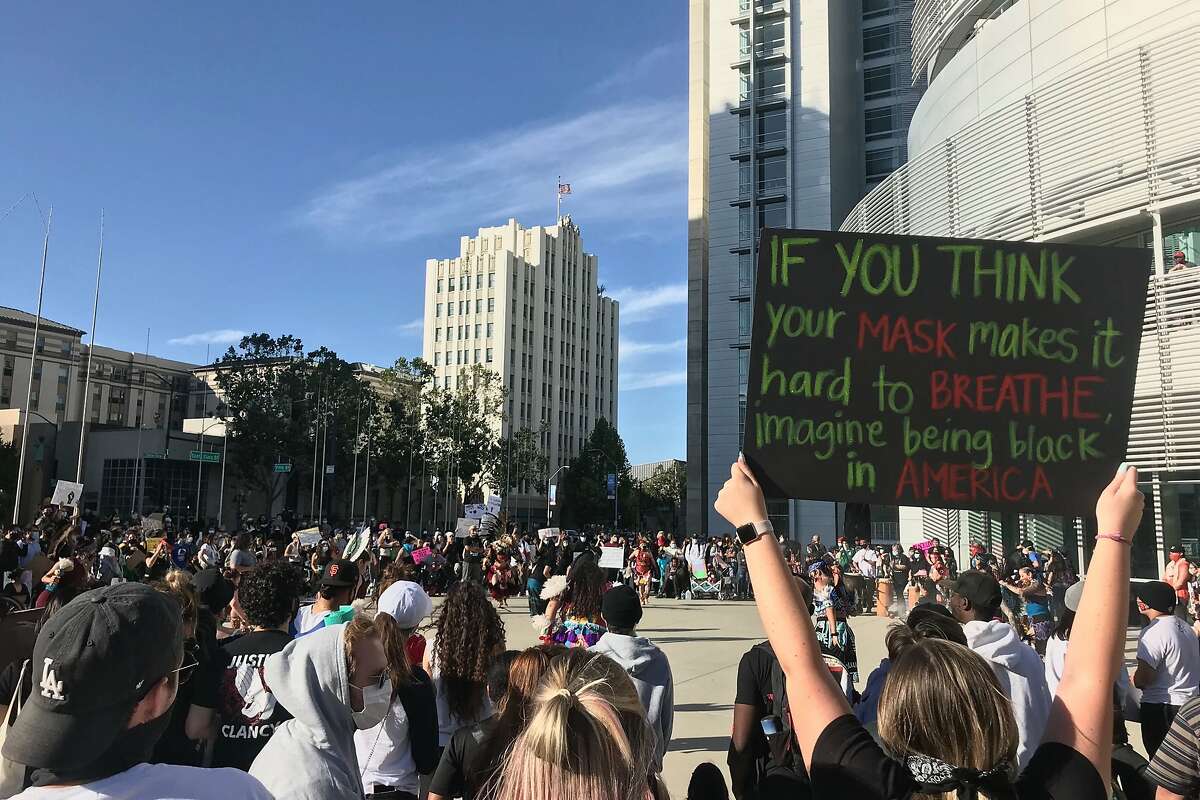
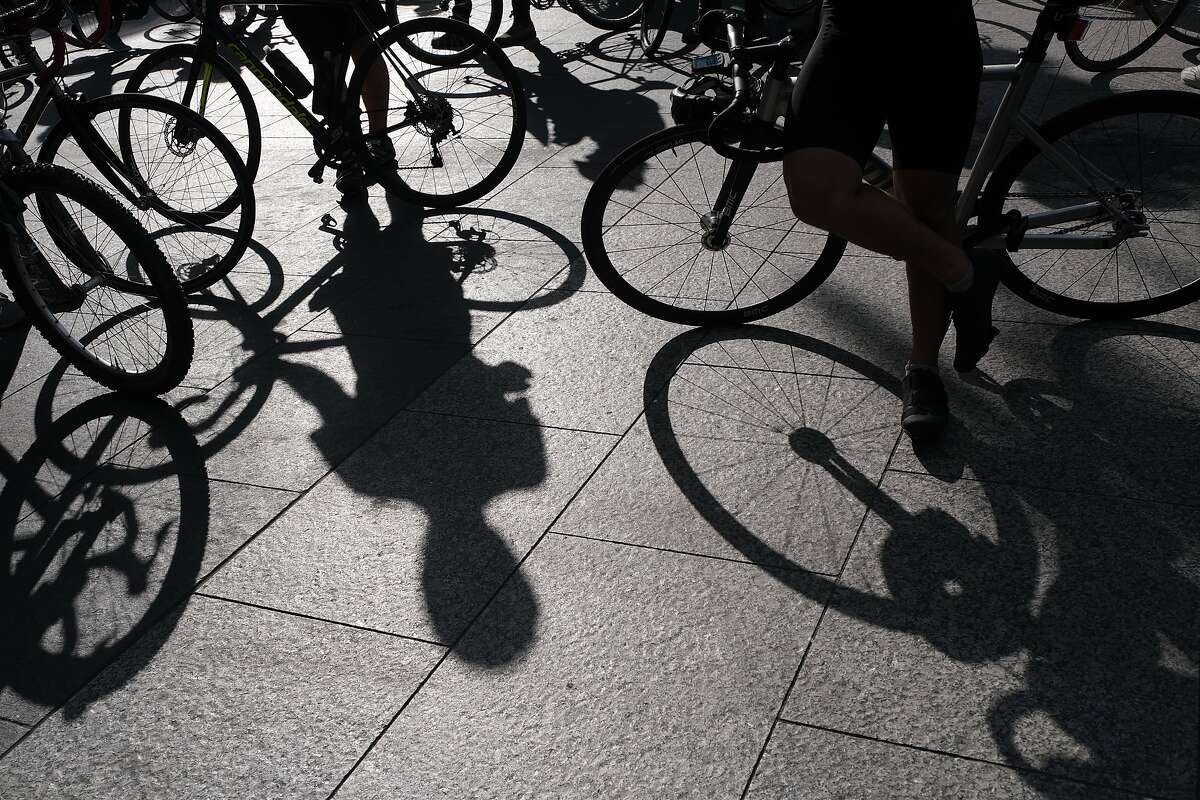
1of7 People participate in a Critical Mass style solidarity ride to demand an end to police violence in San Francisco on Friday June 5, 2020.Photo: Nick Otto / Sfc2of7 Hundreds gather outside San Jose City Hall to protest police brutality and systemic racism on June 5, 2020 in the wake of the police killing in Minnesota of George Floyd.Photo: Lauren Hernandez3of7 People participate in a Critical Mass style solidarity ride to demand an end to police violence in San Francisco on Friday June 5, 2020.Photo: Nick Otto / Sfc
For an eighth straight day, crowds filled streets across the Bay Area in the wake of the police killing in Minneapolis of George Floyd — but this time there were new cries for justice.
In Oakland, they rallied against police brutality to call for an end of a practice in which police are assigned to patrol certain schools.
In San Francisco, they expressed outrage at the killing of a 22-year-old local man by Vallejo police — a man unarmed and kneeling when he was killed Tuesday during unrest set off by the Floyd killing.
Hundreds of people also gathered in San Jose, Walnut Creek, Vallejo and Sunnyvale on Friday.June 5 protest at San Jose StateVolume 90% Hundreds of protesters gathered around Tommie Smith and John Carlos statue at San Jose State University.Video: San Francisco Chronicle
They were on bikes, in cars, on foot and at times, on their knees. They danced, honked, chanted. They conducted die-ins and sit-ins and vigils. They demanded change.
In Oakland, protesters urged the city’s school board to eliminate the district’s police department and the presence of officers on school grounds.
“Oakland’s just really amped up,” said Jasmine Williams, spokeswoman for the Black Organizing Project, one in a coalition of groups organizing car marches, caravans and other events throughout Oakland Friday to advocate for the change.
“We’re struggling to get money for schools right now, so why is this line item here?” Williams said.
Yvette Yarbor, 58, of the Laurel District drove to the protest in her gray Equinox van. Her son graduated from Skyline High and her daughter also attended Oakland public schools.
“I’m just here supporting the cause,” she said. “We don’t need police in schools.”
In San Jose, hundreds of demonstrators gathered at San Jose City Hall for a multicultural event with traditional Mexican dancers performing in the middle of the plaza. Some people created altars for people killed by police, including Oscar Grant and Floyd.
Essa Tokhi, 26, joined the downtown demonstration with members of the Muslim Student Association of America and its San Jose State affiliate.
“I’m here to show solidarity with my black brothers and sisters,” Tokhi said. “We have our own issues, and we have a lot of things we gotta get right ourselves, but today we’re out here to support the black people.”
Hundreds of people are rallying at San Jose City Hall. Passing cars are honking in support, and protesters are chanting, “Black Lives Matter” to the beat of a traditional Mexica dance group. pic.twitter.com/mZJarsazx4— Lauren Hernández (@ByLHernandez) June 6, 2020
Monserrat Andrade Lopez, 17, of East San Jose, sat cross-legged on the San Jose City Hall plaza, where she and a group of friends scribbled messages on cardboard, including “Black Lives Matter” and “If you support a racist system, all you can be is racist.”
She said that, as a Latina, she understands the fear that communities of color feel in response to police presence in general.
Other organized protests Friday included a gathering at Oakland’s Lake Merritt Amphitheater for Breonna Taylor, who was fatally shot by Louisville police officers after they entered her apartment on a no-knock warrant. She was sleeping at the time. Friday would have been her 27th birthday.
A separate vigil in Oakland honored Tony McDade, a black transgender man fatally shot by police in Tallahassee, Fla., on May 27 as they approached him in connection with a stabbing earlier in the day.
In San Francisco, protesters rode bicycles through city streets demanding justice for Floyd.
Also in San Francisco, as well as Vallejo, a protest against police brutality focused on the police killing of Sean Monterrosa, who was kneeling on the ground outside a Walgreens that reportedly had been burglarized Tuesday. Police said the officer fired through his own windshield after mistaking a hammer in Monterrosa’s pocket for a gun.
Hundreds of people gathered at 24th and Mission streets in San Francisco to call for justice in the killing of Monterossa. Family, friends and community members joined to hear speakers, chant Monterossa’s name and tell stories about him. A group of dancers with the Latina Task Force performed a healing ceremony.
His sisters, Michelle and Ashley Monterossa, are calling on Vallejo police to release the body-cam video footage of the shooting and identify the officer who fired the shots.
In Vallejo, protesters also called for justice, at one point standing silently in front of City Hall, with helicopters overhead and the National Guard nearby.
“Sean is part of a bigger movement,” Michelle Monterossa said. “My mama always said God told her Sean had a bigger purpose. We never understood what that meant.”




 CHINDIA ALERT: You'll be living in their world, very soon