

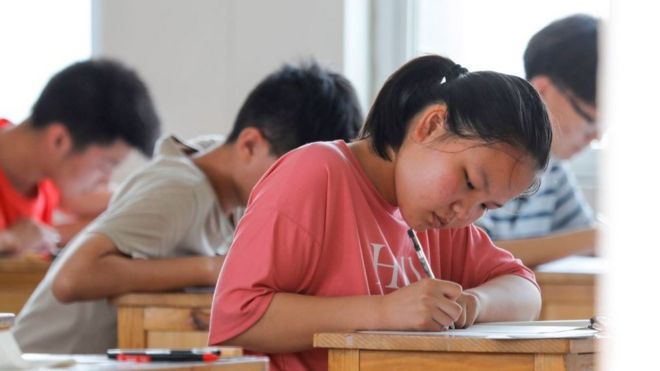
This week around 10 million students across China have sat the Gaokao – a college entrance exam which determines their entire future.
Hanging over their heads, though, is the recent revelation that hundreds of other students before them were victim to an identity theft scandal which saw them robbed of their results.

For Chen Chunxiu, it was an exam that could change everything. Doing well in the Gaokao meant the farmer’s daughter had a shot of getting into her dream university. Failing meant it would remain just that – a dream.
She failed.
Denied admission to college, she took up various jobs – a factory worker, a waitress – before eventually becoming a kindergarten teacher.
But 16 years later, she found to her shock that she had, in fact, earned a place at the Shandong University of Technology – and enrolled there.
But it hadn’t been her. Her score – and in fact, her entire identity – was stolen by a girl whose relatives had pulled strings to make this happen.
Her case is just one of 242 student identity thefts that took place in Shandong province between 2002 and 2009, according to recent media reports.
A shocking tale of systemic cheating
The notoriously hard Gaokao – or “high school exam” – tests school leavers on their Chinese, maths, English and another subject of their choice.
It has been the focal point of the education system since the 1950s, with a break during the Cultural Revolution.
But it’s not just an exam. For millions – especially those in less privileged positions – it’s the ticket to success and upward mobility.
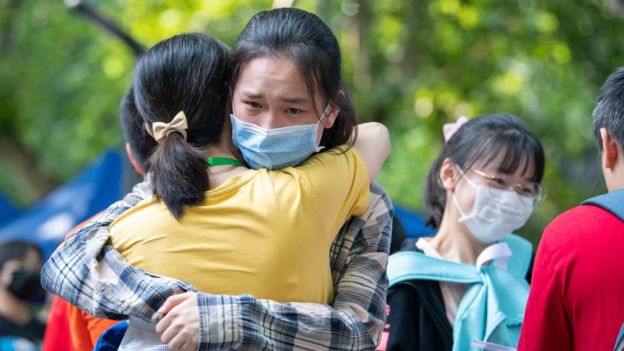
The family of Ms Chen, whose story has been widely covered in China in recent weeks, had high hopes.
Because they lived in poverty and could only afford to fund one child’s education, they made her less academically-inclined older brother drop out of school to make way for her. This was rare in rural China, where typically the education of boys has been prioritised over that of girls.
It was with this hope that Ms Chen took the Gaokao in 2004. Back then, university students in China did not receive rejection letters – if you didn’t receive an acceptance letter, the assumption was simply that you didn’t get in.
So after waiting until September – when the university term usually begins – Ms Chen accepted that no letter was coming and decided to head to work in the city.
Then in May this year, she decided to enrol herself into a course for adults. Entering her details in an official government website, Ms Chen found that it listed her as having enrolled and entered university in 2004 and graduated in 2007.
But the picture shown wasn’t her. Slowly but surely, the truth started to emerge – revealing the shocking extent of cheating that had taken place.
According to state news outlet Xinhua, the imposter’s uncle – who was a local official – is accused of getting help from a local admissions director, who was able to access Ms Chen’s exam information.
Ms Chen had scored 546 out of 750, compared to her imposter, who had scored 303.
The imposter’s father then allegedly intercepted Ms Chen’s admissions letter at the county post office before it was posted. With help from Ms Chen’s high school principal, say reports, they faked an entirely new high school transcript bearing the imposter’s details.
The imposter’s relatives also worked with a police director and staff from the Shandong University of Technology to ensure the enrolment went through and that a blind eye was turned, it is alleged. Ms Chen – a relatively poor farmer’s daughter – did not stand a chance.
The imposter – whose real name is Chen Yanping – then assumed the identity of Ms Chen.
Until today, the imposter’s colleagues still know her as Chen Chunxiu, say media reports. Her degree has since been revoked and she has been sacked from her job. A government report says she is still under investigation.
“I want to ask her in person why she stole my identity,” the real Ms Chen told China’s CCTV in an interview. “You replaced me – what did you expect to happen to me? Are you so selfish?”
Her story has been met with widespread anger: many have questioned the point of working so hard for years for an exam that on the surface, promised equal opportunities for all.
“[Some people] have no idea how important the Gaokao is for those not so well off. Parents work so hard to support their kids… but their way is blocked by those with power,” said one person on Weibo.
‘What can a farmer do?’
According to Chu Zhaohui, a researcher at China’s National Institute of Education Sciences, Gaokao fraud can be divided into two sorts – the kind where where the victim has no idea and the other, where both parties mutually consent to it, perhaps for a fee.
The first category he says, typically involves oversight from more than just one party.
“Enrolment generally involves many parties – schools, examination institutes, enrolment offices, and household management department. So, if there’re loopholes in so many links, it can only show that it is… collaborative cheating”, Mr Chu told BBC Chinese.
In such cases victims are usually in “low social positions” and hence have little way of fighting back, even if they do eventually find out, he adds, as was the case for Ms Chen’s father.
“What can a farmer do?” he asked Chinese media. “If I was powerful, they wouldn’t have dared [do this to her].”
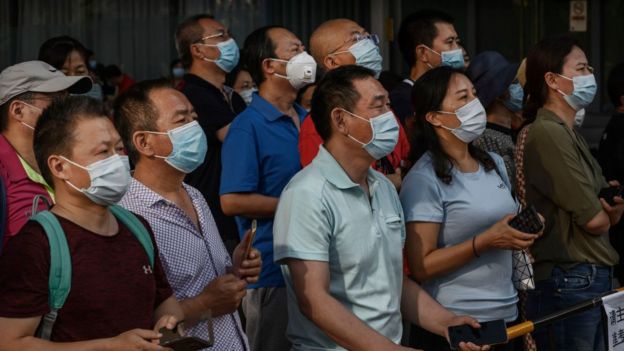
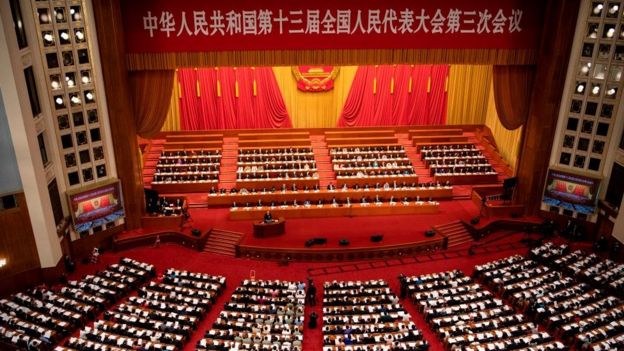
At China’s parliament meeting last month, there were calls for college admission identity theft to be criminalised. One delegate said it was “much more harmful than [monetary] theft”.
Officials in Shandong say new processes are now in place to make sure such incidents will not happen again.
Students will need to submit their offer letter, identity card, residential certificate and an exam attendance certificate before their admission can be confirmed. University acceptance results will also be published online and sent via text message.
And Prof Cheng Fangping, at Renmin University, told BBC Chinese that as student documents were now largely online it was harder for them to be doctored.
The Ministry of Education has also announced that any students found to be involved in identity theft will not be allowed to enrol in university.
Local authorities have launched an investigation into Chen Chunxiu’s case and 46 people have been punished.
Ms Chen is now trying to claim back what should have been her life, and she appealed to be re-admitted to the Shandong university.
After her initial rejection was met with public uproar, the university later said it would “actively strive” to help Ms Chen “realise her wishes”.
(Reuters) – Global coronavirus cases exceeded 12 million on Wednesday, according to a Reuters tally, as evidence mounts of the airborne spread of the disease that has killed more than half a million people in seven months.
FILE PHOTO: Relatives pray before the cremation of a woman, who died due to the coronavirus disease (COVID-19) at a crematorium in New Delhi, India, July 8, 2020. REUTERS/Danish Siddiqui/File Photo
The number of cases is triple that of severe influenza illnesses recorded annually, according to the World Health Organization.
Many hard-hit countries are easing lockdowns put in place to slow the spread of the novel virus, while others, such as China and Australia, implement another round of shutdowns in response to a resurgence in infections. Experts say alterations to work and social life could last until a vaccine is available.
The first case was reported in China in early January and it took 149 days to hit 6 million cases. It has taken less than a third of that time – just 39 days – to double to 12 million cases, the tally shows.
There have been more than 546,000 deaths linked to the virus so far, within the same range as the number of yearly influenza deaths reported worldwide. The first death was reported on Jan. 10 in Wuhan, China before infections and fatalities surged in Europe and then later in the United States.
The United States reported a daily global record of 56,818 new COVID-19 infections on July 3 when global cases reached the 11 million mark. The United States recorded a total of 3 million cases on Tuesday, and accounts for more than a quarter of both global cases and global fatalities putting President Donald Trump’s pandemic strategy under scrutiny.
Brazilian President Jair Bolsonaro tested positive for coronavirus after downplaying the seriousness of the pandemic. The country has reported between 20,000 and 50,000 new cases daily since July 1. Brazil has more than 1.7 million cases and nearly 68,000 deaths.
The Reuters tally, which is based on government reports, shows the disease is spreading the fastest in Latin America. The Americas account for more than half the world’s infections and almost half its deaths. Brazil and the United States account for around 45% of all new cases since the beginning of July.
India – the country with the third highest number of infections – is battling an outbreak of more than 20,000 new cases each day.
In countries with limited testing capacity, case numbers reflect only a proportion of total infections. Experts caution that official data likely underrepresents both cases and deaths.
Source: The BBC

 CHINDIA ALERT: You'll be living in their world, very soon
Leave a comment