22/05/2014

India scales up military forces on disputed China border – CSMonitor.com

Very interesting: Pakistan is invited to Modi’s inauguration, but China is not; and more troops along Chinese border but not  along border with Pakistan!

“India is raising a new mountain strike corps of nearly 90,000 soldiers to strengthen its defense along its disputed border with China in the high reaches of the Himalayas.

Chinese troops hold a banner which reads: "You've crossed the border, please go back" in Ladakh, India. India is raising a new mountain strike corps consisting of some 90,000 soldiers to strengthen its defence along its disputed but largely uninhabited border with China in the high reaches of the Himalayas. Photo taken Sunday, May 5, 2013.

China will be a top foreign policy challenge for Narendra Modi, the incoming prime minister who won a landslide victory last week. Business ties between India and China are booming. But despite rounds of talks, the two countries have yet to resolve their decades-old dispute over the 2,000-mile border between the two countries. It remains one of the most militarized borders in the world.

The strike corps will have its own mountain artillery, combat engineers, anti-aircraft guns, and radio equipment. Over 35,000 soldiers have already been raised in new infantry units in India’s northeastern state of Assam. The entire corps will be fully raised over the next five years with 90,274 troops at a cost of $10.6 billion. The proposal to raise a new strike corps was recommended last year by India’s China Study Group, a government body that considers all strategic issues related to China.

The strike corps signals a new assertiveness in New Delhi and will provide an additional defense capability to India, which for a long time focused on the land borders with Pakistan. While the decision predated Mr. Modi, he is likely to further strengthen India’s military modernization which is one of his party’s top agenda items.

“China has made frequent border transgressions into Indian border,” says retired Lieutenant General Prakash Katoch, who formerly commanded the Indian Army‘s Special Forces wing. “The new prime minister has to ensure that our borders are well protected. It cannot be business as usual.”

He predicts that as both countries are growing and keen to increase their influence, China and India will increasingly step on each other’s areas of interest and importance.”

via India scales up military forces on disputed China border – CSMonitor.com.

Enhanced by Zemanta
21/05/2014

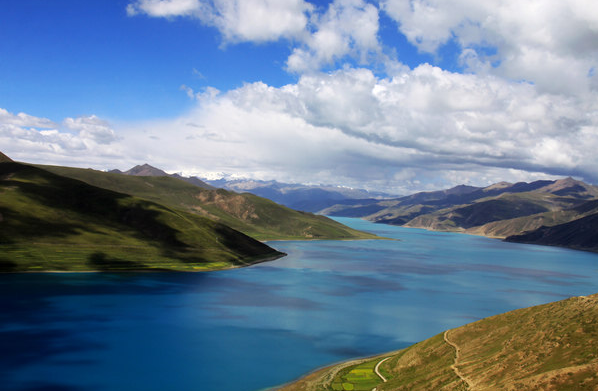
Tibet on track to become global tourist attraction[1]- Chinadaily.com.cn

Tourism increased in the Tibet autonomous region in the first four months of the year, as the region aspires to become a world-class travel destination.

Tibet on track to become global tourist attraction

The region had more than 830,000 tourists from January through April, a year-on-year increase of 23.4 percent, the regional tourism bureau said on Tuesday.

Foreign tourists numbered 20,000, an increase of 10.3 percent, and the number of domestic tourists was 810,000, an increase of 23.8 percent.

Meanwhile, the revenue generated by the tourism industry was 926 million yuan ($148.4 million), an increase of 26.2 percent, it said.

Karral Millar, 62, an Australian tourist, said she had a good time in Tibet.

“It’s wonderful. It’s been three days now. We have visited the Potala Palace and many temples, and we are learning new things about Tibetan Buddhism and history,” Millar said on Tuesday.

Cycling has become a popular way to tour the region in recent years, as many tourists want to have close contact with the natural scenery and culture of Tibet.

“It’s my second time in Tibet. I am absolutely impressed with the natural scenery and unique culture. I feel as if I am at home here,” said Liu Xiaojun, from Hebei province.

“I am also overwhelmed with the hospitality and politeness of the local people,” said Liu, adding that he plans to make a bicycle tour to Zhangmu Port in Tibet’s Xigaze prefecture.

Many businesses near the scenic spots in Lhasa see the coming of summer peak season as a harvest.

“Compared with the same period last year, we had more guests this year. We have 62 rooms, and more than half are booked every day,” said India, 41, a receptionist at the Kyichu Hotel, a Nepalese hotel in Lhasa.

Tibet received more than 12 million tourists from home and abroad lastar.

The region hopes to have 15 million tourists this year.

via Tibet on track to become global tourist attraction[1]- Chinadaily.com.cn.

Enhanced by Zemanta
21/05/2014

Is China’s Housing Bubble Beginning to Burst? – Businessweek

Earlier this month, financial analysts from Japan-based Nomura Group (NMR) issued a grim report on China’s housing market: “To us, it is no longer a question of ‘if’ but rather ‘how severe’ the property market correction will be,” the report read.

Residential apartment buildings under construction in Qingzhou city, in east China’s Shandong province

Nomura—which has historically been bearish on China, as the Wall Street Journal observes—predicted that a downturn in the housing market, caused by oversupply and shrinking developer financing, could sharply impact China’s economy, perhaps even driving GDP growth to less than 6 percent in 2014.

China’s economy is vulnerable because property investment accounts for anywhere from 16 percent to 20 percent of gross domestic product, according to varying analyses.

via Is China’s Housing Bubble Beginning to Burst? – Businessweek.

Enhanced by Zemanta
21/05/2014

India Invites Pakistan to Narendra Modi’s Swearing-In – India Real Time – WSJ

Interestingly, China, another close neighbour has NOT been invited!

“In a surprise gesture, India has invited the leader of Pakistan—its neighbor and arch-enemy—to attend the swearing-in ceremony of a new prime minister.

The leaders of other South Asian nations are being invited, too, including Afghanistan, Sri Lanka, Nepal, Bhutan, Maldives and Bangladesh, according to a spokeswoman for the Bharatiya Janata Party, which dominated India’s recent parliamentary election. But all eyes will be on Pakistan, which has fought three wars with India since the two nations gained independence from the colonial British in 1947.

As of Tuesday afternoon, Pakistan hadn’t yet received its invitation, according to Pakistan’s foreign ministry.

Traditionally, swearings-in have been attended mainly by family members and Indian government figures. India’s next prime minister, Narendra Modi of the BJP, is scheduled to be sworn in at a ceremony on May 26. The invitations have been sent by India’s Ministry of External Affairs.

According to the BJP spokeswoman, Nirmala Sitharaman, invitations have been sent to all members of the South Asian Association for Regional Cooperation, or SAARC. The organization’s purpose is to work toward peace and strengthened economic ties in the region.

“We are looking forward to having a good relationship in our neighborhood and we want to build goodwill,” Ms. Sitharaman told The Wall Street Journal.

Mr. Modi, a Hindu nationalist leader, is expected to pursue a muscular foreign policy. In the past, he has criticized the rival Congress party’s stance on territorial disputes with China and on border skirmishes with Pakistan.  His party, the BJP, won 282 of the 543 elected seats in Parliament this month. The Congress party, which previously led the national government, won only 44 seats—its worst tally in party history.

After winning the elections, Mr. Modi, who has served as the chief minister of Gujarat for more than a decade, was congratulated by Pakistan Prime Minister Nawaz Sharif. Mr. Sharif came to power in Pakistan in the elections held last year.

India and Pakistan have a tense and fragile relationship. The invitation to attend the swearing-in comes only two days after Indian security forces said they were in pursuit of alleged militants in the state of Jammu and Kashmir, where India and Pakistan regularly skirmish.”

via India Invites Pakistan to Narendra Modi’s Swearing-In – India Real Time – WSJ.

Enhanced by Zemanta
21/05/2014

Does China Pose a Threat to Global Food Security? It Says No – China Real Time Report – WSJ

Twenty years ago, environmental advocate Lester Brown got in hot water with Beijing for writing a book called “Who Will Feed China?”

China was displeased with the suggestion in his book that the country’s growing population and water scarcity could drastically burden the world’s food resources. Beijing publicly criticized the author – then began a series of reforms including improving farming techniques and adopting a national policy of self-sufficiency in grain consumption that vindicated Mr. Brown’s arguments. It paved the way for a gradual rapprochement with the American, now 80.

Détente is over.

On Wednesday, China’s agriculture ministry issued a statement again criticizing Mr. Brown. It took umbrage with an essay he wrote titled “Can the World Feed China?” a riff on his earlier book. The essay details Mr. Brown’s concerns that rising domestic pressures on food consumption could result in spiking food prices and political unrest as China joins in a global “scramble for food.”

It isn’t clear why Mr. Brown was singled out for criticism; many analysts have in one form or other also articulated these trends, though arguably not as directly or pungently. But the move underscores how increasingly sensitive China is to the growing impression that it can’t feed itself and that its acquisitions of global food assets are posing a risk to food security for the rest of the world. China has been keen in recent years to head off any impression that it’s on a global grab for natural resources.

Mr. Brown wasn’t immediately available for comment.

The government is unhappy with the notion it’s being blamed for sharpening global competition for food. Mr. Brown’s essay said China’s rising grain imports  mean “it is competing directly with scores of other grain-importing countries.” He also warned that China’s purchase last year of U.S. pork producer Smithfield Foods “was really a pork security move.” So too, he said, was China’s deal with Ukraine to provide $3 billion in loans in exchange for corn. “Such moves by China exemplify the new geopolitics of food scarcity that affects us all,” he wrote.

Not likely, ministry spokesman Bi Meijia said in the government’s statement. Mr. Bi said 97% of China’s grain consumption comes from its own output, not imports.

“On the issue of food security, China not only does not pose a threat to the world, but makes a contribution to global food security,” he said. China intends to continue its existing policies, he said.

Mr. Bi said rising grain imports aren’t due to domestic shortages, but because global prices are lower than domestic prices. The ministry also pointed out that imports accounted for just 2.6% of domestic grain production volume in 2013, and just 4% of global output.

via Does China Pose a Threat to Global Food Security? It Says No – China Real Time Report – WSJ.

Enhanced by Zemanta
19/05/2014

The Twin Deficits That Threaten Modi’s India – Businessweek

For Narendra Modi, getting elected as prime minister of India is the easy part. Now comes dealing with the twin deficits—in the national budget and in foreign trade—that endanger the world’s largest democracy.

Opposition leader and India's next prime minister Narendra Modi greets supporters during a visit to seek his mother's blessings in Gandhinagar, the western Indian state of Gujarat on May 16

Overnight poll results show that Modi’s opposition Bharatiya Janata Party and its allies scored the biggest Indian election win in 30 years. “Voters tired of sluggish economic growth and corruption handed a historic defeat to the Gandhi dynasty that has dominated politics since the country’s founding,” Bloomberg News reported today.

In April, the International Monetary Fund issued a 66-page report on India that highlighted the challenges facing India. The report notes that India is not the only Group of 20 country with high budget deficits, nor is it the only one with high trade deficits. What’s unusual is that it’s high in both.

Despite notable progress in shrinking both deficits, India remains vulnerable to a crisis of confidence among global investors, the IMF report says. Advanced economies are vulnerable to rapid fiscal deterioration, the report says, when they have debt-to-GDP ratios above 80 percent of GDP and persistent deficits in the current account, the broadest measure of trade in goods and services. Emerging economies such as India’s are vulnerable even at lower debt levels, the report says, citing work by Harvard economists Kenneth Rogoff and Carmen Reinhart.

via The Twin Deficits That Threaten Modi’s India – Businessweek.

Enhanced by Zemanta
19/05/2014

‘No Gene for Invasion in Chinese People’s Blood,’ Says Xi, Amid Sino-Vietnam Tensions – Businessweek

As tensions grow between China and its neighbors, some words of reassurance are certainly welcome. Still, it’s questionable just how calming Xi Jinping’s recent ones were.

Ethnic Chinese refugees from Vietnam are confined to a dockyard camp in Hong Kong on Nov. 1, 1979

China does not accept that “might is right,” said China’s president and party secretary, speaking yesterday at a commemoration ceremony in Beijing for the 60th anniversary of the Chinese People’s Association for Friendship with Foreign Countries. “There is no gene for invasion in Chinese people’s blood,” Xi continued, the official Xinhua News Agency reported on May 16.

Speaking of invasions, that is what China did when it sent troops into northern Vietnam in 1979, a foray that sparked a short-lived but bloody war between the two countries. China and Vietnam have a history of “collaboration and cordiality, but also tumult and hostility” going back as far as the first century B.C., wrote Dennis McCornac, a professor at Loyola University Maryland, in 2011.

via ‘No Gene for Invasion in Chinese People’s Blood,’ Says Xi, Amid Sino-Vietnam Tensions – Businessweek.

Enhanced by Zemanta
19/05/2014

Modi’s Next Move – India Real Time – WSJ

The simplest way to understand the enormity of the Bharatiya Janata Party’s victory Friday in India’s election is to place it in historical context.

For the first time since 1984, India’s voters have given a single party rather than a ragtag coalition a majority in Parliament. The BJP won 282 seats, 10 more than the 272 needed to reach the halfway mark in the 543-seat lower house of Parliament. The BJP-led National Democratic Alliance coalition snagged 336 seats.

For the first time ever, India’s traditionally left-leaning politics has moved decisively to the right. Even when it won more seats than the left-of-center Congress Party in three elections in the late 1990s, the BJP always lagged its rival in share of the popular vote. This time the BJP snagged nearly one third of the national vote, while Congress claimed less than a fifth. The BJP also made inroads into southern and eastern India, outside its traditional strongholds in the north and west.

The rightward swing is all the more notable because incoming Prime Minister Narendra Modi belongs to the conservative wing of India’s conservative party. Unlike the last BJP prime minister, Atal Bihari Vajpayee (1998-2004), Mr. Modi cut his teeth in politics battling Congress when it briefly suspended democracy in the mid-1970s, not admiring Jawaharlal Nehru’s parliamentary eloquence in defense of socialist policies in the 1950s.

Congress itself has been reduced to a rump. The 44 seats it won is less than half of its previous low of 114 seats in 1999. Congress has proved naysayers wrong before by bouncing back. Still, for the first time talk of the possible extinction of a party that has ruled India for all but 13 years since independence in 1947 seems plausible. And the two main communist parties, which have traditionally wielded influence both inside and outside Parliament and helped set the tone for much anti-capitalist and anti-Western discourse, have been reduced to a footnote. Together they hold a meager 10 seats.

via Modi’s Next Move – India Real Time – WSJ.

Enhanced by Zemanta
17/05/2014

India’s Modi gets hero’s welcome as he brings new era to New Delhi | Reuters

Hundreds of Indians thronged the leafy streets of New Delhi on Saturday to greet Narendra Modi‘s triumphant march into the capital after he decimated the Nehru-Gandhi dynasty and the ruling Congress party in the biggest election victory the country has seen in 30 years.

Hindu nationalist Narendra Modi, the prime ministerial candidate for India's Bharatiya Janata Party (BJP), gestures towards his supporters from his car during a road show upon his arrival at the airport in New Delhi May 17, 2014. REUTERS/Adnan Abidi

Modi leaned far out of his car, waving a victory sign to jubilant supporters, in a drive from the airport to the headquarters of his Bharatiya Janata Party (BJP) in the center of town.

A Hindu nationalist who critics fear will be divisive and autocratic, Modi toned down religious issues in his pitch to India’s 815 million voters and won the world’s biggest ever election with promises of economic development for all.

The three-times chief minister of the western state of Gujarat is an outsider to Delhi’s power circle. The low-caste son of a tea stall-owner, his rise to power signals the end of an era dominated by the descendants of India’s first prime minister, independence hero Jawaharlal Nehru.

“Four to five generations have been wasted since 1952, this victory has been achieved after that,” Modi said, in a jibe at the Nehru-Gandhi family and the Congress it dominates.

Describing himself as a “worker”, he hailed grass-roots campaigners who showered him with pink rose petals as he arrived at party headquarters. There he met other party leaders and was expected to start discussions about forming a cabinet. Modi will not formally take office until after Tuesday, the party said.

Modi has given India its first parliamentary majority after 25 years of coalition governments, with his party winning more than six times the seats garnered by Congress.

With almost all 543 seats declared by Saturday morning, Modi’s BJP looked set to win 282 seats, 10 more than the majority required to rule. With its allied parties, it was heading for a comfortable tally of around 337 – the clearest result since the 1984 assassination of prime minister Indira Gandhi propelled her son Rajiv to office.

During the campaign Modi was explicit about wanting to end the dominance of the Nehru-Gandhi family on Indian politics. He may have achieved the goal, with Congress reduced to just 44 seats, less than half of its previous worst showing.

Modi’s landslide win gives him ample room to advance reforms started 23 years ago by current Prime Minister Manmohan Singh but which have stalled in recent years.

Despite his party’s pasting, 81-year-old Singh was magnanimous in his final address to the nation on Saturday, wishing the incoming government success. Later, he tendered his resignation.

“I am confident about the future of India,” he said in his televised message. “I firmly believe that the emergence of India as a major powerhouse of the evolving global economy is an idea whose time has come.”

Unlike Singh and his predecessors, Modi will not have to deal with unruly partners to implement reform. That could usher in profound economic changes, with some supporters imagining him as India’s answer to former British leader Margaret Thatcher.

via India’s Modi gets hero’s welcome as he brings new era to New Delhi | Reuters.

Enhanced by Zemanta
16/05/2014

Islamic leaders join efforts against extremism – China – Chinadaily.com.cn

China’s top Islamic leaders urged the nation’s Muslims to resist religious extremism and oppose to terrorism after a number of violent attacks in the Xinjiang Uygur autonomous region in March and April.

An SVG map of China with the Xinjiang autonomo...

An SVG map of China with the Xinjiang autonomous region highlighted Legend: Image:China map legend.png The orange area is Aksai Chin, a part of Xinjiang which is claimed by India. (Photo credit: Wikipedia)

Around 80 religious leaders and scholars discussed Islamic doctrine by quoting the Quran and the teachings of the Prophet Muhammad on Wednesday and Thursday in Urumqi, the region’s capital. On Thursday, Islamic leaders in China passed a proposal calling on all Muslims in the country to regulate their behavior, resist religious extremism and improve their moral outlook.

Abulitif Abdureyim, director of the Xinjiang Islamic Association, said governments at all levels in the region are resisiting religious extremism.

“The attackers who carried out the terrorist activities cannot go to heaven because they have violated the sayings in the Quran,” he said.

Wang Yujie, a professor of religious studies at Renmin University of China, said separatist forces are the main source of terrorism in Xinjiang.

In recent years, China has seen a number of violent attacks on police, government organs and civilians. Most of the attacks have taken place in Xinjiang.

A national security blue paper said on May 6 that religious extremism was the major reason for 10 violent terrorist attacks last year.

via Islamic leaders join efforts against extremism – China – Chinadaily.com.cn.

Enhanced by Zemanta
Law of Unintended Consequences

continuously updated blog about China & India

ChiaHou's Book Reviews

continuously updated blog about China & India

What's wrong with the world; and its economy

continuously updated blog about China & India