Archive for ‘1949’

24/05/2020

Xi Focus: “What is people first?” Xi points to how China saves lives at all costs

Chinese President Xi Jinping, also general secretary of the Communist Party of China Central Committee and chairman of the Central Military Commission, takes part in a deliberation with his fellow deputies from the delegation of Inner Mongolia Autonomous Region at the third session of the 13th National People’s Congress (NPC) in Beijing, capital of China, May 22, 2020. (Xinhua/Ju Peng)

BEIJING, May 23 (Xinhua) — “What is people first?” Chinese President Xi Jinping asked, before offering his own answer when he was talking with lawmakers at the ongoing national legislative session.

“So many people worked together to save a single patient. This, in essence, embodies doing whatever it takes (to save lives),” he said.

Xi, also general secretary of the Communist Party of China Central Committee and chairman of the Central Military Commission, is a deputy to the 13th National People’s Congress.

During his deliberations with fellow deputies from Inner Mongolia Autonomous Region on Friday, “people” was a keyword.

Xi referred to a story told by another deputy that morning. Luo Jie, from the COVID-19 hard-hit province of Hubei, told reporters at the session how medical workers in his hospital spent 47 days saving an 87-year-old COVID-19 patient.

“About 10 medical workers meticulously took care of the patient for dozens of days, and finally saved the patient’s life,” Xi said. “I am really impressed.”

In the COVID-19 pandemic, health workers around the world got to know the elderly are the most difficult to treat and require the most sophisticated medical resources. China has given every patient equal treatment irrespective of their age or wealth.

Chinese President Xi Jinping, also general secretary of the Communist Party of China Central Committee and chairman of the Central Military Commission, takes part in a deliberation with his fellow deputies from the delegation of Inner Mongolia Autonomous Region at the third session of the 13th National People’s Congress (NPC) in Beijing, capital of China, May 22, 2020. (Xinhua/Huang Jingwen)

In Hubei alone, more than 3,600 COVID-19 patients over the age of 80 have been cured. In the provincial capital Wuhan, seven centenarian patients have been cured.

“We mobilized from around the nation the best doctors, the most advanced equipment and the most needed resources to Hubei and Wuhan, going all out to save lives,” Xi said during the deliberations, adding that the eldest patient cured is 108 years old.

“We are willing to save lives at all costs. No matter how old the patients are and how serious their conditions have become, we never give up,” Xi said.

Xi joined political advisors and lawmakers on Thursday and Friday in paying silent tribute to the lives lost to COVID-19 as the top political advisory body and the national legislature opened their annual sessions.

This year’s government work report said China’s economy posted negative growth in the first quarter of this year, but it was “a price worth paying” to contain COVID-19 as life is invaluable.

“As a developing country with 1.4 billion people, it is only by overcoming enormous difficulties that China has been able to contain COVID-19 in such a short time while also ensuring our people’s basic needs,” the report said.

Epidemic response is a reflection of China’s governing philosophy.

The fundamental goal for the Party to unite and lead the people in revolution, development and reform is “to ensure a better life for them,” Xi said.

The nation’s average life expectancy reached 77 years in 2018, more than double that in 1949, when the people’s republic was founded.

Chinese people are not just living longer but better lives, with more material wealth and broader choices to pursue individual dreams. All rural poor will bid farewell to poverty this year as part of the goal of building a moderately prosperous society in all respects.

The Party’s long-term governance, Xi said, rests on “always maintaining close bond with the people.”

“We must always remain true to the people’s aspiration and work in concert with them through thick and thin,” Xi said.

Source: Xinhua

29/04/2020

Tsai Ing-wen under pressure amid pro-independence push for constitutional change in Taiwan

  • Hardline politicians want president to fulfil promise to overhaul constitution to reflect the self-ruled island’s political reality
  • A petition calls for two referendums on the issue – proposing it either be replaced with a new one or revised
The push for constitutional change could lead to a cross-strait conflict. Photo: Handout

Taiwanese President Tsai Ing-wen is under growing pressure from the hardline camp to push for constitutional change to reflect the self-ruled island’s independent status – something observers say could provoke a cross-strait conflict.

With Tsai due to be sworn in for a second four-year term next month after a landslide victory in January’s election, hardline pro-independence politicians want her to fulfil a 2015 campaign promise: to overhaul the constitution so that it reflects Taiwan’s political reality. The process has been stalled since Tsai’s first term, which began in 2016.

Leading the charge is the Taiwan New Constitution Foundation, a group formed last year by a Tsai adviser and long-time independence advocate Koo Kwang-ming.

The foundation launched a petition at the end of March calling for two referendums on the constitution – proposing that it either be replaced with a new one or revised.

The existing constitution was adopted when Kuomintang leader Chiang Kai-shek and the KMT fled to Taiwan and set up an interim government in 1949 following their defeat by Mao Zedong’s communists in mainland China.

Drawn up in 1947, the constitution still puts the mainland and Mongolia under the Republic of China jurisdiction – Taiwan’s official name for itself. In reality, its jurisdiction extends only to Taiwan and its outlying islands of Penghu, Matsu and Quemoy, which is also known as Kinmen.

Taiwan’s constitution was adopted when KMT leader Chiang Kai-shek fled to the island in 1949. Photo: Handout
“We have garnered more than 3,000 signatures from the public for the first phase of initiating the proposals to hold two referendums asking the president to push for constitutional change,” Lin Yi-cheng, executive director of the Taiwan New Constitution Foundation, said on Wednesday.

He said they would propose that voters be asked two questions in the referendums: “Do you support the president in initiating a constitutional reform process for the country?”

And: “Do you support the president in pushing for the establishment of a new constitution reflecting the reality of Taiwan?”

“We’re ready to send the two referendum proposals to the Central Election Commission on Thursday,” he said.

Confusion prompts call for China Airlines name change in Taiwan, but at what cost?

14 Apr 2020

Under Taiwan’s Referendum Act, the process for holding a referendum involves three stages: a proposal, endorsement and voting.

Lin said there should be no problem for the commission to approve the proposal stage since they had gathered far more than the minimum 1,931 signatures needed under the act.

The endorsement stage requires a minimum of 290,000 signatures, and if the referendum is held, they will need at least 5 million votes.

Lin said if the process went smoothly, he expected a referendum could be held in August next year, allowing time for review and making the necessary arrangements.

He said if the referendum questions got enough public support, Tsai would need to deal with the issue.

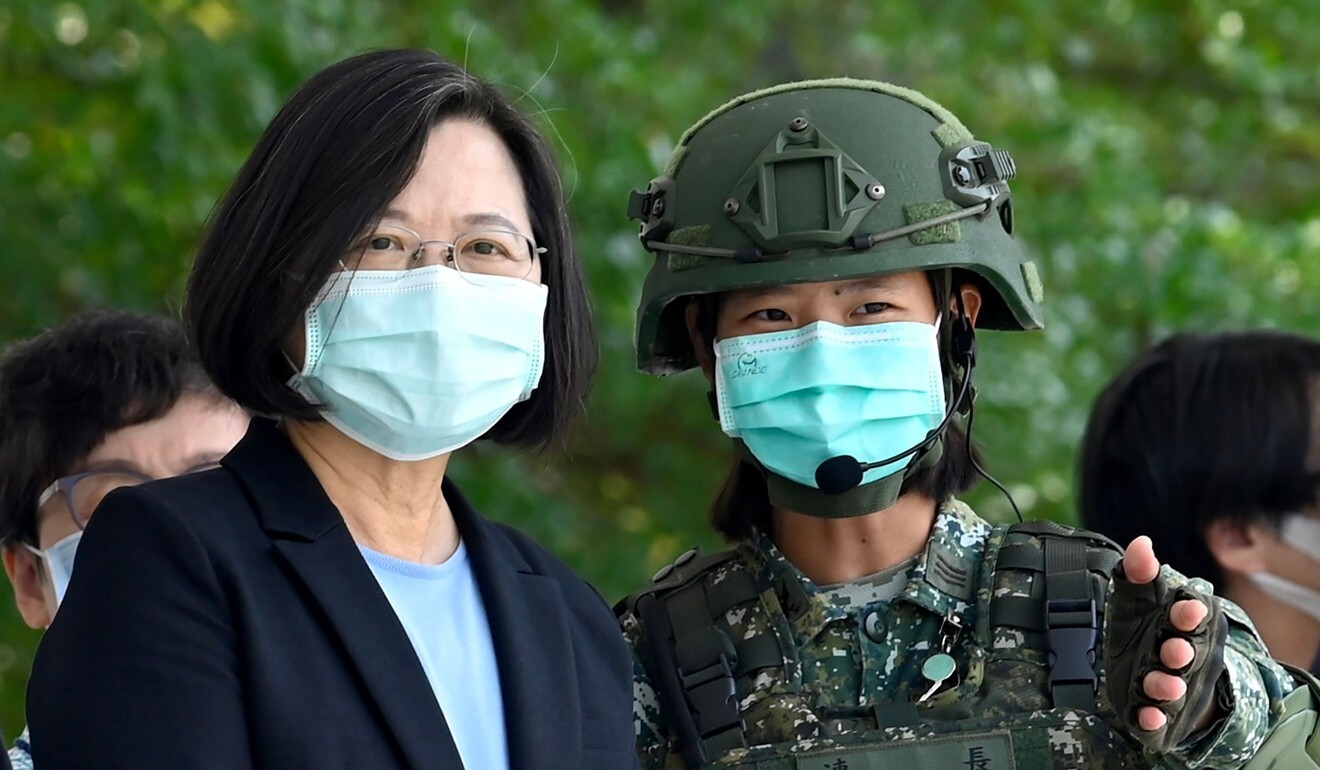
Tsai Ing-wen visits a military base in Tainan earlier this month. The pressure for constitutional change creates a dilemma for the president. Photo: AFP
Tsai’s Democratic Progressive Party government has been tight-lipped over the constitutional change issue, which Beijing sees as a move for the island to declare formal independence from the mainland.
Beijing considers Taiwan a wayward province that must be returned to the mainland fold, by force if necessary, and it has warned Tsai against declaring formal independence.
A DPP official said the foundation’s push would put Tsai in a difficult position.

“If she ignores the referendums, she will come under constant pressure from the hardline camp, and if she seriously considers taking action and instituting a new Taiwan constitution, she will risk a confrontation with Beijing, the consequence of which could be a cross-strait conflict,” said the official, who requested anonymity.

On Tuesday, Zhu Fenglian, a spokeswoman for the mainland’s Taiwan Affairs Office, warned the island against holding any referendum on constitutional revision, saying it would be doomed to end in an impasse and would ultimately fail.

“It will only push Taiwan towards an extremely dangerous abyss and bring disasters to Taiwanese compatriots,” she said.

Chinese air force’s drill ‘aimed at signalling deterrent around Taiwan’

2 Apr 2020

But according to Wang Kung-yi, a political science professor at Chinese Culture University in Taipei, Tsai should not be too worried about the hardline camp move.

“The hardline camp has been marginalised greatly in the past several years as reflected by the poor showing in the legislative elections in January,” Wang said, adding that he expected Tsai to continue her relatively moderate cross-strait policy of not sharply provoking the mainland.

Source: SCMP

01/04/2020

In Taiwan, anger at China over virus drives identity debate

TAIPEI (Reuters) – Anger at being confused with China amid the coronavirus outbreak and Beijing’s stepped-up efforts to assert sovereignty is stirring heated debate in Taiwan about how to further distance itself from its giant and often threatening neighbour

At its core is a debate about whether to drop “China” from the island’s official name, the Republic of China.

During the virus crisis, the World Health Organization (WHO), which considers the island part of China, has listed Taiwan’s far lower case number under China’s, and China has repeatedly insisted only it has the right to speak for Taiwan on the global stage, including about health issues.

Taipei says this has confused countries and led them to impose the same restrictions on Taiwanese travellers as on Chinese, and has minimised Taiwan’s own successful efforts to control the virus.

Taiwan has been debating for years who it is and what exactly its relationship should be with China – including the island’s name. But the pandemic has shot the issue back into the spotlight.

Lin I-chin, a legislator for the ruling Democratic Progressive Party (DPP), said in parliament last month that Taiwan should change its English name to “Republic of Chunghwa”, an English rendering of the word Taiwan uses for China in its name.

“Taiwan has been brought to grief by China,” she said.

On Sunday, the New Power Party, one of Taiwan’s smaller opposition groups, released the results of a survey in which almost three-quarters of respondents said Taiwan passports should only have the word “Taiwan” on them, removing any reference to China.

“During this epidemic period, our people have been misunderstood by other countries, highlighting the urgency of changing the English name,” it said in a statement.

Taiwan’s Foreign Ministry has given a cautious response to the passport idea, noting that according to the constitution, the official name is Republic of China and that the word Taiwan was already added to passport covers in 2003.

“In the future, if there is consensus between the ruling and opposition parties on this new name, the Foreign Ministry shall cooperate in handling it,” spokeswoman Joanne Ou said.

But the government is wary of a name change for Taiwan, saying there is no consensus for such a radical move.

Although the DPP supports the island’s independence – theoretically meaning the official formation of a Republic of Taiwan – President Tsai Ing-wen says there is no need to do so, as the island is already an independent country called the Republic of China. She often refers to the island as the Republic of China, Taiwan.

‘REPUBLIC OF TAIWAN’

Premier Su Tseng-chang has said changing the island’s name isn’t the most urgent issue facing Taiwan.

“If we want to change then it might as well be to ‘Republic of Taiwan’. Taiwan is more well known,” Su said in parliament. “But if there’s no national consensus, a name change isn’t the most important thing for now.”

Taiwan’s official name is a throwback to when the Kuomintang party fled to the island after losing the Chinese civil war to the Communists in 1949, and continued to claim to be China’s legitimate government.

“The Republic of China is a country, Taiwan is not,” Chen Yu-jen, a Kuomintang legislator from the island of Kinmen, which sits just offshore from the Chinese city of Xiamen, told parliament on Monday.

The statement drew a sharp rebuke from Su, who told reporters it meant Chen had no right to be a member of the legislature. Chen said she was simply stating the facts, and that Taiwan is a geographic name, not a national name.

China’s pressure on Taiwan diplomatically and militarily during the virus crisis has also reduced Beijing’s already low standing in the eyes of many Taiwanese.

A March poll commissioned by Taiwan’s China-policy making Mainland Affairs Council and carried out by Taipei’s National Chengchi University showed more than three-quarters of respondents believed China’s government was unfriendly to Taiwan’s, the highest level in a decade.

Any name change would infuriate China, which has a law mandating the use of force to stop Taiwan independence.

Source: Reuters

19/03/2020

China’s Wuhan marks no new coronavirus case, success of strict measures

CHINA-HUBEI-ZERO INCREASE-COVID-19 (CN)

People enjoy sunset on a plank road at the Donghu Lake in Wuhan, capital of central China’s Hubei Province, March 18, 2020. No new infections of the novel coronavirus were reported on Wednesday in Wuhan, the epicenter of the epidemic, marking a notable first in the city’s months-long battle with the microscopic foe. (Xinhua/Shen Bohan)

WUHAN, March 19 (Xinhua) — No new infections of the novel coronavirus were reported on Wednesday in Wuhan, the epicenter of the epidemic, marking a notable first in the city’s months-long battle with the deadly virus and sending a message of hope to the world gripped by the pandemic.

The Health Commission of Hubei Province, where Wuhan is the capital, said the virus’ death toll climbed by eight in the province, but the total confirmed cases of the novel coronavirus disease (COVID-19) in Wuhan and Hubei remained at 50,005 and 67,800 on Wednesday.

No increase was observed in the province’s number of suspected cases, which fell to zero on Tuesday, in another indication that large-scale transmissions have been suppressed at the epidemic ground zero after a slew of strict measures.

Previously, the central Chinese province had reported single-digit increases of new infections, all of which were from Wuhan, for a week in a row since last Wednesday. A month ago, the figure was several thousand a day.

The province also saw 795 patients discharged from hospital after recovery on Wednesday, reducing its caseload of hospitalized patients to 6,636, including 1,809 in severe condition and 465 in critical condition.

With no new cases in Wuhan, the Chinese mainland on Wednesday reduced the increase in domestic transmissions to zero, according to the National Health Commission. The country now faces a greater threat of infections imported from overseas, which jumped by 34 on Wednesday.

“The clearing of new infections in Wuhan came earlier than predicted, but it is still too early to let down our guard,” said Zhang Boli, one of the leading experts advising on the epidemic fight in Hubei.

Arduous work still lies ahead as China strengthens its defence against imported cases from abroad, treats thousands of patients still in serious or critical condition and rehabilitates those discharged from hospitals, said Zhang, an academician of the Chinese Academy of Engineering.

“CUNNING VIRUS”

The novel coronavirus was first identified in Wuhan in December as a new pathogen facing mankind. Before its traits were fully understood, the virus had cut a swath of infections among Wuhan’s unsuspecting public, before jumping from the transportation hub to other parts of China via the largest seasonal human migration ahead of the Spring Festival.

The Chinese leadership has described the COVID-19 outbreak as the most difficult to contain since the founding of the People’s Republic of China in 1949 and “a big test” for the country.

Medical experts said the virus is more contagious, though less deadly, than the SARS virus that belongs to the same coronavirus family. Globally, the SARS virus infected 8,422 people and killed 919 between 2002 and 2003.

“We still have insufficient knowledge of the novel coronavirus. What we already know is it’s a very cunning virus with a long incubation period,” said Wang Daowen, a cardiologist at Tongji Hospital in Wuhan.

“We still found the virus from the anus, if not from the lungs, of one patient after he was hospitalized for 50 days,” said Wang, who was among the first medical experts joining the treatment of COVID-19. “Usually, a virus should vanish from one’s body in two weeks.”

TURNING TIDE

China began to see a drop in the number of COVID-19 patients on Feb. 18, after the number of recovered patients surged and new cases declined. By late February, the virus had withdrawn from most territories on the Chinese mainland, with only single-digit daily increases of infections in areas outside Wuhan.

On March 6, the epidemic epicenter Wuhan slashed the daily increase of confirmed cases to below 100, down from a peak of more than 14,000 in early February. Bruce Aylward, who led the China-WHO joint mission on COVID-19, said the outbreak in China had come down “faster than would have been expected.”

On March 11, the daily increase of locally transmitted infections dropped to single digits for the first time on the Chinese mainland. The virus has so far caused a total of 80,928 infections and 3,245 fatalities, defying earlier predictions by foreign researchers of a more extensive national outbreak.

Behind the downward trends were a raft of strong measures taken by the Chinese government, including canceling mass events, closing scenic attractions, suspending long-distance buses and asking hundreds of millions of Chinese to stay indoors to break transmission chain.

On Jan. 23, Wuhan declared unprecedented traffic restrictions, including suspending the city’s public transport and all outbound flights and trains, in an attempt to contain the epidemic within its territory.

The situation in Wuhan and its nearby cities was grim. Officials said more than 3,000 medics in Hubei contracted the virus at the early stage of the outbreak due to limited knowledge of the virus. Many families lost multiple loved ones.

Following reports of overloaded local hospitals, more than 42,000 medical staff, including those from the military, were dispatched to Hubei from across the country. At the peak of the fight, one in 10 intensive care medics in China were working in Wuhan.

Fleets of trucks carrying aid goods and displaying banners of “Wuhan be strong!” rushed to the city from all corners of the country. Under a “pairing-up support” system, each city in Hubei is taken care of by at least one provincial-level region.

To ensure the timely admission of patients, two hospitals with a total of 2,600 beds were built from scratch in Wuhan within a few days, and 16 temporary hospitals were converted from gyms and exhibition centers to add 13,000 beds. Nucleic acid testing (NAT) capacity in Wuhan reached 24,000 people a day. Testing is made free and treatment fees are covered by China’s basic medical insurance.

Huang Juan, 38, witnessed the first few days of chaos and despair at local hospitals before calm and order gradually set in amid the influx of support.

Huang recalled the hospitals were packed with patients — over 100 patients were waiting for the injection but only one nurse was around. Every day, her mother who had a fever on the eve of the Spring Festival in late January waited 10 hours to be injected.

After a week of imploration, Huang finally found a hospital willing to admit her mother. Ten days later, her mother was discharged upon negative NAT results. “She still had symptoms, but there was no choice, as many patients were waiting for beds,” Huang said.

The situation improved when her father, also diagnosed with the disease, was hospitalized on Feb. 19.

“He was discharged after the doctor confirmed his recovery on March 11. It was apparent that the standards for discharge were raised as Wuhan got sufficient beds,” Huang said.

Cui Cui (pseudonym), 57, also testified to the improving situation. The Wuhan resident was transferred to the newly built Huoshenshan (Fire God Mountain) Hospital as her sickness worsened on Feb. 10.

The military-run hospital that treats severe cases impressed her with a calm ambiance. “Doctors and nurses there called me ‘auntie’ instead of ‘patient’ and spent time chatting with me to ease my anxiety,” said Cui, who was discharged after recovering on Feb. 26.

COMMUNITY CONTROL

Outside Hubei, the battle against the epidemic has tested the mobilization capacity of China’s big cities and remote villages alike as they scrambled to prevent sporadic imported cases from evolving into community outbreaks.

Earlier this month, Beijing said about 827,000 people who returned to the capital city after the Spring Festival holiday were placed in two-week home observation. Around 161,000 property management staff and security guards were on duty to enforce the quarantine rules.

Shanghai, a metropolis in eastern China, has demanded its over 13,000 residential communities to guard their gates and take temperatures of residents upon entrance, according to Zeng Qun, deputy head of the Shanghai Civil Affairs Bureau.

Quyi Community was among the first Shanghai neighborhoods to adopt closed-off management. Since late January, it has been disinfecting public areas, introducing contactless deliveries and ensuring residents returning from severely affected regions are placed in quarantine.

“For those who are under self-quarantine at home, health workers will provide door-to-door visits every day, and services from grocery shopping to psychological counseling are offered,” said Huang Ying, an official with Hongkou District where the community is located.

Shanghai, with a population of 24 million, is among China’s most populous cities and a commercial hub. It was once predicted as the most susceptible to a coronavirus outbreak.

Mathematical models estimated that without prevention and control measures, Shanghai’s infection numbers would exceed 100,000. Even with some interventions, the figure could still reach tens of thousands, according to Zhang Wenhong, who heads Shanghai’s medical team to fight the epidemic.

“But now, the infection number is just over 300. This means the measures taken by Shanghai over the past month are effective,” Zhang said, describing the city as an epitome of China’s battle against the epidemic.

NEW BATTLEGROUNDS

China’s economy became a new battleground as the war against the virus wore on, delaying the reopening of plants after the Spring Festival holiday and causing a shortage of workers with the nationwide traffic restrictions in place.

China has about 170 million rural migrant workers employed away from their hometowns, many of whom could not return to work as enterprises across the country began to resume production on Feb. 10.

In response, local governments have arranged chartered flights and trains to take workers directly to the factories while issuing subsidies to tide companies over difficulties. By early March, the southern manufacturing heartland Guangdong Province had seen 91.2 percent of firms resume operation.

Almost every sector of Chinese society has chipped in on the anti-virus fight, from barbers offering medics free haircuts to factories revamping their assembly lines to produce medical masks.

According to the Ministry of Industry and Information Technology, China’s output of protective clothing has surged to 500,000 pieces per day from fewer than 20,000 pieces at the beginning of the outbreak. The daily output of N95-rated medical masks rose from 200,000 to 1.6 million, while that of regular masks reached 100 million.

“China’s economic and social development over the past decade has laid a sound foundation for the fight against the epidemic and enabled the society to mobilize more quickly,” said Tang Bei, an international public health researcher at Shanghai International Studies University.

China’s tech boom also made contributions — tech companies rolled out disinfecting robots, thermal camera-equipped drones and AI-powered temperature measurement equipment, which have been rapidly deployed to reduce the risks of cross-infection.

The outbreak has led to what is being called “the world’s largest work-from-home experiment.” The number of online meetings supported by Tencent Meeting on Feb. 10, when most enterprises started resuming work, was 100 times that of its previous average daily use.

Lu Chuanying, a researcher with Shanghai Institutes for International Studies, said digital technologies have risen to the fore, not only in the country’s anti-virus efforts but also in the recovery of the virus-hit economy.

“Remote consultations, artificial intelligence and big data were used to contain the epidemic, while telecommuting, online education and online vegetable markets have kept our lives in quarantine going,” Lu said.

Source: Xinhua

20/01/2020

Calls for an investigation after woman drove into Beijing’s Forbidden City

  • Furious internet users have been digging for information on her background as they push for an explanation, while state media urges probe
  • ‘Lu Xiaobao’, who posted pictures of her and a friend with her car at the site, claims to be the wealthy granddaughter-in-law of a revolutionary hero
Pictures of the women posing in front of a car in the Forbidden City went viral. Photo: Weibo
A Chinese woman who drove her luxury SUV into Beijing’s Forbidden City
and posted pictures online has prompted a public search for information about her, while state media called for the case to be investigated.
The photos – showing two women standing in front of a Mercedes-Benz G-Wagen parked in the World Heritage Site, which banned vehicles in 2013 – were posted on microblog site Weibo on Friday under the name “LuxiaobaoLL”. It was captioned: “As it is closed on Monday, [we] avoided tourists and enjoyed the palace.” The post went viral and drew tens of thousands of comments.
The Palace Museum, which runs the 600-year-old landmark, later apologised, confirming that a car had been allowed to enter the complex on Monday last week when it was closed to the public.
It did not identify the pair, but said it would “stop it from happening again”.
Lu Xiaobao claims she is married to the grandson of revolutionary hero He Changgong. Photo: Weibo
Social media user Lu Xiaobao, who posted the photos of herself and a friend, has claimed to be the wealthy granddaughter-in-law of a Chinese revolutionary hero, and that her fortune includes a house in Los Angeles worth more than US$11 million.
Lu herself and the family she says she married into have so far remained silent, and the claims could not be independently verified. But irate social media users have been digging online for information on her background as they push for an official explanation.

Some are concerned that flouting the car ban risked damaging the Ming dynasty complex, and the incident has also reinforced a widespread perception that certain people are granted privileges denied to ordinary Chinese because of their family connections.

Lucky Air passenger who threw ‘good luck’ coins at plane ordered to pay airline US$17,200

3 Jan 2020

Social media users seized on one of Lu’s Instagram posts featuring a house she claims to have bought in 2018. The property is apparently owned by Wang Zhijie, wife of Liu Zhongtian, the billionaire founder of aluminium products maker China Zhongwang, raising suspicion that Lu could be connected to the family.

But the company denied there was any link with the woman in a statement issued on Sunday. “Mr Liu himself doesn’t know Luxiaobao LL or her relatives directly,” it said.

State media has also weighed in on the case, with People’s Daily, the Communist Party mouthpiece, running a scathing commentary on Saturday calling for a thorough investigation by the Palace Museum.

“People are distressed because our national heritage and culture – which we treasure – has been damaged,” the commentary read. “People are furious because there are still people trying to challenge the consensus that the 600-year-old Forbidden City is no longer a private property for feudal privilege.”

The history of the Forbidden City: a visual explainer Hu Xijin, editor-in-chief of state-run tabloid Global Times, also called for a better explanation of the incident.

The woman has claimed that she is married to He Gang, the grandson of He Changgong, who joined the party in 1922, a year after it was established, and played an important role in its early development.

But Hu wrote on Weibo that if the woman’s claim was true, her background was “not so eminent” since He Changgong had not taken any important positions after the founding of the People’s Republic in 1949.

The Palace Museum banned vehicles from the Forbidden City in 2013 to protect the complex. The ban has been strictly enforced, including when former French president Francois Hollande visited that year and had to leave his car outside and walk into the palace.

Source: SCMP
20/09/2019

Xi Focus: Xi stresses ecological protection and high-quality development of Yellow River

CHINA-HENAN-XI JINPING-SYMPOSIUM-YELLOW RIVER PROTECTION AND DEVELOPMENT (CN)

Chinese President Xi Jinping, also general secretary of the Communist Party of China Central Committee and chairman of the Central Military Commission, chairs and addresses a symposium on the ecological protection and high-quality development of the Yellow River in Zhengzhou, capital of central China’s Henan Province, Sept. 18, 2019. (Xinhua/Ju Peng)

ZHENGZHOU, Sept. 19 (Xinhua) — Chinese President Xi Jinping called for concerted efforts to promote ecological protection and high-quality development of the Yellow River.

Xi, also general secretary of the Communist Party of China Central Committee and chairman of the Central Military Commission, made the remarks while chairing a symposium Wednesday during his inspection tour to Henan Province.

NATIONAL STRATEGY

“The protection of the Yellow River is critical to the great rejuvenation and sustainable development of the Chinese nation,” said Xi, adding that it is a major national strategy.

Noting that the peace of the Yellow River is significant to the stability of China, Xi said Chinese people have struggled against the floods and droughts of the Yellow River since ancient times, and the Party and the state have attached great importance to the harnessing and development of the Yellow River after the founding of New China in 1949.

Originating in Qinghai Province, the Yellow River, known as China’s “Mother River” and the cradle of the Chinese civilization, runs through nine provinces and autonomous regions including Shaanxi and Henan before emptying into the Bohai Sea in east China’s Shandong Province.

The river got its name Huanghe in Chinese because of its yellow, muddy water, which appears as it runs through the Loess Plateau in northwest China.

The 5,464-km-long waterway feeds about 12 percent of China’s population, irrigates about 15 percent of arable land, supports 14 percent of national GDP, and supplies water to more than 60 cities.

Xi also pointed out difficulties and problems in protecting the Yellow River, including fragile ecological environment, severe condition of the water resources preservation and development quality that needs to be improved.

SOUL OF CHINESE NATION

Calling for strengthened protection of the ecological environment of the Yellow River basin, Xi said that differences between the upper, middle and lower reaches of the river should be fully considered, given that the Yellow River ecosystem is an organic whole.

Further efforts should be made to ensure the long-term stability of the Yellow River, Xi said, stressing that although the river has not seen major dangers for many years, we should not relax vigilance.

Over the past 2,500 years, the Yellow River has broken its dikes 1,600 times and has made 26 major changes in its course in the lower reaches.

Xi also stressed better use of water resources, with rational planning of the population, urban and industrial development to resolutely curb unreasonable water demand.

When pursuing high-quality development in the region, authorities should actively explore new ways with regional characteristics and participate in the construction of the Belt and Road to promote higher level of opening-up, Xi noted.

Meanwhile, Xi called for preserving, inheriting and carrying forward the Yellow River culture.

“The Yellow River culture, as an important part of the Chinese civilization, is the root and soul of the Chinese nation,” Xi said, calling for telling well the “Yellow River story” to pool spiritual strength for the realization of the Chinese dream of the great rejuvenation of the Chinese nation.

For over 3,000 years, some major dynasties in Chinese history built their capitals in the river basin, making the region the centers of politics, economy and culture in the country.

The Yellow River witnessed the birth of the four era-defining inventions in ancient China — printing techniques, papermaking, gunpowder and the compass, which all emerged in the drainage basin.

At Wednesday’s meeting, Vice Premier Han Zheng, also a member of the Standing Committee of the Political Bureau of the Communist Party of China Central Committee called for efforts to earnestly study and implement the spirit of Xi’s speech and strive to make new progress in the ecological protection and high-quality development of the Yellow River basin.

Source: Xinhua

Law of Unintended Consequences

continuously updated blog about China & India

ChiaHou's Book Reviews

continuously updated blog about China & India

What's wrong with the world; and its economy

continuously updated blog about China & India