Archive for ‘2019’

17/04/2020

Coronavirus: China outbreak city Wuhan raises death toll by 50%

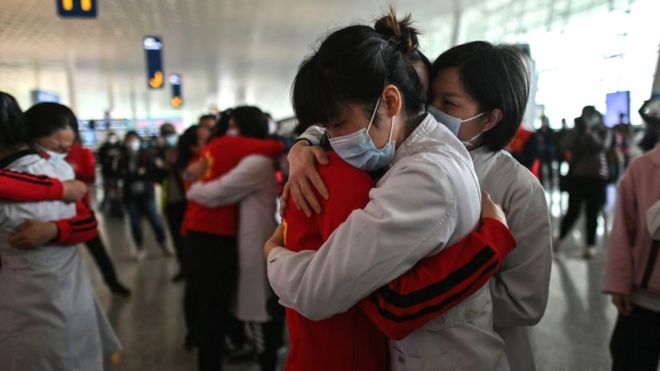
Medical staff from Jilin Province (in red) hug nurses from Wuhan after the Covid-19 lockdown was lifted, 8 April 2020Image copyright GETTY IMAGES
Image caption The Chinese city of Wuhan recently lifted its strict quarantine measures

The Chinese city of Wuhan, where the coronavirus originated last year, has raised its official Covid-19 death toll by 50%, adding 1,290 fatalities.

Wuhan officials attributed the new figure to updated reporting and deaths outside hospitals. China has insisted there was no cover-up.

It has been accused of downplaying the severity of its virus outbreak.

Wuhan’s 11 million residents spent months in strict lockdown conditions, which have only recently been eased.

The latest official figures bring the death toll in the city in China’s central Hubei province to 3,869, increasing the national total to more than 4,600.

China has confirmed nearly 84,000 coronavirus infections, the seventh-highest globally, according to Johns Hopkins University data.

The virus has had a huge impact on the Chinese economy, which shrank for the first time in decades in the first quarter of the year.

What’s China’s explanation for the rise in deaths?

In a statement released on Friday, officials in Wuhan said the revised figures were the result of new data received from multiple sources, including records kept by funeral homes and prisons.

Deaths linked to the virus outside hospitals, such as people who died at home, had not previously been recorded.

Media caption Learn how Wuhan dealt with the lockdown

The “statistical verification” followed efforts by authorities to “ensure that information on the city’s Covid-19 epidemic is open, transparent and the data [is] accurate”, the statement said.

It added that health systems were initially overwhelmed and cases were “mistakenly reported” – in some instances counted more than once and in others missed entirely.

A shortage of testing capacity in the early stages meant that many infected patients were not accounted for, it said.

A spokesman for China’s National Health Commission, Mi Feng, said the new death count came from a “comprehensive review” of epidemic data.

In its daily news conference, the foreign ministry said accusations of a cover-up, which have been made most stridently on the world stage by US President Donald Trump, were unsubstantiated. “We’ll never allow any concealment,” a spokesman said.

Why are there concerns over China’s figures?

Friday’s revised figures come amid growing international concern that deaths in China have been under-reported. Questions have also been raised about Beijing’s handling of the epidemic, particularly in its early stages.

In December 2019, Chinese authorities launched an investigation into a mysterious viral pneumonia after cases began circulating in Wuhan.

Banner image reading 'more about coronavirus'
Banner

China reported the cases to the World Health Organization (WHO), the UN’s global health agency, on 31 December.

But WHO experts were only allowed to visit China and investigate the outbreak on 10 February, by which time the country had more than 40,000 cases.

The mayor of Wuhan has previously admitted there was a lack of action between the start of January – when about 100 cases had been confirmed – and 23 January, when city-wide restrictions were enacted.

Around that time, a doctor who tried to warn his colleagues about an outbreak of a Sars-like virus was silenced by the authorities. Dr Li Wenliang later died from Covid-19.


Analysis box by Stephen McDonell, China correspondent

Wuhan’s death toll increase of almost exactly 50% has left some analysts wondering if this is all a bit too neat.

For months questions have been asked about the veracity of China’s official coronavirus statistics.

The inference has been that some Chinese officials may have deliberately under-reported deaths and infections to give the impression that cities and towns were successfully managing the emergency.

If that was the case, Chinese officials were not to know just how bad this crisis would get in other countries, making its own figures now seem implausibly small.

The authorities in Wuhan, where the first cluster of this disease was reported, said there had been no deliberate misrepresentation of data, rather that a stabilisation in the emergency had allowed them time to revisit the reported cases and to add any previously missed.

That the new death toll was released at the same time as a press conference announcing a total collapse in China’s economic growth figures has led some to wonder whether this was a deliberate attempt to bury one or other of these stories.

Then again, it could also be a complete coincidence.


But China has also been praised for its handling of the crisis and the unprecedented restrictions that it instituted to slow the spread of the virus. WHO Director General Dr Tedros Adhanom Ghebreyesus has hailed China for the “speed with which [it] detected the outbreak” and its “commitment to transparency”.

US President Donald Trump this week halted funding for the WHO, accusing it of making deadly mistakes and overly trusting China.

“Do you really believe those numbers in this vast country called China, and that they have a certain number of cases and a certain number of deaths; does anybody really believe that?” Mr Trump said at the White House on Wednesday.

French President Emmanuel Macron has also questioned China’s handling of the coronavirus outbreak, saying it was “naive” to suggest the country had dealt better with the crisis, adding things “happened that we don’t know about”.

On Thursday, UK Foreign Secretary Dominic Raab said: “We’ll have to ask the hard questions about how [coronavirus] came about and how it couldn’t have been stopped earlier.”

Source: The BBC

06/04/2020

China sees active mobile payment in 2019: report

BEIJING, April 6 (Xinhua) — Chinese people used mobile payment 3.25 times a day in 2019 on average, according to a report released by Chinese card payment giant China UnionPay.

The report, based on a survey of more than 60,000 people, showed that over 20 percent of respondents used mobile payment more than five times a day in 2019.

Customers involved in the survey spent more than 2,900 yuan (about 408 U.S. dollars) each month on average via mobile payment, up 11 percent year on year, the report said.

The survey, jointly conducted by China UnionPay, 17 commercial banks and 18 payment entities, collected about 62,000 questionnaires, with around 70 percent of the respondents aging between 25 and 45 years old.

Owners of micro and small businesses were the most active users of mobile payment, which had deeper penetrations in scenarios including buses, metro systems, parking lots and gas stations in 2019, the report said.

People also had better awareness of risk prevention, with the proportion of respondents experiencing online fraud and reporting losses down 16 percentage points and 26 percentage points, respectively over one year earlier, said the report.

Source: Xinhua

13/03/2020

China Focus: China report says human rights situation deteriorating in U.S.

BEIJING, March 13 (Xinhua) — China on Friday issued a report on human rights violations in the United States.

Titled “The Record of Human Rights Violations in the United States in 2019,” the report said the facts detailed in the document show that “in recent years, especially since 2019, the human rights situation in the United States has been poor and deteriorating.”

The State Council Information Office released the report based on published data, media reports and research findings. It began by citing a quote from U.S. Secretary of State Mike Pompeo in a speech on April 15, 2019: “We lied, we cheated, we stole … It reminds you of the glory of the American experiment.”

“The remarks of U.S. politicians have completely exposed their hypocrisy of adopting double standards on human rights issues and using them to maintain hegemony,” read the report.

The United States released annual reports to “distort and belittle” human rights situation in countries and regions that did not conform to U.S. strategic interests, but turned a blind eye to the “persistent, systematic and large-scale” human rights violations in its own country, the report said.

Consisting of foreword and seven chapters, it detailed facts on human rights violations in the United States relevant to civil and political rights, social and economic rights, discrimination suffered by ethnic minorities, discrimination and violence against women, living conditions of vulnerable groups, and abuses suffered by migrants, as well as U.S. violations of human rights in other countries.

The lack of restraint in the right to hold guns has led to rampant gun violence, posing a serious threat to citizens’ life and property safety in the United States, the report said.

“The United States is a country with the worst gun violence in the world,” read the report. In total, 39,052 people died from gun-related violence in the United States in 2019, and a person is killed with a gun in the United States every 15 minutes, figures showed.

Wealth polarization in the United States hit a 50-year high in 2018, the report said. In 2018, the wealthiest 10 percent held 70 percent of total household wealth. The bottom 50 percent saw essentially zero net gains in wealth over the past 30 years, it noted.

Regarding discrimination suffered by ethnic minorities in the United States, the report said the political structure and ideology of white supremacy in the United States have caused ethnic minorities to suffer all-round discrimination in various fields such as politics, economy, culture and social life.

Since 2016, white supremacy in the United States has shown a resurgence trend, leading to racial opposition and hatred, it noted.

Women in the United States face severe discrimination and violence, according to the report. Women in the United States were 21 times more likely to die by firearm homicide than women in peer nations, it noted, adding that sexual assault cases against women kept increasing.

About the living conditions of vulnerable groups, the report said tens of millions of U.S. children, elderly people, and disabled people live without enough food or clothing, and face threats of violence, bullying, abusing and drugs.

“The U.S. government not only has insufficient political will to improve the conditions for vulnerable groups but also keeps cutting relevant funding projects,” read the report.

While levels of extreme poverty worldwide had dropped dramatically, the poverty ratio of U.S. children was about the same rate as 30 years ago, it said.

The report noted the increasingly strict and inhumane measures taken by the U.S. government against immigrants in recent years, in particular, the “zero-tolerance” policy, which caused the separations of many immigrant families.

Many unaccompanied immigrant children were held in overcrowded facilities, without access to adequate healthcare or food, and with poor sanitation conditions, the report said.

It noted grave abuses at detention facilities for immigrants, including injecting them with sedatives, keeping them in handcuffs, and depriving them of clothing and mattresses.

The United States also wantonly trampled on human rights in other countries and was responsible for many humanitarian disasters around the world, according to the report.

The economic embargo against Cuba and the unilateral sanctions against Venezuela imposed by the United States had been a massive and flagrant violation of the human rights of people in these countries, the report said.

The United States withdrew from several multilateral mechanisms, including the UN Human Rights Council and the UN Global Compact on Migration, shirking off its international obligations and making troubles to the international governance system, it noted.

Source: Xinhua

Law of Unintended Consequences

continuously updated blog about China & India

ChiaHou's Book Reviews

continuously updated blog about China & India

What's wrong with the world; and its economy

continuously updated blog about China & India
