27/04/2020
BEIJING/SHANGHAI (Reuters) – China’s Inceptio Technology, a startup developing self-driving trucks, has raised $100 million in its latest funding round from logistics firm GLP, its key strategic investor G7 and other investors, two sources familiar with the matter told Reuters.
The proceeds from its series A funding round will be used to further develop its technologies and to start commercial trials, said the sources, who declined to be named as they were not authorised to speak to media.
The company, which aims to operate a freight network with autonomous driving trucks in China from 2022, has partnerships with Dongfeng Automobile Co Ltd (600006.SS), Sinotruk Hong Kong Ltd (3808.HK) and Foton (600166.SS).
The two-year-old firm is developing autonomous driving software and an in-car computing system while the truckmakers are responsible for the vehicles’ platforms.
Inceptio declined to comment. G7 and Singapore-based GLP did not immediately respond to requests for comment.
Inceptio focuses on level 3 and 4 technologies. A level 3 vehicle will enable drivers to turn their attention away from driving but they still need to take over if the car encounters a problem, while with level 4 technologies, there is no human intervention in most circumstances.
The trucking industry is expected to an earlier adopter of autonomous driving technology compared to passenger vehicle makers as driving on highways is more predictable than on busy city streets.
German automaker Daimler (DAIGn.DE) and U.S. postal giant United Parcel Service Inc (UPS.N) have invested in self-driving trucks.
Source: Reuters
Posted in $100 million, 2022, aims, attention, authorised, autonomous driving, autonomous driving technology, away from, busy, car, China, Chinese, circumstances, city streets, comment, commercial, Company, compared, computing system, DAIMLER (DAIGn.DE), declined, developing, Dongfeng Automobile Co Ltd, drivers, driving, earlier adopter, encounters, expected, firm, focuses, Foton, freight network, funding, funding round, further develop, G7, German automaker, GLP, Highways, human intervention, immediately, in-car, Inceptio Technology, investors, key strategic investor, latest, level 3 and 4, level 3 vehicle, level 4 technologies, logistics firm, Makers, media, most, named, partnerships, passenger vehicle, predictable, problem, proceeds, raised, respond, responsible, round, self-driving truck, self-driving trucks, series A, Sinotruk Hong Kong Ltd, software, sources, speak, start, startup, take over, technologies, to operate, to requests, trials, trucking industry, truckmakers, trucks, turn, two-year-old, U.S. postal giant, Uncategorized, United Parcel Service Inc (UPS.N), used, vehicles’ platforms, while, will enable |
Leave a Comment »
23/04/2020
- Test in Xiong’an, the new city being built south of Beijing, will focus on everyday goods and services for the first time
- American food outlets to be included in the digital currency tests, conducting small transactions with local firms
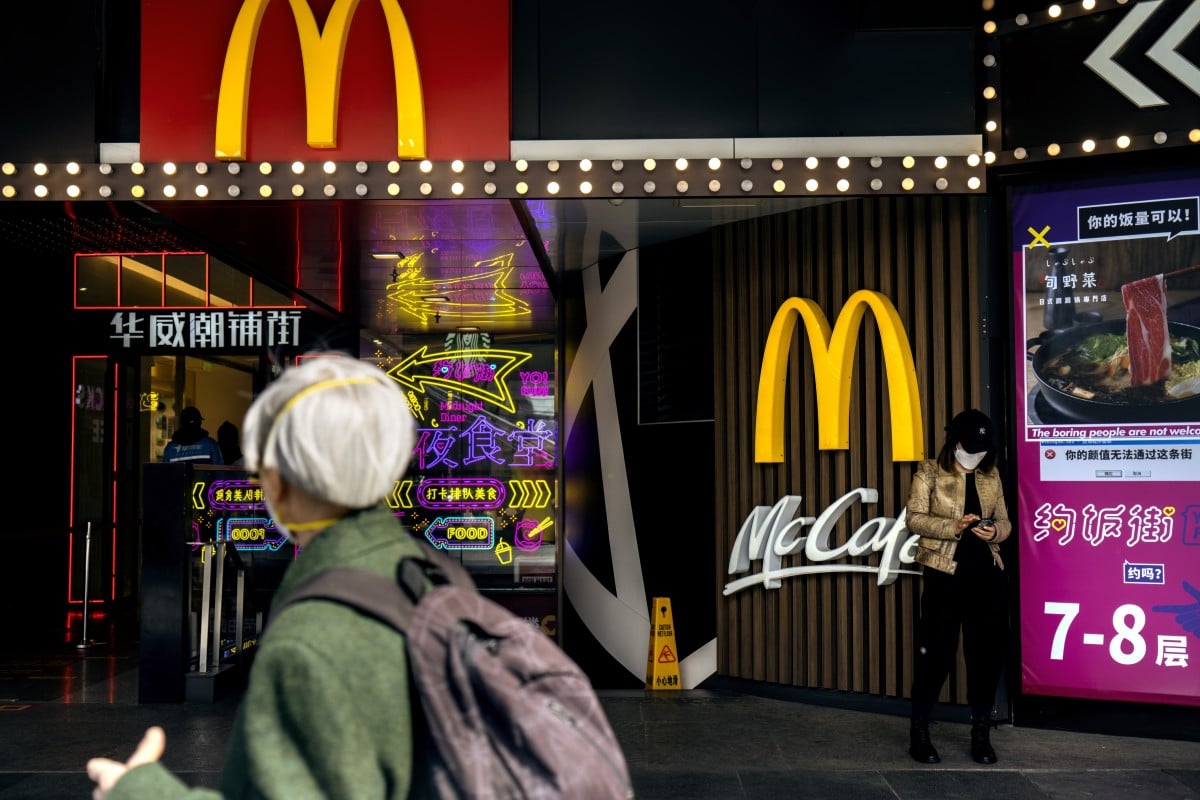
American chains Starbucks, McDonald’s and Subway were named on the People’s Bank of China’s list of firms that will test the digital currency in small transactions with 19 local businesses. Photo: Bloomberg
China’s central bank has accelerated the testing of its new sovereign digital currency and, for the first time, will include some foreign consumer brands in the programme.
American chains Starbucks, McDonald’s and Subway were named on the People’s Bank of China (PBOC)’s list of firms that will test the
digital currency in small transactions with 19 local businesses.
The global names will be joined by local hotels, convenience stores, a stuffed bun shop, a bakery, a bookstore and a gym, according to details revealed at a promotional event in the Xiong’an New Area, a city being built south of Beijing, news portal Sina.com reported.
The inclusion of businesses providing everyday goods and services marks an expansion of the PBOC’s testing. It follows a previous disclosure that last week in Suzhou the digital currency was used to pay half public sector workers’ travel subsidies for May.
Is China a currency manipulator?
Wednesday’s promotional event was organised by the local branch of the National Development and Reform Commission, the powerful planning agency, and attended by representatives of the Big Four state-owned banks and two of the country’s internet giants – Alibaba and Tencent.
China has not released a timetable for launching the digital yuan, but last week’s reports on new testing have fanned speculation that it could be imminent.
The tests were reportedly accelerated after Facebook launched its Libra project in June last year, an attempt to create a
global digital currency pegged to a basket of currencies and backed by global commercial giants.
The Libra Association, the consortium managing the project, announced changes last week in an attempt to win regulatory approval and pave the way for an official launch sometime later this year. The consortium said it would create multiple digital units tied to existing currencies such as the US dollar or the euro, rather than a single token based on a basket of currencies.
China’s official digital currency, known as Digital Currency Electronic Payment (DCEP), came into the public spotlight last week
when a screenshot of a test version of an app developed by the Agricultural Bank of China circulated online.
The digital currency app has several basic functions, similarly to other Chinese online payment platforms such as Alipay and WeChat Pay – the country’s two most popular online payment tools – allowing users to make and receive payments, and transfer money.
“It’s certain that the DCEP is now in its final testing stage and should be officially launched,” BlockVC, an investment firm, said in a research note.
The PBOC’s digital currency research institute confirmed last Friday that testing was being conducted in four cities: Shenzhen, Suzhou, Xiong’an and Chengdu. In addition, venues for the 2022 Winter Olympics in Beijing and Zhangjiakou will join the testing programme in the future.
What is the Hong Kong Dollar Peg?
The institute, which was inaugurated in 2017, said that the test versions and applications of the currency had not been finalised.
The project testing is based on two principles: the central bank issues the virtual money to commercial banks who then pass it on to consumers, and that is aimed at replacing cash in all transactions.
China is the first major economy to publicly announce plans for a sovereign digital currency, aiming to better control the rapid rise of digital payments worldwide.
The PBOC has, however, cracked down on the trading of other digital currencies and banned banks from accepting cryptocurrencies, which it views as a risk to financial stability.
Source: SCMP
Posted in 2022, accelerated, Agricultural Bank of China, Alibaba, American, among, bakery, Beijing, Big Four, bookstore, built, Chengdu, China’s, conducting, consortium, convenience stores, cryptocurrencies, digital currency, Digital Currency Electronic Payment (DCEP), everyday, Facebook, first time, focus, food outlets, Foreign firms, goods and services, Gym, included, internet giants, June, Libra, Libra Association, local firms, local hotels, May, McDonald’s, National Development and Reform Commission, New Area, new city, news portal, People’s Bank of China (PBOC)’s, People’s Bank of China’s, planning agency, public sector workers’, reported, set to, Shenzhen, Sina.com, small, South, sovereign, starbucks, stuffed bun shop, Subway, Suzhou, TENCENT, test, transactions, travel subsidies, Uncategorized, Winter Olympics, Xiongan, Zhangjiakou |
Leave a Comment »
23/04/2020
BEIJING (Reuters) – China will cut its subsidies on new energy vehicles (NEV) by 10% this year, and will expand government purchases of NEVs, the finance ministry said on Thursday.
China will in principle cut such subsidies by 20% in 2021 and 30% in 2022, the finance ministry said in a statement. However, it will not cut subsidies on qualified new energy commercial vehicles earmarked for public purposes this year.
Under the plan, China would extend subsidies for NEV purchases to 2022, rather than ending them this year, and extend their purchase tax exemption for two years.
China will slightly lift the requirements for the driving range and power efficiency of cars qualified for the subsidies, the statement said, adding authorities will support the sales of cars with swappable batteries, a technology that has been pursued by Chinese electric vehicle makers Nio Inc (NIO.N) and BAIC BluePark (600733.SS).
Only passenger cars cheaper than 300,000 yuan (34,330.23 pounds) will be offered subsidies, it said. The price is higher than starting price of Tesla Inc’s (TSLA.O) China-made Model 3 sedans.
China also said authorities will give priority to purchase new energy vehicles for government use but did not give further details.
The new policy is effective from April 23. NEVs include battery-powered electric, plug-in hybrid and hydrogen fuel-cell vehicles.
China has set an aggressive goal for NEVs to account for a fifth of auto sales by 2025 compared with the current 5%, as it seeks to reduce pollution and cultivate homegrown champions.
Sales of NEVs, however, contracted for a ninth month in a row in March and were down over 50% from a year earlier, according to data from the China Association of Automobile Manufacturers (CAAM).
Source: Reuters
Posted in 10, 20%, 2021, 2022, 2025, 30, 50%, according, account, aggressive, April, auto sales, BAIC BluePark, batteries, battery-powered electric, cars, champions, cheaper, China, China-made Model 3, Chinese, commercial vehicles, compared, contracted, cultivate, current, cut, Data, down, driving, earlier, earmarked, effective, efficiency, electric vehicle makers, ending, exemption, expand, extend, fifth, Finance Ministry, from, goal, Government, higher, homegrown, However, in a row, in principle, lift, March, month, new, new energy vehicles (NEV), ninth, Nio Inc, offered, only, passenger, plug-in hybrid and hydrogen fuel-cell vehicles, policy, pounds, power, price, public purposes, purchase tax, purchases, pursued, qualified, range, reduce pollution, requirements, Sales, sedans, slightly, starting price, statement, subsidies, swappable, Technology, Tesla Inc’s, this year, Thursday, to cut, two, Uncategorized, year, years, yuan |
Leave a Comment »
20/04/2020
BEIJING/SHANGHAI (Reuters) – China expects to import more soybeans and pork this year following the novel coronavirus outbreak and African swine fever, which has decimated its pig herds.
Soybean imports are forecast at 92.48 million tonnes this year, rising to 96.62 million tonnes in 2025 and 99.52 million tonnes in 2029, an official from the agriculture ministry told a video conference on the outlook for agriculture released on Monday.
Pork imports this year are seen rising to 2.8 million tonnes, a 32.7% increase from the previous year.
China is a key buyer and consumer of soybeans and pork globally, and typically imports millions of tonnes of soybeans per year to crush for meal to feed its livestock.
The African swine fever outbreak, however, had slashed China’s pig herd by over 40% last year, reducing supplies in the world’s biggest pork consumer.
Combined with the coronavirus outbreak, which hit the transport of pigs and delayed the restart of slaughtering plants, prices of China’s favourite meat rose to record levels in February.
China has been increasing pork imports in recent months to make up for the drop in domestic supply.
Despite the expected surge in imports, China’s 2020 pork consumption is forecast to fall to 42.06 million tonnes, down 5.6% year-on-year, hit by high prices and a fall in consumer demand due to the coronavirus outbreak, according to the agriculture ministry.
In line with the slowing consumption, China’s slaughtered pig herd this year will fall 7.8% year-on-year to 501.49 million heads. Pork output this year will also decline to 39.34 million tonnes from 2019, but will rebound to around 54 million tonnes in 2022.
In the longer term, however, pork imports are expected to gradually fall, the ministry forecast, while beef and mutton imports are set to increase in the next decade.
Meanwhile, China’s domestic soybean output is seen at 18.81 million tonnes in 2020, a 3.9% gain from the previous year, while crushing volumes were pegged at 85.98 million tonnes.
Soybean consumption will increase steadily and continue to rely mainly on imports in the next 10 years, said a ministry official.
The ministry also said China’s corn acreage and output are both set to increase in 2020, with production forecast to reach over 260 million tonnes this year, while annual rice output is expected to hold steady above 200 million tonnes per year in the next 10 years.
Source: Reuters
Posted in 2019, 2020, 2022, 2025, 2029, 40, African swine fever, agriculture, Agriculture ministry, Aid, beef, Beijing, biggest, buyer, challenges, China, China’s, Combined, Consumer, consumer demand, coronavirus outbreak, crush, decade, decimated, decline, delayed, despite, domestic supply, drop, due, expected, expects, fall, favourite, February, feed, following, forecast, from, globally, gradually, heads, herds, high, higher, hit, However, imports, increasing, industry, key, levels, Livestock, longer term, make up, meal, Meat, million, ministry, Monday, months, more, mutton, next, novel coronavirus outbreak, Official, outbreak, outlook, output, over, per year, Pig, pig herd, plants, Pork, previous, prices, rebound, recent, record, reducing, released, restart, rising, rose, sees, Shanghai, slashed, slaughtered, slaughtering, Soybean, supplies, surge, this year, to import, told, tonnes, Transport, typically, Uncategorized, video conference, while, world’s, year-on-year |
Leave a Comment »
03/10/2019
NEW DELHI (Reuters) – Indian Prime Minister Narendra Modi called on the nation to work toward ending the consumption of single-use plastics by 2022, in a speech on Wednesday.
“Hygiene, protection of environment and protection of life were of keen interest to Gandhi,” said Modi, speaking on the anniversary of the freedom movement leader’s birth. “Plastic is dangerous to all these three goals. So we need to reach the goal of ending single-use plastic by 2022.”
Meanwhile, India held off a plan to impose a blanket ban on single-use plastics as it was seen as a measure too disruptive for industry at a time when India is dealing with an economic slowdown and job losses, officials told Reuters on Tuesday.
In a tweet on Wednesday, India’s environment ministry however, denied that it had planned to issue a ban.
“India, today is on the verge of starting a historic movement against #SingleUsePlastic, setting an example for the world. At such a time, discovering a shelved ban, when none was planned is indeed misleading & doesn’t do justice to its fight against single use plastic,” the ministry said in a tweet.
Reuters had in August reported that India was set to impose a nationwide ban on plastic bags, cups and straws on Oct. 2, in a sweeping measure to stamp out single-use plastics from cities and villages that rank among the world’s most polluted.
Concerns are growing worldwide about plastic pollution, especially in oceans, where nearly 50% of single-use plastic products end up, killing marine life and entering the human food chain, studies have shown.
Source: Reuters
Posted in #SingleUsePlastic, 2022, anniversary, birth, blanket ban, cities, consumption, dangerous, disruptive, economic slowdown, end usage, entering, exhorts, freedom movement leader, Gandhi, goals, held off, historic movement, human food chain, hygiene, impose, India’s Environment Ministry, Indian Prime Minister Narendra Modi, industry, job losses, killing, marine life, measure, most polluted, nation, nationwide ban, oceans, plan, plastic, plastic bags, plastic cups, plastic straws, protection of environment, protection of life, Reuters, single-use plastics, stamp out, sweeping measure, tweet, Uncategorized, villages |
Leave a Comment »



 CHINDIA ALERT: You'll be living in their world, very soon
Chinese self-driving truck startup Inceptio raises $100 million – sources
BEIJING/SHANGHAI (Reuters) – China’s Inceptio Technology, a startup developing self-driving trucks, has raised $100 million in its latest funding round from logistics firm GLP, its key strategic investor G7 and other investors, two sources familiar with the matter told Reuters.
The proceeds from its series A funding round will be used to further develop its technologies and to start commercial trials, said the sources, who declined to be named as they were not authorised to speak to media.
The company, which aims to operate a freight network with autonomous driving trucks in China from 2022, has partnerships with Dongfeng Automobile Co Ltd (600006.SS), Sinotruk Hong Kong Ltd (3808.HK) and Foton (600166.SS).
The two-year-old firm is developing autonomous driving software and an in-car computing system while the truckmakers are responsible for the vehicles’ platforms.
Inceptio declined to comment. G7 and Singapore-based GLP did not immediately respond to requests for comment.
Inceptio focuses on level 3 and 4 technologies. A level 3 vehicle will enable drivers to turn their attention away from driving but they still need to take over if the car encounters a problem, while with level 4 technologies, there is no human intervention in most circumstances.
The trucking industry is expected to an earlier adopter of autonomous driving technology compared to passenger vehicle makers as driving on highways is more predictable than on busy city streets.
German automaker Daimler (DAIGn.DE) and U.S. postal giant United Parcel Service Inc (UPS.N) have invested in self-driving trucks.
Source: Reuters
Posted in $100 million, 2022, aims, attention, authorised, autonomous driving, autonomous driving technology, away from, busy, car, China, Chinese, circumstances, city streets, comment, commercial, Company, compared, computing system, DAIMLER (DAIGn.DE), declined, developing, Dongfeng Automobile Co Ltd, drivers, driving, earlier adopter, encounters, expected, firm, focuses, Foton, freight network, funding, funding round, further develop, G7, German automaker, GLP, Highways, human intervention, immediately, in-car, Inceptio Technology, investors, key strategic investor, latest, level 3 and 4, level 3 vehicle, level 4 technologies, logistics firm, Makers, media, most, named, partnerships, passenger vehicle, predictable, problem, proceeds, raised, respond, responsible, round, self-driving truck, self-driving trucks, series A, Sinotruk Hong Kong Ltd, software, sources, speak, start, startup, take over, technologies, to operate, to requests, trials, trucking industry, truckmakers, trucks, turn, two-year-old, U.S. postal giant, Uncategorized, United Parcel Service Inc (UPS.N), used, vehicles’ platforms, while, will enable | Leave a Comment »