05/05/2020
Joint mission will send two unmanned probes into orbit around the closest planet to the sun
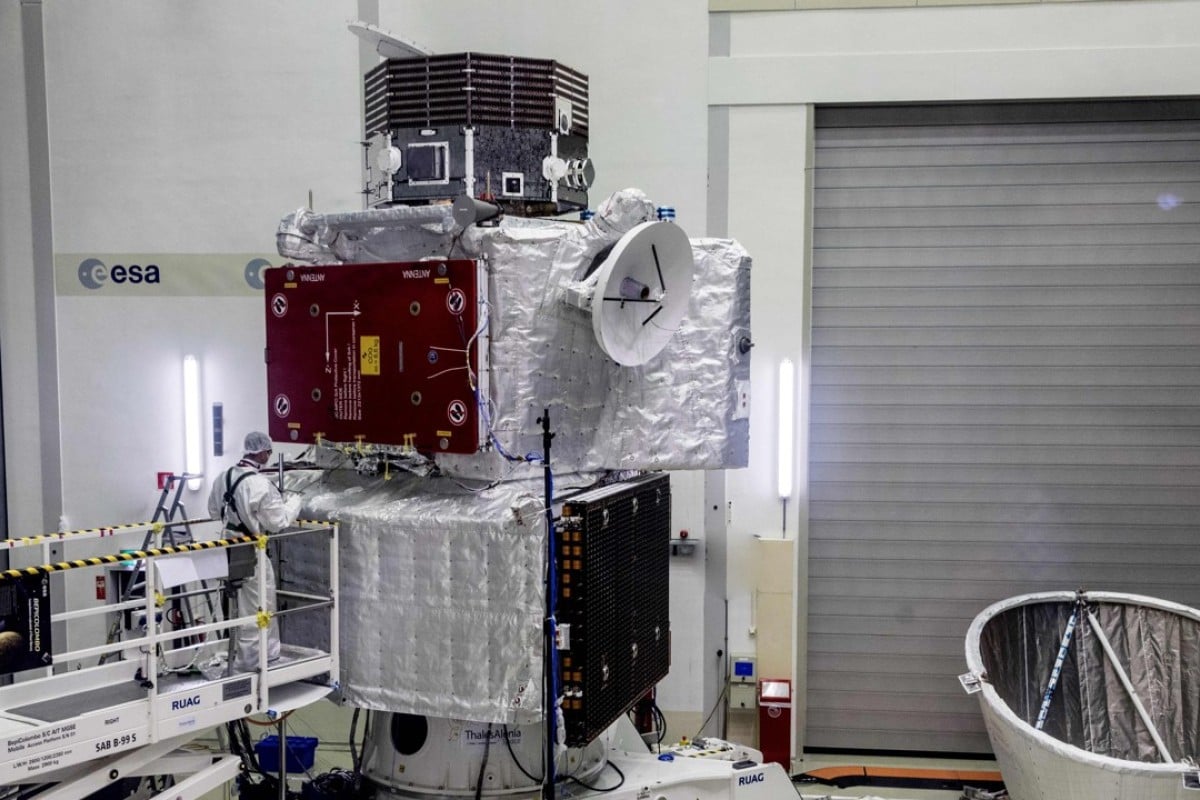
The BepiColombo standing in position at a test facility in Spijkenisse. Its mission to Mercury is scheduled for launch on an Ariane 5 from Europe’s Spaceport in Kourou, French Guiana on October 20. Photo: AFP Photo
Final preparations were underway on Friday for the launch of a joint mission by European and Japanese space agencies to send twin probes to Mercury, the closest planet to the sun.
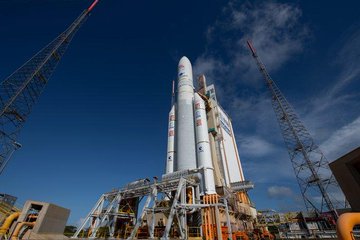
An Ariane 5 rocket is scheduled to lift the unmanned spacecraft into orbit from French Guiana shortly before midnight, the start of a seven-year journey to the solar system’s innermost planet.
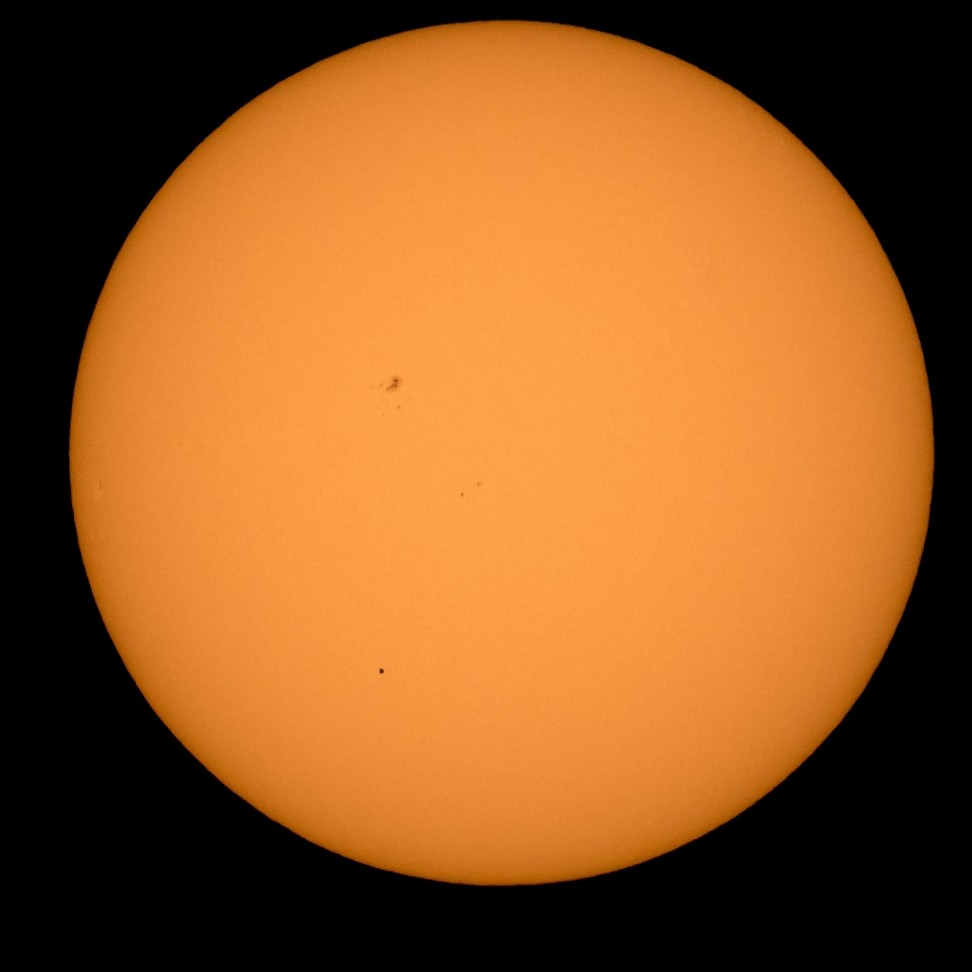
Mercury is seen in silhouette, lower third of image, as it transits across the face of the sun. Photo: AFP PHOTO / NASA / BILL INGALLS
The European Space Agency says the €1.3 billion (US$1.5 billion) mission is one of the most challenging in its history. Mercury’s extreme temperatures, the intense gravity pull of the sun and blistering solar radiation make for hellish conditions.
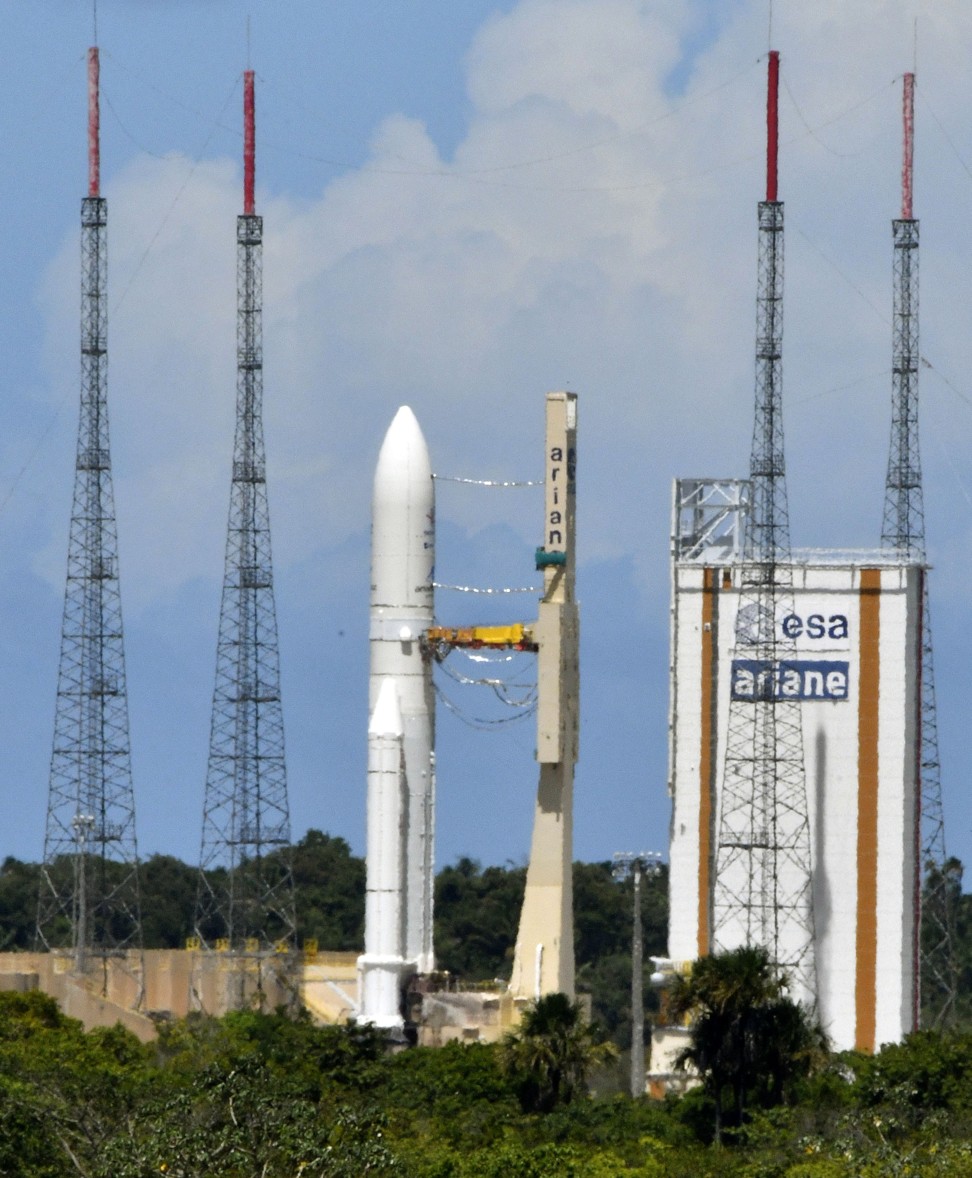
An Ariane-5 rocket is set for launch at the Guiana Space Centre in Kourou in French Guiana. Photo: Kyodo
Newly developed electrical ion thrusters will help nudge the spacecraft, which was named after Italian scientist Giuseppe “Bepi” Colombo, into the right orbit.
Aborted launch astronauts may head to International Space Station this year: Nasa head says
When it arrives, BepiColombo will release two probes – Bepi and Mio – that will independently investigate the surface and magnetic field of Mercury. The probes are designed to cope with temperatures varying from 430 degrees Celsius (806F) on the side facing the sun, and -180 degrees Celsius (-292F) in Mercury’s shadow.
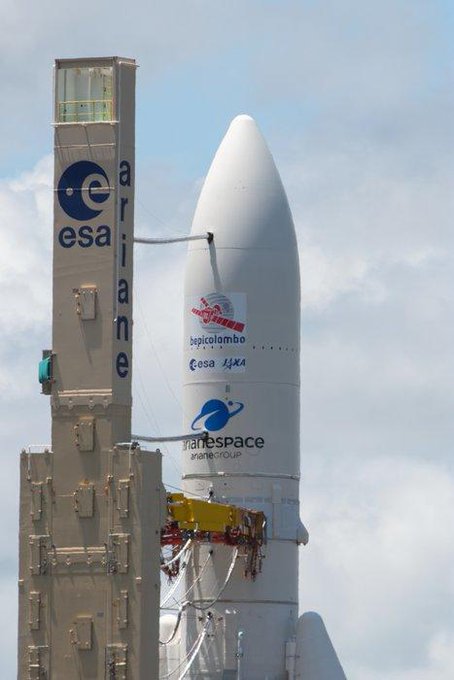
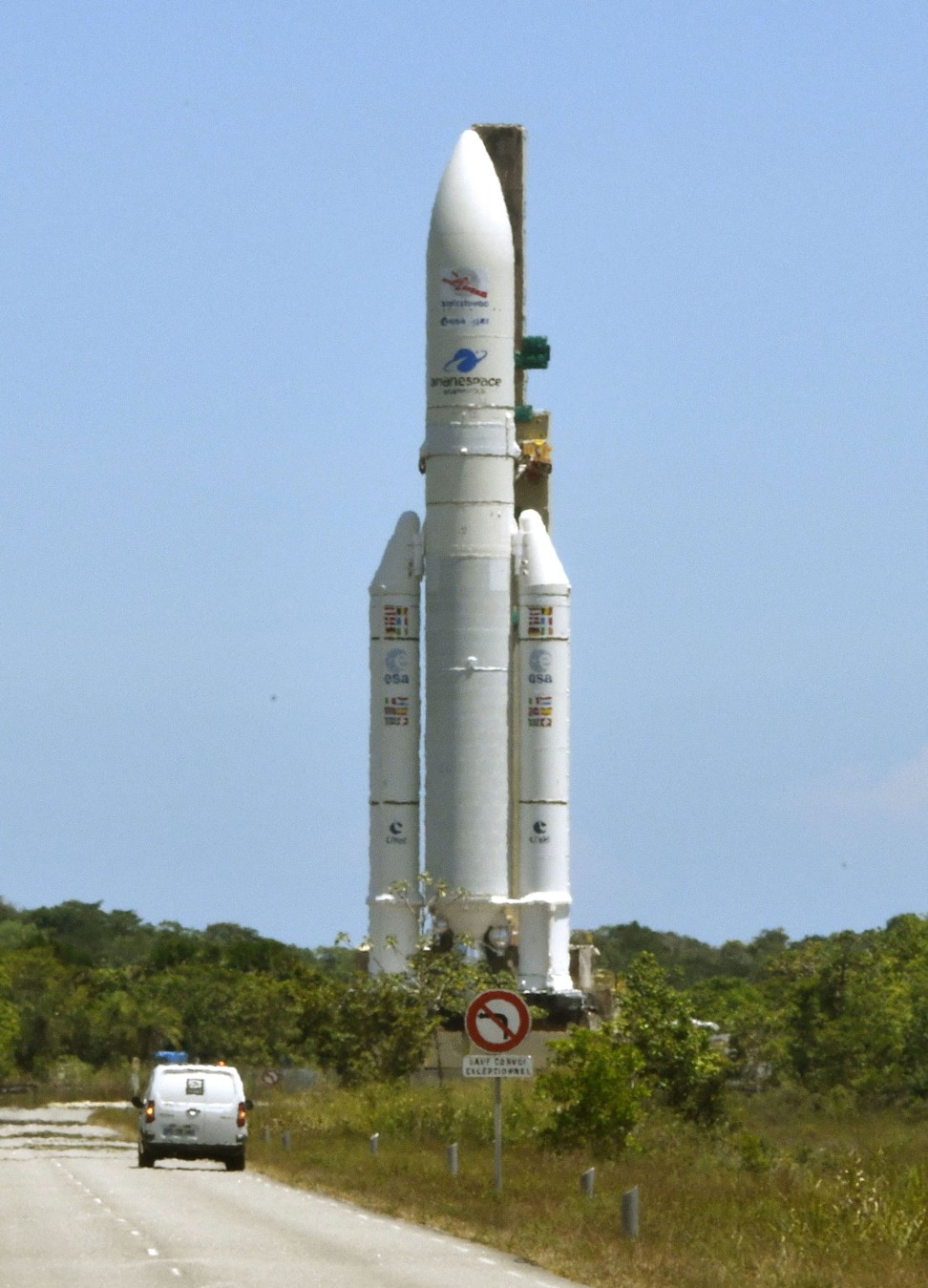
An Ariane-5 rocket is transported to its launch site at the Guiana Space Centre in Kourou. Photo: Kyodo
Scientists hope to build on the insights gained by Nasa’s Messenger probe, which ended its mission in 2015 after a four-year orbit of Mercury. The only other spacecraft to visit Mercury was Nasa’s Mariner 10 that flew past the planet in the mid-1970s.
Japanese space robots have landed on asteroid to carry out world-first survey
22 Sep 2018
Mercury, which is only slightly larger than Earth’s moon, has a massive iron core about which little is known. Researchers are also hoping to learn more about the formation of the solar system from the data gathered by the BepiColombo mission.
Source: SCMP
Posted in 2015, 2025, 7-year, Ariane 5, arriving, asteroid, begins, Bepi, BepiColombo, between, blistering, carry out, closest planet, conditions, cooperation, countdown, December, destination, dropped, earlier, Earth, Earth’s, electrical ion thrusters, elliptical path, Europe, Europe's Spaceport, European, European Space Agency, Europeans, fly-by, French Guiana, German-French rover, Giuseppe “Bepi” Colombo, gravity pull, Guiana Space Centre, Hayabusa2, hellish, innermost, International Space Station, iron core, Italian scientist, Japan, Japan Aerospace Exploration Agency, Japanese, JAXA’s, Joint mission, journey, Kourou, landed, Mariner 10, massive, Mercury, Messenger probe, Mio, mission, Moon, named after, NASA, nudge, orbit, Planet, prepare, Rocket, Ryugu, slow down, solar radiation, solar system’s, space agencies, space robots, spacecraft, Spijkenisse, sufficiently, sun, survey, this month, this year, Uncategorized, unmanned probes, Venus, world-first |
Leave a Comment »
23/04/2020
BEIJING (Reuters) – China will cut its subsidies on new energy vehicles (NEV) by 10% this year, and will expand government purchases of NEVs, the finance ministry said on Thursday.
China will in principle cut such subsidies by 20% in 2021 and 30% in 2022, the finance ministry said in a statement. However, it will not cut subsidies on qualified new energy commercial vehicles earmarked for public purposes this year.
Under the plan, China would extend subsidies for NEV purchases to 2022, rather than ending them this year, and extend their purchase tax exemption for two years.
China will slightly lift the requirements for the driving range and power efficiency of cars qualified for the subsidies, the statement said, adding authorities will support the sales of cars with swappable batteries, a technology that has been pursued by Chinese electric vehicle makers Nio Inc (NIO.N) and BAIC BluePark (600733.SS).
Only passenger cars cheaper than 300,000 yuan (34,330.23 pounds) will be offered subsidies, it said. The price is higher than starting price of Tesla Inc’s (TSLA.O) China-made Model 3 sedans.
China also said authorities will give priority to purchase new energy vehicles for government use but did not give further details.
The new policy is effective from April 23. NEVs include battery-powered electric, plug-in hybrid and hydrogen fuel-cell vehicles.
China has set an aggressive goal for NEVs to account for a fifth of auto sales by 2025 compared with the current 5%, as it seeks to reduce pollution and cultivate homegrown champions.
Sales of NEVs, however, contracted for a ninth month in a row in March and were down over 50% from a year earlier, according to data from the China Association of Automobile Manufacturers (CAAM).
Source: Reuters
Posted in 10, 20%, 2021, 2022, 2025, 30, 50%, according, account, aggressive, April, auto sales, BAIC BluePark, batteries, battery-powered electric, cars, champions, cheaper, China, China-made Model 3, Chinese, commercial vehicles, compared, contracted, cultivate, current, cut, Data, down, driving, earlier, earmarked, effective, efficiency, electric vehicle makers, ending, exemption, expand, extend, fifth, Finance Ministry, from, goal, Government, higher, homegrown, However, in a row, in principle, lift, March, month, new, new energy vehicles (NEV), ninth, Nio Inc, offered, only, passenger, plug-in hybrid and hydrogen fuel-cell vehicles, policy, pounds, power, price, public purposes, purchase tax, purchases, pursued, qualified, range, reduce pollution, requirements, Sales, sedans, slightly, starting price, statement, subsidies, swappable, Technology, Tesla Inc’s, this year, Thursday, to cut, two, Uncategorized, year, years, yuan |
Leave a Comment »
20/04/2020
BEIJING/SHANGHAI (Reuters) – China expects to import more soybeans and pork this year following the novel coronavirus outbreak and African swine fever, which has decimated its pig herds.
Soybean imports are forecast at 92.48 million tonnes this year, rising to 96.62 million tonnes in 2025 and 99.52 million tonnes in 2029, an official from the agriculture ministry told a video conference on the outlook for agriculture released on Monday.
Pork imports this year are seen rising to 2.8 million tonnes, a 32.7% increase from the previous year.
China is a key buyer and consumer of soybeans and pork globally, and typically imports millions of tonnes of soybeans per year to crush for meal to feed its livestock.
The African swine fever outbreak, however, had slashed China’s pig herd by over 40% last year, reducing supplies in the world’s biggest pork consumer.
Combined with the coronavirus outbreak, which hit the transport of pigs and delayed the restart of slaughtering plants, prices of China’s favourite meat rose to record levels in February.
China has been increasing pork imports in recent months to make up for the drop in domestic supply.
Despite the expected surge in imports, China’s 2020 pork consumption is forecast to fall to 42.06 million tonnes, down 5.6% year-on-year, hit by high prices and a fall in consumer demand due to the coronavirus outbreak, according to the agriculture ministry.
In line with the slowing consumption, China’s slaughtered pig herd this year will fall 7.8% year-on-year to 501.49 million heads. Pork output this year will also decline to 39.34 million tonnes from 2019, but will rebound to around 54 million tonnes in 2022.
In the longer term, however, pork imports are expected to gradually fall, the ministry forecast, while beef and mutton imports are set to increase in the next decade.
Meanwhile, China’s domestic soybean output is seen at 18.81 million tonnes in 2020, a 3.9% gain from the previous year, while crushing volumes were pegged at 85.98 million tonnes.
Soybean consumption will increase steadily and continue to rely mainly on imports in the next 10 years, said a ministry official.
The ministry also said China’s corn acreage and output are both set to increase in 2020, with production forecast to reach over 260 million tonnes this year, while annual rice output is expected to hold steady above 200 million tonnes per year in the next 10 years.
Source: Reuters
Posted in 2019, 2020, 2022, 2025, 2029, 40, African swine fever, agriculture, Agriculture ministry, Aid, beef, Beijing, biggest, buyer, challenges, China, China’s, Combined, Consumer, consumer demand, coronavirus outbreak, crush, decade, decimated, decline, delayed, despite, domestic supply, drop, due, expected, expects, fall, favourite, February, feed, following, forecast, from, globally, gradually, heads, herds, high, higher, hit, However, imports, increasing, industry, key, levels, Livestock, longer term, make up, meal, Meat, million, ministry, Monday, months, more, mutton, next, novel coronavirus outbreak, Official, outbreak, outlook, output, over, per year, Pig, pig herd, plants, Pork, previous, prices, rebound, recent, record, reducing, released, restart, rising, rose, sees, Shanghai, slashed, slaughtered, slaughtering, Soybean, supplies, surge, this year, to import, told, tonnes, Transport, typically, Uncategorized, video conference, while, world’s, year-on-year |
Leave a Comment »


 BepiColombo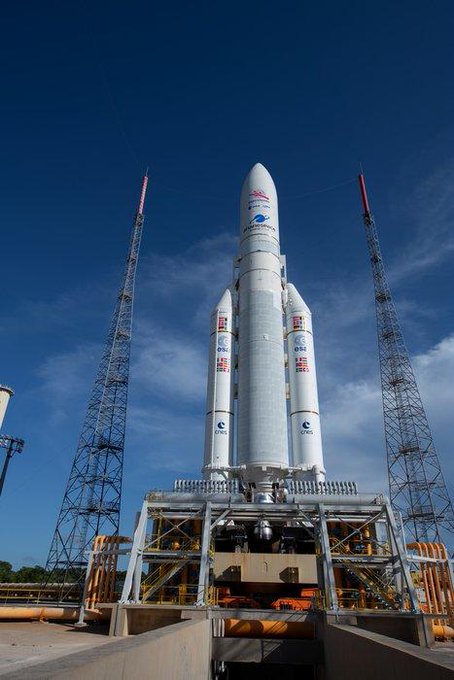



 CHINDIA ALERT: You'll be living in their world, very soon