Archive for ‘accuses’

20/04/2020

Vietnam accuses Beijing of ‘seriously violating’ sovereignty in South China Sea

  • Move to create administrative units for disputed Paracel and Spratly Islands angers Hanoi
  • China has been engaged in a series of stand-offs with rival claimants recently
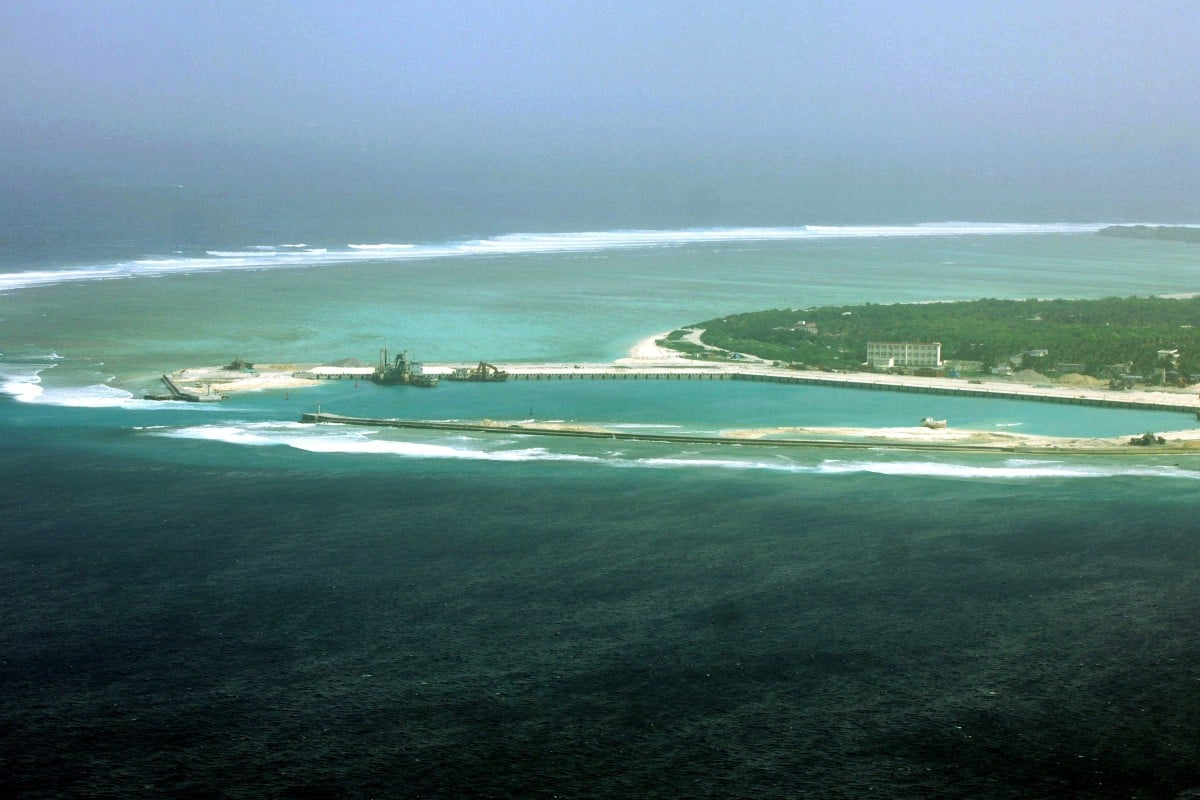
An aerial view of Sanha, a city created to assert China’s claims over the disputed waters. Photo: AFP

China’s latest activities in the South China Sea have triggered a strong protest from rival claimant Vietnam, which said the move “seriously violated” its sovereignty.

The complaint came after China announced on Sunday that it had set up two new administrative districts on the Paracel and Spratly Islands.

The two districts – which China referred to as Xisha and Nansha – will be under the control of Sansha, a city the Chinese government created in 2012 to assert its claims over the South China Sea.

Vietnam’s foreign ministry spokesperson Le Thi Thu Hang issued a statement of protest on Sunday, and said the move would further complicate the situation in the South China Sea.

“These acts are not conducive to the development of the friendly relations between countries and further complicate the situation in the East Sea [Vietnam’s name for the South China Sea], the region and the world,” she said.

“Vietnam demands that China respect Vietnam’s sovereignty and annul its wrongful decisions and not repeat similar activities in the future.”

Under the new plan, the new district of Xisha will be in charge of Paracel Islands, which are also claimed by Vietnam and Taiwan. The Nansha district will manage the Spratly Islands, where there are also multiple competing claims.

Beijing marks out claims in South China Sea by naming geographical features
21 Apr 2020

Chinese Foreign Ministry spokesman Geng Shuang said on Monday that the establishment of the new districts was in line with China’s normal administrative rules.

“China has been resolutely opposing Vietnam’s words and deeds that undermine China’s sovereignty and rights and interests in the South China Sea, and will continue to take necessary measures to firmly safeguard China’s sovereignty and rights and interests.” he said in a press conference

Vietnam is the only claimant which has publicly protested about the move so far. But Zhang Mingliang, an specialist in Southeast Asian politics with Jinan University, said it was likely to have alarmed other members of the Association of Southeast Asian Nations (Asean).

More footage emerges from 2018 near collision of US and China warships in South China Sea
“Setting up such districts will not have much use or actual benefit, and it will cause opposition among the Asean states, many of which have long been suspicious of China’s intentions over the South China Sea,” said Zhang.

“The coronavirus outbreak has already caused some grievances among them towards China, even though they have not been as vocal as the Western countries,” he said.

Richard Heydarian, an academic and former Philippine government adviser, described the move as China taking advantage of a “strategic vacuum” created by the Covid-19 crisis.

South China Sea: Chinese ship Haiyang Dizhi 8 seen near Malaysian waters, security sources say

18 Apr 2020

“On the one hand it’s engaging in face mask diplomacy [providing medical supplies to other countries] … but on the other hand it’s on the offensive,” he said.

“All of them should be seen as part of one package in which China seizes the strategic opportunity of not only its neighbouring countries scrambling to deal with the coronavirus outbreak, but also the US Navy’s suspension of overseas appointments.”

China has recently become involved in a series of stand-off with other claimants in the contested waters.

A Chinese government survey ship reportedly tagged an exploration vessel operated by Malaysia’s state oil company Petronas in the area, and remained off the Malaysian coastline as of late Sunday.

Earlier this month, Vietnam lodged an official protest with China after a Vietnamese fishing boat sunk after a collision in the Paracel Islands.

Source: SCMP

13/09/2019

John Bolton accuses China of stealing F-35 technology to make a stealth fighter. Is this what he was talking about?

  • US National Security Adviser recently said an unnamed Chinese fighter ‘looks a lot like the F-35 … because it is the F-35’
  • The PLA’s only active stealth fighter the J-20 looks rather different to its US counterpart, but the FC-31 prototype may be closer to the mark
A Chinese FC031 stealth fighter pictured during a test flight in November 2014. Photo: Xinhua

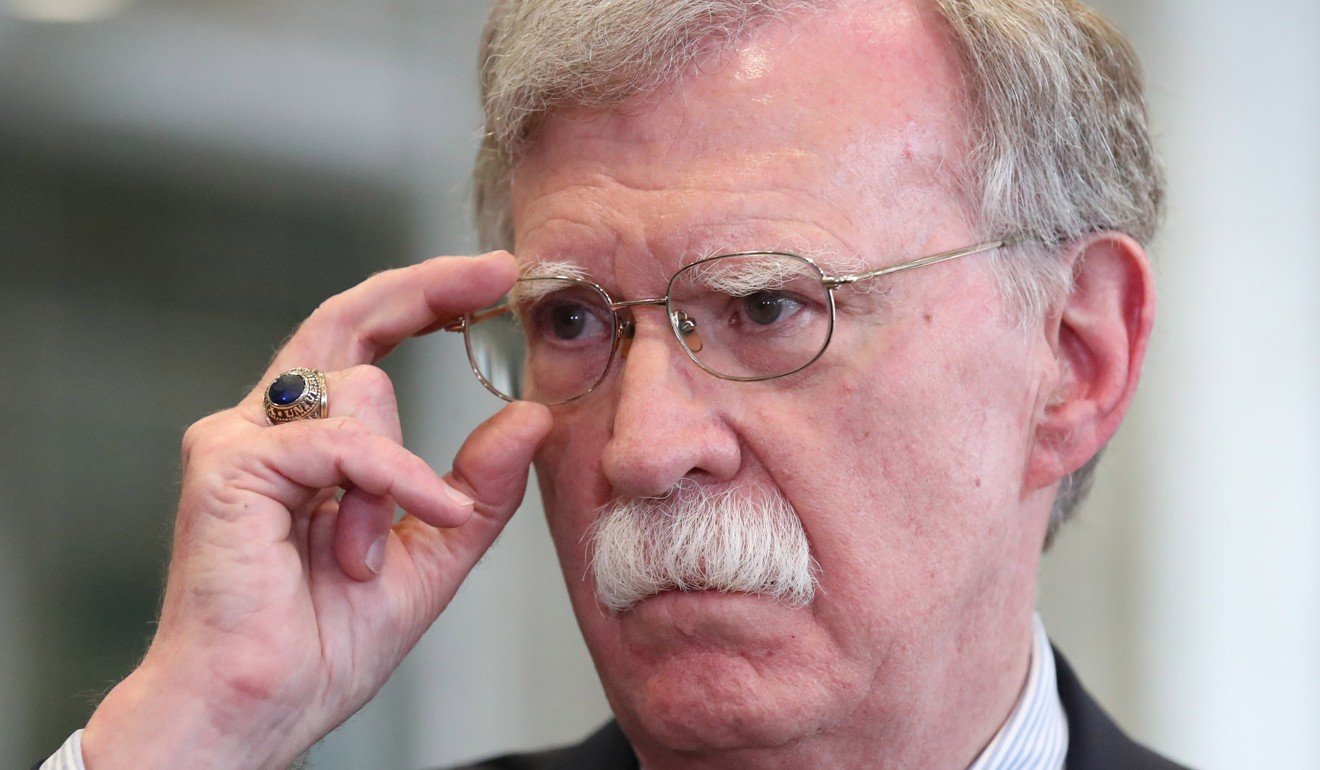
US National Security Adviser John Bolton recently accused China of stealing US technology to make a stealth fighter, a charge Beijing has denied.

On a visit to Ukraine last week, Bolton said an unnamed fifth-generation aircraft “looks a lot like the F-35, that’s because it is the F-35. They just stole it”.

At present China’s only active stealth fighter, the J-20 or Mighty Dragon, looks very different to the F-35 because it has two nose canards – which are not found on any modern US fighters – and it is larger and around 50 per cent heavier.

However, Bolton might have had another fighter in mind – the Shenyang FC-31 Gyrfalcon, which is still in the prototype phase.

John Bolton said China “just stole” the F-35 for its own fighter. Photo: EPA-EFE

The FC-31 is made by the Shenyang Aircraft Design and Research Institute, a branch of the state-owned Aviation Industry Corporation of China.

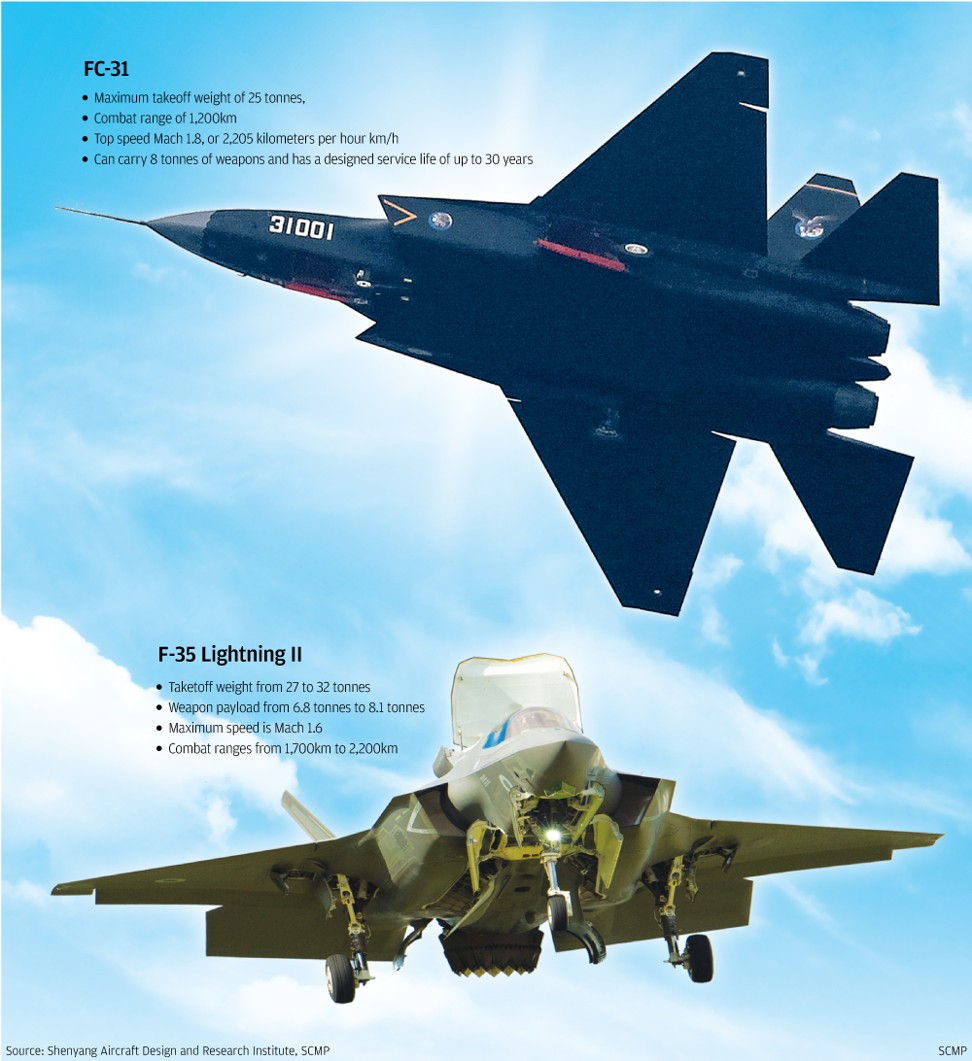
The aircraft, which made its maiden flight in 2012, has broadly similar specifications to the F-35 although it does have twin engines rather than the American jet’s single engine.

The Chinese fighter has a maximum take off weight of 25 tonnes, a combat range of 1,200km (746 miles) and a top speed of Mach 1.8, or 2,205km/h (1,370mph), whereas the US fighter’s take-off weight varies between 27 and 32 tonnes, has a top speed of Mach 1.6 and a range of up to 2,200km (1,367 miles).

The FC-31 has a weapons payload of 8 tonnes, compared with 6.8 to 8.1 tonnes for the different varieties of F-35, and a service life of up to 30 years.

Graphic: SCMP
Graphic: SCMP

Lockheed Martin, which makes the American stealth fighter, has produced three different varieties – the land-based f-35A and two for use on ships: the vertical jump F-35B and catapult-assisted F-35C.

While the Chinese jet was primarily designed for the use of the air force, its light weight also means it could be adapted for use on carriers.

It was reported to have been in the running to be used on China’s next-generation aircraft carriers, but military sources recently said it would lose out to the J-20 because of its slow pace of development and reports of technological problems.

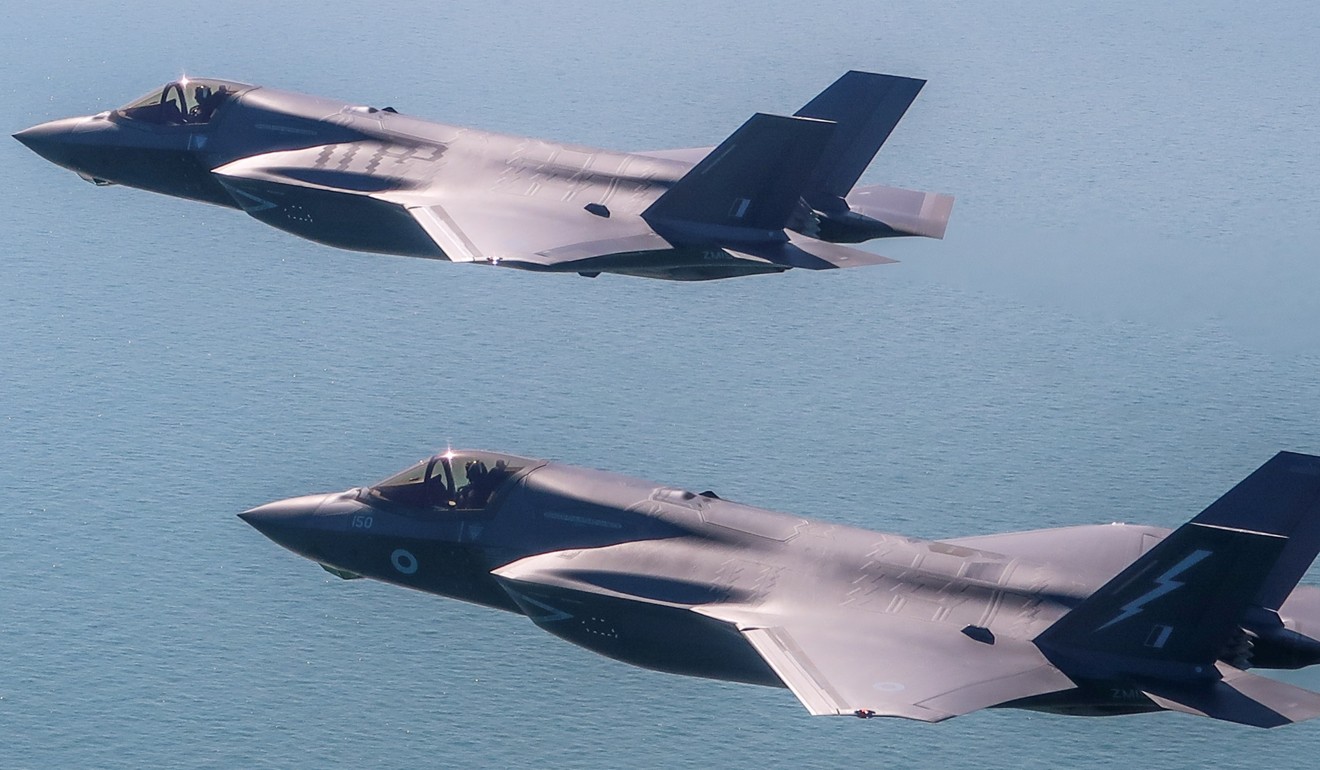
The US currently restricts sales of the F-35 to its closest allies: Photo: EPA-EFE/ USAF

However, the Chinese manufacturer is already actively marketing the fighter to other countries and a model of the plane appeared at the Paris Air Show in June.

One official from the Aviation Industry Corporation of China who attended the Air Show told state media that the firm hoped to “seize some share in the military aircraft market of developed nations”.

One area where the plane does have a definite advantage over its American counterpart is price. The price of a single FC-31 is expected to be about US$70 million, significantly less than the F-35 which has a price tag of around US$100 million per unit.

The US also restricts sales of the fighter to its allies, leaving a potential gap in the market for China to exploit when the fighter is ready for use.

Source: SCMP

03/08/2019

India accuses Pakistan-backed militants of targeting Hindu pilgrims in Kashmir

SRINAGAR/NEW DELHI (Reuters) – Indian security officials said on Friday they had found evidence of attacks planned by Pakistani military-backed militants on a major Hindu pilgrimage in the disputed Muslim-dominated region of Kashmir.

Tension has run high in the mountainous region since a vehicle laden with explosives rammed into an Indian police convoy on Feb. 14, killing 40 paramilitary policemen, and leading to aerial clashes between the two nations.

Indian officials said a mine with Pakistan ordinance marking was among caches of ammunition, explosives and weapons retrieved following intelligence reports of likely attacks on routes used by hundreds of thousands of devout Hindus who trek to the region’s holy Amarnath cave every year.

In an order issued on Friday, the government in the Indian state of Jammu and Kashmir effectively called off the pilgrimage and asked the gathered pilgrims to return home, citing the intelligence reports.

“The Pakistan ordinance factory markings (on the mine)…clearly indicate (the) Pakistan army is involved in terrorism in Kashmir,” Indian military commander Lieutenant-General K.J.S. Dhillon told a news conference in Srinagar.

There was no immediate comment from spokesmen for Pakistan’s military and its foreign ministry.

Muslim-majority Kashmir has been the site of decades of hostility between nuclear arch-rivals India and Pakistan. Both countries claim it in full but rule it in part.

India accuses Pakistan of funding armed militants, along with separatist groups in India’s portion of the region considered non-violent by international observers.

Islamabad denies the Indian accusation, saying it provides only diplomatic and moral support to the separatist movement.

In recent months, Pakistan says it has cracked down on Islamic militant groups, including arresting Hafiz Saeed, the alleged mastermind of the militant attack on India’s financial capital of Mumbai in 2008 that left 166 people dead.

Pakistani Prime Minister Imran Khan, who is battling an economic crisis at home, said in April that his country had nothing to gain from allowing armed militants to infiltrate into Indian-controlled Kashmir, and that Pakistan was doing its best to stop such incursions.

Khan is also working on rebuilding Pakistan’s image in Washington after an extended period of acrimony. The United States is relying on Islamabad’s support to seal a deal with the Taliban in Afghanistan that would allow U.S. troops to be pulled out after a protracted war lasting almost 18 years.


PANIC BUYING

Dhillon said security forces in Kashmir, where more than 300 people have died in just the last six months, were still being targeted with improvised explosive devices.

“All these things are an indication that Pakistan and the Pakistani army is desperate to disrupt peace in Kashmir Valley,” he said.

Police had received intelligence reports there could be an increase in militant-led violence, Kashmir police chief Dilbagh Singh told the briefing in the region’s main city of Srinagar.

India has moved an additional 10,000 paramilitary troops into the restive region because of the security situation, training requirements and the need for rotation, a home ministry official said on Friday.

The influx swells an estimated 40,000 troops already in the region to provide security for the Amarnath pilgrimage. The new deployment has caused concern among residents that Indian security forces planned another major crackdown.

They are fearful that a curfew may be imposed, affecting their ability to go out, and supplies coming in. There has been some panic buying at grocery stores in the past week and long queues at petrol stations.

Regional leaders indicated they are worried that Indian Prime Minister Narendra Modi’s government will now try to remove decades-old special rights for the people of the state, including an amendment to the Indian constitution made in 1954 known as Article 35A. That amendment prevents people from outside the state from buying property there.

“Various speculations are rife including removal of 35A to change the demography of the state and its Muslim majority character,” separatist leader Mirwaiz Umar Farooq told Reuters.

“As in the past, people and the leadership have to be ready to resist every attempt to undo it,” said Farooq, who is the chairman of Hurriyat, a political movement that wants independence from India.

Source: Reuters

29/07/2019

Experts accuse U.S. of using Xinjiang to interfere in China’s domestic affairs

URUMQI, July 28 (Xinhua) — A group of Chinese experts have criticized the United States for adopting double standards on counterterrorism and deradicalization and using Xinjiang-related issues as a tool to interfere in China’s domestic affairs.

The experts, who specialize in studies in the fields of human rights, international relations and anti-terrorism, made the remarks at a seminar held recently in Urumqi, capital of Xinjiang Uygur Autonomous Region.

Wang Yu, an associate researcher with the Institute of Chinese Borderland Studies, said China’s anti-terror measures implemented in Xinjiang in recent years have provided a new solution to the global fight against terrorism.

For some time China’s Xinjiang has seen frequent incidents of terrorist attacks, but over the past nearly three years, there have been no such incidents in the region, Wang noted.

Gu Liyan, a researcher with the Xinjiang Academy of Social Sciences, accused the United States of using human rights issues to erode public trust in governments of some other countries and create social conflict and unrest there, so as to attain its global hegemony.

“Whatever measures or policies China implements on counterterrorism and deradicalization will never accord with the so-called human rights standards of the U.S.,” she said.

Li Wei, a researcher with the China Institute of Contemporary International Relations, said education and training centers were established in Xinjiang in order to prevent trainees from falling victim to terrorism and extremism.

China’s measures on deradicalization offer a successful case study to the international community and have won widespread recognition and acclaim, said Li.

Shu Hongshui, an anti-terror expert at Northwest University of Political Science and Law, said the U.S. adoption of double standards on counterterrorism and deradicalization is intended to curb China’s development.

The propaganda warfare waged by the United States and some other Western countries against China on Xinjiang-related issues is unable to conceal their strategic anxiety and predicament, Shu said

Source: Xinhua

04/04/2019

Manila accuses Beijing of violating its sovereignty as South China Sea dispute rages on

  • Philippines’ foreign ministry weighs in on controversy over presence of Chinese fleet near contested Thitu Island
  • Manila has ‘consistently manifested its … objections or concerns over illegal, tension-raising or coercive activities’, statement says
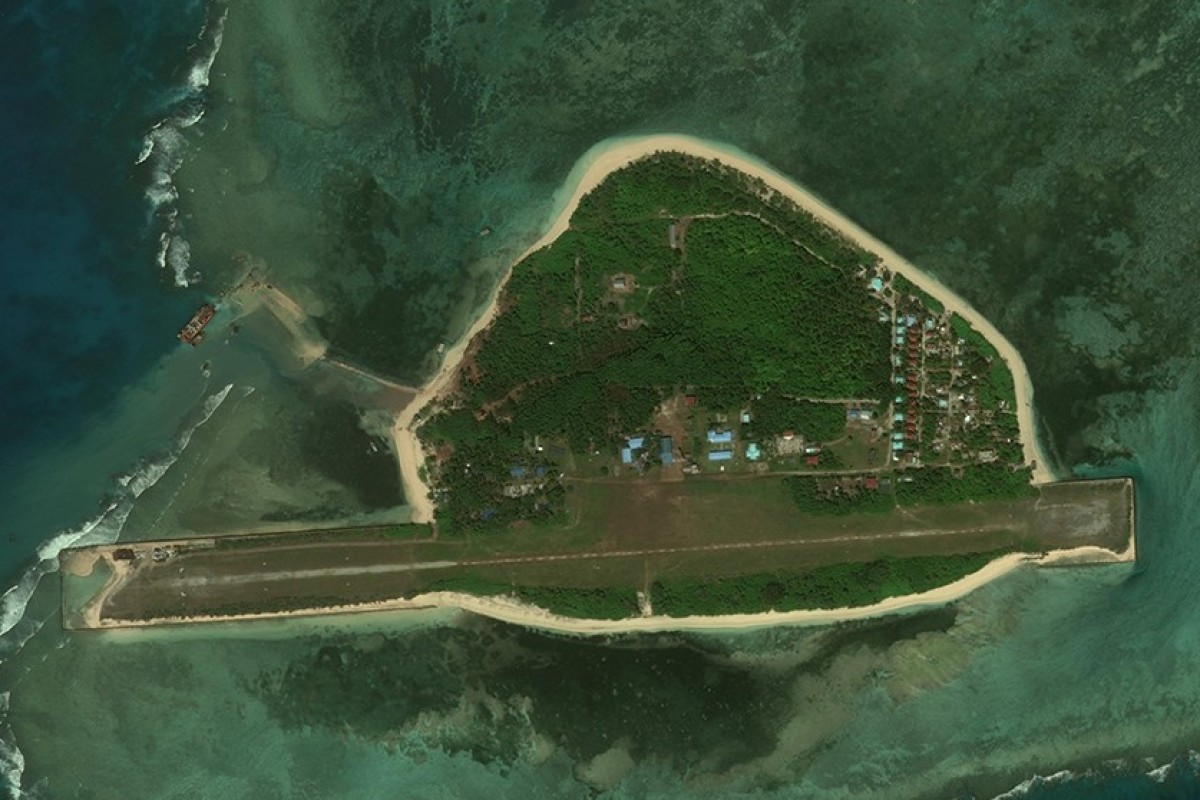
The Philippines is angry about the presence of a Chinese fleet close to Thitu Island in the South China Sea. Photo: AMTI
The Philippines’ foreign ministry on Thursday accused Beijing of violating its sovereignty and jurisdiction by allowing hundreds of vessels to sail close to an island claimed by Manila in the South China Sea.
The statement came just three days after Philippine Defence Minister Delfin Lorenzana
described China’s growing presence in the disputed waters as “very concerning”, saying on a trip to Washington that it was encroaching on the Philippines’ exclusive economic zone.
The conflict relates to the presence of up to 
200 Chinese vessels near Thitu Island

, which Manila calls Pag-asa, in the disputed Spratly Islands.

The Department of Foreign Affairs in Manila said the Philippines “has consistently manifested its position on Pag-asa … and its objections or concerns over illegal, tension-raising or coercive activities, through diplomatic actions … and in meetings with the Chinese side”.
The statement said Thitu is part of the Kalayaan island group – the local name for the Spratlys – and an integral part of the Philippines, over which it has sovereignty and jurisdiction.

“The presence of Chinese vessels near and around Pag-asa and other maritime features in the KIG is illegal,” it said.

US, Philippines in talks on rocket system to deter Beijing

“Such actions when not repudiated by the Chinese government are deemed to have been adopted by it,” it said. “The presence of Chinese vessels within the KIG, whether military, fishing or other such will thus continue to be the subject of appropriate action by the Philippines”.

The foreign ministry said earlier it had filed a diplomatic protest about the presence of more than 200 Chinese vessels near Thitu between January and March.

Satellite images captured in February by the Asia Maritime Transparency Initiative under the Washington-based Centre for Strategic and International Studies show almost 100 Chinese ships apparently hampering Philippine construction work on Thitu.

The fleet, dispatched from the nearby Subi Reef, includes naval and coastguard vessels, as well as dozens of fishing boats.

Manila was planning to upgrade its military facilities on Thitu, including the construction of an airstrip, but the project was suspended because of the Chinese interference.

The defence chiefs of the US and the Philippines reaffirmed their security alliance on Monday in Washington. As well as agreeing to boost cooperation, the US promised to increase its support for Manila’s military modernisation – a move seen as a response to Beijing’s increasingly assertive posturing in the South China Sea.

Philippine President Rodrigo Duterte says he will not confront China over the South China Sea dispute as doing so would end in war. Photo: AP
Despite the statements from his ministries,

Philippine President Rodrigo Duterte

said on Wednesday that Beijing wanted to be friends with Manila and that he would not confront China over their competing claims in the South China Sea because it would end in war.

The foreign affairs department in Manila also sought to sound a positive note in its statement, saying the maritime dispute was not the “sum total” of Philippines-China relations, and should not exclude mutually beneficial cooperation in other fields.
US more likely than Philippines to end up in ‘shooting war’
A day after the two nations wrapped up their latest meeting on the South China Sea, Chinese foreign ministry spokesman Geng Shuang said on Thursday the two sides had reaffirmed their differences but would continue to seek a resolution.
“China looks forward to working with the Philippines to make active efforts to safeguard the overall interests of China-Philippines cooperation and peace and stability in the South China Sea,” he said.
Hong Kong-based military expert Song Zhongping said the presence of the Chinese vessels near Thitu was a clear statement of Beijing’s intent.

“Beijing believes Thitu Island is Chinese territory, so any work there should be done by China, not the Philippines,” he said.

It also wanted to stop Manila “opening the door to dangerous people” he said, referring to the Southeast Asian nation’s announcement about allowing the US access to five more of its military bases.

Source: SCMP

Law of Unintended Consequences

continuously updated blog about China & India

ChiaHou's Book Reviews

continuously updated blog about China & India

What's wrong with the world; and its economy

continuously updated blog about China & India