Archive for ‘Aircraft’

20/09/2019

Aviation watchdog may ask Boeing to set up 737 MAX simulators in India

NEW DELHI (Reuters) – India’s aviation safety regulator may ask Boeing (BA.N) to set up simulators in India to train pilots on the 737 MAX planes once it clears the aircraft as safe for flying, a senior official with direct knowledge of the matter told Reuters.

The 737 MAX, the fastest-selling plane in Boeing’s history, has been grounded the world over since March in the aftermath of two fatal crashes in five months that killed 346 people.

India’s Directorate General of Civil Aviation (DGCA) will also conduct an independent inspection of the grounded planes once they are cleared for flying by the U.S. regulator, the Federal Aviation Administration (FAA).

“Once FAA re-certifies it and says these issues have been resolved then we will evaluate whether what they are saying is right or wrong … We will carry out our own inspections,” the official said, adding that it is unlikely the planes will fly in Indian skies until next year.

Boeing is making software changes and drawing up a new pilot training plan, and will need to conduct a key certification test flight to get the FAA’s approval before it can put the planes back in the air. Some federal officials expect the test flight to be conducted in October.

“Later this year India will send a team. We would like to take a look at their flight data, some simulators will also be required for training pilots,” the official said, adding it may ask Boeing to have simulators in India.

Indian carrier SpiceJet (SPJT.BO) has about a dozen Boeing 737 MAX planes in its fleet and a total of 155 on order – among the largest single orders for the narrow-body plane.

Boeing has delivered some 385 737 MAX jets globally before the March grounding and has roughly 5,000 orders for the aircraft, a more fuel-efficient version of the manufacturer’s best-selling single-aisle 737 series.

Source: Reuters

03/06/2019

Indian Air Force’s AN-32 aircraft with 13 onboard goes missing

airforce,India,breaking

An AN-32 aircraft of the Indian Air Force with 13 people onboard has gone missing after taking off from Jorhat in Assam.

The aircraft was headed to Mechuka Advance Landing Ground, the landing strip in the eastern Himalayas of Arunachal Pradesh’s West Siang district. The landing strip is about 30-odd km from the nearest point on the India-China border.

The transport aircraft took off from Jorhat at 12.25 pm.

It was in contact with ground agencies for the next 35 minutes. An Indian Air Force official said there had been no contact after 1 pm.

A total of eight crew and five passengers are onboard the aircraft.

News agency ANI said Sukhoi-30 combat aircraft and C-130 Special Ops aircraft had also been deployed on a search mission to locate the IAF aircraft.

Monday’s missing aircraft revived memories of the AN-32 that went missing while flying from Chennai to Port Blair in July 2016.
A massive search mission had been launched to find the 29 people on the transport plane. The IAF had then carried out 200 search sorties to cover over 2 lakh square nautical miles multiple times by these aircraft. The IAF court of inquiry later concluded that it was unlikely that the missing personnel on board the aircraft survived the accident.
Source: Hindustan Times
20/02/2019

Channel storm damaged Russian S-400 missiles bound for China

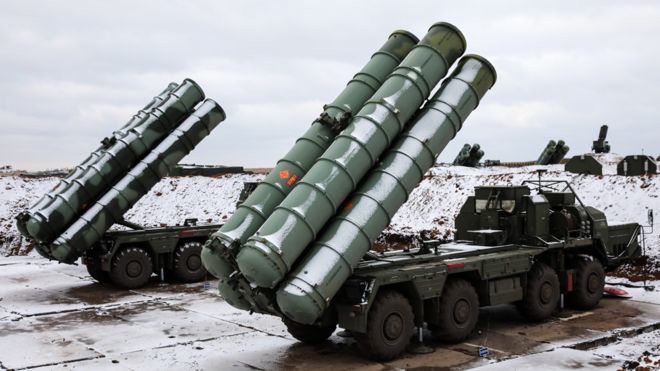
S-400s in Crimea, Nov 2018Image copyrightGETTY IMAGES
Image captionSince annexing Crimea in 2014 Russia has deployed S-400 missiles there

A storm in the English Channel damaged S-400 anti-aircraft missiles that Russia was shipping to China, but now they are being replaced, Russia says.

The ship with its damaged cargo returned to Russia last March, but two other Russian ships delivered S-400s to China successfully.

The deal was reported by the Russian government website Rossiiskaya Gazeta.

China is under US sanctions for buying S-400s and other Russian arms. India and Turkey are also buying S-400s.

A Russian arms industry chief, Dmitry Shugayev, said Russia would complete the delivery of the S-400s to China by the end of 2020.

China is getting two regimental units, which amounts to at least 128 missiles.

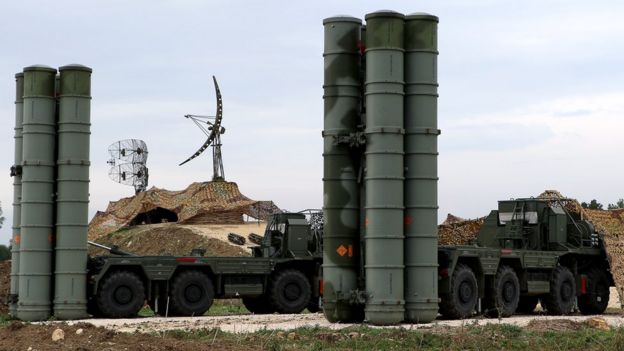
The S-400 surface-to-air missile system at Hmeimim airbase in Syrian province of Latakia (16 Dec 2015)Image copyrightAFP
Image captionThe S-400 missile system is deployed at Russia’s Hmeimim airbase in Syria

The S-400 “Triumf” is one of the most sophisticated surface-to-air missile systems in the world. It has a range of 400km (248 miles) and one S-400 integrated system can shoot down up to 80 targets simultaneously.

Russia says it can hit aerial targets ranging from low-flying drones to aircraft flying at various altitudes and long-range missiles.

The US sanctions are aimed at putting pressure on the Russian government over its annexation of Crimea and intervention in eastern Ukraine in 2014.

In October, India signed a $5bn (£3.9bn) deal to buy five S-400 regimental units. That amounts to at least 320 missiles. Each S-400 launch vehicle – a heavy lorry – carries four missiles.

Russia has deployed S-400s to protect its military airbase at Hmeimim in Syria.

Turkey, a Nato member, is buying S-400s despite US warnings. The US wants to sell Patriot missiles, made by Raytheon Co, to Turkey instead. The US argues that S-400s are incompatible with Nato systems.

“We made the S-400 deal with Russia, so it’s out of the question for us to turn back. That’s done,” Turkish President Recep Tayyip Erdogan said.

Neither Turkey nor India are yet under US sanctions over the purchases.


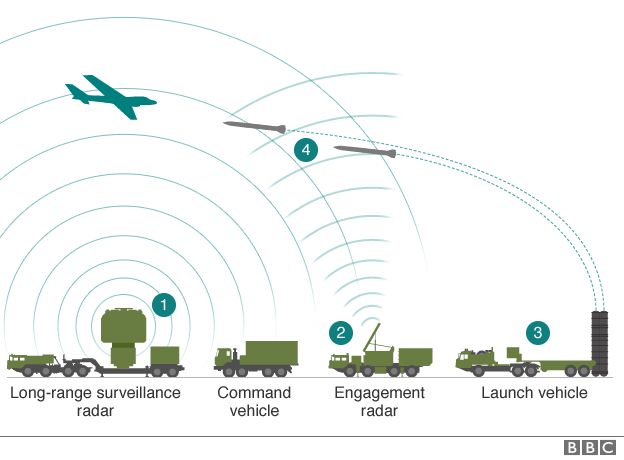
How the S-400 system works

Diagram of how S-400 missile system works
  1. Long-range surveillance radar tracks objects and relays information to command vehicle, which assesses potential targets
  2. Target is identified and command vehicle orders missile launch
  3. Launch data are sent to the best placed launch vehicle and it releases surface-to-air missiles
  4. Engagement radar helps guide missiles towards target.

Source: The BBC

05/12/2018

Seoul voices concerns as more Chinese military aircraft spread their wings in South Korean air defence zone

Lee Jeong-ho reports on China's diplomacy for the Post. He also covers East Asian security and defence stories. ” data-title=”<a href="/author/lee-jeong-ho">Lee Jeong-ho</a>” data-html=”true” data-template=”

” data-original-title=””> 

6SHARE

Related Articles

South Korea has voiced its frustration about repeated intrusions into its air defence identification zone by Chinese military aircraft, moves that analysts say reflect Beijing’s opposition to strengthening ties between Seoul, Tokyo and Washington.

South Korean authorities said a Chinese plane, possibly a Shaanxi Y-9 electronic warfare and surveillance aircraft flew into the Korean zone Monday last week without notice. The plane entered near Socotra Rock in the Sea of Japan, or East Sea, at about 11am and flew out and into Japan’s air defence identification zone about 40 minutes later.

The plane re-entered the South Korean air defence zone, near the southeastern city of Pohang, at about 12.43pm. Then it travelled up to South Korea’s Exclusive Economic Zone in the Sea of Japan, cutting between the South Korean mainland and Ulleung island.

It was unusual for a Chinese aircraft to have taken that route. The plane was reported to have left the zone at 3.53pm.

Air defence identification zones are not covered by any international treaty and it is standard practice to notify the country concerned before entering its airspace.

The aircraft did not enter South Korean territorial airspace, which under the United Nations Convention on the Law of the Sea is defined as 12 nautical miles from shore.

According to the South Korean Air Force, the number of Chinese military aircraft entering its identification zone is rising. In 2016, there were about 60 incursions, 70 in 2017 and 110 were reported up to September this year.

Seoul called Du Nongyi, the Chinese military attaché to South Korea, to its defence ministry after Monday’s incident to expressed its “serious concerns” and called for “measures to prevent recurrences”.

A middle-ranking South Korea Air Force officer said Seoul paid “extra attention” to the incident.

Security analysts said the flights were a demonstration of China’s worries about increased US military activity in the region if US-North Korea negotiations failed.

Sending military planes over area allowed China to extend its surveillance and sent a message that it was watching and, if necessary, willing to act to protect its interests in the region, analysts said.

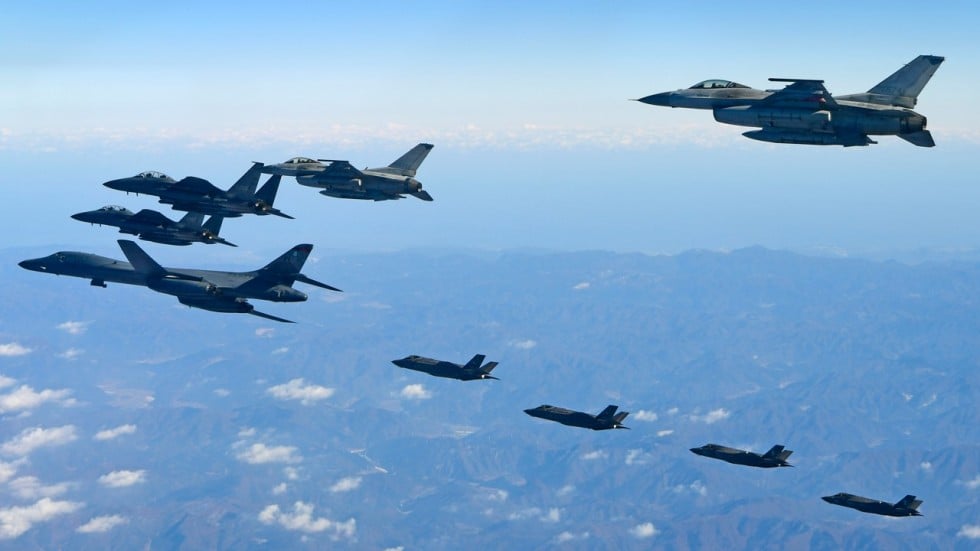
The US has sent military assets, including nuclear-capable B-52 bombers, to the Sea of Japan, prompting criticism from Beijing and Pyongyang. The US has long said North Korea’s behaviour was justification for joint military exercises with South Korea. These were stepped down this year to encourage Pyongyang at the negotiation table but could be stepped up again if talks on denuclearisation fail.

“China’s moves are part of its grand strategy to exert greater influence, presence, and pressure in the Indo-Pacific region … Possible failure of US-North Korea negotiations would be in [Beijing’s] calculations,” said Ryo Hinata-Yamaguchi, a visiting professor at Pusan National University in South Korea and adjunct fellow at the Pacific Forum – a donor-funded, non-profit foreign policy research institute based in Honolulu, Hawaii.

“I expect the [US-South Korea] exercises to resume at full scale [if] the US-North Korea negotiations or inter-Korean relations deteriorate … when both Washington and Seoul view that [the drills are] necessary.”

Zhao Tong, a fellow with the nuclear policy programme at the Carnegie-Tsinghua Centre for Global Policy in Beijing, said Monday’s overflight had several meanings.

The resumption of US-South Korea drills and Japan’s recent military modernisation “would be viewed by China as a direct threat to its own security and the overfly of Chinese aircraft could be used to send a deterrence signal”.

“Japan, in particular, is hosting increasingly advanced US military assets on its territory. Chinese reconnaissance aircraft flying in the Sea of Japan can help it keep an eye on what is going on in that region,” Zhao said.

Beijing fears the strengthening of an alliance network between the South Korea and Japan and, consequently, the completion of a US-South Korea-Japan triangle, often referred to as an Asian Nato.

South Korea and Japan signed a military intelligence pact in 2016, which China criticised as a deal between countries that shared a “cold-war mentality”.

“For China, the formation of a US-South Korea-Japan alliance triangle would be one of their biggest concerns as it would essentially be a powerful containment strategy against Beijing,” Hinata-Yamaguchi said.

“China would take, and has taken, measures to avoid the formation of an US-South Korea-Japan alliance triangle, such as the [push for] ‘three positions’ promised between China and the South Korea in the autumn of 2017,” Hinata-Yamaguchi said.

But Beijing played down the flight and called it a “routine arrangement”.

Ren Guoqiang, spokesman at the Ministry of National Defence, said last week that Chinese forces were “in line with the international law and practice” and the South Korea side “didn’t have to be too surprised about it”.

The ministry did not respond to requests for further comment.

Law of Unintended Consequences

continuously updated blog about China & India

ChiaHou's Book Reviews

continuously updated blog about China & India

What's wrong with the world; and its economy

continuously updated blog about China & India