

 Image copyright GETTY IMAGES
The lockdown in Indian-administered Kashmir has cost the region’s economy more than $1bn in two months, according to industry experts. BBC Hindi’s Vineet Khare reports.
Mushtaq Chai recalls the afternoon of 2 August when he received a “security advisory” from the administration. A prominent local businessman, he owns several hotels across the Muslim-majority valley in Indian-administered Kashmir.
The note warned of “terror threats” and advised that tourists and Hindu pilgrims should “curtail their visit… and return as soon as possible”.
Mr Chai, like many others, took the advisory seriously. Two years before, seven Hindu pilgrims were killed in a militant attack while returning from the Amarnath cave, a major Hindu shrine in Kashmir’s Anantnag district.
“This was the first time in Kashmir’s history that tourists and pilgrims were asked to leave,” Mr Chai says.
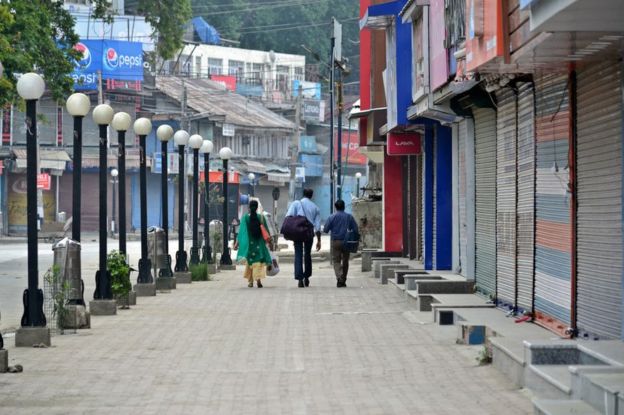 Image copyright GETTY IMAGES
Soon officials arrived to enforce the order, and Mr Chai and his staff made arrangements for all of the guests to leave immediately.
Days later, on 5 August, the federal government stripped the region of its special status and placed it under a communications lockdown.
Two months on, the situation is far from normal. Internet and mobile phone connections remain suspended, public transport is not easily available, and most businesses are shut – some in protest against the government, and others for fear of reprisals from militants opposed to Indian rule.
There is also a shortage of skilled labour, as some 400,000 migrants have left since the lockdown began.
What’s more, the streets are deserted and devoid of the tourist business which had supported up to 700,000 people.

Read more about Kashmir
- Kashmir’s crippled courts leave detainees in limbo
- The complicated truth behind Kashmir’s ‘normality’
- ‘Even I will pick up a gun’: Inside Kashmir’s lockdown
- Kashmiris allege torture in army crackdown
The lockdown has not come cheap.
A government official, who did not wish to be named, says they are “awaiting a financial package” from the federal government. But the Kashmir Chamber of Commerce and Industry estimates the shutdown has already cost the region more than $1.4bn (£1.13bn), and thousands of jobs have been lost.
“There are around 3,000 hotels in the valley and they are all empty. They have loans to pay off and daily expenses to bear,” says Mr Chai, sitting in his mostly empty hotel in the capital, Srinagar.
Only a handful of his 125 staff are at work. Many haven’t returned because of lack of transport – or fear. Tensions have been high in the region, and there have been a number of protests in the city.
But the situation may improve in the coming days as the government has announced that tourists will allowed in the state from Thursday.
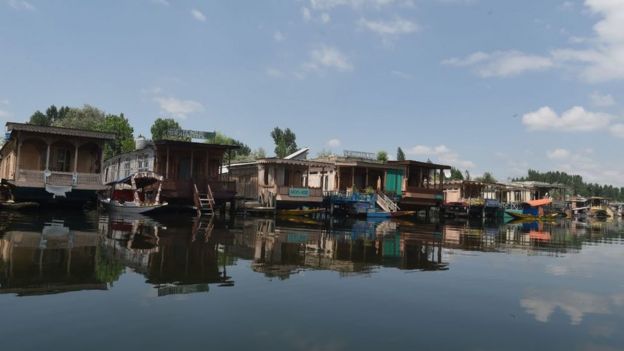 Image copyright GETTY IMAGES
But it isn’t just the hotels which have suffered.
“No internet has meant more than 5,000 travel agents have lost work,” says Javed Ahmed, a travel agent himself. “The government says give jobs to the youth. We are young but jobless. We have nothing to do with politics. We want jobs.”
Srinagar’s almost 1,000 iconic houseboats have also been running empty.
“Every houseboat needs up to $7,000 a year for maintenance,” says Hamid Wangnoo from the Kashmir Houseboats Owners Association. “For many, this is the only source of livelihood.”
And it isn’t just tourism.
“More than 50,000 jobs have been lost in the carpet industry alone,” according to Shiekh Ashiq, president of the chamber of industry.
He says July to September is when carpet makers usually receive orders for export – especially overseas, so they can deliver by Christmas.
But they are unable to contact importers, or even their own employees, because of the communications lockdown.
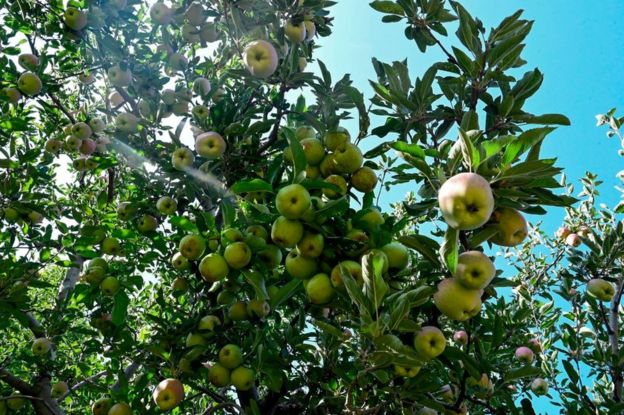 Image copyright GETTY IMAGES
In southern Kashmir, the region’s famous apples are still waiting to be plucked from the trees. But shops and cold storage units are shut, and the main apple market is empty. Last year, it did business worth $197m, local farmers say.
“I feel so much pain seeing my apples hanging from the trees that I don’t go to the orchard anymore,” says a worried apple grower, who did not wish to be named.
“Apples account for 12–15% of Kashmir’s economy, but more than half of this year’s produce has not been plucked,” says economic journalist Masood Hussain. “If this continues through October, it will have devastating consequences.”
In Srinagar, some shop owners wait outside their stores and open them for a customer before closing them hurriedly – until the next customer arrives.
One such owner says he is unhappy with the government’s decision, but he is also scared of angry locals who want him to keep his business closed.
“But how do I survive without my daily earnings?” he asked.

 CHINDIA ALERT: You'll be living in their world, very soon