Archive for ‘android’

10/02/2020

China’s first-quarter smartphone sales may halve due to coronavirus: analysts

SHANGHAI (Reuters) – China’s smartphone sales may plunge by as much as 50% in the first quarter, as many retail shops have closed for an extended period and production has yet to fully resume due to the fast spread of a new coronavirus, according to research reports.

The virus outbreak, which has killed more than 900 people and roiled China’s manufacturing industry, comes as top smartphone vendors such as Huawei had hoped China’s 5G rollout plans this year would help the world’s biggest smartphone market rebound after years of falling sales.

“Vendors’ planned product launches will be canceled or delayed, given that large public events are not allowed in China,” research firm Canalys said in a note last week.

“It will take time for vendors to change their product launch roadmaps in China, which is likely to dampen 5G shipments.”

Canalys expects China’s smartphone shipments to halve in the first quarter from a year ago, while IDC, another research firm that tracks the tech sector, forecasts a 30% drop.

Apple Inc said last week it is extending its retail store closures in China and has yet to finalise opening dates, as Foxconn, which assembles iPhones, struggles to fully resume factories.

Foxconn received government approval on Monday to resume production at a plant in the city of Zhenghzou, but its major plant in Shenzhen remain unopened.

Huawei, China’s biggest smartphone vendor, said its manufacturing capacity is “running normally” without specifying further. But like many other local peers, Huawei relies heavily on third-party manufacturers for production.

If factories cannot resume production to full capacity on time, this could delay brands’ ability to bring their newest products to market, analysts said.

Xiaomi Corp, Huawei, and Oppo, three of China’s top Android brands, are all expected to announce flagship devices in the first half.

Oppo told Reuters that while the impact of the virus will affect operations at some local factories, “manufacturing capacity can be guaranteed effectively” thanks to its plants overseas.

Xiaomi did not respond to requests for comment.

“The delays in reopening factories and the labour return time will not only affect shipments to stores, it will also affect the product launch times in the mid- and long-term,” Will Wong, an IDC analyst, said.

Globally, smartphone production will decrease by 12% in the March quarter to a five-year low of 275 million units, research firm TrendForce said on Monday. It revised down iPhone production by 10% to 41 million units, while Huawei’s output forecast was cut by 15% to 42.5 million phones.

Samsung Electronics Co, the world’s top smartphone maker, is seen the least affected by the virus outbreak as its main production base is in Vietnam, the report said, lowering its production forecasts by just 3% to 71.5 million units.

Source: Reuters
20/05/2019

Huawei’s use of Android restricted by Google

Google has barred the world’s second biggest smartphone maker, Huawei, from some updates to the Android operating system, dealing a blow to the Chinese company.

New designs of Huawei smartphones are set to lose access to some Google apps.

The move comes after the Trump administration added Huawei to a list of companies that American firms cannot trade with unless they have a licence.

Google said it was “complying with the order and reviewing the implications”.

Huawei said it would continue to provide security updates and after sales services to all existing Huawei and Honor smartphone and tablet products covering those have been sold or still in stock globally.

“We will continue to build a safe and sustainable software ecosystem, in order to provide the best experience for all users globally,” it added.

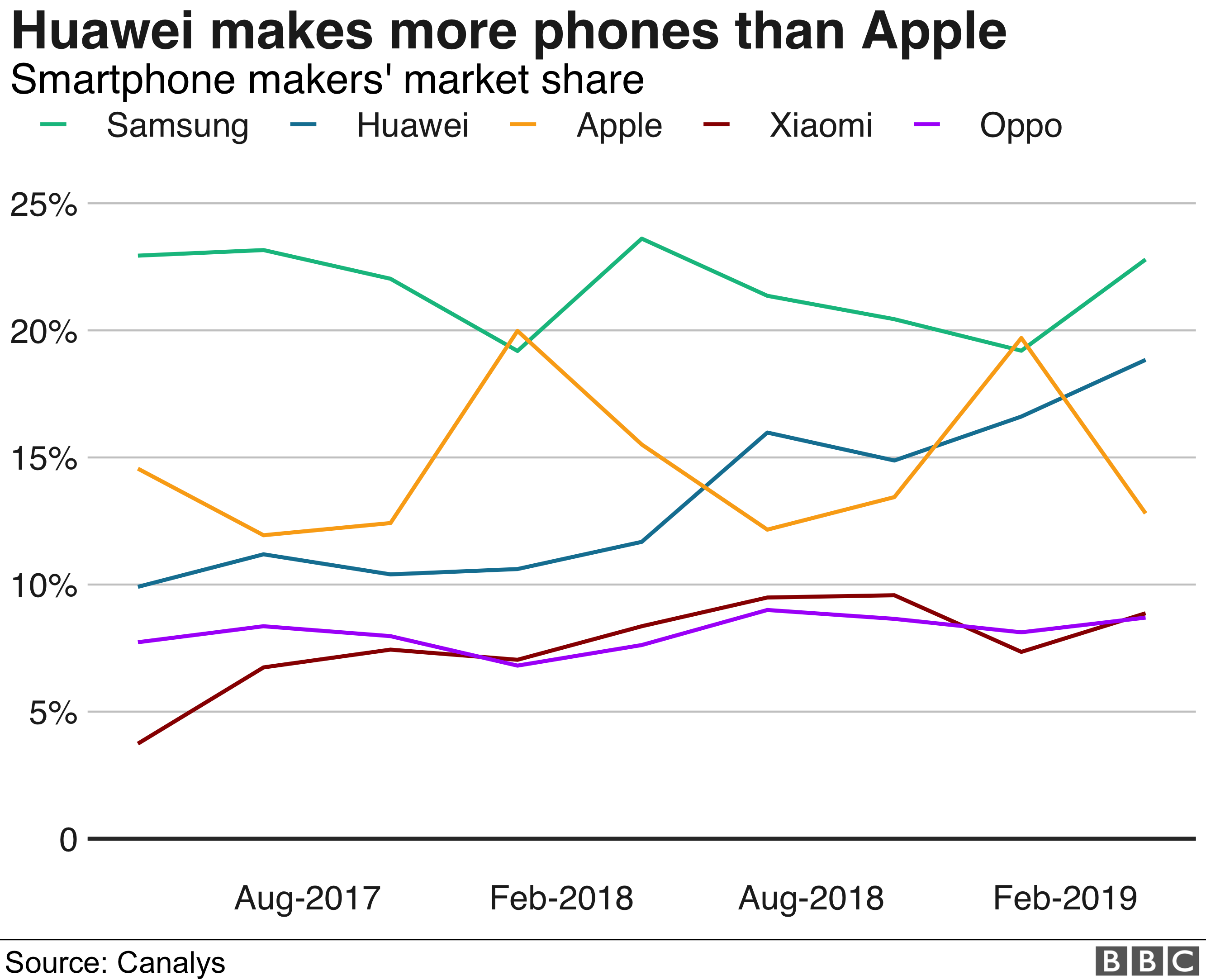
Mobile market shares

What does this mean for Huawei users?

Existing Huawei smartphone users will be able to update apps and push through security fixes, as well as update Google Play services.

But when Google launches the next version of Android later this year, it may not be available on Huawei devices.

Future Huawei devices may no longer have apps such as YouTube and Maps.

Huawei can still use the version of the Android operating system available through an open source licence.

Ben Wood, from the CCS Insight consultancy, said the move by Google would have “big implications for Huawei’s consumer business”.

What can Huawei do about this?

Last Wednesday, the Trump administration added Huawei to its “entity list“, which bans the company from acquiring technology from US firms without government approval.

In his first comments since the firm was placed on the list, Huawei chief executive Ren Zhengfei told Japanese media on Saturday: “We have already been preparing for this.”

He said the firm, which buys about $67bn (£52.6bn) worth of components each year according to the Nikkei business newspaper, would push ahead with developing its own parts.

Huawei faces a growing backlash from Western countries, led by the US, over possible risks posed by using its products in next-generation 5G mobile networks.

Several countries have raised concerns that Huawei equipment could be used by China for surveillance, allegations the company has vehemently denied.

Huawei has said its work does not pose any threats and that it is independent from the Chinese government.

However, some countries have blocked telecoms companies from using Huawei products in 5G mobile networks.

So far the UK has held back from any formal ban.

“Huawei has been working hard on developing its own App Gallery and other software assets in a similar manner to its work on chipset solutions. There is little doubt these efforts are part of its desire to control its own destiny,” said Mr Wood.

Media caption We explain the controversy around Huawei’s 5G tech – using castles

Short-term damage for Huawei?

By Leo Kelion, BBC Technology desk editor

In the short term, this could be very damaging for Huawei in the West.

Smartphone shoppers would not want an Android phone that lacked access to Google’s Play Store, its virtual assistant or security updates, assuming these are among the services that would be pulled.

In the longer term, though, this might give smartphone vendors in general a reason to seriously consider the need for a viable alternative to Google’s operating system, particularly at a time that the search giant is trying to push its own Pixel brand at their expense.

As far as Huawei is concerned, it appears to have prepared for the eventuality of being cut off from American know-how.

Its smartphones are already powered by its own proprietary processors, and earlier this year its consumer devices chief told German newspaper Die Welt that “we have prepared our own operating systems – that’s our plan B”.

Even so, this move could knock its ambition to overtake Samsung and become the bestselling smartphone brand in 2020 seriously off course.


What about the US-China trade war?

The latest move against Huawei marks an escalation in tensions between the firm and the US.

The company is facing almost two dozen criminal charges filed by US authorities. Washington is also seeking the extradition of Huawei executive Meng Wangzou from Canada, where she was arrested in December at the behest of American officials.

It comes as trade tensions between the US and China also appear to be rising.

The world’s two largest economies have been locked in a bruising trade battle for the past year that has seen tariffs imposed on billions of dollars worth of one another’s goods.

Earlier this month, Washington more than doubled tariffs on $200bn of Chinese goods, prompting Beijing to retaliate with its own tariff hikes on US products.

The move surprised some – and rattled global markets – as the situation had seemed to be nearing a conclusion.

The US-China trade war has weighed on the global economy over the past year and created uncertainty for businesses and consumers.

Source: The BBC

Law of Unintended Consequences

continuously updated blog about China & India

ChiaHou's Book Reviews

continuously updated blog about China & India

What's wrong with the world; and its economy

continuously updated blog about China & India