05/04/2020
- The coronavirus pandemic has completely changed patterns of consumer psychology across the world, experts say
- Complexity of the crisis, the number of variables and its magnitude make a consumer recovery unprecedented and difficult to predict
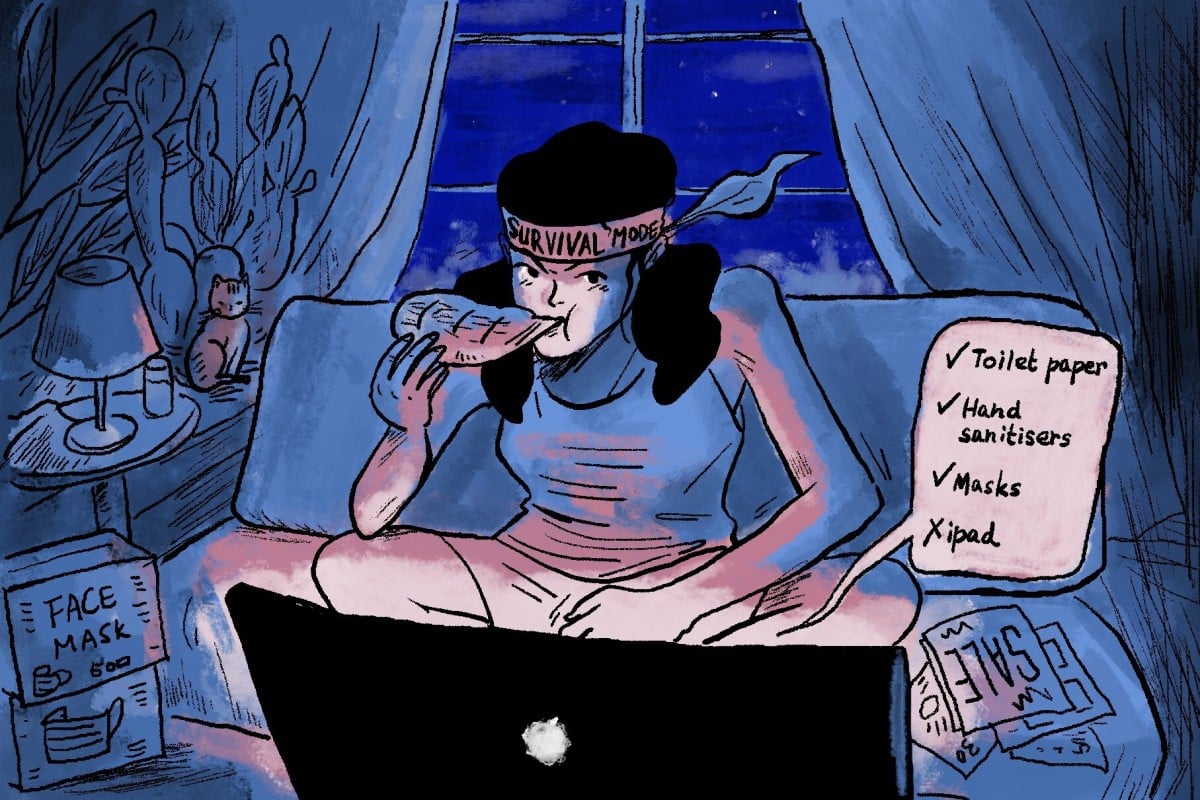
The coronavirus has caused panic buying around the world as consumers frantically stockpile of goods such as toilet paper, hand sanitisers and masks. Illustration: Brian Wang
Before the coronavirus crisis began rippling through the global economy, Susan Wang had big plans for 2020.
Not only was she going to buy a new Apple MacBook and iPad, plus a projector so she could host friends for movies at home, but she was set on making a career move.
“I was planning to change my job, but my headhunter told me that all recruitment has been postponed to the second quarter,” said the 27-year-old who works for a British company in Hong Kong.
“Our headquarters in London has a plan for redundancy, too. It is better to save some money in case I get laid off.”
As Covid-19 spreads across the world, sending stock markets reeling and prompting big companies to slash jobs, Wang has become increasingly frugal like scores of other consumers from China to the United States.
She has stopped eating at restaurants and now tries to keep her weekly food bill under HK$500 (US$64), whereas in the past she wouldn’t think twice about spending HK$100 per meal.
Amid mounting uncertainty, the
coronavirus pandemic – which has claimed the lives of more than 41,000 people and infected at least 842,000 worldwide – is fundamentally changing consumer behaviour in Asia, Europe and North America.
Consumer experts said the 2009 global financial crisis, the Great Depression that started in 1929 and the September 11 terrorist attacks give some clues about how and when global consumption might recover. But the complexity of this crisis, the number of variables and its magnitude make this consumer recovery unprecedented and difficult to predict, they added.
Coronavirus: What impact will the economic fallout from the Covid-19 pandemic have on you?
“The coronavirus pandemic has completely changed patterns of consumer behaviour all over the world. People are afraid, and when people are afraid, they go into survival mode,” said Jesse Garcia, a Los Angeles-based consumer psychologist, who is also the CEO of market consulting firm My Marketing Auditors.
plummeted a record 44 per cent in February and those figures are only expected to get worse, with sales forecast to slump between 30 and 40 per cent in the first half of the year, according to the Hong Kong Retail Management Association.
In the US, retail sales dropped by 0.5 per cent in February, even before many states had issued stay-at-home orders to protect the world’s largest economy. The decline was the biggest fall since December 2018.
Experts say non-essential products and services are set to be worst affected by the coronavirus pandemic, while goods and services that can be consumed at home will see a spike in sales.
The coronavirus pandemic has completely changed patterns of consumer behaviour all over the world. People are afraid, and when people are afraid, they go into survival mode – Jesse Garcia
“Online consumer behaviour is frenetic,” said Ross Steinman, a professor of psychology at Widener University in the US state of Pennsylvania. “Consumers are refreshing and refreshing and refreshing websites to secure grocery delivery times, purchase paper towels from their usual big box retailer and scavenge for rice and canned soup from third party sellers on Amazon.
“A pronounced spike in coronavirus cases will only amplify the freneticism.”
So far, one of the
biggest shortages for consumers is toilet paper. Television stations across the globe have beamed images of empty supermarket shelves and huge queues as people hoard toilet paper rolls, masks and hand sanitiser.
The frantic stockpiling can be explained by a psychological concept called informational conformity, said Vicki Yeung, associate professor at the Department of Applied Psychology at Lingnan University in Hong Kong.
A pronounced spike in coronavirus cases will only amplify the freneticism – Ross Steinman
“When people lack knowledge and are in an uncertain situation, they tend to follow the group’s behaviour and blindly conform, but once they obtain more information, and digest and process the situation, the panic gradually fades away,” she said.
“During this Covid-19 pandemic, people generally feel jittery and anxious because they feel their sense of control has disappeared.”
Unlike other recent global crises such as the September 11 attacks, the coronavirus is less a one-time sharp shock to the system and more of a rolling source of anxiety that could retreat and resurface repeatedly, consumer behaviour experts said.
This was the pattern with the Black Death plague that hit Europe in 1347 and returned episodically over many years, ultimately killing millions of people.
During this Covid-19 pandemic, people generally feel jittery and anxious because they feel their sense of control has disappeared – Vicki Yeung
“It may be we’ll have to shut down things again in October or August. And this could go on for years,” said Charley Ballard, an economist with Michigan State University in the US. “The more that happens, the more damage it does to buoyant consumer psychology.”
Furthermore, relative to the 2009 financial crisis and even the Great Depression, when much of the damage was concentrated at least initially in the financial sector, this crisis has seen virtually the entire economy grind to a halt all at the same time, devastating employment and consumption.
Last week, a record 3.3 million Americans applied for unemployment benefits within one week, as restaurants, hotels, barber shops, gyms and retail outlets shut down in a nationwide bid to stem the pandemic. The previous record of 695,000 was set in 1982.
On Tuesday, Goldman Sachs predicted the US jobless rate will hit 15 per cent in the second quarter of this year from the coronavirus economic freeze, and could rise further beyond that to near the historic peak of 24.9 per cent seen in 1933 during the Great Depression. Economists at the St. Louis district of the US Federal Reserve projected unemployment could cost as many as 47 million jobs in the US this year, sending the unemployment rate past 32 per cent before making a sharp recovery.
US now has world’s most coronavirus cases, surpassing China
China’s unemployment rate jumped to 6.2 per cent for January and February from 5.2 per cent in December and 5.3 per cent a year earlier. It was the highest level since records began in 2016, but did not include China’s estimated 291 million migrant workers.
Consumer spending accounts for more than 60 per cent of the Chinese economy and drives 70 per cent of the US economy. But with the pandemic causing many people to go into hibernation and likely to lead to cycles of job cuts, economists have predicted a consumer-led global recession by the second quarter of this year.
Just how long it will take for consumer behaviour to return to normal depends on each person’s psychological resilience, including how quickly they can adapt to change, how optimistic they are and whether they can adopt strategies to regain a sense of control, Yeung said.
Anirban Mukhopadhyay, chair professor of marketing at Hong Kong University of Science and Technology said as long as the coronavirus threat was still present, people would remain fearful to some extent. But he added that people were resilient.
Satellite images show world sites deserted amid coronavirus pandemic
“Human beings adapt to events and stimuli over time,” Mukhopadhyay said. “Research has shown that even people who win lotteries tend to return to their earlier levels of life satisfaction after some months, as do people who have to have amputations.
“So even if the source of the fear does not go away, we learn to live with it.”
Ballard, from Michigan State University, estimated it could take upwards of two years for American consumers to feel secure enough in their jobs and gain enough confidence to fully open their wallets. A longer and more episodic duration for the disease could push that higher, he added.
Further complicating the consumer picture, he said, is that many supply chains are at risk of breaking. And consumers will be wary of spending for a while in many traditional areas, including crowded sporting events and concerts, restaurants and flights.
A new phase of coronavirus blame game: what is the legacy of Covid-19 on global supply chains?
Some experts have even suggested that consumer behaviour may be permanently changed as a result of the pandemic.
“It seems very unlikely that people will get back to life as it was before, once the coronavirus is over,” said Andreas Kappes, a lecturer in psychology at City University of London.
“People’s behaviour is extremely orthodox, often referred to as the status quo bias and captured in expressions like ‘past behaviour best predicts future behaviour.’ Now, the crisis forces us to change our behaviour, radically, and we might discover that new way suits us better.”
Source: SCMP
Posted in 1347, Amazon, Americans, anxious, Apple MacBook, Asia, ‘survival mode', barber shops, Black Death plague, British company, career move, China, City University of London, Consumer, consumer behaviour, coronavirus, Coronavirus pandemic, COVID-19, Covid-19 pandemic, Department of Applied Psychology, Economists, Europe, Goldman Sachs, Great Depression, gyms, hand sanitisers, headhunter, headquarters, Home, Hong Kong, Hong Kong University of Science and Technology, hotels, infected, iPad, jittery, Lingnan University, London, masks, Michigan State University, movies, North America, Panic buying, patterns, Pennsylvania, projector, psychology, radically altered, redundancy, restaurants, retail outlets, retreats, Satellite images, September 11 terrorist attacks, St. Louis, toilet paper, Uncategorized, US, US Federal Reserve, Widener University, World |
Leave a Comment »
31/05/2019
- Fears of trade war impact also appear to be affecting willingness to spend and prompting moves to safeguard wealth in foreign currencies and gold
- Rising food prices and unemployment levels adding to concerns despite state and social media urging nation to stand strong in face of adversity
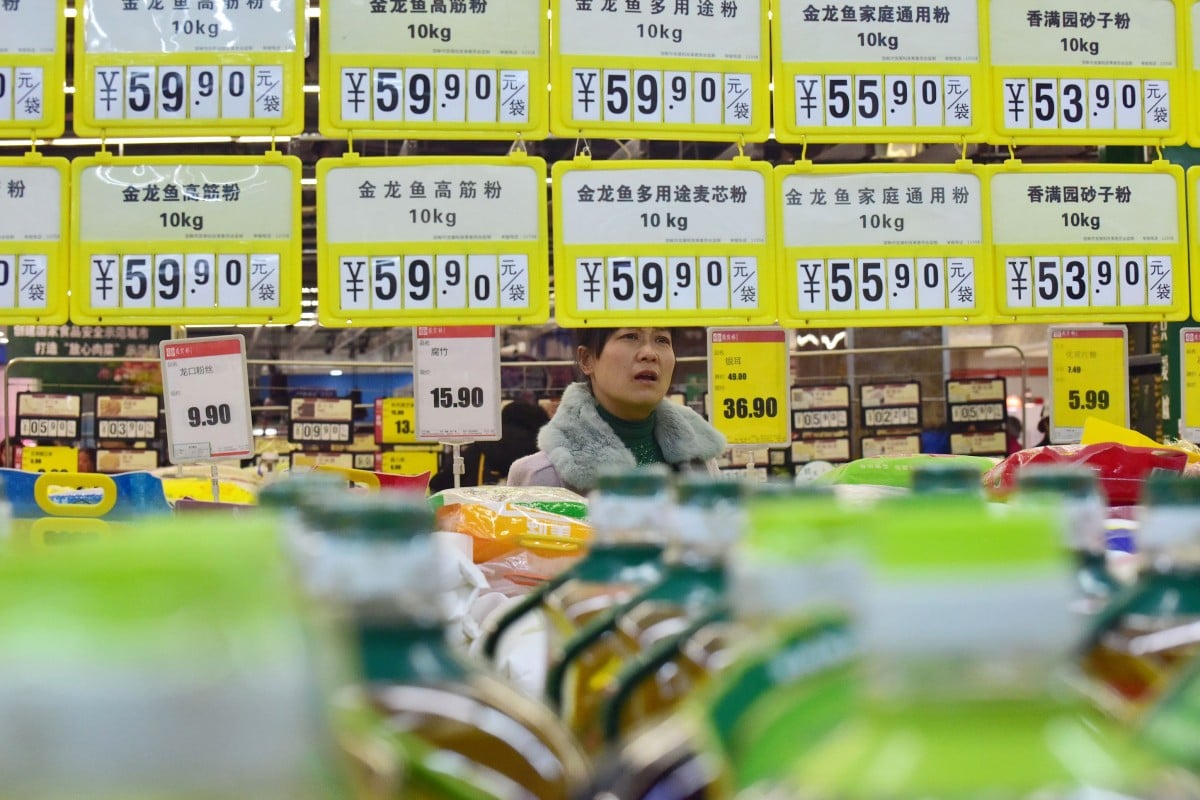
Food prices jumped 6.1 per cent in April due to higher pork and fruit prices, with pork price increases accelerating to 14.4 per cent from 5.1 per cent in March. Photo: Reuters
China’s middle class, particularly better-educated white collar workers, are growing increasingly confused and anxious over how the trade war with the United States will affect the lives of ordinary citizens, in contrast to official press and social media which have been dominated by messages urging the country to stand strong in face of the adversity.
Concerns about the impact of the trade war, combined with rising food prices, are already affecting consumers’ willingness to spend, which could cause a further deceleration in Chinese economic growth.
These concerns may also increase efforts by the upper and upper middle classes to safeguard their wealth by buying gold or foreign currency and moving their wealth abroad.
For China’s urban middle class, who have benefited from the country’s economic boom in the last few decades and may have taken it for granted that life would be better, the intensified rivalry between China and the US is bringing a strong sense of uncertainty about their future, pushing citizens to scramble for any information about the trade war away from the official propaganda rhetoric.
“Please tell me the proper understanding of what the impact of the trade war will be on the lives of ordinary people like us. Thanks!” wrote Su Gengsheng, a popular online writer and blogger with more than 300,000 followers on China’s largest social media platform Weibo, four days after the
on US$200 million of Chinese imports.
The post was unusual for Su’s extremely non-political account after she rose to popularity with cosmetics recommendations and make-up tips. However, the trade war question seemed to speak to the heart of the concerns shared by many of Su’s followers, and rapidly attracted thousands of replies and likes as well as more than 10,000 shares. Comments on the post were soon blocked because they “violated relevant laws and regulations”, although the original post was still visible.
Despite a lack of access to uncensored news, the adverse effects of the trade war have started to be felt and are rapidly becoming known throughout Chinese society. This is especially true for those who now have things to lose, including the value of their stocks and real estate, the chances of sending their children to study in the US, or even just being able to watch the final season of Game of Thrones on television.
The government’s nationalistic rallying cry, asking people to tighten their belts and to prepare for prolonged hardships, has further amplified concerns among those citizens who have worked hard to earn a comfortable lifestyle.
We used to think [a trade war] used to be absolutely impossible. Now I start to fear there will be a devaluation of the [yuan] in the near future, and even a more horrible situation aheadUnnamed Guangzhou-based exporter
“Recently, I often chat with my classmates and clients who live and work abroad. We talk very carefully as we are afraid of our WeChat account being blocked because of any sensitive content related to trade war news. But I really need to know more about what is really happening in the trade war and what will come next,” said a Guangzhou-based exporter in his 40s, who asked not to be named.
“In just two weeks, the mentality of my friends around me has changed. We used to think [a trade war] to be absolutely impossible. Now I start to fear there will be a devaluation of the [yuan] in the near future, and even a more horrible situation ahead if the two sides engage in a full-scale war, not only in trade and technology, but also in finance and the currency market.
“I would love it if all my fears were unnecessary, but I can’t help but have them. I think I might need to make a contingency plan, like keeping a certain amount of either yen, US dollars or Australian dollars in cash at home, only for emergencies in extreme situations. A problem may not arise, but now I really need to be aware of the possibility because of my family.”
The latest news on the economy and on the government’s response to the trade war has been unsettling for some, and came as a fresh blow to Chinese middle-class confidence on top of growing risks of inflation and unemployment.
Food prices jumped 6.1 per cent in April due to higher pork and fruit prices, with
increases accelerating to 14.4 per cent from 5.1 per cent in March. Last week, Beijing set up a
the State Council Employment Work Leading Group, to monitor the country’s employment situation, underscoring the government’s increasing concern over unemployment due to the continuing escalation of the trade war with the US and in the wake of recent high-profile lay-offs by the likes of Sony Mobile, Cisco Systems and Oracle.
“The yuan is sliding towards 7 to the US dollar, a 500-gram package of grapes has soared to 30 yuan (US$4.3) at the wet market, and Vice-Premier Hu Chunhua will head the group watching job market stress. There is more and more news on the effects of the trade war and how it is starting to impact our daily life,” said Yan Chao, a 30-year-old operations manager at a Shanghai-based advertising company.
“My job is very important for me as my wife is a housewife and we have a daughter who is just two years old. My parents are retired doctors and pay most of the mortgage for me. My wife and I are going to buy a new car through a car loan, but maybe it’s better to delay that plan until maybe next year when the economic situation becomes certain.”
The exchange rate with the US dollar hovered around 6.9 last week, but Li Yue, a veteran Shenzhen-based electronics engineer, has been converting some of his yuan savings at exchange rates of around 6.3, 6.5, and 6.7.
“It was very difficult to search for foreign technical information via the internet in the 1990s, and now I look longingly to that time. As a technologist, I have a full understanding that if Sino-US relations continue to deteriorate, or if China loses more orders from Western countries, many of the industrial supply chains developed in the past will soon be scrapped,” said Li Yue.
Other Chinese citizens are taking steps to safeguard their wealth due to fears of the effects of the trade war.
There is more and more news on the effects of the trade war and how it is starting to impact our daily lifeYan Chao
“I even heard some wealthy people are going to banks in Hong Kong to buy gold bars and keeping them in the bank for safety,” said Li Zhenbiao, a Guangzhou-based agent helping wealthy Chinese citizens emigrate and buy property overseas. “It’s a good choice if you are not optimistic about the [outlook for the] economy and the value of the yuan … but it’s a very new [practice] and just emerging. Not many people have acted yet to buy gold bars. After all, the investment threshold is high. Buying and stockpiling some dollars is the easiest thing to do for ordinary people.”
The high levels of debt held by many individuals is also of particular concern if the economy slows down further.
Eli Mai, a sales manager in Guangzhou, owns two flats with a total market value of 7 million yuan (US$1 million), with around 2 million yuan outstanding on the mortgages.
Mai, 35, spends most of his monthly salary, about 15,000 yuan (US$2,200), on his mortgage, while the family uses his wife’s income for daily expenses. At the beginning of last year, Mai felt that his career was stagnant and that his expenses were greater than his income. Therefore, he borrowed 300,000 yuan (US$43,400) from a local bank, with an average interest rate of over 5 per cent, and used the money to invest in a friend’s travel agency.
“The business is not profitable yet. I just pray that the trade war will end as soon as possible,” Mai said. “But on the other hand, I think it will be far from a happy ending.”
Source: SCMP
Posted in anxious, China-US trade war, China’s middle class, growing desperate, impact, Uncategorized |
Leave a Comment »




 CHINDIA ALERT: You'll be living in their world, very soon