31/10/2019
- Negotiations going ‘as planned’, foreign ministry says after cancellation of Apec summit at which presidents were set to meet to sign ‘phase-one’ agreement
- With an election looming and possible impeachment inquiry, Trump in more of a hurry to reach a deal than Xi, observers say
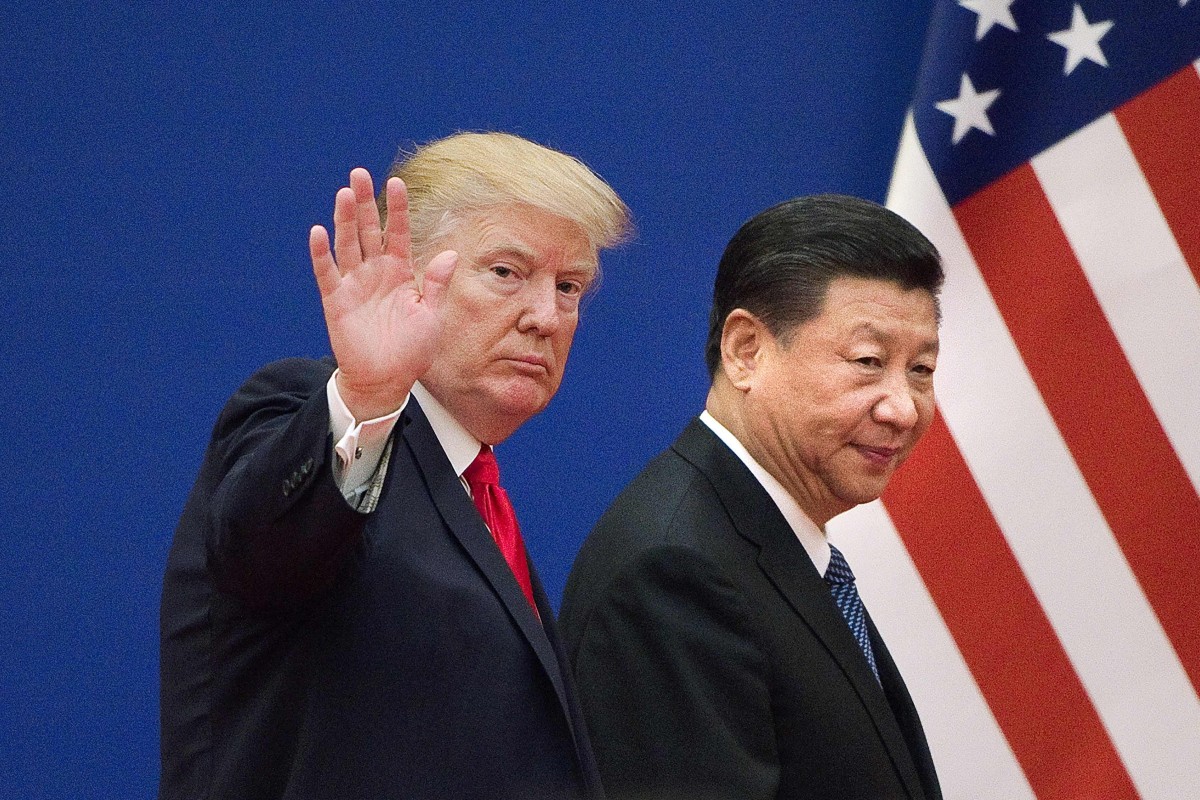
Talks between China and the US are going well, according to the Chinese foreign ministry. Photo: AFP
Presidents Xi Jinping and
Donald Trump have “maintained contact”, China’s foreign ministry said on Thursday after authorities in Chile announced the cancellation of the upcoming
Apec summit at which the US and Chinese leaders were set to meet and possibly sign a trade deal.
Talks between the two nations were going well, ministry spokesman Geng Shuang told a daily press briefing.
“The negotiations are smooth and things are working out as planned,” he said.
“Regarding the meeting between the two state leaders, they have maintained contact through various means.”
Geng’s comments came after China’s commerce ministry said that top trade negotiators from the two countries would hold a telephone conversation on Friday.
Xi and Trump were due to meet on the sidelines of the Asia-Pacific Economic Cooperation summit in Santiago on November 16-17, but the event was cancelled due to the ongoing protests in the country. The leaders were also expected to sign an interim trade deal based on the ground made at the latest negotiations in Washington on October 11.
According to diplomatic observers, while Beijing wants a truce in the trade dispute it is in less of a hurry than Trump, who is facing the threat of impeachment and trying to prepare for an election campaign.
Shen Dingli, an expert in international relations based in Shanghai, said that China faced less domestic opposition to its handling of the trade talks than Washington.
“Trump is facing a lot of problems on both the diplomatic and domestic fronts,” he said. “[But] I think both sides still need an agreement. It is always better to have an agreement than not.”
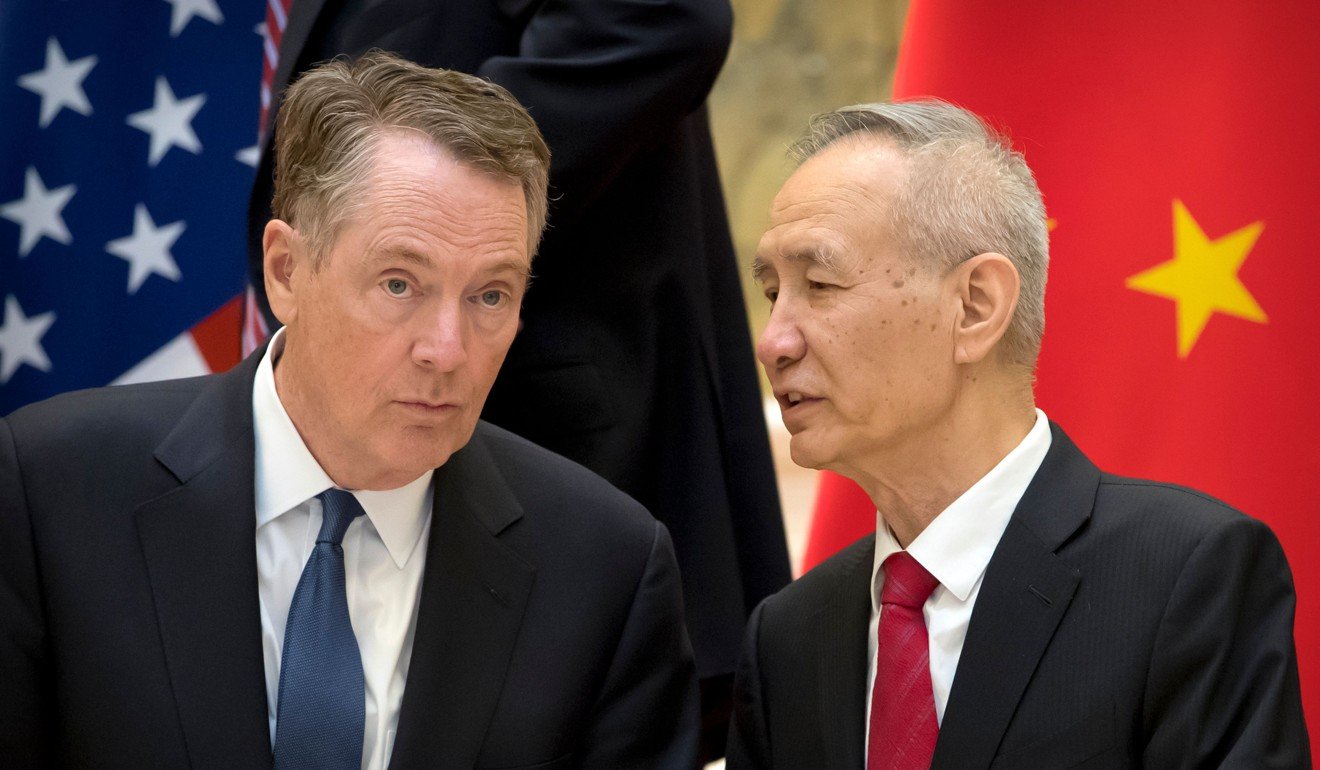
US Trade Representative Robert Lighthizer (left) and Chinese Vice-Premier Liu He met in Washington early this month. Photo: AFP
Yuan Zheng, an expert on China-US relations at the Chinese Academy of Social Sciences, said that while the Apec summit had offered a convenient way for the presidents to meet, the substance of the deal was more important than where it might be signed.
“It’s true that the deal can be signed by representatives instead of the presidents but this depends very much on how keen Trump is for the presidential meeting to happen,” he said.
“He is facing an election and huge domestic pressure, so he … needs to show his strong leadership more than Xi. But of course, if the deal is set and if the details of the meeting are practical, the Chinese side would like a presidential meeting too.”
Shen Dingli, an expert in international relations, says China faces less domestic opposition to its handling of the trade talks than Washington. Photo: AP
Speaking after the talks in Washington between
Chinese Vice-Premier Liu He, US Trade Representative Robert Lighthizer and US Treasury Secretary Steven Mnuchin, Trump said the two sides had reached a “substantial phase one deal” and that after it had been put down on paper it would be signed at the Apec meeting.
Tai Hui, chief market strategist for Asia at JPMorgan Asset Management, said the cancellation of the Chile summit should not stop the US and China agreeing a truce.
“If the two sides are genuinely willing to reach an interim deal before mid-December, when the next increase in tariffs on Chinese goods is due to take place, they will find a venue to get it done,” he said.
Source: SCMP
Posted in Apec summit, Asia-Pacific Economic Cooperation, Asia-Pacific Economic Cooperation (APEC), Beijing, Chile, Chinese Academy of Social Sciences, Chinese Academy of Social Sciences (CASS), Chinese goods, Chinese Vice-Premier Liu He, in contact, JPMorgan Asset Management, President Donald Trump, President Xi Jinping, Robert Lighthizer, Shanghai, tariffs, trade deal, Uncategorized, Washington |
Leave a Comment »
19/10/2019
WASHINGTON (Reuters) – U.S. President Donald Trump on Friday said he thinks a trade deal between the United States and China will be signed by the time the Asia-Pacific Economic Cooperation meetings take place in Chile on Nov. 16 and 17.
Chinese Vice Premier Liu He will provide Beijing’s perspective on the progress of the talks in a speech on Saturday, according to a tweet from editor-in-chief of the Global Times, a tabloid published by the People’s Daily of China’s ruling Communist Party.
“I think it will get signed quite easily, hopefully by the summit in Chile, where President Xi and I will both be,” Trump told reporters at the White House, without providing details.
“We’re working with China very well,” Trump also said.
The White House has announced that China agreed to buy up to $50 billion of U.S. farm products annually, as part of the first phase of a trade deal, although China seems slow to follow through.
The so-called phase 1 deal was unveiled at the White House last week during a visit by vice premier He as part of a bid to end a tit-for-tat trade war between Beijing and Washington that has roiled markets and hammered global growth. U.S. officials said a second phase of negotiations could address thornier issues like forced technology transfer and non-financial services issues.
Source: Reuters
Posted in Asia-Pacific Economic Cooperation, Asia-Pacific Economic Cooperation (APEC), Beijing’s, Chile, Chinese Vice Premier Liu He, Global Times, hopes, People’s Daily, perspective, phase 1 deal, President Trump, President Xi Jinping, ruling communist party, signed, U.S. farm products, U.S.-China trade deal, Uncategorized, Washington, White House |
Leave a Comment »
17/10/2019
BEIJING (Reuters) – China’s commerce ministry said on Thursday that China hoped to reach a phased agreement with the United States over trade as early as possible, and make progress on canceling tariffs on each others’ goods.
A phased agreement would help restore market confidence and reduce uncertainty, Gao Feng, spokesman at the ministry, told reporters, adding that both sides were maintaining close communication.
On Oct. 11, U.S. President Donald Trump outlined the first phase of a deal to end the trade war with China and suspended a threatened tariff hike, but officials on both sides said much more work needed to be done before an accord could be agreed.
Trump had originally planned to proceed with a hike in tariffs to 30% from 25% on about $250 billion worth of Chinese goods last week. But the U.S. administration has yet to make a decision on how to address planned 10% tariffs on roughly $156 billion of Chinese goods due to take effect on Dec. 15.
U.S. and Chinese trade negotiators are working on nailing down a Phase 1 trade deal text for their presidents to sign next month, U.S. Treasury Secretary Steven Mnuchin said on Wednesday.
Mnuchin said the Trump administration’s “objective” was for the agreement to be signed between the presidents of the two countries at a Nov. 16-17 summit of Asia-Pacific Economic Cooperation countries in Santiago, Chile.
Working-level representatives from both countries are working on specifics of an agreement now, Gao said.
In recent days, there have been positive signs from China.
China’s securities regulator on Friday unveiled a firm timetable for scrapping foreign ownership limits in futures, securities and mutual fund companies for the first time.
Increasing foreign access to the sector is among the U.S. demands at the trade talks.
A day before, the U.S. Department of Agriculture confirmed net sales of 142,172 tonnes of U.S. pork to China in the week ended Oct. 3, the largest weekly sale to the world’s top pork market on record.
Trump said China had agreed to make purchases of $40 billion to $50 billion in U.S. agricultural goods. Mnuchin said the purchases would be scaled up to that amount annually.
On Wednesday, Chinese Premier Li Keqiang said China will remove business restrictions on foreign banks, brokerages and fund management firms, without giving details.
Source: Reuters
Posted in Asia-Pacific Economic Cooperation, canceling tariffs, Chile, China’s commerce ministry, Chinese premier Li Keqiang, phased agreement, Santiago, Steven Mnuchin, Trade, trade war, U.S. agricultural goods, U.S. pork, U.S. President Donald Trump, U.S. Treasury Secretary Steven Mnuchin, Uncategorized, United States |
Leave a Comment »



 CHINDIA ALERT: You'll be living in their world, very soon