06/07/2019
- Ambassador Vikram Misri has called on China to balance its US$60 billion trade deficit with India ‘before the issue becomes politically sensitive’
- He also says India will not take sides over its use of US-blacklisted Huawei, as ‘any decision taken over this will only be taken in our national interest’
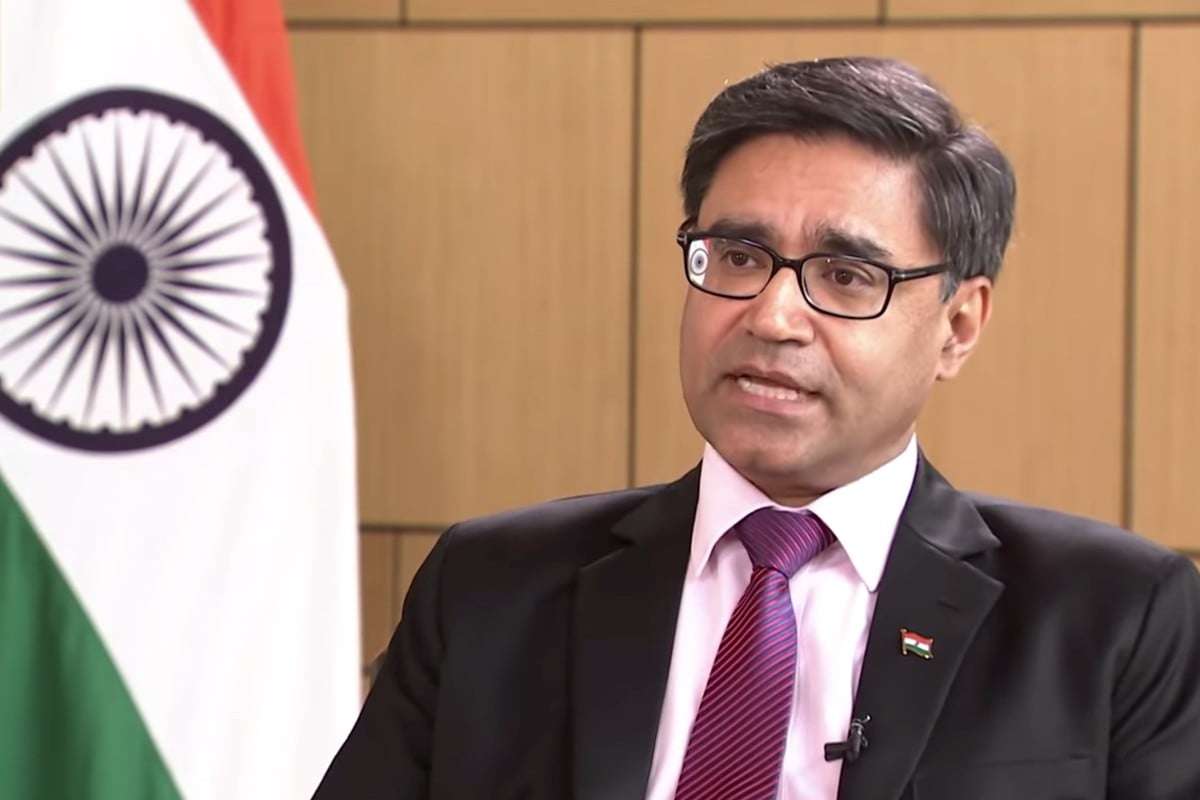
Indian ambassador to China Vikram Misri says that while the countries’ differences will not derail ties, there are still thorny issues to grapple with. Photo: CGTN
so they do not get in the way of the Asian superpowers working together for global stability, India’s top diplomat in China said on Friday.
To emphasise his point, Ambassador Vikram Misri listed eight long-standing and new bilateral issues that required attention, including
’s almost US$60 billion trade deficit with China, cooperation on counterterrorism and a
.
“This trade imbalance is not economically sustainable in the long run,” said Misri at an Asia Society event in Hong Kong. “It is in our mutual interest to find workable solutions before the markets react in unpredictable ways and the issue becomes politically sensitive.”
Frosty ties between two of the world’s largest economies have thawed in the past year following a 73-day
in 2017, with Beijing seeking to forge closer ties with New Delhi amid its ongoing trade and tech war with the United States.
Ivanka Trump, the unlikely messenger of India-US relations
In May, Beijing dropped its long-held objections towards United Nations sanctions on
, the founder and leader of terrorist group Jaish-e-Mohammed, which was behind the suicide bombing of Indian soldiers that brought India and Pakistan to the brink of war earlier this year.
Analysts said this would pave the way for a better relationship between India and China.
Misri said both countries enjoyed a “full-spectrum relationship” of economic, commercial and people-to-people ties, and this was reinforced by the “strong personal bond” Indian Prime Minister
and Chinese President
had, despite the “elements of competition”.
The leaders of the two nations met four times last year and twice in 2019, with Xi set to visit India later this year. Both men share an understanding that “our rise can be mutually reinforcing” and a mutual interest in “preventing differences from turning into disputes”, the ambassador added.
But while Misri, a career diplomat posted to Beijing at the start of this year, stressed that differences would not derail ties, he made no bones about the thorny issues both sides are grappling with.
Will Modi’s snub of Xi’s belt and road derail China-India ties?
Both nations are still engaged in the second of a three-stage process to settle their border dispute – the world’s largest in terms of area, he said.
The first stage was an agreement on the political parameters for a boundary settlement in 2005. The current stage involves agreeing on a framework for a boundary settlement, which Misri said would be translated “into a delineated and demarcated boundary” in the final stage.
Communication over water and shared rivers has also been a key area of cooperation for the two nations.
Indian ambassador to China Vikram Misri speaking at the Asia Society in Hong Kong. Photo: Asia Society
They have established channels for information sharing on cross-frontier rivers, which last year enabled the Chinese side to warn the relevant Indian authorities of a landslide which would send a large amount of water to India. While in this instance the two sides were able to avert a loss of life, they can do more to broaden cooperation, Misri said.
He alluded to how China and India are vying for influence in the Indian Ocean, saying it was an area where both had “contiguous zones of maritime interest”.
The two sides need to work together to preserve peace and stability in the Indo-Pacific region – which stretches from the Indian Ocean to the central Pacific Ocean – and ensure transparent economic and commercial cooperation, infrastructure and connectivity, he said.
As China, India and Russia draw close, has Trump overplayed his hand?
Misri, who served as the private secretary to Modi as well as former prime ministers Manmohan Singh and I.K. Gujral, said there were three areas of mutual interest for India and China.
Besides a “peaceful periphery”, they should cooperate to ensure there are open international systems regarding trade and technology, and that global governance is reformed so the voices of nations such as theirs can be heard.
The Russia-India-China trilateral meeting on the sidelines of last month’s
summit in Osaka, where leaders discussed issues ranging from energy security to climate change, was an opportunity to discuss alternative viewpoints on changing international issues.
This was crucial amid the economic instability caused by
, that were causing “generalised damage” to the global economy, Misri said.
In the question and answer session with the event’s 112 attendees, Misri was asked if India was feeling the pressure to choose in the face of US efforts to get its allies to reconsider using or ban Chinese tech firm
from their superfast 5G networks.
Washington says Huawei equipment could be used by Beijing for spying and the US Commerce Department has placed the company on its entity list, effectively banning US companies from selling equipment and components to it.
When US President
and Xi met at the G20 summit, Trump announced American companies could resume sales to Huawei as long as the products involved did not threaten national security.
Misri referred to this, and said: “Let’s see how it shapes up.”
He added the issue was far from decided for India as it had only achieved 4G connectivity recently and was not yet ready to build out its
Still, he said, “there’s no question on taking sides over this”. “Our leadership is very clear that any decision taken over this will only be taken in our national interest.”
Source: SCMP
Posted in 5G infrastructure, Ambassador Vikram Misri, Asia Society, Beijing, China alert, cross-frontier rivers, differences, disputes, Huawei, India alert, Indian Prime Minister Narendra Modi, manmohan singh, New Delhi, Osaka, President Xi Jinping, Russia, Russia-India-China trilateral meeting, Uncategorized, us commerce department, US President Donald Trump |
Leave a Comment »
05/07/2019
- Documentary looks at the fantasy photo shoots of couples, including some who married decades ago when only drab clothing was allowed
- It looks beyond the colourful clothes to consider issues of freedom, status, money and the new ‘China dream’
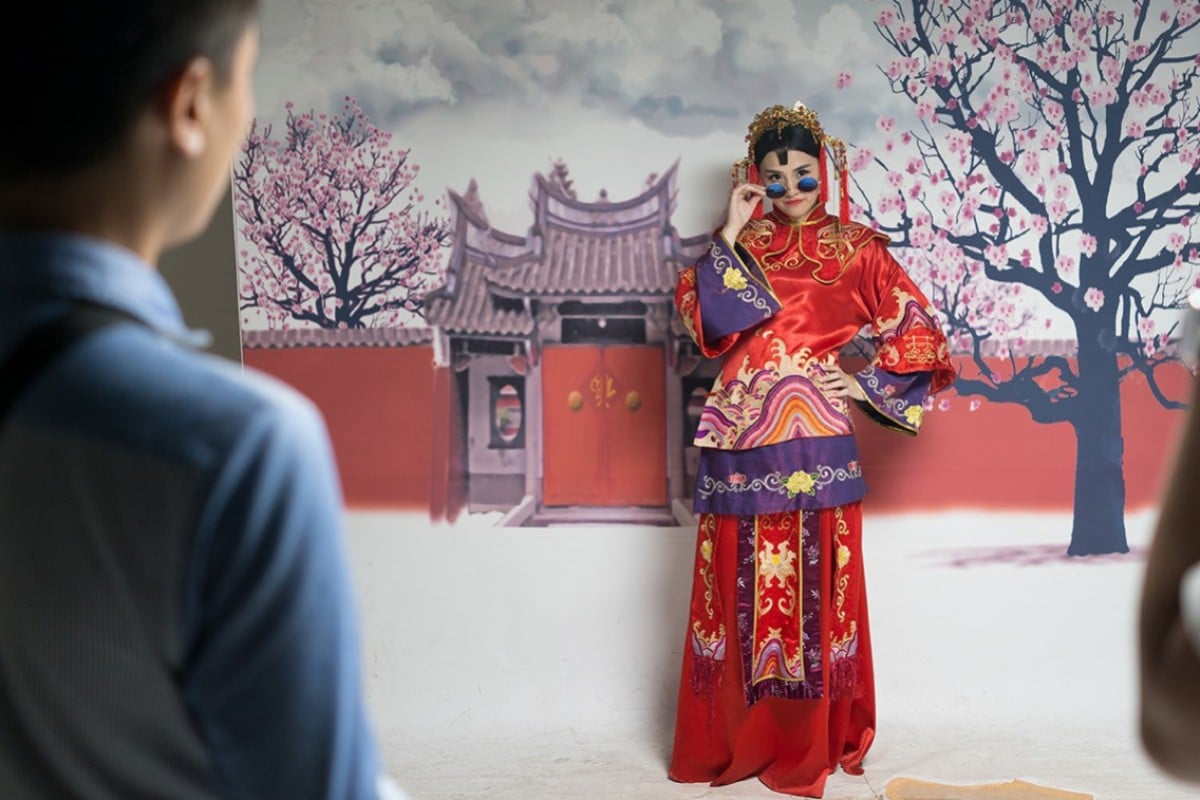
A still from China Love, a documentary by Olivia Martin-McGuire.
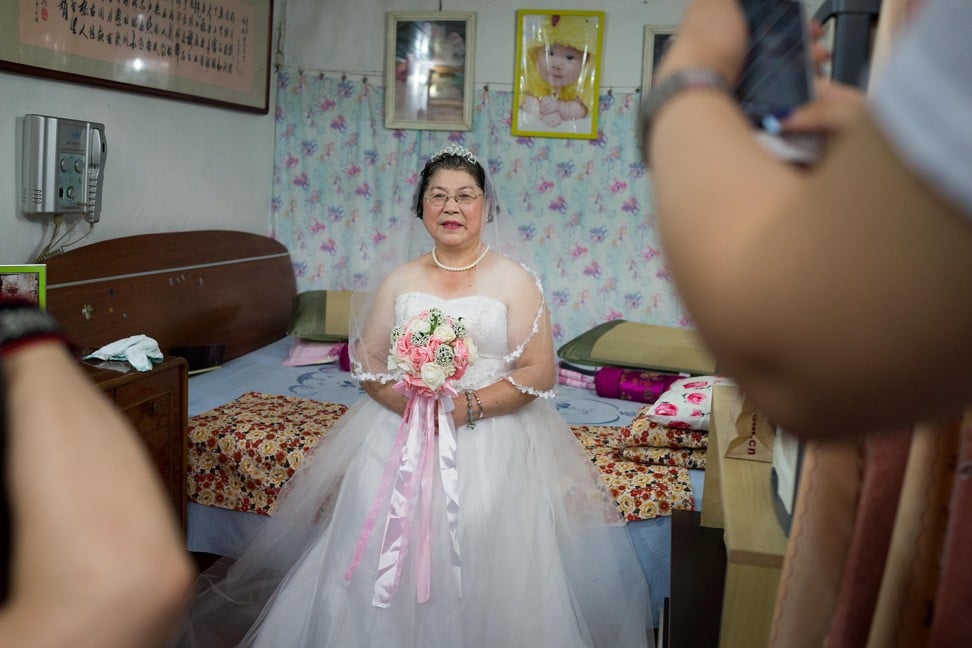
Pei-Pei and Xuezhong live in Shanghai’s French Concession. They married in 1968 and, as was typical for the time, have just one small black-and-white wedding photo.
“Pre-wedding photography could never have happened in 1968 because of the Cultural Revolution,” says Xuezhong, referring to the upheaval that took place under Mao Zedong, from 1966 to 1976. “Colourful clothing was not allowed. We had no choice.”
They did choose, however, to create new memories by having the wedding photos of their dreams taken decades later in a modern setting.
Their story is one of five featured in the documentary
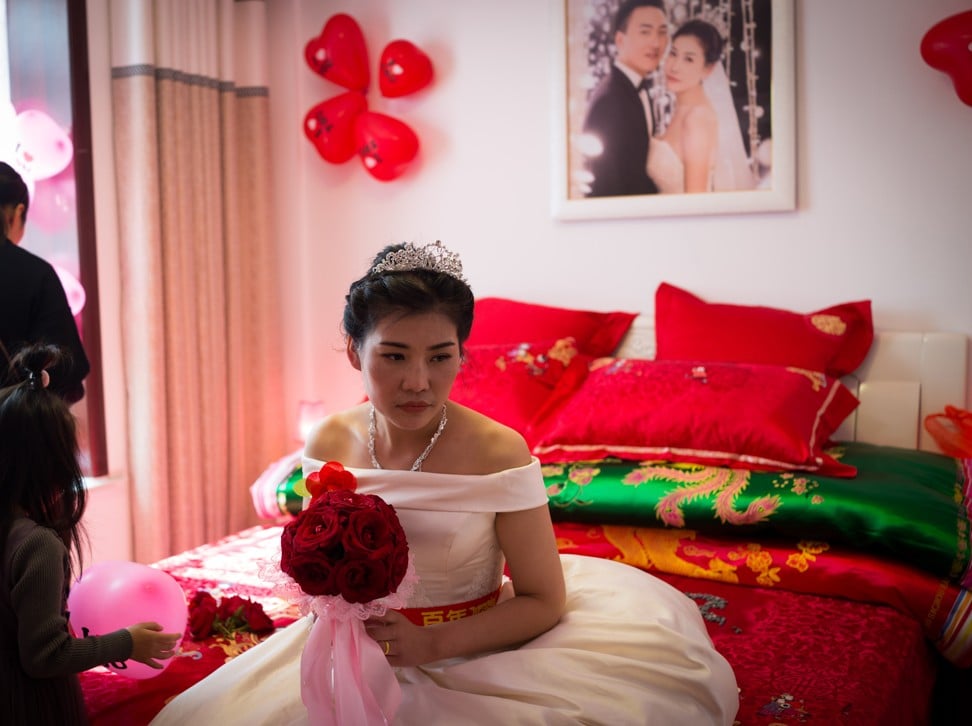
, which explores relationships in contemporary China through the lens of the booming pre-wedding photo industry. It follows couples as they navigate love and family in the lead-up to the most important ritual in Chinese society: marriage.
The documentary debuts in Hong Kong this week, with a special screening on Thursday at the Asia Society, in Admiralty. Attending the screening will be the film’s Australian director, Olivia Martin-McGuire, who spent four years in Shanghai, where a series of photographs taken on the city’s streets developed into a fascination with matters of the heart.
“It started when I saw all these couples in amazingly colourful costumes – some hitching up their dresses to reveal trainers – having [pre-wedding] photos taken near The Bund,” she says.
But Martin-McGuire says the film is more than a commentary on the pre-wedding photography business. It delves into issues of freedom, status, money and the new “China dream”.
“Just over 40 years ago, marriage in China was arranged by the state. Romantic love was seen as a capitalist concept,” she says.
China Love director Olivia Martin-McGuire. Photo: Gráinne Quinlan
Fast forward a generation and the picture couldn’t be more different, with China’s wedding industry today worth a staggering US$80 billion, according to Martin-McGuire.
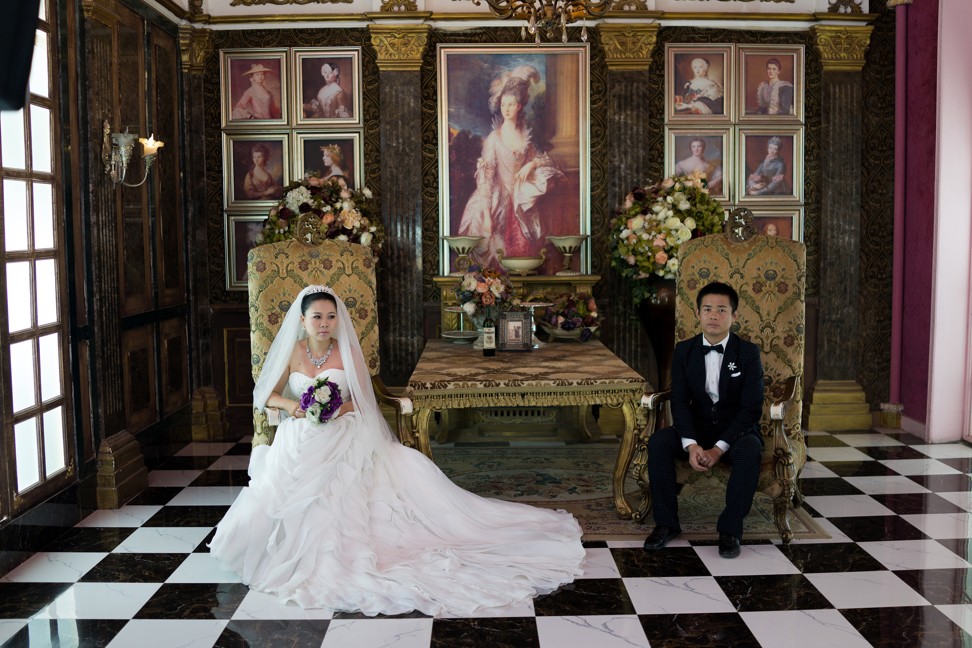
A big part of that goes on the pre-wedding photos, with some couples spending up to US$500,000 for shoots in exotic locations.
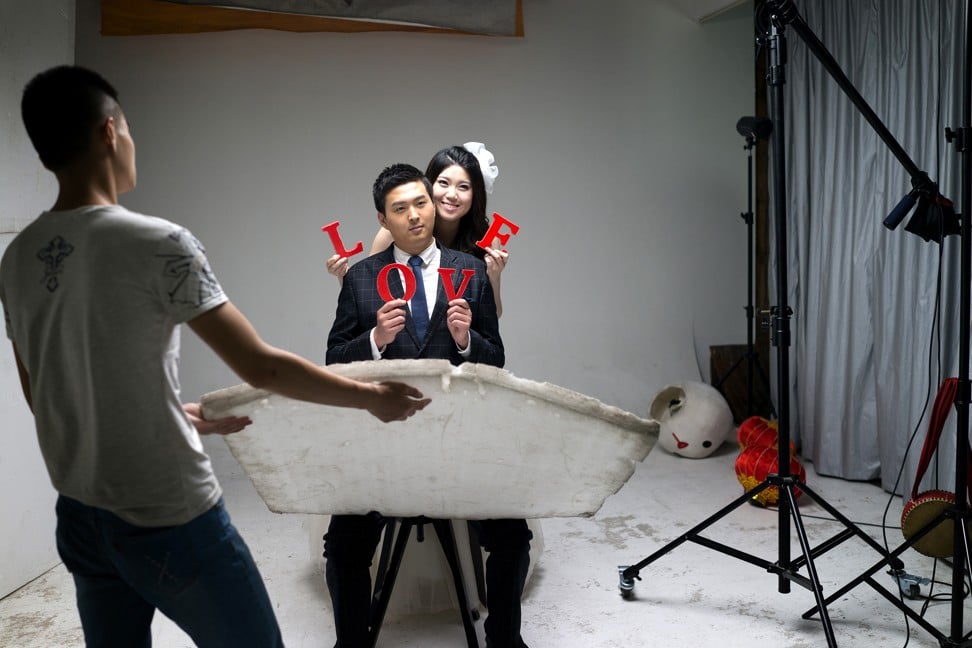
Shoots usually involve several costume and backdrop changes, and can see couples transform into characters from a fantasy. Take Jenny Cheng, born in Urumqi, capital of the Xinjiang Uygur autonomous region, and Australian-born David Shaw. The couple, who are featured in the film and will attend the screening in Hong Kong, had their wedding photos taken under water.
“I wanted the film to feel youthful, fun, and represent the sense of possibility that is infectious in China,” says Martin-McGuire.
China Love will be screened on Thursday, at 6.30pm, at the Asia Society, 9 Justice Drive, Admiralty, followed by a panel discussion. Visit
for details. Photos from the documentary will be featured in the “
” exhibition at the Shanghai Centre of Photography, 2551-1, 1 Longteng Avenue, Shanghai, until August 9.
Stills from China Love
Pei-Pei all set for her shoot.
A couple at the Only Photo Studio, outside Shanghai.
A couple in Shanghai’s Thames Town, which is modelled on London.
Pre-wedding shoots can be exhausting.
A couple at the Only Photo Studio outside Shanghai.
Source: SCMP
Posted in Admiralty, Asia Society, Ürümqi, China Love film, country’s billion-dollar, French Concession, Hong Kong, London, Only Photo Studio, outside Shanghai., pre-wedding photo industry, Shanghai, Shanghai Centre of Photography, Thames Town, The Bund, Uncategorized, Xinjiang Uygur Autonomous Region |
Leave a Comment »






 CHINDIA ALERT: You'll be living in their world, very soon