Archive for ‘aviation market’

29/04/2020

Cathay Pacific looks to increase passenger flights in late June if coronavirus travel restrictions are eased

  • Carrier targets return of daily services to major Asian cities and more frequent long-haul services
  • Airline to monitor global situation and adjustments may be made ‘as necessary’
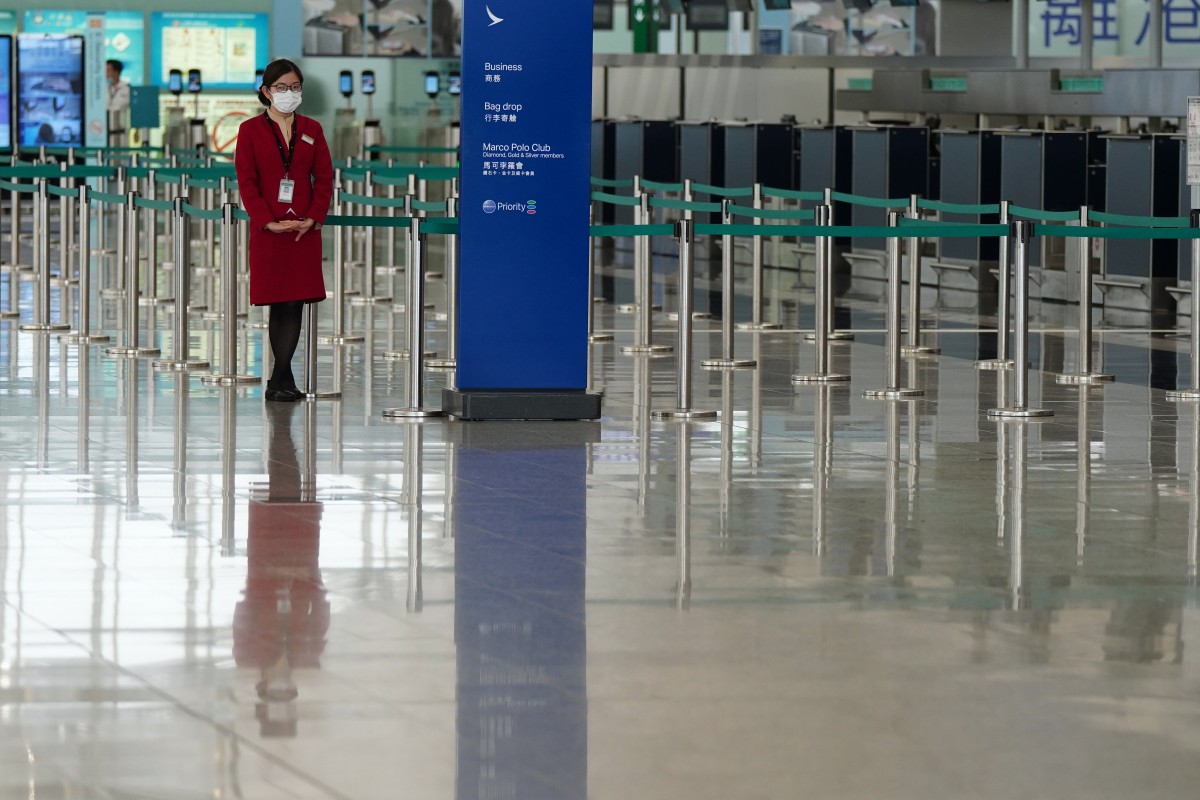
A Cathay Pacific employee stands near the check-in desks at a virtually deserted Hong Kong International Airport. Photo: Sam Tsang
Cathay Pacific Airways has signalled its intent to start reversing its near-total grounding of aircraft because of the coronavirus pandemic, and plans to start increasing its number of passenger flights in the last week of June.
The airline said it hoped to add more long-haul destinations, make flights more frequent, and reinstate some major Asian cities to its daily schedule for the first time in several months, “subject to government travel restrictions”.
Cathay scaled its operations back to a skeleton schedule of 3 per cent of services in early April, and that was extended until June 20. The newly announced increases would take that up to 5 per cent.
The global airline industry has been rocked by the pandemic, which triggered a collapse in air travel demand amid severe travel restrictions and tough quarantine measures.
Tracking the massive impact of the Covid-19 pandemic on the world’s airline industry in early 2020 Singapore Airlines, another of Asia’s major carriers, said last week it would maintain a 96 per cent reduction in flights until the end of June.
Cathay, which has 236 aircraft, currently operates long-haul flights to London Heathrow, Los Angeles, Vancouver and Sydney twice a week, but will increase that to five times a week.

On top of that, Amsterdam, Frankfurt, San Francisco and Melbourne are among the long-haul destinations set to return three times a week.

With regional routes currently operating three times a week, including Tokyo Narita, Taipei, Beijing and Singapore, Asian routes will increase to a daily service. Osaka and Seoul would also return to the network, too.

“We will continue to monitor the developing situation and further adjustments may be made as necessary,” the airline said.

Coronavirus: ban on non-residents leaves Hong Kong airport virtually deserted
Earlier this month, Cathay’s budget unit HK Express extended its total grounding until June 18, having been on hiatus since March 23.

Meanwhile, Boeing has added to warnings of a very slow recovery in air travel, with Dave Calhoun, its CEO, saying demand may not return to 2019 levels for two to three years.

Cathay Pacific’s daily passenger volume has collapsed from regular previous peaks of 100,000 to less than 1,000 in April. Over the past two months, the company has been running more than 250 extra pairs of cargo-only passenger flights to maintain air freight capacity, much of which is accounted for by passenger services.

In a bid to cut costs, most of the Cathay Pacific Group’s 34,200 staff have taken three weeks of unpaid leave. Also, 433 cabin crew in the US and Canada were told they would be laid off, while about 200 pilots in the UK, Australia have been furloughed.

The International Air Transport Association, which revised down pandemic-related revenue losses for the global sector to US$314 billion (HK$2.4 trillion) two weeks ago, said last week the Hong Kong aviation market would take a US$7.5 billion hit this year, a 27 per cent increase on the previous estimate. That equates to a 59 per cent decline in air travel demand, or a loss of almost 31 million passengers, in 2020.

BOCOM International, a financial services company, forecast in a report on Monday that the city’s aviation sector would lose HK$65.2 billion in revenue in 2020, yet Cathay Pacific could emerge as a winner if it survived largely unscathed, given the weakness of rivals at home and in the region plus its dominant position in Hong Kong.

“Hong Kong aviation is at the most critical juncture in its history. Though calamitous, Covid-19 is set to reshape Hong Kong’s aviation industry for the years, possibly decades, to come,” said transportation analyst Luya You.

“Covid-19’s sweeping blows now offer a blank slate for remaining players to regain lost leadership or gain new markets. If [Cathay Pacific] can survive intact from Covid, the carrier could enjoy winner-takes-all growth trajectory in the years following [2020].”

Source: SCMP

28/10/2019

Economic Watch: China’s international aviation market set to take off

BEIJING, Oct. 27 (Xinhua) — Beijing Daxing International Airport, a new aviation hub in the Chinese capital, started international flight operation Sunday, joining the country’s expanding airport network to serve outbound and inbound travelers.

During winter and spring, a total of 570,000 passenger trips are expected to be made via 15 overseas flight routes at the airport, which boasts fast customs clearance services thanks to smart technologies.

Airports across China are seeing flights to and from a growing number of overseas destinations, as domestic and international airlines race to tap the booming international aviation market.

China’s international aviation market is small compared with some countries, but enjoys fast growth and huge potential, said Zhao Wei, a professor with the Civil Aviation Management Institute of China, at the 2019 China Aviation and Tourism Forum.

The steady expansion of the outbound tourism market and the large number of individuals who are yet to enjoy air travel will drive the sector’s rise, Zhao said.

China is the world’s largest outbound tourism market. About 81.29 million overseas trips were made during the first half of this year, up 14 percent year on year. The total for the whole year might grow 12 percent year on year to reach about 168 million trips, the China Tourism Academy predicted.

The country’s airports saw 126 million cross-border passenger trips made in 2018, up 13 percent over 2017. The McKinsey Global Institute foresaw threefold growth in the number of people in China able to afford airline travel in the next 10 years, with the upper strata of China’s fast-growing middle class poised to become the principal engine of air-travel spending.

With the outbound travel market booming, the number of overseas airlines and destinations entering the Chinese market continues to increase, observed Brenda He, managing director with tourism marketing and sales services provider Travel Link Group, which saw growing market demand from overseas airlines and tourism authorities.

To improve international air travelers’ experience, aviation services should be developed in coordination with tourism development and destinations promotion, He said.

Li Xiaoping, senior vice president with China’s largest online travel agency Ctrip, said airports need to upgrade their infrastructure and services to improve travelers’ experience by meeting their diversifying consumption and entertainment demands.

Future airports will become social-networking and cultural venues, Li said. “An airport can become a sightseeing spot in its own right.”

Source: Xinhua

Law of Unintended Consequences

continuously updated blog about China & India

ChiaHou's Book Reviews

continuously updated blog about China & India

What's wrong with the world; and its economy

continuously updated blog about China & India