Chindia Alert: You’ll be Living in their World Very Soon
aims to alert you to the threats and opportunities that China and India present. China and India require serious attention; case of ‘hidden dragon and crouching tiger’.
Without this attention, governments, businesses and, indeed, individuals may find themselves at a great disadvantage sooner rather than later.
The POSTs (front webpages) are mainly 'cuttings' from reliable sources, updated continuously.
The PAGEs (see Tabs, above) attempt to make the information more meaningful by putting some structure to the information we have researched and assembled since 2006.
Calgary Zoo to ship pair back home after pandemic upends delivery of essential fresh produce
Er Shun and Da Mao refuse to eat some of the centre’s locally sourced supplies
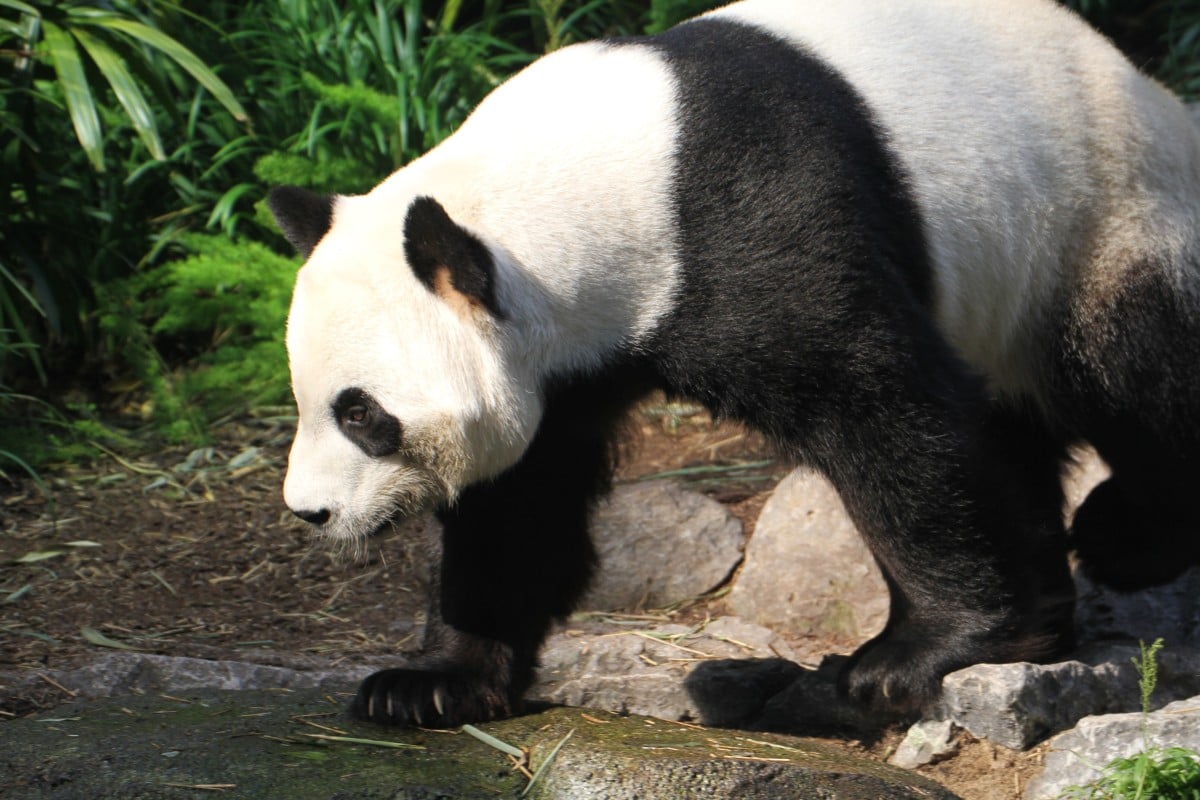
The Calgary Zoo cannot guarantee supplies of fresh bamboo for its giant pandas.Photo: Calgary Zoo
A Canadian zoo has decided to send two adult giant pandas back to China because the
coronavirus pandemic has disrupted essential deliveries of fresh bamboo.
The Calgary Zoo said it previously had bamboo flown in from China directly, but was forced to switch to domestic supplies after flights were cancelled.
The pandas had refused to eat some of the local product, which had been degraded by longer delivery times, and the supplies could be disrupted without warning, the zoo said.
“Knowing a second wave of Covid-19 is likely, and the bamboo supply chain challenges will continue to negatively impact the zoo’s ability to bring bamboo to the giant pandas, the Calgary Zoo feels it’s critical to move the beloved giant pandas back to China where there are abundant local sources of bamboo as soon as possible,” the zoo said on Tuesday.
Giant pandas in Hong Kong mate naturally for the first time in a decade
Giant pandas feed almost exclusively on fresh bamboo and each adult chews through about 40kg (88 pounds) of the plant every day.
“We believe the best and safest place for Er Shun and Da Mao to be during these challenging and unprecedented times is where bamboo is abundant and easy to access,” Calgary Zoo president and chief executive Clément Lanthier said, referring to the two pandas. “This was an incredibly difficult decision to make but the health and well-being of the animals we love and care for always comes first.”
Er Shun and Da Mao arrived in Canada in 2014 as part of a 10-year agreement between Canada and China. They spent five years at the Toronto Zoo and arrived in Calgary in March 2018 with their cubs, Jia Panpan and Jia Yueyue.
It is unclear whether the cubs will be sent to China as well.
The zoo said the pandas would be deeply missed by staff, volunteers, donors and visitors from around the world. Although in-person farewells were not possible during the zoo’s temporary closure, the public could see the pandas online through PandaCam, it said.
In all, 58 giant pandas in 17 countries are on loan from China, according to the Chengdu Research Base of Giant Panda Breeding in Sichuan province.
Finland is the most recent recipient, taking delivery of a pair in January 2018, while
Beijing’s Chaoyang district remains the last high-risk area in China, with virus preventive measures continuing to impact on travel and shopping plans
China faces the dilemma of preventing a re-emerge of the pandemic, while also pushing to get its economy back to normal
China’s continued pandemic prevention measures, coupled with still hesitant consumer demand, will inevitably lead to persistent limitations on the nation’s economic recovery, analysts said. Photo: Bloomberg
After nearly three months of being quarantined by herself in Beijing, Mary Zhao was looking forward to the upcoming long weekend at the start of May to be able to finally reunite with her parents.
But Zhao was forced to abandon her plan for the Labour Day holidays as Beijing’s upmarket Chaoyang district, where she lives, remains the only high-risk zone for coronavirus in the entire country.
If she travelled the five hours by car, or two hours via bullet train, to the neighbouring Hebei province, she would first have to undergo a 14-day quarantine before seeing her parents. Her parents would also have the same two week quarantine to look forward to once they returned home if they came to visit their daughter in Beijing.
These strict controls to prevent a re-emergence of the coronavirus outbreak are making a return to normal life impossible for many, and mean the final economic and social cost
from China’s draconian preventive measures could be much larger than expected.
Wuhan declares ‘victory’ as central Chinese city’s last Covid-19 patients leave hospital
It underscores the dilemma facing China’s leaders on how to balance the need to
and to avoid a fresh outbreak. On the surface, China may be able to declare victory as even Wuhan, the city where the virus was first detected, announced that the last Covid-19 patient had left hospital on Sunday. But fears of a renewed outbreak have kept the country’s cinemas and most schools closed, with travel between provinces discouraged.
China’s national borders also remain largely closed, with flights being cut to a minimum, and a mandatory 14-day quarantine for every arrival. In the number of places where new cases have been reported, quarantine requirements have been tightened, including Harbin and a few other cities near the border with Russia.
Chaoyang, the home to one of Beijing’s main business districts and most foreign embassies, changed its risk rating to high from low in the middle of April after three new cases were reported, dealing a fresh blow to the district’s
and forcing many of the 3.5 million residents to cancel their travel plans.
On the outskirts of Beijing, near Beijing Capital International Airport, returning migrant workers to Picun village were ordered to stop at entrance and could only be escorted inside by their landlord, with many villages and residential compounds remaining closed to outsiders.
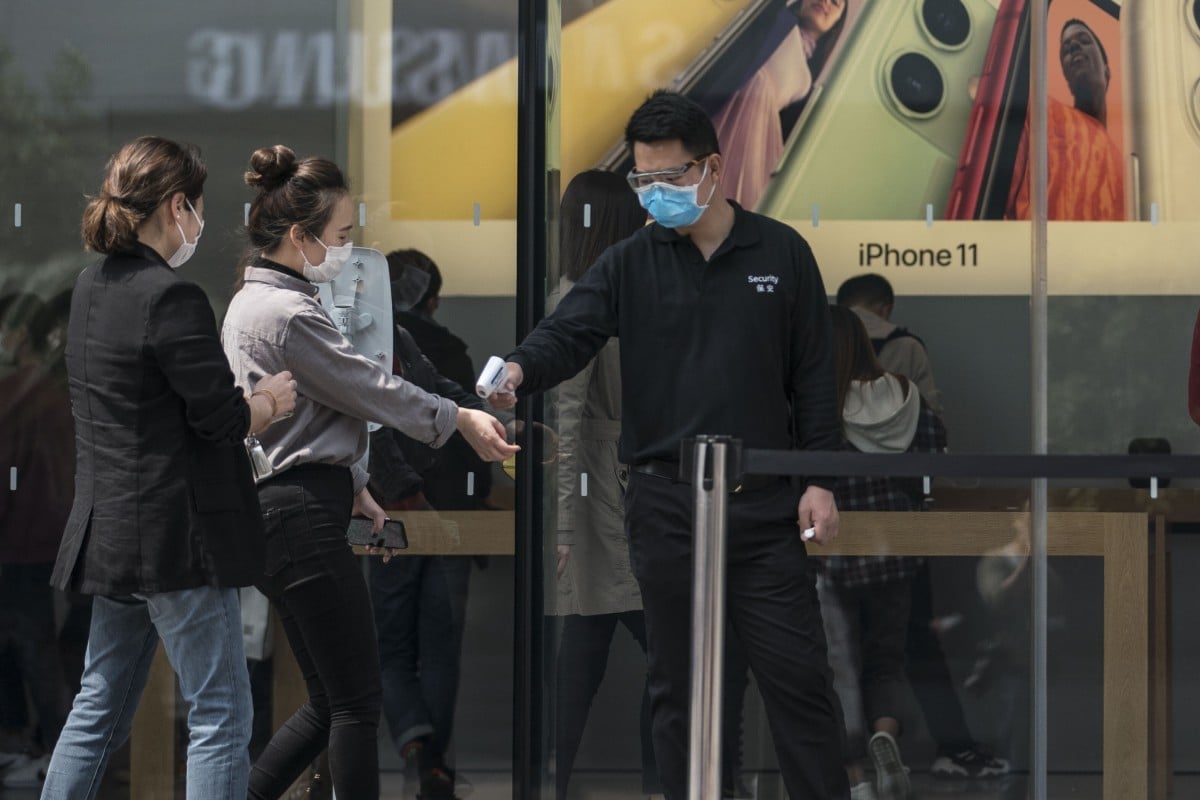
In the high-end shopping district of Guomao, some shops also remain closed as there are few potential customers, while over in the popular Sanlitun area, metal barriers restrict access and temperature checkpoints are still required.
The landmark Apple Store in the popular Taikoo shopping centre is open, but with limited customers allowed inside, there are long queues outside. Customers are required to scan a QR code to check their movements over the last few days before entering.
Coronavirus: More schools reopen in China for students preparing for university entrance exams
“Why do I have to spend 20 minutes just to get into the Apple Store? The sun has almost melted me down,” one visitor complained to the security guards at the front of the shop.
China’s continued pandemic prevention measures, coupled with still hesitant consumer demand, will inevitably lead to persistent limitations on the nation’s economic recovery, analysts said.
Ernai Cui, an economist at research firm Gavekal Dragonomics, said on Monday that China’s cautious approach to lifting restrictions “points to a weak second quarter for consumer services”, adding additional pressure to the economic recovery.Mao Zhenhua, a researcher at the China Institute of Economics at Renmin University, said China’s preventive measures will inevitably be a drag on production, employment and exports.



 CHINDIA ALERT: You'll be living in their world, very soon