Chindia Alert: You’ll be Living in their World Very Soon
aims to alert you to the threats and opportunities that China and India present. China and India require serious attention; case of ‘hidden dragon and crouching tiger’.
Without this attention, governments, businesses and, indeed, individuals may find themselves at a great disadvantage sooner rather than later.
The POSTs (front webpages) are mainly 'cuttings' from reliable sources, updated continuously.
The PAGEs (see Tabs, above) attempt to make the information more meaningful by putting some structure to the information we have researched and assembled since 2006.
Members of a Chinese surveying team reach the summit of Mt. Qomolangma on May 27, 2020. A Chinese surveying team reached the summit of Mount Qomolangma on Wednesday morning, a crucial step in the country’s mission to remeasure the height of the world’s highest peak. (Xinhua/Penpa)
MOUNT QOMOLANGMA BASE CAMP, May 27 (Xinhua) — A Chinese surveying team reached the summit of Mount Qomolangma on Wednesday morning to conduct a series of surveys on the pinnacle of the planet.
The event marked a crucial step in China’s mission to remeasure the height of the world’s highest peak, which scientists believe will enhance human knowledge of nature and help boost scientific development.
After summiting, team members began erecting a survey marker on the snow-covered peak, which measures less than 20 square meters.
The surveying team set off for the summit from an assault camp at an altitude of 8,300 meters at around 2:10 a.m. Wednesday.
Members of a road construction team depart from the advance camp at an altitude of 6,500 meters of Mount Qomolangma in southwest China’s Tibet Autonomous Region, May 10, 2020. A road construction team will work on a route to the peak of Mount Qomolangma on May 12 if weather conditions permit. China initiated a new round of measurement on the height of Mount Qomolangma, the world’s highest peak, on April 30. The measurement team consists of members from the Ministry of Natural Resources and the national mountaineering team. (Xinhua/Sun Fei)
MOUNT QOMOLANGMA BASE CAMP, May 10 (Xinhua) — A road construction team will work on a route to the peak of Mount Qomolangma on May 12 if weather conditions permit.
In order to complete missions of building a route to the peak and transporting materials to camps below 8,300 meters above sea level, members of road construction and transportation teams departed for a camp at an altitude of 7,028 meters from the advance camp at an altitude of 6,500 meters at 7:00 a.m. Sunday.
The members eliminated potential safety hazards along the route and arrived at the camp at 2:00 p.m.
On May 12, a total of 12 guides will depart from the camp at an altitude of 7,028 meters to transport materials to another camp.
China initiated a new round of measurement on the height of Mount Qomolangma, the world’s highest peak, on April 30. The measurement team consists of members from the Ministry of Natural Resources and the national mountaineering team.
Since the founding of the People’s Republic of China in 1949, Chinese surveyors have conducted six rounds of scaled measurement and scientific research on Mount Qomolangma and released the height of the peak twice in 1975 and 2005, which was 8,848.13 meters and 8,844.43 meters respectively.
Chinese surveyors hike toward a higher spot after setting out from a base camp at an altitude of 5,200 meters in southwest China’s Tibet Autonomous Region on May 7, 2020. The Chinese measurement team of over 30 surveyors Thursday arrived at a base camp at an altitude of 6,500 meters, as they endeavor to accomplish a mission to remeasure the height of the world’s highest mountain. (Photo by Lhagba/Xinhua)
MOUNT QOMOLANGMA BASE CAMP, May 7 (Xinhua) — A team of over 30 Chinese surveyors Thursday arrived at a base camp at an altitude of 6,500 meters, as they endeavor to accomplish a mission to remeasure the height of the world’s highest mountain.
The team arrived at the advance camp at around 5 p.m. safe and sound, after they set out from their base camp at an altitude of 5,200 meters, located in Tingri County of Tibet Autonomous Region in southwest China, on Wednesday.
The team will take a rest and continue to debug height measuring equipment at the base camp for at least one day before moving on.
They arrived at a transition camp at a height of 5,800 meters at around 6 p.m. Wednesday and spent the night there. They began climbing at around 11 a.m., passed nearby the East Rongbuk glacier and arrived at the advance camp after six hours’ walk.
The advance camp sits on a slope next to the end of the glacier, and is the last camp before the snow line and the ice and snow road. After about an hour’s walk up from the camp, the surveyor will arrive at the shoe-changing point, where climbers need to wear crampons to continue climbing on the icy road.
Known as the “devil camp,” many professional mountain guides who have reached the peak of Mount Qomolangma many times also suffer from altitude sickness here due to its geographical location surrounded by mountains and poor air circulation.
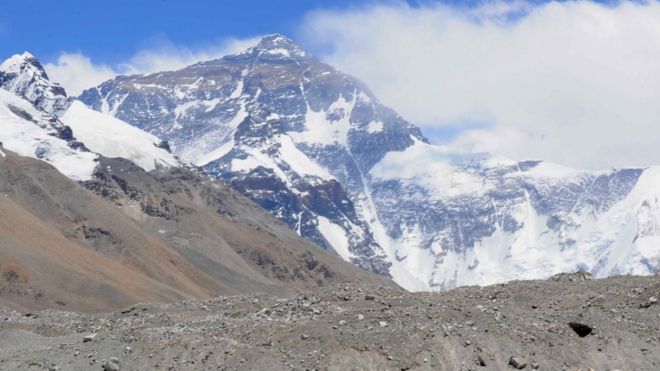
Image copyrightGETTY IMAGESImage captionMore and more people want to see the world’s tallest peak
China has closed the base camp on its side of Mount Everest to visitors who don’t have climbing permits.
Authorities have resorted to the unusual move to deal with the mounting waste problem at the site.
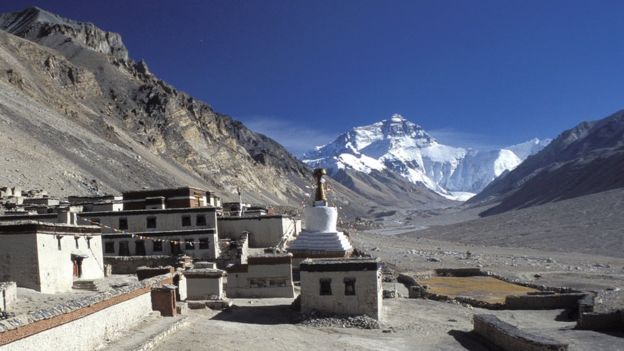
The ban means tourists can only go as far as a monastery slightly below the 5,200m (17,060ft) base camp level.
More people visit the mountain from the southern side in Nepal, but over the past years numbers have been rising steadily on the Chinese side as well.
The Chinese base camp, located in Tibet, is popular as it is accessible by car – whereas the Nepalese camp can only be reached by a hike of almost two weeks.
The world’s highest peak has been struggling with escalating levels of rubbish for years, as the number of visitors rises.
The Chinese Mountaineering Association says 40,000 visited its base camp in 2015, the most recent year with figures. A record 45,000 visited Nepal’s base camp in 2016-7 according to Nepal’s Ministry of Forests and Soil Conservation.
Image copyrightGETTY IMAGESImage captionTourists are still allowed to go as far as the Rongbuk monastery
Ordinary tourists will only be banned from areas above Rongbuk monastery, which is around 5,000m above sea level, according to China’s state news agency Xinhua.
Mountaineers who have a permit to climb the 8,848m peak will still be allowed to use the higher camp.
In January, authorities announced that they would limit the number of climbing permits each year to 300.
On Chinese social media, claims have spread in recent days that its base camp will be permanently closed to tourists – but Xinhua cited officials denying that.
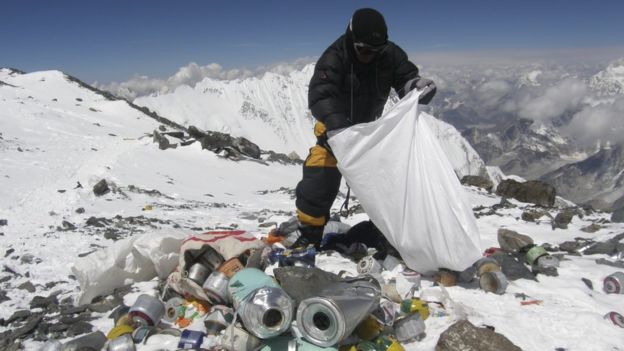
Image copyrightGETTY IMAGESImage captionThe temperature and high altitude make clean-up efforts on Everest a tough task
The official announcement about the closure was made in December, on the website of the Tibetan authorities.
It stated that three clean-up operations last spring had collected eight tonnes of waste, including human faeces and mountaineering equipment climbers had left behind.
This year’s clean-up efforts will also try to remove the bodies of mountaineers who have died in the so-called death zone above 8,000m, where the air is too thin to sustain life for long.
Due to the cold and high altitude, these bodies often remain on the mountain for years or even decades.



 CHINDIA ALERT: You'll be living in their world, very soon