Archive for ‘Basic Law’

22/05/2020

NPC: China begins move to impose controversial Hong Kong security law

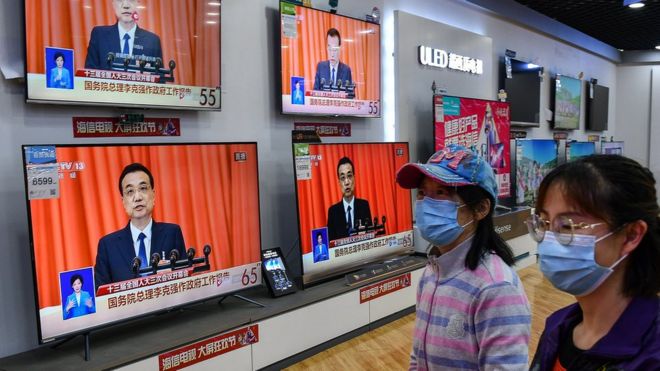
Shoppers walking past a broadcast of Chinese Premier Li Keqiang delivering his speech at the opening of the NPCImage copyright AFP / GETTY
Image caption Shoppers walking past a broadcast of Chinese Premier Li Keqiang delivering his speech at the opening of the NPC on Thursday

China’s ruling Communist Party has set in motion a controversial national security law for Hong Kong, a move seen as a major blow to the city’s freedoms.

The law to ban “treason, secession, sedition and subversion” could bypass Hong Kong’s lawmakers.

Critics say China is breaking its promise to allow Hong Kong freedoms not seen elsewhere in China.

It is likely to fuel public anger and may even trigger fresh protests and demands for democratic reform.

The plan was submitted at the annual National People’s Congress (NPC), which largely rubber-stamps decisions already taken by the Communist leadership, but is still the most important political event of the year.

Hong Kong, a semi-autonomous region and an economic powerhouse, was always meant to have introduced such laws after the handover from British control to Chinese rule in 1997.

After last year’s wave of sustained and violent protest, Beijing is now attempting to push them through, arguing “law-based and forceful measures” must be taken to “prevent, stop and punish” such protests in the future.

On Friday, Hong Kong’s government said it would co-operate with Beijing to enact the law, adding it would not affect the city’s freedoms.

What is in Beijing’s proposed law?

The “draft decision” – as it is known before approval by the NPC – was explained by Wang Chen, vice chairman of the Standing Committee of the NPC.

It consists of an introduction and seven articles. Article 4 may prove the most controversial.

That article says Hong Kong “must improve” national security, before adding: “When needed, relevant national security organs of the Central People’s Government will set up agencies in Hong Kong to fulfil relevant duties to safeguard national security in accordance with the law.”

China could essentially place this law into Annex III of the Basic Law, which covers national laws that must be implemented in Hong Kong – either by legislation, or decree.

Addressing the congress, Premier Li Keqiang spoke of the economic impact of the coronavirus and on Hong Kong and Macau said: “We’ll establish sound legal systems and enforcement mechanisms for safeguarding national security in the two Special Administrative Regions.”

What do opponents say the dangers are?

Hong Kong is what is known as a “special administrative region” of China.

It has observed a “one country, two systems” policy since Britain returned sovereignty in 1997, which has allowed it certain freedoms the rest of China does not have.

Pro-democracy activists fear that China pushing through the law could mean “the end of Hong Kong” – that is, the effective end of its autonomy and these freedoms.

Last year’s mass protests in Hong Kong were sparked by a bill that would have allowed extraditions to mainland China.
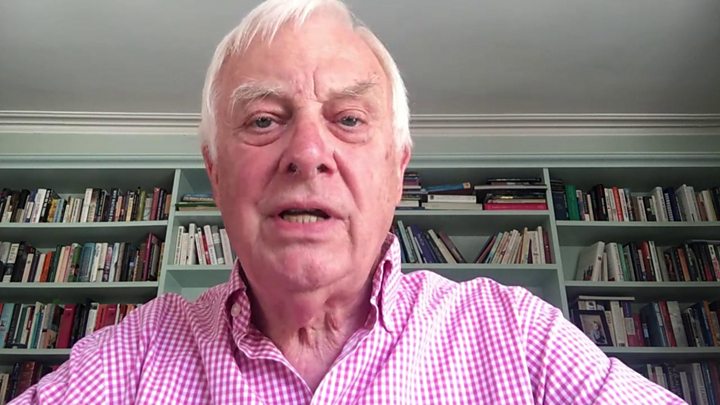
Media caption Former Hong Kong governor Chris Patten: “UK should tell China this is outrageous”

The bill was paused, then withdrawn – but the protests continued until the virus outbreak at the end of the year.

The US has also weighed in, with President Trump saying the US would react strongly if it went through – without giving details.

It is currently considering whether to extend Hong Kong’s preferential trading and investment privileges.

Why is China doing this?

Mr Wang said the security risks had become “increasingly notable” – a reference to last year’s protests.

“Considering Hong Kong’s situation at present, efforts must be made at the state-level to establish and improve the legal system and enforcement mechanisms,” he is quoted as saying in state media.
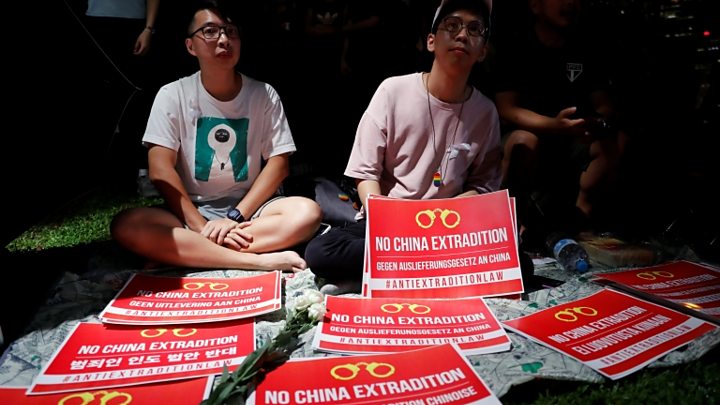
Media caption The BBC’s Helier Cheung on Hong Kong’s 2019 protests

Beijing may also fear September’s elections to Hong Kong’s legislature.

If last year’s success for pro-democracy parties in district elections is repeated, government bills could potentially be blocked.

What is Hong Kong’s legal situation?

Hong Kong was under British control for more than 150 years up to 1997.

The British and Chinese governments signed a treaty – the Sino-British Joint Declaration – that agreed Hong Kong would have “a high degree of autonomy, except in foreign and defence affairs”, for 50 years.

This was enshrined in the Basic Law, which runs out in 2047.

As a result, Hong Kong’s own legal system, borders, and rights – including freedom of assembly and free speech – are protected.

But Beijing has the ability to veto any changes to the political system and has, for example, ruled out direct election of the chief executive.
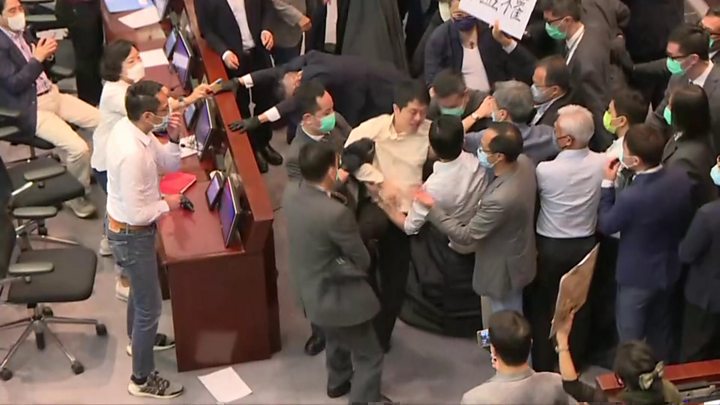
Media caption Uproar on Monday in Hong Kong’s legislature

Source: The BBC

11/11/2019

Police shooting exposes deep divide online between mainland China and Hong Kong

  • Mainland social media users come out in strong support for the officer, compounding extensive coverage of vandalism of businesses with ties across the border
Hong Kong’s police force has gained support from online commenters on the mainland. Photo: Nora Tam
As Monday morning’s police shooting of a protester triggered a wave of shock and outrage in Hong Kong, across the border in mainland China, the response online was just as swift – but in support of the force.
“Support Hong Kong police opening fire! Clean up Hong Kong’s cockroaches!” one popular financial blogger on Weibo, China’s Twitter-like platform, said as he shared footage of the incident.
In the video, an officer grapples with a protester and points his gun towards another approaching protester. The second protester reaches out towards the gun, the officer dodges, steps back and shoots him in the torso.

“It feels great [to watch]! Kill them all, these trash and tumours of society,” a Weibo user replied to the video, with a thumbs-up emoji.

“Hongkong’s loser youth, [police] should totally open fire!! It would be best to shoot them in the head,” another post read.
These comments, and many others like them flooding social media in mainland China, highlight the deep divisions in views on each side of the border as Hong Kong’s political crisis drags into its sixth month.

Despite some initial sympathy, mainland public sentiment towards Hong Kong has hardened since July, amid state propaganda painting the protesters as a separatist movement plotted by “Western black hands”.

In recent weeks, the rancour from the mainland has only appeared to deepen, with photos and videos of protesters vandalising businesses with ties to the mainland spreading online.

Last month, a mainland Chinese banker was assaulted in a confrontation with protesters during his lunch break in Central, drawing the wrath of many mainlanders and renewed online calls for military intervention.

Extensive media coverage of the vandalism and attack, as well as a series of inflammatory commentaries, have further fanned the anger.

On Monday, the social media account of state-run Beijing Daily ran the story of the shooting under the headline: “This morning, a gunshot in Hong Kong, to the applause of citizens!”

“At such a critical moment, the police officer acted so bravely and restrained,” the report said.

“After the police fired the shot and subdued the rioters, some citizens at the scene directly applauded the police. The reaction of the public directly shows that the officer fired not only in a legal and reasonable way, but also in line with the will of the people.”

In the video, a man in a dark blue jumper claps his hands at a nearby traffic light, as police officers pin the protesters to the ground.

The Beijing Daily report did not refer to angry bystanders condemning the officers as “murderers”.

Hong Kong police officer who shot protester receives death threats against children after personal details released online, force says

Hu Xijin, editor-in-chief of nationalist tabloid Global Times, and a regular – and hugely popular – commentator on Hong Kong’s unrest, also weighed in.

“As a media worker, I resolutely support this Hong Kong police officer gunning down the attacking rioters,” he wrote to his 2 million fans on Weibo in a post that included video of the shooting.

Hu accused Hong Kong and Western media of “focusing their coverage on the police shooting and diluting the illegal, criminal and evil deeds of the rioters”.

“Such guiding of public opinion is disgusting,” he wrote.

Hu ended his post with a message to Hong Kong police: “Don’t you be afraid of anything, resolutely defend Hong Kong’s law and order, be strong and be tough. You’re not alone on the front lines. Behind you there are not only the [patriotic] Hong Kong public and the nation, but also the country’s paramilitary police and the People’s Liberation Army Hong Kong garrison, who can enter Hong Kong and offer support in accordance with the Basic Law when needed.”

The post was liked more than 26,000 times in six hours.

Scores of Chinese students flee Hong Kong over fears they will be attacked as anti-mainland sentiment sweeps through protesters in city

Meanwhile, Taiwanese President Tsai Ing-wen called on the Hong Kong government to give a detailed response to the Hong Kong people’s calls for democracy and freedom, which she described as “the only path to return to stability and order”.

“Governments should not fire upon unarmed people, this will only exacerbate the problem,” she wrote on her official Facebook account. “Beijing and the Hong Kong government should respond to the Hong Kong people, not with bullets but with the promise of democracy and freedom.”

Taipei’s Mainland Affairs Council, which oversees the island’s policies on Beijing, called on all sides to give up their arms and aggressive actions to make way for peaceful conversation.

Source: SCMP

12/09/2019

President Xi meets Macao’s new chief executive

CHINA-BEIJING-XI JINPING-HO IAT SENG-MEETING (CN)

Chinese President Xi Jinping meets with Ho Iat Seng, the newly elected and appointed chief executive of the Macao Special Administrative Region, at the Great Hall of the People in Beijing, capital of China, Sept. 11, 2019. (Xinhua/Xie Huanchi)

BEIJING, Sept. 11 (Xinhua) — President Xi Jinping on Wednesday met with Ho Iat Seng, the newly elected and appointed chief executive of the Macao Special Administrative Region (SAR), at the Great Hall of the People in Beijing.

Xi congratulated Ho on his appointment by the central government as the fifth-term chief executive of the Macao SAR.

“You has long adhered to the position of loving the country and Macao, enthusiastically served the Macao society, worked wholeheartedly on public posts including as a member of the National People’s Congress Standing Committee and president of the Legislative Assembly of the Macao SAR, and made contributions to the country’s reform and opening up, modernization, as well as prosperity and stability of Macao,” Xi said to Ho, adding that the central government fully recognizes such efforts.

“Your nomination and election with overwhelming support fully show that you have won broad endorsement in Macao,” Xi told Ho.

This year marks the 20th anniversary of Macao’s return to the motherland.

For the past 20 years, under the leadership of two chief executives Edmund Ho Hau Wah and Chui Sai On, the Macao SAR government has united people from all walks of life, fully and accurately understood and implemented the principle of “one country, two systems,” firmly upheld the authority of the Constitution and the Basic Law, passed on the core values of loving the country and Macao, promoted Macao’s rapid economic growth, sustained improvement in people’s livelihood and social stability and harmony, demonstrating to the world a successful practice of “one country, two systems” with Macao characteristics, said Xi.

“One country, two systems” has proved to be a workable solution welcomed by the people, said Xi.

Xi hoped that Ho will accurately grasp Macao’s situation and the country’s strategic development needs, unite and lead the Macao SAR government and people from all walks of life to strive for the region’s long-term development and continue the successful implementation of “one country, two systems.”

Ho said he is honored to be appointed the fifth-term chief executive of the Macao SAR by the central government.

Ho pledged to, under the leadership of President Xi and the central government, firmly implement the “one country, two systems” principle, safeguard the authority of the Constitution and the Basic Law, maintain favorable relations between the central government and the Macao SAR, uphold the central government’s overall governing power, defend the country’s sovereignty, security and development interests and make steady progress in implementing the “one country, two systems” principle.

Han Zheng and other senior officials also attended the meeting.

Source: Xinhua

05/09/2019

Premier Li signs decree to appoint Ho Iat Seng as Macao SAR chief executive

BEIJING, Sept. 5 (Xinhua) — Chinese Premier Li Keqiang on Wednesday signed a State Council decree on the appointment of Ho Iat Seng as the fifth-term chief executive of the Macao Special Administrative Region (SAR).

The decision was made according to related regulations of the Basic Law of Macao SAR. Ho’s tenure will start from Dec. 20, 2019.

Source: Xinhua

Law of Unintended Consequences

continuously updated blog about China & India

ChiaHou's Book Reviews

continuously updated blog about China & India

What's wrong with the world; and its economy

continuously updated blog about China & India