Chindia Alert: You’ll be Living in their World Very Soon
aims to alert you to the threats and opportunities that China and India present. China and India require serious attention; case of ‘hidden dragon and crouching tiger’.
Without this attention, governments, businesses and, indeed, individuals may find themselves at a great disadvantage sooner rather than later.
The POSTs (front webpages) are mainly 'cuttings' from reliable sources, updated continuously.
The PAGEs (see Tabs, above) attempt to make the information more meaningful by putting some structure to the information we have researched and assembled since 2006.
Image copyright AFP / GETTYImage caption Shoppers walking past a broadcast of Chinese Premier Li Keqiang delivering his speech at the opening of the NPC on Thursday
China’s ruling Communist Party has set in motion a controversial national security law for Hong Kong, a move seen as a major blow to the city’s freedoms.
The law to ban “treason, secession, sedition and subversion” could bypass Hong Kong’s lawmakers.
Critics say China is breaking its promise to allow Hong Kong freedoms not seen elsewhere in China.
It is likely to fuel public anger and may even trigger fresh protests and demands for democratic reform.
The plan was submitted at the annual National People’s Congress (NPC), which largely rubber-stamps decisions already taken by the Communist leadership, but is still the most important political event of the year.
Hong Kong, a semi-autonomous region and an economic powerhouse, was always meant to have introduced such laws after the handover from British control to Chinese rule in 1997.
After last year’s wave of sustained and violent protest, Beijing is now attempting to push them through, arguing “law-based and forceful measures” must be taken to “prevent, stop and punish” such protests in the future.
On Friday, Hong Kong’s government said it would co-operate with Beijing to enact the law, adding it would not affect the city’s freedoms.
That article says Hong Kong “must improve” national security, before adding: “When needed, relevant national security organs of the Central People’s Government will set up agencies in Hong Kong to fulfil relevant duties to safeguard national security in accordance with the law.”
China could essentially place this law into Annex III of the Basic Law, which covers national laws that must be implemented in Hong Kong – either by legislation, or decree.
Addressing the congress, Premier Li Keqiang spoke of the economic impact of the coronavirus and on Hong Kong and Macau said: “We’ll establish sound legal systems and enforcement mechanisms for safeguarding national security in the two Special Administrative Regions.”
What do opponents say the dangers are?
Hong Kong is what is known as a “special administrative region” of China.
It has observed a “one country, two systems” policy since Britain returned sovereignty in 1997, which has allowed it certain freedoms the rest of China does not have.
Pro-democracy activists fear that China pushing through the law could mean “the end of Hong Kong” – that is, the effective end of its autonomy and these freedoms.
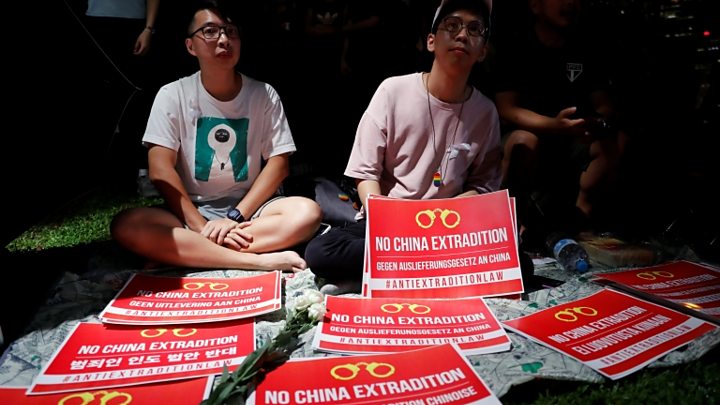
Last year’s mass protests in Hong Kong were sparked by a bill that would have allowed extraditions to mainland China.
Media caption Former Hong Kong governor Chris Patten: “UK should tell China this is outrageous”
The bill was paused, then withdrawn – but the protests continued until the virus outbreak at the end of the year.
The US has also weighed in, with President Trump saying the US would react strongly if it went through – without giving details.
It is currently considering whether to extend Hong Kong’s preferential trading and investment privileges.
Why is China doing this?
Mr Wang said the security risks had become “increasingly notable” – a reference to last year’s protests.
“Considering Hong Kong’s situation at present, efforts must be made at the state-level to establish and improve the legal system and enforcement mechanisms,” he is quoted as saying in state media.
Media caption The BBC’s Helier Cheung on Hong Kong’s 2019 protests
Beijing may also fear September’s elections to Hong Kong’s legislature.
If last year’s success for pro-democracy parties in district elections is repeated, government bills could potentially be blocked.
What is Hong Kong’s legal situation?
Hong Kong was under British control for more than 150 years up to 1997.
The British and Chinese governments signed a treaty – the Sino-British Joint Declaration – that agreed Hong Kong would have “a high degree of autonomy, except in foreign and defence affairs”, for 50 years.
This was enshrined in the Basic Law, which runs out in 2047.
Joint mission will send two unmanned probes into orbit around the closest planet to the sun
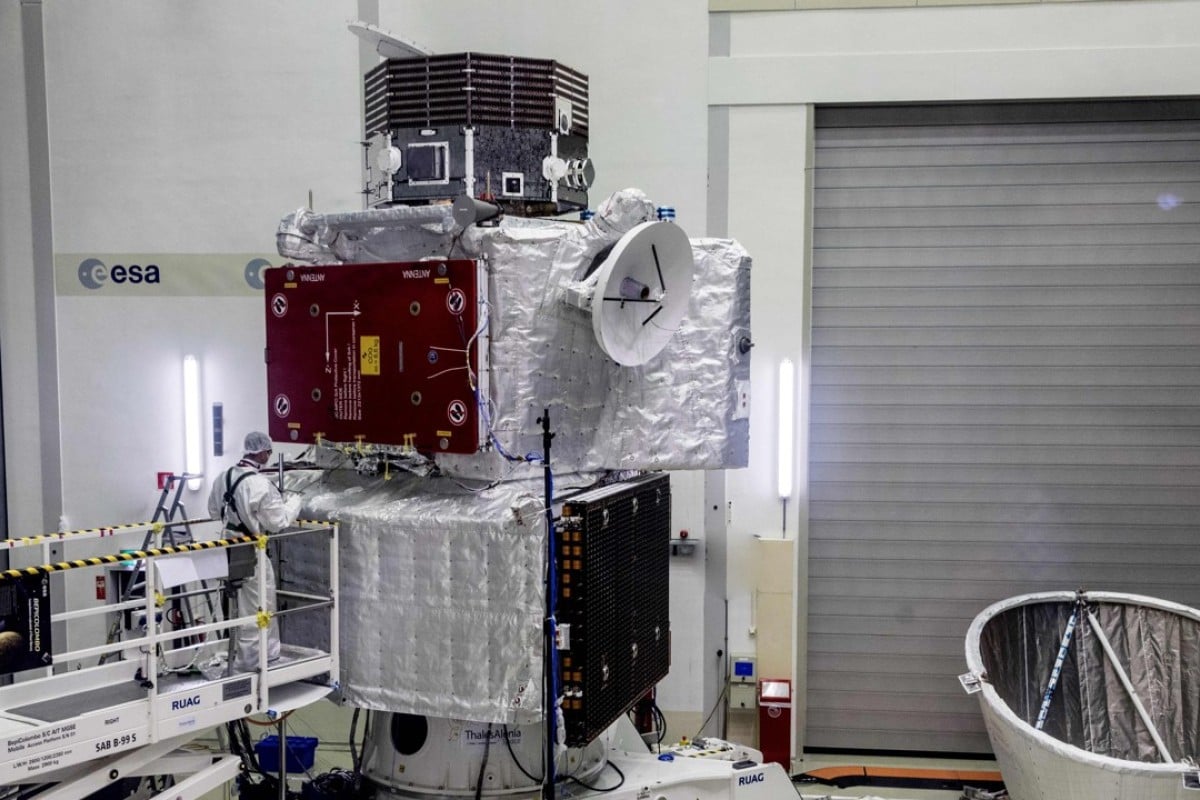
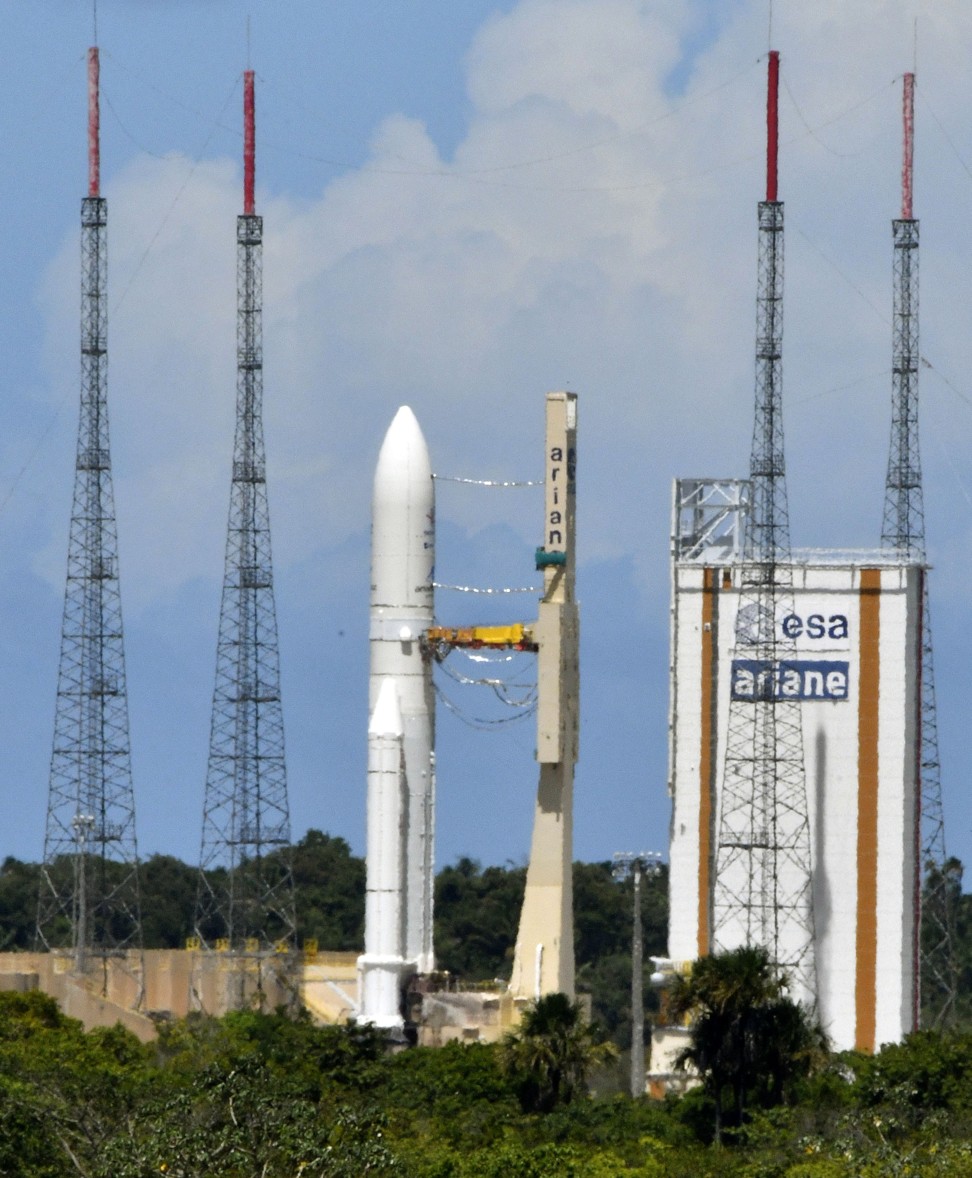
The BepiColombo standing in position at a test facility in Spijkenisse. Its mission to Mercury is scheduled for launch on an Ariane 5 from Europe’s Spaceport in Kourou, French Guiana on October 20. Photo: AFP Photo
Final preparations were underway on Friday for the launch of a joint mission by European and Japanese space agencies to send twin probes to Mercury, the closest planet to the sun.
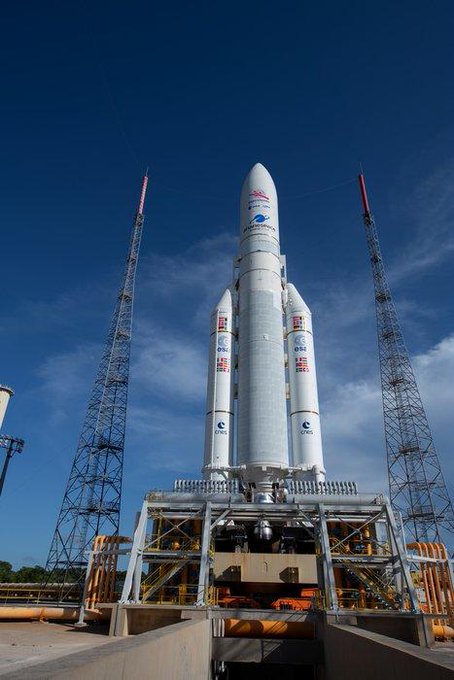
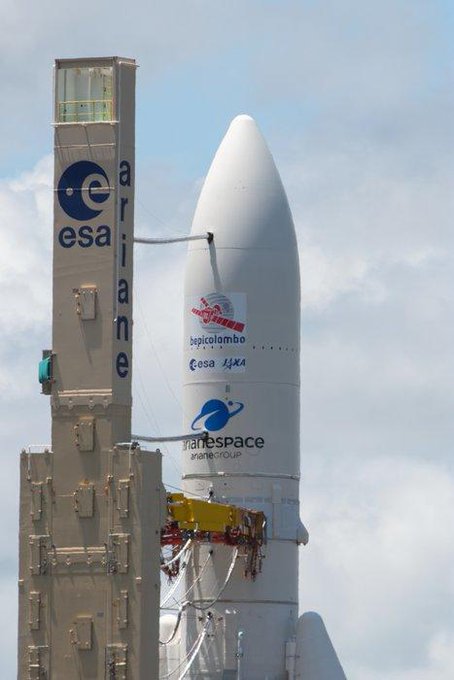
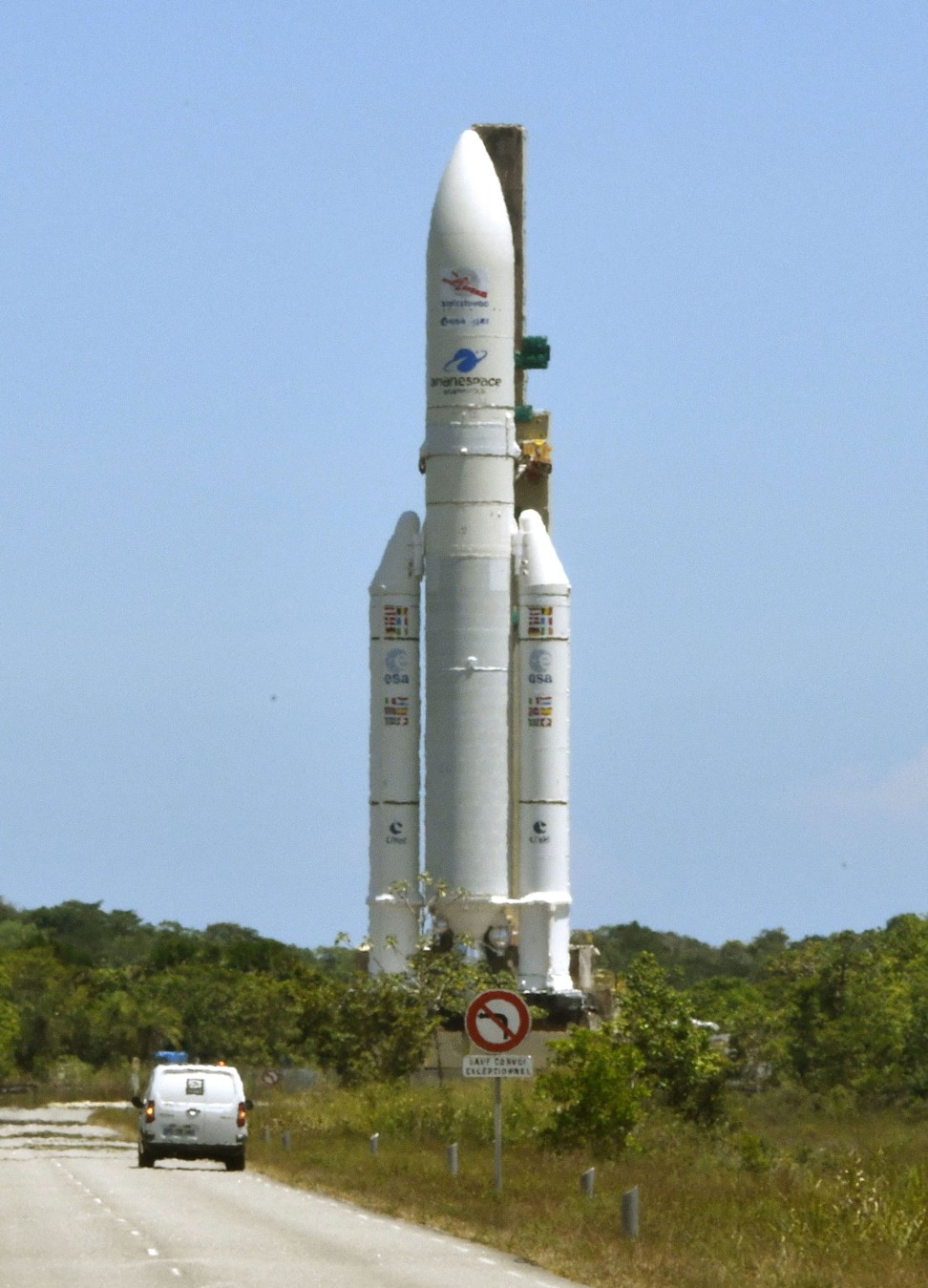
An Ariane 5 rocket is scheduled to lift the unmanned spacecraft into orbit from French Guiana shortly before midnight, the start of a seven-year journey to the solar system’s innermost planet.
Mercury is seen in silhouette, lower third of image, as it transits across the face of the sun. Photo: AFP PHOTO / NASA / BILL INGALLS
The European Space Agency says the €1.3 billion (US$1.5 billion) mission is one of the most challenging in its history. Mercury’s extreme temperatures, the intense gravity pull of the sun and blistering solar radiation make for hellish conditions.
The BepiColombo spacecraft will have to follow an elliptical path that involves a fly-by of Earth, two of Venus and six of Mercury itself so it can slow down sufficiently before arriving at its destination in December 2025.
An Ariane-5 rocket is set for launch at the Guiana Space Centre in Kourou in French Guiana. Photo: Kyodo
Newly developed electrical ion thrusters will help nudge the spacecraft, which was named after Italian scientist Giuseppe “Bepi” Colombo, into the right orbit.
Aborted launch astronauts may head to International Space Station this year: Nasa head says
12 Oct 2018
When it arrives, BepiColombo will release two probes – Bepi and Mio – that will independently investigate the surface and magnetic field of Mercury. The probes are designed to cope with temperatures varying from 430 degrees Celsius (806F) on the side facing the sun, and -180 degrees Celsius (-292F) in Mercury’s shadow.
An Ariane-5 rocket is transported to its launch site at the Guiana Space Centre in Kourou. Photo: Kyodo
Scientists hope to build on the insights gained by Nasa’s Messenger probe, which ended its mission in 2015 after a four-year orbit of Mercury. The only other spacecraft to visit Mercury was Nasa’s Mariner 10 that flew past the planet in the mid-1970s.
Japanese space robots have landed on asteroid to carry out world-first survey
22 Sep 2018
Mercury, which is only slightly larger than Earth’s moon, has a massive iron core about which little is known. Researchers are also hoping to learn more about the formation of the solar system from the data gathered by the BepiColombo mission.
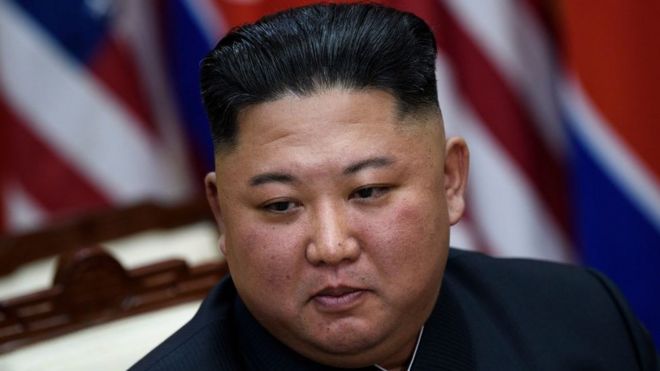
Image copyright BRENDAN SMIALOWSKIImage caption Kim Jong-un has not been seen in public for more than two weeks
Speculation and rumour about Kim Jong-un’s health may amount to nothing, but questions about who might succeed him in the short or long term will always be there. The BBC spoke to analysts about the contenders and whether history is on their side.
A male member of the Kim family has been in charge of North Korea ever since its founding by Kim Il-sung in 1948 – and the mythology of this family runs deep throughout society.
Propaganda about its greatness begins for citizens before they can even read: pre-schoolers sing a song called: “I want to see our leader Kim Jong-un.”
So how can you imagine a North Korea without this symbolic and political figure at the top? How would elites organise themselves, as well as society as a whole?
The easy answer is: we don’t know. More interestingly, they don’t know either. They have never had to do it.
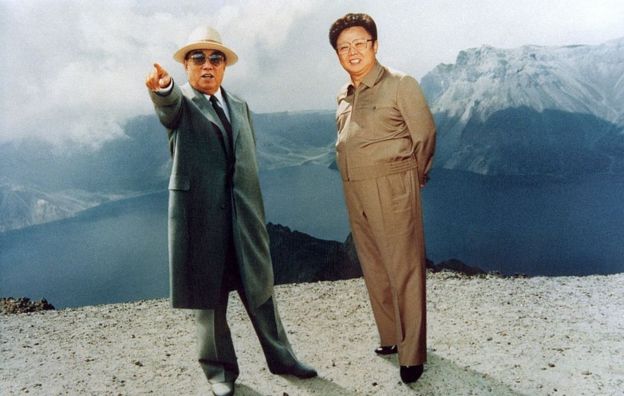
Image copyrightXINHUAImage captionKim Il-sung is the founder of North Korea and his son Kim Jong-il took over
As Kim Jong-un was being prepared for power, they even began using the term “Paektu Bloodline” to help legitimise his rule. Paektu is the sacred and mythologised mountain where Kim Il-sung is said to have waged guerrilla war and where Kim Jong-il was reportedly born. Kim Jong-un still goes there when he wants to emphasise important policy decisions.
There has always been a Kim at the ideological heart of the country.
What would North Korea be like without such an heir? Kim Jong-un, 36, is believed to have children – but they are far too young. It is thought he has three children, the oldest being 10 and the youngest three. Kim Jong-un himself was considered young when he took power – he was 27.
It is likely that some sort of group leadership would emerge, perhaps as in Vietnam, that leans heavily on the founder’s teachings and legitimacy to boost their own standing.
Observers can track who holds certain key positions and can follow news and open-source intelligence about important institutions, but can’t really tell how factions are developing, nor who is holding power through personal rather than institutional bonds. Moreover, sometimes vice or deputy directors wield more real power than the titular heads of institutions. This makes all predictions extremely difficult.
The three remaining Kims
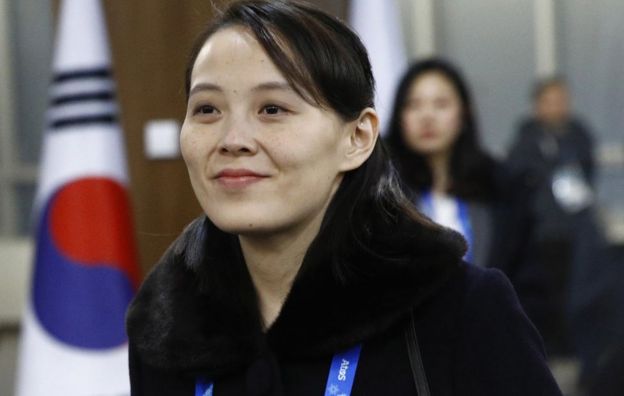
Image copyrightPATRICK SEMANSKY – POOL /GETTY IMAGESImage captionKim Yo-jong, as the only woman in the top leadership, has sparked fascination
The are three Kims who could potentially be involved in the political make-up of North Korea if Kim Jong-un were to disappear. They all face limitations in carrying on family rule.
The first is Kim Yo-jong, Kim Jong-un’s younger sister. She is said to have been a favourite of her father who commented on her precocity, her interest in politics from a young age. Her manner is efficient, mild and one suspects rather observant. Much has been made of her closeness to her brother. At the Singapore Trump-Kim summit she was famously on hand to pass him a pen to sign the agreement with, and at the next summit in Hanoi, was pictured peeking out from behind corners as her brother posed for statesman-like photos.
Yet she was not above a temporary demotion after the Hanoi summit – purportedly because of its failure although this will never be confirmed. She doesn’t sit on the top policy-making body, the State Affairs Commission, but is an alternate member of the Politburo and vice director of the Propaganda and Agitation Department (PAD) of the Workers’ Party of Korea. These may seem like incomprehensible acronyms but the PAD is a powerful organisation that ensures ideological loyalty in the system.
She is a woman, however, and this makes it hard to imagine her occupying the top position in such a deeply patriarchal country. North Korea is an extremely male state, in which gender carries rigid expectations. Being supreme leader, and certainly running the military, does not fit in the range of womanly duties.
The second is Kim Jong-chul. He is Kim Jong-un’s older brother, but has never appeared interested in politics or power. (He is known to be interested in Eric Clapton.) At most, he could be a symbolic link to the Kim family: perhaps made the head of a foundation and put forward to read the odd speech.
The final one is Kim Pyong-il, Kim Jong-il’s half-brother. His mother – Kim Jong-il’s stepmother – was angling to have him become Kim Il-sung’s successor. She failed and was sidelined by Kim Jong-il as he rose in influence. Kim Pyong-il was sent to Europe in 1979, where he has held various ambassadorships, returning to North Korea only last year. This means it is very unlikely he has the network to be a central player in elite politics in Pyongyang.
The second-most powerful man in North Korea right now
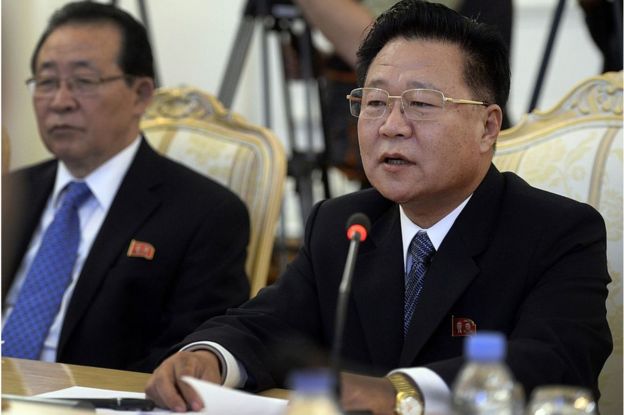
Image copyrightALEXANDER NEMENOV/AFP VIA GETTY IMAGESImage captionAs special envoy for Kim Jong-un Choe Ryong-hae (right) has met foreign dignitaries
There are other individuals who have been central in the Kim Jong-un era, but it is difficult to know who among them would form co-operative relationships and who would compete with one another.
One is Choe Ryong-hae. He has had his ups and downs under Kim Jong-un, but having weathered a few storms currently sits on the presidium of the politburo and is also first vice chairman of the State Affairs Commission. Last year he became the first new president in 20 years, replacing the aging Kim Yong-nam – so he is the person who represents the North at international engagements.
Choe has also held high positions in the military and the Organization and Guidance Department (OGD) of the Worker’s Party of Korea, responsible for enforcing loyalty throughout the regime. This is an extremely powerful organisation: it enforces the adherence of all citizens to North Korea’s ideology. He is probably the second most powerful man in North Korea.
The old spymasters and rising political grandees
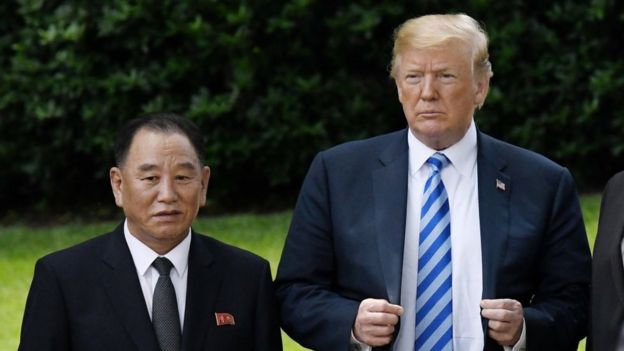
Image copyrightOLIVIER DOULIERY-POOL/GETTY IMAGESImage captionKim Yong-chol travelled to Washington DC to meet Donald Trump
Another is Kim Yong-chol. This general paved the way for the Trump-Kim summits, meeting US Secretary of State Mike Pompeo several times. He has been head of the United Front Department (responsible for relations with South Korea) and the Reconnaissance General Bureau, the country’s main intelligence service. He seems to have suffered a demotion following the collapse talks with the United States, but it is unlikely this spymaster will remain obscure for long.
Yet another is Kim Jae-ryong. As well as being on the State Affairs Commission, he is Premier of the Cabinet, a moderately influential position. Relatively little is known about him, but his star has risen in the past years as others have fallen. He is known for managing industries and ran the most isolated province, home to key military-industrial sites, for several years. This may mean he has been closely involved in the nuclear program.
Jong Kyong-taek is responsible for the State Security Department, which investigates and punishes political crimes. It also helps physically protect the leadership. These are crucial responsibilities that help enforce stability in the system.
Hwang Pyong-so is another official who has held top military posts and has run the OGD in the Kim Jong-un era. Like Choe (and many others) he has been disciplined; he doesn’t seem to have been rehabilitated in the same way, however. Other 2010s foreign policy stalwarts Ri Yong-ho and Ri Su-yong have also seen roles diminish recently. They have been replaced by Ri Son-gwon and Kim Hyung-jun. The former is said to be an ally of Kim Yong-chol.
The military enforcers
A handful of top generals of the Korean People’s Army (KPA) would also certainly exert influence in any transition period. Currently, two men sit atop the General Political Bureau of the KPA, Kim Su-gil and Kim Won-hong. This bureau enforces political loyalty in the military, something that would be absolutely crucial during periods of uncertainty.
Kim Won-hong, helps illustrate how difficult it is to predict how power would be shared if Kim Jong-un were no longer there. Kim Won-hong and Hwang Pyong-so had been thought to be rivals, competing to influence Kim Jong-un at the other’s expense.
Amongst top elites, who would clash and who would ally? Would there be pro and anti-Kim Yo-jong factions? Would the fear of instability stop rivalries from getting out of hand? After all, it is in no elite politician’s interest to see the state collapse, opening the door for some kind of takeover by South Korea, or even China.
There is currently no perfect contender: his sister would have to overcome the sexism and the break from tradition of a male heir. Anybody else is not directly descended from that all-important Paektu bloodline. but in the end, they will all have to think of the unity of the state they have defied every international norm to preserve.
BEIJING (Reuters) – Beijing’s new $63 billion Daxing airport began its first scheduled international flights on Sunday as it ramped up operations to help relieve pressure on the city’s existing Capital airport.
Shaped like a phoenix – though to some observers it is more reminiscent of a starfish – the airport was designed by famed Iraqi-born architect Zaha Hadid, and formally opened in late September ahead of the Oct. 1 celebrations of the 70th anniversary of the People’s Republic of China.
It boasts four runways and is expected to handle up to 72 million passengers a year by 2025, eventually reaching 100 million.
China Southern Airlines (600029.SS) and China Eastern Airlines (600115.SS) will be the main domestic carriers at Daxing, though Air China (601111.SS) will provide a small number of flights too.
An Air China flight to Bangkok was the first international flight to leave on Sunday, while British Airways (ICAG.L) will operate the first transcontinental flight, to London.
About 50 foreign airlines, including Finnair (FIA1S.HE), plan to move all or part of their China operations to the airport in the coming quarters.
The relocation of all the airlines which will use Daxing is to due to be completed by the winter of 2021. Air China and its Star Alliance partners will remain mostly at Capital airport.
The airport, roughly the size of 100 football fields and expected to become one of the world’s busiest, has come in for some criticism due to its distance from central Beijing.
By public transport it takes over an hour to reach it from Beijing’s central business district, more than double the time needed to reach Capital airport, which strains at the seams and is often hit by delays.
Officials say Daxing airport is not only designed to serve Beijing, but also the surrounding province of Hebei and next-door city of Tianjin, to boost regional development.
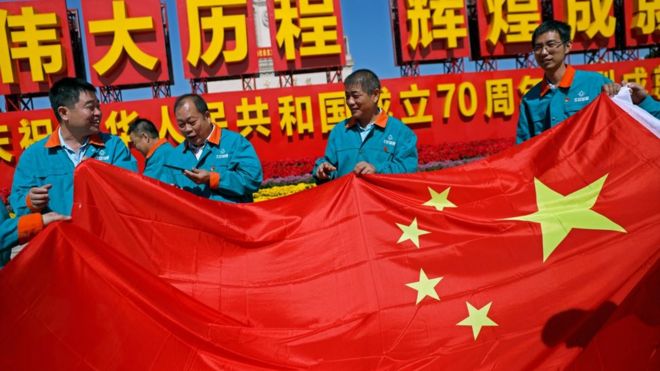
Image copyright EPAImage caption China is getting dressed up for its big birthday party
One week from now, the People’s Republic of China will mark its 70th anniversary with celebrations on a scale not seen in China in decades.
Beijing is pulling out all stops and 1 October will be flush with fireworks, fanfare and a huge military parade.
To ensure it goes smoothly, authorities have been ramping up security in the capital – and online – for weeks.
But with yet more protests expected in Hong Kong, the territory might just rain on China’s parade.
What is it all about?
The birth of modern China was declared on 1 October 1949, after the communists under Mao Zedong won the civil war that followed World War Two.
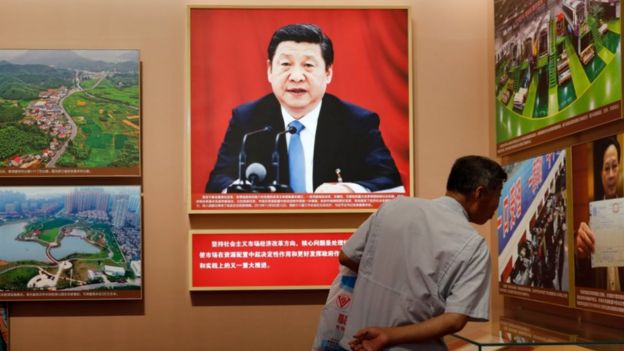
Image copyright EPAImage caption Exhibitions are highlighting the achievements of the Communist Party
The date is marked every year, but celebrations for this 70th anniversary are expected to eclipse previous events.
It’s the first big anniversary since China has emerged as a global power. While 10 years ago China was a superpower in the making, it is now the world’s second largest economy, almost eye-to-eye with the United States.
What to expect?
The main celebrations will take place in the capital, Beijing, where there will be a grand military parade with “advanced weapons” on display, followed by a “mass pageant”.
President Xi Jinping – considered the most powerful Chinese leader since Mao – will address the Chinese people. His speech is expected to celebrate China’s rapid growth and which will be closely watched for any indication of the country’s direction in the coming years.
The president will also hand out honours for contributions to the country and in the evening there will be a grand gala and fireworks show.
All official Chinese celebrations are carefully choreographed and the success of this one is particularly important to the government.
The Dos and Don’ts
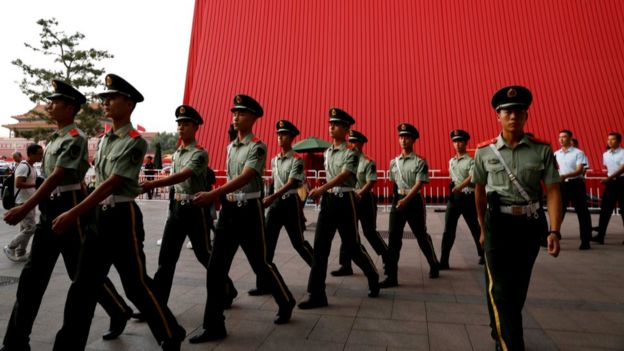
The parade – open to invited guests only – will take place around Tiananmen Square in central Beijing. The surrounding area will be practically under lockdown, and in fact has been so several times already.
During rehearsals leading up to the big day, hotels near Tiananmen Square told guests that for several hours each day, no-one would be able to leave the hotel or return to it should they be out, leading to much travel chaos and rebookings.
Many shops and restaurants in the centre are also closed or have shortened hours and some subway stations are temporarily shut.
Image copyright EPAImage caption Security is tight ensure the party goes to plan
Trains to Beijing are running numerous safety checks on their passengers and vehicles going into the city are also being tightly watched.
On the big day itself, areas around Tiananmen Square will be blocked and guarded. Local residents will need to identify themselves if they want to pass.
To ensure the sun will shine brightly on the celebration in notoriously polluted Beijing, several coal plants and construction sites in and around the city have been ordered to stop work for the duration.
There’s also a ban on any low-flying aerial vehicles in place. That means anything from light aircraft to drones, balloons and even racing pigeons.
Censorship galore
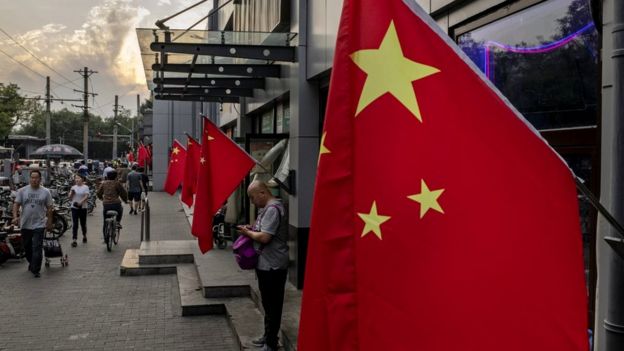
Across much of the city centre, there are national flags set up at every door. Voluntary inspectors are monitoring the streets and locals have told the BBC they’re being questioned after having even brief conversations with foreigners
One person said she was asked by an inspector: “Who were those foreigners? Why were they here?”
The tight control naturally extends online as well. Popular social media platform Weibo said it was deleting content that “distorts” or “insults” the country’s history ahead of the anniversary.
Image copyright GETTY IMAGESImage caption Every house and every shop is sporting a national flag
Chinese journalists are always expected to toe the party line anyway, but starting in October they will have to pass an extra test to prove they are versed particularly in Xi Jinping’s teachings, officially called Xi Jinping Thought on Socialism with Chinese Characteristics, which has been written into the constitution.
Whether or not they pass the exam will then determine whether they’ll be accredited as journalists.
“The fundamental point with this ‘training’ and indoctrination process isn’t so much about the content,” David Bandurski of China Media Watch told the BBC.
“It is about reinforcing the message and understanding among journalists that they work, first and foremost, for the Chinese Communist Party, and serve its agenda.”
So not only will the events be choreographed – the domestic coverage of them will also be tightly guarded.
What about Hong Kong?
Despite Beijing’s determination to let its achievements shine on 1 October, there’s a good chance Hong Kong will pull focus.
Anti-Beijing protests always take place in Hong Kong on China’s National Day, but this time, the activists know that the world is watching.
Anti-government protests have rocked the city for months and the situation shows no sign of dying down.
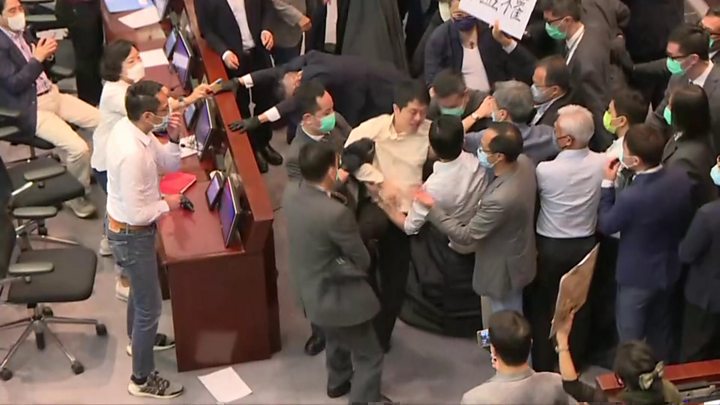
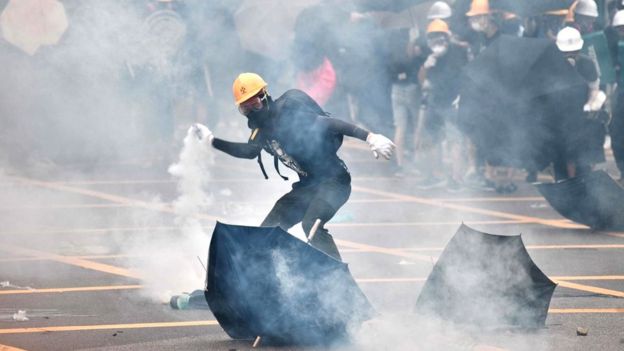
Clashes between police and activists have been becoming increasingly violent, with police using tear gas and activists storming parliament.
Image copyright AFPImage caption The protests have often escalated into violent clashes
That means two things for 1 October: official celebrations in the territory are being toned down to avoid clashes – the annual fireworks display has been cancelled – while at the same time, activists are planning to step up their protests.
On Sunday 29 September, a “Global Anti Totalitarianism March” is scheduled to take place at various locations around the world in support of Hong Kong.
On 1 October itself, a march in central Hong Kong is planned with everyone asked to wear black.
If the past weeks’ demonstrations are anything to go by, the smiles and celebrations in Beijing will be competing for media space with pictures of tear gas and angry young protesters in Hong Kong.
The city’s ambitious waste and recycling rules took effect on Monday, aiming to emulate successes of comparable policies in Japan, Taiwan and California
President Xi Jinping has urged China – the world’s second-biggest waste producer after the United States – to sort rubbish better
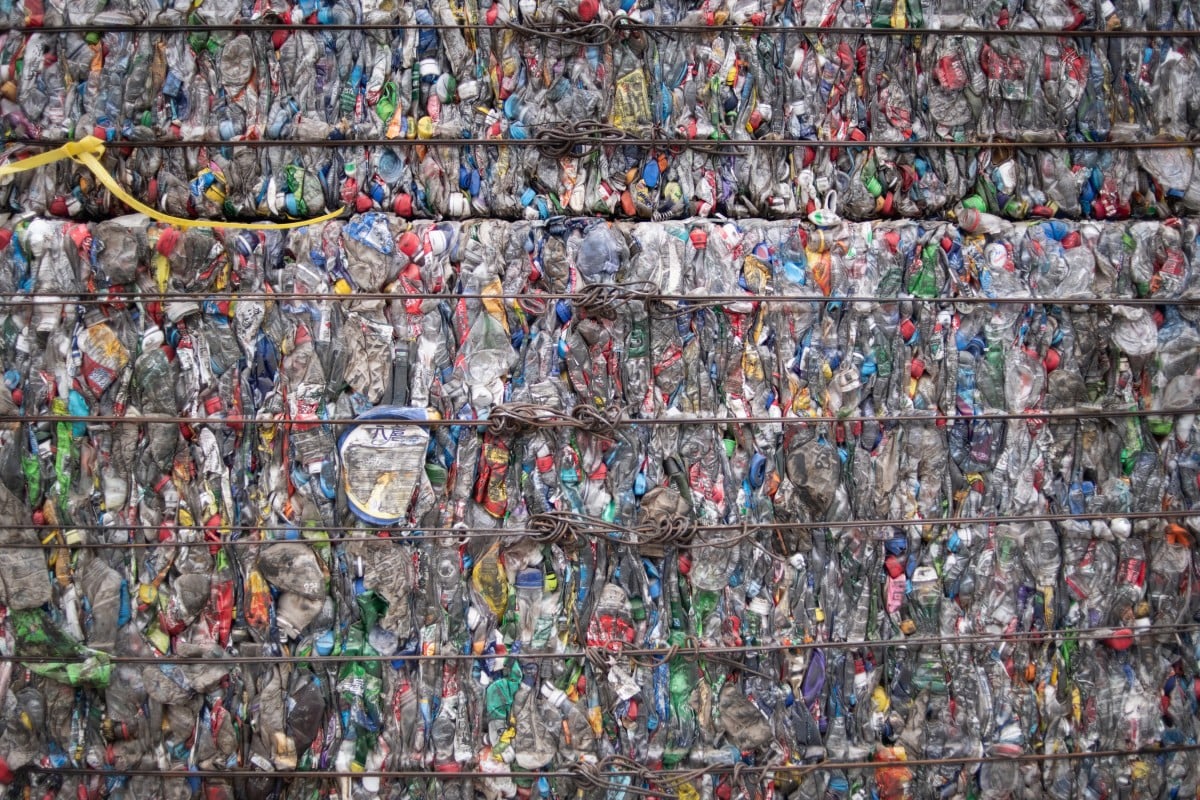
Recyclables such as plastic must be separated from wet garbage, dry garbage and hazardous waste under the new rules in Shanghai. Photo: AFP
At 9pm, Li Zhigang was sitting in front of his fruit shop on a bustling street in central Shanghai’s Xujiahui area, peeling the thin layers of plastic from rotten pears and mangoes.
“This is so much trouble!” he mumbled to himself while throwing the plastic into one trash can and the fruit into another.
In the past, Li simply threw away what could not be sold with the packaging on, but from July 1 he could be fined up to 200 yuan (about US$30) for doing so.
Like Li, many of the tens of millions of residents in the eastern Chinese city have been complaining in recent weeks that the introduction of compulsory
is making life difficult, but at the same time have been having to learn to do it.
Calls for garbage sorting have brought little progress in China in the past decade, but Shanghai is leading a fresh start for the world’s second-largest waste producer with its new municipal solid waste (MSW) regime, observers have said.
China generated 210 million tonnes of MSW in 2017, 48 million tonnes less than the United States, according to the World Bank’s What a Waste database.
“If we say China is now classifying its waste, then it’s Shanghai that is really doing it,” said Chen Liwen, a veteran environmentalist who has worked for non-governmental organisations devoted to waste classification for the past decade.
“It’s starting late, comparing with the US, Japan or Taiwan, but if it’s successful in such a megacity with such a huge population, it will mean a lot for the world,” she said.
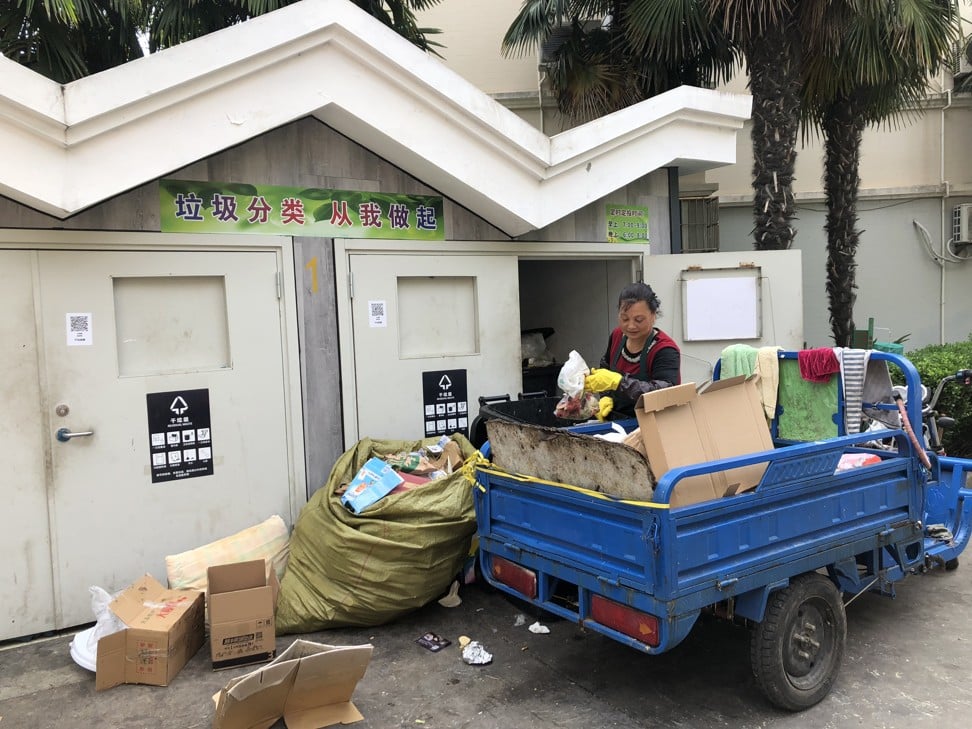
A cleaner re-sorts household waste left at a residential facility in Shanghai. Photo: Alice Yan
Household waste in the city is now required to be sorted into four categories: wet garbage (household food), dry garbage (residual waste), recyclable waste and hazardous waste.
General rubbish bins that had previously taken all types of household waste were removed from buildings. Instead, residents were told to visit designated trash collection stations to dispose of different types of waste during designated periods of the day.
Companies and organisations flouting the new rules could be fined 50,000-500,000 yuan (US$7,000-70,000), while individual offenders risked a fine of 50-200 yuan.
The city’s urban management officers will be mainly responsible for identifying those who breach the rules.
Huang Rong, the municipal government’s deputy secretary general, said on Friday that nearly 14,000 inspections had been carried out around the city and more than 13,000 people had been warned on the issue since the regulations were announced at the start of the year.
As July 1’s enforcement of the rules approached, it became a much-discussed topic among Shanghainese people. A hashtag meaning “Shanghai residents almost driven crazy by garbage classification” was one of the most popular on China’s Twitter-like Weibo platform.
“My daughter took a box of expired medicine from her workplace to the trash collection station near our home yesterday because she couldn’t find the local bin for hazardous waste,” Li said.
While the measures force a change of habits for most people, they bring opportunities for some.
Du Huanzheng, director of the Recycling Economy Institute at Tongji University, said waste sorting was crucial for China’s recycling industry.
“Without proper classification, a lot of garbage that can be recycled is burned, and that’s a pity,” he said. “After being classified, items suitable to be stored and transported can now be recycled.”
G20 set to agree on ways to reduce plastics in oceans
Shanghai’s refuse treatment plants deal with 19,300 tonnes of residual waste and 5,050 tonnes of kitchen waste every day, according to the municipal government. By contrast, only 3,300 tonnes of recyclables per day are collected at present.
Nationwide, the parcel delivery industry used more than 13 billion polypropylene woven bags, plastic bags and paper boxes as well as 330 million rolls of tape in 2016, but less than 20 per cent of this was recycled, according to a report by the State Post Bureau.
Prices of small sortable rubbish bins for home use have surged on e-commerce platforms, while bin makers are also developing smart models in response to new needs.
Some communities are deploying bins that people are required to sign in with their house number to use, and are equipped with a “big data analysis system”. The system records households have “actively participated” and which have not, so that neighbourhood management can publicise their addresses and make house visits, according to a report by Thepaper.cn.
In a residential community in Songjiang district, grocery store owner Nie Chuanguo has found something new to sell: a rubbish throwing service.
He has offered to visit homes, collect waste and throw it into the right bin at a designated time. He charges 30 yuan a month for those living on the ground and first floors, 40 yuan for those on the second and third, and 50 yuan for the fourth and fifth.
“This service will start from July 1. Many people have come to inquire about it,” he said.
According to Du, waste classification is not only about environmental impact or business opportunities. “Garbage sorting is an important part of a country’s soft power,” he said.
For China, it was an opportunity to improve its international reputation, he said. “In the past, Chinese people were rich and travelled abroad, but they threw rubbish wilfully, making foreigners not admit we are a respected powerhouse.”
He added: “It’s also related to 1.3 billion people’s health, since the current waste treatment methods – burying and burning – are not friendly to the environment.”
Shanghai’s part in tackling waste comes amid President Xi Jinping’s repeated calls for the country to sort waste better.
“For local officials, it is a political task,” said Chen, who heads a waste management programme in rural China called Zero Waste Villages.
Huang said the president had asked Shanghai in particular to set a good example in waste classification.
In March 2017, the central government set out plans for a standardised system and regulations for
, with a target for 46 major cities, including Shanghai, to recycle 35 per cent of their waste by then.
In early June, Xi issued a long statement calling for more action from local governments.
However, it was a long process that required input from individuals, government and enterprises, Du said.
“Japan took one generation to move to doing its waste sorting effectively, so we shouldn’t have the expectation that our initiative will succeed in several years,” Du said.
How China’s ban on plastic waste imports caused turmoil
“The lessons we can learn from Japan include carrying out campaigns again and again, and paying close attention to educating young pupils about rubbish classification.”
Chen echoed that Shanghai’s waste sorting frenzy now was only a beginning.
“What we can see now is that people are being pushed to sort waste by regulators, but what’s next? How shall we keep up the enthusiasm?” she asked.
She suggested that how well officials worked on garbage sorting should be included in their job appraisal, and that ultimately people should pay for waste disposal.
“The key to waste classification, going by international experience, is making polluters pay,” Chen said.
Most of Hong Kong and Taiwan’s dumped plastic bottles come from mainland
There is plenty of experience for Shanghai to learn from in California, where unrecyclable waste is charged for at twice the price of recyclables, and Taiwan, where people are charged only for disposal of residual waste, according to Chen.
Taiwan has one of the world’s most impressive recycling rates, with nearly 60 per cent of its waste between January and October last year having been recycled, according to the Taipei government.
The daily amount of garbage produced per person during that period was about 0.41kg – down substantially from 1.14kg in 1997 – the government said.
Hong Kong has tried to copy the Taipei model over the years but failed, with a recycling rate of MSW slightly above 30 per cent in recent years, according to official data.
until late 2020 at the earliest. Under its plan, 80 per cent of household waste will have to go into designated bags and will be priced at an average of 11 HK cents (1 US cent) per litre.
On Friday, Shanghai officials admitted that there were plenty of challenges involved in
sorting and transport.
Zhang Lixin, deputy chief of the municipal housing administration, said: “Many property management companies fear the difficulties brought by garbage sorting or are reluctant to implement the new rules.”
The administration trained the heads of more than 200 companies across the city in April, he said.
“We do find that some cleaners and rubbish trucks mix the waste, despite residents being asked to throw different types in different bins,” said Deng Jianping, head of the city’s landscaping and city appearance administration – the government department spearheading the initiative.
In the interests of curbing such practices, they could face fines of up to 50,000 yuan or even have their licences revoked, he said.


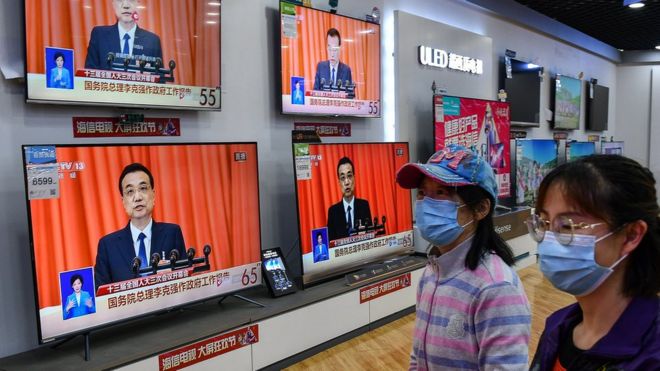 Image copyright AFP / GETTY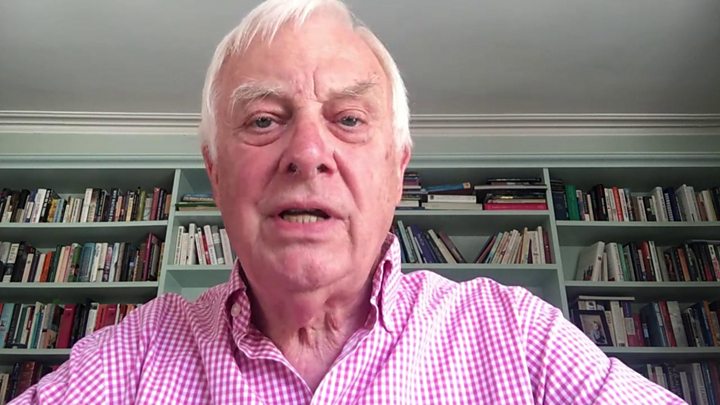






 CHINDIA ALERT: You'll be living in their world, very soon