Chindia Alert: You’ll be Living in their World Very Soon
aims to alert you to the threats and opportunities that China and India present. China and India require serious attention; case of ‘hidden dragon and crouching tiger’.
Without this attention, governments, businesses and, indeed, individuals may find themselves at a great disadvantage sooner rather than later.
The POSTs (front webpages) are mainly 'cuttings' from reliable sources, updated continuously.
The PAGEs (see Tabs, above) attempt to make the information more meaningful by putting some structure to the information we have researched and assembled since 2006.
The president is set to become the first Russian leader to make a state visit to the Philippines for more than 40 years, according to a former envoy
Moscow is aware of China’s entry into the Philippines, and could have its eye on some projects there, while the US is also watching developments
Russian President Vladimir Putin and Philippine President Rodrigo Duterte shake hands during a 2016 meeting in Peru. Photo: EPA
The timing of Moscow’s announcement over the weekend that President Vladimir Putin
has accepted an invitation to visit Manila has raised eyebrows, as it comes on the eve of crucial bilateral talks between the Philippines and China on joint oil exploration in the
In a statement immediately welcomed by the Philippine presidential palace, Igor Khovaev, Russia’s ambassador to the Philippines, on Saturday told reporters Putin had accepted Duterte’s invitation “with gratitude”.
No date has been set for the visit, with Khovaev only saying Moscow would “do our best to arrange this meeting as soon as possible”.
A steering committee with representatives from both Manila and Beijing is set to meet this week to discuss the joint oil exploration deal. China has proposed a 60 per cent-40 per cent split in favour of the Philippines, according to Hermogenes Esperon,
Courting Russia with South China Sea oil is a ‘dangerous gamble’ for Duterte
Neither side has clarified if the split refers to ownership or revenue, and no other details were disclosed.
After an August meeting with Duterte, Chinese President Xi Jinping said the countries could take a “bigger step” in jointly developing oil and gas resources if they could properly handle their sovereignty dispute in the South China Sea.
But defence and security analysts say the Philippine president took a “dangerous gamble” on a visit to Russia last month, when he invited the Russian state oil company Rosneft to explore for oil in Philippine waters – which include parts of the South China Sea claimed by China.
The timing of Moscow’s announcement has not gone unnoticed.
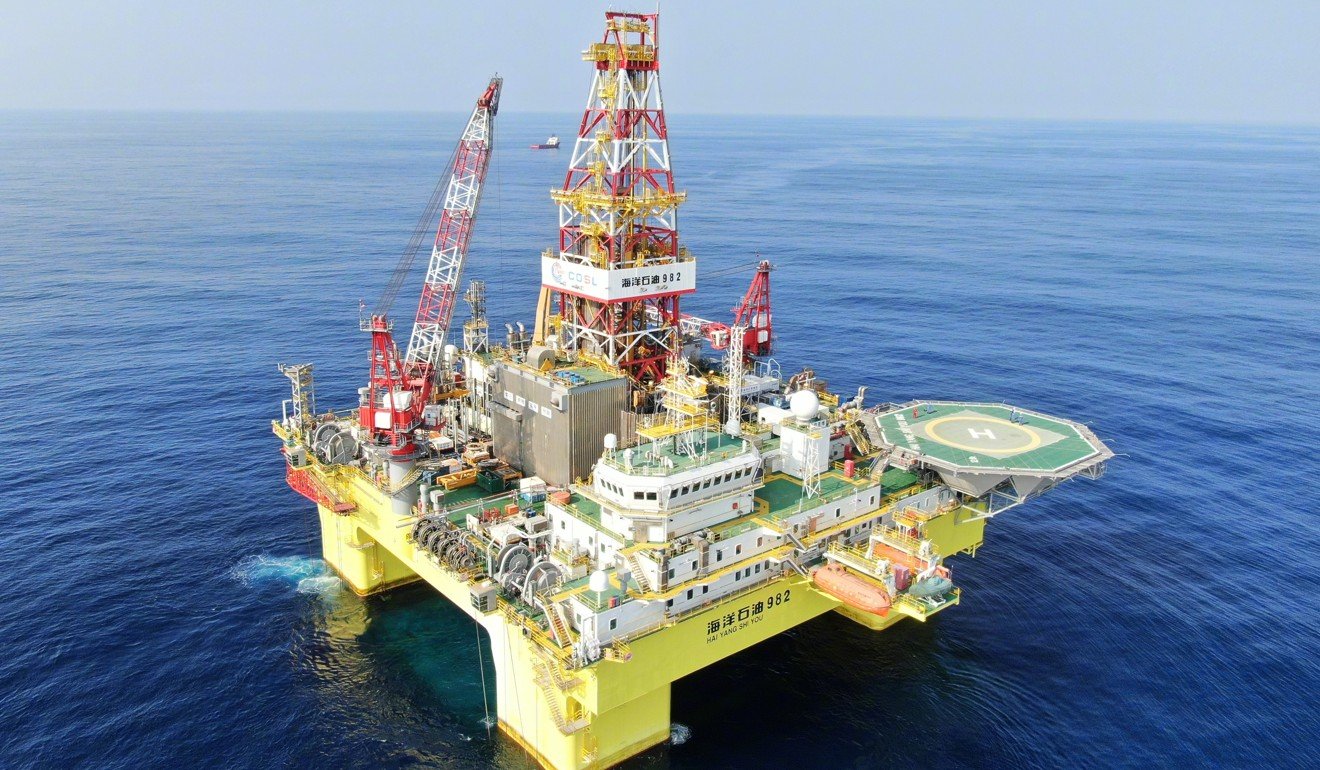
A Chinese deepwater oil rig in the South China Sea. Photo: Weibo
“It’s a welcome and historic development. Some wise guy in the Duterte government thought about timing [the invitation to Putin around the oil talks with Beijing],” said retired Philippine ambassador Lauro Baja, who once served as president of the United Nations Security Council.
Baja told the Post that no Russian president had visited the Philippines during his more than 40 years with the Department of Foreign Affairs.
“The Philippines then was almost a nonentity as far as Russia was concerned, [but] maybe now Russia recognises the strategic importance of the Philippines [in terms of] regional politics,” he said.
Baja said Moscow was aware of China’s entry into the Philippines, and could have its eye on some projects there.
“For all their so-called alliance, China and Russia are fierce competitors for influence and other benefits. And I think Russia has some objectives in mind like selling armaments and [forging] technological agreements,” he said, while cautioning that the situation remained “nebulous”.
New Philippines military chief sees no ‘shooting war’ in South China Sea despite disputes
“It’s a fascinating development but things are still early … For now, this is [just] an invitation extended by Duterte and accepted in principle by Putin.”
The United States will also be monitoring developments in the Philippines, according to Greg Poling, director of the Washington-based Centre for Strategic and International Studies’ Asia Maritime Transparency Initiative.
“Russia is eager to boost its influence in the region, and doubtless doing so with a long-standing US ally is seen as a bonus by Moscow,” he said. “There is nothing that prevents the Philippines from engaging in security cooperation with Russia, but the devil will be in the details.”
Poling added that the US would be concerned if Russia-Philippine cooperation involved acquiring military platforms that were incompatible with the shared platforms and doctrines used by Washington and Manila, as well as the latter’s other major security partners, namely Australia, Japan and South Korea.
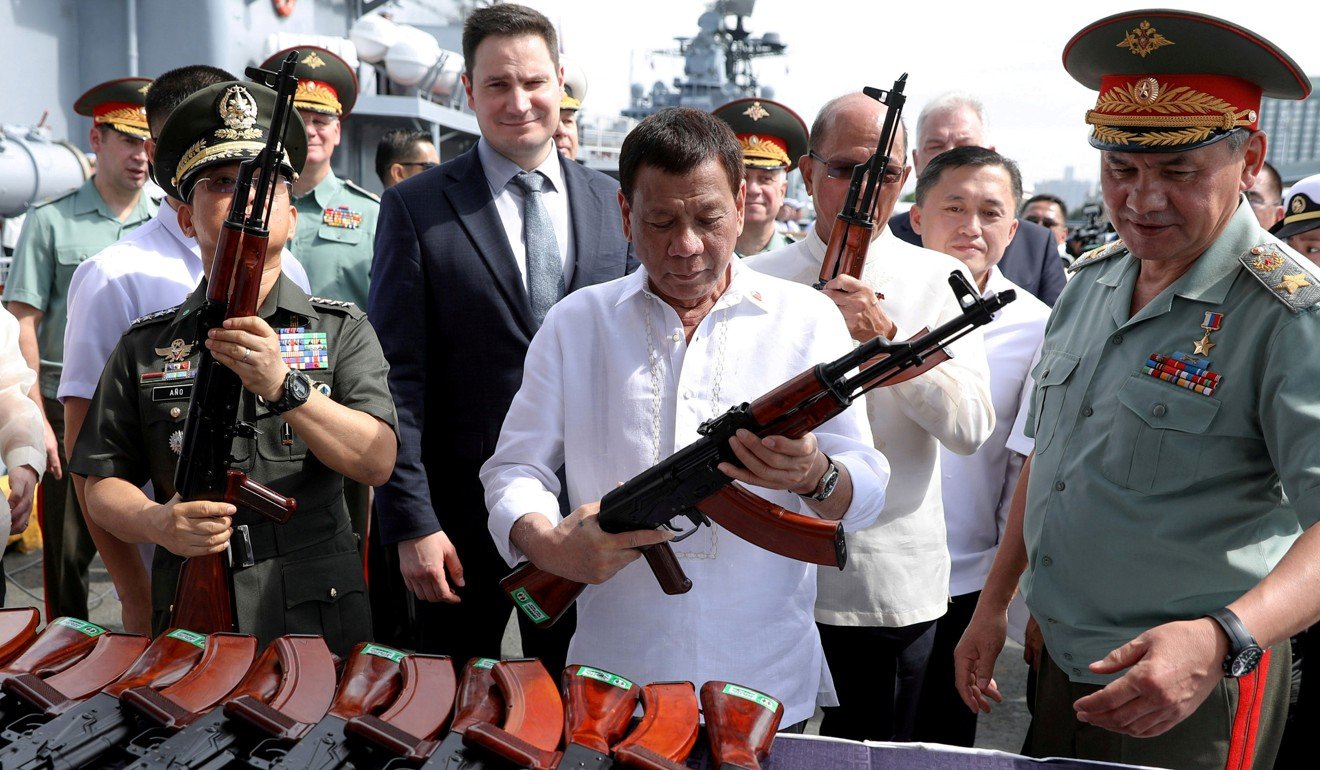
Philippine President Rodrigo Duterte inspects firearms donated by Russia in 2017. Photo: Reuters
“The US will also be concerned if any acquisitions or cooperation with Russia might threaten information security or intelligence cooperation between the US and the Philippines,” he said.
“And finally, any major platforms acquired from Russia would likely require the US to impose sanctions on the Philippines unless a waiver is granted, and the US government has been very stingy about awarding those waivers because they undermine the effectiveness of the sanctions regime.”
“Imagine a US stronghold and long-time ally and former colony becoming a manufacturing hub for Russian arms. And it makes it worse if [the Philippine armed forces] buys them too,” he said.
“Weakening the US alliances in Asia will benefit Russia [as it is] one of the US’ competitors in arms sales and geopolitics.”
Russia offers arms technology to the Philippines with ‘no conditions’ as US ties falter
The Philippines, Montero said, would benefit from such an arrangement since it is “a laggard in defence technology”. However, he pointed out that the country’s armed forces continue to buy weapons from the US and receive American arms as grants, potentially limiting the domestic market for Russian arms.
Navy cooperation has also been on the agenda, as Moscow and Manila discussed signing a new naval pact in March, while warships from each country have visited the other this year. Philippine naval vessels made their first-ever visit to Russia in October, while three Russian ships docked in the Philippines for a goodwill visit in January.
Russia is the top supplier of arms to Southeast Asia, and the No 2 global arms supplier, behind the US. Southeast Asia bought US$6.6 billion of Russian arms between 2010 and 2017, or more than 12 per cent of Russia’s sales, according to the Stockholm International Peace Research Institute, a Swedish think tank that publishes global arms tracking data.
After nearly 10 years of planning, the country’s two shipbuilders will be reunited with a combined revenue of US$141.5 billion
China’s two shipbuilding giants have built hundreds of military vessels over the past few years as the country’s navy seeks to modernise rapidly. Photo: Xinhua
China on Friday announced the merger of the country’s two largest state-owned shipbuilding giants, a step Beijing has been preparing for nearly a decade to strengthen the competitiveness of its shipbuilding industry.
The intention to merge the Shanghai-based China State Shipbuilding Corp (CSSC) and the China Shipbuilding Industry Co (CSIC), based in Dalian, Northern Liaoning province, was announced in a statement on the website of the state-owned Assets Supervision and Administration Commission of the State Council, China’s cabinet.
The merger would enable China to establish a shipbuilding giant with a combined revenue up to 1 trillion yuan (US$141.5 billion), capable of building vessels ranging from warships, like aircraft carriers, to civilian ships such as container ships and oil tankers, said a source familiar with the merger plan.
“This merger has been in the making since Hu Wenming, a former party leader of the state-owned aviation industry, was assigned to CSSC as party secretary in 2010,” the source said, requesting anonymity because of the sensitivity of the issue.
“The merger plan was put on the drawing board at a time when the world shipping industry had entered a golden period in 2009, and the business of CSSC and CSIC was at its peak, but [China’s] analysis indicated a decline was on the horizon, as has actually happened in recent years.”
Chinese shipbuilder touts warships in push to expand arms sales in region
CSIC and CSSC were part of the same group until 1999 when they were split into two separate entities. Since then, China has overtaken South Korea and Japan to become the world’s largest builder of merchant ships, a rise spurred by the boom in world trade and the country’s accession to the World Trade Organisation in 2001.
CSSC manages shipbuilding business in the east and south of China, while CSIC oversees activities in the northern and western parts of the country. Both are also primary contractors for PLA naval ships.
Commercial shipbuilding was the major source of revenue for both enterprises, given they were generally less technologically challenging and of lower cost to build, the source said.
“Developing and building warships for the PLA needs more manpower and more advanced technologies because naval ships, which are built for sea battles, take longer to build and require cutting-edge technologies, hence the higher costs,” the source said.
China tests new warships in live-fire drills near Vietnam
CSSC and CSIC have built hundreds of military vessels over the past few years as the Chinese navy seeks to modernise rapidly. These have included aircraft carriers, Type 055 destroyers, Type 075 amphibious assault ships and Type 094A nuclear submarines.
But, the source said, the two giants’ naval warship building mission would be cut back next year, as Beijing expected greater financial pressure as a result of slower economic growth. The merger would allow the two companies to pool their resources and enhance their competitiveness, especially in the development of mega vessels.
But the source said the two giants’ naval warships building missions would be cut back beginning next year as Beijing foresees greater financial pressure as a result of slower economic growth. The merger will allow the two companies to pool their resources and enhance their competitiveness, especially in areas of mega vessels.
“The merger is also part of China’s long-term maritime energy development plan to meet President Xi Jinping’s sustainable and clean energy goal, because China needs more giant vessels to help ship oil and gas from other countries,” the source said.
BEIJING, Oct. 25 (Xinhua) — Chinese top legislator Li Zhanshu on Friday met with Brazilian President Jair Messias Bolsonaro in Beijing.
Li, chairman of the Standing Committee of the National People’s Congress (NPC), said both China and Brazil are major developing countries and emerging markets with important influence, and relations between the two countries, featured with more strategic and comprehensive significance, have far transcended the bilateral scope.
Given the complex international situation, strengthening all-round cooperation between the two countries will be conducive to promoting the construction of a new type of international relations and building of a community with a shared future for humanity, Li said.
Both sides should continue their mutual support of issues regarding each other’s core interests and major concerns to push their comprehensive strategic partnership to constantly reach new heights, he suggested.
“The National People’s Congress of China stands ready to further enhance exchange and cooperation with the National Congress of Brazil to provide legal guarantee and support for smooth pragmatic cooperation between China and Brazil,” Li said.
China is a great country, said Bolsonaro, who noted Brazil’s new government attaches great importance to relations with China and considers China as Brazil’s important partner. He said his government is ready to enhance cooperation with China, deepen friendship between the two countries and advance bilateral ties to a new high.
was back in waters close to home on Friday afternoon, according to an online platform that provides information about maritime activity.
As of 4pm, the Haiyang Dizhi 8 (Marine Geology 8), which had been operating close to Vanguard Bank – a disputed reef in the Spratly Island chain claimed by both Beijing and Hanoi – was located just off Macau, the MarineTraffic service said.
China’s foreign ministry said on Thursday that the vessel had finished the work it had started “in Chinese-controlled waters in early July”.
“According to our understanding the work is now complete,” spokeswoman Hua Chunying told a regular press briefing, without elaborating.
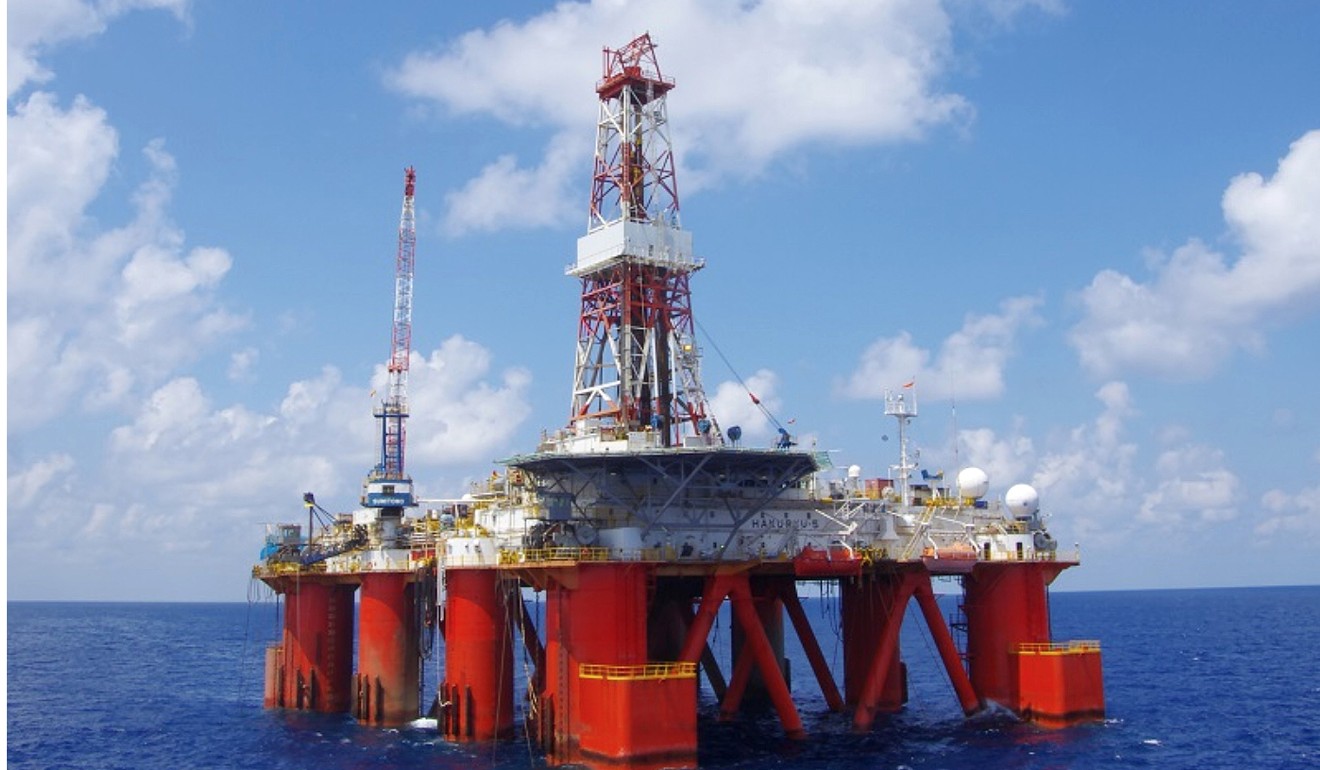
The Japanese oil rig, Hakuryu 5, is reported to have completed its drilling mission near Vanguard Bank earlier this week. Photo: Japan Drilling Co
While in the Vanguard Reef area, the Haiyang Dizhi 8, escorted by heavily armed coastguard vessels, made multiple passes by an oil block operated by Russian energy company Rosneft.
Observers say the presence of the Chinese vessels in the region is part of Beijing’s efforts to prevent Hanoi from partnering with international energy firms to explore energy reserves in the disputed waterway. The latest activity triggered a months-long stand-off between the two countries.
The departure of the Haiyang Dizhi 8 came amid reports that the Japanese oil rig, Hakuryu 5, owned by Tokyo-based Japan Drilling Company and employed by Rosneft, had earlier this week completed a drilling mission it started in May near Vanguard Bank.
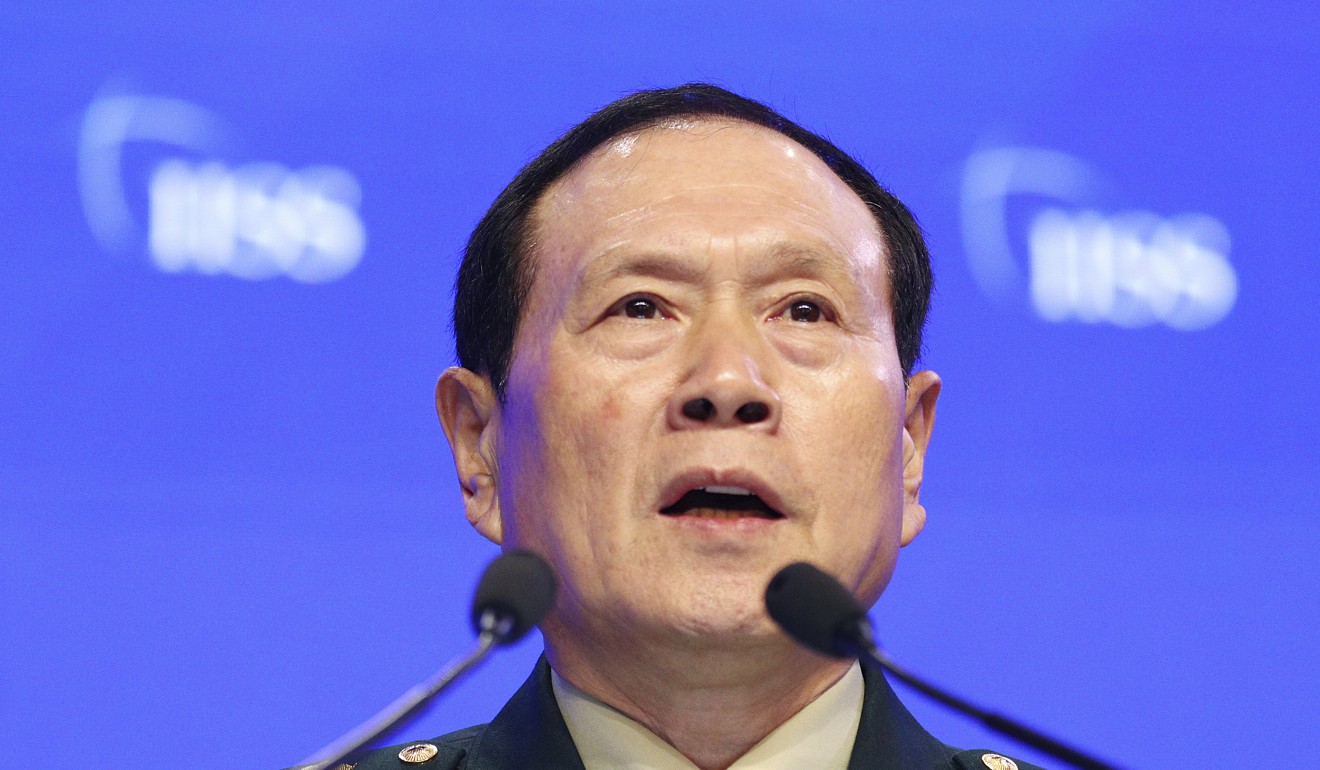
China’s Defence Minister Wei Fenghe told a regional security conference that the South China Sea was an inalienable part of China’s territory. Photo: AP
Although China and Vietnam have said they are looking for a diplomatic solution to prevent confrontations, neither has shown any signs of backing down and tensions have continued to rise.
On Monday, China’s Defence Minister Wei Fenghe told military and defence officials attending a regional security conference in Beijing that the South China Sea was an inalienable part of China’s territory.
“We will not allow even an inch of territory that our ancestors have left to us to be taken away,” he said in his opening speech at the Xiangshan Forum.
Also on Monday, Vietnamese Prime Minister Nguyen Xuan Phuc told lawmakers at the National Assembly that Hanoi would never give any territorial concessions.
“The situation in the South China Sea has become increasingly complicated,” he said. “Our party and state have consistently stated that what belongs to our independence, sovereignty and territorial integrity, we will never give up.”
Last week, Hanoi pulled DreamWorks’ animated film Abominable from theatres over a scene featuring a map that shows Beijing’s self-declared “nine-dash line” in the South China Sea. China uses the U-shaped line to claim sovereignty over more than 80 per cent of the resource-rich waterway, parts of which are also claimed by Vietnam, Malaysia, the Philippines and Brunei.
Ian Storey, a senior fellow at the ISEAS-Yusof Ishak Institute in Singapore, said that the withdrawal of the Haiyang Dizhi might only be “temporary”.
“China has made its point about drilling activities within the nine-dash line and expects Vietnam to suspend further exploration and production activities,” he said. “[But] of course Vietnam won’t.”
China, Malaysia seek to resolve South China Sea disputes with dialogue mechanism
Zhang Mingliang, a specialist in Southeast Asian affairs at Jinan University in the south China city of Guangzhou, said that the Chinese ship’s withdrawal was unlikely to have had anything to do with the comments made by Vietnam.
“I think the main reason is that it had finished its work,” he said. “But the withdrawal could also be seen as an attempt to ease the [China’s] tensions with the US.”
The significance for relations between Beijing and Hanoi was minimal, he said, as the two nations were engaged in one of the world’s most complicated territorial disputes.
“The impact on Sino-Vietnam relations will be limited because there have been too many disputes like this one,” he said.
BEIJING, Oct. 23 (Xinhua) — Chinese authorities demand primary and middle schools to step up education on environment protection and reduce the use of plastic, according to a statement issued Wednesday.
The schools should not force students to use plastic book covers, especially substandard ones, which could damage children’s health, said the statement.
The statement also requires low-carbon consumption in curricular and extracurricular activities and in school management so as to raise the environmental awareness among the students.
Together the two countries are home to more than 80% of the world’s unicorns.
It comes as Washington and Beijing fight a trade war and jostle to become the world’s technology leader.
“China and the US dominate… despite representing only half of the world’s GDP and a quarter of the world’s population,” said Hurun Report Chairman Rupert Hoogewerf.
Chinese payments company Ant Financial tops the list with a valuation of $150bn.
Founded in 2014, Ant Financial’s main business is online payment platform Alipay, which was spun out of e-commerce giant Alibaba.
China’s Bytedance ranks second, with a valuation of $75bn. The fast-growing technology firm owns popular video-sharing platform TikTok.
Chinese ride-sharing company Didi Chuxing rounds out the top three, valued at $55bn.
High-profile US companies including home-rental site Airbnb, office space firm WeWork and electronic cigarette maker Juul also feature in the top 10.
Technology tensions
The report comes at a time of tense relations between the world’s two largest economies.
The US and China have been embroiled in a trade battle for the past year. Their power struggle has also played out in the technology sector, with Chinese telecoms giant Huawei becoming a central part of their dispute.
Vice-ministerial meeting was last held in 2014 as Seoul agreed to the deployment of a US anti-missile system
China and South Korea are expected to resume their vice-ministerial strategic defence dialogue after a five-year break. Photo: Reuters
China and South Korea are set to hold high-level defence talks on Monday for the first time since 2014, when tensions emerged over Seoul’s plans to allow deployment of a US anti-missile system.
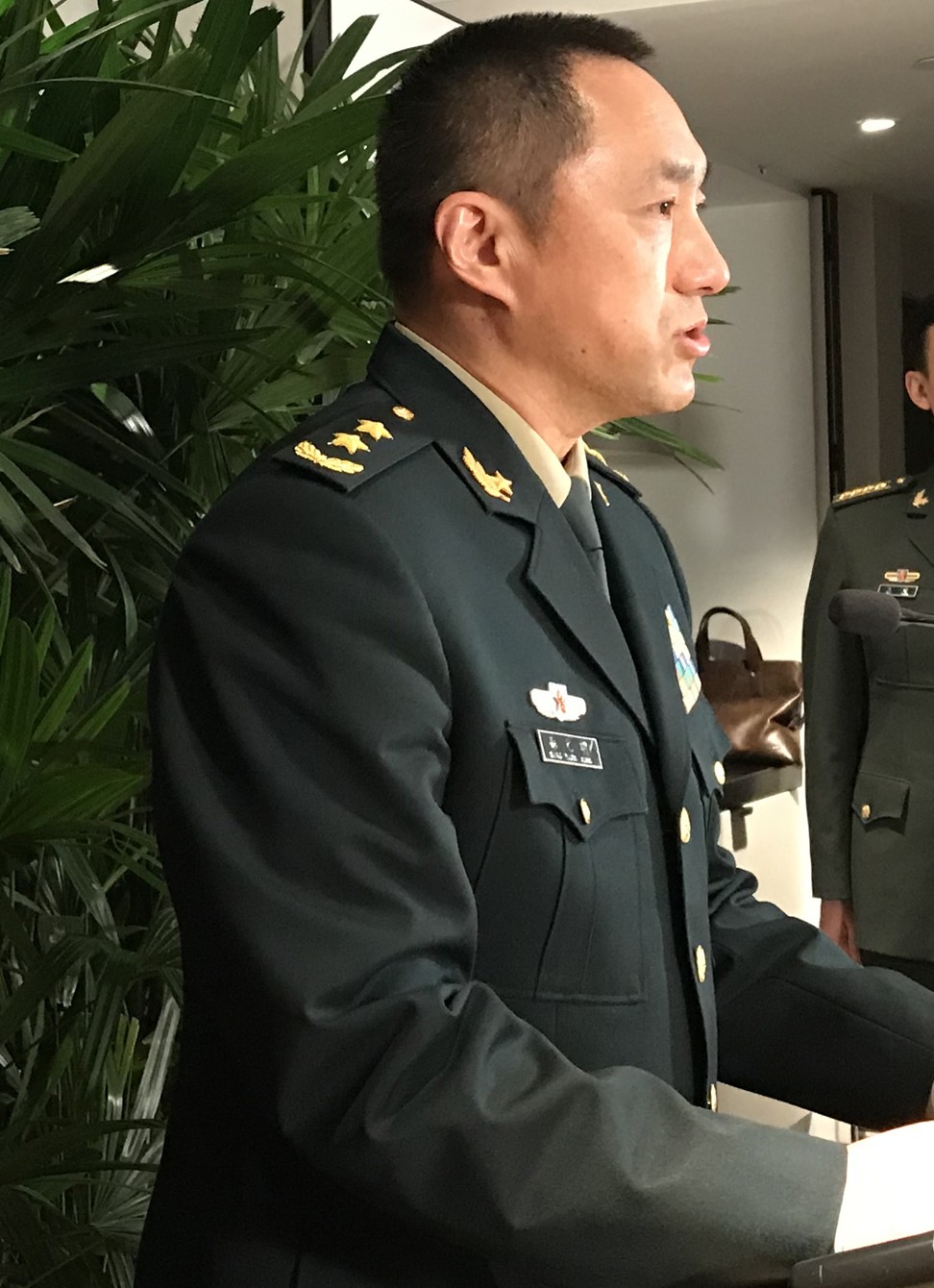
Lieutenant General Shao Yuanming, deputy chief of the Joint Staff Department of the Central Military Commission, is expected to meet South Korean defence vice-minister Park Jae-min in Beijing, according to Yonhap News Agency.
They will talk on the sidelines at the Xiangshan Forum, a three-day gathering on Asia-Pacific security and defence which started on Sunday.
The defence ministry in Seoul said the officials were expected to “have in-depth discussions on the Korean peninsula security conditions and issues of mutual concern”, Yonhap reported.
Lieutenant General Shao Yuenming is expected to resume China’s part in a high-level defence dialogue with South Korea. Photo: Minnie Chan
Relations between China and South Korea were strained by Seoul’s decision to host American Terminal High-Altitude Area Defence system (THAAD) but ties have warmed as both countries have pushed back against pressure from the US.
Washington and Seoul are at odds over a cost-sharing agreement for the US military, with US President Donald Trump demanding South Korea contribute more for the presence of US forces.
Hwang Jae-ho, director of the Global Security Cooperation Centre at Hankuk University of Foreign Studies in Seoul, said the meetings, formally known as the China-South Korea vice-ministerial strategic defence dialogue, resumed mainly because the countries now had more mutual interests.
Seoul fears US is delaying envoy’s approval in retaliation for scrapping of security pact, sources say
“Now China has to make more friends in the international community as its ties with the United States have gone bad, and South Korea is looking for China to help rein in Pyongyang. At a time like this, it’s inevitable for the two countries to want to move closer,” Hwang said.
The deployment of THAAD, a proposed military hotline, and South Korea’s air defence identification zone are expected to be high on the agenda.
First held in 2011, the defence dialogue was hosted alternately by Seoul and Beijing. It was suspended in 2015 when South Korea, then under president Park Geun-hye, said it was considering THAAD as a deterrent against North Korea’s nuclear ambitions.
Beijing disapproved and said China was the real target. Each country then placed unofficial economic and cultural bans on the other. These included Chinese sanctions against South Korea’s Lotte supermarket chain and a ban on TV airtime for South Korean bands.
Tensions began to slowly ease after November 2017, when the two countries said they had decided to set aside their differences and advance their strategic partnership. Seoul also promised not to host additional THAAD missiles nor join a US-led missile defence system that involved Japan.
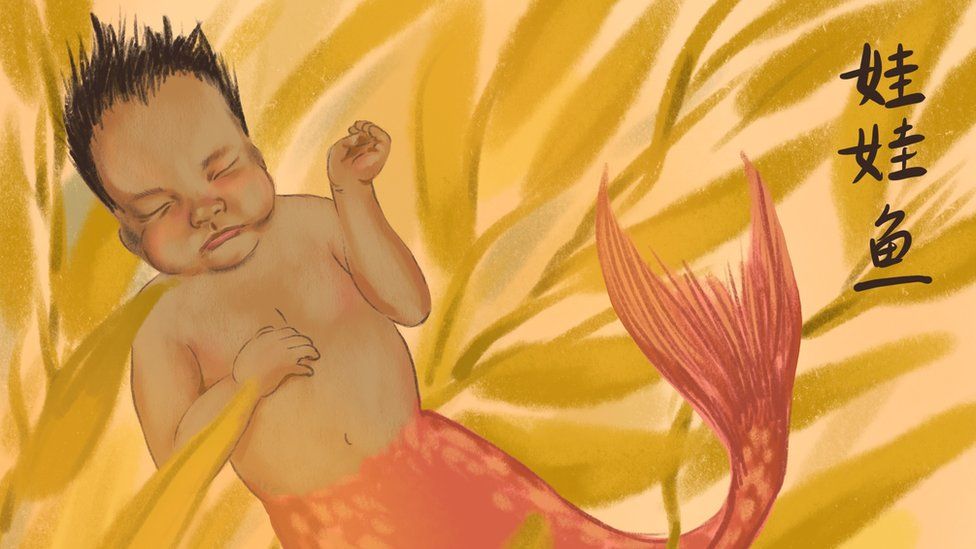
Image copyright FRANKIE HUANGImage caption The Giant salamander is ironically referred to as a “baby fish” in China
What do you get when you cross a baby with a fish?
It’s not the start of a dad joke, but one of a series of pictures drawn by Shanghai-based illustrator Frankie Huang.
Chinese is already one of the most pictorial languages in the world, but she’s taking it to the next level – by literally turning words into pictures. Her series, Putong Animals, re-imagines animals according to what they’re called in Mandarin Chinese – or Putonghua – the official language of China.
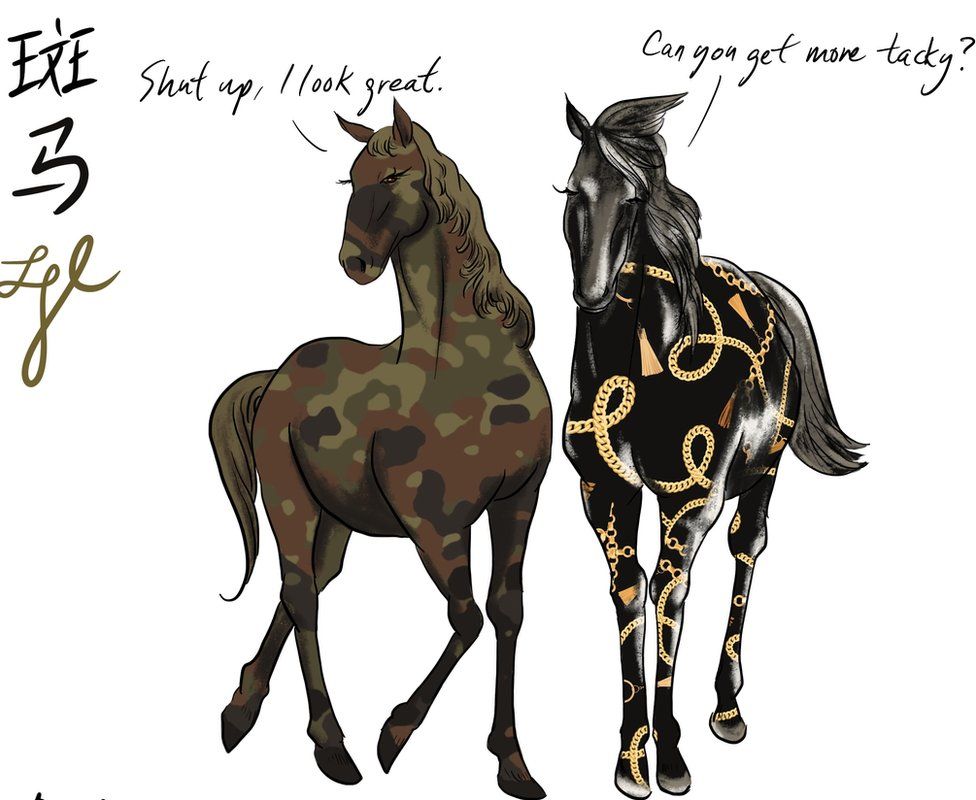
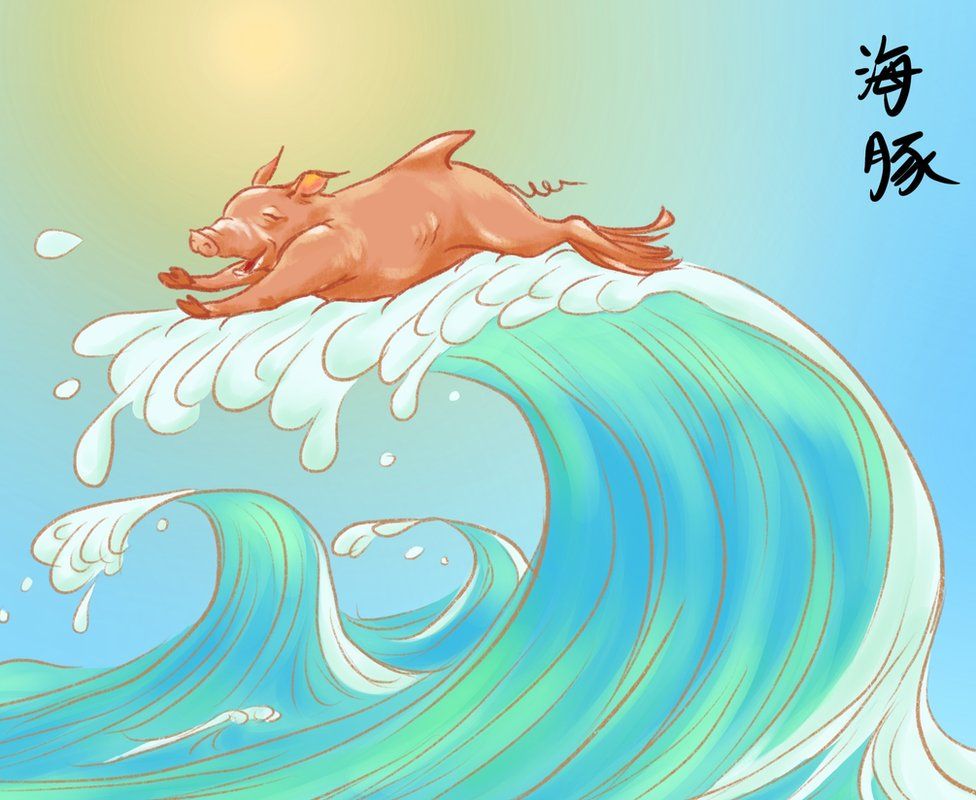
In Mandarin a zebra, for example, is literally a “patterned horse”. The dolphin has unflatteringly been turned into a “sea pig”.
Image copyright FRANKIE HUANGImage caption The Zebra is referred to literally as a “patterned horse” in Mandarin
Frankie says she came up with the idea for the series after seeing people on Twitter discussing how some animals had “really funny names when you translate them literally”.
“I realised no-one had done a series of this and I thought to myself ‘I suppose it’s time then’,” she told the BBC. “I wanted to create something that was not just pretty but also interesting.”
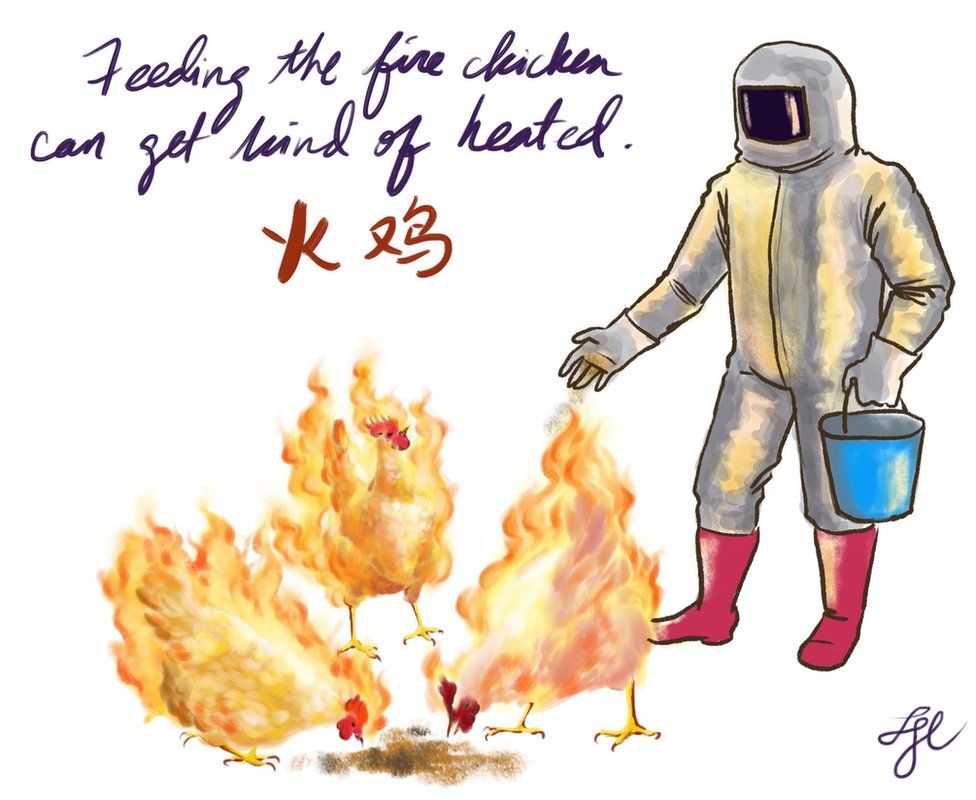
Image copyright FRANKIE HUANGImage caption Turkeys are “fire chickens” in Mandarin
“The turkey – or fire chicken – was the first one I drew. It was just a bunch of chickens on fire and a guy in a hazmat suit feeding them,” she said. “You can see that my technique actually developed as I got more into it.”
Frankie was born in the Chinese capital, Beijing, but grew up in the US, exposing her to both English and Mandarin from a young age.
“I’m both an outsider and insider [to the Chinese language] because of my upbringing, I think sometimes you need to be an outsider in order to really appreciate something,” said the illustrator.
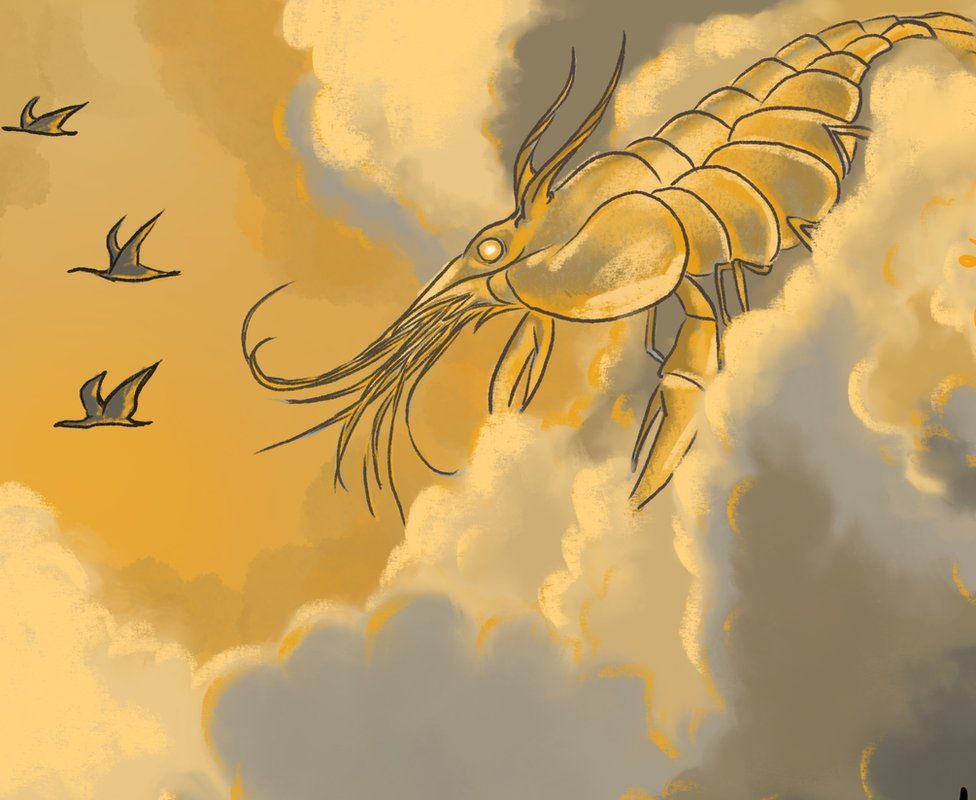
Image copyright FRANKIE HUANGImage caption The celestial lobster is known as a “dragon prawn”
Another one of Frankie’s favourite illustrations is the “dragon prawn” – or lobster.
“I wanted to make it look really majestic and godlike,” said Frankie. “Someone commented that it’s a celestial crustacean, I thought that was such a nice name for it.”
Image copyright FRANKIE HUANGImage caption While the dolphin is given the less than graceful name of “sea pig”
It takes Frankie around three hours to produce one illustration, from conceptualisation to sketching it out and eventually colouring it in.
She has for now completed her series on Putong Animals, but she is looking into turning the animals into characters of their own.
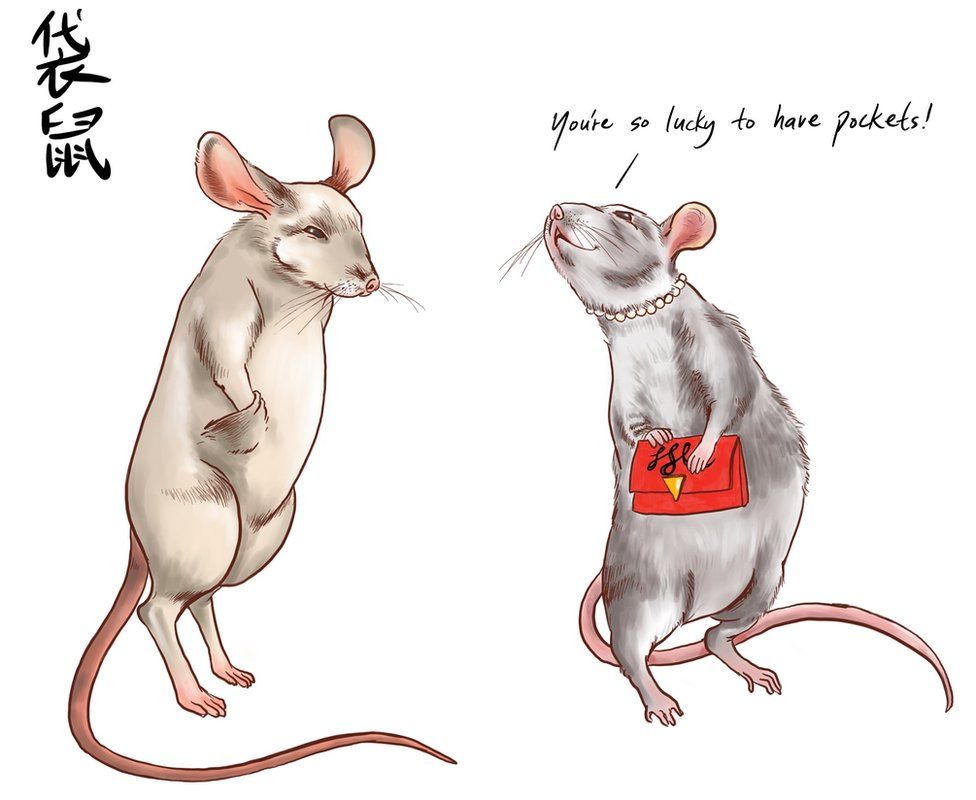
Image copyright FRANKIE HUANGImage caption Kangaroos are known as “pocket mice”, though they are far from tiny
“Even as far back as ancient Greece with Aesop’s fables, people were telling stories through animals,” she said.
“I actually started to write a story about the lives of the fire chicken. They’re on a planet where people use them in their lives, [like] putting them under their beds during winter to keep them warm. I want to eventually give them more personality.”
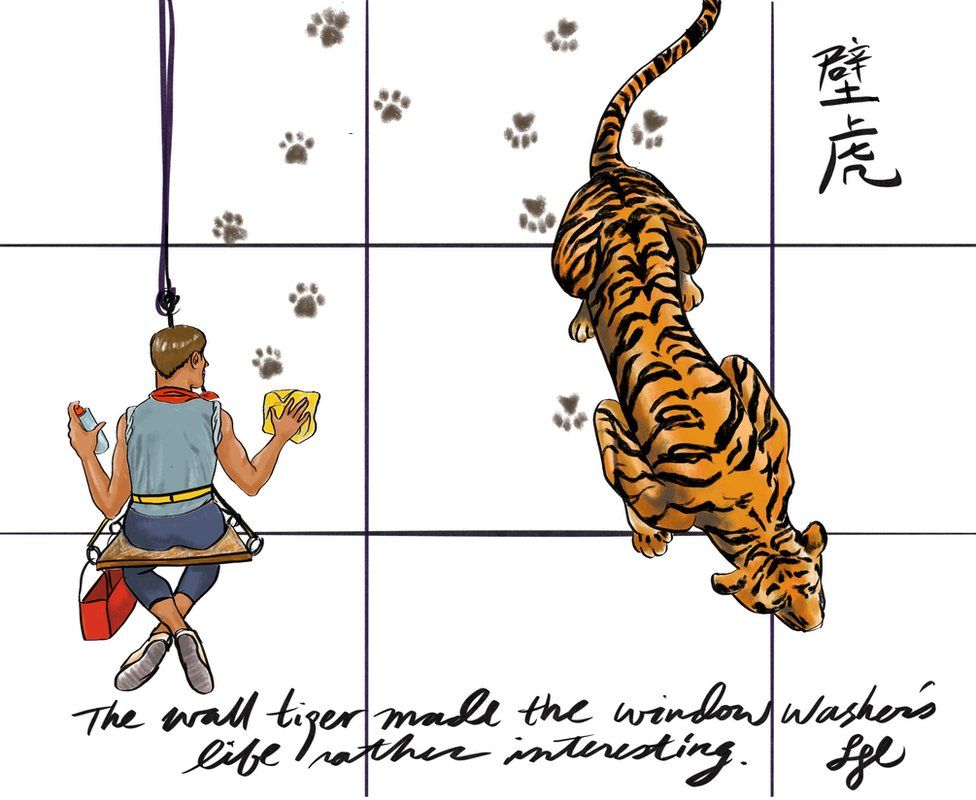
Image copyright FRANKIE HUANGImage caption The tiny gecko on the other hand, has earned the imposing name of “Wall Tiger”
But it’s not just animals that she illustrates – she’s also delved into Chinese phrases.
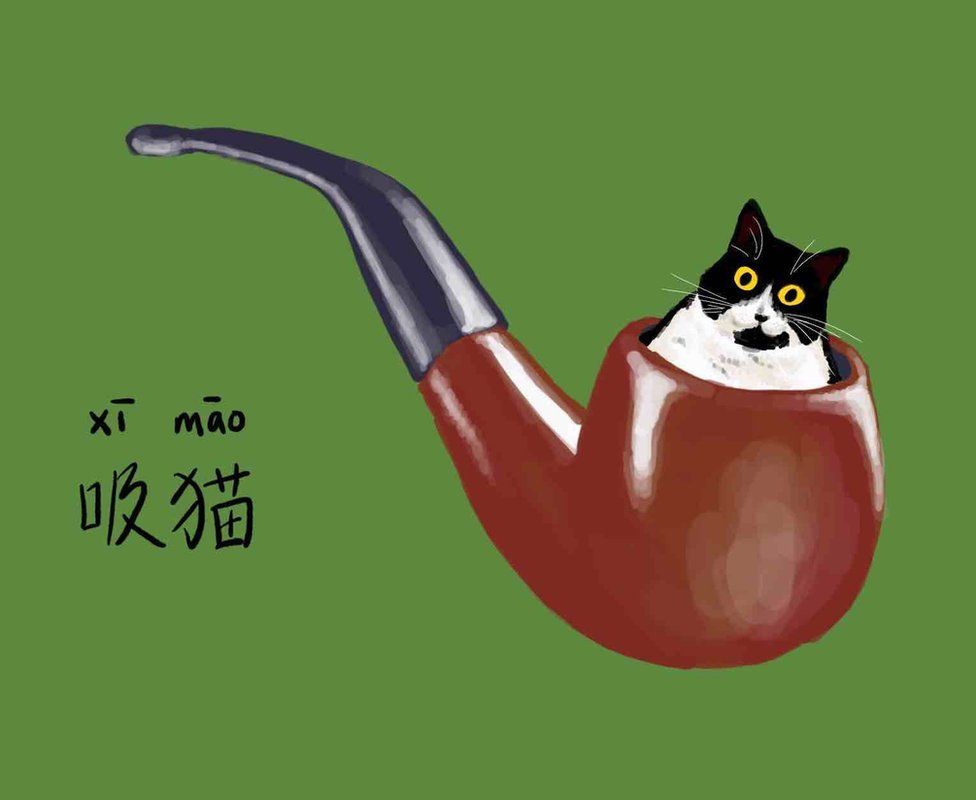
This picture showing a cat in a pipe is meant to illustrate the Chinese phrase “xi mao”, which literally translated, means to “inhale cat”.
Image copyright FRANKIE HUANGImage caption If someone is addicted to cats, they are “inhaling cat”
It’s a phrase that’s spread across young people in China, to describe someone who is a cat addict.
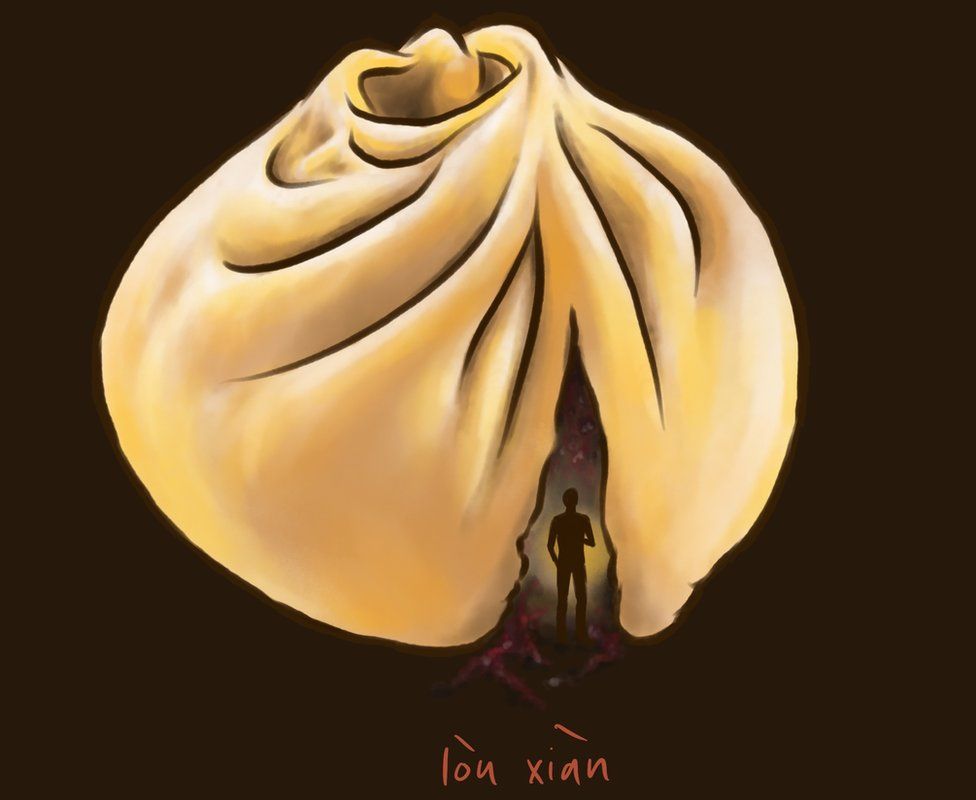
Another one she’s done shows stuffing spilling out of a dumpling – a literal translation of the Chinese phrase “lou xian”, or “for stuffing to leak out”. The phrase refers to a situation where truth is revealed.
“If you look closer, you’ll actually see some tentacles coming out of the dumpling, because I drew it after I watched Stranger Things 3,” Frankie laughingly admits.
Image copyright FRANKIE HUANGImage caption And the stuffing is out on this one
But she’s of course not the first person to have put a clever play on Chinese words – and sometimes others have done so for more political reasons.
Social media in China is heavily censored, and it’s not uncommon for social media companies in China to remove “sensitive” content. This was one of the obstacles that #MeToo – the movement that encouraged people to openly talk about their experiences of sexual harassment – faced in China.
The phrase #MeToo was heavily censored but to get around this, many instead began posting the Chinese words “rice bunny”, which is pronounced “mi tu” in Mandarin.
“One of the things that made me look more closer into pulling together and dissecting the Chinese language was the [phrase] mi tu,” said Frankie.
“The censorship forces [Chinese people] to constantly stay ahead of the government so they come up with these wonderful creations, sort of like how diamonds are created under enormous pressure. All these gems of wit are found on the Chinese internet.”
This is part of what Frankie hopes her illustrations will do – help people to recognise “humour and wit of the Chinese culture”.
“I want to hopefully reach more people to help them be interested in the Chinese language and culture,” she said.
“In this day and age, China is in the press constantly. [I want to show] there’s so much more to China than just the politics.
“I want to be independent of all these things and show people that you can love and enjoy the culture without all the politics. The politics are new, but this [language] is not.”
on Saturday reiterated his promise to keep opening up the nation’s markets to companies and investors from around the world.
“The door of China’s opening up will only open wider and wider, the business environment will only get better and better, and the opportunities for global multinational companies will only be more and more,” he said in a congratulatory letter read out by Vice-Premier Han Zheng at the inaugural Qingdao Multinationals Summit in the east China city.
The two-day event, which ends on Sunday, was organised by China’s commerce ministry and the provincial government of Shandong with the aim, according to its website, of giving multinational companies “the opportunity to articulate their business values and vision” and “promote cooperation with host countries”.
In his letter, Xi praised multinational companies for the role they had played in China’s opening up and reform over the past four decades, describing them as “important participants, witnesses and beneficiaries”.
China was willing to continue opening up to benefit not only itself but the world as a whole, he said.
“Only when the world is good, China is good. Only when China is good, can the world get better.”
Despite its upbeat tone, Xi’s message comes as Beijing is facing intense scrutiny from the international business community over its state-led economic model – one of the main bones of contention in its trade war with the US – and its attempts to prevent foreign firms from speaking out on issues it deems too sensitive, from Hong Kong to human rights.
Foreign firms have also long complained about the barriers they face when trying to access China’s markets and the privileged treatment it gives to state-owned enterprises. Even though Beijing has promised to reform its state sector, foreign businesses have complained of slow progress, and just last month the European Union Chamber of Commerce urged the EU to take more defensive measures against China’s “resurgent” state economy.
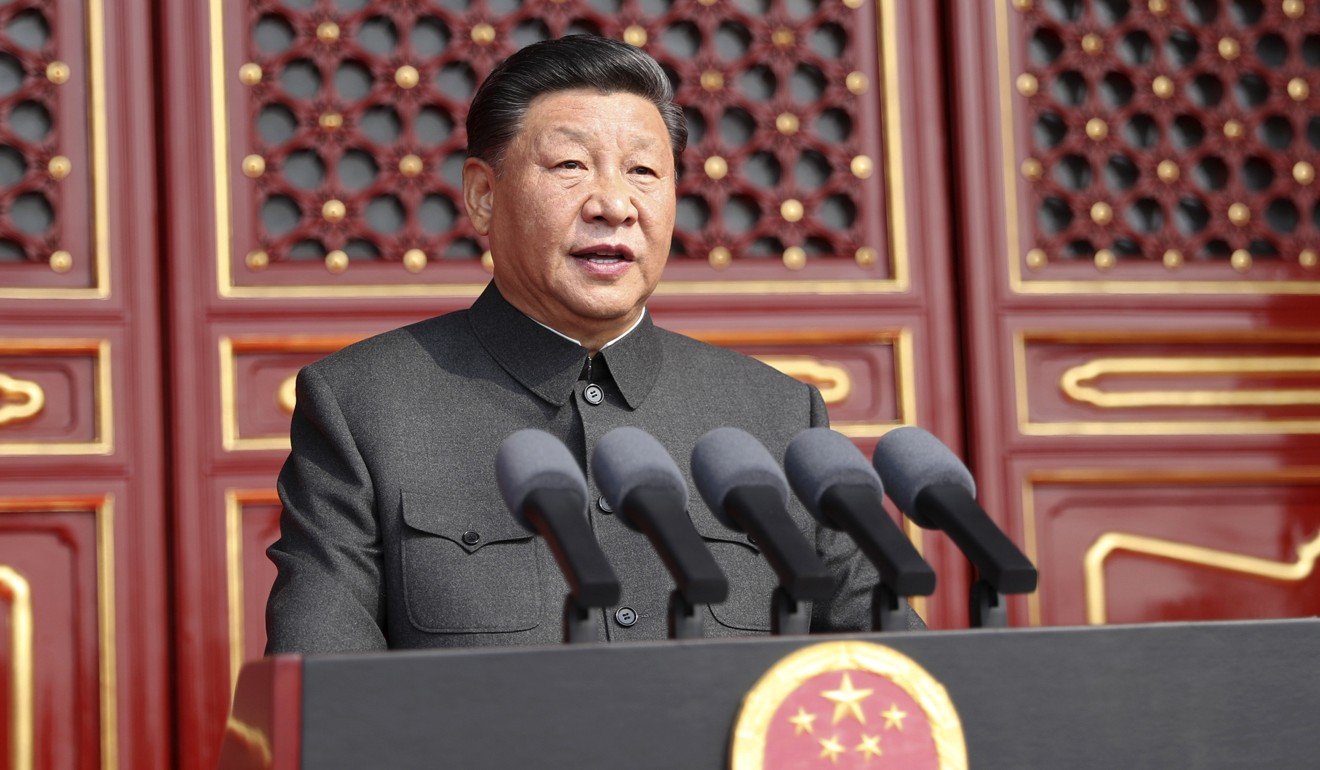
Xi promised “more and more” opportunities for global firms. Photo: AP
Sheman Lee, executive director of Forbes Global Media Holding and CEO of Forbes China, said at the Qingdao summit that foreign firms were facing a difficult trading environment in the world’s second-largest economy.
“Multinationals have seen their growth in China slow in recent years because of the growing challenge from local firms, a gradually saturating market and rising operation costs,” he said.
Craig Allen, president of the US-China Business Council, said that many multinational companies were reluctant to release their best products in China out of fear of losing their intellectual property.
China still not doing enough to woo foreign investment
In his letter, Xi said that over the next 15 years, the value of China’s annual imports of goods would rise beyond US$30 trillion, while the value of imported services would surpass US$10 trillion a year, creating major opportunities for multinational companies.
China would also reduce tariffs, remove non-tariff barriers and speed up procedures for customs clearance, he said.
Commerce Minister Zhong Shan said at the opening ceremony that China would also continue to improve market access and intellectual property protection.
The country supported economic globalisation and would safeguard the multilateral trade system, he said, adding that it was willing to work with the governments of other countries and multinational corporations to promote economic globalisation.
Xi Jinping says the value of China’s annual goods imports will rise beyond US$30 trillion over the next 15 years. Photo: Bloomberg
The promise to continue to open up China’s markets came after the State Council
– the nation’s cabinet – made exactly the same pledge at its weekly meeting on Wednesday.
After the latest round of trade war negotiations in Washington, Beijing said it had achieved “substantive progress” on intellectual property protection, trade cooperation and technology transfers, all of which have been major bones of contention for the United States.
Despite its pledge to welcome multinational companies into its market, China is in the process of creating a list of “unreliable foreign entities” it considers damaging to the interests of Chinese companies. The roster, which is expected to include FedEx, is seen as a response to a similar list produced earlier by the United States.
Xi’s gesture would also appear to have come too late for South Korean multinational
, which announced on October 4 it had ended the production of smartphones at its factory in Huizhou, Guangdong province – its last in China – with the loss of thousands of jobs.
Vice-Premier Hu Chunhua will lead delegation at two-day summit that is expected to be attended by 400 officials and 200 businesspeople
Observers say it is Beijing’s latest effort to regain momentum in the region and will be closely watched in the US
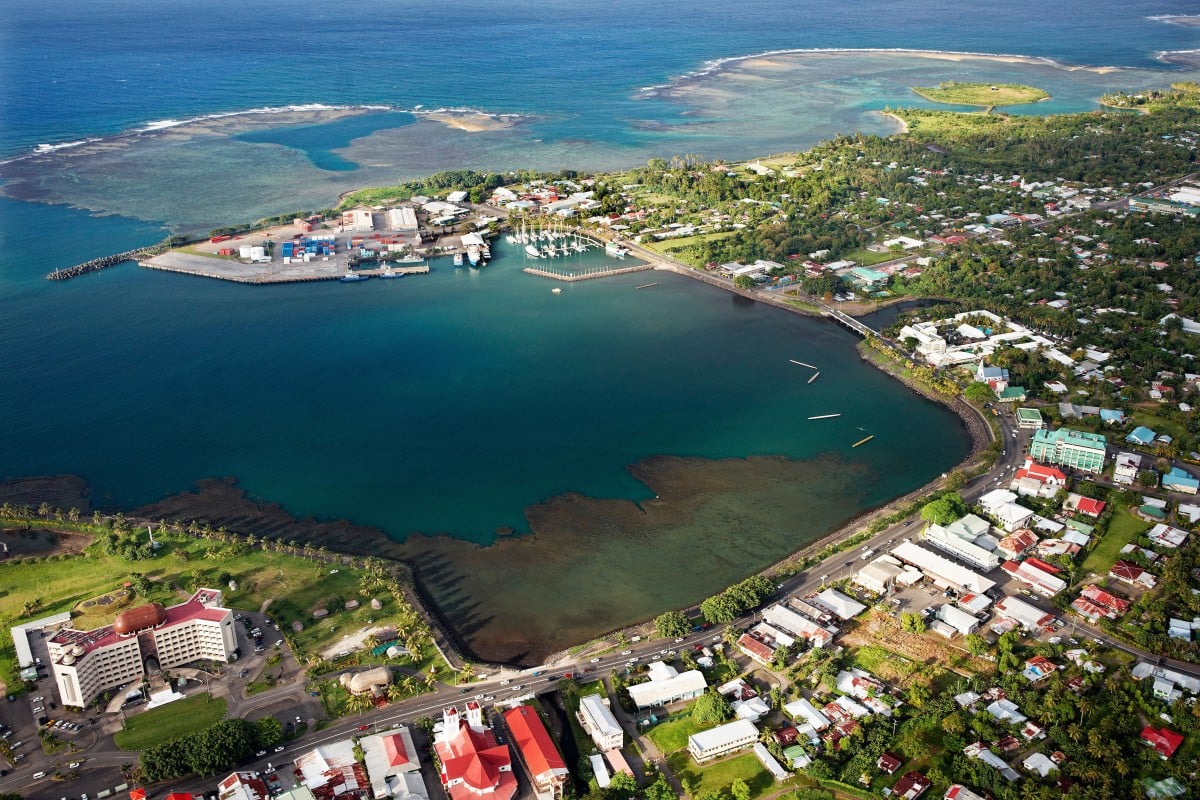
Samoan capital Apia will host the third China-Pacific Island Countries Economic Development Cooperation Forum, which begins on Sunday. Photo: Alamy
China will seek to expand its economic and diplomatic influence in the South Pacific at a forum this weekend, amid growing concern from the US and its allies over Beijing’s push in the strategically important region.
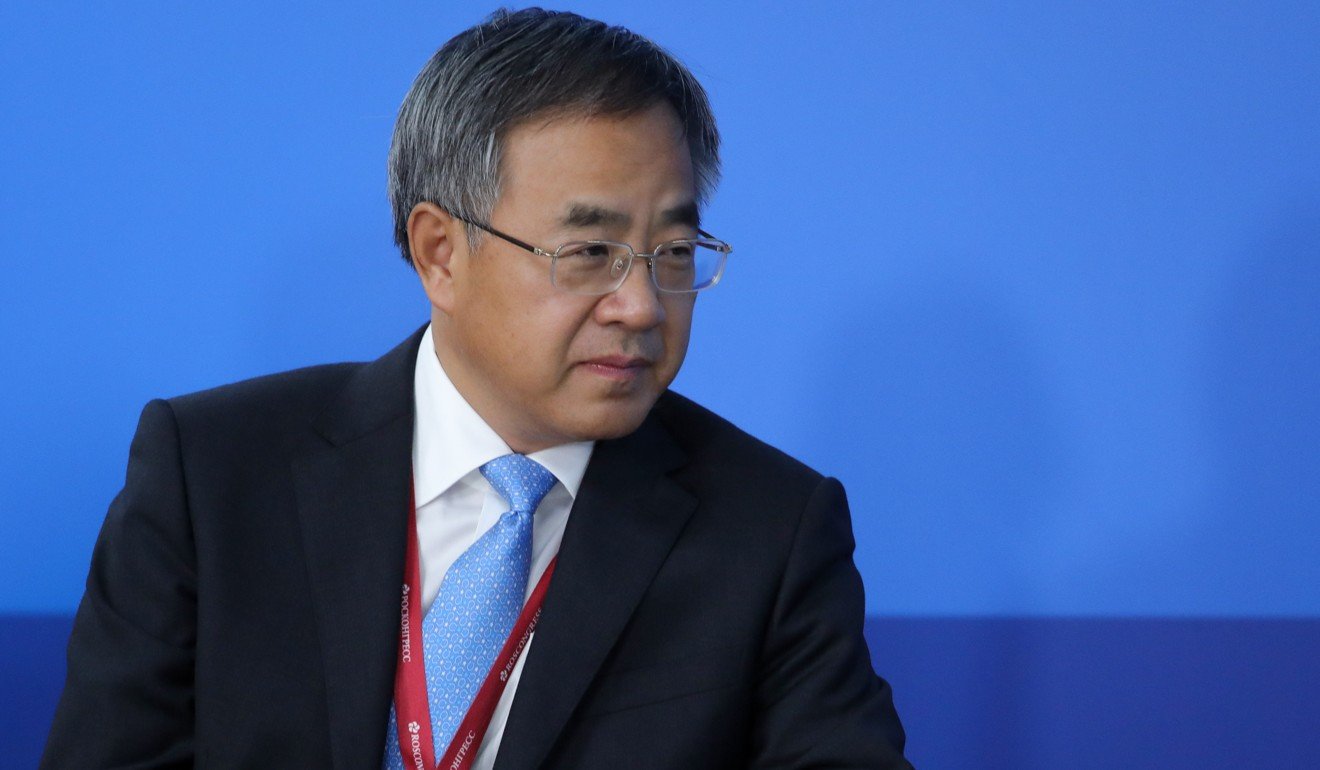
Vice-Premier Hu Chunhua will lead the Chinese delegation at the third China-Pacific Island Countries Economic Development Cooperation Forum in the Samoan capital Apia, which begins on Sunday. It is expected to be attended by 400 officials and more than 200 businesspeople.
Hu, the former Communist Party chief of China’s manufacturing powerhouse Guangdong who now overseas commercial and agricultural affairs, is expected to deliver a keynote speech at the opening ceremony.
Beijing sees the two-day forum as “timely” and “a good opportunity to deepen mutually beneficial cooperation between China and the Pacific”, a commerce ministry spokesperson told the official Economic Daily newspaper.
Trade, agriculture and fisheries, as well as tourism, infrastructure and climate change were at the top of the agenda for the forum, the spokesperson said.
Leaders of all the Pacific nations – except the four that do not have formal diplomatic ties with Beijing – are expected to attend the forum. Australia, which has “observer status” at the summit, will send Ewen McDonald, deputy secretary of the Department of Foreign Affairs and Trade and the head of its Pacific office.
Vice-Premier Hu Chunhua will lead the Chinese delegation at the forum. Photo: EPA-EFE
The forum comes after China hailed a “new breakthrough” in the region following the decision last month by the Solomon Islands and then Kiribati – despite warnings from the US – to cut diplomatic ties with Taipei and switch to Beijing.
They are the latest of Taipei’s allies to be poached by Beijing as it ramps up pressure on the self-ruled island that it sees as a renegade province to be reunited with the mainland, by force if necessary.
Observers said this weekend’s forum was Beijing’s latest effort to regain momentum in the Pacific.
“Having one of China’s top 25 officials visit the region so soon after [Chinese President] Xi Jinping spent close to three days in Papua New Guinea last November is certainly significant,” said Jonathan Pryke, director of the Pacific Islands programme at the Lowy Institute in Sydney, referring to Hu’s position in the 25-member Politburo.
“It shows clearly China’s attempt to recapture momentum after the West, and in particular Australia, have redoubled their efforts in maintaining and building relationships in the Pacific,” he said.
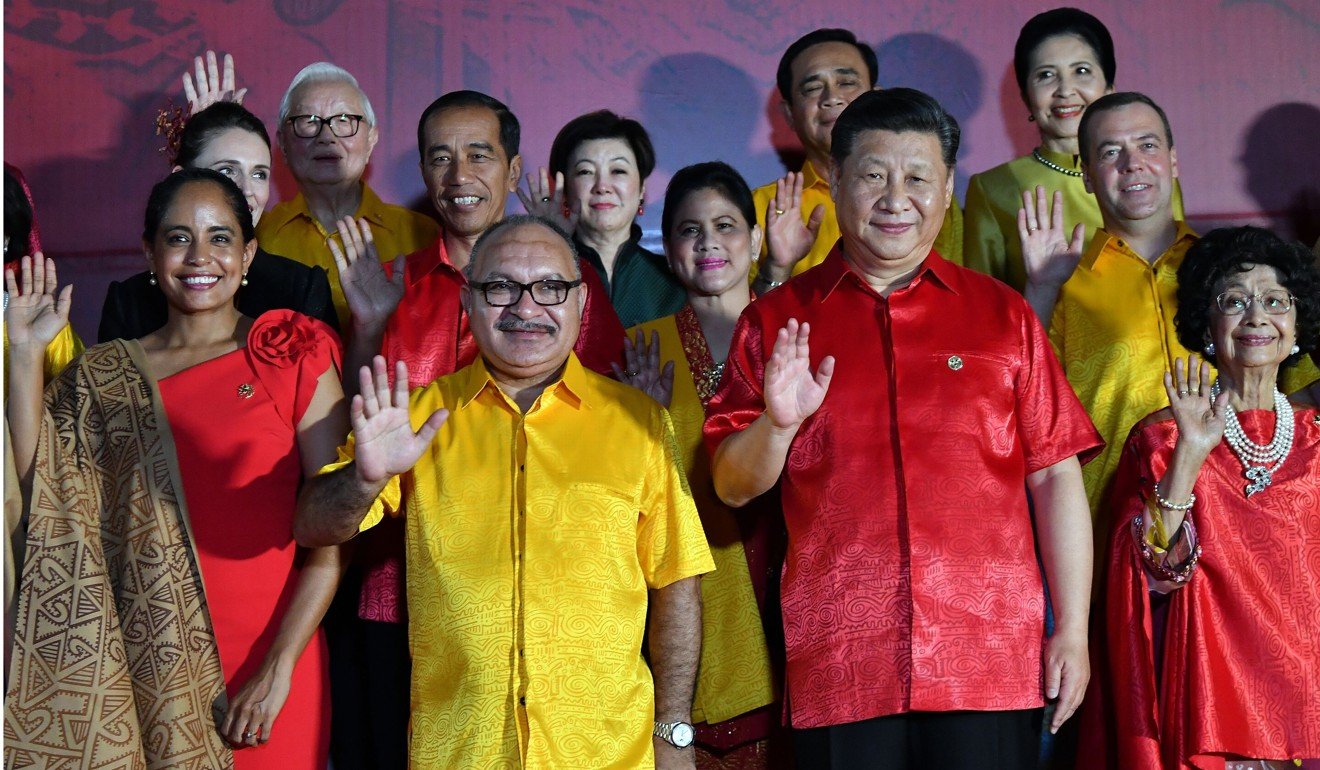
Papua New Guinea’s Prime Minister Peter O’Neill (second from left) and Chinese President Xi Jinping (second from right) pose for a photo during Xi’s visit in November. Photo: AFP
First held in Fiji in 2006, the forum is part of China’s efforts to expand its reach in the resource-rich region.
Back then, premier Wen Jiabao announced 3 billion yuan of concessional loans to Pacific nations and promised to facilitate more trade, medical aid and tourism with the countries. Chinese capital has been pouring into the region – particularly from the mining and fisheries sectors – ever since.
Of note was a 440 million yuan investment, supported by loans from the Export-Import Bank of China, to build a central business centre at Nuku’alofa, the capital of Tonga.
US and allies sideline China in PNG’s Bougainville by helping fund independence vote
As China’s influence grows, the South Pacific – a region traditionally under US hegemony, and on Australia’s doorstep – has “increasingly become a major power that cannot be neglected” and “an important part of China’s greater strategic landscape”, according to Shi Chunlin, an associate professor at Dalian Maritime University.
Trade has increased between China and the eight Pacific nations that have diplomatic ties with Beijing, rising to a combined US$4.32 billion last year – up 25 per cent from 2017.
China has also become the largest trading partner of new ally the Solomons, the second-largest to Papua New Guinea and Fiji, and the third-largest to Samoa.
China’s direct investment in the region has also jumped, reaching US$4.53 billion last year, a more than fourfold increase from the US$900 million of 2013.
Pryke said Beijing was expected to offer new support and loans to the Pacific nations.
“But the Pacific are much more picky about how they want to engage with all partners than they were a decade ago,” he added.
Returning from a trip to China earlier this month, Solomon Islands Prime Minister Manasseh Sogavare confirmed Beijing would provide a US$74 million grant to build a new stadium for the 2023 Pacific Games in the capital Honiara – something its former ally Taipei had committed to fund.
China Sam Group also reportedly signed an agreement on September 22 to lease the island of Tulagi in the Solomons, the site of a former Japanese naval base. The agreement mentioned the development of a refinery on the island, but critics said it could also potentially be used as a military base.
China is now the second-largest donor in the region, only after Australia, which has viewed Beijing’s financial largesse with suspicion.
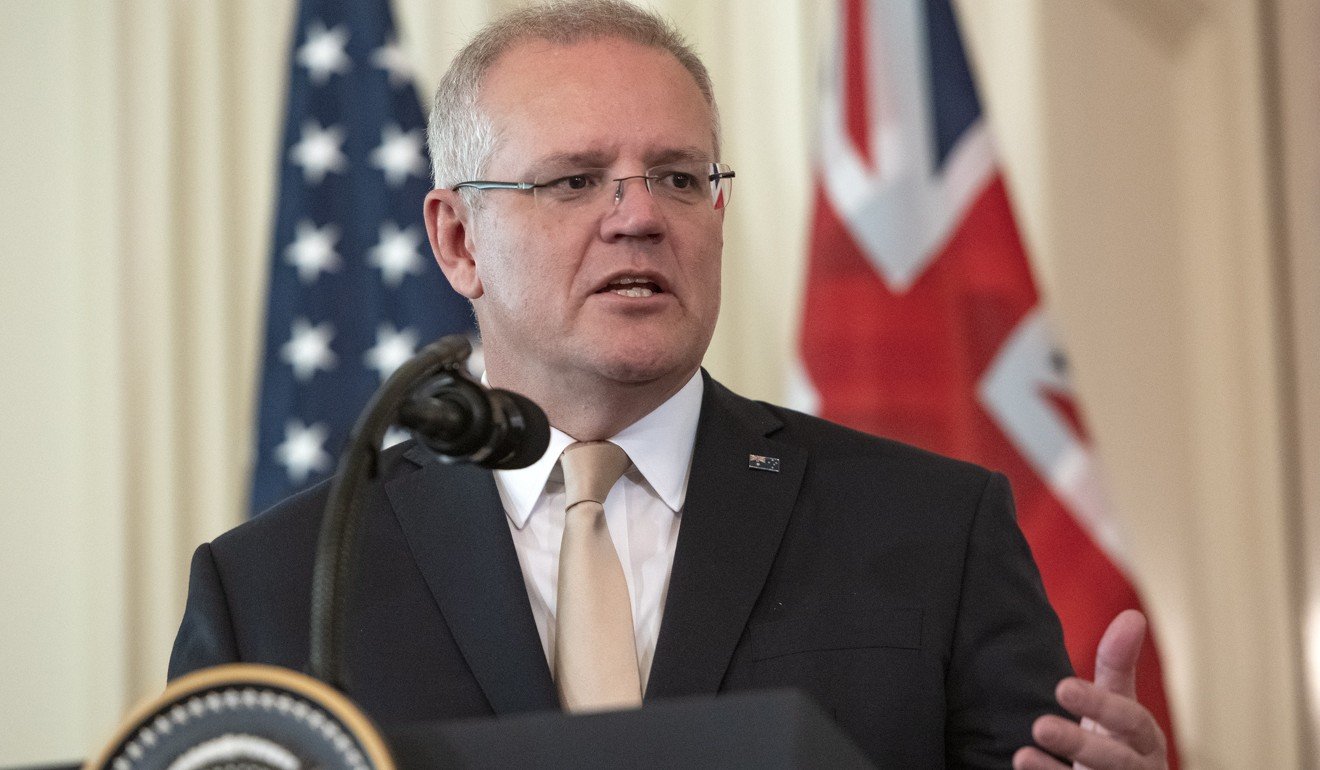
Last year, in an apparent effort to counter China’s rising influence in the region, Australian Prime Minister Scott Morrison announced that Pacific countries would be offered up to US$2.18 billion in grants and cheap loans to build infrastructure.
Australian Prime Minister Scott Morrison last year announced up to US$2.18 billion in grants and cheap loans for infrastructure in Pacific nations. Photo: EPA-EFE
The US, meanwhile, has also been wary of China’s push in the Pacific, amid an escalating geopolitical competition between the world’s two largest economies across many fronts – from trade to tech supremacy and security. The US has long maintained exclusive defence access in the region through its Guam military base and security pacts with the Federated States of Micronesia, the Marshall Islands and Palau.
Derek Grossman, a senior defence analyst with the US-based Rand Corporation, said this year’s forum in Samoa was likely to be higher profile than previous years after Beijing lured away two more diplomatic allies from Taipei.
He said it would be “closely watched in the US for how Beijing continues to leverage sweet economic deals via its Belt and Road Initiative to potentially entice others to switch”.
“The US, along with close friends Australia, Japan and New Zealand, are becoming increasingly concerned over the prospects for China to one day curry enough influence in these small island states to gain port access that could be used for new naval bases,” he said.
The most important issue at the forum, he said, would be “whether the West assesses that China is making further inroads with these states”.
“The likely answer will be that it is, suggesting that the US and its partners will have to compete with China in this region to ensure that it remains ‘free and open’, per the US Indo-Pacific strategy,” he said.







 CHINDIA ALERT: You'll be living in their world, very soon