07/07/2019
TOKYO, July 6 (Xinhua) — “When I wrote the letter, I didn’t expect to receive a reply from President Xi Jinping. I was surprised and honored,” said Daichi Nakashima with excitement.
The 27-year-old Japanese man said he had received the reply from Xi before the Chinese leader attended the Group of 20 summit in Osaka. “When my friend told me on WeChat, I was shocked!” Nakashima said in an exclusive interview with Xinhua.
Nakashima had several times been a winner in the Panda Cup Japan Youth Essay Contest. Founded in 2014, the competition is co-sponsored by People’s China magazine, the Chinese embassy in Japan and the Japan Science Society, aiming to help Japanese youths have a more comprehensive, objective and rational understanding of China.
Nakashima began learning Chinese in college and has participated in several short-term exchange programs in China.
When talking about his original intention of writing a letter to Xi, Nakashima said, “I wanted to convey the warmth and friendship of the Chinese people I felt during my visit to China and the importance of mutual understanding and exchanges between Japanese and Chinese youths.”
Xi, in his reply, said he was glad to see that Nakashima has been studying the Chinese language and literature for a long time and, by participating in essay contests and exchange activities in China, has learned more about China and strengthened his bonds with Chinese friends.
“It’s the best affirmation and recognition of my persistence for so many years. I’m very touched,” Nakashima said.
Born in 1992, Nakashima first learned about China through classics like “Romance of the Three Kingdoms” and “Outlaws of the Marsh,” but it was a two-week trip to Tianjin in 2011 that gave him a glimpse of a vibrant China.
After that, he visited Beijing, Sichuan, Guangdong and other places. Last year, he went to Fudan University in Shanghai and studied for half a year.
Nakashima found that Chinese youth are very familiar with Japanese anime, music and so on, while Japanese youngsters do not know much about China. Their impression of China is restricted to Chinese tourists, “not knowing about Chinese movies and popular music,” he said.
Nakashima said he believes that the friendship between the two peoples needs more bilateral youth exchanges, as President Xi said in the letter.
Noting that China and Japan are close neighbors separated by only a narrow strip of water, Xi said the friendship between the two countries is rooted in the people, and that the future of the friendship between the two peoples is in the hands of the young people.
Xi said he hopes that the youth of China and Japan will strengthen exchanges and mutual learning, enhance mutual understanding, develop long-lasting friendships, and contribute to creating an even brighter future for bilateral relations.
Xi also encouraged Nakashima to continue to promote the China-Japan friendship. Nakashima said this is an encouragement, a mission and also motivation for him to move forward.
Nakashima graduated with a master’s degree in April and has begun to work in a publishing house. He has been determined to introduce excellent works such as Chinese picture books and science fiction to Japan, so that Japanese teenagers can feel the affinity between the two countries.
“I have met many friendly Chinese people and made many friends that are very important to me. In the future, I will continue to make efforts to help Japanese and Chinese youth deepen mutual understanding,” he said.
Source: Xinhua
Posted in Beijing, Chinese embassy in Japan, comprehensive, contributions, Daichi Nakashima, Fudan University, Group of 20 (G20), guangdong province, inspires, Japan Science Society, Japan-China friendship, Japanese youth, letter, master's degree, objective, Osaka, Outlaws of the Marsh, Panda Cup Japan Youth Essay Contest, People's China magazine, President Xi, publishing house, rational understanding, Romance of the Three Kingdoms, Shanghai, shocked, sichuan province, Tianjin, Uncategorized, WeChat |
Leave a Comment »
06/07/2019
TIANJIN/BEIJING, July 6 (Xinhua) — Even at the age of 100, Yang Enze, one of the founders of China’s optical communication, does not stop his research and teaching as a professor at Tianjin University.
Besides his pioneering achievements as the chief engineer of China’s first optical communication project for practical use in the 1970s, Yang is also known as a survivor and a witness of the war of Japanese aggression against China.
“I was admitted to Wuhan University in 1937, the year when Japanese troops attacked the Lugou Bridge, also known as Marco Polo Bridge, on the outskirts of Beijing, on July 7,” said the senior recalling the start of his academic study.
The incident marked the beginning of Japan’s full-scale war against China during World War II and triggered China’s full-scale resistance against the invasion.
Ahead of the 82nd anniversary of the incident that falls on Sunday, Yang said because of the war, his university in central China’s Hubei Province was relocated to southwestern province of Sichuan to avoid the enemy forces. “Even in Sichuan, there were a lot of Japanese bombings, but none of the students missed any of the classes as long as there was no air-raid siren,” he recalled.
It was at that time he and many of his peers cemented the belief that the country needed advanced science and technology for reconstruction and revival.
“I have always kept in mind late chairman Mao Zedong’s words that it was Japanese militarists’ crime that was to blame for the war, not Japanese civilians, ” Yang said, noting that he still gets in touch with many Japanese scholars.
He established the first optical communication laboratory in Tianjin in 1985, when he was invited to teach at Tianjin University. In Yang’s career, he has made friends with several leading experts from Japan at international conferences and even kept friendship with some of them.
Also in Tianjin, Morita Naomi, a Japanese language teacher in Nankai University, works as a consultant to the school’s research institute of Zhou Enlai-Daisaku Ikeda.
“By involving in the research of the friendship between the late Chinese premier and the Japanese philosopher, I want to search for the core factors that help consolidate the friendship between the two peoples,” said Naomi.
She came to Nankai to pursue a master-degree study in Modern Chinese and Chinese Literature in 2010 and has stayed ever since.
When she first arrived, she had troubles even in learning Chinese phonics. Now she can read and speak Chinese fluently, write beautiful Chinese characters, and study ancient Chinese literature independently.
As a teacher, she feels frustrated that most of her Chinese students are more likely to be attracted by Japanese animation and games rather than Japanese literature.
According to the school’s statistics, nearly half of the undergraduates in the 2019 class of Japanese major chose to work in Japanese-funded enterprises or Japanese-related enterprises after graduation.
Naomi said Japanese visitors to China are more likely to choose destinations like Beijing, Shanghai and Guangzhou. Peking University in Beijing impresses young Japanese most.
According to a report released by the China Tourism Academy, China received 2.69 million Japanese visitors in 2018, making Japan China’s fourth largest source of foreign tourists. In the same year, Chinese made 9.06 million outbound visits to Japan as a direct destination.
The academy released the report at the 2019 China-Japan Tourism Forum Dalian held on May 26, which focused on promoting win-win cooperation on cultural exchanges and tourism between the two countries.
China and Japan agreed to push forward bilateral relations along the right track of peace, friendship and cooperation, at the summit of the Group of 20 (G20) major economies held in Osaka, Japan, in June.
This year marks the 70th anniversary of the founding of the People’s Republic of China, and Japan has also entered the Era of Reiwa. It is also the China-Japan Youth Exchange Promotion Year, for promoting friendship and cooperation in a wide range of areas between the two peoples.
“We keep the wartime memory not because we bear the hatred, but because we want the younger generations to cherish what they own today and move towards a better future,” said 70-year-old Zhen Dong, who on Friday visited an exhibition on Beijing’s past, held in Beijing Municipal Archives.
Zhao Hongwei, a professor with Tokyo-based Hosei University, said when it comes to the bilateral relations between China and Japan, it is very important to promote the free trade agreement and expand the markets of both sides.
Source: Xinhua
Posted in air-raid siren, ancient Chinese literature, Beijing, Beijing Municipal Archives, chairman Mao Zedong, China Tourism Academy, China-Japan friendship, China-Japan Tourism Forum, China-Japan Youth Exchange Promotion Year, Dalian, Era of "Reiwa", Group of 20 (G20), Guangzhou, Hosei University, hubei province, Japan, Japanese bombings, Modern Chinese and Chinese Literature, Nankai University, Osaka, Peacebuilders, Peking University, People's Republic of China (PRC), Shanghai, sichuan province, Tianjin University, Uncategorized, war of Japanese aggression, Zhou Enlai-Daisaku Ikeda |
Leave a Comment »
06/07/2019
BEIJING, July 6 (Xinhua) — Chinese State Councilor and Foreign Minister Wang Yi will visit Poland, Slovakia and Hungary from July 7 to 13, at the invitation of Polish Foreign Minister Jacek Czaputowicz, Slovak Foreign Minister Miroslav Lajcak, and Hungarian Foreign Minister Peter Szijjarto respectively.
He will also co-host the second plenary session of China-Poland Intergovernmental Cooperation Committee with Czaputowicz and the second China-Hungary “Belt and Road” working group meeting with Szijjarto during the visit, foreign ministry spokesperson Geng Shuang said Saturday in Beijing.
Source: Xinhua
Posted in Beijing, China-Hungary "Belt and Road" working group, China-Poland Intergovernmental Cooperation Committee, Chinese State Councilor and Foreign Minister, Hungary, Poland, Slovakia, Uncategorized, Wang Yi |
Leave a Comment »
06/07/2019
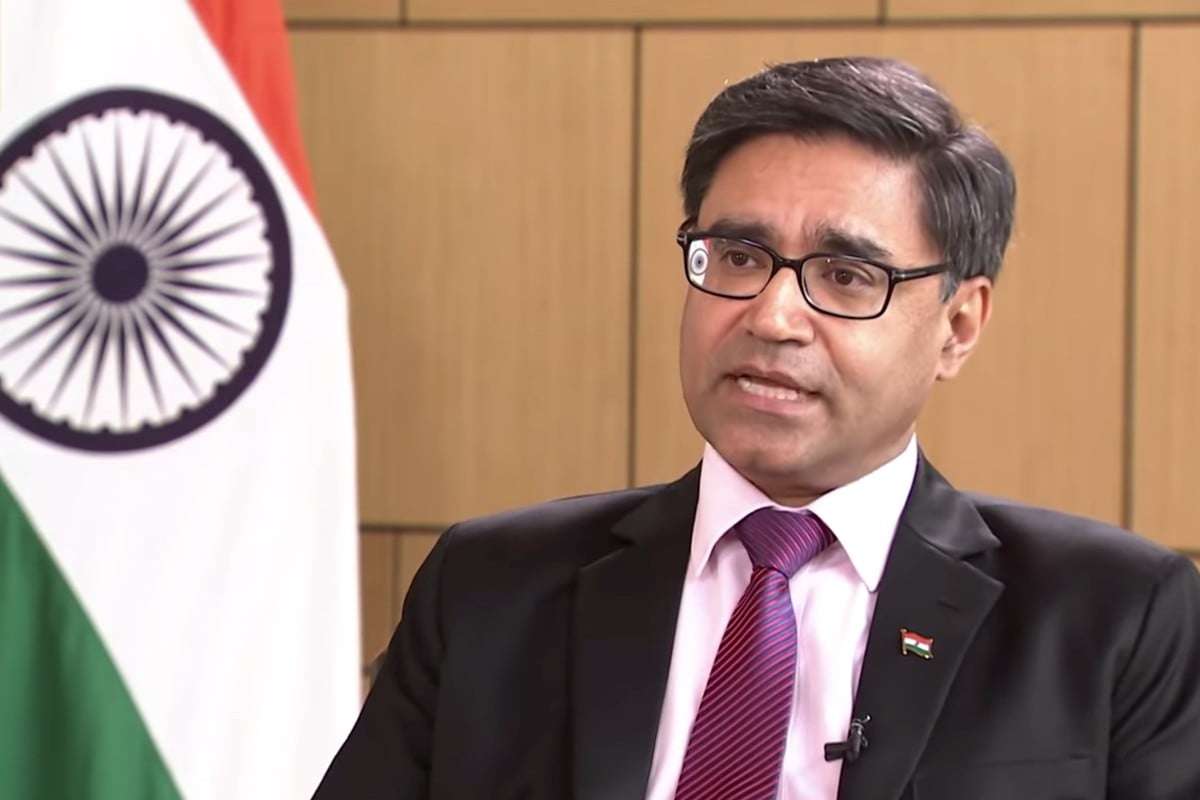
- Ambassador Vikram Misri has called on China to balance its US$60 billion trade deficit with India ‘before the issue becomes politically sensitive’
- He also says India will not take sides over its use of US-blacklisted Huawei, as ‘any decision taken over this will only be taken in our national interest’
Indian ambassador to China Vikram Misri says that while the countries’ differences will not derail ties, there are still thorny issues to grapple with. Photo: CGTN
so they do not get in the way of the Asian superpowers working together for global stability, India’s top diplomat in China said on Friday.
To emphasise his point, Ambassador Vikram Misri listed eight long-standing and new bilateral issues that required attention, including
’s almost US$60 billion trade deficit with China, cooperation on counterterrorism and a
.
“This trade imbalance is not economically sustainable in the long run,” said Misri at an Asia Society event in Hong Kong. “It is in our mutual interest to find workable solutions before the markets react in unpredictable ways and the issue becomes politically sensitive.”
Frosty ties between two of the world’s largest economies have thawed in the past year following a 73-day
in 2017, with Beijing seeking to forge closer ties with New Delhi amid its ongoing trade and tech war with the United States.
Ivanka Trump, the unlikely messenger of India-US relations
In May, Beijing dropped its long-held objections towards United Nations sanctions on
, the founder and leader of terrorist group Jaish-e-Mohammed, which was behind the suicide bombing of Indian soldiers that brought India and Pakistan to the brink of war earlier this year.
Analysts said this would pave the way for a better relationship between India and China.
Misri said both countries enjoyed a “full-spectrum relationship” of economic, commercial and people-to-people ties, and this was reinforced by the “strong personal bond” Indian Prime Minister
and Chinese President
had, despite the “elements of competition”.
The leaders of the two nations met four times last year and twice in 2019, with Xi set to visit India later this year. Both men share an understanding that “our rise can be mutually reinforcing” and a mutual interest in “preventing differences from turning into disputes”, the ambassador added.
But while Misri, a career diplomat posted to Beijing at the start of this year, stressed that differences would not derail ties, he made no bones about the thorny issues both sides are grappling with.
Will Modi’s snub of Xi’s belt and road derail China-India ties?
Both nations are still engaged in the second of a three-stage process to settle their border dispute – the world’s largest in terms of area, he said.
The first stage was an agreement on the political parameters for a boundary settlement in 2005. The current stage involves agreeing on a framework for a boundary settlement, which Misri said would be translated “into a delineated and demarcated boundary” in the final stage.
Communication over water and shared rivers has also been a key area of cooperation for the two nations.
Indian ambassador to China Vikram Misri speaking at the Asia Society in Hong Kong. Photo: Asia Society
They have established channels for information sharing on cross-frontier rivers, which last year enabled the Chinese side to warn the relevant Indian authorities of a landslide which would send a large amount of water to India. While in this instance the two sides were able to avert a loss of life, they can do more to broaden cooperation, Misri said.
He alluded to how China and India are vying for influence in the Indian Ocean, saying it was an area where both had “contiguous zones of maritime interest”.
The two sides need to work together to preserve peace and stability in the Indo-Pacific region – which stretches from the Indian Ocean to the central Pacific Ocean – and ensure transparent economic and commercial cooperation, infrastructure and connectivity, he said.
As China, India and Russia draw close, has Trump overplayed his hand?
Misri, who served as the private secretary to Modi as well as former prime ministers Manmohan Singh and I.K. Gujral, said there were three areas of mutual interest for India and China.
Besides a “peaceful periphery”, they should cooperate to ensure there are open international systems regarding trade and technology, and that global governance is reformed so the voices of nations such as theirs can be heard.
The Russia-India-China trilateral meeting on the sidelines of last month’s
summit in Osaka, where leaders discussed issues ranging from energy security to climate change, was an opportunity to discuss alternative viewpoints on changing international issues.
This was crucial amid the economic instability caused by
, that were causing “generalised damage” to the global economy, Misri said.
In the question and answer session with the event’s 112 attendees, Misri was asked if India was feeling the pressure to choose in the face of US efforts to get its allies to reconsider using or ban Chinese tech firm
from their superfast 5G networks.
Washington says Huawei equipment could be used by Beijing for spying and the US Commerce Department has placed the company on its entity list, effectively banning US companies from selling equipment and components to it.
When US President
and Xi met at the G20 summit, Trump announced American companies could resume sales to Huawei as long as the products involved did not threaten national security.
Misri referred to this, and said: “Let’s see how it shapes up.”
He added the issue was far from decided for India as it had only achieved 4G connectivity recently and was not yet ready to build out its
Still, he said, “there’s no question on taking sides over this”. “Our leadership is very clear that any decision taken over this will only be taken in our national interest.”
Source: SCMP
Posted in 5G infrastructure, Ambassador Vikram Misri, Asia Society, Beijing, China alert, cross-frontier rivers, differences, disputes, Huawei, India alert, Indian Prime Minister Narendra Modi, manmohan singh, New Delhi, Osaka, President Xi Jinping, Russia, Russia-India-China trilateral meeting, Uncategorized, us commerce department, US President Donald Trump |
Leave a Comment »
05/07/2019
SHIJIAZHUANG, July 4 (Xinhua) — Authorities in Beijing, Tianjin and Hebei will conduct joint law enforcement in environment-related areas from 2019 to 2020.
That was learned from a working meeting, held Wednesday in Langfang of Hebei Province, on joint law enforcement involving ecology and environment in Beijing, Tianjin and Hebei.
The campaign is aimed at handling cases of cross-region environmental pollution and related violations.
The authorities will inspect industries, with priority going to polluters such as printing, furniture-making, medicine and pesticide, and rubber products. They will also inspect water resources in regional border areas.
China pledged to coordinate its efforts on environmental protection and economic development in 2019. It promised to push for better air quality with better regional coordination and heavy-polluter revamps, according to the Ministry of Ecology and Environment.
Source: Xinhua
Posted in Beijing, Beijing-Tianjin-Hebei region, Hebei province, Joint law enforcement on environment, Langfang, Ministry of Ecology and Environment (MEE), Tianjin, Uncategorized |
Leave a Comment »
05/07/2019
- Civil affairs ministry reaffirms plan to eradicate names that ‘violate the core values of socialism, damage national confidence’
- One man says it reminds him of the dark days of the Cultural Revolution
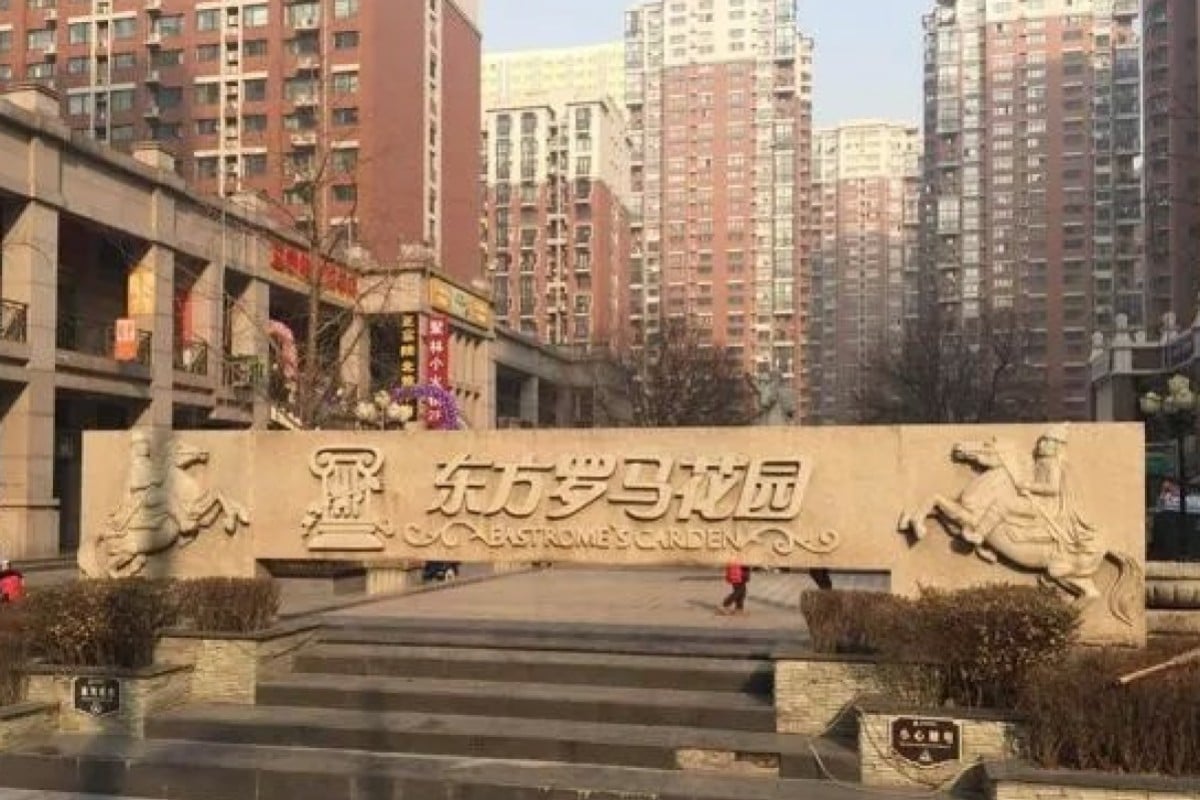
Beijing wants to eradicate place and property names, like “East Rome’s Garden”, that are influenced by foreign or “weird” words. Photo: Weibo
Beijing has reiterated its commitment to rid Chinese cities of “big, foreign and weird” property and place names, sparking a backlash from the public.
The campaign began last year when six government departments introduced a joint policy requiring provincial and county authorities to identify all such properties within their jurisdictions and rename them by the end of March.
On Friday, the Ministry of Civil Affairs reaffirmed its support for the plan, but reminded local governments to implement it “prudently and appropriately”.
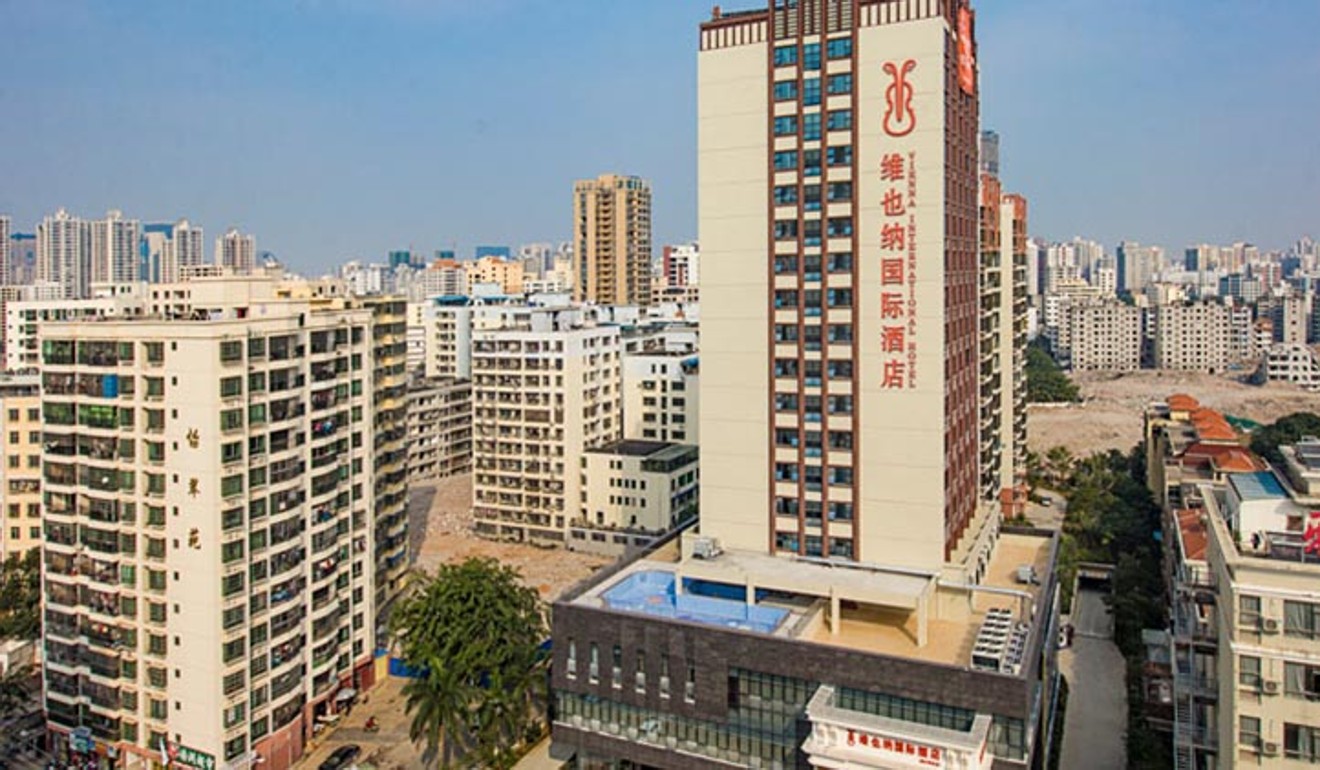
Many Chinese properties, especially hotels and apartment buildings, incorporate famous foreign places, like Manhattan, California or Paris, into their names, but under the new rule they all have to go. According to a report by local newspaper Sanqin Metropolis Daily, in one city in Xian, the capital of Shaanxi province, at least 98 apartment projects, hotels, townships, communities and office towers need to be rebranded.
Many Chinese properties, like the Vienna International Hotel, incorporate famous foreign places into their names. Photo: Weibo
But for some people, the plan is nothing more than a waste of time and money.
“If projects are forced to change their names, what about the name on the property certificate, the enterprise licence and tax registration? Do they have to be changed too?” asked Zhu Yun, a woman who lives in Guangzhou, the capital of south China’s Guangdong province.
Hospital’s plan for ‘lucky’ Harvard babies gets poor marks
“And what’s the standard for the new names, and who’s going to do the renaming? It’s just a waste of people’s energy and money, and will do nothing for the national culture or confidence.”
Zhu Min, an octogenarian who also lives in Guangdong, said the scheme had echoes of a darker time in China’s history.
“It reminds me of the bad times of the Cultural Revolution,” he said. “At that time, a great number of streets, roads and stores were forced to rename, because they contained elements of old customs and old culture.”
The debate has also been raging online, with tens of thousands of people airing their views on social media.
“Cultural and national confidence is about respect for multiculturalism,” one person wrote on Weibo, China’s Twitter-like platform.
Tsinghua University sues kindergartens for using its name
Despite the outcry, the civil affairs ministry said the implementation of the scheme was “an important measure … to carry forward the national and local culture”, Xinhua reported.
“The relevant regulations and guidelines of the campaign should be strictly observed to prevent the campaign from being expanded in an arbitrary manner,” it said.
The plan announced last year stated that “big, foreign, weird” place names and those based on homonyms “violate the core values of socialism, damage national confidence, and affect the production and lives of the people, and must be rectified and cleaned up”.
Source: SCMP
Posted in Beijing, big, foreign and weird, California, China still committed, Cultural Revolution, East Rome’s Garden, getting rid of, guangdong province, Guangzhou, Manhattan, Ministry of Civil Affairs, Paris, place names, Sanqin Metropolis Daily, shaanxi province, Tsinghua University, Uncategorized, Vienna International Hotel, Weibo, Xi'an |
Leave a Comment »
05/07/2019
- Riot police deployed after week of unrest over proposed plant next to residential areas – echoing recent years’ protests against incinerators elsewhere in the country
- District government urges people to ignore rumours and says plant’s location has yet to be finalised
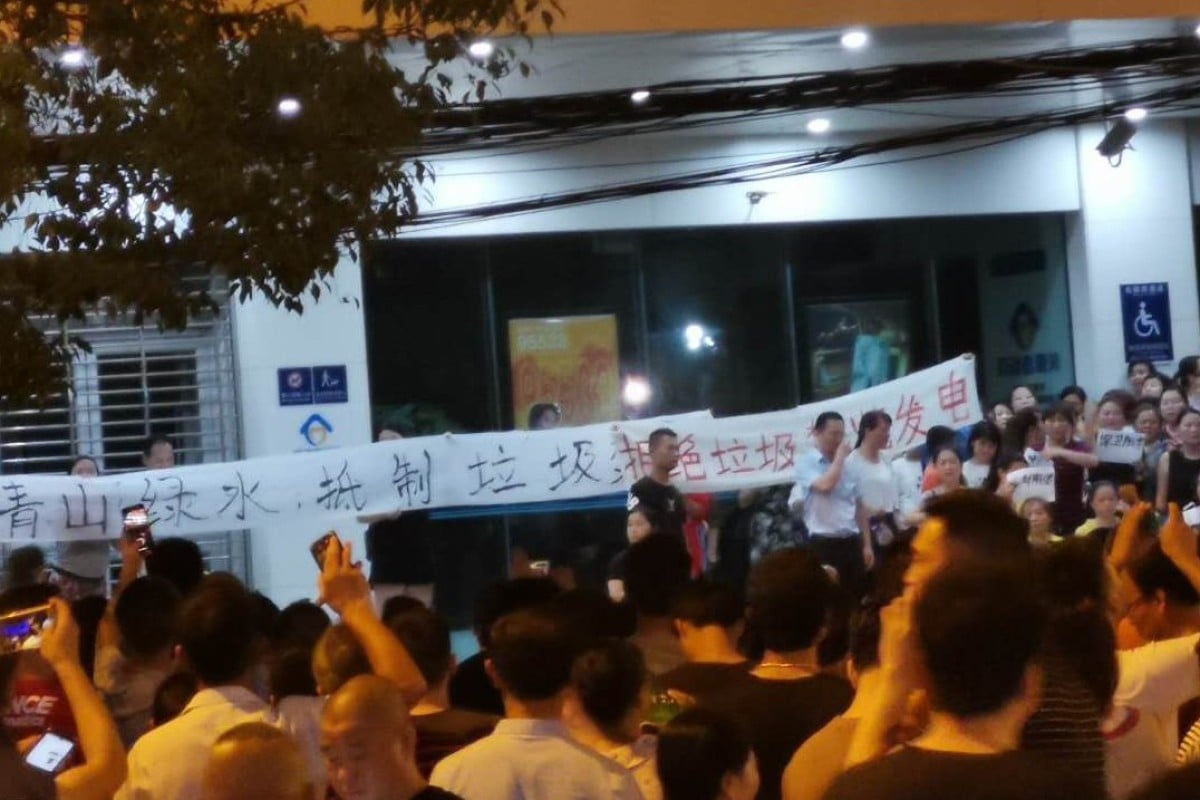
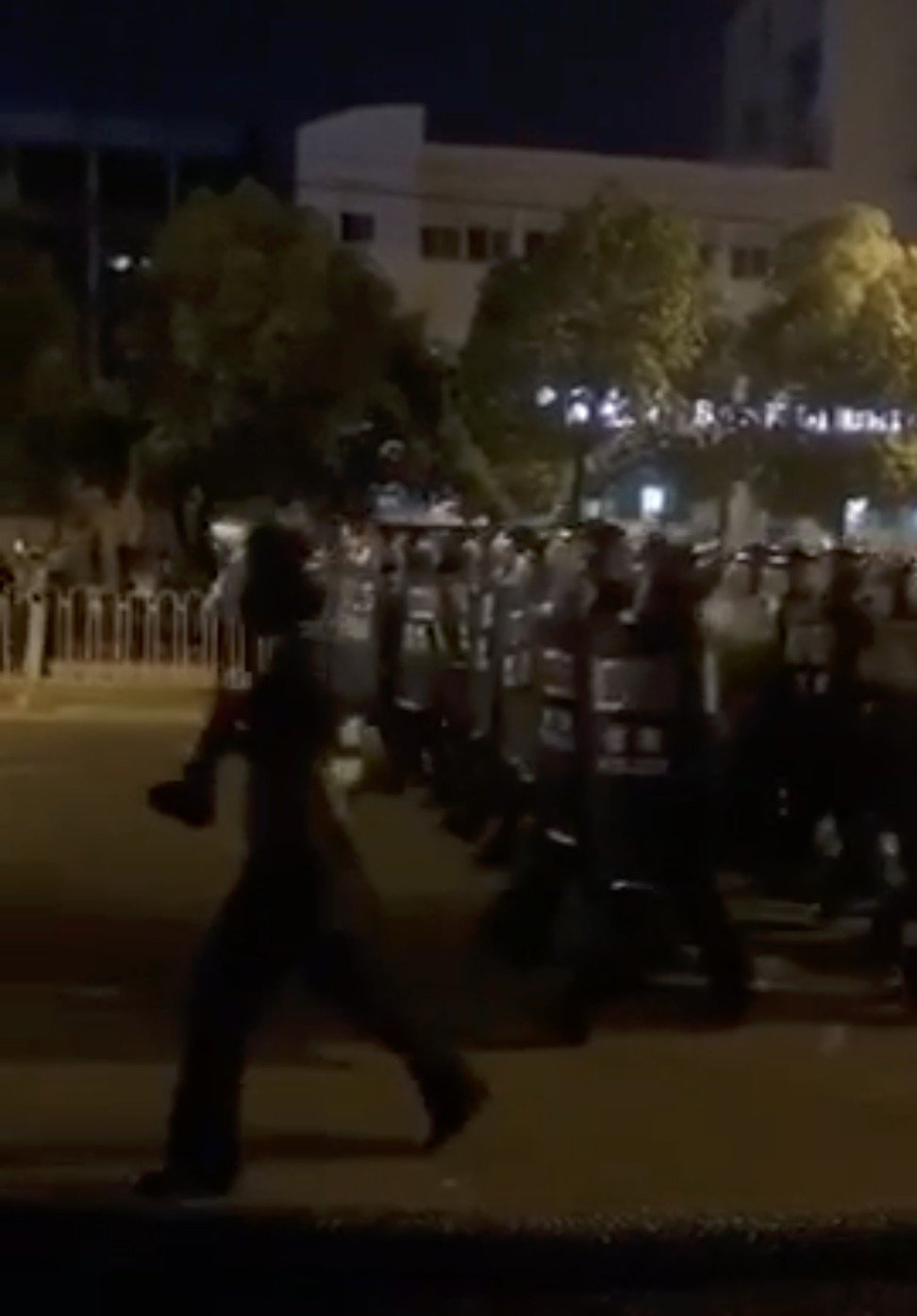
People in Yangluo protest against the proposed incineration plant on Thursday night. Photo: Handout
Thousands of people took to the streets in central China on Thursday night in a seventh day of protests against the construction of a waste incineration plant.
Protesters carried banners and chanted as they marched against a waste-to-energy plant that could be built next to residential areas in Yangluo, near Wuhan, the capital of Hubei province.
Residents were angered by plans to build the plant on a garbage landfill site that had been expected to be turned into a public park.
They shouted slogans such as “Return us the green mountain and clear waters” and “Garbage burning plant get lost from Yangluo”.
Riot police move in as protests continue in Yangluo on Thursday. Photo: Handout
A letter to the public by the Xinzhou district government on Wednesday had urged people “not to listen to or spread rumours”, and said that a location had yet to be finalised for the plant.
“What is rumoured online to be the garbage burning project that has already started is in fact demolition work for a railway construction project,” the letter said.
Converting waste to energy by burning it has been adopted in China as an alternative to burying rubbish in landfill sites – which causes pollution and requires a lot of land – but it has been widely resisted because of fears that it is a health hazard. Large protests against incinerators have been held in recent years in Zhejiang, Jiangsu, Hubei, Beijing and Guangdong.
“We understand the need to dispose of garbage in an environmentally friendly way, but does it have to be that close to our homes? Two universities and more than 10 residential areas are within a 3km (1.86 miles) radius,” said the man, referring to the Wuhan University of Bioengineering and Wuhan Engineering Institute.
Yangluo, designated as an economic and technology development area, is 30km northeast of downtown Wuhan and has a population of 300,000. The incineration plant would handle 2,000 tonnes of waste per day, the Wuhan urban management committee said last month.
Residents asked about the progress of the project in early June and were told that the authorities were still choosing a site.
Protests broke out last Friday after rumours spread that the project had already started – forcing the district government to say on Saturday that it would “not start without approval from the public”.
Nonetheless, thousands of protesters – about 10,000, according to one source – marched on Saturday and Sunday, leading to some arrests, although those detained at the weekend had since been released, protesters said.
After minor protests on Monday and Tuesday, residents gathered in greater numbers in Yangluo on Wednesday and Thursday nights, met by a heavy police presence.
Videos seen by the South China Morning Post show hundreds of riot police marching through the streets, equipped with helmets, shields and batons
The crowd dispersed at about 10pm as police began to round up some protesters. They were taken aboard a coach and two men were handled roughly, the videos showed.
Chinese town residents clash with riot police over incinerator
An official from the Xinzhou district government’s publicity department stressed to the Post that the project would not begin without public approval and its location had not yet been chosen.
Source: SCMP
Posted in Beijing, economic and technology development area, garbage landfill site, Guangdong, Hubei, hubei province, Jiangsu, public park, south china morning post, Thousands protest, Uncategorized, waste incineration plant, Wuhan, Wuhan Engineering Institute, Wuhan University of Bioengineering, Xinzhou, Yangluo, Zhejiang |
Leave a Comment »
04/07/2019
Chinese President Xi Jinping (2nd R) and his wife Peng Liyuan (1st R) pose for photos with Bulgarian President Rumen Radev (2nd L) and his wife in Beijing, capital of China, July 3, 2019. Chinese President Xi Jinping held talks with Bulgarian President Rumen Radev here Wednesday. (Xinhua/Huang Jingwen)
BEIJING, July 3 (Xinhua) — Chinese President Xi Jinping on Wednesday held talks with Bulgarian President Rumen Radev in the Great Hall of the People in Beijing, and they decided to lift state-to-state ties to a strategic partnership.
Bulgaria was one of the first countries to establish diplomatic relations with New China, Xi noted, hoping that the two countries take the strategic partnership as a new starting point, work together to cope with the test of international changes and inject new impetus into bilateral cooperation.
Xi stressed that the two sides should respect and trust each other and strengthen exchanges between the two governments, legislative bodies and political parties while maintaining mutual support on issues involving each other’s core interests and major concerns.
“The two countries share many of the same or similar views on the international situation and should jointly safeguard the international system based on multilateralism and the international law,” said Xi.
Bulgaria is also one of the first Central and Eastern European countries to sign intergovernmental cooperation documents with China on the Belt and Road Initiative. Xi said China is willing to strengthen the synergy between the two countries’ development strategies, promote infrastructure connectivity, expand trade and investment and cement people-to-people exchanges.
Xi reiterated China’s firm support for the European integration process, EU’s unity and growth and Europe’s more important role in international affairs, saying that China’s upholding such stances is not an expedient measure.
“It is hoped that the new EU institutions will maintain the stability and continuity of their China policy,” said Xi, who also expected the new EU institutions to work with China to promote the building of partnership on the basis of mutual respect, fairness and justice, cooperation and win-win result.
“Bulgaria is a good friend and partner of China in the EU and an important participant and advocate of the cooperation between China and the Central and Eastern European countries. It is hoped that the Bulgarian side will continue to play a constructive role in this regard,” said Xi.
Radev said he was very happy to visit China on the occasion of celebrating the 70th anniversary of the establishment of bilateral diplomatic ties.
Lifting the bilateral ties to a strategic partnership will further strengthen the foundation of bilateral relations, said Radev.
Radev said the Bulgarian side is ready to deeply participate in the Belt and Road Initiative by giving full play to its advantages of location in the region and trying to become a gateway and hub connecting Europe and Asia.
The Bulgarian side is willing to expand cooperation with the Chinese side in such areas as trade, transportation, aviation, logistics, finance, innovation, local areas and people-people exchanges, and welcomes Chinese enterprises to increase investment in Bulgaria, said Radev.
While expressing Bulgaria’s support for multilateralism and the World Trade Organization, the Bulgarian president said his country stands ready to step up communication and work for advancing Europe-China relations and cooperation between the Central and Eastern European countries and China.
Source: Xinhua
Posted in Beijing, Belt and Road Initiative (BRI), Bulgaria, Bulgarian President, Central and Eastern European countries, China alert, Chinese President Xi Jinping, European integration process, Great Hall of the People, lift ties, strategic partnership, Uncategorized |
Leave a Comment »
04/07/2019
- China’s talent is turning away from multinationals and towards domestic tech champions in the search for a more fulfilling career
- Change in sentiment comes amid raging US-China tech war and perceptions of ‘bamboo ceiling’ in the West
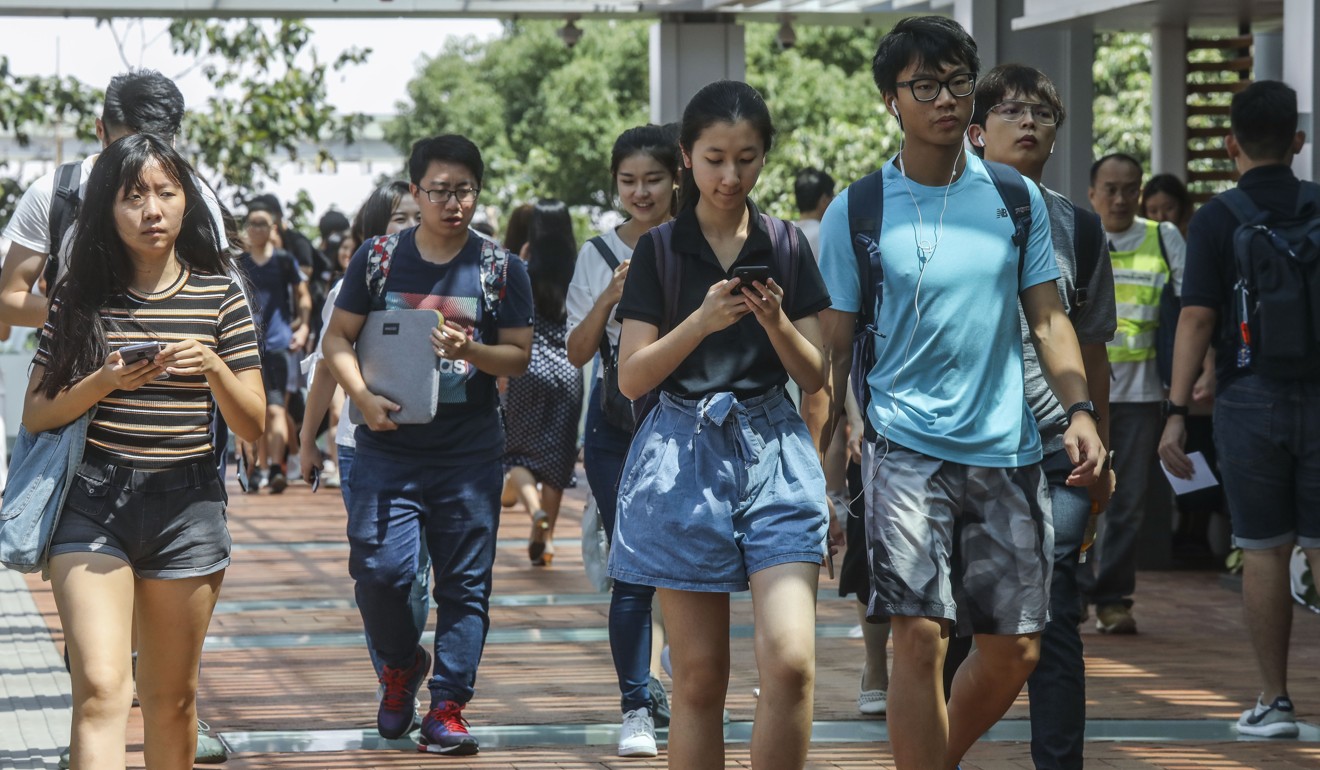
An increasing number of Chinese jobseekers are looking towards domestic tech firms. Image: SCMP
Molly Liu left her hometown Beijing to pursue a master’s degree in the United States in the 1990s.
After graduation, she fought hard to win an entry-level position at a US-based consultancy and after a period was later sent back to China to help the company’s expansion.
In the land of opportunity, the ambitious US firm showered her with avenues to pursue her career and she ended up working in Hong Kong as well as being one of the first people on the ground for the consultancy in Shanghai, Beijing, Taipei and Singapore.
Times have changed, though. Recently, her only son, Ben Zhang, turned down a hard-to-get job offer from a Boeing subsidiary in the US after gaining a master’s degree in computer science from Carnegie Mellon University in Pittsburgh, Pennsylvania.
Chinese students educated in the US are now looking more at jobs in China. Photo: SCMP
He decided to return to Beijing in 2018 and now works as a product manager at Chinese smartphone maker Xiaomi. He is convinced that the start-up turned tech major can offer him the same sort of opportunities today that the US tech consultancy offered his mother in the 1990s.
This family story about the career choices of two different generations of US-educated Chinese students reflects a wider trend. Once upon a time, US corporations could cherry-pick top Chinese talent from American universities with the promise of large salaries, generous benefits and the chance to work at market-leading organisations.
Today, China’s cutting-edge technology companies – often referred to as China Tech Corporation (CTC) – are the most sought-after employers among many Chinese students, who want more than just a cushy life.
This marks another blow for multinational corporations (MNCs) already struggling to do business in China amid a myriad of restrictions and growing hostility towards them as the US-China trade and tech war gathers pace.
“What I look for in a job is not money. My parents are not counting on me to support them,” says 28-year-old Zhang, whose team in Xiaomi is working on a wide array of connected devices, from televisions to lamps to smart locks. “What I care about most is personal improvement and access to the best resources a company can offer.”
“In Boeing, I could probably work on a new product once every two to three years. But at Xiaomi, every three months, we can roll out a new product,” he added. “You can bring so many things into people’s everyday lives in China, like using your voice to control a TV or an air conditioner – things you can only imagine in the US.”
Zhang is not alone and many Chinese today perceive a “bamboo ceiling” in the US, where they are more often seen as engineers rather than executives.
One Chinese executive who now oversees the technology unit of a listed finance and insurance firm in China said that he used to lead a team of 20 engineers at one of the world’s most valuable tech companies in Silicon Valley.
“My job was to keep optimising the performance of a product [in Silicon Valley],” he said.
“But within three years in China, I was promoted to the chief scientist of our entire company, leading a team of 1,000,” said the man, who asked to remain anonymous as some of his family still reside in the US.
How Trump’s assault on Huawei is forcing the world to contemplate a digital iron curtain
According to an April survey by professional networking site LinkedIn, an increasing number of Chinese jobseekers share Zhang’s outlook. LinkedIn compiled a list of the top 25 most desired employers in China, and about 60 per cent were local Chinese companies, with 13 of them internet firms.
CTC bagged four of the top five spots, with e-commerce giant Alibaba, search giant operator Baidu and Bytedance – which operates short video hit TikTok – taking the lead.
Tesla ranked sixth behind its Chinese challenger Nio. Amazon, the only other foreign company in the top ten, ranked eighth.
Alibaba is the owner of the South China Morning Post.
Li Qiang, executive vice-president of Zhaopin, one of China’s largest online recruiters, described the rising status of CTC among jobseekers as “the dawning of a new era”.
“Nowadays, there is nothing a multinational can offer that a domestic firm cannot, be it a compensation package or the chance to be part of international expansion,” said Beijing-based Li.
“Jobseekers are not particularly looking for domestic firms or multinational firms. They are after good firms and most of the good firms in China these days happen to be domestic tech firms,” said Li.
Li’s comments reflect the wider opportunities within the domestic economy for Chinese jobseekers today, after the rise of many successful private-sector companies and a thriving start-up scene over the past 10 years, meaning it’s not just a one-way street to a state-owned enterprise (SOE) any longer.
A survey by Zhaopin in late 2018 found that 28 per cent of Chinese university students said MNCs were their employer of choice, down from 33.6 per cent in 2017.
Even on pay and benefits, CTC is catching up with multinationals. Zhang said Xiaomi matched the offer from the Boeing unit in the US and many leading tech firms offer benefits such as gym memberships and childcare facilities.
And the rags-to-riches stories of many leading China tech entrepreneurs, some of whom have become billionaires, continue to grab media attention and inspire the younger generation.
To be sure, Chinese students would still rather work for an MNC than an SOE – but the rise of CTC can be seen in company rankings and in the total number of CTC companies in the top employer list, according to Zhaopin.
For a growing number of Chinese students, the doors to America are closing
William Wu, China country manager of global employer brand consultancy Universum, said that the one element Chinese jobseekers pay most attention to these days is whether or not a job can be “a good reference point for a future career”. And a growing number of private Chinese companies now have global brand recognition.
A recent survey by Universum shows that Apple and Siemens were the only two Western names in the top 10 ideal employers for Chinese students in the engineering sector this year, while there were four foreign firms in the top 10 list in 2017.
Huawei Technologies, the Chinese telecoms giant that has been put on a US trade blacklist after the Trump administration said it was a national security risk, ranked top in the Universum list. Xiaomi, the smartphone maker Ben Zhang works for, ranked second while Apple, one of the most valuable tech firms in the US, ranked seventh.
It seems that China’s rising clout in the world is now an attractive factor for jobseekers.
“Every engineer would like to see the technology they’ve worked on have the potential to change the world one day,” said Li Yan, head of multimedia understanding at Chinese short video major Kuaishou. “In the old times Chinese companies were at the bottom of the global value chain, now they are climbing up, providing more opportunities for talent to create world-changing products.”
At Beijing-based Kuaishou, Li’s 100-strong artificial intelligence algorithm team – many of whom joined from Microsoft Asia Research – is working to make machines understand content better than humans by studying the millions of user-generated videos on the company’s platform every day.
CTC companies do have a strong home advantage, with big Western firms having to navigate a myriad of restrictions.
For example, the “Great Firewall” lets Chinese authorities control the content and information reaching the country’s 800 million-plus internet population. Western firms also face other forms of red tape, such as having to form joint ventures with local partners.
Amazon earlier this year announced the close of its China marketplace, giving up the brutal fight with Chinese online shopping giants such as Alibaba to capture domestic e-commerce market share. Oracle China reportedly laid off 900 people in March as it winds down its research and development center in the country.
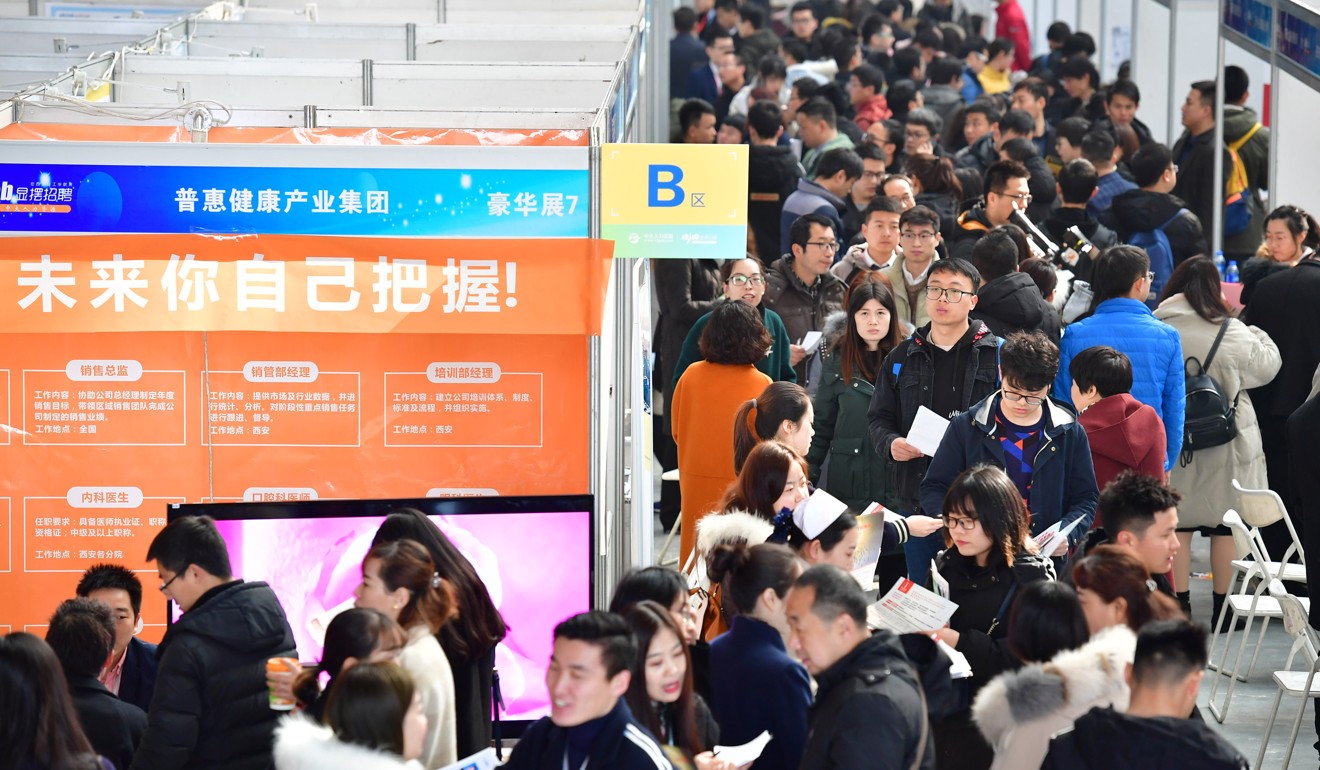
Job applicants visit a provincial job fair at Qujiang International Conference and Exhibition Center in Xian, northwest China’s Shaanxi Province in February. Photo: Xinhua
Oracle has never confirmed the number of lay-offs but said the job cuts formed part of an overall global strategy transformation.
However, there has been little sympathy for those losing their jobs in China, judging by social media posts.
Some people posted that those working for big US tech firms are not “wolf” enough compared with counterparts who work for local tech firms, referring to the long work-hours culture of the domestic tech scene.
A viral story titled “Why there should be no pity for the sacked Oracle China employees” said the company was Beijing’s biggest nursery because of the flexible “work from home” culture and generous compensation package offered to employees.
Oracle said to begin mass lay-offs in China as part of global move to cloud services
“They had every chance to join rising domestic internet firms. But they settled for high salary and low work pressure, which eventually made them frogs in boiling water. Why pity them?” said the article, adding that the earlier people give up on the “glory” of working for MNCs, the quicker they will benefit.
Not all Chinese workers would agree, and there has been a recent backlash against the “996” culture within China’s tech sector, where people routinely work from 9am to 9pm, six days a week.
With geopolitical uncertainty growing day by day, though, many Chinese are asking why leave the family behind for an uncertain fate overseas?
A survey done by consultancy BCG and The Network in 2018 showed that only one in three China residents was willing to move abroad for work, down from 61 per cent in 2014. The country is also the 20th most popular destination worldwide to relocate for a job, compared with 29th in the 2014.
“One of my graduate classmates in the US just gave up a six-digit package at Oracle and joined drone maker DJI in Shenzhen,” said Ben Zhang. “I asked what prompted his return to China. He sent me the viral article and asked, ‘who wants a life that one can see the end of from the very beginning?’”
Source: SCMP
Posted in Alibaba, Apple, ‘bamboo ceiling’, “Great Firewall”, Baidu, Beijing, big brand multinationals, Boeing, Bytedance, Carnegie Mellon University, China Tech Corporation (CTC), China’s top talent, Hong Kong, huawei technologies, Kuaishou, LinkedIn, multinational corporations (MNCs), Nio. Amazon, Oracle China\, Pennsylvania, Pittsburgh, Qujiang International Conference and Exhibition Center, rising domestic tech stars, shaanxi province, Shanghai, Siemens, Silicon Valley, Singapore, south china morning post, state-owned enterprise (SOE), Taipei, Tesla, TikTok, Uncategorized, Universum, wants to work, Xi'an, Xiaomi |
Leave a Comment »
04/07/2019
- ‘There’s no need for a confrontation in technology because science has no borders,’ says the founder of CloudMinds
- Huang has watched from up close as the US gradually descended from its telecoms supremacy and China caught up
Bill Huang in 2018. Photo: YouTube
Bill Huang, a Chinese-American telecoms industry veteran, used to target China and its vast, untapped market with the technological know-how he had learned in the US.
But over the past few years, the tables have turned. In his latest business endeavour, the engineer turned entrepreneur is relying on China for a key technology that would transform mobile communication for the next decade – and it is a technology the US has fallen behind on.
As one of the first young mainland Chinese to attend graduate school in the US after diplomatic relations were resumed 40 years ago, and as one of the early participants in Beijing’s global recruitment programme to attract top talent in science and technology, Huang has a unique perspective on the current bilateral stand-off that centres on technology.
CloudMinds Technology, a privately held robotics sector company he founded in 2015, needs the superfast 5G network to support its cloud-based platforms for operating intelligent robots. The next-generation wireless technology has become a flash point in the escalating US-China tech rivalry, and Huang is at the forefront of it all.
“It’s kind of like a one-sided rivalry. Because the US doesn’t have the [5G] technology,” Huang said on the sidelines of a recent conference on China in Philadelphia.
For months, the US government has waged a campaign to block the Chinese telecoms giant Huawei from dominating global 5G networks, lobbying allies to shun the company for what it says are risks of espionage or sabotage by Beijing.
Huawei is already ahead of its European rivals in market share thanks in part to its lower prices. But so far no companies in the US – which has long led the telecoms industry – can make the equipment needed to build the next generation of networks.
Huang, 57, who spent three decades in the mobile communication sector, has watched from up close as the US gradually descended from its telecoms supremacy and China quietly caught up.
Technology is not like martial arts, or Shakespeare’s book, it’s not like everything is copyrighted Bill Huang, CEO of CloudMinds Technology
In its heyday, US giants like AT&T sold network equipment to countries around the world. Huang himself once worked at AT&T’s research hub Bell Labs, a dominant leader in telecoms innovation known as “the idea factory” and arguably the most innovative scientific institution for a long stretch of the 20th century.
“In the last 20 years, the US went from [being] No 1 in the telecommunications industry to now almost exiting telecommunications equipment manufacturing,” Huang said, citing the acquisition of Lucent and Motorola by European counterparts.
It was a decline Huang witnessed with an initial sense of sadness. As a veteran of Bell Labs, he said, he had felt extremely proud of the company’s contribution not only to America, but to telecoms technology worldwide.
“But secondly I also felt a level of pride for China,” he said, “because it went from nothing in telecommunications to lead the world in telecommunications in less than 30 years.”
Huawei was under secret US surveillance, US fraud hearing told
Glenn O’Donnell, an analyst at Forrester Research, said the decline of major US telecoms providers had little to do with politics, but was a function of inadequate interest in innovatation because of their dominance in the field.
“The long lease cycles and until recently the relative maturity of the market really didn’t lend itself well for real innovation,” he said.
“And that’s now changing, and all of those players that decided not to play in telecommunications are now wishing they had a stake because there’s a lucrative new market.”
Also drastically different today is the state of relations between China and the US. As they fight their costly trade war, tensions and acrimony have spilled into other aspects of bilateral relations, from technology, defence and geopolitics to ideology. There are even warnings of “decoupling” – something almost unimaginable to Huang, whose personal trajectory has been shaped by the intertwined ties between his homeland and his adopted country.
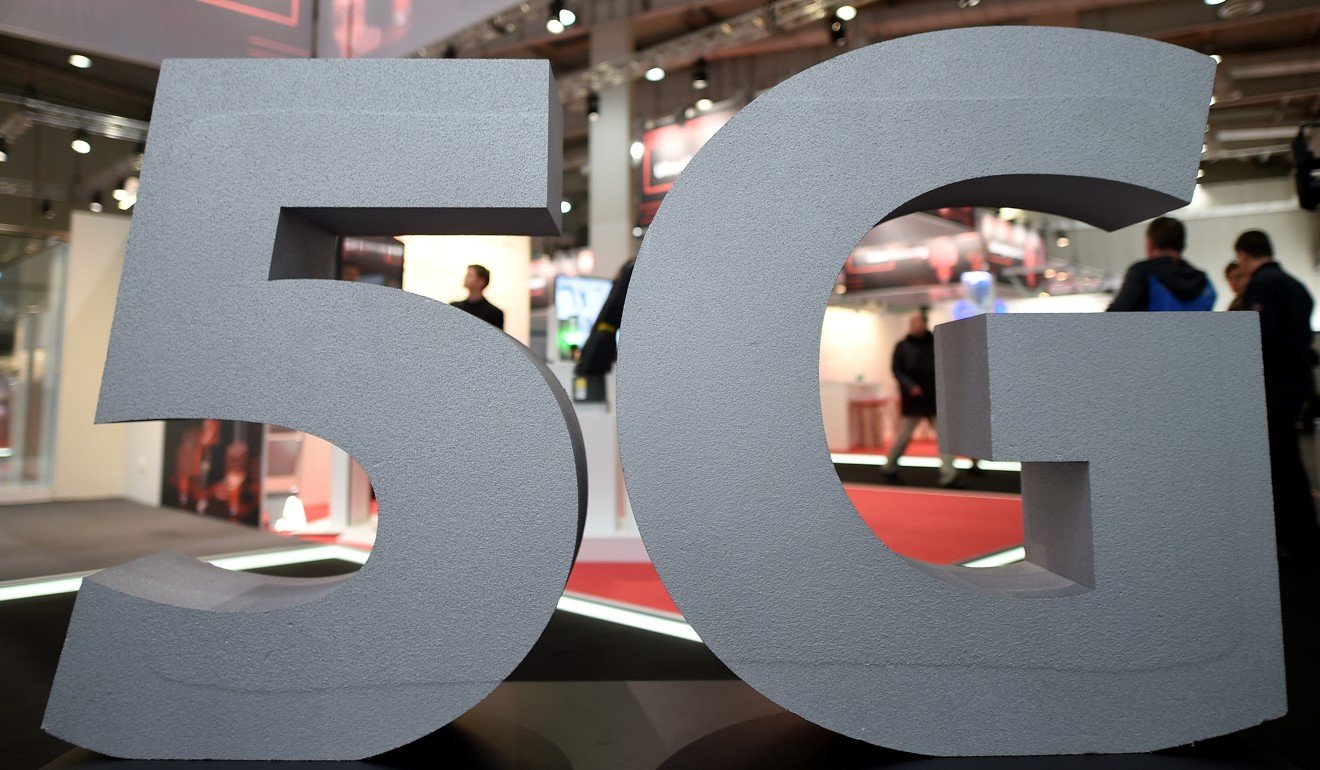
Fifth-generation mobile telecommunications technology, or 5G, enables data to be transferred at a speed that is 20 times faster than current standards. Photo: Reuters
He calls himself “a product of China-US relations”. Such was his proud conviction that he gave his son the middle name “Nixon”, after the president who put relations with China back on track in 1972 with a historic trip to Beijing that ended over two decades of antagonism and isolation since the Chinese Communist Party took power.
The visit by Richard Nixon – who died in 1994, the same year Huang’s son was born – not only mended bilateral relations, but created an opportunity for Huang and many others like him: to learn the most advanced science and technology from the world’s leading innovation powerhouse.
Born in 1962 into an intellectual family in southwestern China, Huang spent most of his childhood in the turmoil of the Cultural Revolution.
“As professors, my parents had a very difficult time during the Cultural Revolution. But they insisted that we spend time to study,” he said.
Huang recalled being a “wild kid”, going to school to “have fun”. But when the time came to study, he was able to pick up the pace, which he attributed to the academic minds that run in his family.
Hailed as a “child prodigy”, he passed the country’s first university entrance exam in a decade at the age of 15. A year later, in 1978, he was in the first batch of students to enter university after the disruptions of the decade-long upheaval. He chose to major in electrical engineering, following in his father’s footsteps.
In his sophomore year at the Huazhong Institute of Technology, his parents told him to apply for graduate programmes in the US.
“They think the US has the best technology in the world, and they wanted me to come here to study,” he said. “I read everything about the US … and I was very eager to come.”
Arriving at the University of Illinois’ Chicago campus in 1982, at age 20, Huang was one of the first new Chinese graduates to further their studies in the US after the re-establishment of diplomatic relations in 1979. He did not speak English (although he could read it), and had to enrol in a three-month language training program before he could attend lectures.
He studied computer science in addition to electrical engineering, working day and night on projects in the lab – a time he looks back on with fondness.
“It was some of the most intense time in my life, I suppose,” Huang said. “But I was young and relentless, and I could go on for three days without sleep. … I thoroughly enjoyed it.”
US to speed up 5G development plans as race with China accelerates
Despite their vastly different cultural backgrounds, Huang made friends with his American classmates and fellow foreign students, some of whom were from India and what was then the Soviet Union.
“I experienced zero racial prejudice,” he said. “That was Chicago in the 1980s. I don’t know what happened today, [but back then] it was thoroughly what I thought was the ‘melting pot’.”
In his computer science classes, Huang learned Unix – a state-of-the-art operating system developed by Bell Labs – from adjunct professors who had helped create the program.
Little did he know he would later become a researcher at Bell Labs. “That was the holy ground of telecommunications,” he said, still beaming with pride when speaking of his former employer, which invented, among other things, the communications satellite and the cellular telephone system.
Bill Huang as a graduate student in Chicago in the early 1980s. Photo: CCTV
In 1994, Huang joined 10 other former Bell Labs engineers at a California-based telecoms infrastructure provider that targeted the vast and underserved Chinese market. A year later, the company merged with a telecoms software company to become UTStarcom, with Huang as its co-founder and chief technology officer.
UTStarcom tapped into the fast-growing Chinese telecoms market with a low-cost, limited-range wireless service known as the Personal Access System (PAS). It went public on the Nasdaq exchange five years later. In 2001, China passed the US as having the most mobile phone customers. The rapidly expanding market propelled UTStarcom’s growth; its revenues increased tenfold between its IPO and 2003, when it controlled 60 per cent of China’s PAS market.
In 2007, having lived in the US for longer than he did in China and having become an American citizen, Huang moved from Silicon Valley to Beijing with his wife and son. China Mobile, the country’s largest telecoms operator, had asked him to help build a “Bell Labs for China” – a request he readily accepted.
“It was not only a simple job, but a responsibility, a challenge I thought I should accept no matter what,” he told Chinese state broadcaster CCTV in 2017.
Smartphone screen with resolution million times higher than iPhone: Chinese researchers make technology breakthrough
As the head of the China Mobile Research Institute, Huang led the carrier’s leap from 3G to 4G, and he was also at the centre of 5G research. “We put a lot of effort into researching what standards are required for the future network,” he said.
His return to China preceded the “Thousand Talents Plan”, a state-backed recruitment drive to lure the world’s brightest scientists and experts – especially those with roots in China – with lavish grants. But when the plan was set up in 2008, Huang was among the first batch of researchers to be enlisted.
“I express my heartfelt thanks to the state and the people for giving me such a good opportunity and condition to return home and serve the country,” Huang was quoted as saying at a forum for recipients of Thousand Talents awards hosted by People’s Daily in 2010.
“I worked for over 20 years abroad, and all my work was in the field of technology. I hope to bring the whole set of things I know back to China,” he added.
The recruitment scheme, much celebrated at the time, has become a sensitive subject today as tensions between the US and China escalate. It has drawn growing scrutiny and suspicion from the US, where investigators are looking for any connection to theft of American intellectual property. In response, China hushed up or deleted references to the programme in universities, companies and cyberspace.
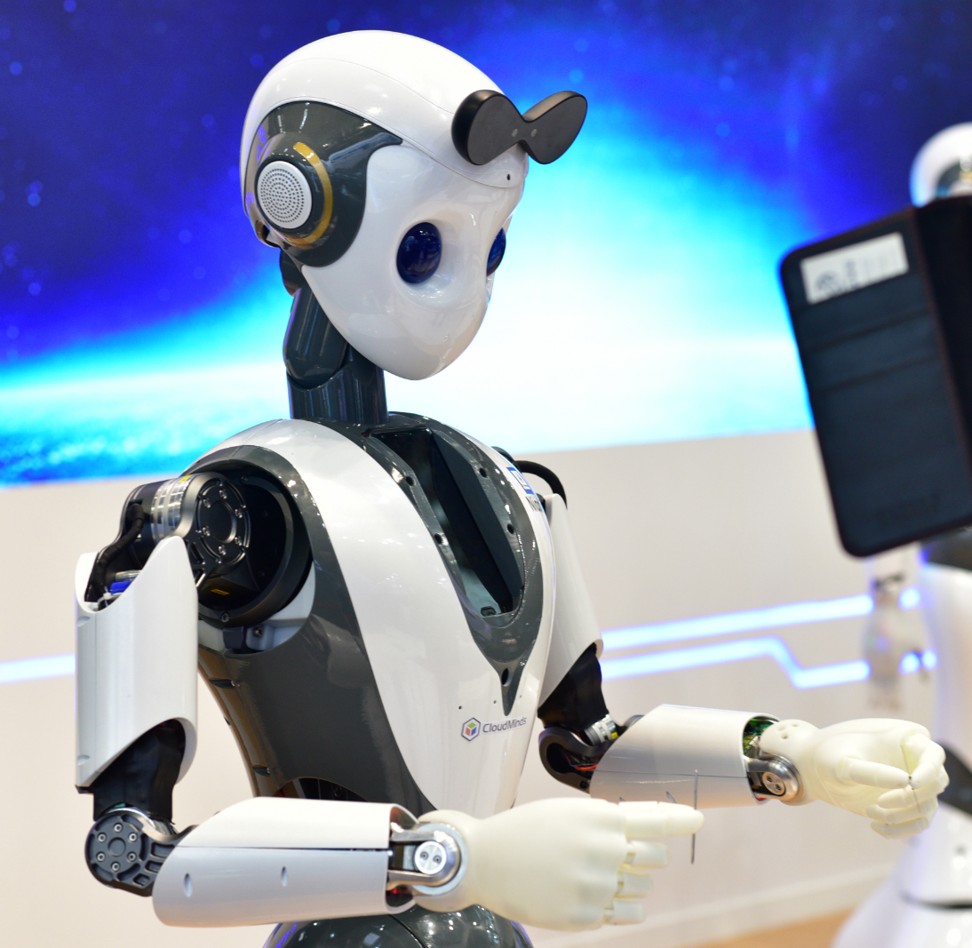
A robot made by CloudMinds Technology showcased at the Mobile World Congress Barcelona in February. Photo: Handout
When asked about US complaints regarding China’s alleged technology theft, Huang gave a vehement defence of China.
“I think these are just basically blatant accusations with no ground,” he said. “Ninety-nine per cent [of the technologies] are not stolen. There are industrial espionage cases … but they’re not systematic cases, and they’re not [the result of the] rivalry between China and the US – they’re the result of competition.”
Huang also dismissed accusations that Chinese scientists and experts have “stolen” US technology.
“Technology is not like martial arts, or Shakespeare’s book, it’s not like everything is copyrighted,” he said.
“Everyone in Silicon Valley in the last 50 years started from somewhere, and then they become an entrepreneur and they move [on] to start their own companies. So in the early days, everyone took a little bit from what they have worked on.”
“It was customary, and then it became very litigious. Then people started saying: wait a minute, you can do that? So there were many exemplary cases, then it became more and more refined in what you can take and what you cannot take; what is protected and what is not protected. All of these things are happening industry-wide, it’s not a single US and China issue.”
Can China meet US demands over IP theft and forced technology transfer?
But intellectual property theft is not the only American grievance. Many US companies have accused China of forced technology transfers, with foreign businesses required to hand over technology to their Chinese partners in exchange for access to the market.
Huang said that complaint “has been there since day one”.
“Chinese companies will always complain about American companies. American companies will always complain about Chinese companies. The reason is very simple: every company would want to use regulations and law to their advantage,” he said.
A trained engineer, Huang holds a “globalist” view of technology – at odds with the national security perspective that has become prevalent in Washington.
“There’s no need for a confrontation in technology because science has no borders,” he said.
“In Huawei labs, there are many American engineers. In Intel and Qualcomm’s labs, I can assure you there are many Chinese engineers, and there are many German, French, Swedish engineers in all of these organisations. The fact they’re sold by a Chinese company or they’re sold by an American company has no meaning because behind the technologies is an international effort.”
To make his point, Huang calls the technology created by CloudMinds a “US and China technology”.
“I mean, how do you categorise it? Is it created by China or the US? It’s created by both. Because we have engineers in Silicon Valley, and we have engineers in Beijing.”
Protecting IP in China is hard, but awareness is rising, thanks to Trump
The company has dual headquarters, with its global operation based in Santa Clara, California, and its China operation based in Beijing – a structure Huang says now “makes perfect sense”.
“That was by design, by our lawyers. They kind of foresaw, if there [are] going to be trade tensions, this would be the right way to do it.”
But Huang questions if these tensions – a large part of which he said had been “politicised” – are so deeply embedded in every corner of society.
“I come to the United States very often, and I talk to the industry. I still feel it is the same America.”
“I encountered no scrutiny, no warning, and everyone is encouraging us, both from the US and from China, to continue our practice,” he said, adding that he only felt the tension when speaking to lawyers and government officials.
“But I am worried by all these stories. I think that’s why I said earlier: in the media it all looks very scary, but in practice, it’s all business as usual.”
Source: SCMP
Posted in America couldn’t offer, AT&T, Beijing, Bell Labs, Bill Huang, California, China Mobile Research Institute, Chinese engineers, CloudMinds, Cultural Revolution, Forrester Research, French, German, Huawei, Huazhong Institute of Technology, Intel, IP theft, People’s Daily, Qualcomm Inc, Richard Nixon, Santa Clara, Silicon Valley, Swedish, Thousand Talents awards, Uncategorized, University of Illinois, Unix, US-trained telecoms entrepreneur, UTStarcom, wireless technology |
Leave a Comment »







 CHINDIA ALERT: You'll be living in their world, very soon